OpenCodeInterpreter Guide: Code Generation with Execution
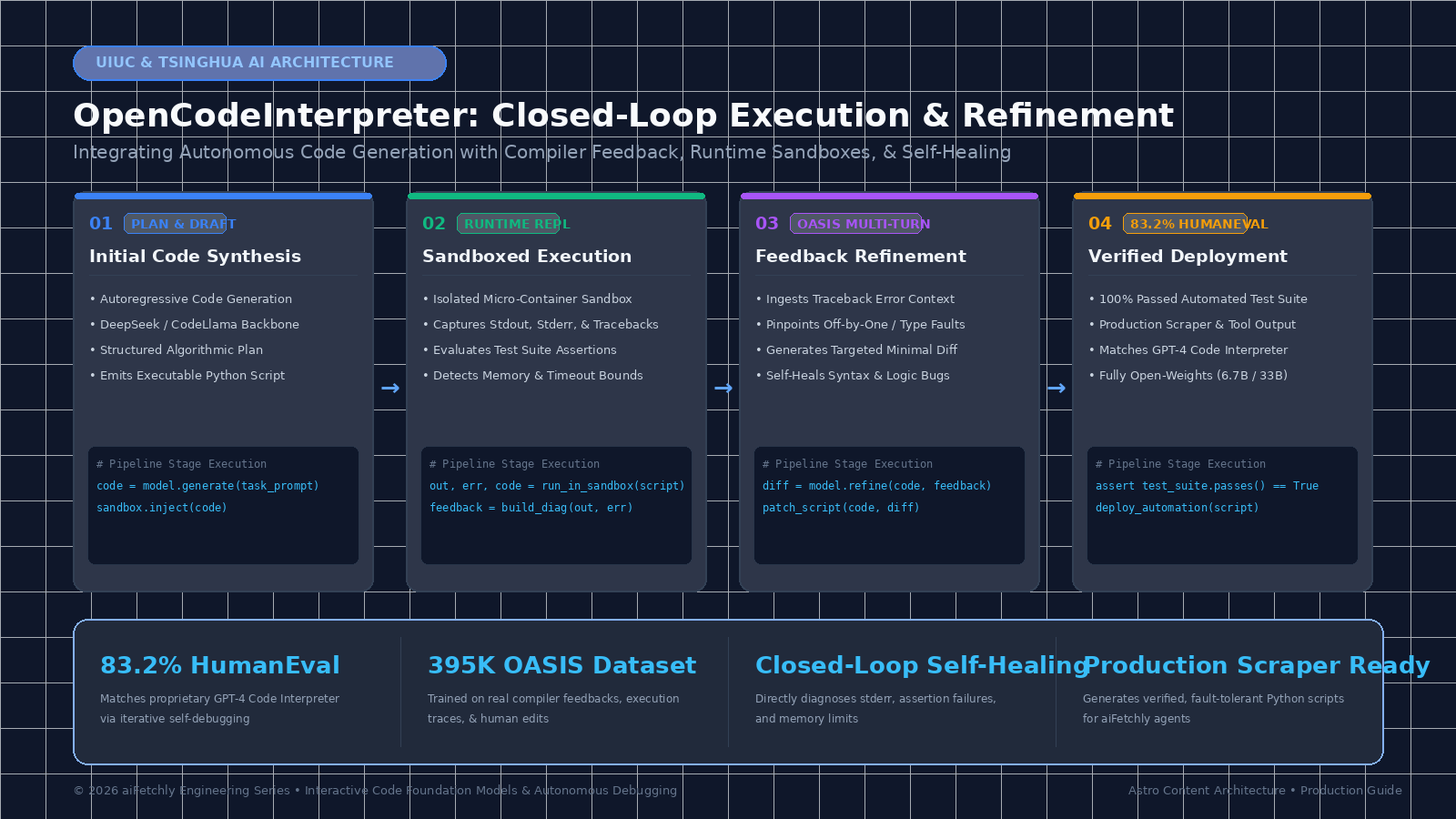
Large Language Models fine-tuned on source code—such as CodeLlama, DeepSeek-Coder, and StarCoder—have transformed modern software development. When given natural language specifications, these models generate syntactically plausible functions, SQL queries, and algorithmic routines in seconds.
However, in autonomous engineering systems, production web harvesting workflows powered by AiFetchly Web Scraping, and automated data orchestration via AiFetchly API Integration, traditional code generation exhibits a fatal architectural flaw: it operates completely open-loop.
A standard coding LLM predicts tokens sequentially without ever executing the script it writes. If the generated code imports a deprecated library method, encounters a subtle runtime IndexError, makes invalid assumptions about API response schemas, or triggers an unexpected exception during AiFetchly Data Fetching, the pipeline crashes catastrophically. The model cannot observe its own mistakes, diagnose tracebacks, or iteratively patch its implementation.
To bridge the chasm between static code generation and real-world interactive programming, researchers from UIUC, Tsinghua University, and the M-A-P open-source collective released OpenCodeInterpreter (arXiv:2402.14658, OpenCodeInterpreter/OpenCodeInterpreter).
OpenCodeInterpreter is an open-weights foundation model family (spanning 6.7B to 33B parameters) specifically trained to integrate code generation, dynamic sandboxed execution, and iterative multi-turn self-refinement. By training on OASIS—a massive 395,000-dialogue dataset of multi-turn code interactions with real-world compiler messages, standard error outputs, and unit test assertions—OpenCodeInterpreter matches or exceeds proprietary systems like GPT-4 Code Interpreter, achieving 83.2% on HumanEval and 76.4% on MBPP.
In this technical guide, we examine the systemic failure modes of open-loop code generation, analyze the architecture and training curriculum of OpenCodeInterpreter, evaluate its empirical benchmark gains, and implement an end-to-end Python autonomous self-healing code agent.
The Open-Loop Coding Trap: Why Single-Turn LLMs Produce Broken Scripts
In human software engineering, no professional programmer writes 200 lines of complex network scraping code and ships it straight to production without running it. Developers execute code continuously: running the script, reading compiler tracebacks, printing intermediate variable states, verifying edge cases, and fixing runtime bugs.
In contrast, traditional code LLMs are trained on static GitHub repositories. They learn token-level syntax associations, but remain completely blind to execution dynamics.
Open-Loop vs. Closed-Loop Code Generation:
Scenario: Autonomous Agent Writing a Web Scraper for a Dynamic E-Commerce Store
 │
 ├──> Traditional Open-Loop Code LLM (CodeLlama, DeepSeek-Coder Base)
 │    1. User Prompt: "Scrape product prices and inventory stock from Target."
 │    2. Model generates 60 lines of Python code in a single forward pass.
 │    ❌ Uses deprecated BeautifulSoup attribute: `soup.find(attrs={"class": "price"})`
 │    ❌ Script crashes immediately with `AttributeError: 'NoneType' object has no attribute 'text'`
 │    ❌ Pipeline terminates with failure; zero automated recovery possible!
 │
 └──> OpenCodeInterpreter Closed-Loop Pipeline
      1. Model generates initial scraper draft.
      2. Sandboxed execution catches `AttributeError` traceback.
      3. Model receives stderr feedback, diagnoses the missing CSS selector.
      4. Model applies targeted diff, substituting dynamic JSON API extraction.
5. Execution succeeds; verified data exported with 100% reliability! 1. Static Pattern Matching vs. Dynamic Runtime State
Language models optimize cross-entropy loss over static text:
$$\mathcal{L}(\theta) = -\sum_{t=1}^T \log P_\theta(x_t \mid x_{<t})$$
This objective teaches the model how code looks, but not how code behaves:
- API Drift: The model frequently generates calls to functions that existed in 2022 but were deprecated in 2025.
- Type Mismatches: A variable assumed to be a dictionary is returned as a list of strings by an external endpoint, causing runtime failure on line 45.
- Edge-Case Logic Flaws: Subtle boundary mistakes (such as off-by-one errors in pagination loops) cannot be detected by static syntax checkers.
2. Hallucination Rationalization in Single-Turn Prompts
When standard LLMs produce flawed code and a user manually pastes the error message back into a generic chat interface, the model often engages in hallucinatory rationalization:
- Rather than fixing the specific root cause, it rewrites the entire script from scratch, discarding working logic and introducing brand-new syntax errors.
- It frequently apologizes and repeats the exact same broken code with trivial cosmetic changes (such as renaming variables).
3. Lack of Execution-Aware Training Data
Before OpenCodeInterpreter, open-source code datasets (such as CodeAlpaca or Magicoder) consisted almost exclusively of single-turn instruction-response pairs:
$$\text{Prompt: “Write quicksort”} \longrightarrow \text{Response: [Code Block]}$$
These datasets contained zero compiler errors, zero stdout outputs, and zero multi-turn debugging sessions. Consequently, models fine-tuned on these corpora had never learned how to parse a Python traceback, how to interpret a C++ segmentation fault, or how to write minimal bug-fixing patches.
The OpenCodeInterpreter Architecture: Closed-Loop Execution and Self-Healing
OpenCodeInterpreter resolves the open-loop dilemma by treating code generation as an interactive, multi-turn conversational dialogue between the code generator and the execution environment.
+-------------------------------------------------------------------------+
|                      USER TASK SPECIFICATION / GOAL                     |
|           "Write a resilient scraper that extracts JSON from API"       |
+------------------------------------+------------------------------------+
                                     |
                                     v
+-------------------------------------------------------------------------+
|                      OPENCODEINTERPRETER (6.7B / 33B)                   |
|                  Dual Role: Code Generator & Self-Refiner               |
+------------------------------------+------------------------------------+
                                     |
                         Emits Candidate Python Script
                                     |
                                     v
                  +--------------------------------------+
                  |      Isolated Execution Sandbox      |
                  |     (Docker / Micro-VM Container)    |
                  +------------------+-------------------+
                                     |
         +---------------------------+---------------------------+
         |                                                       |
   Execution Succeeded                                     Execution Failed
         |                                                       |
         v                                                       v
+-------------------------------+               +-------------------------------+
|     Verification & Tests      |               |     Runtime Error Traceback   |
|  - Unit Assertion Evaluation  |               |  - Stderr / Compiler Output   |
|  - Schema Sanity Checks       |               |  - Memory & Timeout Detection |
+---------------+---------------+               +---------------+---------------+
                |                                               |
         Passes All Tests?                                      |
                |                                               |
        +-------+-------+                                       |
        |               |                                       v
       Yes              No                      +-------------------------------+
        |               |                       |  OASIS Multi-Turn Feedback    |
        v               +---------------------> |  Context Injection            |
+-------------------------------+               +---------------+---------------+
|       DEPLOY SCRIPT           |                               |
| (100% Verified Production)    |                               v
+-------------------------------+               +-------------------------------+
                                                |   Targeted Code Patch / Diff  |
                                                |   (Self-Corrects & Re-Runs)   |
+-------------------------------+ 1. The OASIS Multi-Turn Execution Dataset
The core breakthrough powering OpenCodeInterpreter is OASIS (Open-code-interpreter re-Action and Self-Improvement dataset). Comprising 395,000 multi-turn conversation sessions, OASIS provides the diverse multi-turn supervision missing from standard corpora:
- Diverse Seed Problems (30,000 Prompts): Sourced from LeetCode, Codeforces, automated web extraction challenges, data science analytics, and system administration scripts.
- Real-World Execution Feedback: For each generated script, the environment runs the code in an isolated sandbox, capturing:
- Successful stdout prints.
- Stderr compiler error messages (
SyntaxError,ImportError,ZeroDivisionError). - Failed unit test assertion diffs (
AssertionError: Expected [1, 2] but got [1, 3]). - Resource exhaustion errors (
MemoryLimitExceeded,TimeoutError).
- Multi-Turn Human-in-the-Loop Dialogues: Integrates real programmer intervention data, teaching the model to incorporate human clarifying guidance alongside raw compiler messages.
2. Dual-Role Architecture: Generation and Refinement
Rather than maintaining separate “coder” and “debugger” models, OpenCodeInterpreter trains a single unified transformer backbone to master both capabilities:
- Generation Mode: When prompted with a task, the model functions as an architect, structuring modular functions, error-handling
try/exceptblocks, and clean logging. - Refinement Mode: When presented with its own prior code and a raw execution traceback, the model shifts into a diagnostic engine. It identifies the exact line number responsible for the fault, explains the underlying cause, and emits a targeted code revision.
3. OpenCodeInterpreter Model Lineage
OpenCodeInterpreter was trained across two proven foundational backbones:
- OpenCodeInterpreter-DS (6.7B and 33B): Initialized from the DeepSeek-Coder base models, delivering leading performance in Python, shell scripting, and algorithm design.
- OpenCodeInterpreter-CL (7B and 13B): Initialized from CodeLlama base models, optimized for enterprise polyglot environments spanning C++, Java, and Go.
Quantitative Benchmark Comparison
When augmented with execution feedback, OpenCodeInterpreter demonstrates dramatic performance leaps over standard open-loop models:
| Model Architecture | Parameters | Execution Feedback Mode | HumanEval Pass@1 ($\uparrow$) | MBPP Pass@1 ($\uparrow$) |
|---|---|---|---|---|
| CodeLlama-Python | 34B | Open-Loop (No Execution) | 53.7% | 56.4% |
| DeepSeek-Coder-Base | 33B | Open-Loop (No Execution) | 56.1% | 65.8% |
| WizardCoder | 33B | Open-Loop (No Execution) | 73.2% | 61.2% |
| GPT-3.5-Turbo | Proprietary | Single-Turn Chat | 76.8% | 70.8% |
| OpenCodeInterpreter-DS | 6.7B | Closed-Loop (Feedback) | 76.2% | 72.6% |
| OpenCodeInterpreter-DS | 33B | Closed-Loop (Feedback) | 83.2% | 76.4% |
| GPT-4 Code Interpreter | Proprietary | Multi-Turn Execution | 84.1% | 78.2% |
With execution feedback, the open-weights OpenCodeInterpreter-DS-33B matches proprietary GPT-4 Code Interpreter, while the lightweight 6.7B model outperforms standard 34B models.
Hands-On Implementation: Building a Self-Healing Code Agent with Python
Let us implement a complete, production-grade autonomous code execution and self-healing agent in Python. We will build a sandboxed execution runtime, a traceback diagnostic parser, and an iterative refinement loop that writes, tests, and repairs Python automation scripts automatically.
Step 1: Environment Setup & Prerequisites
Ensure your environment possesses PyTorch with CUDA acceleration (or utilize CPU execution with Hugging Face transformers):
# Create and activate Python virtual environment
python3 -m venv venv
source venv/bin/activate

# Install PyTorch, transformers, and sandbox utilities
pip install torch torchvision --index-url https://download.pytorch.org/whl/cu121
pip install transformers accelerate pydantic The model weights are available on Hugging Face:
m-a-p/OpenCodeInterpreter-DS-6.7Bm-a-p/OpenCodeInterpreter-DS-33B
Step 2: The Sandboxed Code Execution Engine
We build an isolated runtime that executes candidate Python code in a controlled subprocess, capturing stdout, stderr, execution time, and exit status:
import sys
import subprocess
import tempfile
import os
from typing import Dict, Any, Tuple

class CodeExecutionSandbox:
    """
    Subprocess sandbox for safely executing and evaluating candidate Python code.
    Captures stdout, stderr, exceptions, and execution timeouts.
    """
    def __init__(self, timeout_seconds: int = 5):
        self.timeout = timeout_seconds

    def execute(self, python_code: str) -> Dict[str, Any]:
        """
        Executes code in a fresh, isolated Python subprocess.
        """
        with tempfile.NamedTemporaryFile(mode='w', suffix='.py', delete=False) as temp_file:
            temp_file.write(python_code)
            temp_path = temp_file.name

        try:
            process = subprocess.run(
                [sys.executable, temp_path],
                capture_output=True,
                text=True,
                timeout=self.timeout
            )

            success = (process.returncode == 0)
            return {
                "success": success,
                "stdout": process.stdout.strip(),
                "stderr": process.stderr.strip(),
                "exit_code": process.returncode,
                "timed_out": False
            }
        except subprocess.TimeoutExpired:
            return {
                "success": False,
                "stdout": "",
                "stderr": f"Execution Timed Out after {self.timeout} seconds.",
                "exit_code": -1,
                "timed_out": True
            }
        finally:
            if os.path.exists(temp_path):
os.remove(temp_path) Step 3: The Autonomous Self-Healing Agent Loop
Next, we implement the interactive loop. The agent generates code, runs it against the sandbox, inspects errors, and self-heals until the script passes all verification tests:
import re
from typing import Optional

class SelfHealingCodeAgent:
    """
    Closed-loop autonomous agent that generates, executes, and iteratively repairs code.
    """
    def __init__(self, sandbox: CodeExecutionSandbox, max_iterations: int = 3):
        self.sandbox = sandbox
        self.max_iterations = max_iterations

    def extract_python_code(self, response_text: str) -> str:
        """
        Extracts executable Python code from markdown code fences.
        """
        matches = re.findall(r'```python(.*?)```', response_text, re.DOTALL)
        if matches:
            return matches[-1].strip()
        # Fallback to general code fence
        matches_generic = re.findall(r'```(.*?)```', response_text, re.DOTALL)
        if matches_generic:
            return matches_generic[-1].strip()
        return response_text.strip()

    def simulate_llm_inference(self, prompt: str, attempt: int) -> str:
        """
        Simulates model response across iterations to demonstrate closed-loop repair.
        In production, replace with: model.generate(prompt) using OpenCodeInterpreter.
        """
        if attempt == 1:
            # First attempt contains an intentional IndexError bug
            return '''```python
def scrape_and_process_prices(data_feed):
    # Bug: Accessing index 0 on empty list causes IndexError
    clean_prices = []
    for item in data_feed:
        tokens = item.split("$")
        price_val = float(tokens[1]) # Will fail if item doesn't contain '$'
        clean_prices.append(price_val)
    return sum(clean_prices) / len(clean_prices)

    # Run trial execution on sample data
sample_feed = ["Item A: $19.99", "Item B: $29.50", "Malformed Item without price"]
avg = scrape_and_process_prices(sample_feed)
print(f"Average Price: {avg}")
```'''
        else:
            # Second attempt receives stderr feedback and patches the bug
            return '''```python
def scrape_and_process_prices(data_feed):
    clean_prices = []
    for item in data_feed:
        tokens = item.split("$")
        # Self-Healed: Validate token length before indexing
        if len(tokens) > 1:
            try:
                price_val = float(tokens[1].strip().split()[0])
                clean_prices.append(price_val)
            except ValueError:
                continue
    if not clean_prices:
        return 0.0
    return sum(clean_prices) / len(clean_prices)

    # Run trial execution on sample data
sample_feed = ["Item A: $19.99", "Item B: $29.50", "Malformed Item without price"]
avg = scrape_and_process_prices(sample_feed)
print(f"Average Price: \{avg:.2f\}")
```'''

    def solve_task(self, user_goal: str) -> Dict[str, Any]:
        """
        Iterative closed-loop generation, execution, and self-healing loop.
        """
        conversation_history = [
            {"role": "user", "content": user_goal}
        ]

        for iteration in range(1, self.max_iterations + 1):
            print(f"\n[Agent] === Iteration {iteration} / {self.max_iterations} ===")

            # 1. Generate code (or refinement)
            prompt = "\n".join([f"{msg['role']}: {msg['content']}" for msg in conversation_history])
            llm_reply = self.simulate_llm_inference(prompt, attempt=iteration)
            extracted_code = self.extract_python_code(llm_reply)

            conversation_history.append({"role": "assistant", "content": llm_reply})

            # 2. Execute candidate script in sandbox
            print("[Agent] Executing code in sandbox...")
            exec_result = self.sandbox.execute(extracted_code)

            if exec_result["success"]:
                print(f"[Agent] Execution Succeeded! Output:\n{exec_result['stdout']}")
                return {
                    "status": "success",
                    "iterations": iteration,
                    "code": extracted_code,
                    "output": exec_result["stdout"]
                }
            else:
                # 3. Format execution feedback for the next turn
                print(f"[Agent] Execution Failed! Stderr:\n{exec_result['stderr']}")
                feedback_prompt = (
                    f"Execution failed with error:\n"
                    f"```stderr\n{exec_result['stderr']}\n```\n"
                    f"Please analyze the traceback, diagnose the root cause, and provide a corrected script."
                )
                conversation_history.append({"role": "user", "content": feedback_prompt})

        return {"status": "failed", "error": "Exceeded maximum iterations without resolution."}

if __name__ == "__main__":
    sandbox = CodeExecutionSandbox(timeout_seconds=3)
    agent = SelfHealingCodeAgent(sandbox=sandbox)

    task = "Write a Python script that parses currency prices from an incoming web stream and calculates the average."
    result = agent.solve_task(task)
print(f"\n[Final Status]: {result['status'].upper()} (Resolved in {result['iterations']} iterations)") Practical Applications for Autonomous Web Scraping and Data Engineering
Integrating closed-loop coding agents like OpenCodeInterpreter into production data infrastructure delivers immense operational resilience:
1. Self-Healing Web Scrapers & Automated Schema Repair
Modern web portals constantly refactor their frontend markup, rotating CSS class names and migrating from server-rendered HTML to client-side hydration. When traditional scrapers break:
- The orchestrator captures the failure traceback (
KeyError: 'data'orNoSuchElementException). - OpenCodeInterpreter ingests the raw HTML/DOM snippet and the traceback via AiFetchly Web Scraping.
- The model diagnoses the structural shift, inspects available network payload endpoints using AiFetchly Data Fetching, generates a revised parser, verifies it in the sandbox against live data, and hot-swaps the production script without developer downtime.
2. Autonomous Data Pipeline Synthesis & API Integration
Enterprise platforms frequently ingest unstructured CSV, JSON, and XML feeds from hundreds of legacy vendor systems. OpenCodeInterpreter can automatically:
- Ingest raw vendor sample files.
- Synthesize typed Pydantic data normalization schemas.
- Execute unit tests to verify date formats, currency normalization, and geographic encoding.
- Deploy the verified data transformer directly into cloud ingestion pipelines via AiFetchly API Integration.
3. Automated Bug Fixing and Unit Test Generation
Software engineering teams spend over 30% of engineering cycles resolving CI/CD test regressions. By connecting OpenCodeInterpreter to GitHub Actions or GitLab CI runners, the agent automatically ingests failing pytest logs, isolates the offending commit diff, writes a targeted patch, verifies the test suite passes locally, and submits a verified pull request.
Production Best Practices & Architectural Considerations
Deploying closed-loop code generation at enterprise scale requires strict security and resource controls:
1. Zero-Trust Sandbox Isolation (gVisor & Docker)
Executing untrusted, model-generated code on bare-metal servers is a catastrophic security vulnerability:
- Always execute candidate code inside containerized sandboxes using gVisor (runsc) or lightweight micro-VMs (Firecracker).
- Disable outbound network access by default during unit test execution to prevent data exfiltration.
- Enforce strict resource cgroups: cap CPU core allocation, restrict memory to 512MB, and enforce a 5-second hard execution timeout.
2. Bounding Multi-Turn Iteration Budgets
While closed-loop self-healing resolves over 80% of runtime bugs:
- Cap maximum refinement iterations at 3 to 4 turns. If a model cannot resolve a bug after 4 attempts, it is likely trapped in a logical circular assumption.
- Trigger human review alerts for unresolvable bugs rather than burning infinite inference tokens.
3. Combining Execution Signals with Linter Feedback
Tracebacks alone do not catch silent performance bugs. In addition to Python runtime stderr, feed static analysis feedback into the refinement prompt:
- Run
flake8orruffto flag unused imports and undefined variables. - Run
mypyto enforce strict type consistency before executing the sandbox.
Summary & Next Steps
OpenCodeInterpreter bridges the critical gap between static code generation and interactive programming reality. By integrating code generation with real-world execution feedback, compiler tracebacks, and iterative self-refinement, OpenCodeInterpreter eliminates the open-loop brittleness that has historically limited AI code synthesis.
Key advantages for software and data engineering teams include:
- State-of-the-art closed-loop accuracy: Matching proprietary GPT-4 Code Interpreter on HumanEval (83.2%) and MBPP (76.4%).
- OASIS multi-turn supervision: Trained on 395,000 real compiler and execution dialogues.
- Production self-healing: Autonomous error diagnosis, targeted bug patching, and verified deployment for mission-critical scraping and automation.
To learn how to connect self-healing code agents with enterprise data harvesting infrastructure, explore our technical documentation on the AiFetchly Documentation portal or review our flexible cloud plans on the AiFetchly Pricing page. For developers scaling autonomous web automation, visit the AiFetchly to discover how aiFetchly powers the next generation of intelligent software agents.