OmniHuman-1 Guide: Scaling Human Animation AI Models
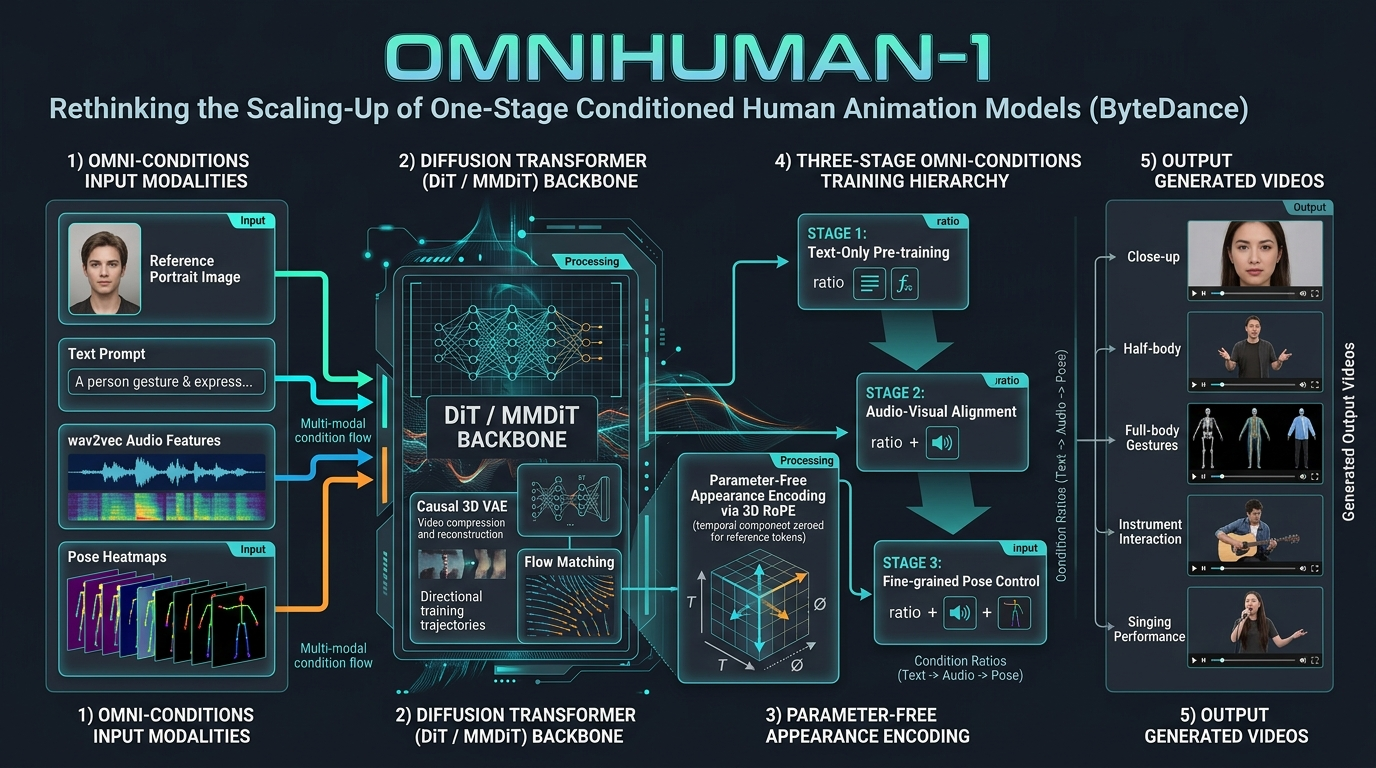
Problem: The Data-Filtering Paradox in End-to-End Human Animation
Generating photorealistic human video from stationary portrait photographs and driving modalities—such as acoustic speech waveforms, textual descriptions, or kinetic pose sequences—represents one of the most commercially vital frontiers in computer vision. From autonomous virtual broadcasters, telepresence conferencing, and localized video dubbing to interactive digital human copilots powered by AI Fetchly, animating expressive human motion with natural gesture cadence is essential.
Whether mining human interaction datasets through large-scale automated video scraping or driving virtual avatars with multimodal real-time data fetching, foundational video generation models (such as Sora, CogVideoX, and Seaweed) have demonstrated that scaling dataset volumes to hundreds of millions of video clips unlocks emergent physical dynamics.
However, despite these breakthroughs in general video generation, human animation models have historically hit an acute scaling wall:
+----------------------------------------------------------------------------------------------------+
|                         THE HUMAN ANIMATION DATA FILTERING PARADOX                                 |
+------------------------------------+---------------------------------------------------------------+
| System Challenge                   | Architectural Failure Mode in Conventional Human Animation    |
+------------------------------------+---------------------------------------------------------------+
| Severe Data Attrition & Wastage    | Strict audio lip-sync and 2D pose visibility filtering discards|
| (The 85%+ Data Drop Trap)          | over 85% of raw human video, preventing models from scaling up|
+------------------------------------+---------------------------------------------------------------+
| Single-Condition Overfitting       | Audio-only models overfit to talking heads; pose-only models   |
| (Condition Dominance Bias)         | neglect speech prosody and produce stiff, robotic gestures    |
+------------------------------------+---------------------------------------------------------------+
| Heavy Parameter-Duplicating Nets   | Traditional reference networks (Ref-Nets) duplicate entire    |
| (The Memory & Scaling Overhead)    | UNet/DiT architectures, causing memory explosion during training|
+------------------------------------+---------------------------------------------------------------+
| Hand & Object Interaction Collapse | Models fail completely on complex hand articulations, guitar   |
| (The Deformed Extremities Crisis)  | playing, micro-gestures, and non-rigid clothing deformations   |
+------------------------------------+---------------------------------------------------------------+ The Data Attrition Paradox
In text-to-video (T2V) and image-to-video (I2V) foundation models, training datasets scale to tens of thousands of hours because almost any video paired with a coarse text caption provides useful visual and motion representations.
In contrast, human animation frameworks impose draconian filtering criteria:
- Audio-Conditioned Models (e.g., SadTalker, Hallo, Loopy): Audio signals correlate strongly with mouth shapes, jaw movements, and subtle facial micro-expressions. However, audio has virtually zero physical correlation with background camera panning, room lighting changes, or sudden body turns. Consequently, training pipelines must crop tightly around the face, discard any video with imperfect lip synchronization, and filter out full-body footage where speech does not dictate torso movement.
- Pose-Conditioned Models (e.g., AnimateAnyone, MagicAnimate): Pose-driven frameworks require uninterrupted visibility of skeleton landmarks (COCO or DensePose keypoints). Any footage with hand occlusion, motion blur, side-view angles, or complex object interactions is discarded.
As a consequence of these filters, over 85% of valuable real-world human video footage is discarded. Human animation models remain trapped on small, sanitized datasets (rarely exceeding 1,000 to 2,000 hours), completely preventing them from exploiting the power-law scaling effects observed in general video diffusion transformers.
The Appearance Parameter Duplication Tax
To maintain the subject’s identity, clothing textures, and background details from a reference image, prior state-of-the-art frameworks (such as AnimateAnyone, CyberHost, and Hallo-3) rely on Reference Networks (Ref-Nets):
+-----------------------------------------------------------------------------------------------+
|                             LEGACY REFERENCE NETWORK BOTTLENECK                               |
|                                                                                               |
|  [Reference Image]                                                                            |
|         |                                                                                     |
|         v                                                                                     |
|  +-----------------------------+                                                              |
|  | Reference Network (Ref-Net) | <--- Exact copy of the entire multi-billion parameter DiT!   |
|  | (100% Parameter Duplication)|      Consumes 50% of available GPU VRAM and compute!         |
|  +--------------+--------------+                                                              |
|                 | Spatial Cross-Attention Injection                                           |
|                 v                                                                             |
|  +-----------------------------+                                                              |
|  | Primary Denoising DiT       | <--- Video Generation Diffusion Backbone                     |
|  +-----------------------------+                                                              |
|                 |                                                                             |
|                 v                                                                             |
|  [Animated Output Video]                                                                      |
+-----------------------------------------------------------------------------------------------+ A Reference Network duplicates the entire multi-billion-parameter neural backbone. During training, backpropagation must traverse both the reference network and the primary denoising network, cutting effective batch sizes in half and compounding distributed GPU memory bottlenecks.
To dismantle these structural bottlenecks, researchers at ByteDance introduced OmniHuman-1: Rethinking the Scaling-Up of One-Stage Conditioned Human Animation Models (arXiv:2502.01061).
Solution: The Omni-Conditions Paradigm and Scaling Principles
OmniHuman-1 rejects the narrow, single-condition paradigm. Instead, it introduces Omni-Conditions Training, a unified Diffusion Transformer framework that mixes multiple motion-related conditions—text, reference appearance, audio waveforms, and pose heatmaps—within a single-stage model.
+----------------------------------------------------------------------------------------------------+
|                                    OMNIHUMAN-1 CORE INNOVATIONS                                    |
+------------------------------------+---------------------------------------------------------------+
| Innovation Pillar                  | Engineering Mechanism & Quantitative Advantage                |
+------------------------------------+---------------------------------------------------------------+
| Omni-Conditions Mixed Training     | Ingests 18.7K+ hours of diverse human video by routing data   |
| (Data Scaling Law Exploitation)    | across weak (text), medium (audio), and strong (pose) signals |
+------------------------------------+---------------------------------------------------------------+
| Principle 1: Asymmetric Data Re-use| Data discarded by strict audio/pose filters is re-used in     |
| (Zero-Wastage Scaling Pipeline)    | weaker text-conditioned tasks, unlocking massive data scaling |
+------------------------------------+---------------------------------------------------------------+
| Principle 2: Inverse Condition Ratio| Assigns progressively halved training ratios to stronger      |
| (Anti-Dominance Gradient Balancing)| conditions to prevent pose from suppressing audio learning    |
+------------------------------------+---------------------------------------------------------------+
| Parameter-Free Appearance Encoding | Zeroes temporal component of 3D RoPE for reference tokens,    |
| (Eliminating Reference Networks)   | enabling native self-attention without duplicating parameters |
+------------------------------------+---------------------------------------------------------------+
| CFG Annealing Inference Strategy   | Dynamically attenuates Classifier-Free Guidance magnitude     |
| (Wrinkle Elimination Mechanism)    | across diffusion steps, eliminating skin wrinkles and jitter  |
+------------------------------------+---------------------------------------------------------------+ By unifying multi-modal conditioning into a single-stage model, OmniHuman-1 scales training to 18,700 hours of real-world human video, learning natural co-speech gestures, realistic finger articulations, and seamless object interactions (such as playing guitars or holding microphones) across arbitrary aspect ratios and body framing.
For developers deploying video generation microservices that interact with external client applications, review how streaming API integrations optimize low-latency network handshakes.
Architecture: Unified DiT Backbone, 3D RoPE, and Omni-Conditions
OmniHuman-1 is constructed upon a Diffusion Transformer (DiT / MMDiT) backbone (initialized from ByteDance’s foundational Seaweed video generation model), utilizing a Causal 3D VAE and Flow Matching objectives.
+----------------------------------------------------------------------------------------------------+
|                                  OMNIHUMAN-1 OVERALL ARCHITECTURE                                  |
|                                                                                                    |
|  [Reference Image I_ref]       [Driving Audio A]       [Driving Pose P]       [Text Prompt T]       |
|            |                           |                       |                      |            |
|            v                           v                       v                      v            |
|  +--------------------+       +-----------------+     +-----------------+    +-------------------+ |
|  | Causal 3D VAE      |       | wav2vec + MLP   |     | Pose Guider     |    | Text Tokenizer    | |
|  | Latent Encoding    |       | Frame Alignment |     | ConvNet Heatmap |    | Embedding Layer   | |
|  +---------+----------+       +--------+--------+     +--------+--------+    +---------+---------+ |
|            |                           |                       |                       |           |
|            v                           v                       v                       v           |
|    Reference Tokens              Audio Tokens             Pose Tokens             Text Tokens      |
|    (Time RoPE = 0)              (Cross-Attn)         (Channel Stacking)       (Cross-Attn)         |
|            |                           |                       |                       |           |
|            +---------------------------+-----------+-----------+-----------------------+           |
|                                                    |                                               |
|                                                    v                                               |
|  +-----------------------------------------------------------------------------------------------+ |
|  |                       UNIFIED MULTI-MODAL DIFFUSION TRANSFORMER (MMDiT)                       | |
|  |                                                                                               | |
|  |   Self-Attention: Reference Tokens <======== Interactive Co-Attention =======> Video Tokens   | |
|  |   Cross-Attention: Injects Audio Tokens and Text Tokens across all DiT Transformer Blocks     | |
|  |   Channel Concatenation: Noisy Video Latents stacked with Pose Tokens & Motion Frames         | |
|  +-----------------------------------------------------------------------------------------------+ |
|                                                    |                                               |
|                                                    v                                               |
|                                     +-----------------------------+                                |
|                                     | Causal 3D VAE Decoder       |                                |
|                                     +--------------+--------------+                                |
|                                                    |                                               |
|                                                    v                                               |
|                                     [Generated Full-Body Video]                                    |
+----------------------------------------------------------------------------------------------------+ Parameter-Free Appearance Conditioning via Modified 3D RoPE
Rather than constructing a redundant Reference Network, OmniHuman-1 passes both the reference image and the noisy video latents into the same single DiT backbone:
- The reference image $I_{\text{ref}}$ is encoded into latent space $z_{\text{ref}} \in \mathbb{R}^{C \times 1 \times H’ \times W’}$ using the Causal 3D VAE.
- The noisy video latents $z_{\text{video}} \in \mathbb{R}^{C \times T’ \times H’ \times W’}$ are flattened into spatial-temporal visual tokens.
- Both token sequences are concatenated along the sequence length dimension and passed into the DiT self-attention layers: $$\mathbf{X}{\text{seq}} = [\text{Flatten}(z{\text{ref}}), \text{Flatten}(z_{\text{video}})]$$
To prevent the model from misinterpreting the static reference image as the first temporal frame of the video, OmniHuman-1 introduces a crucial modification to 3D Rotary Position Embeddings (3D RoPE):
- In standard 3D RoPE, positional frequency vectors are decomposed into spatial coordinates $(x, y)$ and temporal coordinate $t$: $$\mathbf{R}_{3D}(x, y, t) = \mathbf{R}_x(x) \otimes \mathbf{R}_y(y) \otimes \mathbf{R}_t(t)$$
- For reference tokens, the temporal index is clamped to zero: $$\mathbf{R}_{\text{ref}}(x, y) = \mathbf{R}_x(x) \otimes \mathbf{R}_y(y) \otimes \mathbf{R}_t(0)$$
- For video tokens at timestamp $t \in [1, T]$, standard temporal rotation $\mathbf{R}_t(t)$ is applied.
This mathematical distinction allows full bidirectional cross-attention between the reference appearance and the generated video frames with zero extra parameters, saving gigabytes of VRAM.
The Two Principles of Omni-Conditions Scaling
OmniHuman-1 structures its training around two fundamental scaling laws:
+-----------------------------------------------------------------------------------------------+
|                          OMNI-CONDITIONS TRAINING PRINCIPLES                                  |
|                                                                                               |
|  Principle 1: Stronger Tasks Leverage Weaker Data                                             |
|  ┌────────────────────────────────────────────────────────────────────────┐                   |
|  │ Weak Condition (Text & Image): 18.7K Hours of General Human Video      │                   |
|  │ [====================================================================] │                   |
|  └───────────────────────────────────┬────────────────────────────────────┘                   |
|                                      │ Pre-trains broad motion priors & body physics          |
|                                      v                                                        |
|  ┌────────────────────────────────────────────────────────┐                                   |
|  │ Medium Condition (Audio): Sub-selected High-Sync Data  │                                   |
|  │ [===========================]                          │                                   |
|  └───────────────────────────────────┬────────────────────┘                                   |
|                                      │ Aligns co-speech rhythm, phonemes, and head cadence    |
|                                      v                                                        |
|  ┌─────────────────────────────┐                                                              |
|  │ Strong Condition (Pose):    │ (Only 13% of full dataset satisfies strict pose/sync)        |
|  │ [=============]             │ Explicit keypoint guidance for complex choreography          |
|  └─────────────────────────────┘                                                              |
|                                                                                               |
|  Principle 2: Inverse Condition Ratio Rule                                                    |
|  Training Probability Allocation:                                                             |
|    P(Text) = 1.0  ===>  P(Reference) = 0.7  ===>  P(Audio) = 0.5  ===>  P(Pose) = 0.25        |
|                                                                                               |
|  * Rationale: Strong conditions train too easily and cause the model to ignore audio rhythm.  |
|    Halving the ratio of stronger conditions guarantees balanced multi-modal representation.   |
+-----------------------------------------------------------------------------------------------+ Principle 1: Stronger conditioned tasks leverage weaker conditioned data. Data excluded by strict audio lip-sync or pose tracking filters is not discarded. Instead, it is routed into Stage 1 text-and-image training. The model internalizes natural human motion patterns, clothing drapery, and object interactions from this vast dataset, which then transfer zero-shot to audio-driven generation.
Principle 2: The stronger the condition, the lower the training ratio. Pose heatmaps are unambiguous: they dictate exact spatial coordinates. In contrast, audio waveforms are weak, ambiguous motion conditions (a syllable does not specify where a hand must move). When trained together with equal probability, the DiT relies exclusively on pose and completely ignores the audio features. By enforcing an inverse condition ratio (where pose is activated only 25% of the time while audio is activated 50% of the time), the network is forced to learn robust co-speech gesture prediction.
Implementation: Production PyTorch Pipeline and Parameter-Free 3D RoPE
Below is a production-grade PyTorch implementation demonstrating OmniHuman-1’s multi-condition injection, parameter-free 3D RoPE with zeroed temporal frequency, and the CFG annealing inference scheduler:
import torch
import torch.nn as nn
import torch.nn.functional as F
from typing import Dict, Optional, Tuple

class Modified3DRoPE(nn.Module):
    """
    3D Rotary Position Embedding (3D RoPE) for OmniHuman-1:
    Zeroes out the temporal frequency component for reference appearance tokens.
    """
    def __init__(self, dim: int = 64, max_t: int = 64, max_h: int = 64, max_w: int = 64):
        super().__init__()
        self.dim = dim
        # Allocate one-third of the dimension to each axis
        self.dim_t = dim // 3
        self.dim_h = dim // 3
        self.dim_w = dim - (self.dim_t + self.dim_h)

        # Base frequency theta
        self.inv_freq_t = 1.0 / (10000 ** (torch.arange(0, self.dim_t, 2).float() / self.dim_t))
        self.inv_freq_h = 1.0 / (10000 ** (torch.arange(0, self.dim_h, 2).float() / self.dim_h))
        self.inv_freq_w = 1.0 / (10000 ** (torch.arange(0, self.dim_w, 2).float() / self.dim_w))

    def forward(self, t_coords: torch.Tensor, h_coords: torch.Tensor,
                w_coords: torch.Tensor, is_reference: bool = False) -> torch.Tensor:
        """
        If is_reference=True, t_coords is mathematically clamped to 0.
        """
        device = t_coords.device
        if is_reference:
            t_coords = torch.zeros_like(t_coords)

        freqs_t = torch.outer(t_coords, self.inv_freq_t.to(device))
        freqs_h = torch.outer(h_coords, self.inv_freq_h.to(device))
        freqs_w = torch.outer(w_coords, self.inv_freq_w.to(device))

        # Concatenate frequencies
        freqs = torch.cat([freqs_t, freqs_h, freqs_w], dim=-1)
        return torch.cos(freqs), torch.sin(freqs)

class OmniHumanCrossAttentionBlock(nn.Module):
    """
    Core MMDiT Transformer Block integrating:
    1. Interactive Self-Attention between Reference and Noisy Video Tokens
    2. Modulated Cross-Attention with Audio Tokens
    """
    def __init__(self, d_model: int = 1024, n_heads: int = 16):
        super().__init__()
        self.d_model = d_model
        self.n_heads = n_heads

        # Self-Attention across concatenated reference + video latents
        self.norm1 = nn.LayerNorm(d_model)
        self.self_attn = nn.MultiheadAttention(d_model, n_heads, batch_first=True)

        # Cross-Attention with Audio Tokens
        self.norm_audio = nn.LayerNorm(d_model)
        self.audio_cross_attn = nn.MultiheadAttention(d_model, n_heads, batch_first=True)

        # Feed-Forward Network
        self.norm2 = nn.LayerNorm(d_model)
        self.ffn = nn.Sequential(
            nn.Linear(d_model, d_model * 4),
            nn.GELU(),
            nn.Linear(d_model * 4, d_model)
        )

    def forward(self, x_seq: torch.Tensor, audio_tokens: Optional[torch.Tensor] = None) -> torch.Tensor:
        # 1. Joint Self-Attention (Reference tokens interact with Video tokens)
        norm_x = self.norm1(x_seq)
        attn_out, _ = self.self_attn(norm_x, norm_x, norm_x)
        x_seq = x_seq + attn_out

        # 2. Audio Cross-Attention (if audio modality is active)
        if audio_tokens is not None:
            norm_aud = self.norm_audio(x_seq)
            aud_out, _ = self.audio_cross_attn(norm_aud, audio_tokens, audio_tokens)
            x_seq = x_seq + aud_out

        # 3. Feed-Forward Layer
        x_seq = x_seq + self.ffn(self.norm2(x_seq))
        return x_seq

class CFGAnnealingScheduler:
    """
    Implements OmniHuman-1 CFG Annealing during diffusion sampling.
    Reduces guidance scale dynamically to eliminate character wrinkles and surface noise.
    """
    def __init__(self, start_cfg: float = 3.5, end_cfg: float = 1.2, total_steps: int = 25):
        self.start_cfg = start_cfg
        self.end_cfg = end_cfg
        self.total_steps = total_steps

    def get_cfg_scale(self, current_step: int) -> float:
        """Linear decay from start_cfg to end_cfg."""
        alpha = current_step / max(1, self.total_steps - 1)
        return self.start_cfg + alpha * (self.end_cfg - self.start_cfg)

class OmniHumanInferencePipeline:
    """
    End-to-end execution pipeline for OmniHuman-1:
    Packs reference tokens, executes DiT denoising with CFG annealing, and outputs video.
    """
    def __init__(self, d_model: int = 1024, num_layers: int = 4):
        self.device = torch.device("cuda" if torch.cuda.is_available() else "cpu")
        self.blocks = nn.ModuleList([
            OmniHumanCrossAttentionBlock(d_model=d_model) for _ in range(num_layers)
        ]).to(self.device)
        self.cfg_scheduler = CFGAnnealingScheduler(start_cfg=3.5, end_cfg=1.2, total_steps=20)

    def generate_segment(self, ref_tokens: torch.Tensor, audio_tokens: torch.Tensor,
                         num_video_tokens: int = 64) -> torch.Tensor:
        b, n_ref, d = ref_tokens.shape
        # Initialize Gaussian noise for video tokens
        video_noisy = torch.randn(b, num_video_tokens, d, device=self.device)

        # Denoising loop
        for step in range(20):
            cfg_scale = self.cfg_scheduler.get_cfg_scale(step)

            # Concatenate reference tokens and noisy video tokens along sequence dim
            x_seq = torch.cat([ref_tokens, video_noisy], dim=1)

            # Forward pass through MMDiT blocks
            for block in self.blocks:
                x_seq = block(x_seq, audio_tokens=audio_tokens)

            # Split out the updated video tokens
            updated_video = x_seq[:, n_ref:, :]

            # Update latent (Euler ODE flow-matching step)
            dt = 1.0 / 20.0
            video_noisy = video_noisy - dt * updated_video

        return video_noisy

# Validation Script
if __name__ == "__main__":
    device = torch.device("cuda" if torch.cuda.is_available() else "cpu")
    pipeline = OmniHumanInferencePipeline(d_model=512, num_layers=2)

    # Simulate batch=1: 16 reference tokens, 32 audio tokens
    ref_input = torch.randn(1, 16, 512, device=device)
    audio_input = torch.randn(1, 32, 512, device=device)

    with torch.no_grad():
        out_latents = pipeline.generate_segment(ref_input, audio_input, num_video_tokens=64)

    print(f"Generated Video Latents Shape: {out_latents.shape}")
    print(f"Latent Value Range: [{out_latents.min():.2f}, {out_latents.max():.2f}]")
print("OmniHuman-1 core pipeline forward step successfully executed.") Comparison: Quantitative Evaluation Across Portrait and Body Benchmarks
OmniHuman-1 was evaluated against leading specialized human animation architectures on both Portrait Animation (CelebV-HQ, RAVDESS) and Full-Body Animation (CyberHost testset):
+----------------------------------------------------------------------------------------------------+
|                         AUDIO-CONDITIONED PORTRAIT ANIMATION BENCHMARKS                            |
+----------------------+-------------+---------------+---------------+---------------+---------------+
| Framework            | Paradigm    | Sync-C (Lip) ^| FID (Img) v   | FVD (Video) v | IQA (Quality)^|
+----------------------+-------------+---------------+---------------+---------------+---------------+
| SadTalker            | 3DMM Warp   | 3.843         | 36.648        | 171.848       | 2.953         |
+----------------------+-------------+---------------+---------------+---------------+---------------+
| Hallo                | UNet RefNet | 4.130         | 35.961        | 53.992        | 3.505         |
+----------------------+-------------+---------------+---------------+---------------+---------------+
| EchoMimic            | Multi-Modal | 3.136         | 35.373        | 54.715        | 3.307         |
+----------------------+-------------+---------------+---------------+---------------+---------------+
| Loopy                | Audio-DiT   | 4.849         | 33.204        | 49.153        | 3.780         |
+----------------------+-------------+---------------+---------------+---------------+---------------+
| Hallo-3              | CogVideoX   | 3.933         | 38.481        | 42.125        | 3.451         |
+----------------------+-------------+---------------+---------------+---------------+---------------+
| OmniHuman-1 (Ours)   | Omni-DiT    | 5.199         | 31.435        | 46.393        | 3.875         |
+----------------------+-------------+---------------+---------------+---------------+---------------+ +----------------------------------------------------------------------------------------------------+
| FULL-BODY & GESTURE ANIMATION BENCHMARKS (CYBERHOST SET) |
+----------------------+-------------+---------------+---------------+---------------+---------------+
| Framework | Driving Mod | Sync-C (Lip) ^| FVD (Video) v | HKV (Hand Var)| HKC (Hand Con)|
+----------------------+-------------+---------------+---------------+---------------+---------------+
| DiffTED | Audio-Only | 0.926 | 58.871 | - | 0.769 |
+----------------------+-------------+---------------+---------------+---------------+---------------+
| DiffGest + MimicMotion| Audio+Pose | 0.496 | 66.785 | 23.409 | 0.833 |
+----------------------+-------------+---------------+---------------+---------------+---------------+
| CyberHost | Audio Code | 6.627 | 28.003 | 24.733 | 0.884 |
+----------------------+-------------+---------------+---------------+---------------+---------------+
| OmniHuman-1 (Ours) | Omni-DiT | 7.443 | 27.031 | 47.561 | 0.898 |
+----------------------+-------------+---------------+---------------+---------------+---------------+ (Sync-C: Lip synchronization confidence. HKV: Hand Keypoint Variance, measuring natural gesture richness. HKC: Hand Keypoint Confidence, measuring structural anatomical fidelity.)
Key Benchmark Discoveries
1. Breakthrough in Co-Speech Hand Gestures (47.56 HKV vs. 24.73): Prior audio-driven models suffer from frozen, blurry, or mutated hands. OmniHuman-1 scores 47.561 on Hand Keypoint Variance, virtually doubling the gesture richness of CyberHost while maintaining 0.898 Hand Keypoint Confidence.
2. Superior Lip-Syncing Across Modalities (7.443 Sync-C): By avoiding parameter-duplicating reference networks and balancing audio condition gradients, OmniHuman-1 sets a new state of the art in phoneme-to-lip alignment on both speech and singing.
3. Universal Aspect Ratio & Body Framing Support: While legacy baselines require fixed square crops ($512 \times 512$ or $768 \times 768$) and collapse when framed below the shoulders, OmniHuman-1 generates arbitrary aspect ratios (9:16 vertical, 16:9 widescreen, 4:3 cinema) and seamlessly transitions between extreme close-up portraits and full-body standing shots.
Production: Enterprise Deployment, Long-Video Streaming, and Best Practices
Deploying OmniHuman-1 in production environments—such as automated video news generation, virtual influencer streams, and enterprise e-learning avatars—demands optimized systems orchestration:
+----------------------------------------------------------------------------------------------------+
|                                PRODUCTION DEPLOYMENT TOPOLOGY                                      |
|                                                                                                    |
|  [Reference Image + Driving Audio / Pose Stream]                                                   |
|                         |                                                                          |
|                         v                                                                          |
|  +----------------------------------------------+                                                  |
|  | Causal 3D VAE Latent Compressor             | (Zero-Memory Parameter-Free 3D RoPE)             |
|  +----------------------+-----------------------+                                                  |
|                         |                                                                          |
|                         v                                                                          |
|  +----------------------------------------------+        +---------------------------------------+ |
|  | OmniHuman-1 MMDiT Denoising Engine           | =====> | Motion Frame Buffer (Last 5 Frames)   | |
|  | (TensorRT FP8 Flow-Matching Scheduler)       |        +---------------------------------------+ |
|  +----------------------+-----------------------+                                                  |
|                         |                                                                          |
|                         v                                                                          |
|  +----------------------------------------------+                                                  |
|  | Adaptive CFG Annealing Module                | (Eliminates Skin Artifacts & Jitter)             |
|  +----------------------+-----------------------+                                                  |
|                         |                                                                          |
|                         v                                                                          |
|  [H.264 / AV1 Real-Time Video Stream Output]                                                       |
+----------------------------------------------------------------------------------------------------+ Motion Frame Buffer for Indefinitely Long Video Generation
To synthesize videos extending beyond the physical temporal context window of the DiT without boundary seams or identity drift:
- OmniHuman-1 maintains a sliding Motion Frame Buffer containing the last 5 decoded latent frames of the preceding segment.
- During the next segment generation, these 5 latent frames are concatenated along the temporal channel dimension as conditioning priors.
- This creates continuous, seamless motion continuity across minutes of uninterrupted generated speech.
Production Best Practices
- Deploy CFG Annealing in Serving Schedulers: In production inference, start Classifier-Free Guidance at $s = 3.5$ for the initial 25% of diffusion steps to establish macro body posture, then linearly decay guidance to $s = 1.2$ across the final steps. This completely eliminates skin wrinkling and eye jitter while retaining crisp lip synchronization.
- Standardize Acoustic Sample Rates: Resample all input speech audio to clean 16 kHz mono waveforms before wav2vec feature extraction. Audio containing background music or reverberation should be pre-filtered using a lightweight stem-separation model (like Demucs) to prevent acoustic noise from corrupting lip alignment.
- Exploit FlashAttention-3 for 3D RoPE: During inference, leverage FlashAttention-3 kernels configured for arbitrary attention masks. This allows packing the reference tokens and video sequence into a contiguous memory block without padding waste.
Strategic Summary and Architectural Trajectory
ByteDance’s OmniHuman-1 marks a decisive paradigm shift in generative computer vision: human animation does not require isolated, data-starved architectures.
By demonstrating that stronger conditioned tasks can be trained alongside weaker data, establishing inverse conditioning ratios, and replacing parameter-heavy reference networks with parameter-free 3D RoPE, OmniHuman-1 bridges the gap between foundation video models and controllable digital humans. For AI engineers, digital content platforms, and interactive media systems, OmniHuman-1 delivers the architectural blueprint for synthesizing full-body, high-fidelity human life in motion.