OmniGen Guide: Unified In-Context Image Generation Model
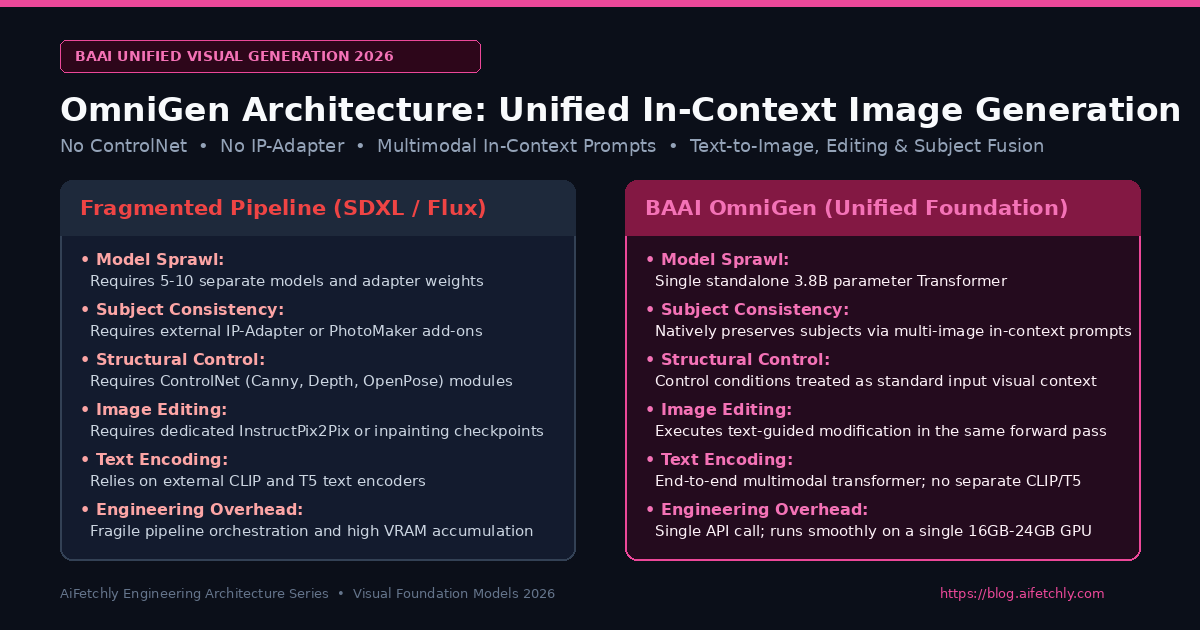
The Problem: The Fragmented Ecosystem of Visual Generation
In modern automated digital asset production, automated e-commerce catalog pipelines, and intelligent visual workflows like AiFetchly, generative artificial intelligence is expected to perform a diverse array of visual tasks:
- Generating photorealistic products from text prompts (Text-to-Image).
- Editing existing images according to natural language instructions (Image Editing).
- Synthesizing novel scenes while keeping specific characters or objects consistent (Subject-Driven Generation).
- Controlling composition, human poses, depth geometry, and line edges (Controlled Generation).
However, achieving this multi-task capability in production has historically required gluing together a sprawling, brittle web of independent models and auxiliary adapters:
1. Architectural Fragmentation and Model Sprawl
To build a full-featured visual creation suite with standard diffusion pipelines (such as Stable Diffusion XL or Flux):
- Developers must load the core Text-to-Image backbone (3B to 12B parameters).
- To preserve character identity across shots, they must attach IP-Adapter or PhotoMaker cross-attention weights.
- To enforce pose, edge, or depth control, they must deploy multiple ControlNet models (often 1.5GB to 3GB each for Canny, Depth, and OpenPose).
- To perform local edits, they must switch to specialized Inpainting models or InstructPix2Pix checkpoints.
Serving this Frankenstein-like pipeline requires accumulating tens of gigabytes of disparate model weights in GPU High-Bandwidth Memory (HBM), creating severe orchestration latency, GPU memory thrashing, and fragile dependency trees.
2. The Information Bottleneck of External Encoders
Traditional diffusion pipelines rely on frozen external text and image encoders:
- Text Bottleneck: Models rely on pre-trained CLIP or T5 encoders. CLIP is notorious for poor compositional binding (failing on prompts with multiple colored objects or complex spatial relationships), while T5 introduces multi-gigabyte memory footprints.
- Visual Bottleneck: External image adapters project reference images through frozen CLIP vision towers, stripping fine-grained high-frequency textures, spatial geometry, and exact pixel boundaries.
3. Rigid, Predefined Task Boundaries
Existing adapters only operate within hardcoded task definitions:
- ControlNet can only follow the specific structural map it was trained on (e.g., Canny edge).
- If an enterprise workflow requires combining multiple heterogeneous conditions—such as: “Take the jacket from Image 1, put it on the person in Image 2, follow the camera angle in Image 3, and place them on a snowy mountain from text”—the standard adapter stack fails completely due to interference and conflicting cross-attention weights.
The Solution: OmniGen’s Unified In-Context Generation Paradigm
To dismantle this fragmentation, researchers at the Beijing Academy of Artificial Intelligence (BAAI) (Xiao et al., 2024 / open-sourced late 2024) introduced OmniGen, a 3.8-billion-parameter unified foundation model.
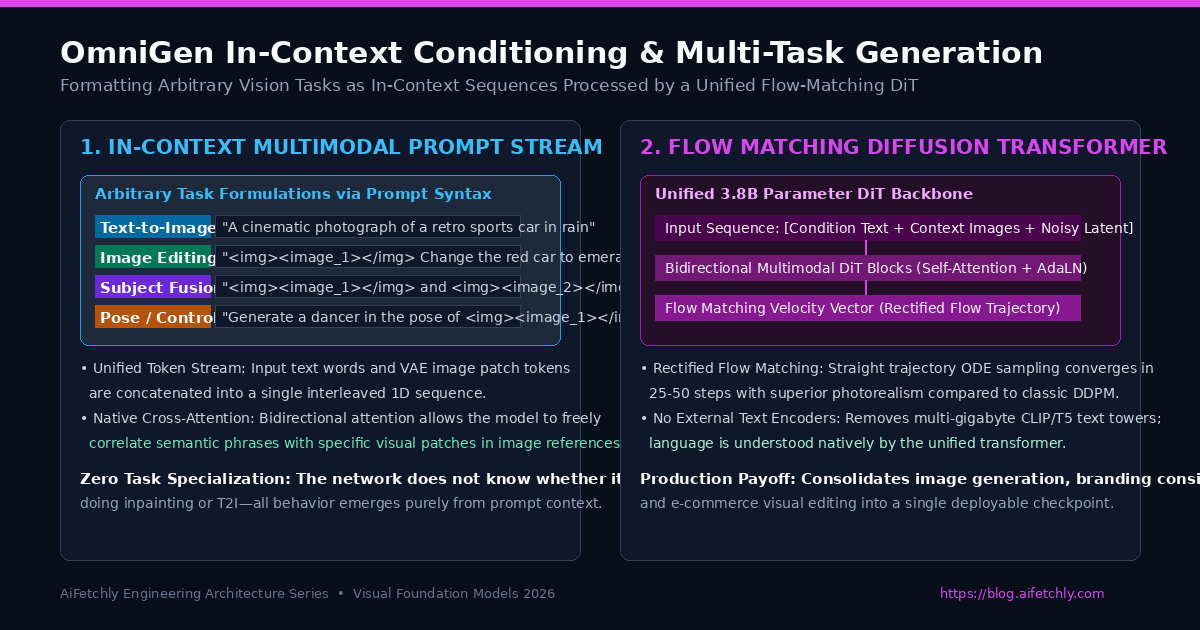
OmniGen introduces a fundamental paradigm shift inspired by large language models: treat all visual generation, editing, and control tasks as Multimodal In-Context Conditioning within a single, end-to-end Diffusion Transformer (DiT).
The Core Architectural Tenets of OmniGen
-
Multimodal In-Context Prompting:
- In large language models, tasks (summarization, translation, code generation) are not handled by separate models; they are specified via in-context prompt formatting.
- OmniGen applies this exact philosophy to computer vision. Input sequences seamlessly interleave natural text instructions with multiple arbitrary reference images: $$\mathbf{X} = \left[ \text{text}_1, \text{<img>}\mathbf{I}_1\text{</img>}, \text{text}_2, \text{<img>}\mathbf{I}_2\text{</img>}, \dots \right]$$
- Whether the user wants standard text-to-image, pose transfer, style copying, or identity fusion, the task is expressed purely through the arrangement of text and images in the prompt stream.
-
No Auxiliary ControlNet or IP-Adapter Modules:
- Structural control (depth maps, canny edges, human skeletons) and subject references are fed directly into the model as standard context images.
- The model learns to interpret structural guides natively, eliminating the need to train or load secondary ControlNet weights.
-
No External Text Encoders:
- OmniGen completely discards separate CLIP or T5 text encoders.
- Text tokens and visual latent patch tokens are processed directly by the unified Transformer backbone, establishing native semantic grounding across modalities.
Systems Mechanics: Flow Matching and Unified DiT Backbone
Beneath its unified prompt interface, OmniGen operates on a streamlined, hardware-efficient architecture:
1. Unified 1D Token Serialization
When an inference request arrives:
- Reference Images: Each conditioning image is passed through a pre-trained Variational Autoencoder (VAE) encoder to yield a continuous latent feature map. The latent map is sliced into non-overlapping spatial patches and flattened into a 1D sequence of visual tokens.
- Text Instructions: The text prompt is tokenized using standard BPE tokenization and projected into the transformer’s hidden embedding dimension ($d = 3,072$).
- Target Generation Latent: A noisy Gaussian latent representing the image to be generated is patched and appended to the end of the sequence.
- Full Bidirectional Attention: Unlike unidirectional autoregressive generation, OmniGen’s Transformer processes all conditioning tokens (text and context images) using full bidirectional self-attention, allowing every generated pixel to attend freely to all reference tokens across all layers.
2. Rectified Flow Matching Formulation
OmniGen replaces traditional Denoising Diffusion Probabilistic Models (DDPM) with Rectified Flow Matching:
- Traditional diffusion follows curved probability trajectories, requiring 50 to 100 discretization steps to generate crisp images.
- Rectified flow matching models direct, straight-line velocity vectors between the Gaussian prior noise distribution and the clean data distribution: $$x_t = (1 - t) x_0 + t x_1, \quad v_t = \frac{d x_t}{d t} = x_1 - x_0$$
- Straight trajectories allow Ordinary Differential Equation (ODE) solvers (such as Euler or midpoint solvers) to generate high-fidelity, photorealistic outputs in as few as 25 to 50 inference steps.
3. Native Spatial Alignment and Multi-Subject Disentanglement
Because context images and text share the same self-attention layers:
- The model resolves coreference naturally: when the prompt refers to “the person in
<image_1> wearing the shoes in
<image_2>”, cross-token attention maps route identity features from the first image and footwear textures from the second image without feature bleeding or face distortion.
Implementation: Running Multi-Task Generation with OmniGen
OmniGen is available via Hugging Face (Shitao/OmniGen-v1) and the official omnigen Python package.
Below is a complete, runnable script demonstrating how to load OmniGen-v1 and execute three distinct visual tasks—Text-to-Image, Subject-Driven Generation, and Instruction-Based Image Editing—using the exact same model:
import torch
from PIL import Image
from OmniGen import OmniGenPipeline

def run_omnigen_multi_task_demo():
    print("Loading BAAI OmniGen-v1 (3.8B parameters)...")

    device = "cuda" if torch.cuda.is_available() else "cpu"

    # Initialize unified pipeline (automatically loads flow matching DiT and VAE)
    pipe = OmniGenPipeline.from_pretrained("Shitao/OmniGen-v1")
    if device == "cuda":
        pipe.to("cuda", dtype=torch.bfloat16)

    # Task 1: Standard Text-to-Image (T2I)
    print("\n--- Task 1: Text-to-Image Generation ---")
    prompt_t2i = "A futuristic server room with glowing green fiber optic cables and neon ambient lighting, 8k resolution, cinematic."
    images_t2i = pipe(
        prompt=prompt_t2i,
        height=1024,
        width=1024,
        guidance_scale=2.5,
        num_inference_steps=30,
        seed=42
    )
    images_t2i[0].save("/tmp/omnigen_t2i_output.png")
    print("Saved /tmp/omnigen_t2i_output.png")

    # Task 2: Subject-Driven Multi-Image Fusion
    # Generates a scene preserving the subjects from two distinct reference images
    print("\n--- Task 2: Subject-Driven Multi-Image Fusion ---")
    # Simulate two input images
    ref_subject = Image.new("RGB", (512, 512), color=(200, 50, 50))
    ref_background = Image.new("RGB", (512, 512), color=(50, 150, 200))
    ref_subject.save("/tmp/ref_subject.png")
    ref_background.save("/tmp/ref_bg.png")

    prompt_fusion = (
        "A photo of <img><|image_1|></img> placed in the setting of <img><|image_2|></img>, "
        "seamless photorealistic composite, high detail."
    )
    images_fusion = pipe(
        prompt=prompt_fusion,
        input_images=["/tmp/ref_subject.png", "/tmp/ref_bg.png"],
        height=1024,
        width=1024,
        guidance_scale=3.0,
        num_inference_steps=35,
        seed=123
    )
    images_fusion[0].save("/tmp/omnigen_fusion_output.png")
    print("Saved /tmp/omnigen_fusion_output.png")

    # Task 3: Instruction-Based Image Editing
    print("\n--- Task 3: Instruction-Based Editing ---")
    prompt_edit = "<img><|image_1|></img> Change the glowing cables to deep violet and add a robotic maintenance drone in the air."
    images_edit = pipe(
        prompt=prompt_edit,
        input_images=["/tmp/omnigen_t2i_output.png"],
        height=1024,
        width=1024,
        guidance_scale=2.5,
        num_inference_steps=30,
        seed=999
    )
    images_edit[0].save("/tmp/omnigen_edited_output.png")
    print("Saved /tmp/omnigen_edited_output.png")

if __name__ == "__main__":
    if torch.cuda.is_available():
        run_omnigen_multi_task_demo()
    else:
print("CUDA GPU with bfloat16 support recommended for OmniGen inference.") Architectural Comparison: OmniGen vs. SDXL + Adapters vs. Flux
To evaluate OmniGen’s architectural simplification, examine how it compares against traditional diffusion ecosystems:
| Feature Dimension | SDXL + Adapters Pipeline | Black Forest Labs Flux.1 | BAAI OmniGen-v1 |
|---|---|---|---|
| Model Footprint | 5 to 10 separate models | Single T2I DiT model | Single Unified 3.8B DiT |
| ControlNet Support | Requires external weights | Requires X-Labs ControlNet | Native (In-context visual input) |
| Subject Consistency | Requires IP-Adapter / LoRA | Requires LoRA / fine-tuning | Native (Multi-image prompting) |
| Image Editing Mode | InstructPix2Pix / Inpaint | Inpainting adapter required | Native (Natural language edit) |
| Text Encoder | Dual CLIP (OpenCLIP + ViT) | Dual T5-XXL + CLIP-L | None (Native Transformer tokens) |
| Sampling Mechanism | DDPM / DPM-Solver | Flow Matching (50 steps) | Rectified Flow (25-35 steps) |
| VRAM for Full Suite | 24GB - 36GB (Multi-model) | 16GB - 24GB (T2I only) | 16GB - 24GB (All tasks unified) |
| Developer Complexity | High (Complex pipeline) | Moderate (T2I only) | Extremely Low (Single API call) |
Production Engineering: Deploying OmniGen in Automated Pipelines
In enterprise content engines, automated data extraction platforms, and autonomous web agents like AiFetchly, deploying OmniGen delivers three major operational advantages:
1. Frictionless E-Commerce Asset Generation
E-commerce catalog generation traditionally requires tedious manual rendering or fragile ControlNet poses:
- With OmniGen, an agent takes a raw product photo (
<image_1>) and an influencer model photo (<image_2>) and generates an authentic product placement shoot with a single text prompt: “Put the jacket from<image_1> on the model in
<image_2> walking down a street in Milan”.
- Eliminates manual masking, segmentation, and Photoshop compositing.
2. Single-Checkpoint Container Serving
In cloud Kubernetes GPU clusters:
- Serving multiple specialized diffusion endpoints (one for text-to-image, one for inpainting, one for pose control) incurs severe cold-start penalties and underutilizes compute resources.
- OmniGen consolidates all visual generation tasks behind a single container service, drastically simplifying load balancing, Docker image caching, and auto-scaling.
3. Iterative Visual Refinement in Agentic Loops
Autonomous AI research agents frequently need to revise visual assets based on programmatic feedback:
- Instead of re-running an entire diffusion graph from scratch, the agent passes its earlier generated output back into OmniGen as
<image_1>with instructions to adjust contrast, fix background artifacts, or reposition an element. - Retains overall composition while executing targeted local modifications in a deterministic forward pass.
By proving that arbitrary visual tasks can be unified under in-context multimodal conditioning, BAAI OmniGen marks the beginning of the post-adapter era in generative computer vision.