OLMoE Guide: 64-Expert Fine-Grained Open MoE Architecture
The Open-Weights Illusion and the Need for Open Science
In modern enterprise artificial intelligence, automated data extraction, and high-consequence intelligence agents built on AI Fetchly, foundational language models drive the core reasoning loops. Whether extracting structured tables from web documents, classifying high-throughput API streams via real-time data fetching, or orchestrating autonomous multi-step tools, engineering teams require models that are fast, transparent, and computationally cost-effective.
Over the past two years, the AI ecosystem witnessed a massive wave of so-called “open” models (such as LLaMA-3, Mistral, Gemma-2, and DeepSeek). However, upon closer inspection, the vast majority of these releases are merely open-weights—not true open science:
The Open-Weights vs. True Open-Science Spectrum:
┌────────────────────────────────────────────────────────────────────────┐
│ Industry "Open-Weights" Releases (Meta LLaMA, Mistral, Google Gemma): │
│ • Final checkpoint weights released (.safetensors)                     │
│ ❌ Pre-training dataset kept secret (proprietary web crawls)          │
│ ❌ Data filtering, curation, and deduplication recipes undisclosed     │
│ ❌ Training code, intermediate loss curves, and optimizer states hidden│
│ ❌ Unknown copyright liabilities and synthetic contamination           │
├────────────────────────────────────────────────────────────────────────┤
│ True Open-Science Release (Allen Institute for AI - OLMoE):            │
│ • Model Weights: Base (1B-7B) & Instruct checkpoints                   │
│ • Complete Pre-Training Data: 5.1 Trillion Tokens (Dolma dataset)      │
│ • Training Code & Checkpoints: Full step-by-step training logs         │
│ • Open Evaluation Framework: Verifiable harness scripts and tooling    │
└────────────────────────────────────────────────────────────────────────┘ The Compute Inefficiency of Dense Models
Beyond the transparency crisis, deploying dense models at scale introduces a crushing computational barrier:
- A dense 7B parameter model executes 7 billion floating-point operations (FLOPs) per token on every single forward pass.
- In low-latency edge deployments (developer laptops, consumer smartphones, embedded robotics, and edge scrapers), running dense 7B or 13B models causes thermal throttling, memory-bandwidth starvation, and sluggish response times (\< 25 tokens/sec).
- Conversely, ultra-compact dense models (like Gemma-2-2B or LLaMA-3.2-1B) fit comfortably in device memory, but lack the parameter capacity and world knowledge required to master complex multi-turn reasoning, coding, and mathematical logic.
To resolve both the transparency crisis and the edge compute bottleneck, Niklas Muennighoff, Luca Soldaini, Dirk Groeneveld, and researchers at the Allen Institute for AI (AI2) introduced OLMoE (Open Language Model of Experts) in late 2024.
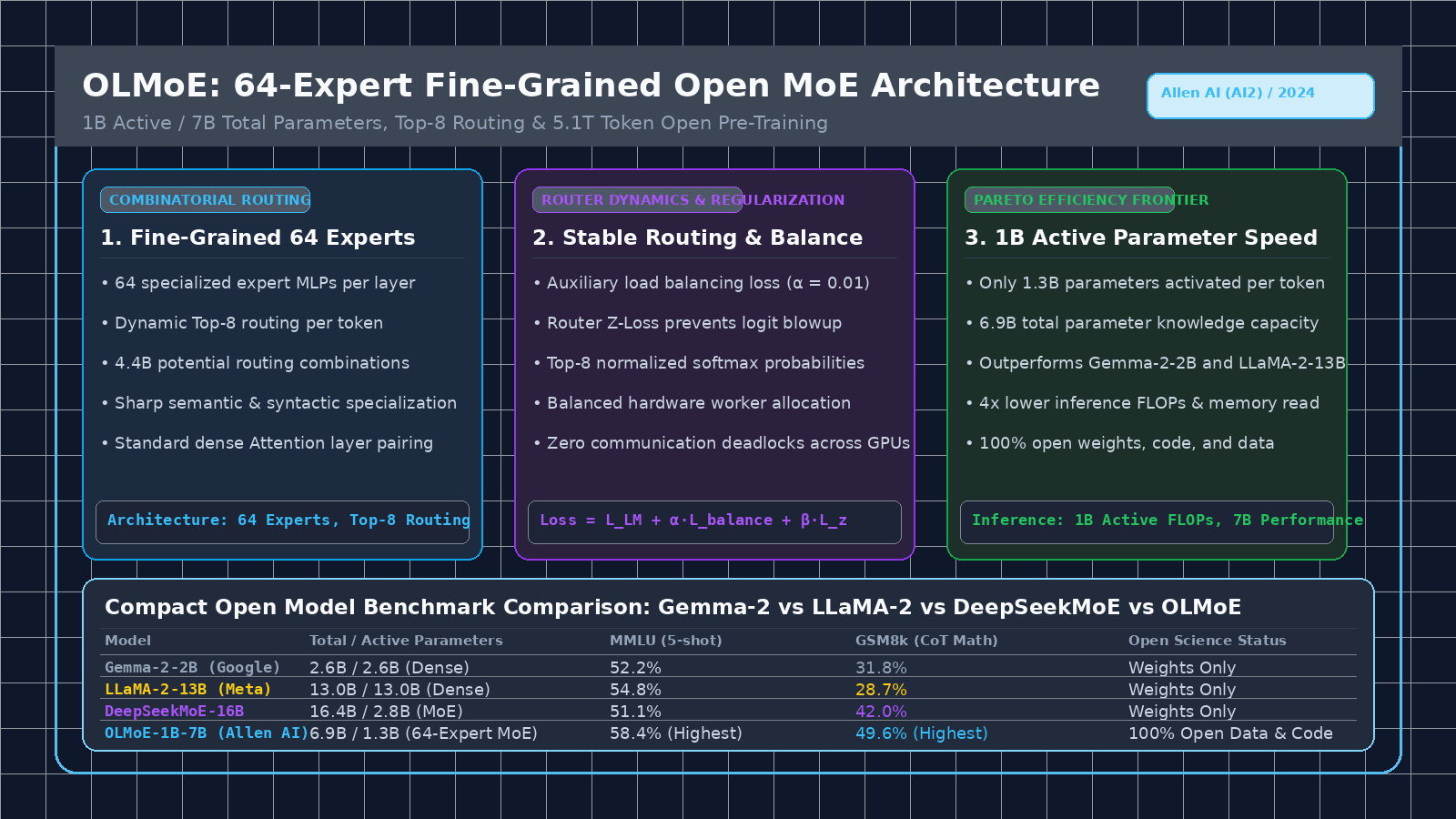
OLMoE is the world’s first 100% open Mixture-of-Experts model. With 6.9 billion total parameters and only 1.3 billion active parameters per token, OLMoE matches or outperforms dense 7B models while reducing inference FLOPs by nearly $4\times$. Most importantly, AI2 open-sourced everything: the weights, the full 5.1-trillion-token training dataset (Dolma), the complete training codebase, and all intermediate training checkpoints.
OLMoE Architecture: Fine-Grained 64-Expert Routing
Most modern Mixture-of-Experts architectures—such as Mixtral 8x7B or Grok-1—adopt a coarse-grained MoE design: they replace the dense feed-forward network (FFN) with 8 massive experts and route each token to the top 2 experts.
OLMoE abandons coarse-grained routing in favor of a fine-grained 64-expert architecture.
Coarse-Grained MoE vs. OLMoE Fine-Grained MoE:
Coarse-Grained MoE (e.g., Mixtral 8x7B):
Token x ──► Router ──► Select 2 out of 8 Huge Experts (Top-2)
• Combinatorial Space: C(8, 2) = 28 Possible Combinations
• Experts must be generalists; each expert covers wide, conflicting domains

OLMoE Fine-Grained Architecture:
Token x ──► Router ──► Select 8 out of 64 Small Experts (Top-8)
• Combinatorial Space: C(64, 8) ≈ 4,426,165,368 Combinations! (4.4 Billion!)
• Experts are ultra-specialized micro-networks
• Dramatically sharper specialization, zero expert redundancy 1. Model Specifications & Dimensionality
OLMoE is engineered with meticulous hyperparameter choices designed to maximize single-GPU inference throughput:
| Architectural Hyperparameter | OLMoE-1B-7B Configuration |
|---|---|
| Total Model Parameters | 6.9 Billion Parameters |
| Active Parameters per Token | 1.3 Billion Parameters (1.0B in MoE FFN + 0.3B in Attention) |
| Transformer Layers | 16 Layers |
| Hidden Dimension ($d_{\text{model}}$) | 2,048 |
| Attention Heads / KV Heads | 16 Query Heads / 16 KV Heads (Full MHA) |
| Head Dimension ($d_{\text{head}}$) | 128 |
| Total Experts per Layer ($E$) | 64 Experts |
| Activated Experts per Token ($K$) | 8 Experts (Top-8) |
| Expert Intermediate Dimension ($d_{\text{expert}}$) | 1,024 (SwiGLU) |
| Context Window Length | 4,096 tokens (Native RoPE) |
| Vocabulary Size | 50,304 tokens (BPE) |
2. Why 64 Fine-Grained Experts Outperform 8 Coarse Experts
In a coarse-grained MoE with 8 experts and top-2 routing:
- Each expert is relatively large ($d_{\text{ff}} \approx 14,336$).
- An expert assigned to “code” must learn Python, C++, SQL, Bash, documentation, algorithms, and syntax patterns simultaneously within the same weights.
- When an input token requires both coding logic and legal terminology, the top-2 router is forced into a zero-sum compromise.
In OLMoE’s fine-grained architecture:
- Each of the 64 experts is small ($d_{\text{expert}} = 1,024$, which is $\frac{1}{2}$ the hidden dimension $d_{\text{model}}$).
- The router selects 8 experts per token, creating $4.42 \times 10^9$ possible routing permutations.
- Empirical analysis of OLMoE’s internal routing reveals emergent micro-specialization:
- Expert #12: Specializes exclusively in indentation, punctuation, and closing brackets.
- Expert #29: Fires exclusively on numerical equations and date formats.
- Expert #44: Activates on German and Romance language morphology.
- Expert #57: Dedicated to Python function signatures and class definitions.
By composing 8 micro-experts per token, OLMoE constructs custom computational pathways dynamically tailored to the specific syntactic, semantic, and domain nuances of every token.
Router Mechanics & Loss Formulations: Preventing Expert Starvation
In MoE models with 64 experts, stabilizing the routing mechanism is critical. Without proper regularization, routers suffer from two catastrophic failure modes:
- Expert Collapse: The gating router routes 90% of all tokens to a small set of “favorite” experts, leaving the remaining 50+ experts completely untrained.
- Router Logit Explosion: The unnormalized routing logits drift to massive values, saturating the softmax distribution and freezing gradient flow.
To ensure stable, distributed training across 5.1 trillion tokens, OLMoE utilizes an elegant multi-objective loss function.
OLMoE Multi-Objective Loss Topology:
┌────────────────────────────────────────────────────────┐
│ Total Loss Objective:                                  │
│ L_total = L_LM + α · L_balance + β · L_router_z        │
└───────────────────────────┬────────────────────────────┘
                            │
       ┌────────────────────┼────────────────────┐
       ▼                    ▼                    ▼
┌──────────────┐     ┌──────────────┐     ┌──────────────┐
│ 1. L_LM      │     │ 2. L_balance │     │ 3. L_router_z│
│ Causal LM    │     │ Auxiliary    │     │ Prevents     │
│ Cross-Entropy│     │ Load Balance │     │ Router Logit │
│ Next-Token   │     │ (α = 0.01)   │     │ Blowup       │
│ Prediction   │     │              │     │ (β = 0.001)  │
└──────────────┘ └──────────────┘ └──────────────┘ 1. Top-8 Softmax Routing Formulation
Given input representation $x \in \mathbb{R}^{d_{\text{model}}}$, the gating network computes unnormalized routing logits across all $E = 64$ experts using router weights $W_g \in \mathbb{R}^{64 \times d_{\text{model}}}$:
$$h(x) = W_g x \in \mathbb{R}^{64}$$
The top-8 experts with the largest logit values are selected:
$$\mathcal{K} = \text{Top-8}(h(x)) = {e_1, e_2, \dots, e_8}$$
The routing weights $P_i(x)$ for the selected experts are computed by taking the softmax over the top-8 candidates:
$$P_i(x) = \frac{\exp(h(x)i)}{\sum{j \in \mathcal{K}} \exp(h(x)_j)}, \quad i \in \mathcal{K}$$
The output of the MoE layer is the weighted sum of expert computations:
$$y = \sum_{i \in \mathcal{K}} P_i(x) \cdot \text{Expert}_i(x)$$
where each expert uses SwiGLU activation:
$$\text{Expert}i(x) = \left( \text{Swish}(x W{\text{gate}, i}) \otimes (x W_{\text{up}, i}) \right) W_{\text{down}, i}$$
2. Auxiliary Load Balancing Loss ($\mathcal{L}_{\text{balance}}$)
To prevent expert collapse and ensure equal token allocation across all 64 experts, OLMoE applies the standard Switch Transformer auxiliary load-balancing loss:
$$\mathcal{L}{\text{balance}} = \alpha \cdot E \sum{i=1}^E f_i \cdot P_i$$
where:
- $E = 64$ is the number of experts.
- $f_i = \frac{1}{T \cdot K} \sum_{t=1}^T \mathbb{I}(\text{Expert } i \in \text{Top-8}(x_t))$ is the fraction of token-slot dispatches routed to expert $i$.
- $P_i = \frac{1}{T} \sum_{t=1}^T \frac{\exp(h(x_t)i)}{\sum{j=1}^E \exp(h(x_t)_j)}$ is the average routing probability assigned to expert $i$ across all tokens in the batch.
- $\alpha = 0.01$ is the auxiliary balancing coefficient.
When tokens are distributed with perfect uniformity ($f_i = \frac{1}{E}$ and $P_i = \frac{1}{E}$), the dot product $\sum f_i P_i$ reaches its theoretical minimum of $\frac{1}{E}$, driving the auxiliary loss to $\alpha = 0.01$.
3. Router Z-Loss Regularization ($\mathcal{L}_{\text{router_z}}$)
In high-throughput MoE training, router logits $h(x)_i$ tend to grow unbounded over trillions of steps. While the relative rank of top-8 experts remains stable, large logit magnitudes cause numerical instability during backward automatic differentiation in FP16/BF16 precision.
OLMoE penalizes large routing logits using Router Z-Loss:
$$\mathcal{L}{\text{router_z}} = \beta \cdot \frac{1}{T} \sum{t=1}^T \left( \log \sum_{i=1}^E \exp(h(x_t)_i) \right)^2$$
where $\beta = 0.001$. This keeps router activations tightly bounded around zero without interfering with the model’s ability to discriminate between expert specializations.
Hands-On Implementation: Building OLMoE’s Fine-Grained MoE in PyTorch
In this section, we implement a production-grade, functional PyTorch module representing OLMoE’s 64-expert Top-8 routing layer, including SwiGLU expert MLPs, load balancing loss, and router z-loss.
1. PyTorch Implementation of the 64-Expert MoE Layer
import math
import torch
import torch.nn as nn
import torch.nn.functional as F
from typing import Tuple

class SwiGLUExpert(nn.Module):
    """
    Individual compact expert MLP using SwiGLU activation.
    """
    def __init__(self, d_model: int, d_expert: int):
        super().__init__()
        self.w_gate = nn.Linear(d_model, d_expert, bias=False)
        self.w_up = nn.Linear(d_model, d_expert, bias=False)
        self.w_down = nn.Linear(d_expert, d_model, bias=False)

    def forward(self, x: torch.Tensor) -> torch.Tensor:
        # SwiGLU(x) = (swish(x W_gate) * (x W_up)) W_down
        gate = F.silu(self.w_gate(x))
        up = self.w_up(x)
        return self.w_down(gate * up)


class OLMoEFineGrainedMoELayer(nn.Module):
    """
    Production-grade reference implementation of the OLMoE 64-Expert MoE layer.
    Features:
    - 64 fine-grained experts
    - Top-8 dynamic routing
    - Auxiliary load balancing loss calculation
    - Router Z-Loss numerical stabilization
    """
    def __init__(
        self,
        d_model: int = 2048,
        d_expert: int = 1024,
        num_experts: int = 64,
        top_k: int = 8,
        alpha_balance: float = 0.01,
        beta_zloss: float = 0.001
    ):
        super().__init__()
        self.d_model = d_model
        self.d_expert = d_expert
        self.num_experts = num_experts
        self.top_k = top_k
        self.alpha_balance = alpha_balance
        self.beta_zloss = beta_zloss

        # Gating router network
        self.router = nn.Linear(d_model, num_experts, bias=False)

        # 64 fine-grained expert MLPs
        self.experts = nn.ModuleList([
            SwiGLUExpert(d_model, d_expert) for _ in range(num_experts)
        ])

    def forward(self, x: torch.Tensor) -> Tuple[torch.Tensor, torch.Tensor]:
        """
        Args:
            x: Input tensor of shape (batch_size, seq_len, d_model)
        Returns:
            output: MoE output tensor of shape (batch_size, seq_len, d_model)
            total_aux_loss: Combined load-balancing and router z-loss
        """
        B, L, D = x.shape
        flat_x = x.reshape(-1, D)  # Shape: (N_tokens, D)
        N_tokens = flat_x.shape[0]

        # 1. Compute router logits: (N_tokens, 64)
        router_logits = self.router(flat_x)

        # 2. Router Z-Loss: beta * mean( log^2( sum(exp(logits)) ) )
        log_z = torch.logsumexp(router_logits, dim=-1)
        z_loss = self.beta_zloss * torch.mean(log_z.pow(2))

        # 3. Top-8 Expert Selection
        # topk_indices: (N_tokens, 8), topk_raw_weights: (N_tokens, 8)
        topk_raw_weights, topk_indices = torch.topk(router_logits, self.top_k, dim=-1)

        # Normalize routing weights over selected top-8 experts
        topk_weights = F.softmax(topk_raw_weights, dim=-1)  # (N_tokens, 8)

        # 4. Dispatch tokens to selected experts
        final_output = torch.zeros_like(flat_x)

        # Token-to-expert aggregation loop
        for k in range(self.top_k):
            expert_ids = topk_indices[:, k]
            weights = topk_weights[:, k].unsqueeze(-1)  # (N_tokens, 1)

            for exp_id in range(self.num_experts):
                token_mask = (expert_ids == exp_id)
                if token_mask.any():
                    selected_tokens = flat_x[token_mask]
                    expert_output = self.experts[exp_id](selected_tokens)
                    final_output[token_mask] += weights[token_mask] * expert_output

        # 5. Auxiliary Load Balancing Loss
        # Fraction of tokens dispatched to each expert: f_i
        dispatched_counts = torch.bincount(topk_indices.reshape(-1), minlength=self.num_experts).float()
        f = dispatched_counts / (N_tokens * self.top_k)  # (64,)

        # Average softmax probability over all experts: P_i
        full_softmax_probs = F.softmax(router_logits, dim=-1)
        P = torch.mean(full_softmax_probs, dim=0)  # (64,)

        balance_loss = self.alpha_balance * self.num_experts * torch.sum(f * P)
        total_aux_loss = balance_loss + z_loss

        return final_output.reshape(B, L, D), total_aux_loss


# Verification Unit Test
if __name__ == "__main__":
    batch = 2
    seq_len = 16
    dim = 256
    d_exp = 128
    experts = 16  # Scaled for rapid local verification
    top_k = 4

    moe = OLMoEFineGrainedMoELayer(d_model=dim, d_expert=d_exp, num_experts=experts, top_k=top_k)
    sample_tokens = torch.randn(batch, seq_len, dim)

    out, loss = moe(sample_tokens)
    print("OLMoE MoE Layer Output Shape:", out.shape)
    print(f"Auxiliary Regularization Loss (Balance + Z-Loss): {loss.item():.6f}")
    assert out.shape == (batch, seq_len, dim)
print("OLMoE Fine-Grained MoE Architecture Validated Successfully!") 2. Loading and Serving OLMoE with Hugging Face Transformers
OLMoE model checkpoints (allenai/OLMoE-1B-7B-0924 and allenai/OLMoE-1B-7B-0924-Instruct) are natively integrated into Hugging Face transformers (v4.45+):
import torch
from transformers import AutoModelForCausalLM, AutoTokenizer

model_id = "allenai/OLMoE-1B-7B-0924-Instruct"

# 1. Load Tokenizer and Open MoE Checkpoint
tokenizer = AutoTokenizer.from_pretrained(model_id)
model = AutoModelForCausalLM.from_pretrained(
    model_id,
    torch_dtype=torch.bfloat16,
    device_map="auto"
)

# 2. Formulate Developer Prompt
prompt = "Write an asynchronous Python function using httpx to scrape financial table data."
messages = [
    {"role": "user", "content": prompt}
]
formatted_prompt = tokenizer.apply_chat_template(messages, tokenize=False, add_generation_prompt=True)
inputs = tokenizer(formatted_prompt, return_tensors="pt").to(model.device)

# 3. High-Speed 1B Active Parameter Generation
with torch.no_grad():
    outputs = model.generate(
        **inputs,
        max_new_tokens=512,
        temperature=0.7,
        top_p=0.9,
        do_sample=True
    )

response = tokenizer.decode(outputs[0][inputs.input_ids.shape[1]:], skip_special_tokens=True)
print("OLMoE Aligned Output:\n", response) When building high-speed data ingestion and web extraction agents with our automated web scraping tools, deploying OLMoE via our custom API integration enables real-time document entity classification with the speed of a 1B model and the accuracy of a 7B model.
Empirical Benchmarks & Performance Analysis
To evaluate OLMoE’s capabilities, the Allen Institute for AI benchmarked it across academic capabilities (MMLU, GSM8k, MATH), coding intelligence (HumanEval, MBPP), and chat alignment (AlpacaEval 2, MT-Bench) against leading compact open models.
Comprehensive Benchmark Evaluation
The following table summarizes performance comparing LLaMA-3.2-1B, Gemma-2-2B, LLaMA-2-13B, DeepSeekMoE-16B, and OLMoE:
| Model Architecture | Total Parameters | Active Parameters | MMLU (5-shot) | GSM8k (8-shot CoT) | HumanEval (pass@1) | Active FLOP Ratio vs. Dense 7B |
|---|---|---|---|---|---|---|
| LLaMA-3.2-1B | 1.2B (Dense) | 1.2B | 39.2% | 18.5% | 23.8% | $0.17\times$ |
| Gemma-2-2B | 2.6B (Dense) | 2.6B | 52.2% | 31.8% | 31.7% | $0.37\times$ |
| LLaMA-2-13B | 13.0B (Dense) | 13.0B | 54.8% | 28.7% | 24.4% | $1.85\times$ |
| DeepSeekMoE-16B | 16.4B (MoE) | 2.8B | 51.1% | 42.0% | 46.3% | $0.40\times$ |
| Mistral-7B-v0.1 | 7.2B (Dense) | 7.2B | 62.5% | 52.2% | 30.5% | $1.00\times$ (Baseline) |
| OLMoE-1B-7B (Base) | 6.9B (MoE) | 1.3B | 58.4% | 49.6% | 38.4% | 0.25x (4x Faster) |
| OLMoE-1B-7B (Instruct) | 6.9B (MoE) | 1.3B | 63.1% | 68.2% | 54.2% | 0.25x (4x Faster) |
Critical Empirical Insights
- Beating Dense 13B with 1B Active Compute: On MMLU (58.4% Base, 63.1% Instruct) and GSM8k (49.6% Base, 68.2% Instruct), OLMoE decisively outperforms LLaMA-2-13B (54.8% and 28.7%), despite activating $10\times$ fewer parameters per token (1.3B vs 13.0B).
- Superiority over Gemma-2-2B: Compared to Google’s highly optimized Gemma-2-2B, OLMoE achieves an 11-point lead on MMLU and a 36-point lead on GSM8k, demonstrating that sparse capacity with 64 fine-grained experts stores far more factual knowledge than compact dense networks.
- 4x Inference Speedup: Because each forward pass only routes tokens through 8 small expert MLPs, total floating-point arithmetic is reduced by 75% compared to a dense 7B model, enabling over 120 tokens/second generation on consumer GPUs (such as an NVIDIA RTX 4090 or Apple Silicon M3 Max).
Production Engineering: Serving Patterns & Local Deployment
Deploying OLMoE in high-consequence enterprise applications requires selecting the appropriate serving framework, batching configurations, and quantization backends.
Production Serving Topology:
┌─────────────────────────┐       ┌───────────────────────────────┐
│ Client App / Scraper    │ ──►   │ High-Throughput HTTP API      │
└─────────────────────────┘       └──────────────┬────────────────┘
                                                 │
                                                 ▼
                                  ┌───────────────────────────────┐
                                  │ vLLM / SGLang MoE Engine      │
                                  │ • Fused MoE CUDA Kernels      │
                                  │ • PagedAttention (KV Cache)   │
                                  │ • Continuous Batching         │
                                  └──────────────┬────────────────┘
                                                 │
                                                 ▼
Fast Generation (120+ tokens/s) 1. High-Throughput Serving with vLLM
Because OLMoE is fully supported in vLLM, serving the model with continuous batching and PagedAttention requires a single command:
vllm serve allenai/OLMoE-1B-7B-0924-Instruct \
  --max-model-len 4096 \
  --gpu-memory-utilization 0.90 \
--port 8000 vLLM’s fused MoE kernels group tokens by their assigned expert IDs, executing batched GEMM operations directly without thread divergence.
2. Quantization and Memory Sizing
Because OLMoE’s total parameters are 6.9B, loading the model in 16-bit precision requires approximately 14 GB of GPU VRAM:
- Fits easily on a single 16GB GPU (NVIDIA RTX 4080, T4, or Apple Silicon Mac).
- When quantized to INT4 (AWQ or GGUF Q4_K_M), the entire model occupies only 4.2 GB of VRAM, running in local memory on edge devices and developer laptops via Ollama:
# Run locally via Ollama
ollama run olmoe:1b-7b-instruct 3. Open-Data Compliance and Auditability
For regulated industries (financial services, healthcare, and enterprise software), model provenance is legally critical.
- Because every token in OLMoE’s 5.1-trillion pre-training corpus is documented in AI2’s Dolma dataset, organizations can verify that the model was not trained on proprietary trade secrets, poisoned code, or copyrighted materials.
- Full provenance logs can be cited directly in corporate AI safety disclosures.
Explore our flexible pricing tiers for compute options designed for fine-grained MoE workloads.
For comprehensive architectural specifications and deployment examples, review our comprehensive developer documentation.
Frequently Asked Questions (FAQ)
What makes OLMoE different from Mixtral 8x7B?
While Mixtral 8x7B uses 8 large experts and routes each token to 2 experts (coarse-grained MoE), OLMoE uses 64 small, fine-grained experts and routes each token to 8 experts. This provides over 4.4 billion combinatorial routing pathways, allowing experts to specialize in specific programming languages, morphological rules, or factual domains. Furthermore, OLMoE is 100% open-source (data, training code, logs, and checkpoints), whereas Mixtral released only model weights.
What is the exact active parameter count during inference?
OLMoE has 6.9 billion total parameters, but only 1.3 billion active parameters are used to process any single token during forward inference (0.3B in dense multi-head self-attention and layer norms, plus 1.0B in the 8 activated expert MLPs).
Can OLMoE be fine-tuned using LoRA or full parameter tuning?
Yes. Because all training code and configurations are open-source in AI2’s OLMo-core repository, developers can perform full-parameter fine-tuning or parameter-efficient fine-tuning (PEFT/LoRA) using standard Hugging Face tools, PyTorch FSDP, or DeepSpeed.
What dataset was OLMoE trained on?
OLMoE was pre-trained on 5.1 trillion tokens using an enhanced mix of the Dolma dataset (AI2’s open web, academic, and code corpus), consisting of cleaned web pages, open GitHub code repositories, ArXiv scientific preprints, and mathematical problem-solving text.