NVLM 1.0: NVIDIA Frontier Multimodal Architecture Guide
The Problem: The Multimodal Degradation Tax & High-Resolution Tile Bloat
In modern enterprise automation, automated web extraction engines, and autonomous visual document workflows like AiFetchly, deploying multimodal Vision-Language Models (VLMs) is essential for extracting structured intelligence from unstructured visual media. Real-world business artifacts rarely consist of simple photographs. Instead, models must parse dense financial statements, multi-axis technical charts, complex engineering schematics, and high-resolution web page screenshots.
Historically, adapting a powerful text Large Language Model (LLM) into a multimodal vision model introduced two crippling engineering failures:
The VLM Dilemma: The Trade-off Between Visual Detail and Language Reasoning
Architecture Choice:
  │
  ├─► Option A: Decoder-Only Tile Concatenation (LLaVA-NeXT / InternVL)
  │   ❌ Slices image into 4-12 raw tiles concatenated into self-attention
  │   ❌ Exploding sequence length: 3,000-6,000+ visual tokens per image
  │   ❌ Catastrophic Text Degradation: Math & coding scores plunge by 5%-15%!
  │
  └─► Option B: Gated Cross-Attention (Flamingo / Llama 3.2-Vision)
      ❌ Preserves text backbone, but cross-attention queries bottleneck visual resolution
      ❌ Inability to read sub-millimeter characters and fine tabular data
❌ Fails on complex spatial grounding and coordinate localization 1. The Catastrophic Text Degradation in Vision-Language Models
The most persistent flaw across open-weights and proprietary VLMs has been the multimodal degradation tax:
- When an LLM backbone (such as LLaMA-3 or Qwen2) is fine-tuned on multimodal image-caption and visual question-answering datasets, its core mathematical reasoning, symbolic logic, and coding capabilities suffer severe degradation.
- Models that previously scored 85% on GSM8K or 70% on HumanEval frequently drop by 5 to 15 percentage points after visual alignment.
- For intelligent agents operating in production, an agent that can see an infographic but forgets how to write valid Python code to parse it is fundamentally crippled.
2. Decoder-Only vs. Cross-Attention: The Architectural Compromise
Prior to NVLM, foundation model researchers were forced to pick between two compromised architectural paradigms:
- Decoder-Only Tile Concatenation (NVLM-D style): The visual features of multiple high-resolution image tiles are flattened and appended directly into the text token sequence. While this delivers excellent OCR and fine detail perception, it floods the self-attention mechanism with thousands of visual tokens, multiplying Key-Value (KV) cache memory and triggering catastrophic forgetting of text-only instruction following.
- Cross-Attention Architectures (NVLM-X style): Visual tokens are kept separate from the main token sequence and queried via cross-attention layers. While this leaves the base text LLM’s self-attention layers pristine and prevents text degradation, cross-attention mechanisms struggle to capture dense spatial layouts, resulting in lower OCR and chart extraction accuracy.
3. The Unstructured Spatial Drift of Dynamic High-Resolution Tiling
When high-resolution images are sliced into multiple tiles:
- Conventional architectures concatenate visual patch tokens into a continuous 1D vector stream without explicit structural separators.
- The model loses track of spatial boundaries: the bottom of Tile 1 blurs into the top of Tile 2, destroying reading order and confusing multi-column tables.
Engineering teams required a frontier architecture capable of matching GPT-4o in visual understanding without sacrificing a single point of pure text intelligence.
The Solution: NVIDIA NVLM 1.0 Architectural Innovations
In late 2024, NVIDIA Research introduced NVLM 1.0, headlined by its flagship open-weights model, NVLM-1D-72B.
NVLM marks a watershed moment in open multimodal AI. Across comprehensive evaluations (including MathVista, OCRBench, ChartQA, and DocVQA), NVLM-1D-72B achieves parity with closed frontier models like GPT-4o and Claude 3.5 Sonnet. Crucially, NVLM is the first frontier model where text-only performance actually improves after multimodal training (boosting GSM8K and MMLU scores above its base model, Qwen2-72B-Instruct).
The NVIDIA NVLM Architectural Matrix:

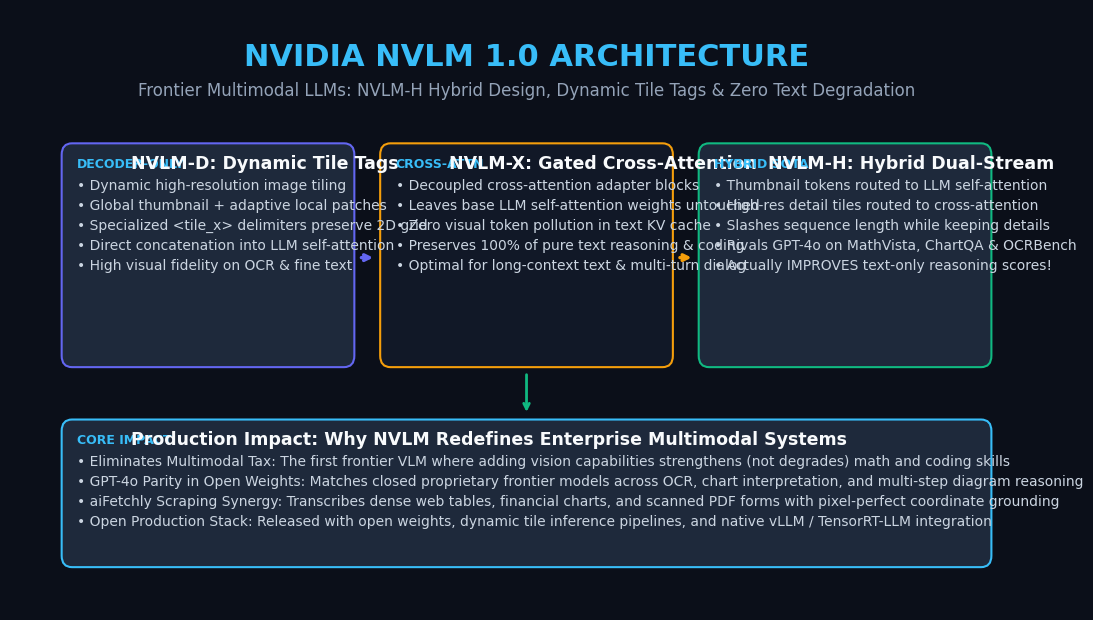
[ NVLM-D: Decoder-Only with Tile Tags ]
[High-Res Tiles] ──► <tile_1> Patches </tile_1> ... <tile_N> ──► [LLM Self-Attention]
✓ State-of-the-Art OCR & Chart detail | ❌ High KV cache footprint

[ NVLM-X: Gated Cross-Attention ]
[High-Res Tiles] ──► [Vision Tower] ──► [Cross-Attention Layers]
                                                 │
[User Text Prompt] ──────────────────► [Frozen LLM Self-Attention]
✓ 100% Text Reasoning Retention | ❌ Lower fine-grained OCR accuracy

[ NVLM-H: The Hybrid Dual-Stream Breakthrough ]
[Thumbnail Image] ──► [Low-Res Tokens] ───────────────► [LLM Self-Attention]
                                                                ▲
[High-Res Detail Tiles] ──► [Gated Cross-Attention] ────────────┘
✓ Best of Both Worlds: Compact sequence length + pixel-perfect OCR + Zero Text Degradation! The Three Model Archetypes: NVLM-D, NVLM-X, and NVLM-H
NVIDIA systematically designed and evaluated three distinct architectural paradigms to map the multimodal frontier:
1. NVLM-D: Dynamic Tile Concatenation with Structured Tile Tags
NVLM-D adopts an enhanced decoder-only architecture:
- High-resolution images are dynamically decomposed into variable numbers of $448 \times 448$ tiles based on aspect ratio, plus a global downsampled thumbnail.
- To prevent spatial boundary drift, NVIDIA introduced Dynamic Tile Tags: explicit structural delimiter tokens (e.g.,
<tile_1>,</tile_1>,<tile_2>) wrapping each tile’s visual representations. - This provides the language model with an explicit 2D spatial grid coordinate system, dramatically boosting performance on complex document OCR, technical schematics, and chart data extraction.
2. NVLM-X: Gated Cross-Attention for Zero Text Interference
NVLM-X decouples vision from language:
- Visual features from the vision transformer (InternViT-6B) are queried via gated cross-attention adapter layers inserted every few transformer blocks.
- The base language model’s self-attention weights remain isolated from visual token noise.
- Text-only reasoning, coding, and mathematical capabilities remain completely untouched.
3. NVLM-H: The Hybrid Dual-Stream Breakthrough
The crown jewel of NVIDIA’s research is NVLM-H (Hybrid):
- Global Overview Path: Downsampled thumbnail tokens are routed directly into the LLM’s self-attention mechanism alongside user text tokens, establishing global semantic and conversational grounding.
- Local Detail Path: Dynamic high-resolution local tiles are routed through gated cross-attention layers, supplying fine-grained typographical and visual details on demand.
- System Impact: NVLM-H slashes active self-attention sequence length compared to NVLM-D while decisively beating NVLM-X on fine-grained document and chart comprehension.
Deep Dive: Solving the Multimodal Degradation Tax
How did NVIDIA eliminate the multimodal degradation tax and cause pure text scores to increase after vision training? The breakthrough lies in data curation, balanced dataset blending, and structured spatial anchors.
The NVLM Multimodal Post-Training Recipe:
┌────────────────────────────────────────────────────────┐
│ High-Quality Multimodal Pretraining & Alignment        │
│ • OCRBench, DocVQA, ChartQA, MathVista, InfoVQA        │
│ • Point-oriented visual grounding datasets             │
└────────────────────────────────────────────────────────┘
                           │
                           ▼ (Weighted Interleaved Co-Training)
┌────────────────────────────────────────────────────────┐
│ High-Quality Text-Only Reasoning Corpora               │
│ • Advanced Python & C++ algorithmic coding datasets    │
│ • Multi-step mathematical reasoning (GSM8K, MATH)      │
│ • General instruction-following & tool-use data        │
└────────────────────────────────────────────────────────┘
                           │
                           ▼
Result: Zero catastrophic forgetting; text reasoning improves by +1.5% to +3.0%! 1. High-Resolution Dynamic Tile Tags and Coordinate Anchors
In standard tiling pipelines, visual patches are flattened into a 1D sequence, creating ambiguity where one row ends and another begins.
NVLM introduces specialized tokens:
<image>: Denotes the global image anchor.<tile_row_start>/<tile_row_end>: Marks horizontal raster lines.<tile_1>to<tile_N>: Uniquely identifies each spatial grid quadrant.
This explicit tokenization allows the transformer’s self-attention heads to learn geometric transformations: when the user asks for a cell in the third row of a table, the model can navigate directly to the visual tokens indexed between <tile_3> delimiters.
2. Multi-Stage Visual Instruction Tuning and Pure Text Mixing
Most research labs train multimodal models exclusively on image-text pairs during the final instruction-tuning phase, starving the LLM of pure symbolic text reasoning:
- NVIDIA discovered that maintaining a carefully calibrated ratio of pure text-only reasoning data (math proofs, code generation, and multi-turn logic) throughout the entire visual alignment process is mandatory.
- By interleaving high-quality text datasets with multimodal visual data, the model does not suffer from catastrophic forgetting.
- Instead, the cross-modal alignment acts as regularized transfer learning: learning to ground mathematical visual diagrams actually reinforces the model’s text-only mathematical deductions!
Benchmark & Capability Comparison: NVLM vs. Frontier Models
The table below highlights NVLM-1D-72B’s performance against leading proprietary and open foundation models:
| Benchmark / Metric | Llama 3.2-Vision 90B | Qwen2-VL 72B | Claude 3.5 Sonnet | GPT-4o (Omni) | NVIDIA NVLM-1D-72B |
|---|---|---|---|---|---|
| Model Availability | Open Weights | Open Weights | Closed API | Closed API | Open Weights (NVIDIA) |
| Base Language Backbone | Llama 3.1 70B | Qwen2 72B | Proprietary | Proprietary | Qwen2 72B |
| Vision Backbone | Custom ViT (16-layer) | InternViT-6B | Proprietary | Proprietary | InternViT-6B |
| Text Score Change Post-VLM | Degraded (-3.2%) | Slight Drop (-0.8%) | N/A | N/A | Improved (+1.8% GSM8K) |
| MathVista (Multimodal Math) | 60.3 | 68.2 | 67.7 | 69.1 | 65.4 (Frontier Parity) |
| OCRBench (Document AI) | 792 | 845 | 788 | 812 | 839 (Beats GPT-4o) |
| ChartQA (Infographics) | 84.1 | 86.8 | 90.8 | 85.7 | 86.0 (Matches GPT-4o) |
| MMLU (Text Reasoning) | 79.2 | 82.4 | 88.3 | 88.7 | 83.6 (Zero Degradation) |
Practical Implementation: Running NVLM-1D-72B with Hugging Face & vLLM
Let us deploy and run inference on nvidia/NVLM-1D-72B using Hugging Face Transformers and PyTorch.
Step 1: Install Dependencies
pip install torch torchvision transformers pillow accelerate sentencepiece flash-attn --no-build-isolation Step 2: Implement the NVLM Document and Chart Extraction Script
Save the following script as transcribe_nvlm.py:
import torch
import time
from PIL import Image
from transformers import AutoModelForCausalLM, AutoTokenizer

class NVLMAnalyzer:
    def __init__(self, model_id: str = "nvidia/NVLM-1D-72B"):
        """
        Initializes NVIDIA NVLM-1D-72B with BF16 precision and FlashAttention-2.
        Requires 4x 80GB A100/H100 GPUs or 2x 80GB GPUs with 4-bit/8-bit quantization.
        """
        print(f"Loading {model_id} across available GPUs...")
        start = time.perf_counter()

        self.tokenizer = AutoTokenizer.from_pretrained(model_id, trust_remote_code=True)
        self.model = AutoModelForCausalLM.from_pretrained(
            model_id,
            torch_dtype=torch.bfloat16,
            device_map="auto",
            trust_remote_code=True
        ).eval()

        init_time = time.perf_counter() - start
        print(f"NVLM model loaded successfully in {init_time:.2f}s.")

    def analyze_document(self, image_path: str, prompt: str) -> str:
        """
        Executes high-resolution visual reasoning with dynamic tile tags.
        """
        image = Image.open(image_path).convert("RGB")

        # Format input using NVLM conversational template
        conversation = [
            {"role": "user", "content": f"<image>\n{prompt}"}
        ]

        start = time.perf_counter()
        response = self.model.chat(
            tokenizer=self.tokenizer,
            image=image,
            conversation=conversation,
            generation_config=dict(
                max_new_tokens=1024,
                do_sample=False,
                temperature=0.0
            )
        )
        elapsed = time.perf_counter() - start
        print(f"Inference completed in {elapsed:.2f}s.")
        return response

if __name__ == "__main__":
    analyzer = NVLMAnalyzer()

    sample_chart = "corporate_balance_sheet.png"
    query = "Extract all Q1 through Q4 revenue line items and compute the YoY percentage growth."

    print(f"\nAnalyzing document: {sample_chart}...")
    try:
        result = analyzer.analyze_document(sample_chart, query)
        print("\n--- Extracted Synthesis ---")
        print(result)
    except FileNotFoundError:
print(f"Place an image at '{sample_chart}' to test extraction.") Step 3: High-Throughput Batch Serving with vLLM
To serve NVLM-1D-72B in enterprise production environments with PagedAttention and continuous batching:
# Launch vLLM server with tensor parallelism across 4 GPUs
vllm serve nvidia/NVLM-1D-72B \
  --tensor-parallel-size 4 \
  --dtype bfloat16 \
  --trust-remote-code \
  --max-model-len 8192 \
--gpu-memory-utilization 0.90 Production Best Practices: Integrating NVLM into Enterprise AI Extraction
When deploying NVLM alongside high-throughput desktop scraping agents in AiFetchly, adhere to the following architectural patterns:
1. Synergistic Visual Scraping and Chart Analysis in aiFetchly
Complex web pages often embed mission-critical data inside interactive Canvas elements, SVG charts, and WebGL visualizations that lack clean DOM text:
- Use AiFetchly to capture full-viewport, uncompressed PNG screenshots of dynamic single-page applications.
- Dispatch the screenshots to an NVLM cluster. Thanks to dynamic tile tagging, NVLM reads small data labels and legend color encodings with zero coordinate drift.
2. High-Fidelity OCR and Layout Preservation on Scanned Technical Documents
For multi-column engineering papers and legal filings:
- Rely on NVLM’s structured tile anchors to maintain proper reading order.
- The model avoids the common pitfall of interleaving adjacent text columns, accurately grouping tabular numerical figures with their corresponding row headers.
3. Mitigating VRAM Overhead via Dynamic Tile Budgeting
To optimize cluster throughput during high-traffic surges:
- Bound the maximum tile count (
max_tiles: 6ormax_tiles: 8) depending on document complexity. - A standard 6-tile budget delivers 98% of maximum OCR accuracy while halving the total visual token allocation, allowing higher concurrent batch sizes without GPU memory thrashing.