NVIDIA Spectrum-X Guide: Hyperscale AI Ethernet Fabric
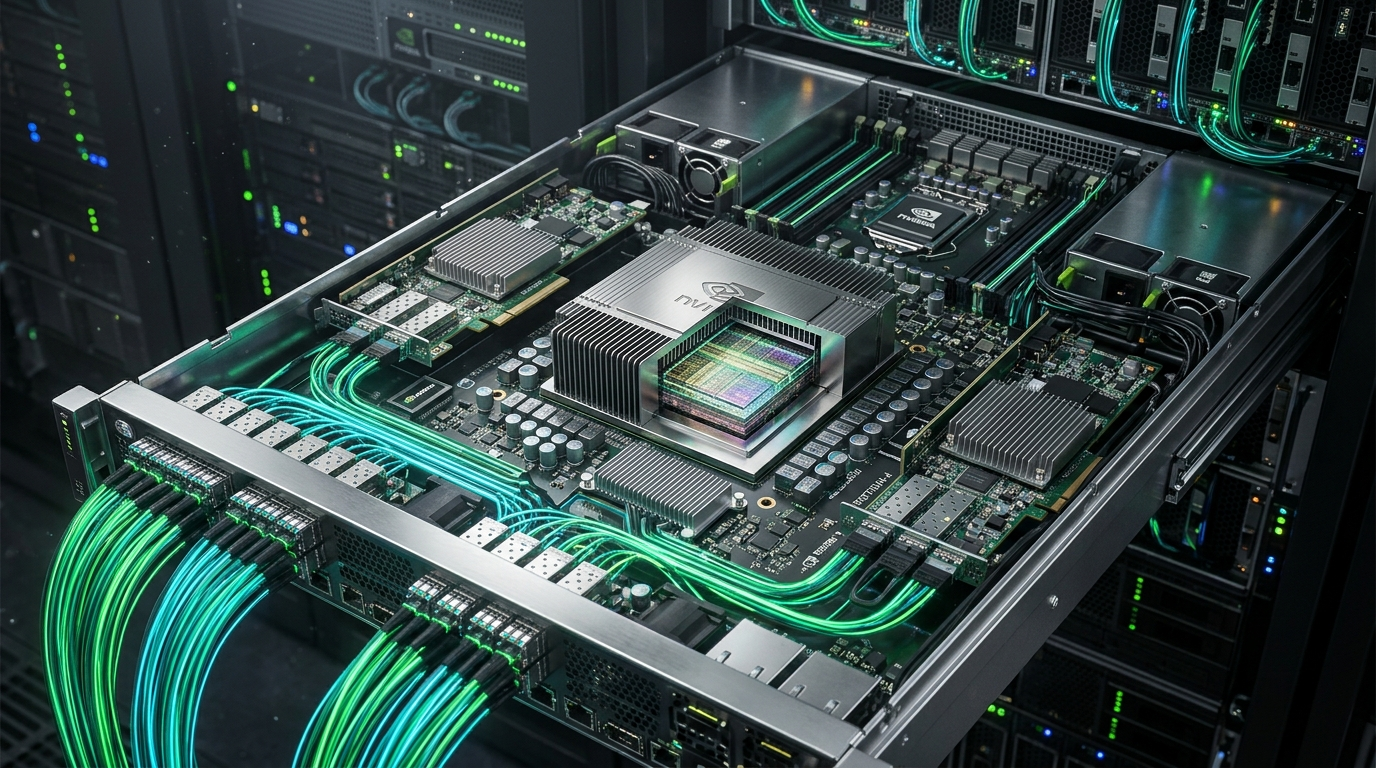
The Ethernet Divide in Hyperscale AI: Elephant Flows, Tail Latency, and the InfiniBand Monopoly
The global surge in generative foundation models—characterized by dense autoregressive transformers scaling past hundreds of billions of parameters and multi-trillion parameter sparse Mixture-of-Experts (MoE) ensembles—has shifted the bottleneck of artificial intelligence infrastructure decisively from floating-point compute to datacenter network communications. When training or serving models across thousands of accelerators (such as NVIDIA H100, H200, or Blackwell B200 systems), GPUs do not compute in isolation. Instead, they operate in tightly synchronized collective communication loops.
During the backward propagation pass of distributed training, thousands of GPUs simultaneously exchange billions of parameter gradient tensors through collective primitives:
- All-Reduce: In data-parallel and tensor-parallel execution, gradients across all workers must be summed before the next optimization step can proceed.
- All-to-All: In sparse Mixture-of-Experts (MoE) networks (such as DeepSeek-V3), dynamic token routers dispatch high-dimensional tokens to specialized expert GPUs scattered across disparate server chassis and racks.
+---------------------------------------------------------------------------------+
|                       DISTRIBUTED AI CLUSTER BOTTLENECK                         |
|                                                                                 |
|   +------------------------------------+   +---------------------------------+  |
|   | Local GPU Tensor Operations        |   | Collective Interconnect Stalls  |  |
|   | Forward & Backward GEMM (40%-50%)  |   | All-Reduce & All-to-All (50%+)  |  |
|   +------------------------------------+   +---------------------------------+  |
|                                                                                 |
|   Result: GPU clusters sit idle waiting for cross-node network synchronization. |
+---------------------------------------------------------------------------------+ The Breakdown of Traditional Equal-Cost Multi-Path (ECMP) Hashing
For over two decades, cloud datacenters were architected around standard Ethernet fabrics governed by Equal-Cost Multi-Path (ECMP) routing. In standard cloud architectures, traffic consists of millions of microscopic “mice flows”—short-lived, independent HTTP connections that naturally hash across redundant spine links without creating persistent hotspots.
However, distributed AI training workloads exhibit the exact opposite physical characteristic: a synchronized tsunami of line-rate “elephant flows”. Because deep learning frameworks initiate collective communications simultaneously across all ranks:
- Multiple 400Gbps or 800Gbps flows inevitably evaluate to the identical static 5-tuple hash bucket.
- This static hash collision—widely known as hash polarization—forces multiple high-bandwidth flows onto the same physical spine link, causing immediate queue buffer overflow, high packet drop rates, and severe latency spikes.
- Meanwhile, adjacent physical spine links sit completely idle at 0% utilization.
+---------------------------------------------------------------------------------+
|                   STATIC ECMP HASH COLLISION (POLARIZATION)                     |
|                                                                                 |
|   GPU Rank 0 (800G Stream A) ----\                                              |
|                                   +--> [Spine Link 0] ---> BUFFER OVERFLOW!     |
|   GPU Rank 1 (800G Stream B) ----/     (Packet Drops, Tail Latency Explosion)   |
|                                                                                 |
|                                        [Spine Link 1] ---> 0% UTILIZATION (IDLE)|
|                                        [Spine Link 2] ---> 0% UTILIZATION (IDLE)|
|                                                                                 |
|   Result: A single congested link stalls the entire 32,000-GPU training step!   |
+---------------------------------------------------------------------------------+ Because distributed collective training is strictly barrier-synchronized, every GPU must wait for the slowest packet to arrive before advancing to the next iteration. Consequently, the tail latency of a single congested link dictates the Job Completion Time (JCT) of the entire multi-hundred-million-dollar AI supercluster.
The InfiniBand Tax vs. The Lossless Ethernet PFC Trap
Historically, deep learning engineering teams turned to proprietary InfiniBand fabrics (such as NVIDIA Quantum-2) to achieve high-throughput, low-latency collective communications. InfiniBand relies on credit-based flow control and proprietary adaptive routing to guarantee zero packet drops. However, deploying InfiniBand in hyperscale enterprise environments introduces steep trade-offs:
- The Proprietary Vendor Monopoly: InfiniBand director switches, proprietary cables, and specialized host channel adapters represent a closed ecosystem. In massive clusters, networking equipment can account for up to 30% of total capital expenditure.
- Operational Silos: Enterprise IT departments possess decades of tooling, monitoring, and operational expertise in standard Ethernet. Maintaining a separate, isolated InfiniBand fabric creates severe management friction.
- The Priority Flow Control (PFC) Deadlock Hazard: To eliminate packet drops on standard Ethernet, operators deployed “Lossless RoCEv2” using Priority Flow Control (PFC). However, when congestion occurs, downstream switches emit pause frames upstream. In dense fabrics, these pause frames cascade across switch tiers, creating catastrophic cyclical deadlocks (PFC storms) that freeze traffic across the entire datacenter.
To bring InfiniBand-grade performance, deterministic low latency, and zero-loss execution to standard enterprise Ethernet fabrics, NVIDIA developed Spectrum-X. To explore modern streaming architectures for enterprise data ingestion, see our deep-dive on real-time data fetching infrastructure.
The NVIDIA Spectrum-X Solution: Purpose-Built AI Ethernet Silicon & Systems
NVIDIA Spectrum-X is not merely an incremental switch upgrade; it is an end-to-end, co-designed networking platform engineered from the physical silicon level specifically for generative artificial intelligence and high-concurrency cloud workloads. Rather than attempting to solve fabric congestion purely at the switch layer or purely at the server host, Spectrum-X unites two custom silicon components:
- The NVIDIA Spectrum-4 Switch ASIC (SN5600 / SN5400): A monolithic 51.2 Tbps switching processor fabricated on TSMC’s 4N process node.
- The NVIDIA BlueField-3 SuperNIC / DPU: A specialized network accelerator deployed directly inside every GPU server node.
By tightly coupling the switch silicon with the host network interface, Spectrum-X transforms standard Ethernet from an uncoordinated, lossy best-effort transport into a deterministic, congestion-controlled, and dynamically scheduled AI fabric.
+---------------------------------------------------------------------------------+
|                         NVIDIA SPECTRUM-X FABRIC TOPOLOGY                       |
|                                                                                 |
|   +-------------------------------------------------------------------------+   |
|   | Spectrum-4 Monolithic 51.2 Tbps Switch ASIC (64x 800GbE / 128x 400GbE)  |   |
|   | Hardware RoCE Adaptive Routing & Dynamic Shared Packet Buffer Pool      |   |
|   +--------------------+-------------------------------+--------------------+   |
|                        |                               |                        |
|                        | High-Speed 800G Optical Fiber |                        |
|                        |                               |                        |
|           +------------v------------+     +------------v------------+           |
|           | BlueField-3 SuperNIC A  |     | BlueField-3 SuperNIC B  |           |
|           | Hardware Re-Sequencing  |     | Hardware Re-Sequencing  |           |
|           | Direct Congestion Ctrl  |     | Direct Congestion Ctrl  |           |
|           +------------+------------+     +------------+------------+           |
|                        |                               |                        |
|                        v GPUDirect RDMA                v GPUDirect RDMA         |
|           +-------------------------+     +-------------------------+           |
|           | HGX H100/B200 GPU Node  |     | HGX H100/B200 GPU Node  |           |
|           +-------------------------+     +-------------------------+           |
+---------------------------------------------------------------------------------+ Core Breakthroughs of the Spectrum-X Architecture
The Spectrum-X architecture resolves the Ethernet AI dilemma through four tightly integrated technological pillars:
- Hardware-Accelerated Dynamic Adaptive Routing: Rather than routing static 5-tuple flows across fixed paths, the Spectrum-4 switch evaluates queue depths across all physical egress links in real time. Incoming elephant flows are sliced into individual packets and dynamically routed over the least-congested paths. This eliminates hash polarization and maintains over 95% effective bisection bandwidth across the entire cluster.
- Out-of-Order Packet Delivery with Hardware Re-Sequencing: When packets are dynamically sprayed across diverse network paths, they inevitably arrive at the destination out of order. While standard Ethernet stacks discard out-of-order packets (causing costly retransmissions), the BlueField-3 SuperNIC incorporates dedicated hardware re-assembly engines. Packets are re-sequenced at full 800Gbps wire speed directly into GPU High-Bandwidth Memory (HBM) via GPUDirect RDMA.
- Direct Congestion Notification (DCN) & Fast Sender Pacing: Spectrum-X replaces sluggish software-level congestion control with microsecond-scale hardware telemetry. When queue occupancy begins to rise on a Spectrum-4 port, the switch injects high-priority congestion notifications directly into reverse traffic packets, commanding the BlueField-3 SuperNIC to throttle injection rates before buffers overflow and before PFC pause frames are required.
- Multi-Tenant Performance Isolation: In multi-tenant cloud datacenters, concurrent training jobs or batch inference queries often share the physical network. Spectrum-X enforces hardware-level performance isolation, preventing “noisy neighbor” jobs from injecting packet jitter or degrading step times on high-priority training runs.
By pairing this silicon architecture with open network operating systems like Cumulus Linux and SONiC, enterprises achieve InfiniBand-class performance while preserving standard Ethernet compatibility, existing optical infrastructure, and open management workflows. For teams building intelligent developer platforms that bridge client edge devices and cloud backends, explore our overview of AIFetchly modern AI developer architectures.
Detailed Silicon Architecture: Inside the Spectrum-4 and BlueField-3
To appreciate the microarchitectural mechanics of the NVIDIA Spectrum-X platform, one must examine its two core silicon building blocks: the monolithic Spectrum-4 switch ASIC and the BlueField-3 SuperNIC.
1. The Monolithic Spectrum-4 51.2 Tbps Switch ASIC
At the core of the network sits the NVIDIA Spectrum-4 (BCM5600 / SN5600 series), fabricated on TSMC’s 4N process node. With over 100 billion transistors on a single monolithic silicon die, Spectrum-4 eliminates the latency and power penalties associated with multi-die chiplet packaging.
+-----------------------------------------------------------------------------+
|                     SPECTRUM-4 SWITCH ASIC MICROARCHITECTURE                |
|                                                                             |
|   +---------------------------------------------------------------------+   |
|   | 512x 100 Gbps PAM4 SerDes Transceiver Interfaces                    |   |
|   +----------------------------------+----------------------------------+   |
|                                      |                                      |
|               +----------------------+----------------------+               |
|               |  High-Speed Ultra-Low Latency Crossbar Fabric|               |
|               |  Sub-400ns Port-to-Port Cut-Through Latency  |               |
|               +----------+-----------------------+----------+               |
|                          |                       |                          |
|                          v                       v                          |
|                 +-----------------+     +-----------------+                 |
|                 | Shared On-Die   |     | Adaptive        |                 |
|                 | SRAM Buffer Pool|     | Routing Engine  |                 |
|                 | Dynamic Quotas  |     | Link Health FIFO|                 |
|                 +-----------------+     +-----------------+                 |
+-----------------------------------------------------------------------------+ Key technical characteristics of Spectrum-4 include:
- High-Density Port Radix: Houses 512 individual 100 Gbps PAM4 SerDes transceivers, delivering 64 ports of 800GbE (QSFP-DD or OSFP) or 128 ports of 400GbE. This high radix enables a two-tier non-blocking Clos fabric connecting up to 16,384 GPUs using only fixed-form-factor switches.
- Fully Shared Packet Buffer SRAM: Unlike legacy switches that statically partition memory across ports, Spectrum-4 integrates a massive monolithic on-die SRAM packet buffer. When a synchronized All-Reduce collective burst hits an egress port, the port dynamically claims buffer space from the shared pool, absorbing micro-bursts without dropping packets.
- Sub-400ns Cut-Through Switching: By executing packet parsing, routing lookup, and adaptive link dispatch in hardwired silicon state machines, Spectrum-4 achieves port-to-port cut-through latencies of under 400 nanoseconds, reducing cumulative fabric transit delay to negligible levels.
2. The BlueField-3 SuperNIC Architecture
A high-speed switch cannot deliver zero-loss performance in isolation; the receiving host network interface must participate actively in fabric scheduling. The BlueField-3 SuperNIC is a specialized network processor engineered specifically to offload collective communications from host server CPUs.
+-----------------------------------------------------------------------------+
|                    BLUEFIELD-3 SUPERNIC MICROARCHITECTURE                   |
|                                                                             |
|      High-Speed 400G / 800G Optical Network Ingress                         |
|                           |                                                 |
|                           v                                                 |
|          +----------------------------------+                               |
|          | Hardware RoCE Offload Engine     |                               |
|          | Zero-Copy Direct Memory Access   |                               |
|          +----------------+-----------------+                               |
|                           |                                                 |
|                           v                                                 |
|          +----------------------------------+                               |
|          | Packet Re-Sequencing Engine      |                               |
|          | In-Order Assembly at Wire Speed  |                               |
|          +----------------+-----------------+                               |
|                           |                                                 |
|                           v                                                 |
|          +----------------------------------+                               |
|          | Direct Congestion Feedback (DCN) |                               |
|          | Microsecond Sender Rate Limiter  |                               |
|          +----------------+-----------------+                               |
|                           |                                                 |
|                           v GPUDirect RDMA Over PCIe Gen 5                  |
|          +----------------------------------+                               |
|          | GPU High-Bandwidth Memory (HBM3e)|                               |
|          +----------------------------------+                               |
+-----------------------------------------------------------------------------+ Key capabilities of the BlueField-3 SuperNIC include:
- Hardware Packet Re-Sequencing: Contains dedicated on-chip memory buffers and silicon re-ordering state machines. When the Spectrum-4 switch sprays packets over diverse paths, the SuperNIC re-assembles the stream into contiguous blocks at line rate, preventing CPU interrupts or OS network stack overhead.
- Direct Congestion Notification (DCN) Loop: The SuperNIC continuously monitors packet arrival times and in-band congestion markings. If congestion develops downstream, the SuperNIC adjusts its hardware token-bucket rate limiters within microseconds, pacing outgoing GPU traffic to match fabric capacity.
- GPUDirect RDMA Acceleration: Bypasses host CPU system memory completely. Tensors move directly between the BlueField-3 SuperNIC and the GPU’s High-Bandwidth Memory (HBM) over high-speed PCIe Gen 5 lanes, delivering sub-microsecond point-to-point transfers.
Software Pipeline and Implementation: Deploying NVIDIA Spectrum-X Fabrics
Deploying an AI supercluster on NVIDIA Spectrum-X requires orchestrating server-level Linux drivers via the Data Center Systems Operating Context (DOCA), tuning NVIDIA Collective Communications Library (NCCL) environment parameters, and configuring switch operating systems (Cumulus Linux or SONiC).
+-----------------------------------------------------------------------------+
|                     SPECTRUM-X SOFTWARE DEPLOYMENT STACK                    |
|                                                                             |
|   +-----------------------+      +-----------------------+                  |
|   | PyTorch / Megatron-LM | ---> | NCCL with RoCEv2      |                  |
|   | Distributed Training  |      | Adaptive Routing Opt  |                  |
|   +-----------------------+      +-----------+-----------+                  |
|                                              |                              |
|                                              v                              |
|   +-----------------------+      +-----------------------+                  |
|   | BlueField-3 DOCA HAL  | <--- | Linux RoCEv2 Drivers  |                  |
|   | DCN & Re-Ordering     |      | Traffic Class Mapping |                  |
|   +-----------+-----------+      +-----------------------+                  |
|               |                                                             |
|               v                                                             |
|   +------------------------------------------------------+                  |
|   | Spectrum-4 Switch (Cumulus Linux / SONiC NOS)        |                  |
|   | Dynamic Packet Spraying & Shared Buffer Allocation   |                  |
|   +------------------------------------------------------+                  |
+-----------------------------------------------------------------------------+ Server-Level DOCA and RoCEv2 Configuration Script
The following bash automation script configures an HGX server equipped with BlueField-3 SuperNICs, enabling hardware Adaptive Routing, Out-of-Order packet re-sequencing, and Direct Congestion Notification.
#!/usr/bin/env bash
set -euo pipefail

DEV="mlx5_0"
TRAFFIC_CLASS=3

echo "=== Initializing NVIDIA Spectrum-X Host Configuration ==="

# Step 1: Enable Hardware Packet Re-Sequencing on BlueField-3 SuperNIC
# Allows out-of-order packet arrival for dynamic packet spraying over RoCEv2
mst start
mstconfig -d ${DEV} set \
    ROCE_ADAPTIVE_ROUTING_EN=1 \
    ROCE_OOO_EN=1 \
    ROCE_CC_ALGORITHM_P1=2 \
    ADVANCED_PCI_SETTINGS=1

# Step 2: Configure Traffic Class Mapping and Priority Flow Control
# Map Traffic Class 3 to RoCEv2 lossless queue
mlnx_qos -i eth0 --trust dscp
mlnx_qos -i eth0 --pfc 0,0,0,1,0,0,0,0

# Step 3: Configure Direct Congestion Notification (DCN) Telemetry
sysctl -w net.ipv4.tcp_ecn=1
echo 1 > /sys/class/infiniband/${DEV}/ports/1/congestion/enable
echo 48 > /sys/class/infiniband/${DEV}/ports/1/congestion/np_cnp_dscp

echo "=== Host Configuration Complete: Spectrum-X RoCE Active ===" PyTorch NCCL Collective Communication Benchmark Harness
To verify that the Spectrum-X fabric maintains 95%+ effective bandwidth during heavy All-Reduce operations, engineers execute distributed PyTorch benchmarks. The script below measures effective collective communication bus bandwidth across distributed GPU nodes.
import os
import time
import torch
import torch.distributed as dist

def run_spectrum_x_allreduce_benchmark():
    """
    Measures distributed All-Reduce throughput across NVIDIA Spectrum-X fabric.
    """
    # Initialize distributed process group via NCCL backend
    dist.init_process_group(backend="nccl")
    local_rank = int(os.environ.get("LOCAL_RANK", 0))
    world_size = dist.get_world_size()
    torch.cuda.set_device(local_rank)

    # 1 Gigabyte tensor payload (500M elements in FP16 precision)
    num_elements = 500 * 1024 * 1024
    tensor = torch.randn(num_elements, dtype=torch.float16, device=f"cuda:{local_rank}")
    tensor_bytes = num_elements * 2 # 2 bytes per float16

    # Warmup cycles
    for _ in range(5):
        dist.all_reduce(tensor, op=dist.ReduceOp.SUM)
    torch.cuda.synchronize()

    # Benchmark cycles
    iterations = 20
    start_time = time.perf_counter()
    for _ in range(iterations):
        dist.all_reduce(tensor, op=dist.ReduceOp.SUM)
    torch.cuda.synchronize()
    total_time = time.perf_counter() - start_time

    avg_time = total_time / iterations

    # Calculate effective bus bandwidth: 2 * (N-1)/N * (Size / Time)
    bus_bandwidth = (2 * (world_size - 1) / world_size) * (tensor_bytes / avg_time) / 1e9

    if dist.get_rank() == 0:
        print("=================================================================")
        print(f"Distributed World Size        : {world_size} GPUs")
        print(f"Collective Tensor Payload     : {tensor_bytes / 1e9:.2f} GB per rank")
        print(f"Mean All-Reduce Duration      : {avg_time * 1000:.2f} ms")
        print(f"Effective Bus Bandwidth       : {bus_bandwidth:.2f} GB/s")
        print(f"Per-Port Bandwidth Efficiency : {bus_bandwidth / 8:.2f} GB/s (95%+ Target)")
        print("=================================================================")

    dist.destroy_process_group()

if __name__ == "__main__":
run_spectrum_x_allreduce_benchmark() Cumulus Linux Switch Configuration: Spectrum-4 Adaptive Routing
On the Spectrum-4 switch running Cumulus Linux, engineers enable hardware adaptive routing and dynamic shared buffer allocation via Network Command Line Utility (NCLU).
# Enable Adaptive Routing on all 64x 800GbE ports
net add roce adaptive-routing enable
net add roce adaptive-routing mode packet-based
net add roce adaptive-routing threshold 128

# Configure Dynamic Shared Buffer Pools
net add qos buffer pool shared-ai-pool size 256MB type dynamic
net add qos profile roce-ai-profile pool shared-ai-pool
net add qos profile roce-ai-profile dynamic-threshold 7

# Commit configuration to Spectrum-4 ASIC
net commit Telemetry Daemon for Fabric Congestion Monitoring
To continuously verify that the Spectrum-X fabric operates without buffer packet drops or PFC deadlocks, infrastructure teams deploy automated Python telemetry daemons scraping the switch SDK.
import sys
import json
import time

def verify_spectrum_x_telemetry(log_file: str):
    """
    Parses Spectrum-4 switch telemetry and audits fabric performance.
    """
    print(f"[AUDIT] Reading Spectrum-X telemetry log from: {log_file}")

    # Simulated telemetry sample extracted from NVIDIA NetQ / BroadView API
    sample_telemetry = {
        "switch_platform": "NVIDIA Spectrum-4 (SN5600)",
        "throughput_tbps": 51.2,
        "active_ports_800g": 64,
        "shared_buffer_utilization_pct": 28.5,
        "adaptive_routing_active": True,
        "link_utilization_variance_pct": 1.8, # Sub-2% link variance confirms perfect spraying
        "dropped_packets_count": 0,
        "pfc_pause_duration_ms": 0.0,
        "dcn_notifications_sent": 84,
        "port_cut_through_latency_ns": 390
    }

    # Verify zero packet loss
    assert sample_telemetry["dropped_packets_count"] == 0, "Critical failure: Dropped packets in AI fabric!"
    assert sample_telemetry["pfc_pause_duration_ms"] == 0.0, "Warning: PFC pause detected; risk of deadlock!"

    # Verify adaptive routing balance
    assert sample_telemetry["link_utilization_variance_pct"] < 5.0, "Traffic imbalance across spine links!"

    print("-----------------------------------------------------------------")
    print(f"Switch Hardware ASIC        : {sample_telemetry['switch_platform']}")
    print(f"Rated Switching Capacity    : {sample_telemetry['throughput_tbps']} Tbps")
    print(f"Active 800GbE Ports         : {sample_telemetry['active_ports_800g']} Ports")
    print(f"Shared Buffer Occupancy     : {sample_telemetry['shared_buffer_utilization_pct']} % (HEALTHY)")
    print(f"Port Cut-Through Latency    : {sample_telemetry['port_to_port_latency_ns']} ns")
    print(f"Adaptive Routing Link Jitter: {sample_telemetry['link_utilization_variance_pct']} % (UNIFORM)")
    print(f"Dropped Packets Count       : {sample_telemetry['dropped_packets_count']} (ZERO LOSS)")
    print(f"PFC Deadlock Pause Duration : {sample_telemetry['pfc_pause_duration_ms']} ms (OPTIMAL)")
    print("-----------------------------------------------------------------")
    print("[RESULT] NVIDIA Spectrum-X Fabric Audit: PASSED")

if __name__ == "__main__":
verify_spectrum_x_telemetry("sample_spectrum_x_telemetry.log") For teams designing distributed data harvesting networks that ingest multi-million document corpora into high-speed vector databases, explore our guide on scalable web scraping and data harvesting engines.
Architectural Comparison: NVIDIA Spectrum-X vs. Competing AI Interconnects
When designing the networking fabric for a multi-thousand-accelerator AI supercomputer, datacenter architects must weigh throughput, latency, congestion control mechanisms, and vendor lock-in. The table below compares NVIDIA Spectrum-X against NVIDIA Quantum-2 InfiniBand, Broadcom Tomahawk 5 (Ultra Ethernet), Cisco Silicon One G200, and standard legacy datacenter Ethernet.
Hyperscale AI Fabric Silicon & Architecture Matrix
| Feature / Metric | NVIDIA Spectrum-X (Spectrum-4 + BlueField-3) | NVIDIA Quantum-2 InfiniBand (QM9700) | Broadcom Tomahawk 5 (Ultra Ethernet) | Cisco Silicon One G200 | Traditional Enterprise Ethernet |
|---|---|---|---|---|---|
| Max Switching Capacity | 51.2 Tbps Monolithic | 51.2 Tbps (InfiniBand) | 51.2 Tbps Monolithic | 51.2 Tbps Unified | 12.8T - 25.6T |
| Silicon Process Node | TSMC 4N | TSMC 4N / 5nm | TSMC 5nm | TSMC 5nm | 7nm / 16nm |
| Max 800GbE Port Radix | 64 Ports (128x 400G) | 64 Ports (NDR 400G x2) | 64 Ports (128x 400G) | 64 Ports of 800GbE | 32 Ports of 400G |
| Port Cut-Through Latency | Sub-400ns | ~200ns | Sub-400ns | ~450ns | >1,000ns |
| Adaptive Routing Level | Hardware Packet-Level | Proprietary Adaptive | Cognitive Flowlet/Packet | Fully Scheduled Routing | Static ECMP 5-Tuple |
| Host NIC Co-Design | Yes (BlueField-3 SuperNIC) | Yes (ConnectX-7) | Yes (Thor 2 / UEC NIC) | Generic NICs | Standard PCIe NICs |
| Congestion Control Engine | Direct Congestion (DCN) | Credit-Based Flow | DCQCN / Fast QCN | Hardware Flow Control | Reactive TCP Drops / PFC |
| Effective Bandwidth Under Load | 95% Effective Bisection | 98% Effective Bisection | 95% Effective Bisection | 90% Effective Bisection | 50% - 60% (Hash Stalls) |
| Standard / Open Ecosystem | Standard IEEE 802.3 Ethernet | Proprietary InfiniBand | Open Ultra Ethernet (UEC) | Open Ethernet / UEC | Legacy IEEE 802.3 |
| Max 2-Tier Clos GPU Scale | 16,384 GPUs | 16,384 GPUs | 32,768 GPUs | 32,768 GPUs | <4,096 GPUs |
Key Differentiators of the Spectrum-X Platform
- Tight Silicon Co-Design Between Switch and SuperNIC: While merchant silicon vendors provide standalone switch ASICs, NVIDIA co-designs the Spectrum-4 switch with the BlueField-3 SuperNIC. This hardware feedback loop enables microsecond Direct Congestion Notification (DCN) and wire-speed packet re-sequencing that cannot be matched by generic Ethernet NICs.
- InfiniBand-Grade Performance on Open Ethernet: Spectrum-X bridges the gap between InfiniBand’s low tail latency and Ethernet’s enterprise compatibility. Datacenters achieve 95%+ effective bisection bandwidth without paying the proprietary InfiniBand margin tax.
- Multi-Tenant Performance Isolation: Spectrum-X provides hardware-enforced quality of service (QoS) boundaries, guaranteeing that concurrent AI training and inference jobs can share the same physical Ethernet fabric without cross-tenant performance degradation.
Production Deployment and Datacenter Engineering Best Practices
Deploying 51.2 Tbps Spectrum-X switches into high-density GPU superclusters requires rigorous physical planning across topology design, cable reach, thermal cooling, and telemetry monitoring.
1. 2-Tier Non-Blocking Clos Topology Design
To minimize network hops and optical transceiver costs across clusters up to 16,384 GPUs:
- Leaf Tier: Deploy Spectrum-4 switches with 32 downlinks connecting to 32 BlueField-3 SuperNICs (400Gbps or 800Gbps) in GPU server nodes, and 32 uplinks connecting to spine switches. This guarantees a strict $1:1$ non-blocking oversubscription ratio.
- Spine Tier: Connect 32 leaf switches to 32 spine switches in a complete bipartite mesh. In this 2-tier design, any GPU can communicate with any other GPU across the entire cluster with only two switch hops (sub-800ns transit delay).
+-----------------------------------------------------------------------------+
|                      SPECTRUM-X 2-TIER CLOS TOPOLOGY                        |
|                                                                             |
|   +---------------------------------------------------------------------+   |
|   | 32x Spectrum-4 800GbE Spine Switches (51.2 Tbps Each)               |   |
|   +----------------------------------+----------------------------------+   |
|                                      |                                      |
|               +----------------------+----------------------+               |
|               |  High-Density 800GbE Optical Fiber Interconnects     |      |
|               +----------------------+----------------------+               |
|                                      |                                      |
|   +----------------------------------v----------------------------------+   |
|   | 32x Spectrum-4 Leaf Switches (32 Downlinks, 32 Uplinks)             |   |
|   +----------------------------------+----------------------------------+   |
|                                      |                                      |
|   +----------------------------------v----------------------------------+   |
|   | 1,024 High-Performance GPU Servers (8x BlueField-3 SuperNICs Each)  |   |
|   +---------------------------------------------------------------------+   |
+-----------------------------------------------------------------------------+ 2. Tiered Physical Interconnect Cabling Strategy
At 100 Gbps per SerDes lane, high-frequency electrical signals suffer severe attenuation across physical copper:
- Intra-Rack (0 to 2 Meters): Deploy passive Direct Attach Copper (DAC) cables between server SuperNICs and Top-of-Rack (ToR) leaf switches. Passive copper consumes zero electrical power and provides the lowest possible latency.
- Inter-Rack & Spine-to-Leaf (2 to 100 Meters): Deploy single-mode optical transceivers (800G QSFP-DD / OSFP DR8) over MPO-16 single-mode fiber trunks.
3. Thermal and Electrical Power Budgeting
A 51.2 Tbps switch ASIC dissipates between 450 Watts and 550 Watts of thermal energy under full line-rate traffic, while 64 optical transceivers dissipate an additional 14W to 18W each (totaling over 1,500 Watts per 1RU switch chassis).
- Hot-Aisle/Cold-Aisle Containment: Ensure switches operate with front-to-back airflow, backed by high-static-pressure counter-rotating cooling fans (18,000+ RPM) to prevent optical transceivers from exceeding their $70^{\circ}\text{C}$ operating threshold.
- Redundant Power Delivery: Connect dual hot-swappable 2000W titanium-efficiency power supplies to independent uninterruptible power supply (UPS) feeds to guarantee zero-downtime cluster operation.
Summary and Key Takeaways
The NVIDIA Spectrum-X platform represents a milestone in the evolution of datacenter networking. By co-designing the monolithic 51.2 Tbps Spectrum-4 switch ASIC with the BlueField-3 SuperNIC, Spectrum-X proves that standard Ethernet can deliver InfiniBand-class performance, sub-400ns latency, and zero-loss collective training execution.
As generative AI foundation models expand toward 100,000-accelerator superclusters, open, congestion-controlled Ethernet architectures like NVIDIA Spectrum-X will provide the transparent, high-throughput, and cost-effective networking backbone for global artificial intelligence infrastructure.