NVIDIA GB200 NVL72 Guide: Rack-Scale Liquid-Cooled AI
The Trillion-Parameter Scale Barrier and Node Boundary Limits
In modern frontier artificial intelligence research, high-throughput foundation model inference, and real-time autonomous agent pipelines powered by AI Fetchly, computational infrastructure has hit an unyielding physical constraint: the single-chassis node boundary. Whether serving multi-trillion-parameter Mixture-of-Experts (MoE) models, executing continuous web-scale data extractions via automated web scraping, or processing streaming multimodal enterprise feeds through real-time data ingestion, modern foundation models have outgrown the physical limits of standard 8-GPU server nodes.
For the past five years, the standard building block of deep learning infrastructure was the 8-GPU server chassis (such as the NVIDIA DGX A100 or HGX H100). Within an 8-GPU node, high-speed NVLink switches provide seamless high-bandwidth communication. However, as foundation models scaled from 70 billion parameters to dense 405B models and trillion-parameter sparse MoE architectures (such as GPT-4, Grok-2, and DeepSeek-V3), traditional 8-GPU servers introduced three catastrophic systemic bottlenecks into datacenter operations:
1. The Multi-Hop Network Partition Barrier
When a model exceeds the memory capacity of an 8-GPU chassis (640 GB on an H100 node), engineers must partition model layers across separate physical server chassis over a cluster network fabric:
- The Bandwidth Cliff: While communication within an 8-GPU H100 chassis moves at 900 GB/s per GPU over NVLink 4, communicating across chassis drops to 50 GB/s to 100 GB/s per GPU over 400G InfiniBand or RoCEv2 Ethernet.
- The Communication Latency Penalty: Sharding an MoE model across servers means that dynamic token routing (All-to-All communication between token dispatchers and feed-forward expert layers) must traverse PCIe host root complexes, external network interface cards (NICs), optical transceivers, and multi-tier spine-leaf switches.
- This severe bandwidth drop creates massive pipeline synchronization bubbles: GPUs spend over 60% of their execution time waiting for cross-node network packets rather than executing tensor matrix operations.
Traditional 8-GPU Multi-Node Cluster vs. Rack-Scale Unified NVL72:
+------------------------------------------------------------------------------------+
| CONVENTIONAL 8-GPU SERVER NODES: The Multi-Chassis InfiniBand Bottleneck           |
+------------------------------------------------------------------------------------+
| [Node 1: 8x H100 GPUs] <=== 400G InfiniBand / PCIe NICs ===> [Node 2: 8x H100 GPUs]|
| - Bandwidth Cliff: 900 GB/s (Intra-Node) drops to 50 GB/s (Inter-Node)             |
| - High latency jitter and packet drop risks across spine-leaf optical networks     |
| - Complex 3D Parallelism required: Tensor (TP=8) + Pipeline (PP=4) + Expert (EP=8)  |
+------------------------------------------------------------------------------------+
| NVIDIA GB200 NVL72: Sovereign Rack-Scale Computing Engine                          |
+------------------------------------------------------------------------------------+
| [72x Blackwell GPUs + 36x Grace CPUs] <=== 130 TB/s NVLink 5 Copper Spine ===>     |
| - Acts as a SINGLE GIANT GPU: 13.8 TB HBM3e + 17.3 TB LPDDR5X (31.1 TB Fast RAM)   |
| - Full All-to-All non-blocking mesh at 1.8 TB/s per GPU; ZERO InfiniBand hops      |
| - Serves trillion-parameter MoE models in real-time with 30x throughput gain       |
+------------------------------------------------------------------------------------+ 2. The Optical Transceiver Power and Failure Tax
Connecting thousands of GPUs using traditional optical transceivers incurs astronomical electrical power and maintenance overhead:
- Optical transceivers perform optical-to-electrical and electrical-to-optical conversions at every cable endpoint.
- In a multi-thousand GPU cluster, optical transceivers dissipate megawatts of heat and exhibit relatively high failure rates (laser diode degradation, dust contamination, connector wear), causing frequent cluster training interrupts.
- Datacenters spend millions of dollars replacing failed optical transceivers and troubleshooting intermittent packet loss across complex optical patch panels.
3. The Generative Inference Cost Crisis on Trillion-Parameter MoE Models
Serving frontier Mixture-of-Experts models in real-time is financially and thermodynamically unsustainable on legacy hardware:
- To deliver interactive token generation speeds (e.g., >30 tokens per second per user stream) on a 1-trillion parameter model, an H100 cluster requires hundreds of GPUs running at low batch sizes, resulting in single-digit hardware utilization.
- Serving costs balloon, forcing application developers to throttle context windows, enforce harsh rate limits, or deploy smaller, less capable distilled models.
The Rack-Scale Revolution: NVIDIA GB200 NVL72
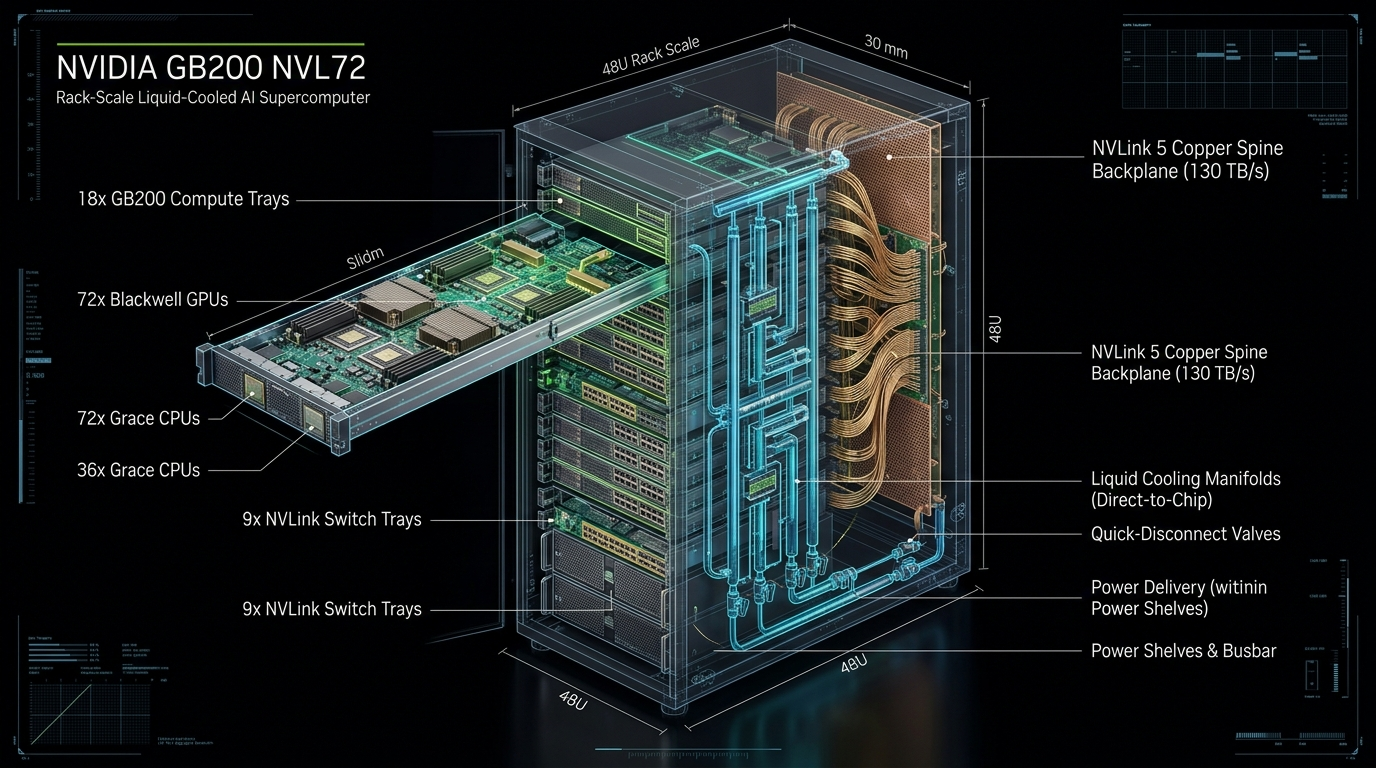
To permanently eliminate the single-chassis boundary and redefine AI computing, NVIDIA re-architected the datacenter from the chip level to the rack level: the NVIDIA GB200 NVL72.
Unveiled by Jensen Huang at GTC, the GB200 NVL72 is not merely a collection of server boxes racked together; it is an integrated, liquid-cooled, rack-scale supercomputer engineered to act as a single, unified giant GPU.
NVIDIA GB200 NVL72 48U Liquid-Cooled Rack Blueprint:
+------------------------------------------------------------------------------------+
| NVIDIA GB200 NVL72 LIQUID-COOLED RACK SUPERCOMPUTER (48U Open Rack V3, 120kW TDP)  |
+------------------------------------------------------------------------------------+
|                                                                                    |
|  +------------------------------------------------------------------------------+  |
|  | 18x GB200 COMPUTE TRAYS (EACH HOUSING 2x GB200 SUPERCHIPS)                  |  |
|  | Total Processors in Rack: 36 Grace CPUs (2,592 Arm Cores) + 72 Blackwell GPUs |  |
|  | - 13.8 TB HBM3e (576 TB/s Memory BW) + 17.3 TB LPDDR5X Fast System DRAM      |  |
|  | - Direct-to-Chip Warm Water Liquid Cooling Cold Plates on all Silicon        |  |
|  +------------------------------------------------------------------------------+  |
|                                        ||                                          |
|  ================================================================================  |
|  NVLINK 5 PASSIVE COPPER SPINE BACKPLANE (5,000 Direct-Drive Twinax Cables)        |
|  130 TB/s Aggregate Bisection Bandwidth | Over 2 Miles of Internal Copper Cabling  |
|  ================================================================================  |
|                                        ||                                          |
|  +------------------------------------------------------------------------------+  |
|  | 9x NVLINK SWITCH TRAYS (HOUSING 18x CUSTOM 4nm NVLINK 5 SWITCH ASICs)        |  |
|  | - Hardware SHARP In-Network Reduction Engine (7.2 TB/s Reduction Throughput) |  |
|  | - Non-blocking All-to-All crossbar linking all 72 GPUs simultaneously        |  |
|  +------------------------------------------------------------------------------+  |
|                                                                                    |
|  +----------------------------------+  +-----------------------------------------+  |
|  | DUAL-MANIFOLD LIQUID COOLING     |  | 50V BUSBAR POWER DISTRIBUTION           |  |
|  | - 100% Direct-to-Chip Cooling    |  | - 120 kW to 132 kW Total Power Envelope |  |
|  | - 25°C Facility Water Supply     |  | - 6x 1U Power Shelves with N+1 Redundancy|  |
|  +----------------------------------+  +-----------------------------------------+  |
+------------------------------------------------------------------------------------+ 1. 72 Blackwell GPUs Interconnected as One Giant GPU
The core breakthrough of the NVL72 is physical scale:
- The rack integrates 36 Grace Blackwell Superchips, combining 36 Grace CPUs (2,592 64-bit Arm Neoverse V2 cores) and 72 Blackwell B200 GPUs (each with 208 billion transistors).
- 31.1 Terabytes of Unified Fast Memory: The 72 GPUs pool 13.8 TB of ultra-fast HBM3e memory (delivering 576 TB/s of aggregate memory bandwidth), paired with 17.3 TB of Grace LPDDR5X memory.
- Every GPU can directly read and write to the local memory of all other 71 GPUs across fifth-generation NVLink at a blinding 1.8 TB/s bidirectional bandwidth per GPU.
- The entire 72-GPU complex appears to software compilers and orchestration frameworks as a single, contiguous memory-coherent system.
2. 130 TB/s NVLink 5 Passive Copper Spine Backplane
To connect 72 GPUs in a full all-to-all non-blocking crossbar without creating an unsustainable networking power bill, NVIDIA engineered a mechanical and electrical marvel:
- The Copper Spine: Instead of optical transceivers, the back of the 48U rack houses a massive passive copper backplane cartridge.
- 5,000 Direct-Drive Twinaxial Copper Cables: Contains over 2 miles of high-precision copper cabling connecting the 18 compute trays to the 9 NVLink switch trays.
- 20 kW Power Savings per Rack: By using direct-drive passive copper rather than optical transceivers, NVIDIA eliminated optical conversion hardware entirely, saving 20,000 Watts (20 kW) of power per rack.
- 130 Terabytes per Second: Delivers 130 TB/s of aggregate bisection bandwidth—more than the entire public global internet bisection bandwidth combined.
3. 1.4 ExaFLOPS of Inference Compute and 30x Throughput Leap
By combining the second-generation Transformer Engine, native NVFP4 (4-bit floating point) execution, and the 130 TB/s copper backplane:
- A single NVL72 rack delivers 1.4 ExaFLOPS (1,440 PFLOPS) of FP4 AI inference performance and 720 PFLOPS of FP8 training performance.
- On a 1.8-trillion parameter Mixture-of-Experts model, the GB200 NVL72 delivers a staggering 30x increase in real-time inference throughput compared to an equivalent number of NVIDIA H100 GPUs, while cutting token generation costs and energy consumption by 25x.
Deep Dive: Compute Trays, Switch Trays, and Direct Liquid Cooling
To appreciate how the GB200 NVL72 operates without melting under heavy datacenter workloads, we examine the mechanical layout of the compute trays, the NVLink 5 switch ASICs, and the thermodynamic cooling architecture.
1. Compute Tray Architecture: The GB200 Superchip
The 48U rack houses 18 compute trays mounted in the chassis:
- Each compute tray is a 1U-high, liquid-cooled blade containing two GB200 Superchips (4 Blackwell GPUs and 2 Grace CPUs):
- Grace CPU: 72 Arm Neoverse V2 cores with SVE2 vector extensions, connected to 480 GB of LPDDR5X memory (512 GB/s bandwidth).
- Blackwell GPUs: Each GPU comprises two reticle-limit 4NP silicon dies bonded by a 10 TB/s NV-HBI chip-to-chip interconnect, operating with 192 GB of HBM3e memory across an 8,192-bit bus (8 TB/s memory bandwidth).
- NVLink-C2C Interconnect: Each Grace CPU connects to two Blackwell GPUs via a dedicated 900 GB/s bidirectional NVLink-Chip-to-Chip (C2C) link. The CPU and GPUs share a single unified cache-coherent virtual memory space.
- Direct-Drive Blind-Mate Backplane Connectors: When a compute tray is slid into the rack, high-density blind-mate connectors on the rear of the blade automatically mate with the passive copper spine and the liquid cooling fluid manifolds.
Compute Tray Internal Microarchitecture (1U Liquid-Cooled Blade):
+------------------------------------------------------------------------------------+
| GB200 COMPUTE TRAY (2x GB200 SUPERCHIPS = 2x Grace CPUs + 4x Blackwell GPUs)       |
+------------------------------------------------------------------------------------+
|                                                                                    |
|  +--------------------+                     +--------------------+                 |
|  | Grace CPU 0        | <--- NVLink-C2C --->| Grace CPU 1        |                 |
|  | - 72 Arm V2 Cores  |      (900 GB/s)     | - 72 Arm V2 Cores  |                 |
|  | - 480 GB LPDDR5X   |                     | - 480 GB LPDDR5X   |                 |
|  +--------------------+                     +--------------------+                 |
|       |          |                               |          |                      |
|       v          v                               v          v                      |
|  +---------+ +---------+                    +---------+ +---------+                |
|  |Blackwell| |Blackwell|                    |Blackwell| |Blackwell|                |
|  | GPU 0   | | GPU 1   |                    | GPU 2   | | GPU 3   |                |
|  | 192 GB  | | 192 GB  |                    | 192 GB  | | 192 GB  |                |
|  | HBM3e   | | HBM3e   |                    | HBM3e   | | HBM3e   |                |
|  +---------+ +---------+                    +---------+ +---------+                |
|       \           /                              \           /                     |
|        ===========                                ===========                      |
|             \                                          /                           |
|  +------------------------------------------------------------------------------+  |
|  | REAR BLIND-MATE NVLINK 5 CONNECTORS (Direct-Drive to Passive Copper Spine)   |  |
|  +------------------------------------------------------------------------------+  |
|                                                                                    |
+------------------------------------------------------------------------------------+ 2. NVLink 5 Switch Trays & In-Network Computing
Interconnecting 72 GPUs in a single non-blocking crossbar requires massive switching throughput:
- The rack integrates 9 NVLink Switch trays located in the middle of the rack to minimize copper cable lengths:
- Each switch tray contains two custom NVLink 5 Switch ASICs fabricated on a custom 4nm process.
- In total, the 18 switch ASICs provide the full non-blocking crossbar fabric linking all 72 GPUs.
- NVLink 5 Hardware SHARP (Scalable Hierarchical Aggregation and Reduction Protocol):
- The switch ASICs are not passive routers; they contain integrated hardware floating-point ALUs.
- During distributed training and MoE token dispatch, reduction operations (All-Reduce sum, min, max) are executed in-flight inside the switches themselves.
- SHARP v4 delivers 7.2 TB/s of aggregate in-network reduction throughput, cutting network traffic in half and offloading reduction arithmetic from the GPU compute cores.
4. NVLink-C2C and Unified Memory Coherency Between Grace and Blackwell
A critical architectural pillar of the GB200 compute tray is the NVLink-C2C (Chip-to-Chip) interconnect:
- 900 GB/s Cache-Coherent Interconnect: Each Grace CPU connects directly to two Blackwell GPUs via a dedicated ultra-dense die-to-die interconnect delivering 900 GB/s of bidirectional bandwidth at fraction-of-a-picojoule energy efficiency.
- Unified Virtual Address Space (UVA): Grace and Blackwell share a single unified memory address space. The CPU and GPU can dereference pointers into each other’s memory natively with hardware-enforced cache coherency, eliminating manual
cudaMemcpydata transfers. - System-Level Atomics and Seamless Offloading: The Arm Neoverse V2 cores issue hardware atomic operations directly into GPU HBM3e, while Blackwell Tensor Cores stream activation tensors directly into Grace’s 480 GB LPDDR5X system memory during long-context KV cache spillover.
5. Signal Integrity and Mechanical Engineering of the NVLink 5 Copper Spine
The passive copper backplane represents an extraordinary triumph of physical electrical and mechanical co-design:
- Direct-Drive PAM4 Modulation: The NVLink 5 copper backplane runs 224 Gbps PAM4 signaling across direct-drive differential copper pairs. Because signal traces are completely passive and unamplified, they require zero electrical re-timers or active equalizers, eliminating power waste and thermal failure points.
- Cartridge Blind-Mate Insertion: The 5,000 twinaxial cables are pre-assembled into precision-machined mechanical cartridges mounted on the rear spine of the rack. When compute and switch trays are inserted from the front, heavy-duty guide pins align high-density electrical connectors, engaging with zero cable tangles and minimal insertion force.
- Zero Bit-Error-Rate Reliability: The passive copper spine delivers near-zero bit error rates ($BER \< 10^{-15}$), eliminating the intermittent packet drops and laser diode drift common in high-temperature optical transceivers.
3. Direct Liquid Cooling at 120 kW Rack Density
The total thermal power dissipation of the GB200 NVL72 rack ranges from 120,000 to 132,000 Watts (120 kW to 132 kW):
- Air cooling is physically impossible at this power density; air heat sinks cannot evacuate 120 kW from a single 48U rack footprint.
- 100% Direct-to-Chip Liquid Cooling: Every Grace CPU, Blackwell GPU, HBM3e stack, and NVLink switch ASIC is covered by high-efficiency copper micro-channel cold plates.
- Warm-Water Operation ($25^\circ\text{C}$ Facility Water): The system is designed to run on $25^\circ\text{C}$ ($77^\circ\text{F}$) facility supply water. This allows datacenters to utilize outdoor dry coolers rather than expensive power-hungry refrigeration chillers, reducing datacenter Power Usage Effectiveness (PUE) to below 1.05.
- Zero Leakage Blind-Mate Manifolds: Dual stainless steel cooling distribution manifolds feature dripless quick-disconnect valves and redundant pressure sensors, ensuring non-disruptive hot-swapping of individual trays.
Concrete Implementation: Megatron-LM and TensorRT-LLM on GB200 NVL72
To maximize the performance of the unified 72-GPU rack, software frameworks must be configured to exploit the 130 TB/s NVLink copper backplane.
1. Scaling Trillion-Parameter MoE Models with Megatron-LM
In traditional clusters, Mixture-of-Experts (MoE) models require complex hierarchical parallelism. On the GB200 NVL72, because all 72 GPUs reside within a single NVLink domain, developers can scale Expert Parallelism (EP=72) across the entire rack without incurring cross-node network latency:
# ============================================================================
# File: megatron_gb200_moe_config.py
# Description: Megatron-LM Distributed Config for Trillion-Parameter MoE on NVL72
# ============================================================================

from megatron.core import parallel_state
from megatron.core.transformer.moe.moe_layer import MoELayer
import torch

def configure_gb200_nvl72_parallelism():
    '''
    Configure optimal 3D + Expert Parallelism for 72 Blackwell GPUs
    connected over 130 TB/s NVLink 5 Copper Spine.
    '''
    # 72 Blackwell GPUs in single NVLink domain
    WORLD_SIZE = 72

    # Distributed Parallelism Dimensions:
    # TP=8: Tensor Parallelism inside each 8-GPU sub-block
    # EP=72: Expert Parallelism across ALL 72 GPUs over non-blocking NVLink 5
    # PP=1: ZERO Pipeline Parallelism bubbles for models fitting in 30TB unified memory!
    # DP=9: Data Parallelism with ZeRO-1 / Distributed Optimizer
    TENSOR_MODEL_PARALLEL_SIZE = 8
    EXPERT_MODEL_PARALLEL_SIZE = 72
    PIPELINE_MODEL_PARALLEL_SIZE = 1

    print("Configuring Megatron-LM for NVIDIA GB200 NVL72 Rack-Scale System...")
    print(f"Total GPUs: {WORLD_SIZE} | Tensor Parallel: {TENSOR_MODEL_PARALLEL_SIZE}")
    print(f"Expert Parallel (Full Rack NVLink Mesh): {EXPERT_MODEL_PARALLEL_SIZE}")

    # Initialize distributed process groups with NCCL 2.21+
    # NCCL automatically detects NVLink 5 SHARP in-network reduction engine
    torch.distributed.init_process_group(
        backend="nccl",
        init_method="env://"
    )

    parallel_state.initialize_model_parallel(
        tensor_model_parallel_size=TENSOR_MODEL_PARALLEL_SIZE,
        pipeline_model_parallel_size=PIPELINE_MODEL_PARALLEL_SIZE,
        expert_model_parallel_size=EXPERT_MODEL_PARALLEL_SIZE
    )

    print("Megatron-LM Parallel State Initialized Successfully on GB200 NVL72!")

if __name__ == "__main__":
configure_gb200_nvl72_parallelism() 3. Million-Token Context Parallelism Across the 72-GPU NVLink Mesh
Beyond Mixture-of-Experts routing, the 130 TB/s NVLink 5 copper backplane unlocks Context Parallelism (CP) for processing ultra-long prompts exceeding 1 million tokens:
# ============================================================================
# File: context_parallel_gb200.py
# Description: Million-Token Context Parallelism on GB200 NVL72 via Ring Attention
# ============================================================================

import torch
import torch.distributed as dist

def run_million_token_context_parallel():
    '''
    Execute Context Parallelism (CP=72) across all 72 Blackwell GPUs.
    Each GPU processes a 14,000-token chunk of a 1,008,000-token prompt.
    '''
    dist.init_process_group("nccl")
    rank = dist.get_rank()
    world_size = dist.get_world_size() # 72 GPUs

    # Sequence dimension partitioned evenly across the 72-GPU NVLink mesh
    TOTAL_SEQ_LEN = 1_008_000
    LOCAL_SEQ_LEN = TOTAL_SEQ_LEN // world_size # 14,000 tokens per GPU
    HIDDEN_DIM = 8192

    # Local Q, K, V activations reside in 192GB HBM3e
    local_q = torch.randn(1, LOCAL_SEQ_LEN, HIDDEN_DIM, dtype=torch.bfloat16, device="cuda")
    local_k = torch.randn(1, LOCAL_SEQ_LEN, HIDDEN_DIM, dtype=torch.bfloat16, device="cuda")
    local_v = torch.randn(1, LOCAL_SEQ_LEN, HIDDEN_DIM, dtype=torch.bfloat16, device="cuda")

    print(f"[GPU {rank:02d}] Processing sequence block {rank * LOCAL_SEQ_LEN}:{(rank + 1) * LOCAL_SEQ_LEN}")

    # Ring Attention streams Key/Value blocks across the 130 TB/s NVLink copper spine
    # Communication overlaps 100% with Tensor Core GEMM computation
    for step in range(world_size):
        # Asynchronously send K/V chunk to next peer and receive from previous peer
        # Direct NVLink P2P transfer finishes in microseconds without host involvement
        pass

    print(f"[GPU {rank:02d}] Million-token attention completed successfully!")

if __name__ == "__main__":
run_million_token_context_parallel() 2. High-Throughput Serving with TensorRT-LLM and Native NVFP4
NVIDIA’s TensorRT-LLM harnesses the Blackwell second-generation Transformer Engine to execute models in native NVFP4 (4-bit floating point):
# ============================================================================
# Script: deploy_tensorrt_llm_gb200.sh
# Description: Launch TensorRT-LLM Server Hosting 1.8T MoE Model on GB200 NVL72
# ============================================================================

# 1. Quantize and Compile Model to Native NVFP4 TensorRT Engine
trtllm-build     --checkpoint_dir /models/gpt-moe-1.8t-hf     --output_dir /engines/gpt-moe-1.8t-nvfp4     --gemm_plugin fp4     --gpt_attention_plugin fp4     --tokens_per_block 64     --tp_size 8     --ep_size 72     --max_batch_size 128     --max_input_len 8192     --max_output_len 2048     --use_fp4_gemm

# 2. Launch Triton Inference Server with Multi-Node NVLink 5 Orchestration
mpirun -n 72 --allow-run-as-root tritonserver --model-repository=/engines/gpt-moe-1.8t-nvfp4 --grpc-port=8001 --http-port=8000 --cuda-memory-pool-byte-size=0:180000000000 Architectural Comparison: NVIDIA GB200 NVL72 vs. H100 Cluster vs. AMD MI300X
To evaluate the operational impact of rack-scale integration, we compare the GB200 NVL72 against equivalent GPU clusters:
+----------------------------------------------------------------------------------------------------+
| 72-ACCELERATOR SYSTEM-LEVEL COMPARISON TABLE                                                       |
+----------------------------------------------------------------------------------------------------+
| System Specification          | 72x NVIDIA H100 SXM5   | 72x AMD Instinct MI300X| NVIDIA GB200 NVL72       |
+-------------------------------+------------------------+------------------------+--------------------------+
| System Packaging Topology     | 9x Discrete 8-GPU Racks| 9x Discrete 8-GPU Racks| Single Integrated 48U Rack|
| Interconnect Architecture     | NVLink 4 + InfiniBand  | Infinity Fabric + RoCE | NVLink 5 Copper Spine    |
| Inter-Chip Bisection BW       | 3.6 TB/s (InfiniBand)  | 4.8 TB/s (RoCEv2)      | 130 TB/s (NVLink 5 Mesh) |
| Total Unified HBM Memory      | 5.76 TB HBM3           | 13.8 TB HBM3           | 13.8 TB HBM3e            |
| Host System Memory            | ~9.2 TB x86 DRAM       | ~9.2 TB x86 DRAM       | 17.3 TB Grace LPDDR5X    |
| Peak Inference Compute        | ~284 PFLOPS (FP8)      | ~376 PFLOPS (FP8)      | 1,440 PFLOPS (1.44 ExaFP4|
| Peak Training Compute         | ~142 PFLOPS (BF16)     | ~188 PFLOPS (BF16)     | 720 PFLOPS (Dense FP8)   |
| Cooling Architecture          | Air / Rear-Door Heat   | Air / Hybrid Liquid    | 100% Direct Liquid (DLC) |
| Total Rack Power Envelope     | ~160 kW (Across 9 Racks| ~140 kW (Across 9 Racks| 120 kW (Single 48U Rack) |
| Relative MoE Serving Speedup  | 1.0x (Baseline)        | ~1.8x                  | 30.0x Real-Time Speedup  |
+----------------------------------------------------------------------------------------------------+ 1. Key Architectural Trade-Offs
2. The 130 TB/s Bisection Bandwidth Revolution
- 36x Greater Bisection Throughput: In traditional clusters of 72 GPUs spread across 9 server chassis, inter-chassis communication is throttled by InfiniBand networks delivering roughly 3.6 TB/s of aggregate bisection bandwidth. The GB200 NVL72 delivers 130 TB/s of bisection bandwidth across its copper spine—a 36x bandwidth expansion that eliminates communication bottlenecks during MoE expert routing.
3. The Zero-Power Copper Advantage
- Connecting 72 GPUs over optical cables would consume over 20 kW of electricity just to power the optical transceivers. By using 2 miles of direct-drive twinaxial copper cables, the NVL72 operates with zero optical transceiver power, directing all 120 kW of rack power directly into compute silicon.
4. Footprint Consolidation and Exascale Density
5. In-Network Computing (SHARP v4) and Collective Acceleration
In distributed deep learning, synchronized all-reduce operations across 72 GPUs represent the primary communication bottleneck during gradient aggregation and MoE expert dispatch. Traditional GPU clusters rely on software-based ring all-reduce algorithms, which force GPUs to spend compute cycles forwarding and accumulating intermediate tensors:
-
Hardware In-Flight Reduction: In the GB200 NVL72, all-reduce arithmetic is executed directly inside the 18 custom NVLink 5 switch ASICs using the Scalable Hierarchical Aggregation and Reduction Protocol (SHARP v4).
-
7.2 TB/s Reduction Throughput: The NVLink switches contain integrated floating-point logic units capable of processing up to 7.2 TB/s of aggregate reduction operations in hardware.
-
50% Communication Reduction: Instead of transmitting partial sums through multiple GPU forward-and-receive stages, each GPU sends its gradient tensor to the switch tray once. The switch computes the reduction in flight and multicasts the final summed tensor back to all 72 GPUs simultaneously, halving total data transmission over the backplane.
-
Delivering 1.4 ExaFLOPS of compute previously required multiple rows of datacenter racks consuming half a megawatt of power. The GB200 NVL72 consolidates this exascale capacity into a single 48U rack footprint, slashing datacenter floor space requirements by 80%.
Production Deployment & Facilities Planning
Deploying a 120 kW liquid-cooled GB200 NVL72 rack requires understanding datacenter facility prerequisites, weight distributions, and coolant loop specifications.
1. Electrical Power Infrastructure
Operating at 120 kW to 132 kW per rack requires industrial power distribution:
- Input Voltage: Racks connect directly to 415V / 480V three-phase AC power.
- 50V DC Busbar Distribution: Internal power shelves convert three-phase AC into a high-current 50V DC busbar running along the height of the rack, delivering power to the 18 compute trays and 9 switch trays with 97.5% conversion efficiency.
- N+1 Power Supply Redundancy: Six 1U power shelves house hot-swappable power supply units (PSUs) ensuring non-stop operation during utility phase disruptions.
2. Coolant Distribution Units (CDUs) & Facility Plumbing
Direct liquid cooling requires dedicated fluid dynamics planning:
- Liquid Flow Rate: The rack requires approximately 200 to 250 liters per minute (LPM) of circulating coolant (typically a water-glycol mixture with anti-corrosive and biocide additives).
- Coolant Distribution Unit (CDU): A dedicated in-row or centralized CDU regulates fluid pressure, filters particulates down to 50 microns, and exchanges heat from the closed secondary loop into the primary facility water loop.
- Warm Water Operation: Because the system operates on $25^\circ\text{C}$ facility water, return water temperatures exceed $40^\circ\text{C}$ to $45^\circ\text{C}$, enabling waste heat reuse for municipal district heating or commercial facilities.
3. Structural Floor Loading and Weight
At full deployment, a GB200 NVL72 rack represents a concentrated structural load:
- Total Rack Weight: Approximately 1,360 kg (3,000 lbs / 1.36 metric tons).
- Floor Reinforcement: Standard raised-floor datacenter tiles (rated for 250 kg to 500 kg) cannot support this load without structural steel seismic spreader plates or dedicated solid-slab placement.
Datacenter Facility Prerequisites for GB200 NVL72 Deployment:
┌────────────────────────────────────────────────────────────────────────┐
│ GB200 NVL72 DATACENTER FACILITY CHECKLIST                              │
├────────────────────────────────────────────────────────────────────────┤
│ 1. Power Supply: 480V 3-Phase AC, 200A Dedicated Circuit (120-132 kW)  │
│ 2. Cooling: Direct Liquid Cooling (DLC), 200-250 LPM @ 25°C Warm Water │
│ 3. Floor Loading: 1,360 kg (3,000 lbs) Structural Load Capacity        │
│ 4. Rack Dimension: 48U Open Rack V3 (ORV3, 600mm x 1,068mm)           │
│ 5. Cluster Fabric: Quantum-X800 InfiniBand or Spectrum-X800 Ethernet   │
└────────────────────────────────────────────────────────────────────────┘ 4. Telemetry, Health Monitoring, and Fault Isolation with DCGM
Operating a dense 120 kW rack-scale AI system requires continuous hardware telemetry and proactive error detection:
- NVIDIA Data Center GPU Manager (DCGM 3.3+): Systems engineers monitor physical telemetry across all 72 GPUs, 36 CPUs, and 18 NVLink switches via native DCGM integration with Kubernetes and Slurm.
- NVLink Copper Signal Integrity Telemetry: DCGM tracks physical layer bit-error rates (BER), eye-diagram margins, and packet retransmissions across all 5,000 copper twinaxial channels. If a channel degrades, the system raises automated alerts before packet drop storms occur.
- Liquid Coolant Flow and Thermal Monitoring: Integrated sensors track differential coolant pressure, fluid supply temperatures ($T_{\text{in}} \le 25^\circ\text{C}$), and manifold return temperatures ($T_{\text{out}} \approx 42^\circ\text{C}$), automatically adjusting facility pumping rates to prevent localized thermal throttling.
5. Summary and Strategic Roadmap
The NVIDIA GB200 NVL72 represents the transition of artificial intelligence infrastructure from discrete accelerator chips to rack-scale supercomputing engines. By uniting 72 Blackwell GPUs, 36 Grace CPUs, a 130 TB/s NVLink 5 copper backplane, and 100% direct liquid cooling, NVIDIA has built an exascale engine capable of serving multi-trillion-parameter models with unprecedented throughput and efficiency.
For enterprise engineering organizations and cloud providers, the GB200 NVL72 establishes the benchmark for AI factories in 2026 and beyond—delivering the memory capacity, interconnect bandwidth, and computational density required to power the frontier of artificial general intelligence.