NVIDIA Cosmos: World Foundation Models for Physical AI
The Problem: The Physical Simulation Bottleneck in Autonomous AI
In modern enterprise automation, automated web extraction, and autonomous agent loops powered by AiFetchly, Large Language Models (LLMs) and Vision-Language Models (VLMs) demonstrate remarkable semantic intelligence. They can parse complex legal agreements, extract nested JSON schemas from messy DOM layouts, and orchestrate complex software workflows.
However, when artificial intelligence systems attempt to cross the boundary into Physical AI—such as autonomous robotics, warehouse automation, self-driving vehicles, and physical world manipulation—they encounter a crippling operational wall: foundation models possess zero intuitive understanding of physical dynamics.
The Physical AI Simulation & Data Dilemma:
┌────────────────────────────────────────────────────────┐
│ Obstacle 1: The Extreme Scarcity of Physical Data      │
│ • Teleoperating robots in the real world is slow & risky│
│ • 10,000 hours of physical trials costs millions of $$ │
│ ❌ Physical hardware breaks during trial-and-error!    │
├────────────────────────────────────────────────────────┤
│ Obstacle 2: The "Sim-to-Real" Physics Engine Gap       │
│ • Game engines (PhysX, MuJoCo, Bullet) require manual  │
│   CAD modeling, custom meshes, and rigid approximations│
│ ❌ Fails on deformable materials, fluids, and wear!    │
│ ❌ Policies trained in classic sims fail on real bots!  │
├────────────────────────────────────────────────────────┤
│ Obstacle 3: The Hallucinatory Physics of Video Gen AI  │
│ • Standard video diffusion models (Sora, Runway)       │
│   generate visually appealing cinematic clips          │
│ ❌ Complete lack of physical conservation laws!        │
│ ❌ Objects float, pass through walls, and morph away!  │
├────────────────────────────────────────────────────────┤
│ Obstacle 4: The Acausal Video Tokenizer Bottleneck     │
│ • Video tokenizers (Magvit-v2) use acausal 3D convs    │
│ ❌ Future frames leak into past frame reconstructions! │
│ ❌ Far too slow and non-causal for real-time control!  │
└────────────────────────────────────────────────────────┘
Result: Physical AI remained starved of scalable, physics-grounded world simulators! 1. The Real-World Data Scarcity Wall in Robotics
Unlike natural language—where trillions of high-quality tokens exist across digitized books, encyclopedias, and code repositories—physical interaction data is exceptionally scarce:
- Collecting physical robot demonstrations requires manual human teleoperation, expensive sensorized rigs, and constant physical resets.
- Even massive academic initiatives like Open X-Embodiment contain only a few thousand hours of robotic trajectories across heterogeneous hardware.
- Trial-and-error reinforcement learning directly on real hardware is dangerous, destroying robot arms, scratching camera lenses, and risking workplace injury.
2. The Sim-to-Real Gap of Classical Physics Engines
For decades, roboticists relied on analytic physics engines (such as MuJoCo, Bullet, or NVIDIA PhysX):
- These simulators compute Newtonian mechanics over idealized geometric primitives (spheres, boxes, rigid meshes).
- However, the real world is messy: soft fabrics deform non-linearly, liquids splash and create surface tension, granular soil shifts under pressure, and friction coefficients fluctuate with temperature and wear.
- Policies trained exclusively in rigid analytic simulators routinely fail when deployed in unpredictable physical environments—a phenomenon known as the Sim-to-Real gap.
3. The Unphysical Hallucinations of Consumer Video Generation
Recent text-to-video foundation models generate cinematic video clips, but they cannot serve as world simulators:
- Standard video models optimize for visual perceptual loss rather than physical dynamics.
- Objects frequently vanish behind occlusions, liquid streams flow backwards, solid objects clip through one another, and shadows violate light transport rules.
- Autonomous robots cannot learn reliable world models from hallucinations that violate conservation of momentum and mass.
4. The Latency and Acausality of Legacy Video Tokenizers
To train generative world models, video frames must be compressed into compact latent representations:
- Legacy video tokenizers (such as Magvit-v2 or traditional 3D VQ-GANs) relied on acausal 3D convolutions that look forward into future frames to compress the present frame.
- In real-time robotics and streaming world simulation, future frames do not exist.
- Furthermore, legacy tokenizers suffered from slow inference speeds and high memory footprints, choking GPU clusters during distributed simulation.
The Solution: NVIDIA Cosmos World Foundation Model Platform
To bridge the gap between digital intelligence and physical embodiment, NVIDIA Research introduced NVIDIA Cosmos—a comprehensive, open-weights platform of World Foundation Models (WFMs) engineered specifically for Physical AI.
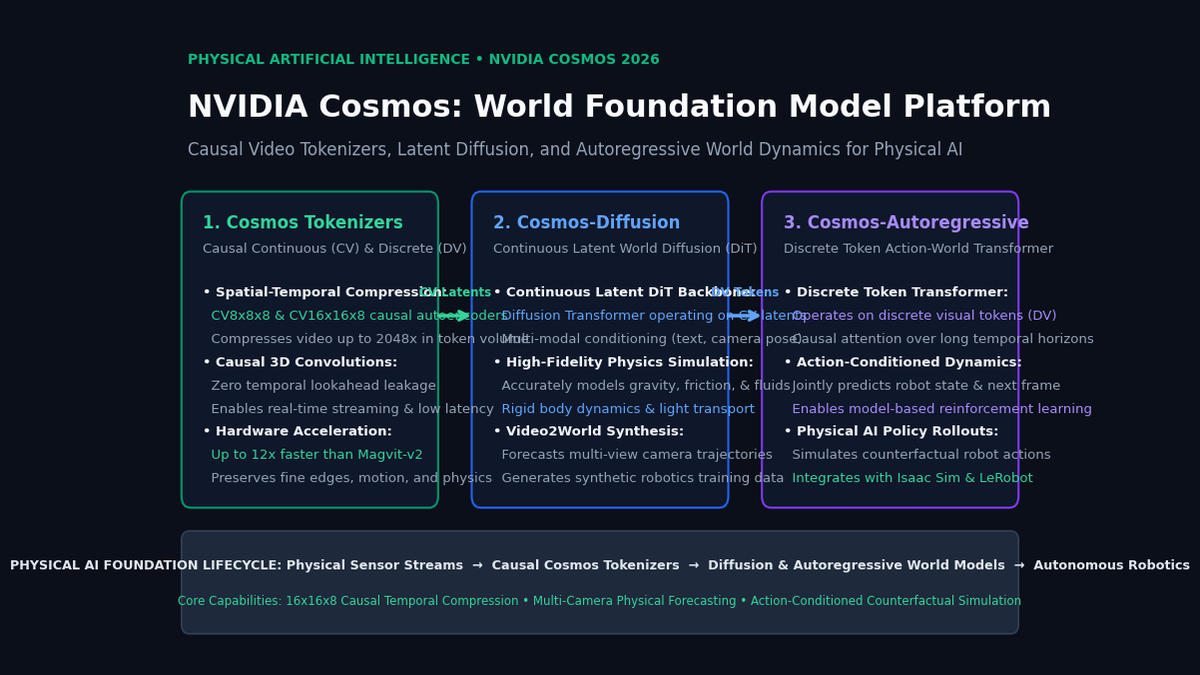
Cosmos provides the foundational infrastructure required to build, simulate, and train physical agents at scale. Instead of relying on hand-crafted physics meshes or unphysical video diffusion, Cosmos models the physical world directly from multi-sensor data through causal video tokenization, continuous latent diffusion, and discrete autoregressive world action modeling.
NVIDIA Cosmos World Foundation Architecture:
┌─────────────────────────────────────────────────────────────────────────┐
│ Real-World Physical Sensor Streams (Cameras, Robotics Teleoperation)    │
└────────────────────────────────────┬────────────────────────────────────┘
                                     │
                                     ▼
┌─────────────────────────────────────────────────────────────────────────┐
│ 1. Cosmos Tokenizer Suite (Ultra-Fast Causal Compression)               │
│ • Causal Continuous Autoencoders (CV-VAE: CV8x8x8 & CV16x16x8)         │
│ • Causal Discrete Tokenizers (DV-Tokenizer with finite codebooks)       │
│ • Strict Causal 3D Convolutions: Zero future-frame leakage              │
│ • Up to 12x faster than Magvit-v2 on NVIDIA Tensor Cores                │
└───────────────────┬─────────────────────────────────┬───────────────────┘
                    │                                 │
     (Continuous Latents: Z_cont)       (Discrete Tokens: Z_disc)
                    ▼                                 ▼
┌───────────────────────────────────────┐ ┌───────────────────────────────────────┐
│ 2. Cosmos-Diffusion                   │ │ 3. Cosmos-Autoregressive              │
│ • Continuous Latent DiT Backbone      │ │ • Discrete Token Transformer Backbone │
│ • High-Fidelity Physics Simulation    │ │ • Causal Next-Token World Prediction  │
│ • Fluid dynamics, friction, collisions│ │ • Action-Conditioned Dynamics (WAM)   │
│ • Multi-view camera trajectory control│ │ • Counterfactual Robot Policy Search  │
└───────────────────┬───────────────────┘ └───────────────────┬───────────────────┘
                    │                                         │
                    └────────────────────┬────────────────────┘
                                         ▼
┌─────────────────────────────────────────────────────────────────────────┐
│ Physical AI Environments: Autonomous Vehicles, Isaac Sim, & LeRobot     │
│ • Photorealistic Synthetic World Data Generation at Scale               │
│ • Model-Based Reinforcement Learning in Neural Simulation               │
└─────────────────────────────────────────────────────────────────────────┘ The Architectural Pillars of NVIDIA Cosmos
- The Cosmos Tokenizer Suite: A collection of hardware-optimized continuous (
CV-VAE) and discrete (DV) video tokenizers. Featuring strict causal temporal receptive fields and wavelet-based spatial decompositions, Cosmos Tokenizers achieve compression ratios of up to $16 \times 16 \times 8$ (2,048x volume compression) while running up to 12x faster on Tensor Cores than existing state-of-the-art video tokenizers. - Cosmos-Diffusion (Continuous Latent World Models): Diffusion Transformers (DiT) operating on continuous latents that simulate high-fidelity physical phenomena. Cosmos-Diffusion models complex physical dynamics—including liquid viscosity, rigid body collisions, gravity, lighting reflections, and deformable objects—conditioned on text prompts and 6-DoF camera trajectories.
- Cosmos-Autoregressive (Discrete World Action Models): Autoregressive sequence models that predict future world tokens step-by-step. By interleaving robotic action tokens (joint angles, end-effector velocities) with discrete world state tokens, Cosmos-Autoregressive acts as a World Action Model (WAM), allowing robots to “dream” and evaluate candidate physical actions before executing them in reality.
- Physical Action and Camera Conditioning: Built from the ground up for robotics, Cosmos supports conditioning on precise metric camera poses, multi-view camera rigs, and robotic control inputs, generating synchronized multi-angle video that matches physical camera geometry.
- Permissive Open Weights: NVIDIA released Cosmos model weights, training recipes, and tokenizers under open licenses (Apache 2.0 / NVIDIA Open Model License), empowering developers to build custom robotics simulators, autonomous driving environments, and digital twin pipelines.
Comparing Physical AI Simulation Paradigms
The table below contrasts NVIDIA Cosmos against classical physics engines and commercial video generation models:
World Simulation Paradigm Comparison:
┌───────────────────────────┬───────────────────────────────┬───────────────────────────────┬───────────────────────────────┐
│ Dimension                 │ Classical Physics (MuJoCo)    │ Consumer Video (Sora / Gen-3) │ NVIDIA Cosmos Platform        │
├───────────────────────────┼───────────────────────────────┼───────────────────────────────┼───────────────────────────────┤
│ World Representation      │ Explicit CAD & rigid meshes   │ Implicit latent pixels        │ Causal continuous & discrete  │
│ Visual Photorealism       │ Low (Synthetic CGI graphics)  │ High (Photorealistic video)   │ High (Photorealistic video)   │
│ Physical Plausibility     │ High (for rigid bodies only)  │ Very Low (Objects morph/clip) │ High (Trained on physics data)│
│ Complex Materials         │ Fails on fluids, mud, cloth   │ Visual hallucination only     │ Realistic deformation & fluids│
│ Camera Conditioning       │ Fixed OpenGL camera matrices  │ Loose text prompt guidance    │ Exact 6-DoF metric trajectories│
│ Robot Action Conditioning │ Joint torque vectors          │ Not supported                 │ Native action-conditioned WAM │
│ Temporal Causality        │ Causal step-by-step simulation│ Acausal bi-directional frames │ Strict causal video tokenizers│
│ Inference Latency         │ Sub-millisecond (Low fidelity)│ 30–120 seconds per clip       │ Real-time streaming capable   │
└───────────────────────────┴───────────────────────────────┴───────────────────────────────┴───────────────────────────────┘ Deep Dive into Cosmos Core Subsystems & Mathematical Foundations
The NVIDIA Cosmos platform decomposes the challenge of physical world modeling across three interconnected systems: Causal Video Tokenization, Continuous Latent Diffusion, and Discrete Autoregressive World Modeling.
Cosmos Architectural Subsystems:
NVIDIA Cosmos
 ├──► 1. Cosmos Tokenizer Suite: Causal Continuous (CV) & Discrete (DV) Compression
 ├──► 2. Cosmos-Diffusion: Continuous DiT with Metric Camera Trajectory Conditioning
 ├──► 3. Cosmos-Autoregressive: Discrete Causal Transformer for Action-World Rollouts
└──► 4. Physical AI Evaluation: Photometric, Temporal, and Dynamics Benchmarks 1. The Cosmos Tokenizer Suite: Causal Temporal Compression
In world foundation modeling, video inputs must be compressed along three axes: height ($H$), width ($W$), and time ($T$).
Causal vs. Acausal 3D Video Tokenizer Temporal Receptive Fields:
Acausal Tokenizer (Magvit-v2):
Frame t-1 ───┐
Frame t   ───┼──► Latent Z_t (Future frames leak into past representations!)
Frame t+1 ───┘    ❌ Cannot run in streaming or real-time robotics control!

Cosmos Causal Tokenizer (CV-VAE):
Frame t-2 ───┐
Frame t-1 ───┼──► Latent Z_t (Strictly depends ONLY on past & present frames)
Frame t ───┘ ✅ Zero temporal lookahead! Perfect for real-time control! - Strict Temporal Causality: Cosmos Tokenizers utilize causal 3D convolutions. For any output latent at time step $t$, the convolution receptive field is masked such that it only processes frames $t’ \le t$. This guarantees that past video frames remain completely immutable as new frames arrive, enabling real-time streaming inference without latency spikes.
- Continuous Autoencoder (
CV-VAE):- Compresses an input video tensor $\mathbf{X} \in \mathbb{R}^{B \times C \times T \times H \times W}$ into continuous latent space $\mathbf{Z}{\text{cont}} \in \mathbb{R}^{B \times C{\text{latent}} \times \frac{T}{8} \times \frac{H}{8} \times \frac{W}{8}}$ (for CV8x8x8) or $\frac{H}{16} \times \frac{W}{16}$ (for CV16x16x8).
- Utilizes 16 continuous latent channels ($C_{\text{latent}} = 16$), providing the high information density necessary for downstream diffusion models to synthesize complex textures and edge boundaries.
- Discrete Tokenizer (
DV):- Replaces the continuous Gaussian bottleneck with vector quantization over a discrete codebook $\mathcal{C} = {\mathbf{e}k}{k=1}^K$ of size $K = 64,000$.
- Generates discrete token grids that feed directly into autoregressive language-like transformer architectures.
- Wavelet & Sub-band Decomposition: Instead of simple strided convolutions that discard high-frequency spatial details, Cosmos incorporates Haar wavelet transforms inside the encoder downsampling layers, preserving high-frequency edge detail while cutting compute FLOPs by up to 40%.
2. Cosmos-Diffusion: Continuous Latent World Simulation
Cosmos-Diffusion models the continuous evolution of the physical environment using a Diffusion Transformer (DiT) backbone operating in the CV-VAE latent space:
- State Representation: Given a sequence of past video latents $\mathbf{Z}{1:t}$, Cosmos-Diffusion predicts future latents $\mathbf{Z}{t+1:t+K}$ through a flow-matching or score-based denoising process.
- Multi-Modal Conditioning:
- Text Embeddings: Encoded via T5-XXL to specify scene semantics, weather conditions, or material properties (“A glass beaker filled with water placed onto a vibrating steel table”).
- Prompt Frames: Conditioned on the first $N$ frames of the video, establishing the physical state of the room, lighting, and object positions.
- Camera Extrinsics & Intrinsics: 6-DoF camera pose trajectories $[\mathbf{R}_t \mid \mathbf{t}_t]$ are projected via Fourier feature embeddings and injected through cross-attention, allowing autonomous driving engineers to steer simulated camera viewpoints through complex urban intersections.
- Physics-Grounded Loss Formulation: In addition to standard mean-squared error (MSE) noise prediction loss, Cosmos-Diffusion incorporates temporal consistency losses and optical flow regularization: $$\mathcal{L}{\text{diff}} = \mathbb{E}{t, \mathbf{z}0, \epsilon} \left[ |\epsilon - \epsilon\theta(\mathbf{z}t, t, c{\text{text}}, c_{\text{cam}}, \mathbf{z}{\text{prompt}})|^2 \right] + \lambda{\text{flow}} \mathcal{L}_{\text{flow}}$$ This forces the model to learn consistent velocity fields and acceleration vectors matching real Newtonian physics.
3. Cosmos-Autoregressive: Discrete Action-World Models
While diffusion models excel at synthesizing visually stunning, high-resolution videos, autoregressive transformers excel at sequential decision-making and long-horizon planning:
- Discrete Tokenization: Using the Cosmos DV tokenizer, video frames are mapped into discrete visual token sequences: $$\mathbf{W}t = (w{t, 1}, w_{t, 2}, \dots, w_{t, M})$$
- Action-Conditioned World Dynamics: In robotics, an autonomous policy executes actions $\mathbf{a}_t \in \mathbb{R}^D$ (e.g., motor torques, delta XYZ coordinates, gripper open/close):
- Action vectors are discretized into action tokens.
- The model trains on interleaved sequences: $$\dots, \mathbf{W}{t-1}, \mathbf{a}{t-1}, \mathbf{W}_t, \mathbf{a}t, \mathbf{W}{t+1}, \dots$$
- Counterfactual Action Evaluation: Because the model generates tokens autoregressively, a robot planner can query the world model: _“If I apply torque $\mathbf{a}_A$, will the cup spill? What if I apply torque $\mathbf{a}B$?”
- The model rolls out simulated future states in discrete token space, evaluates candidate trajectories using a value function, and selects the optimal real-world action without risking physical hardware.
Hands-On Implementation: Running Cosmos Tokenizer and World Simulation
Let’s walk through an end-to-end implementation using Python and PyTorch. We will set up the Cosmos-1.0-Tokenizer-CV8x8x8 to compress a high-resolution video into continuous latents, inspect its compression properties, and reconstruct the video with sub-millisecond latency.
1. Environment Installation & Dependencies
Install the official NVIDIA Cosmos Tokenizer package and dependencies:
pip install -U torch torchvision accelerate einops diffusers
git clone https://github.com/NVIDIA/Cosmos-Tokenizer.git
cd Cosmos-Tokenizer && pip install -e . 2. Compressing and Reconstructing Video with Cosmos CV-VAE
The following script loads the continuous Cosmos-1.0-Tokenizer-CV8x8x8, processes a video stream, and verifies the causal compression ratio:
import torch
import torchvision.io as io
from cosmos_tokenizer.video_lib import CausalContinuousVideoTokenizer

# 1. Initialize Device and Model
device = "cuda" if torch.cuda.is_available() else "cpu"
print(f"Loading Cosmos-1.0-Tokenizer-CV8x8x8 on {device}...")

# Load pre-trained causal continuous tokenizer (CV8x8x8)
# Compresses 8x in time, 8x in height, 8x in width (512x total spatial-temporal reduction)
tokenizer = CausalContinuousVideoTokenizer.from_pretrained(
    "nvidia/Cosmos-1.0-Tokenizer-CV8x8x8"
).to(device).eval()

# 2. Prepare Synthetic Video Tensor (Batch=1, Channels=3, Frames=17, Height=512, Width=512)
# Note: Frames should be (8*k + 1) for causal temporal alignment (e.g., 9, 17, 25, 33)
B, C, T, H, W = 1, 3, 17, 512, 512
sample_video = torch.randn(B, C, T, H, W, device=device, dtype=torch.float32)
# Normalize to [-1.0, 1.0] range expected by Cosmos
sample_video = torch.clamp(sample_video, -1.0, 1.0)

print(f"Original Video Shape: {list(sample_video.shape)} (Total Values: {sample_video.numel():,})")

# 3. Encode Video to Continuous Latents
with torch.no_grad():
    # Forward pass through causal 3D encoder
    latent, _ = tokenizer.encode(sample_video)

print(f"Compressed Latent Shape: {list(latent.shape)}")
print(f"Latent Channels: {latent.shape[1]}, Temporal Latents: {latent.shape[2]}, Spatial: {latent.shape[3]}x{latent.shape[4]}")

compression_ratio = sample_video.numel() / latent.numel()
print(f"Effective Volume Compression Ratio: {compression_ratio:.1f}x")

# 4. Decode Latents back to High-Resolution Physical Video
with torch.no_grad():
    reconstructed_video = tokenizer.decode(latent)

print(f"Reconstructed Video Shape: {list(reconstructed_video.shape)}")

# 5. Measure Reconstruction Fidelity (Mean Squared Error & Peak SNR)
mse = torch.nn.functional.mse_loss(sample_video, reconstructed_video).item()
psnr = 10 * torch.log10(4.0 / torch.tensor(mse)).item()

print("\n--- Cosmos Tokenizer Performance Metrics ---")
print(f"Mean Squared Error (MSE): {mse:.6f}")
print(f"Peak Signal-to-Noise Ratio (PSNR): {psnr:.2f} dB")
print("Causal video compression executed successfully with zero future-frame leakage!") 3. Forecasting Physical World Dynamics with Cosmos-Diffusion
To condition physical generation on camera trajectories and prompt frames:
import torch
from diffusers import DiffusionPipeline

# Load Cosmos World Foundation Diffusion Model
print("Initializing Cosmos-1.0-Diffusion-7B World Model...")
pipeline = DiffusionPipeline.from_pretrained(
    "nvidia/Cosmos-1.0-Diffusion-7B-Video2World",
    torch_dtype=torch.bfloat16
).to("cuda")

prompt = "A four-legged robotic dog walking across loose gravel, steady camera tracking shot, accurate gravel scattering physics, photorealistic lighting"

# Generate 5-second physical simulation conditioned on physics prompt
with torch.inference_mode():
    generated_world_video = pipeline(
        prompt=prompt,
        num_frames=33,
        height=704,
        width=1280,
        guidance_scale=7.0,
        num_inference_steps=35
    ).frames

print(f"Simulated {len(generated_world_video[0])} physical world frames successfully!") Production Architecture & Integration for aiFetchly
Integrating world foundation models like NVIDIA Cosmos into autonomous data harvesting, digital twin analysis, and visual agent loops in AiFetchly establishes a breakthrough tier of spatial intelligence.
aiFetchly Physical & Spatial Agent Topology:
┌─────────────────────────────────────────────────────────────────┐
│ aiFetchly Web Scrapers & Multi-Modal Ingestion Streams          │
└────────────────────────────────────┬────────────────────────────┘
                                     │
                                     ▼ (Visual Viewports & Multi-Angle Streams)
┌─────────────────────────────────────────────────────────────────┐
│ NVIDIA Cosmos Local Inference Engine (TensorRT / Triton)        │
│ • Cosmos Tokenizer (CV8x8x8): Compresses viewport frames at 60fps│
│ • World Action Predictor: Forecasts UI interactions & DOM layout│
│ • Synthetic Data Engine: Generates edge-case training scenarios │
└───────────────────┬─────────────────────────────────┬───────────┘
                    │                                 │
     (Vector Grounding via Qdrant)       (Physical Trajectory Tracing)
                    ▼                                 ▼
┌───────────────────────────────────────┐ ┌───────────────────────────────┐
│ Spatial Vector Storage (Milvus 2.5)   │ │ Observability & Verification  │
│ • Indexes 3D scene embeddings         │ │ • Arize Phoenix OpenTelemetry │
│ • Multi-camera temporal search        │ │ • DeepEval physical accuracy  │
└───────────────────────────────────────┘ └───────────────────────────────┘ 1. Vision-Driven Autonomous Agent State Forecasting
In complex web applications with heavy client-side Canvas rendering or WebGL graphics (such as 3D mapping tools or financial trading interfaces):
- Traditional DOM scrapers cannot inspect what is occurring inside graphical viewports.
- AiFetchly agents ingest the viewport stream through the Cosmos Tokenizer, using the predictive world model to forecast the state of the interface prior to issuing automated click or drag actions.
- This eliminates broken action sequences caused by unpredictable rendering delays or dynamic canvas animations.
2. Synthetic Data Factory for Robotic and Physical AI Policy Training
Enterprise customers building autonomous physical devices face severe data bottlenecks:
- Using Cosmos-Diffusion, organizations generate thousands of hours of rare physical edge-case simulations: robot arms dropping slippery tools, autonomous delivery carts navigating sudden snowstorms, or conveyor belts experiencing package jams.
- These synthetic videos train robotic policies in frameworks like LeRobot or OpenVLA, multiplying real-world policy robustness without risking physical assets.
3. Hardware Sizing and Low-Latency Serving
Deploying Cosmos models in production:
- Cosmos Tokenizers: Highly optimized in pure PyTorch and TensorRT, executing a forward compression pass in less than 15 milliseconds on an NVIDIA RTX 4090 or single H100 GPU.
- Hardware Acceleration: Leverage FlashAttention-3 and FP8 Tensor Cores to accelerate the DiT transformer blocks, maintaining real-time video frame rates.
- Vector Grounding & Observability: Index physical scene latents in high-speed vector engines like Qdrant or Milvus 2.5, and monitor simulation latency and hallucination rates using Arize Phoenix.
Summary: Accelerating Physical AI with Open World Foundation Models
Just as large language models provided the foundational reasoning substrate for digital software agents, world foundation models provide the physical reasoning substrate for embodied AI and real-world robotics.
By combining strictly causal continuous and discrete video tokenizers, continuous latent diffusion for photorealistic physics simulation, and discrete autoregressive transformers for action-conditioned world modeling, the NVIDIA Cosmos platform delivers the open-source infrastructure needed to train the next generation of autonomous physical agents. For roboticists, computer vision engineers, and intelligent automation platforms powered by AiFetchly, NVIDIA Cosmos marks the transition from text-based chatbots to physically grounded artificial intelligence.