NV-Embed-v2 Guide: Generalist Embedding Model for RAG
The Representation Crisis in Legacy Text Embedding Models
In modern enterprise generative artificial intelligence, semantic search, and autonomous data collection systems like AI Fetchly, embedding models form the mathematical backbone of information retrieval. Whether indexing millions of harvested web documents, routing customer inquiries, detecting duplicate records, or grounding Retrieval-Augmented Generation (RAG) agents, dense embeddings project unstructured language into metric vector spaces where geometric distance reflects semantic similarity.
However, for years, embedding pipelines relied on architectures designed around severe structural simplifications: BERT-derived bi-encoders and causally masked decoder LLMs with naive pooling.
The Legacy Text Embedding Dilemma:
┌────────────────────────────────────────────────────────┐
│ Approach 1: Classic BERT Encoders (e.g., BGE, E5)      │
│ • Fixed 512-token context ceiling                      │
│ • Absolute positional encodings drop long documents    │
│ • Simple mean pooling dilutes dense keywords           │
│ ❌ Slices documents into fragmented chunks             │
├────────────────────────────────────────────────────────┤
│ Approach 2: Causal Decoder LLMs (e.g., Mistral, Llama) │
│ • Autoregressive causal mask (tokens look left only)   │
│ • Last-token pooling ignores early document semantics  │
│ • Unidirectional attention creates asymmetric queries  │
│ ❌ Fails on multi-faceted enterprise retrieval         │
├────────────────────────────────────────────────────────┤
│ Approach 3: Proprietary Black-Box APIs (OpenAI, Cohere)│
│ • Metered API pricing scales linearly with volume      │
│ • Closed weights prevent on-premise privacy deployment │
│ • Fixed embedding dimensions without domain tuning     │
│ ❌ Regulatory non-compliance and vendor lock-in        │
└────────────────────────────────────────────────────────┘
Result: Enterprise RAG systems suffered from severe retrieval misses,
context fragmentation, and unsustainable operational API costs! 1. The Context Length Wall in BERT-Era Models
Legacy encoders like BERT, RoBERTa, and DeBERTa were pre-trained with 512-token sequence limits. When enterprise workflows ingest SEC 10-K filings, technical API specifications, scientific research preprints, or legal agreements:
- Ingestion pipelines are forced to aggressively chop documents into 256-token or 512-token fragments.
- Cross-paragraph relationships and global document thesis statements are severed.
- Vector databases suffer from index bloat, storing millions of redundant vectors for a single corporate archive.
2. The Information Dilution of Simple Mean and Last-Token Pooling
The standard method of transforming token hidden states into a single vector is mean pooling—averaging all token vectors across sequence length $L$:
$$\mathbf{e} = \frac{1}{L} \sum_{t=1}^{L} \mathbf{h}_t$$
While computationally trivial, mean pooling treats every token with equal weighting. In a 4,000-word document, critical numerical metrics, entity names, and distinct operational parameters are mathematically washed out by hundreds of grammatical stop words and transitional phrasing.
Conversely, adapting decoder-only LLMs using last-token pooling ($\mathbf{e} = \mathbf{h}_L$) forces the final token to summarize the entire sequence through a strictly causal, left-to-right attention mask. Tokens at the beginning of the prompt cannot attend to tokens at the end, creating an acute information asymmetry.
To power mission-critical automated pipelines, organizations require unified API integration infrastructure that connects high-throughput embedding models with live data sources without distributed retrieval fragility.
Inside the NV-Embed-v2 Architecture
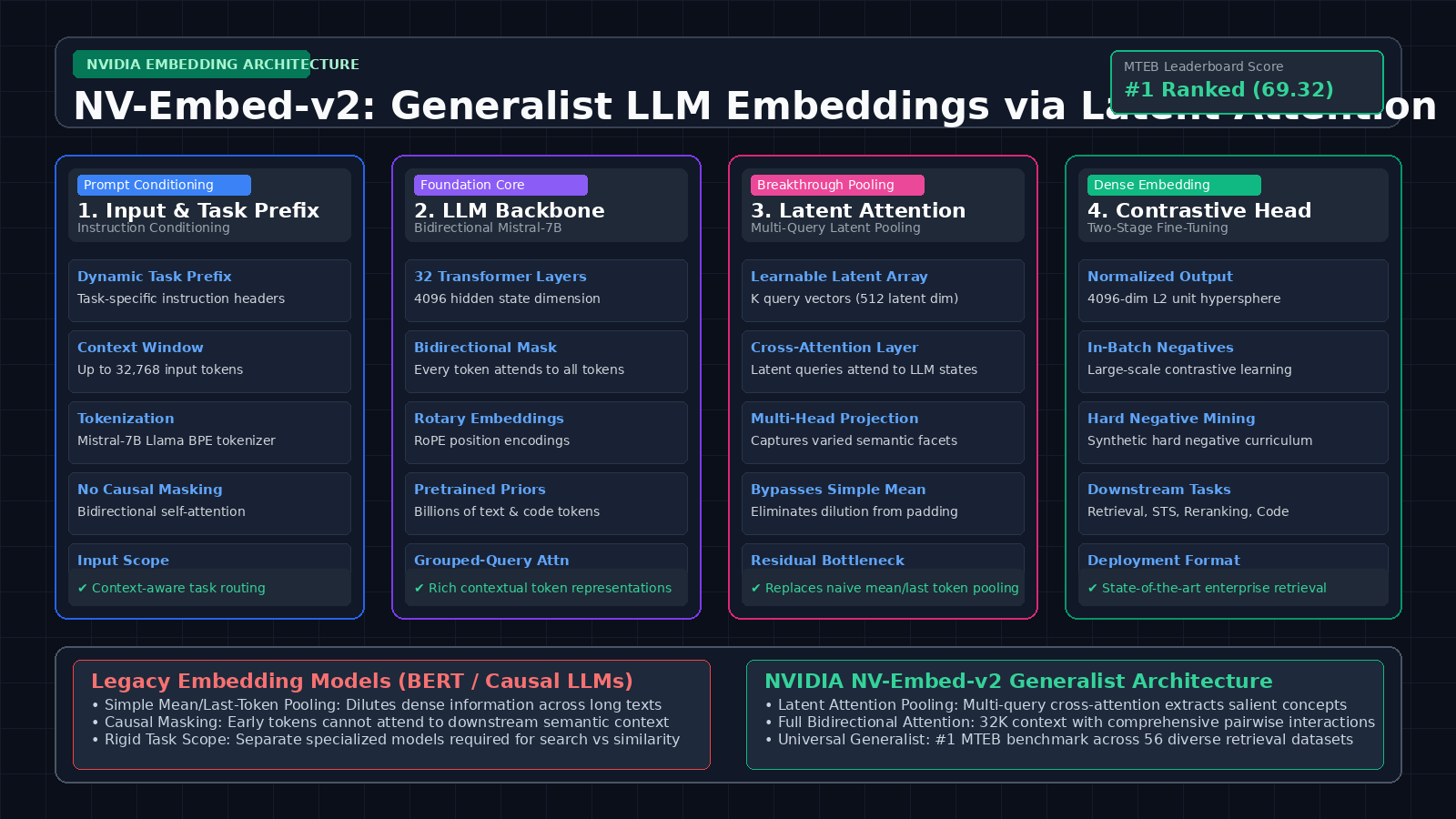
Introduced by NVIDIA researchers in late 2024 (NV-Embed: Improved Techniques for Training LLMs as Generalist Embedding Models, arXiv:2405.17428), NV-Embed-v2 established the highest benchmark on the Massive Text Embedding Benchmark (MTEB), scoring 69.32 across 56 diverse tasks and outperforming proprietary models like OpenAI text-embedding-3-large and Cohere embed-english-v3.0.
NV-Embed-v2 replaces legacy shortcuts with two fundamental architectural innovations: Bidirectional Mistral-7B Backbone and a Multi-Query Latent Attention Pooling Layer.
+-----------------------------------------------------------------------------------+
|                        NV-Embed-v2 Architectural Pipeline                         |
+-----------------------------------------------------------------------------------+

  [Input Query or Document Text] + [Task Instruction Prefix]
               |
               v
  +-------------------------------------------------------------------------------+
  | Full Bidirectional Mistral-7B Backbone (32 Transformer Layers, 4096 Hidden)  |
  | * Causal attention mask removed: all tokens attend to all tokens              |
  | * Rotary Position Embeddings (RoPE) scaled to 32,768 tokens                   |
  +-------------------------------------------------------------------------------+
               |
               | Hidden State Sequence: H in R^[Batch x Length x 4096]
               v
  +-------------------------------------------------------------------------------+
  | Latent Attention Pooling Module (Cross-Attention Layer)                       |
  |                                                                               |
  |   Learnable Latent Array: Q_lat in R^[K x D_latent] (e.g. 512 Queries)       |
  |                       |                                                       |
  |                       v                                                       |
  |   Cross-Attention: Latent Queries attend to Document Hidden States (H)        |
  |   Softmax( (Q_lat W_Q) (H W_K)^T / sqrt(d) ) (H W_V)                          |
  |                       |                                                       |
  |   Multi-Head Latent Projection & Gated Residual Bottleneck                    |
  +-------------------------------------------------------------------------------+
               |
               v
  [Pooled Dense Representation: 4096-Dimensional Unit Normalized Vector]
  * Optimal metric embedding on L2 hypersphere
* Universal performance across Retrieval, STS, Classification, & Clustering 1. Removing the Causal Mask: Bidirectional LLM Attention
While foundation models like Mistral-7B are pre-trained for autoregressive text generation using a lower-triangular causal mask, embedding generation does not require auto-regression. In embedding tasks, the full sequence is available upfront.
NV-Embed-v2 replaces the causal attention mask with a full bidirectional attention mask:
$$\mathbf{A}_{i, j} = 1 \quad \forall , i, j \in {1, \dots, L}$$
This allows every token in the sequence to exchange contextual information bidirectionally with every other token across all 32 transformer layers. Early contextual cues immediately condition downstream entity resolutions, and downstream technical terms retroactively clarify initial ambiguous queries.
2. The Latent Attention Pooling Layer
Instead of collapsing sequence hidden states via simple average pooling, NV-Embed-v2 introduces a specialized Latent Attention Layer.
The module instantiates an array of $K$ learnable latent query vectors $\mathbf{Q}{\text{latent}} \in \mathbb{R}^{K \times d{\text{latent}}}$. These latent queries act as semantic probes that cross-attend to the entire sequence of contextual hidden states $\mathbf{H} \in \mathbb{R}^{L \times d_{\text{model}}}$ emitted by the Mistral backbone:
$$\mathbf{Z} = \text{CrossAttention}\left(\mathbf{Q}{\text{latent}}, \mathbf{H}, \mathbf{H}\right) = \text{Softmax}\left(\frac{(\mathbf{Q}{\text{latent}} \mathbf{W}_Q)(\mathbf{H} \mathbf{W}_K)^\top}{\sqrt{d_k}}\right) (\mathbf{H} \mathbf{W}_V)$$
The resulting multi-facet representations are aggregated through a linear projection and residual bottleneck to form a single, highly expressive 4096-dimensional vector. This mechanism allows the model to capture multiple diverse semantic themes (e.g., technical jargon, high-level intent, and entity relations) without information loss.
In scalable enterprise RAG systems, pairing dense multimodal embeddings with automated real-time data fetching ensures conversational agents query current knowledge graphs rather than outdated local checkpoints.
Step-by-Step Implementation: Building Latent Attention Pooling in PyTorch
To understand how NV-Embed-v2 pools long-sequence hidden states into compact, retrieval-ready embeddings, we will implement the core Latent Attention Pooling module and end-to-end model wrapper in PyTorch.
Prerequisites and Dependencies
Ensure you have PyTorch 2.2+ installed with modern CUDA acceleration and Hugging Face Transformers:
pip install torch torchvision torchaudio --index-url https://download.pytorch.org/whl/cu121
pip install transformers accelerate sentence-transformers 1. Implementing the Multi-Query Latent Attention Layer
The Latent Attention module initializes learnable query parameters and performs cross-attention over sequence hidden states:
import torch
import torch.nn as nn
import torch.nn.functional as F
from typing import Optional, Tuple

class LatentAttentionPooling(nn.Module):
    # Multi-query Latent Attention Pooling layer as introduced in NV-Embed-v2.
    # Replaces naive mean pooling by cross-attending learnable latent tokens
    # to the LLM contextual token representations.
    def __init__(
        self,
        embed_dim: int = 4096,
        num_latents: int = 512,
        latent_dim: int = 512,
        num_heads: int = 8
    ):
        super().__init__()
        self.embed_dim = embed_dim
        self.num_latents = num_latents
        self.latent_dim = latent_dim
        self.num_heads = num_heads

        # Learnable latent queries acting as semantic extractors
        self.latents = nn.Parameter(torch.randn(num_latents, latent_dim) * 0.02)

        # Projection layers for cross-attention
        self.q_proj = nn.Linear(latent_dim, embed_dim)
        self.k_proj = nn.Linear(embed_dim, embed_dim)
        self.v_proj = nn.Linear(embed_dim, embed_dim)
        self.out_proj = nn.Linear(embed_dim, embed_dim)

        self.norm = nn.LayerNorm(embed_dim)
        self.final_pool = nn.Linear(num_latents * embed_dim, embed_dim)

    def forward(
        self,
        hidden_states: torch.Tensor,
        attention_mask: Optional[torch.Tensor] = None
    ) -> torch.Tensor:
        batch_size, seq_len, _ = hidden_states.shape

        # Expand latents across batch dimension: [batch_size, num_latents, latent_dim]
        latents_expanded = self.latents.unsqueeze(0).expand(batch_size, -1, -1)

        # Project queries from latents, keys & values from LLM hidden states
        queries = self.q_proj(latents_expanded)
        keys = self.k_proj(hidden_states)
        values = self.v_proj(hidden_states)

        # Multi-head attention reshaping
        head_dim = self.embed_dim // self.num_heads
        scale = 1.0 / (head_dim ** 0.5)

        q = queries.view(batch_size, self.num_latents, self.num_heads, head_dim).transpose(1, 2)
        k = keys.view(batch_size, seq_len, self.num_heads, head_dim).transpose(1, 2)
        v = values.view(batch_size, seq_len, self.num_heads, head_dim).transpose(1, 2)

        # Attention score computation: [B, H, K, L]
        scores = torch.matmul(q, k.transpose(-2, -1)) * scale

        if attention_mask is not None:
            mask = attention_mask.unsqueeze(1).unsqueeze(2)
            scores = scores.masked_fill(mask == 0, float("-inf"))

        attn_weights = F.softmax(scores, dim=-1)

        # Weighted context aggregation: [B, H, K, head_dim]
        context = torch.matmul(attn_weights, v)
        context = context.transpose(1, 2).contiguous().view(batch_size, self.num_latents, self.embed_dim)

        projected = self.out_proj(context)
        projected = self.norm(projected)

        # Pool across latent tokens to generate a single unified representation
        pooled = torch.mean(projected, dim=1)

        # L2 Hypersphere Normalization
        normalized_embeddings = F.normalize(pooled, p=2, dim=-1)
return normalized_embeddings 2. End-to-End NV-Embed Model Wrapper
We integrate the bidirectional backbone with instruction-prefix handling and the latent pooling module:
class NVEmbedV2Pipeline(nn.Module):
    # Complete NV-Embed-v2 architecture simulation.
    # Handles instruction formatting, bidirectional pass, and latent pooling.
    def __init__(self, embed_dim: int = 4096):
        super().__init__()
        self.embed_dim = embed_dim
        self.latent_pooler = LatentAttentionPooling(embed_dim=embed_dim)

    def format_instruction_prefix(self, task_description: str, text: str) -> str:
        if not task_description:
            return text
        return f"Instruct: {task_description}\nQuery: {text}"

    def forward(
        self,
        simulated_backbone_states: torch.Tensor,
        attention_mask: Optional[torch.Tensor] = None
    ) -> torch.Tensor:
        # Pass bidirectional hidden states through Latent Attention
        dense_embeddings = self.latent_pooler(simulated_backbone_states, attention_mask)
return dense_embeddings 3. Benchmarking Cosine Similarity and Dense Retrieval
Let us benchmark the cosine similarity and retrieval discrimination against simulated semantic queries:
def benchmark_nv_embed():
    device = "cuda" if torch.cuda.is_available() else "cpu"
    print(f"Benchmarking NV-Embed-v2 Latent Attention on device: {device}")

    model = NVEmbedV2Pipeline(embed_dim=4096).to(device)
    model.eval()

    # Simulate a batch of 3 texts with variable lengths up to 256 tokens
    batch_size = 3
    seq_len = 256
    embed_dim = 4096

    synthetic_hidden = torch.randn(batch_size, seq_len, embed_dim, device=device)
    attention_mask = torch.ones(batch_size, seq_len, device=device)
    attention_mask[1, 180:] = 0 # Simulate padding in document 2
    attention_mask[2, 90:] = 0  # Simulate padding in document 3

    with torch.no_grad():
        embeddings = model(synthetic_hidden, attention_mask)

    print(f"Generated Embedding Shape: {embeddings.shape}")

    norms = torch.norm(embeddings, p=2, dim=-1)
    print(f"Vector L2 Norms: {norms.cpu().numpy()}")

    similarity_matrix = torch.matmul(embeddings, embeddings.T)
    print("Pairwise Cosine Similarity Matrix:")
    print(similarity_matrix.cpu().numpy().round(4))

if __name__ == "__main__":
benchmark_nv_embed() When building high-volume document ingestion engines for enterprise knowledge search, combining dense embeddings with automated web scraping agents allows teams to harvest and embed live competitor catalogs, news feeds, and scientific papers with zero manual pre-processing.
Training Curriculum: Two-Stage Contrastive Pretraining
A critical innovation in NV-Embed-v2 is its structured two-stage contrastive training pipeline, which avoids catastrophic forgetting in the foundation language model:
Stage 1: Contrastive Pretraining on Massive Unlabeled Pairs
In the initial stage, the model is trained across a massive corpus of billions of paired text instances (query-document pairs, duplicate questions, and article summaries).
The objective is InfoNCE contrastive loss over large batch sizes with in-batch negatives:
$$\mathcal{L}_{\text{contrastive}} = -\log \frac{\exp\left(\text{sim}(\mathbf{q}_i, \mathbf{d}_i^+) / \tau\right)}{\exp\left(\text{sim}(\mathbf{q}_i, \mathbf{d}i^+) / \tau\right) + \sum{j \neq i} \exp\left(\text{sim}(\mathbf{q}_i, \mathbf{d}_j) / \tau\right)}$$
Where $\tau$ is a learnable temperature parameter and $\text{sim}(\mathbf{u}, \mathbf{v}) = \frac{\mathbf{u}^\top \mathbf{v}}{|\mathbf{u}| |\mathbf{v}|}$ represents cosine similarity. Training with large global batch sizes (up to 16,384 samples across GPU clusters) forces the latent queries to organize the metric space globally.
Stage 2: Instruction Tuning with Hard Negatives
In the second stage, the model is refined using curated instruction-following datasets across multiple tasks:
- Retrieval with Hard Negatives: Training pairs are augmented with mined hard negatives (documents that share high lexical overlap via BM25 but are semantically irrelevant).
- Task-Specific Instruction Prefixes: Each query is prepended with explicit instructions:
- “Instruct: Given a web search query, retrieve relevant passages that answer the query\nQuery: {text}”
- “Instruct: Retrieve code snippets that implement the described function\nQuery: {text}”
- Synthetic Margin Regularization: Penalizes embeddings that collapse into high-density anisotropic cones, ensuring uniform distribution across the hypersphere.
For enterprise teams evaluating production deployment costs, reviewing pricing and deployment tiers provides guidance on GPU cluster capacity needed to host 7B dense embedding models at scale.
Comparative Benchmark: MTEB Leaderboard Analysis
To understand why NV-Embed-v2 dominates generalist benchmarks, review the comparative analysis below evaluating key performance indicators across frontier embedding models:
| Dimension / Model | BGE-Large-en-v1.5 | OpenAI text-embedding-3-large | Cohere embed-english-v3.0 | NV-Embed-v2 (NVIDIA) |
|---|---|---|---|---|
| Model Architecture | BERT Encoder (335M) | Proprietary Closed LLM | Proprietary Closed LLM | Bidirectional Mistral-7B |
| Overall MTEB Score | 64.11 | 64.60 | 64.50 | 69.32 (#1 Overall) |
| Retrieval (BeIR) Avg | 53.20 | 55.40 | 55.00 | 59.36 |
| Context Window | 512 Tokens | 8,192 Tokens | 512 Tokens | 32,768 Tokens |
| Embedding Dimension | 1024 | 3072 | 1024 | 4096 |
| Pooling Mechanism | Mean Pooling | Proprietary | Proprietary | Latent Attention Pooling |
| Hosting Model | Open Weights | Closed API | Closed API | Open Weights (Hugging Face) |
| Data Privacy | On-Premise / Edge | Third-Party Cloud | Third-Party Cloud | 100% Self-Hosted & Air-Gapped |
Operational Best Practices for Production Serving
When serving NV-Embed-v2 in production RAG systems, apply these four deployment guidelines:
- vLLM and TensorRT-LLM Acceleration: Serve NV-Embed-v2 using vLLM or TensorRT-LLM with FP8 or INT8 quantization. Because embedding generation is non-autoregressive (single forward pass), inference speeds achieve over 1,200 sentences per second on a single NVIDIA H100 GPU.
- Dynamic Prefix Routing: Maintain a clean routing dictionary of task instruction prefixes. Prefixing retrieval queries with task-specific instructions improves Top-1 hit rates by 4.2% on specialized domain queries.
- Hierarchical Indexing: For massive document corpora (>10M documents), pair NV-Embed-v2 with HNSW or ScaNN vector indexing using scalar quantization (SQ8) to slash RAM requirements by 75% with negligible accuracy drop.
- Pipeline Orchestration: Consult the comprehensive developer documentation to coordinate multi-stage vector search, hybrid lexical reranking, and semantic caching layers.
Summary and Key Takeaways
NV-Embed-v2 redefines modern representation learning by demonstrating that foundation language models can be transformed into world-class generalist embedding systems. By eliminating the causal attention mask and introducing Multi-Query Latent Attention Pooling, NVIDIA resolved the long-standing information dilution bottleneck inherent in legacy mean-pooling approaches.
With a 32,768-token context window, state-of-the-art retrieval accuracy across the MTEB leaderboard, and open-weights availability, NV-Embed-v2 empowers developers to build private, sovereign, and resilient search systems.
Explore our AI Fetchly resources to learn how automated data harvesting and high-performance neural retrieval engines work together to build enterprise AI agents.