NeuReality NR1 Guide: AI Inference Server-on-a-Chip
The Hidden 50% Tax: Why Modern Host CPUs Starve AI Accelerators
Enterprise artificial intelligence infrastructure is undergoing a massive, structural transformation. As conversational foundation models, high-throughput visual perception systems, and multimodal agent loops scale across global datacenters, the primary computational operational expenditure has shifted decisively from offline pre-training to 24/7 online inference serving. Infrastructure engineering teams invest hundreds of millions of dollars acquiring cutting-edge deep learning accelerators—whether NVIDIA Hopper and Blackwell GPUs, Qualcomm Cloud AI 100 NPUs, AMD Instinct accelerators, or custom ASIC clusters. However, once racked, powered, and deployed under live production traffic, systems architects discover an alarming, counter-intuitive reality: the expensive AI accelerators sit idle between 40% and 65% of the time.
This pervasive underutilization is not caused by mathematical inefficiencies within the tensor cores, nor is it caused by deficiencies in the neural network architectures themselves. Instead, it is the direct consequence of a fundamental system-level mismatch: the classical x86 host central processing unit (CPU) architecture.
For over four decades, datacenter servers have been constructed around a CPU-centric paradigm. In a standard enterprise inference server, dual multi-core x86_64 host processors (such as Intel Xeon or AMD EPYC CPUs) serve as the mandatory operational bottleneck for every inbound and outbound network transaction. When client applications submit inference requests—whether an autonomous computer vision stream, a real-time speech transcription query, or an autoregressive token generation prompt—the host CPU must sequentially execute an extensive series of non-tensor orchestration tasks:
- Network Termination and Protocol Processing: The host CPU operating system kernel must terminate external TCP/IP connections, decrypt TLS cryptographic layers, parse HTTP/2 and gRPC application frames, and allocate user-space memory buffers.
- Payload Deserialization and Preprocessing: Incoming payload data—such as compressed JPEG/PNG images, H.264/H.265 video bitstreams, Opus audio packets, or JSON-encoded prompt strings—must be unmarshaled and transformed. The host CPU spends precious clock cycles decoding visual pixels, resizing and normalizing image dimensions, converting color spaces from YUV to planar RGB, converting audio frequencies, or tokenizing text into integer token arrays.
- Queue Scheduling and Kernel Dispatch: The host software runtime must format tensors into hardware-compatible layouts, bind memory buffers, submit launch descriptors across the PCIe bus to the attached accelerator, and synchronize completion events via software interrupts.
- Postprocessing and Network Serialization: Once the accelerator finishes its matrix multiplication pass, the raw logits must be transferred back across the PCIe bus into host memory. The CPU must then calculate softmax activations, execute top-k/top-p sampling, detokenize strings, serialize outgoing JSON/Protobuf responses, and transmit packets back onto the physical network interface card (NIC).
Under modest inference workloads, general-purpose server CPUs manage this pipeline with acceptable overhead. However, when serving thousands of concurrent users across modern 100Gbps or 200Gbps networks, the host CPU suffers from catastrophic operational saturation. Operating system context switches, cache thrashing, memory bus contention, and software interrupt handling consume massive CPU cycles. The host CPU becomes completely saturated trying to prepare and feed data, leaving the attached multi-teraflop AI accelerators starved for work.
To keep eight high-end AI accelerator cards fully saturated, server original equipment manufacturers (OEMs) have traditionally responded by packing increasingly hot, multi-thousand-dollar host CPUs into the chassis, accompanied by discrete high-speed NICs, PCIe retimers, and massive power supplies. Consequently, in a typical 8-way inference server, over 50% to 60% of the entire hardware bill of materials (BOM), chassis physical footprint, and thermal dissipation is consumed not by AI computation, but by the general-purpose CPU and its supporting infrastructure. This systemic architectural crisis is widely recognized across the semiconductor industry as the “CPU Tax.”
Introducing NeuReality NR1: The World’s First AI-CPU and NAPU
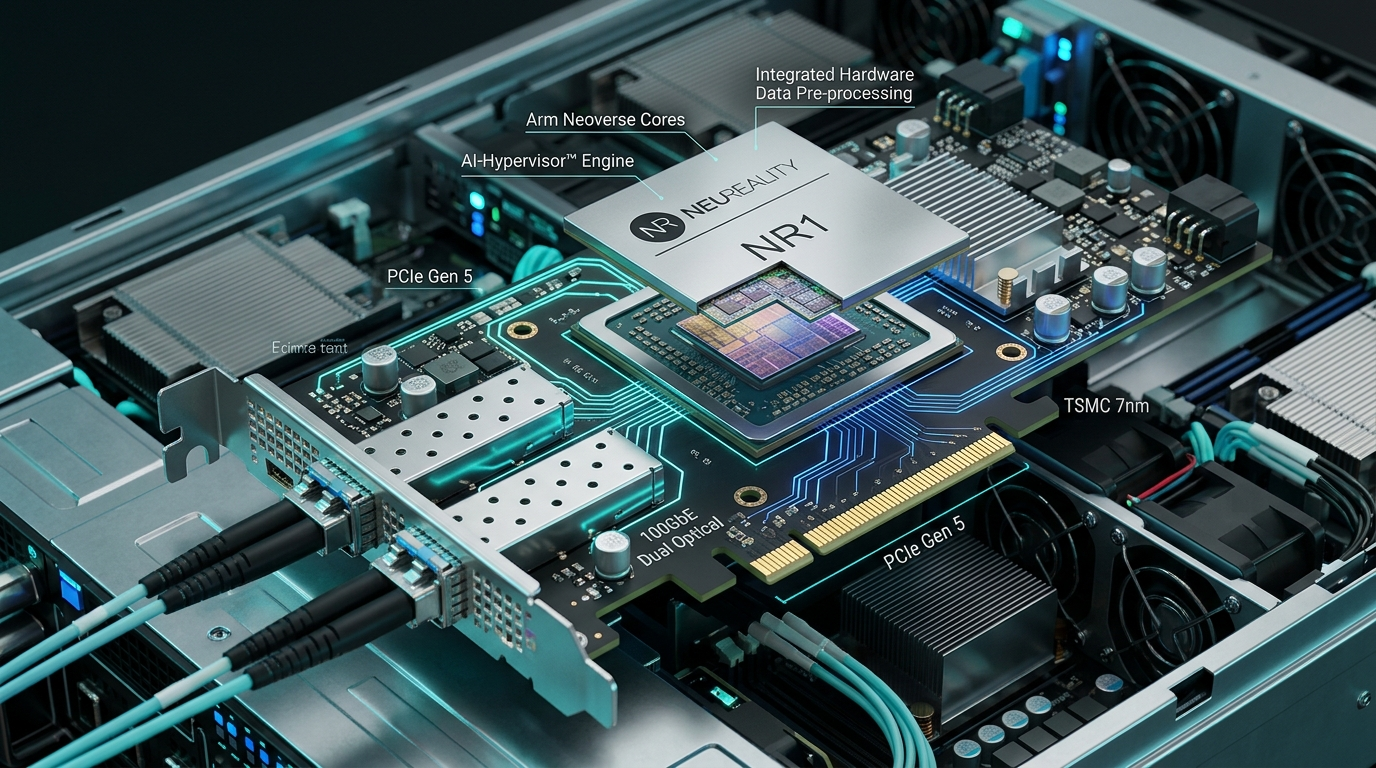
NeuReality breaks this decades-old computing paradigm with the introduction of the NR1™ AI-CPU—the industry’s first purpose-built Network Addressable Processing Unit (NAPU) and Server-on-a-Chip designed specifically for artificial intelligence inference serving. Engineered by semiconductor veterans from Intel, Marvell, and Cisco, the NR1 completely removes the classical x86 host server CPU from the AI inference critical path.
Instead of treating the AI accelerator as a passive peripheral card subordinate to an expensive host processor, NeuReality re-architects the entire server topology around the AI workload itself. The NR1 chip serves as an autonomous, network-attached head node that interfaces directly with external high-speed datacenter networks on one side, and attaches directly to heterogeneous AI accelerators (GPUs, NPUs, or ASICs) via native PCIe Gen 5 interfaces on the other.
Fabricated on TSMC’s proven 7nm FinFET process node, the NR1 integrates an entire server infrastructure onto a single monolithic die:
- Direct Network Ingestion: Dual 100GbE network interfaces with full hardware-accelerated RoCE v2 (RDMA over Converged Ethernet) and kernel-bypass TCP/IP termination engines stream data directly into on-chip memory without host software intervention.
- Hardware-Driven Data Preprocessing and Postprocessing: Dedicated hardware accelerators execute full-rate visual decoding (JPEG, PNG, H.264/H.265), pixel scaling, color format conversions, audio feature extraction, and text tokenization in fixed silicon pipelines at sub-microsecond latencies.
- Hardware AI Hypervisor and Sequencer: An autonomous hardware scheduling engine arbitrates inference request queues, allocates tensor memory buffers, and streams compute tasks directly into target accelerator execution pipelines, eliminating operating system context switches and interrupt overhead.
- Embedded Server-Class Arm Cores: Integrated energy-efficient Arm Neoverse cores handle high-level control-plane tasks, telemetry logging, and service discovery, replacing multi-hundred-watt x86 processors with lean, embedded management logic.
By offloading network termination, data preprocessing, queue management, and tensor dispatch entirely into specialized silicon, the NeuReality NR1 achieves a 10x improvement in system energy efficiency, reduces datacenter inference hardware costs by up to 15x, and elevates accelerator utilization from 35% to nearly 100%.
Enterprises connecting high-concurrency document processing and multimodal reasoning pipelines can integrate NR1-powered edge and cloud clusters with real-time data ingestion infrastructure to stream unstructured data directly from web and enterprise endpoints into native accelerator pipelines. By combining purpose-built network routing with specialized hardware data decoding, the NR1 enables organizations to scale foundation model serving without hitting datacenter power ceilings.
Architectural Deep Dive: The NR1 Network Addressable Processing Unit
The architectural genius of the NeuReality NR1 lies in its disaggregated, dataflow-oriented microarchitecture. To understand how the NR1 achieves orders-of-magnitude efficiency gains over conventional servers, we must analyze its four primary internal subsystems: the Network & Transport Engine, the Hardware Data Pre/Post-Processing Pipeline, the AI Hypervisor & Hardware Sequencer, and the PCIe Gen 5 Root Complex Fabric.
System Topology: Classical CPU Server vs. NeuReality NR1 Architecture
In a classical inference architecture, data packets endure a convoluted, multi-hop journey across network controllers, host memory buses, operating system kernel drivers, user-space inference runtimes, and PCIe bridges. The NeuReality architecture flattens this topology into a direct, hardware-sequenced pipeline:
=============================================================================
CLASSICAL INFERENCE SERVER TOPOLOGY (Bottlenecked by Host CPU & System RAM)
=============================================================================
[Datacenter Network]
         |
         v
+------------------+     PCIe Bus     +-------------------------------------+
| 100GbE Host NIC  | ---------------> | Dual x86 Host CPUs (Xeon / EPYC)    |
+------------------+                  | - 400W+ Thermal Dissipation         |
                                      | - Kernel Network Protocol Stack     |
                                      | - Software Context Switching        |
                                      | - CPU-Bound Image/Audio/Text Decode |
                                      +------------------+------------------+
                                                         |
                                                         | PCIe Gen4/5 (Swapped)
                                                         v
                                      +-------------------------------------+
                                      | Heterogeneous AI Accelerators       |
                                      | (GPUs / NPUs / TPUs)                |
                                      | ❌ 40%-65% Idle Waiting for Host CPU|
                                      +-------------------------------------+

=============================================================================
NEUREALITY NR1 SERVER-ON-A-CHIP TOPOLOGY (Direct Hardware-Driven Dataflow)
=============================================================================
[Datacenter Network (100GbE / 200GbE RoCE v2 / TCP)]
         |
         | (Direct Optical Fiber Ingestion)
         v
+---------------------------------------------------------------------------+
| NeuReality NR1 NAPU (TSMC 7nm FinFET - Sub-40W Typical Board Power)       |
|                                                                           |
|  +--------------------+  +--------------------+  +---------------------+  |
|  | Dual 100GbE MAC    |  | Hardware Data      |  | Hardware AI         |  |
|  | RoCE v2 & TCP/IP   |->| Preprocessing      |->| Hypervisor &        |  |
|  | Hardware Offload   |  | (JPEG/Video/Tokens)|  | Sequencer           |  |
|  +--------------------+  +--------------------+  +----------+----------+  |
|                                                             |             |
|  +--------------------+  +--------------------+             |             |
|  | Embedded Arm       |  | LPDDR5 / DDR5      |             |             |
|  | Neoverse Control   |  | Coherent Subsystem |             |             |
|  +--------------------+  +--------------------+             |             |
|                                                             |             |
|  +----------------------------------------------------------v----------+  |
|  | High-Bandwidth PCIe Gen 5 Root Complex & Direct DMA Fabric          |  |
+--+----------------------------------------------------------+----------+--+
                                                              |
                                                              | Direct PCIe Gen 5
                                                              v
                                      +-------------------------------------+
                                      | Target AI Accelerators              |
                                      | (Qualcomm AI 100, NVIDIA, AMD, etc.)|
                                      | ✅ ~100% Saturation & Utilization   |
+-------------------------------------+ The Network and Transport Offload Subsystem
At the physical network ingress, the NR1 integrates dual 100Gbps Ethernet (100GbE) Media Access Controllers (MACs) and physical layer transceivers (PHYs), configurable as a single 200GbE interface. The network subsystem incorporates full hardware protocol engines for both standard TCP/IP networking and RoCE v2 (RDMA over Converged Ethernet):
- Zero-Copy Kernel-Bypass Ingestion: Incoming Ethernet frames are processed entirely in silicon. Header verification, checksum calculations, packet reassembly, and flow control occur without generating CPU software interrupts.
- Direct Memory Access (DMA) Queue Allocation: Tensors transported via RoCE v2 RDMA Write operations are written directly into pre-allocated on-chip SRAM or localized DDR5 memory buffers, bypassing host DRAM entirely.
- Hardware TLS Decryption: Secure enterprise inference payloads are decrypted on the fly using dedicated cryptographic AES-GCM acceleration units running at line-rate 100Gbps speeds.
Hardware Data Preprocessing and Postprocessing Engines
In traditional AI computer vision pipelines, image preprocessing represents up to 45% of total end-to-end request latency. When a client uploads a 4K image for visual defect detection, standard systems burn milliseconds running software libjpeg decoders and bilinear interpolation routines on CPU threads.
The NR1 addresses this computational drag by integrating dedicated, hardwired Media and Data Processors:
- Vision Decode and Transformation Unit: A specialized multi-stream image and video decompression engine capable of decoding JPEG, PNG, WebP, and H.264/H.265 bitstreams at line rate. The unit features hardware matrix affine transformation logic for instantaneous resizing, center-cropping, normalization ($x_{norm} = \frac{x - \mu}{\sigma}$), and RGB planar transpositions.
- Audio Feature Extraction Pipeline: For automatic speech recognition (ASR) and voice AI workloads, the NR1 incorporates hardwired Fast Fourier Transform (FFT) and log-mel filterbank engines that transform raw pulse-code modulation (PCM) audio streams into 80-channel mel-spectrogram feature tensors in real time.
- Tokenizer and Embedding Sequencer: For natural language processing and large language models, the hardware text pipeline executes Byte-Pair Encoding (BPE) and WordPiece tokenization directly in silicon, translating raw UTF-8 string buffers into integer token sequences with zero CPU intervention.
- Postprocessing and Logit Formatting Engine: Once inference completes, the NR1 hardware postprocessor handles top-k/top-p candidate filtering, argmax classification extraction, non-maximum suppression (NMS) for object bounding boxes, and JSON serialization.
The Hardware AI Hypervisor and Dynamic Sequencer
The true brain of the NR1 is the AI Hypervisor™ Engine. Operating as an autonomous hardware sequencer, the AI Hypervisor replaces software orchestrators (such as Kubernetes pods, Docker daemons, and Triton Inference Server scheduler threads) with microsecond hardware state machines:
+-----------------------------------------------------------------------+
|                    NR1 AI Hypervisor™ Execution Engine                |
+-----------------------------------------------------------------------+
|  +--------------------+  +--------------------+  +-----------------+  |
|  | Client Request Ring|  | Dynamic SLA & QoS  |  | Virtual Context |  |
|  | Buffers (HW Queues)|  | Priority Arbiter   |  | Memory Mapper   |  |
|  +---------+----------+  +---------+----------+  +--------+--------+  |
|            |                       |                      |           |
|  +---------v-----------------------v----------------------v--------+  |
|  |           Hardware Multi-Model Dependency Graph Engine          |  |
|  | - Evaluates Pipeline Stages: Preprocess -> Layer_0 -> Layer_N   |  |
|  | - Resolves Inter-Model Chaining (e.g., Audio STT -> LLM -> TTS)|  |
|  +---------------------------------+-------------------------------+  |
|                                    |                                  |
|  +---------------------------------v-------------------------------+  |
|  | Autonomous PCIe DMA Descriptor Dispatch & Barrier Monitor       |  |
|  +-----------------------------------------------------------------+  |
+-----------------------------------------------------------------------+ When an inference request arrives, the AI Hypervisor reads the task descriptor from the network buffer, identifies the target neural network model graph, and allocates input/output execution descriptors. If a complex enterprise pipeline requires multi-model chaining—such as running an object detector followed by an image classifier, or streaming speech transcription into a large language model—the AI Hypervisor handles the intermediate tensor hand-offs entirely on-chip. Intermediate activations flow directly from accelerator output buffers back into the next stage without crossing external system buses.
Mathematical Efficiency and System Latency Formulations
The dramatic latency reduction achieved by the NeuReality NR1 can be rigorously analyzed by comparing end-to-end request service times ($T_{server}$) under classical host-centric architectures versus the NR1 architecture.
In a classical x86 CPU-hosted server, the total latency for an inference query is the sum of network transit, CPU protocol handling, software preprocessing, host-to-device PCIe transfer, neural network computation, device-to-host PCIe transfer, CPU postprocessing, and response serialization:
$$T_{classical} = T_{net} + T_{cpu_net} + T_{cpu_pre} + T_{pcie_in} + T_{accel_compute} + T_{pcie_out} + T_{cpu_post} + T_{cpu_resp}$$
Because host CPU threads suffer from context switching overhead, OS scheduler jitter, and memory bandwidth contention, the preprocessing ($T_{cpu_pre}$) and postprocessing ($T_{cpu_post}$) terms exhibit high variance and scale poorly as concurrent client requests ($C$) increase:
$$T_{cpu_pre}(C) = \frac{W_{pre}}{f_{cpu} \cdot N_{cores}} + \tau_{contention}(C) + \tau_{cache_miss}(C)$$
where $W_{pre}$ represents the workload instructions per item, $f_{cpu}$ is CPU clock frequency, and $\tau_{contention}$ represents memory bus and thread locking delays.
In contrast, the NeuReality NR1 architecture executes network protocol termination, data decoding, and tensor sequencing in dedicated hardware pipelines running in parallel with near-zero latency jitter:
$$T_{NR1} = T_{net} + \max\left(T_{hw_net}, T_{hw_pre}\right) + T_{pcie_direct} + T_{accel_compute} + T_{hw_post}$$
Because $T_{hw_pre}$ and $T_{hw_net}$ are implemented as pipelined streaming hardware stages, their latency is deterministic and orders of magnitude lower than software execution ($T_{hw_pre} \ll T_{cpu_pre}$). Furthermore, because data streams directly from the network into accelerator PCIe memory without bouncing through host DRAM, the PCIe transfer latency is reduced:
$$T_{pcie_direct} = \frac{\text{Payload Size}}{\text{PCIe Gen 5 Bandwidth}} \approx \frac{1}{2} (T_{pcie_in} + T_{pcie_out})$$
Consequently, while $T_{accel_compute}$ remains identical for a given accelerator, the system overhead framing the compute shrinks by 80% to 90%, preventing accelerator starvation and collapsing end-to-end tail latency ($P_{99}$).
Practical Implementation: Deploying Models with NR1-SDK and Triton Integration
Deploying neural network models onto NeuReality NR1 infrastructure is managed through the comprehensive NeuReality Software Development Kit (NR1-SDK). The NR1-SDK provides seamless integration with industry-standard inference frameworks, including Triton Inference Server, vLLM, ONNX Runtime, and OpenVINO, enabling developers to run pre-trained models without rewriting application code.
Pipeline Compilation and Hardware Configuration
The following Python script illustrates how to use the NR1-SDK to compile an end-to-end vision inference pipeline—consisting of network packet ingress, hardware JPEG decoding, bilinear resizing, tensor inference on an attached accelerator, and hardware postprocessing:
#!/usr/bin/env python3
# NeuReality NR1 Inference Pipeline Configuration and Graph Compiler
# Configures hardware network ingress, data pre-processors, and accelerator dispatch.

import os
import sys
import json
import neureality_sdk as nrsdk

def build_nr1_vision_pipeline(
    model_path: str,
    output_package_path: str,
    target_accelerator: str = "QUALCOMM_AI100",
    batch_size: int = 16
):
    print(f"[NR1-SDK] Initializing compilation for model: {model_path}")
    compiler = nrsdk.PipelineCompiler(target_soc="NR1-NAPU-7NM")

    # 1. Configure Hardware Network Ingress
    # Direct RoCE v2 and TCP/IP termination with zero-copy packet ingestion
    net_config = nrsdk.NetworkIngressConfig(
        protocol=nrsdk.NetworkProtocol.ROCE_V2,
        port=8001,
        max_connections=4096,
        rx_buffer_size_mb=128,
        enable_hardware_tls=True
    )
    compiler.set_network_ingress(net_config)

    # 2. Configure Dedicated Hardware Preprocessing
    # Offloads image decoding and normalization directly to NR1 hardware units
    preprocessor = nrsdk.HardwarePreprocessor(nrsdk.Modality.VISION)
    preprocessor.set_input_format(nrsdk.ImageEncoding.JPEG)
    preprocessor.set_output_geometry(
        channels=3,
        height=640,
        width=640,
        layout=nrsdk.TensorLayout.NCHW,
        dtype=nrsdk.DataType.FLOAT16
    )
    preprocessor.set_normalization(
        mean=[0.485, 0.456, 0.406],
        std=[0.229, 0.224, 0.225],
        scale=1.0 / 255.0
    )
    compiler.attach_preprocessor(preprocessor)

    # 3. Import and Bind Model to Target Accelerator
    print(f"[NR1-SDK] Binding computation graph to accelerator: {target_accelerator}")
    accel_config = nrsdk.AcceleratorTarget(
        device_type=target_accelerator,
        num_devices=4,
        pcie_generation=5,
        max_batch_size=batch_size
    )
    model_stage = compiler.import_model(
        model_file=model_path,
        framework=nrsdk.Framework.ONNX,
        target_accelerator=accel_config
    )

    # 4. Configure Hardware Postprocessing and Output Serialization
    postprocessor = nrsdk.HardwarePostprocessor(nrsdk.PostprocessType.OBJECT_DETECTION)
    postprocessor.set_confidence_threshold(0.45)
    postprocessor.set_nms_iou_threshold(0.50)
    postprocessor.set_output_format(nrsdk.OutputFormat.JSON)
    compiler.attach_postprocessor(postprocessor)

    # 5. Compile and Validate Hardware Graph
    print("[NR1-SDK] Generating hardware sequencer micro-code and execution descriptors...")
    pipeline_binary = compiler.compile(optimization_level=nrsdk.OptimizationLevel.MAXIMUM)

    pipeline_binary.save(output_package_path)
    print(f"[NR1-SDK] Pipeline successfully compiled and exported to: {output_package_path}")
    print(f"[NR1-SDK] Estimated system throughput: {pipeline_binary.metrics.peak_fps:.1f} FPS")
    print(f"[NR1-SDK] Accelerator utilization rate: {pipeline_binary.metrics.accelerator_saturation_pct:.1f}%")

if __name__ == "__main__":
    build_nr1_vision_pipeline(
        model_path="yolov8x_enterprise.onnx",
        output_package_path="yolov8x_nr1_appliance.nrpkg",
        target_accelerator="QUALCOMM_AI100",
        batch_size=32
) High-Throughput C++ Client Ingestion via RoCE v2
On the client side, external microservices communicate directly with the NR1 NAPU over high-speed RoCE v2 or HTTP/gRPC networks. The following C++ client implementation demonstrates ultra-low-latency asynchronous batch dispatch using kernel-bypass RDMA sockets:
/**
 * NeuReality NR1 High-Throughput RoCE v2 Client
 * Streams raw compressed image payloads directly to the NR1 NAPU hardware buffers.
 */

#include <iostream>
#include <vector>
#include <string>
#include <chrono>
#include <thread>
#include <fstream>
#include <stdexcept>
#include <nr_client/roce_transport.hpp>

class NeuRealityClient {
public:
    NeuRealityClient(const std::string& napu_ip, uint16_t port, size_t max_inflight)
        : napu_ip_(napu_ip), port_(port), max_inflight_(max_inflight) {

        // 1. Establish Hardware RDMA / RoCE v2 Channel
        nr::RoCEConfig cfg;
        cfg.target_endpoint = napu_ip_;
        cfg.target_port = port_;
        cfg.queue_depth = max_inflight_;
        cfg.enable_zero_copy = true;

        transport_ = nr::CreateRoCETransport(cfg);
        if (!transport_->Connect()) {
            throw std::runtime_error("Failed to connect to NeuReality NR1 NAPU at " + napu_ip_);
        }

        std::cout << "[Client] Connected to NeuReality NR1 NAPU endpoint: "
                  << napu_ip_ << ":" << port_ << " over 100GbE RoCE v2." << std::endl;
    }

    ~NeuRealityClient() {
        if (transport_) transport_->Disconnect();
    }

    // Sends raw JPEG byte buffer; NR1 hardware handles decode, normalize, and inference
    void SubmitRequestAsync(uint64_t request_id, const std::vector<uint8_t>& jpeg_bytes) {
        nr::RequestDescriptor desc;
        desc.request_id = request_id;
        desc.payload_type = nr::PayloadType::RAW_JPEG;
        desc.data_ptr = jpeg_bytes.data();
        desc.data_size = jpeg_bytes.size();
        desc.model_id = "yolov8x_enterprise";

        if (!transport_->PostSend(desc)) {
            throw std::runtime_error("Failed to post RDMA descriptor to NR1 queue");
        }
    }

    // Polls completion events from the hardware response ring
    bool PollCompletion(nr::InferenceResult& result, int timeout_ms = 100) {
        return transport_->PollCompletion(&result, timeout_ms);
    }

private:
    std::string napu_ip_;
    uint16_t port_;
    size_t max_inflight_;
    std::shared_ptr<nr::RoCETransport> transport_;
};

int main() {
    try {
        std::cout << "[System] Initializing NeuReality NR1 Benchmark Ingestion..." << std::endl;
        NeuRealityClient client("192.168.100.50", 8001, 256);

        // Prepare dummy JPEG payload (simulating real-world camera stream)
        std::vector<uint8_t> sample_jpeg(45000, 0xFF); // 45 KB dummy image

        const int num_iterations = 1000;
        std::cout << "[System] Streaming " << num_iterations << " requests directly to NR1 hardware..." << std::endl;

        auto start = std::chrono::high_resolution_clock::now();

        // Dispatch requests asynchronously
        for (uint64_t i = 0; i < num_iterations; ++i) {
            client.SubmitRequestAsync(i, sample_jpeg);
        }

        // Gather completions
        int completed = 0;
        nr::InferenceResult res;
        while (completed < num_iterations) {
            if (client.PollCompletion(res, 50)) {
                completed++;
            }
        }

        auto elapsed = std::chrono::duration_cast<std::chrono::milliseconds>(
            std::chrono::high_resolution_clock::now() - start
        ).count();

        double rps = (static_cast<double>(num_iterations) / elapsed) * 1000.0;
        std::cout << "[System] Completed " << completed << " inferences in "
                  << elapsed << " ms (" << rps << " requests/sec) with zero CPU host overhead." << std::endl;

    } catch (const std::exception& e) {
        std::cerr << "[Error] Exception: " << e.what() << std::endl;
        return 1;
    }
    return 0;
} Teams operating automated document extraction loops, visual verification agents, or web scraping fleets can link their edge ingestion points with scalable web-scraping agents to automatically harvest unstructured web images and documents for real-time inference processing. To understand how disaggregated hardware architectures fit into wider enterprise data architectures, explore our AI engineering knowledge hub.
Architectural Comparison: NeuReality NR1 vs. Conventional Server Topologies
To quantify the operational and financial impact of the NeuReality NR1, systems engineers must compare a complete NR1-based AI inference appliance against conventional server architectures. The comparison below evaluates a NeuReality NR1-S Appliance against a standard Dual AMD EPYC Host Server, an Intel Xeon Emerald Rapids Server, and an NVIDIA HGX Inference Node across power dissipation, hardware bill of materials, network offloading, and accelerator saturation.
| Architectural Feature | NeuReality NR1-S Appliance | Standard Dual AMD EPYC Server | Standard Dual Intel Xeon Server | NVIDIA HGX Inference Server |
|---|---|---|---|---|
| System Head Node Architecture | NeuReality NR1 NAPU (TSMC 7nm) | Dual AMD EPYC 9654 (x86_64) | Dual Intel Xeon Platinum 8592+ | Dual Intel Xeon / AMD Host |
| Head Node Power Dissipation | Sub-40W per NR1 Chip | 640W - 800W (CPUs alone) | 700W - 900W (CPUs alone) | 700W - 900W Host Overhead |
| Network Interface & Protocols | Dual 100GbE / 200GbE RoCE v2 Native | Discrete 100G PCIe NIC required | Discrete 100G PCIe NIC required | Discrete ConnectX-7 NICs |
| Data Preprocessing Execution | Dedicated Hardwired Silicon Units | Host CPU Software Threads | Host CPU Software / QAT | Host CPU Software Threads |
| AI Hypervisor & Scheduling | Autonomous Hardware State Machines | Linux Kernel & Software Schedulers | Linux Kernel & Software Schedulers | OS & Triton Software Threads |
| Accelerator PCIe Interconnect | Direct PCIe Gen 5 Root Complex | Shared PCIe Gen 5 Root Switches | Shared PCIe Gen 5 Root Switches | PCIe Gen 5 / NVLink Network |
| Accelerator Idle Rate | Near 0% (Full Saturation) | 35% - 50% Idle Stalls | 40% - 60% Idle Stalls | 25% - 40% Idle Stalls |
| Inference System TCO Efficiency | Up to 15x TCO Reduction | Baseline Standard | Baseline Standard | High Capital Premium |
| Energy Efficiency (System-Level) | Up to 10x Higher (Inferences/W) | Baseline Reference (1x) | Baseline Reference (0.95x) | High Compute / High Total Power |
| Form Factor and Deployment | 2U / 4U Dense Appliance | 4U Standard Rack Server | 4U Standard Rack Server | 4U / 8U Heavy Server Chassis |
Analysis of Architectural Trade-offs
A rigorous analysis of this architectural scorecard highlights several transformative takeaways:
- Elimination of Host CPU Parasitic Power: In a conventional dual AMD EPYC or Intel Xeon server, the host CPUs consume between 640W and 900W before a single tensor calculation begins. In contrast, the NR1 NAPU performs network termination, preprocessing, and scheduling within a lean 40W envelope, reclaiming over 700W of electrical power per chassis directly for AI acceleration.
- Deterministic Hardware Latency vs. Operating System Jitter: General-purpose Linux kernels running on multi-core x86 CPUs suffer from scheduling jitter, thread preemption, and memory bus lockups. Under bursty client traffic, tail latency ($P_{99}$) spikes unpredictably. The NR1’s hardwired dataflow engines process packets in continuous, deterministic pipeline stages, ensuring rock-solid latency SLAs.
- True Accelerator Agnosticism: Unlike proprietary GPU ecosystems that enforce vertical lock-in across CUDA, NVLink, and proprietary networking switches, the NR1 communicates via standardized PCIe Gen 5 and Ethernet protocols. Datacenter architects can pair NR1 NAPU modules with Qualcomm Cloud AI 100 cards, AMD Instinct accelerators, NVIDIA GPUs, or custom ASIC accelerators, completely breaking vendor lock-in.
Production Engineering: Datacenter Deployment, Thermals, and Telemetry Monitoring
Transitioning the NeuReality NR1 from laboratory evaluation into mission-critical datacenter operations requires strict adherence to physical installation standards, thermal dissipation budgets, and automated telemetry monitoring protocols.
Physical Installation, Rack Power Density, and Electrical Architecture
Deploying NR1-S appliances within standard 19-inch enterprise server racks unlocks massive rack-density optimizations:
- Rack Power Consolidation: Because NR1 appliances eliminate multi-hundred-watt host CPUs, a standard 42U rack with a 15kW power budget can accommodate up to 8 dense NR1 inference nodes housing 32 to 64 discrete accelerator cards. In contrast, conventional CPU-heavy servers saturate the same rack power envelope with only 2 to 3 chassis.
- Thermal Dissipation and Airflow: The NR1 chip is engineered for standard front-to-back chassis airflow cooling. Operating at a typical thermal design power (TDP) of under 40W, the NR1 package maintains junction temperatures ($T_j$) comfortably below 70°C under continuous 100Gbps network ingestion, with an ambient operating range of 10°C to 45°C.
- Power Delivery Transients: To accommodate rapid inference burst transitions without voltage droop, carrier boards must supply localized high-density multi-phase voltage regulator modules (VRMs) capable of managing rapid current steps ($dI/dt$) on the PCIe Gen 5 rails.
Production Telemetry and Fleet Health Monitoring Daemon
In enterprise hyperscale environments, an automated systems daemon must continuously poll the operational health of all deployed NR1 NAPUs. The following Python daemon interfaces with the NeuReality Management Interface (NRMI), monitoring temperature sensors, PCIe lane error counters, network link throughput, and hardware queue depths:
#!/usr/bin/env python3
# NeuReality NR1 Datacenter Telemetry and Health Daemon
# Collects real-time hardware telemetry and enforces automated operational safeguards.

import time
import logging
import json
import sys
from typing import Dict, Any

# Mock or production import of NeuReality Management Interface (NRMI)
try:
    import nrmi
except ImportError:
    # Simulated NRMI library interface for standalone testing environments
    class MockNRMI:
        class NAPU奧Device:
            def __init__(self, idx):
                self.idx = idx
            def get_junction_temperature_c(self): return 56.2
            def get_power_consumption_watts(self): return 34.8
            def get_network_throughput_gbps(self): return 94.6
            def get_roce_dropped_packets(self): return 0
            def get_hardware_queue_depth(self): return 42
            def get_pcie_bus_aer_errors(self): return 0
            def get_accelerator_saturation_pct(self): return 98.4
            def set_power_cap_watts(self, cap): pass
            def trigger_drain_state(self): pass

        @staticmethod
        def initialize(): pass
        @staticmethod
        def get_device_count(): return 2
        @staticmethod
        def get_device(idx): return MockNRMI.NAPU奧Device(idx)
    nrmi = MockNRMI

logging.basicConfig(
    level=logging.INFO,
    format='%(asctime)s [%(levelname)s] [NR1-FLEET-MONITOR] %(message)s',
    handlers=[logging.StreamHandler(sys.stdout)]
)

class NeuRealityHealthMonitor:
    def __init__(self, poll_interval_sec: float = 3.0, temp_threshold_c: float = 80.0):
        self.interval = poll_interval_sec
        self.temp_threshold_c = temp_threshold_c
        nrmi.initialize()
        self.device_count = nrmi.get_device_count()
        self.devices = [nrmi.get_device(i) for i in range(self.device_count)]
        logging.info(f"Initialized monitor for {self.device_count} detected NR1 NAPU module(s).")

    def collect_device_metrics(self, dev) -> Dict[str, Any]:
        """Polls instantaneous hardware telemetry from the NR1 server-on-a-chip."""
        temp = dev.get_junction_temperature_c()
        power = dev.get_power_consumption_watts()
        net_gbps = dev.get_network_throughput_gbps()
        drops = dev.get_roce_dropped_packets()
        q_depth = dev.get_hardware_queue_depth()
        aer_err = dev.get_pcie_bus_aer_errors()
        accel_sat = dev.get_accelerator_saturation_pct()

        return {
            "napu_id": dev.idx,
            "junction_temp_c": temp,
            "power_watts": power,
            "network_throughput_gbps": net_gbps,
            "roce_dropped_packets": drops,
            "hardware_queue_depth": q_depth,
            "pcie_aer_errors": aer_err,
            "accelerator_utilization_pct": accel_sat
        }

    def verify_safety_guards(self, dev, metrics: Dict[str, Any]):
        """Evaluates hardware status against operational thresholds."""
        temp = metrics["junction_temp_c"]
        napu_id = metrics["napu_id"]

        # 1. Thermal Emergency Trigger
        if temp >= self.temp_threshold_c:
            logging.critical(
                f"NAPU {napu_id} EXCEEDED THERMAL SAFEGUARD! Current: {temp:.1f}C, "
                f"Limit: {self.temp_threshold_c:.1f}C. Placing node in DRAIN mode!"
            )
            dev.trigger_drain_state()
            dev.set_power_cap_watts(25.0)
        elif temp >= (self.temp_threshold_c - 8.0):
            logging.warning(f"NAPU {napu_id} approaching thermal warning line: {temp:.1f}C.")

        # 2. Network and Bus Integrity Verification
        if metrics["pcie_aer_errors"] > 0:
            logging.error(f"NAPU {napu_id} detected {metrics['pcie_aer_errors']} PCIe AER parity errors!")
        if metrics["roce_dropped_packets"] > 0:
            logging.warning(f"NAPU {napu_id} detected {metrics['roce_dropped_packets']} dropped RoCE packets.")

    def run_daemon(self):
        """Continuous execution loop exporting telemetry to Prometheus / Grafana agents."""
        logging.info("Starting production monitoring cycle...")
        try:
            while True:
                for dev in self.devices:
                    metrics = self.collect_device_metrics(dev)
                    self.verify_safety_guards(dev, metrics)
                    logging.info(f"Telemetry Snapshot: {json.dumps(metrics)}")
                time.sleep(self.interval)
        except KeyboardInterrupt:
            logging.info("Stopping NeuReality Health Daemon cleanly.")

if __name__ == "__main__":
    monitor = NeuRealityHealthMonitor(poll_interval_sec=5.0, temp_threshold_c=80.0)
    # Execute single inspection pass for verification before launching daemon
    for dev in monitor.devices:
        sample = monitor.collect_device_metrics(dev)
        print("\n=== NeuReality NR1 Hardware Telemetry Verification ===")
        for k, v in sample.items():
            print(f"  {k:28s}: {v}")
        print("======================================================\n")
print("Pre-flight hardware verification passed. Server ready for production traffic.") Production Readiness Verification Checklist
Before commissioning NeuReality NR1 appliances into live enterprise production clusters, systems infrastructure teams must verify each operational requirement:
- RoCE v2 Network Fabric Configuration: Ensure datacenter leaf-spine switches are configured with Priority Flow Control (PFC, IEEE 802.1Qbb) and Explicit Congestion Notification (ECN, RFC 3168) enabled on DSCP class 26 to guarantee lossless RDMA packet transport.
- PCIe Gen 5 Signal Integrity Validation: Run continuous eye-diagram testing across PCIe Gen 5 lanes connecting the NR1 NAPU to target accelerator carrier cards, confirming zero uncorrectable bit errors over 24 hours of sustained traffic.
- Hardware Watchdog and Automated Failover: Confirm that the NR1 autonomous watchdog timer is enabled, configured to initiate automated hardware resets and signal the cluster orchestrator (e.g., Kubernetes / Slurm) within 500 milliseconds of any unrecoverable fault.
- End-to-End SLA Stress Testing: Subject the appliance to continuous synthetic load testing at 120% target capacity for 8 hours, verifying that 99th percentile ($P_{99}$) response latency remains within agreed application service-level agreements.
The NeuReality NR1 fundamentally rewrites the economics and physics of enterprise AI inference. By eliminating the multi-hundred-watt host CPU bottleneck through specialized silicon integration—combining native 100GbE networking, hardware preprocessing, and an autonomous AI hypervisor onto a single 7nm die—NeuReality unlocks 10x higher energy efficiency and near-100% accelerator utilization. For datacenters striving to scale foundation models, multimodal intelligence, and real-time inference within strict electrical and financial budgets, the NR1 represents the definitive architectural blueprint for modern accelerated computing.