Multi-Token Prediction: Architecture and Serving Guide
The Problem: The Greedy Horizon of Next-Token Prediction
Since the inception of the GPT architecture, autoregressive Large Language Models (LLMs) have been trained on a single fundamental objective: Next-Token Prediction (NTP). Given a sequence of tokens $x_1, x_2, \dots, x_t$, the model minimizes the cross-entropy loss of predicting the immediate successor $x_{t+1}$:
$$\mathcal{L}{\text{NTP}} = - \sum{t=1}^T \log P(x_{t+1} \mid x_1, \dots, x_t)$$
While next-token prediction powered the scaling laws of generative AI, relying solely on single-step prediction introduces two critical systemic bottlenecks in enterprise production:
1. The Greedy Planning Horizon in Complex Reasoning
When a human software engineer or mathematician writes code or constructs a formal proof, they do not formulate sentences one disconnected word at a time. They conceptualize multi-token syntactic structures (e.g., function signatures, loop constructs, variable bindings) several steps ahead.
By contrast, an LLM trained strictly on next-token prediction operates under a myopic, greedy horizon:
- Over-allocation of Compute on Trivial Tokens: The model expends identical transformer depth predicting punctuation marks (such as commas or closing brackets) as it does formulating the critical algorithmic branch of an algorithm.
- Lack of Forward Planning: Because the loss objective only evaluates the immediate next token $x_{t+1}$, intermediate representations in hidden layers are not incentivized to maintain long-range trajectory foresight. This frequently causes models to embark on grammatical paths that lead to dead ends or logical hallucinations.
2. The Autoregressive Inference Latency Wall
At inference time, standard autoregressive generation executes sequentially. To generate an output sequence of $N$ tokens, the GPU must launch $N$ distinct memory-bound forward passes:
$$\text{Total Latency} \approx N \times \left( \frac{\text{Model Weights} + \text{KV Cache}}{\text{GPU Memory Bandwidth}} + \text{Kernel Launch Overhead} \right)$$
Because GPU compute engines remain idle waiting for weights and cache tensors to stream from High Bandwidth Memory (HBM), decoding speed plateaus at 30–60 tokens per second (TPS) on frontier dense checkpoints, bottlenecking high-throughput agent swarms and interactive applications.
The Failure of Naive Multi-Head Prediction
To break the sequential decoding wall, early research attempted to predict multiple tokens simultaneously using parallel output heads (the architecture popularized by early iterations of Medusa and Blockwise decoding).
In naive parallel multi-head setups, the final hidden state of the model $\mathbf{h}_t \in \mathbb{R}^d$ is fed into $K$ separate linear projection heads:
$$\hat{x}_{t+1} = \text{Head}_1(\mathbf{h}t), \quad \hat{x}{t+2} = \text{Head}_2(\mathbf{h}t), \quad \hat{x}{t+3} = \text{Head}_3(\mathbf{h}_t)$$
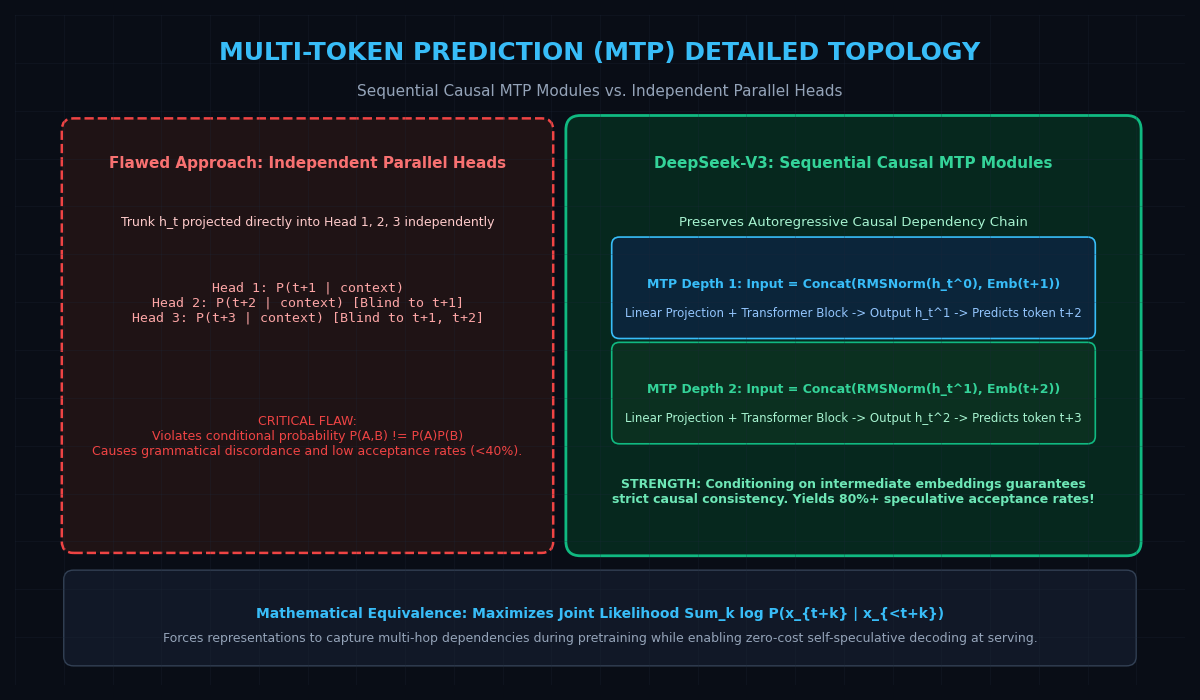
While conceptually simple, independent parallel heads suffer from a catastrophic mathematical flaw: the violation of conditional probability.
According to the chain rule of probability:
$$P(x_{t+1}, x_{t+2} \mid x_{\le t}) = P(x_{t+1} \mid x_{\le t}) \times P(x_{t+2} \mid x_{\le t}, x_{t+1})$$
In naive parallel heads, $\text{Head}2$ predicts $x{t+2}$ conditioned only on $x_{\le t}$—it has zero visibility into which token $\text{Head}1$ actually chose for $x{t+1}$. If $x_{t+1}$ has multiple plausible continuations (e.g., ["def", "class", "async"]), $\text{Head}_2$ predicts an unconditional average across all branches, resulting in severe grammatical discordance, disjointed variable names, and speculative acceptance rates plummeting below 40%.
The Solution: DeepSeek-V3 Sequential Causal MTP
Introduced in foundational research by Meta (Gloeckle et al., ICML 2024) and perfected at scale by DeepSeek-V3 and DeepSeek-R1, modern Multi-Token Prediction (MTP) replaces disconnected heads with a sequential causal pipeline.
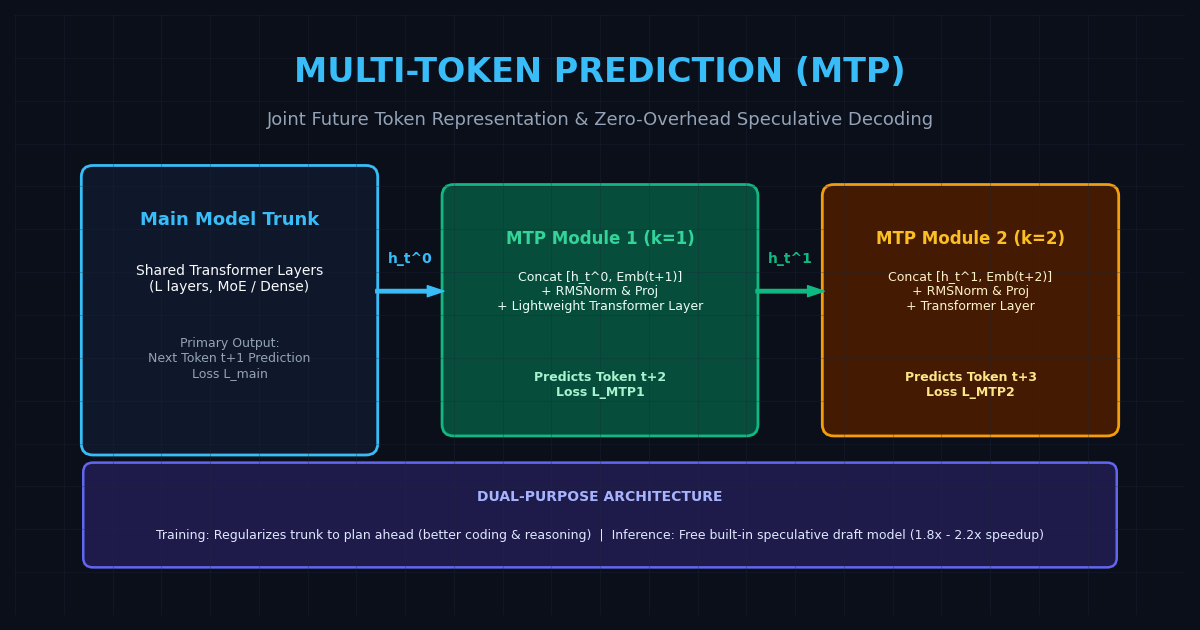
Rather than predicting future tokens in isolation, MTP introduces $D$ sequential prediction modules (typically $D=1$ or $D=2$). Each MTP module possesses its own transformer layer, ensuring that the prediction of token $t+k$ is strictly conditioned on the actual embedding of token $t+k-1$.
1. Sequential Representation Flow
Let $\mathbf{h}t^0$ denote the representation of the $t$-th token emitted by the main transformer trunk (depth 0). To predict the second future token $x{t+2}$ ($k=1$), the first MTP module combines two streams:
- The hidden representation $\mathbf{h}_t^0$ from the main trunk.
- The token embedding $\mathbf{e}{t+1} = \text{Emb}(x{t+1})$ of the intermediate token.
The representations are normalized, concatenated, linearly projected, and processed through a full transformer block:
$$\mathbf{h}_t^1 = \text{TransformerLayer}1\left( \mathbf{W}{\text{proj}}^1 \left[ \text{RMSNorm}(\mathbf{h}t^0) , ; , \text{RMSNorm}(\mathbf{e}{t+1}) \right] \right)$$
The resulting feature vector $\mathbf{h}t^1$ is then passed to a shared or dedicated linear head to output the logit distribution for token $x{t+2}$:
$$P(x_{t+2} \mid x_{\le t+1}) = \text{Softmax}\left( \mathbf{W}_{\text{head}} \mathbf{h}_t^1 \right)$$
For higher prediction depths (e.g., $k=2$ predicting $x_{t+3}$), the second MTP module takes $\mathbf{h}t^1$ and concatenates it with $\mathbf{e}{t+2} = \text{Emb}(x_{t+2})$.
2. Autoregressive Causal Masking in MTP
To prevent information leakage across sequence steps during pre-training, each MTP module preserves strict causal masking. When processing an entire sequence of length $L$ in parallel:
- The input to MTP module $k$ at position $i$ is formed by pairing $\mathbf{h}i^{k-1}$ with the shifted ground-truth embedding $\mathbf{e}{i+k}$.
- Attention inside $\text{TransformerLayer}_k$ uses a standard triangular causal mask.
- Each sequence token $i$ can only attend to representations at or before position $i$.
This architectural discipline guarantees that training and inference distributions remain completely aligned.
3. The Dual Training Objective
During foundation pretraining, the total training loss is the weighted summation of the main trunk’s next-token cross-entropy and the auxiliary MTP losses across all prediction depths:
$$\mathcal{L}{\text{Total}} = \mathcal{L}{\text{main}} + \lambda \sum_{k=1}^D \mathcal{L}_{\text{MTP}}^{(k)}$$
Where: $$\mathcal{L}{\text{MTP}}^{(k)} = - \frac{1}{T-k} \sum{t=1}^{T-k} \log P(x_{t+k+1} \mid x_{\le t+k})$$
Typically, the weighting factor $\lambda$ is set to $1.0$ or adjusted with a gradual warm-up. Crucially, backpropagating gradients from $\mathcal{L}_{\text{MTP}}$ directly into the main trunk forces the backbone layers to learn features that anticipate future sequence trajectory, significantly improving representation density.
Paradigm Comparison: Inference Acceleration Techniques
| Architectural Dimension | Standard Autoregressive | Separate Draft Model | Medusa Parallel Heads | DeepSeek-V3 Sequential MTP |
|---|---|---|---|---|
| Drafting Mechanism | None (Single token) | Independent small LLM | Static parallel linear heads | Causal sequential modules |
| Causal Conditioning | Full sequential | Full sequential | Broken (Independent) | Strictly preserved |
| Training Impact | Baseline | None (Trained separately) | Frozen backbone fine-tune | Enhances main model reasoning |
| VRAM Memory Overhead | 0% | High (2nd model in VRAM) | Minimal (~2%) | Minimal (~3% during serving) |
| Speculative Acceptance Rate | N/A | 65% – 75% | 35% – 50% | 80% – 88% |
| End-to-End Speedup | 1.0x | 1.4x – 1.8x | 1.2x – 1.4x | 1.8x – 2.2x |
| Deployment Complexity | Low | High (2 engines & syncing) | Moderate | Low (Single engine & checkpoint) |
Reference PyTorch Implementation: Sequential MTP Module
Below is a self-contained PyTorch implementation demonstrating a 2-depth Multi-Token Prediction architecture, showing both the training forward pass with joint loss calculation and the inference speculative drafting step.
import torch
import torch.nn as nn
import torch.nn.functional as F
from typing import Tuple, List, Optional

class RMSNorm(nn.Module):
    def __init__(self, dim: int, eps: float = 1e-6):
        super().__init__()
        self.eps = eps
        self.weight = nn.Parameter(torch.ones(dim))

    def forward(self, x: torch.Tensor) -> torch.Tensor:
        var = torch.var(x, dim=-1, unbiased=False, keepdim=True)
        return x * torch.rsqrt(var + self.eps) * self.weight

class MTPModule(nn.Module):
    """
    Sequential Multi-Token Prediction (MTP) block for depth k.
    Combines trunk hidden state with intermediate token embedding.
    """
    def __init__(self, dim: int, num_heads: int = 16):
        super().__init__()
        self.norm_h = RMSNorm(dim)
        self.norm_e = RMSNorm(dim)
        self.proj_in = nn.Linear(dim * 2, dim, bias=False)

        # Lightweight single-layer transformer decoder
        self.attn = nn.MultiheadAttention(embed_dim=dim, num_heads=num_heads, batch_first=True)
        self.norm_attn = RMSNorm(dim)
        self.mlp = nn.Sequential(
            nn.Linear(dim, dim * 4, bias=False),
            nn.SiLU(),
            nn.Linear(dim * 4, dim, bias=False)
        )
        self.norm_mlp = RMSNorm(dim)

    def forward(
        self,
        h_prev: torch.Tensor,       # [B, S, dim] representation from depth k-1
        emb_token: torch.Tensor,    # [B, S, dim] embedding of shifted token
        attn_mask: Optional[torch.Tensor] = None
    ) -> torch.Tensor:
        # 1. Normalize and concatenate features
        h_norm = self.norm_h(h_prev)
        e_norm = self.norm_e(emb_token)
        fused = torch.cat([h_norm, e_norm], dim=-1)
        x = self.proj_in(fused)

        # 2. Causal self-attention
        residual = x
        attn_out, _ = self.attn(x, x, x, attn_mask=attn_mask, is_causal=(attn_mask is None))
        x = self.norm_attn(residual + attn_out)

        # 3. Feed-forward network
        x = self.norm_mlp(x + self.mlp(x))
        return x

class MultiTokenPredictionTransformer(nn.Module):
    """
    Complete Model Architecture incorporating a shared trunk and sequential MTP heads.
    """
    def __init__(self, vocab_size: int = 32000, dim: int = 2048, mtp_depth: int = 1):
        super().__init__()
        self.vocab_size = vocab_size
        self.dim = dim
        self.mtp_depth = mtp_depth

        self.embed_tokens = nn.Embedding(vocab_size, dim)

        # Simplified main model trunk
        self.trunk_layer = nn.TransformerEncoderLayer(
            d_model=dim, nhead=16, dim_feedforward=dim*4, batch_first=True, activation="gelu"
        )
        self.trunk_norm = RMSNorm(dim)
        self.lm_head = nn.Linear(dim, vocab_size, bias=False)

        # Sequential MTP modules (one per future token depth)
        self.mtp_modules = nn.ModuleList([
            MTPModule(dim=dim, num_heads=16) for _ in range(mtp_depth)
        ])

    def forward_train(self, input_ids: torch.Tensor) -> Tuple[torch.Tensor, List[torch.Tensor]]:
        """
        Training forward pass computing main trunk loss and all sequential MTP losses.
        """
        B, S = input_ids.shape
        token_embs = self.embed_tokens(input_ids)

        # 1. Main trunk execution
        h_0 = self.trunk_layer(token_embs)
        h_0 = self.trunk_norm(h_0)
        main_logits = self.lm_head(h_0) # Predicts input_ids shifted by 1

        # 2. Sequential MTP module execution
        mtp_logits_list = []
        h_current = h_0

        for k, module in enumerate(self.mtp_modules):
            # Shift token embeddings to align with intermediate target tokens
            # For depth 0 (k=0), predicts token t+2 using trunk h_t and token embedding of t+1
            shift = k + 1
            if S <= shift:
                break

            h_input = h_current[:, :-shift, :]
            emb_input = token_embs[:, shift:, :]

            h_next = module(h_input, emb_input)
            logits_k = self.lm_head(h_next)
            mtp_logits_list.append(logits_k)
            h_current = h_next

        return main_logits, mtp_logits_list

    @torch.no_grad()
    def speculative_draft_step(
        self,
        h_last: torch.Tensor,         # [1, 1, dim] latest hidden state from trunk
        token_t1: int                 # Sampled token for t+1
    ) -> int:
        """
        Inference step: Main trunk has selected token_t1.
        MTP module 1 immediately drafts candidate token_t2 without a secondary draft model!
        """
        emb_t1 = self.embed_tokens(torch.tensor([[token_t1]], device=h_last.device))
        h_1 = self.mtp_modules[0](h_last, emb_t1)
        logits_t2 = self.lm_head(h_1)
        draft_token_t2 = torch.argmax(logits_t2, dim=-1).item()
return draft_token_t2 Production Serving and System Impacts
Deploying models equipped with Multi-Token Prediction fundamentally shifts the economics and latency dynamics of production LLM serving:
1. Zero-Model-Loading Speculative Decoding
In standard speculative decoding, serving systems (such as vLLM or TensorRT-LLM) require hosting two distinct model checkpoints in GPU memory: a large target model (e.g., LLaMA-3.3 70B) and a small draft model (e.g., LLaMA-3.2 1B). This creates major operational friction:
- GPU Memory Fragmentation: The draft model occupies precious VRAM that could otherwise expand the KV cache pool for higher batch concurrency.
- Vocab and Tokenizer Mismatches: Slight discrepancies between draft and target tokenizers require complex logit re-mapping and alignment kernels.
With MTP, the model is its own drafter. The lightweight MTP modules (representing less than 3% of total model parameters) reside in the same memory space, share identical embedding and projection matrices, and execute in the same inference graph with zero inter-model communication overhead.
2. Dual Speculative Verification Loops
At serving time, engines like SGLang and vLLM execute an interleaved verify-and-draft cycle:
- Step 1: The main trunk processes the current context and validates the draft candidate proposed in the previous turn ($x_t$).
- Step 2: Simultaneously, the main trunk generates the next verified token ($x_{t+1}$).
- Step 3: The MTP module executes a lightweight sub-layer forward pass using the verified token’s embedding to draft the subsequent token ($x_{t+2}$).
- Step 4: If the verification kernel confirms the draft, two tokens are emitted in a single target model forward pass.
Because the MTP modules were trained with strict causal conditioning on intermediate representations, empirical acceptance rates across code generation and natural language tasks exceed 82%, reliably delivering 1.8x to 2.2x real-world throughput speedups.
3. Accelerated Desktop Intelligence with aiFetchly
For data analysts and engineers using AiFetchly, the proliferation of MTP-native foundation models (such as DeepSeek-V3 and Gemma-4 MTP drafters) unlocks unprecedented efficiency on local workstations and private GPU servers. When running complex multi-step web scraping pipelines, competitive intelligence sweeps, or document extraction workflows, MTP enables desktop agents to double their token generation velocity without sacrificing algorithmic precision or increasing enterprise hardware costs.