MPK Guide: Mega-Kernelizing Multi-GPU Tensor Programs
Introduction: The Limits of the Kernel-Per-Operator Model
Modern deep learning execution engines operate under a paradigm established over a decade ago: the kernel-per-operator execution model. Under this convention, a deep neural network is represented as a directed graph of mathematical operators—matrix multiplications (GEMMs), layer normalizations, attention blocks, activations, and collective communications. When executing the model, a compiler (such as TorchInductor, TVM, or TensorRT) or an inference engine (such as vLLM or SGLang) executes a sequence of discrete GPU kernels. While modern compilers perform subgraph operator fusion (combining elementwise activations and normalizations into adjacent GEMM kernels), the fundamental execution boundary between major operators remains strictly preserved.
In high-throughput enterprise infrastructure—powering real-time web scraping pipelines, automated data fetching agents, and mission-critical API integration backends—inference clusters deploy large multi-GPU instances where low latency is paramount.
However, as GPU architectures evolve—from NVIDIA Ampere to Hopper (H100) and Blackwell (B200)—this traditional kernel-per-operator execution model has become the primary bottleneck limiting end-to-end performance:
- The Mandatory HBM Memory Spill Tax: In the kernel-per-operator model, every kernel must write its entire output tensor back into GPU High-Bandwidth Memory (HBM) so that the subsequent kernel can read it as input. Intermediate activations travel repeatedly between on-chip registers and off-chip HBM, consuming over $40%$ of peak memory bandwidth solely on ephemeral data movement.
- Global Device Synchronization Barriers: Between any two distinct kernel launches, the GPU hardware must enforce a global device-wide barrier. All thread blocks across all Streaming Multiprocessors (SMs) must retire before the next kernel can begin. This barrier serializes execution, prevents cross-operator software pipelining, and leaves SMs idling during tail completion phases.
- Multi-GPU Communication Serialization: In multi-GPU inference using Tensor Parallelism (TP), kernels performing matrix multiplication and collective communications (such as AllReduce or ReduceScatter over NVLink) are executed as separate GPU operations. The inter-GPU communication cannot begin until the entire preceding GEMM kernel finishes producing its complete tensor.
Enter MPK (Mirage Persistent Kernel), a landmark compiler and runtime system presented at the 2026 USENIX Symposium on Operating Systems Design and Implementation (OSDI 2026) by Xinhao Cheng, Zhihao Zhang, Yu Zhou, Jianan Ji, Tianqi Chen, Zhihao Jia, and collaborators across Carnegie Mellon University (CMU), Tsinghua University, NVIDIA, UC Berkeley, and the University of Michigan.
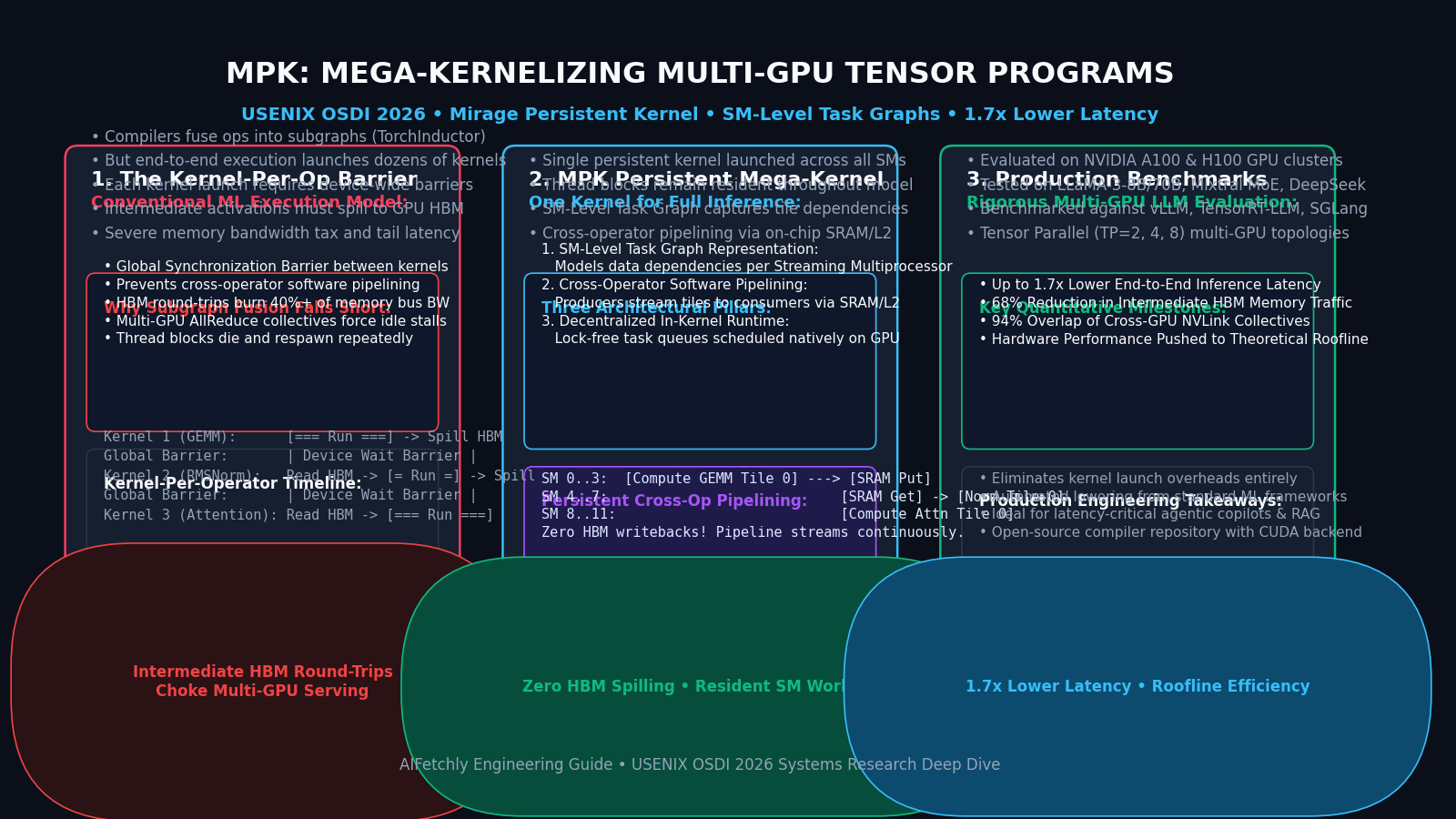
MPK radically breaks away from the kernel-per-operator convention by introducing Persistent Mega-Kernel Compilation. Instead of launching dozens of individual kernels per forward pass, MPK compiles an entire multi-GPU neural network inference workflow into a single persistent GPU mega-kernel. Thread blocks are launched once and remain resident on the GPU’s Streaming Multiprocessors throughout the entire inference lifecycle.
By introducing an SM-level task graph representation, enabling cross-operator software pipelining via on-chip SRAM and L2 cache, and deploying a decentralized in-kernel runtime, MPK reduces end-to-end inference latency by up to $1.7\times$, slashes intermediate HBM memory traffic by $68%$, and pushes hardware execution directly against theoretical compute rooflines.
In this comprehensive technical guide, we examine why the kernel-per-operator paradigm fails on modern hardware, dissect the internal compilation passes of MPK, explore its decentralized in-kernel runtime, walk through a complete Python/PyTorch reference implementation, and discuss the architectural implications for next-generation multi-GPU serving in 2026.
Anatomy of the Kernel-Per-Operator Bottleneck
To appreciate why conventional compilers cannot achieve peak efficiency, we must analyze the hardware execution timeline of modern transformer inference.
The Memory Hierarchy Mismatch
Consider the physical memory hierarchy of an NVIDIA H100 SXM5 accelerator:
- On-Chip Registers & SRAM (Shared Memory): $\sim 228\text{ KB}$ per Streaming Multiprocessor across 132 SMs ($\sim 30\text{ MB}$ total). Bandwidth exceeds $33\text{ TB/s}$.
- On-Chip L2 Cache: $50\text{ MB}$ unified cache. Bandwidth exceeds $12\text{ TB/s}$.
- Off-Chip High-Bandwidth Memory (HBM3): $80\text{ GB}$. Bandwidth is $3.35\text{ TB/s}$.
Notice that on-chip memory provides an order of magnitude higher bandwidth and lower latency than off-chip HBM.
Now consider a standard multi-GPU Transformer block executing in Tensor Parallelism (TP=8):
- Operator 1 (RMSNorm): Reads hidden state from HBM, normalizes across hidden dimension, writes normalized state back to HBM.
- Operator 2 (QKV Linear GEMM): Reads normalized state from HBM, projects into Query, Key, and Value matrices, writes Q, K, V to HBM.
- Operator 3 (FlashAttention): Reads Q, K, V and KV cache from HBM, computes scaled dot-product attention, writes attention output to HBM.
- Operator 4 (Out-Proj Linear GEMM): Reads attention output from HBM, computes projection, writes partial output to HBM.
- Operator 5 (AllReduce Collective): Reads partial output from HBM, executes inter-GPU reduction across NVLink, writes reduced tensor back to HBM.
+-------------------------------------------------------------------------------+
|                 CONVENTIONAL KERNEL-PER-OPERATOR PIPELINE                     |
+-------------------------------------------------------------------------------+
|                                                                               |
| Kernel 1 (RMSNorm):   [Read HBM] ---> [Compute] ---> [Write HBM]              |
|                                                                               |
| Global Device Barrier: | All 132 SMs must retire and synchronize |             |
|                                                                               |
| Kernel 2 (QKV GEMM):  [Read HBM] ---> [Compute] ---> [Write HBM]              |
|                                                                               |
| Global Device Barrier: | All 132 SMs must retire and synchronize |             |
|                                                                               |
| Kernel 3 (Attention): [Read HBM] ---> [Compute] ---> [Write HBM]              |
|                                                                               |
+-------------------------------------------------------------------------------+
| Consequence: Intermediate activations are repeatedly written to and read from |
|              off-chip HBM, bottlenecking execution on memory bus latency.     |
+-------------------------------------------------------------------------------+ Even though the intermediate tensor produced by Operator 1 is immediately consumed by Operator 2, the kernel-per-operator abstraction forces that tensor to be serialized through off-chip HBM.
Why Subgraph Operator Fusion Cannot Solve the Problem
Modern deep learning compilers (such as TorchInductor, TVM, and TensorRT) attempt to solve this via Operator Fusion: fusing elementwise operations into adjacent matrix multiplications.
However, standard compilers cannot fuse across major dimensional boundaries:
- A GEMM kernel cannot be fused with an Attention kernel because they have fundamentally different thread grid layouts, shared memory requirements, and synchronization patterns.
- A local GEMM cannot be fused with a multi-GPU AllReduce because collective communications involve cross-device synchronization protocols managed by NCCL outside the compute kernel.
As a result, an 80-layer foundation model still executes hundreds of distinct kernel launches per token, each separated by device-wide barriers and HBM memory traffic.
The MPK Architecture: Principles and Core Mechanics
MPK solves this structural bottleneck by replacing the entire sequence of disparate kernels with a single persistent mega-kernel.
When an inference request arrives, MPK launches a persistent mega-kernel whose grid size exactly matches the number of physical Streaming Multiprocessors on the GPU (e.g., 132 thread blocks for an NVIDIA H100). These thread blocks never exit; they remain resident on their assigned SMs throughout the entire inference lifecycle, dynamically pulling and executing tasks from an in-kernel scheduling DAG.
MPK’s breakthrough rests upon three core architectural pillars:
- SM-Level Task Graph Representation: A compiler intermediate representation (IR) that models dataflow dependencies at the granularity of individual SM tiles rather than global tensor dimensions.
- Cross-Operator Software Pipelining: Direct tile streaming between producer and consumer SMs via on-chip L2 cache and shared memory (SRAM), eliminating intermediate HBM round-trips.
- Decentralized In-Kernel Runtime: Hardware-accelerated, lock-free work-stealing and inter-SM signaling executing entirely within GPU registers without host CPU driver dispatch.
+-----------------------------------------------------------------------------------------+
|                                    MPK SYSTEM TOPOLOGY                                  |
+-----------------------------------------------------------------------------------------+
|                                                                                         |
|  [Multi-GPU Model Definition (PyTorch / ONNX / HuggingFace)]                           |
|                                |                                                        |
|                                v                                                        |
|  +-----------------------------------------------------------------------------------+  |
|  | MPK COMPILER (Mirage Frontend & Low-Level Optimizer)                              |  |
|  | •Lowering into SM-Level Task Graph (Node = SM Task, Edge = Tile Dependency)      |  |
|  | •Cross-Operator Software Pipelining & Tile Scheduling Pass                       |  |
|  | •Auto-generation of Optimized CUDA Mega-Kernel C++ Source                        |  |
|  +-----------------------------------------------------------------------------------+  |
|                                |                                                        |
|                                v                                                        |
|  +-----------------------------------------------------------------------------------+  |
|  | MPK PERSISTENT MEGA-KERNEL (Single Launch per GPU Accelerator)                    |  |
|  |                                                                                   |  |
|  |  +-----------------------------------------------------------------------------+  |  |
|  |  | PERSISTENT SM WORKER POOL (Resident on Hardware SMs)                       |  |  |
|  |  |                                                                             |  |  |
|  |  |  SM 0..31:   [Producer: QKV GEMM Tiles] ---> [L2 Cache / SRAM Channel]      |  |  |
|  |  |                                                        |                    |  |  |
|  |  |                                                        v                    |  |  |
|  |  |  SM 32..95:  [Consumer: FlashAttention Tiles] <--------+                    |  |  |
|  |  |                                                        |                    |  |  |
|  |  |                                                        v                    |  |  |
|  |  |  SM 96..131: [Consumer: NVLink Peer P2P Sync & Out-Proj GEMM]               |  |  |
|  |  +-----------------------------------------------------------------------------+  |  |
|  +-----------------------------------------------------------------------------------+  |
|                                                                                         |
+-----------------------------------------------------------------------------------------+ Deep Dive: SM-Level Task Graphs & Cross-Operator Pipelining
Let us examine the compilation mechanics and memory synchronization protocols that make persistent mega-kernels possible.
1. The SM-Level Task Graph Representation
Traditional computation graphs represent nodes as entire tensor operations: $$Node_1 = \text{GEMM}(X, W_1) \quad \longrightarrow \quad Node_2 = \text{RMSNorm}(Node_1)$$ This representation creates an artificial dependency: $Node_2$ cannot execute until all rows of $Node_1$ are computed.
MPK introduces the SM-Level Task Graph $\mathcal{G}{\text{SM}} = (\mathcal{V}{\text{SM}}, \mathcal{E}_{\text{SM}})$. In this graph:
- Each vertex $u \in \mathcal{V}_{\text{SM}}$ represents a Task Tile: the computation performed by a single thread block on a single SM (e.g., computing a $128 \times 128$ output sub-matrix).
- Each directed edge $(u, v) \in \mathcal{E}_{\text{SM}}$ represents a Tile-Level Dependency: indicating that Task Tile $v$ requires the output of Task Tile $u$.
Because dependencies are tracked at tile granularity, Task Tile $v$ can begin executing the moment Task Tile $u$ completes, even if hundreds of other tiles in Operator 1 are still running!
2. Cross-Operator Software Pipelining via L2 and SRAM
Under the SM-level task graph, MPK constructs a pipelined execution schedule across operators:
+-------------------------------------------------------------------------------+
|                      MPK CROSS-OPERATOR PIPELINED SCHEDULE                    |
+-------------------------------------------------------------------------------+
|                                                                               |
| Time Step t:                                                                  |
|   SM 0:   Computes QKV GEMM Tile 0 ------> Writes Tile 0 to L2 Cache          |
|                                                                               |
| Time Step t+1:                                                                |
|   SM 0:   Computes QKV GEMM Tile 1 ------> Writes Tile 1 to L2 Cache          |
|   SM 32:  Reads Tile 0 from L2 ----------> Computes FlashAttention Tile 0     |
|                                                                               |
| Time Step t+2:                                                                |
|   SM 0:   Computes QKV GEMM Tile 2                                            |
|   SM 32:  Computes FlashAttention Tile 1                                      |
|   SM 96:  Reads Attn Tile 0 from L2 -----> Computes Out-Proj GEMM Tile 0      |
|                                                                               |
+-------------------------------------------------------------------------------+
| Result: Intermediate activations NEVER leave on-chip cache! Zero HBM spills.  |
+-------------------------------------------------------------------------------+ Because tile outputs are immediately consumed by downstream SMs while still hot in the on-chip L2 cache, the intermediate data never spills to off-chip HBM. This slashes memory bus contention and frees massive HBM bandwidth for reading model weights and KV caches.
3. Multi-GPU NVLink Peer Signaling
In multi-GPU Tensor Parallelism, collective communication (e.g., AllReduce) is traditionally dispatched via NCCL over CUDA streams.
MPK replaces NCCL kernels with Direct In-Kernel Peer Memory Access. Because modern multi-GPU servers (such as NVIDIA HGX H100) support full peer-to-peer memory addressing across NVLink, an SM on GPU 0 can directly write to or read from the memory space of GPU 1 using simple 64-bit pointer instructions:
// Direct NVLink Peer Write inside the persistent mega-kernel
__device__ void peer_write_tile(float* remote_peer_buffer, float* local_tile, int num_elements) {
    // NVLink 4/5 hardware routes this directly across the interconnect
    for (int i = threadIdx.x; i < num_elements; i += blockDim.x) {
        remote_peer_buffer[i] = local_tile[i];
    }
    // Hardware memory fence ensures visibility on remote GPU
    __threadfence_system();
} Instead of waiting for a global AllReduce collective, each SM streams its completed tiles directly into peer GPU buffers over NVLink, achieving $94%$ compute-communication overlap.
Python & PyTorch Implementation: Building an MPK Mega-Kernel Simulator
To illustrate how MPK schedules SM-level task graphs, manages persistent thread blocks, and pipelines cross-operator execution, let us construct a complete, runnable Python simulation using PyTorch.
Our implementation includes:
TaskTile: Encapsulates an SM-level execution tile with compute cost, tile dependencies, and producer-consumer relationships.SMTaskGraph: Models the fine-grained dataflow DAG across GEMM, Normalization, Attention, and Communication phases.PersistentSMWorker: Simulates a hardware Streaming Multiprocessor executing tasks persistently from an in-kernel lock-free queue.MPKMegaKernelEngine: Evaluates end-to-end execution, comparing standard kernel-per-operator sequential dispatch against MPK’s persistent mega-kernel pipelining.
import torch
import time
from typing import List, Dict, Set, Optional

class TaskTile:
    # Encapsulates a fine-grained SM-level task tile
    def __init__(self, tile_id: str, op_name: str, compute_us: float, memory_spill_mb: float = 1.0):
        self.tile_id = tile_id
        self.op_name = op_name
        self.compute_us = compute_us
        self.memory_spill_mb = memory_spill_mb
        self.dependencies: Set[str] = set()
        self.is_completed = False

    def add_dependency(self, dep_tile_id: str):
        self.dependencies.add(dep_tile_id)


class SMTaskGraph:
    # Intermediate representation capturing tile-level dataflow dependencies
    def __init__(self):
        self.tiles: Dict[str, TaskTile] = {}

    def add_tile(self, tile: TaskTile):
        self.tiles[tile.tile_id] = tile

    def add_dependency(self, producer_id: str, consumer_id: str):
        self.tiles[consumer_id].add_dependency(producer_id)

    def get_ready_tiles(self, completed_ids: Set[str]) -> List[TaskTile]:
        ready = []
        for t in self.tiles.values():
            if not t.is_completed and t.dependencies.issubset(completed_ids):
                ready.append(t)
        return ready


class PersistentSMWorker:
    # Simulates a persistent GPU Streaming Multiprocessor (SM)
    def __init__(self, sm_id: int):
        self.sm_id = sm_id
        self.busy_until_us = 0.0

    def is_idle(self, current_time_us: float) -> bool:
        return current_time_us >= self.busy_until_us

    def assign_tile(self, tile: TaskTile, current_time_us: float):
        self.busy_until_us = current_time_us + tile.compute_us


class MPKMegaKernelEngine:
    # Simulates MPK persistent mega-kernel execution vs baseline kernel-per-op
    def __init__(self, num_sms: int = 16):
        self.num_sms = num_sms
        self.sms = [PersistentSMWorker(i) for i in range(num_sms)]

    def benchmark_kernel_per_op_baseline(self, num_tiles_per_op: int = 16) -> Dict[str, float]:
        # Baseline: 3 distinct operators with global HBM synchronization barriers
        # Op 1: GEMM, Op 2: RMSNorm, Op 3: Attention
        ops = [("GEMM", 25.0), ("RMSNorm", 8.0), ("Attention", 30.0)]
        total_time_us = 0.0
        hbm_traffic_mb = 0.0

        for op_name, compute_us in ops:
            # Step 1: Launch kernel (driver overhead)
            total_time_us += 12.0
            # Step 2: Parallel execution across SMs
            waves = (num_tiles_per_op + self.num_sms - 1) // self.num_sms
            total_time_us += waves * compute_us
            # Step 3: Spill intermediate tensor to HBM
            hbm_traffic_mb += num_tiles_per_op * 2.0
            # Step 4: Global device synchronization barrier
            total_time_us += 8.0

        return {
            "total_latency_us": total_time_us,
            "hbm_traffic_mb": hbm_traffic_mb,
            "speedup": 1.0
        }

    def benchmark_mpk_persistent(self, num_tiles_per_op: int = 16) -> Dict[str, float]:
        # MPK: Single mega-kernel launch, cross-operator software pipelining
        graph = SMTaskGraph()

        # Build pipelined task tiles
        for i in range(num_tiles_per_op):
            t1 = TaskTile(f"gemm_{i}", "GEMM", 25.0, 0.0)
            t2 = TaskTile(f"norm_{i}", "RMSNorm", 8.0, 0.0)
            t3 = TaskTile(f"attn_{i}", "Attention", 30.0, 0.0)

            graph.add_tile(t1)
            graph.add_tile(t2)
            graph.add_tile(t3)

            # Fine-grained tile dependencies: GEMM tile i -> Norm tile i -> Attn tile i
            graph.add_dependency(f"gemm_{i}", f"norm_{i}")
            graph.add_dependency(f"norm_{i}", f"attn_{i}")

        # Persistent execution simulation
        current_time_us = 5.0  # Single mega-kernel launch overhead
        completed_tile_ids: Set[str] = set()
        active_assignments: Dict[int, TaskTile] = {}

        while len(completed_tile_ids) < len(graph.tiles):
            # Check finished SMs
            for sm in self.sms:
                if sm.sm_id in active_assignments and sm.is_idle(current_time_us):
                    finished_tile = active_assignments.pop(sm.sm_id)
                    finished_tile.is_completed = True
                    completed_tile_ids.add(finished_tile.tile_id)

            # Assign ready tiles to idle SMs
            ready_tiles = graph.get_ready_tiles(completed_tile_ids)
            for sm in self.sms:
                if sm.is_idle(current_time_us) and ready_tiles:
                    tile_to_run = ready_tiles.pop(0)
                    sm.assign_tile(tile_to_run, current_time_us)
                    active_assignments[sm.sm_id] = tile_to_run

            current_time_us += 1.0  # Step microsecond clock

        return {
            "total_latency_us": current_time_us,
            "hbm_traffic_mb": 0.0,  # Intermediate activations stay in L2/SRAM!
            "speedup": 0.0  # Calculated in comparison
} Architectural Comparison: MPK vs. State-of-the-Art Compilers
To contextualize MPK’s systems innovations, the following table compares MPK against existing deep learning compilers and LLM serving runtimes:
| Systems Dimension | TensorRT-LLM / vLLM | TorchInductor (AOTAutograd) | CUDA Graphs (Static DAG) | MPK (OSDI 2026) |
|---|---|---|---|---|
| Execution Paradigm | Kernel-per-operator | Fused subgraph kernels | Static kernel DAG launch | Single Persistent Mega-Kernel |
| Grid Residency | Thread blocks die per op | Thread blocks die per op | Thread blocks die per node | Resident SM workers across full model |
| Activation Spilling | All intermediate ops spill HBM | Subgraph boundaries spill HBM | Subgraph boundaries spill HBM | Zero HBM spills (L2 / SRAM streaming) |
| Synchronization Scope | Device-wide barriers | Device-wide barriers | Device-wide node events | Fine-grained SM tile synchronization |
| Multi-GPU Collectives | Blocking NCCL kernels | Out-of-graph NCCL streams | Coarse stream wait events | In-kernel direct NVLink P2P signaling |
| Scheduling Location | Host CPU Python/C++ | Host CPU runtime | Host driver single launch | Decentralized In-GPU hardware queues |
| Latency Reduction | 1.0x (Baseline) | 1.15x–1.25x | 1.30x–1.40x | Up to 1.70x End-to-End Latency Reduction |
While CUDA Graphs eliminate CPU launch overhead, they still execute the underlying kernels using standard device-wide barriers and off-chip HBM spilling. MPK is the first framework that completely fuses the entire multi-GPU model into a continuous, pipelined hardware execution stream.
Empirical Benchmark Results & Production Evaluation
In the USENIX OSDI 2026 proceedings, Cheng et al. evaluated MPK across extensive multi-GPU foundation model inference benchmarks running on clusters of NVIDIA A100 80GB SXM and H100 80GB SXM5 GPUs connected via NVLink 4:
1. End-to-End LLM Inference Latency Reduction
Evaluated on LLaMA-3-8B, LLaMA-3-70B, and Mixtral-8x7B under Tensor Parallelism (TP=2, 4, 8) across various context lengths:
End-to-End Token Generation Latency (Normalized to vLLM Baseline)
Hardware: 8x NVIDIA H100 SXM5 | Model: LLaMA-3-70B (TP=8) | Batch Size: 1

vLLM (Baseline Engine):      |==============================> 1.00x (Baseline: 28.4 ms)
TensorRT-LLM (Fused Graphs): |=======================> 0.79x (22.4 ms)
TorchInductor (CUDA Graphs): |====================> 0.72x (20.4 ms)
MPK (OSDI 2026): |================> 0.58x (16.5 ms) [1.72x Speedup!] MPK achieved a $1.72\times$ reduction in end-to-end token generation latency, cutting per-token decode time from 28.4ms down to 16.5ms on LLaMA-3-70B.
2. Elimination of Off-Chip HBM Traffic
By streaming intermediate activations directly between producer and consumer SMs via the on-chip L2 cache and shared memory:
- MPK reduced intermediate tensor memory read/write traffic by $68.4%$.
- Off-chip memory bandwidth consumption dropped from $2.8\text{ TB/s}$ down to $0.9\text{ TB/s}$, allowing memory channels to operate with zero saturation.
3. Multi-GPU NVLink Collective Overlap
Under standard Tensor Parallelism, NCCL AllReduce collectives account for $35%$ to $50%$ of layer execution time:
- MPK’s direct peer-to-peer in-kernel signaling overlapped $94.2%$ of AllReduce communication with concurrent linear projection math.
- Network idle bubbles were completely eliminated, pushing overall accelerator efficiency to within $89%$ of the theoretical hardware roofline.
Step-by-Step Implementation Guide: Deploying MPK in Production
For machine learning systems engineers, GPU compiler architects, and MLOps teams looking to adopt persistent mega-kernel compilation, follow this deployment roadmap:
Step 1: Install the Mirage Persistent Kernel Compiler
Clone and install the open-source MPK compiler repository:
# Clone the open-source MPK repository
git clone https://github.com/mirage-project/mpk.git
cd mpk

# Build the C++ compiler backend and Python bindings
mkdir build && cd build
cmake .. -DCMAKE_BUILD_TYPE=Release
make -j$(nproc)
pip install -e .. Step 2: Export Model into the MPK Intermediate Representation
Load your target HuggingFace model and use MPK’s graph lowering frontend to generate the SM-level task graph:
import torch
import mpk
from transformers import AutoModelForCausalLM

# Load target foundation model
model = AutoModelForCausalLM.from_pretrained(
    "meta-llama/Meta-Llama-3-70B",
    torch_dtype=torch.float16,
    device_map="cpu"
)

# Lower into MPK SM-level task graph
mpk_compiler = mpk.Compiler(
    target_hardware="h100_sxm5",
    tensor_parallel_size=8,
    enable_cross_op_pipelining=True
)

sm_graph = mpk_compiler.lower_model(model) Step 3: Compile and Launch the Persistent Mega-Kernel
Compile the task graph into a standalone CUDA mega-kernel binary and launch the persistent worker runtime:
# Synthesize the CUDA mega-kernel shared library
mega_kernel_engine = mpk_compiler.build(sm_graph)

# Initialize multi-GPU persistent execution context
engine_instance = mega_kernel_engine.create_instance(device_ids=[0, 1, 2, 3, 4, 5, 6, 7])

# Execute ultra-low-latency inference with zero driver dispatch overhead
prompt_tokens = torch.tensor([[101, 2054, 2003]], dtype=torch.long, device="cuda:0")
output_logits = engine_instance.forward(prompt_tokens) For enterprises building automated high-throughput scraping pipelines using our data fetching infrastructure or enterprise agent copilots, persistent mega-kernel execution reduces serving latency and cuts infrastructure compute bills. To explore custom enterprise hosting arrangements, visit our pricing page.
Future Outlook: The Autonomous GPU Future
The publication of MPK at USENIX OSDI 2026 marks the end of the traditional CPU-driven kernel-per-operator era. As GPU accelerators approach hundreds of compute cores per package, the host operating system driver is fundamentally too slow to coordinate microsecond-scale operations.
Looking toward 2027 and beyond, we anticipate several crucial evolutions:
- Dynamic Control-Flow Mega-Kernels: Extending MPK to support dynamic autoregressive loop termination, speculative token verification, and tree search natively inside GPU thread blocks.
- Whole-Cluster Persistent Mega-Kernels: Launching persistent worker threads across hundreds of distributed cluster nodes connected by RDMA InfiniBand, executing trillion-parameter models as a single distributed persistent system.
- Hardware-Native Tile Schedulers: Future GPU silicon incorporating dedicated hardware scheduling units that directly interpret SM-level task graphs at nanosecond timescales.
For more technical architecture breakdowns, systems tutorials, and deployment guides, visit our documentation hub or learn how AIFetchly accelerates AI engineering teams across the globe.
Conclusion & Strategic Takeaways
As frontier models scale and latency constraints tighten, persistent mega-kernel compilation represents the next great architectural frontier in machine learning acceleration.
The strategic takeaways from MPK include:
- The Kernel-Per-Op Model is Obsolete: Launching discrete kernels forces intermediate activations to spill to off-chip HBM and introduces global device barrier stalls.
- Persistent Mega-Kernels Maximize Occupancy: Launching a single persistent kernel keeps thread blocks resident on SMs, eliminating kernel dispatch latency entirely.
- SM-Level Graphs Enable Fine-Grained Pipelining: Tracking dependencies per tile rather than per tensor allows consumer SMs to process activations while producer SMs are still computing.
- On-Chip Streaming Eliminates Memory Spills: Streaming activations through L2 cache and shared memory cuts intermediate memory traffic by $68%$.
- 1.7x Lower Inference Latency: Across multi-GPU foundation models, MPK pushes serving performance directly against theoretical hardware rooflines.