Moore Threads MTT S4000 Guide: 48GB MUSA Datacenter AI GPU
The Sovereign Compute Dilemma: Proprietary GPU Monopolies and Enterprise Hardware Lock-In
The global artificial intelligence race has created an unprecedented concentration of technological and infrastructural dependency. Over the past decade, the rapid ascent of frontier generative foundation models—ranging from multi-hundred-billion parameter large language models (LLMs) and Mixture-of-Experts (MoE) ensembles to multimodal vision-language diffusion transformers—has been powered almost exclusively by a single dominant merchant silicon vendor. While modern datacenter GPUs provide immense theoretical floating-point density, enterprise infrastructure architects, sovereign cloud operators, and hyperscale datacenter providers face four catastrophic operational and geopolitical vulnerabilities:
- The Proprietary Software Moat (The CUDA Lock-In): For over fifteen years, the deep learning software ecosystem has been tightly coupled to proprietary graphics processing unit (GPU) programming frameworks. Millions of custom PyTorch operators, CUDA kernels, FlashAttention implementations, and distributed collective libraries were written specifically for proprietary SIMT (Single Instruction, Multiple Threads) instruction sets. Migrating existing deep learning pipelines to alternative hardware has historically required manual code rewrites, kernel re-tuning, and fragile driver wrappers, creating immense software friction that discourages silicon diversification.
- Exorbitant Gross Margin Premiums and TCO Escalation: Relying on a single supplier has exposed datacenters to severe capital expenditure drag. Commercial server-grade GPUs command staggering pricing premiums, with 8-GPU chassis solutions frequently costing several hundred thousand dollars. When scaling clusters to tens of thousands of accelerators to train foundational models, hardware acquisition and recurring support licensing severely erode enterprise margins.
- Severe Packaging and High-Bandwidth Memory (HBM) Supply Bottlenecks: Contemporary flagship GPUs rely on complex 2.5D advanced packaging technologies (such as TSMC’s CoWoS—Chip-on-Wafer-on-Substrate) and multi-layer High-Bandwidth Memory (HBM3/HBM3e) stacks. Advanced packaging and HBM manufacturing suffer from rigid foundry capacity constraints and long lead times, causing multi-month datacenter construction delays even when physical real estate and power grids are fully prepared.
- The Need for Full-Function Heterogeneous Acceleration: Many alternative accelerators rushed to market as narrow, fixed-function ASIC matrix multipliers. While these chips run basic dense GEMMs, they lack full graphical pipelines, video transcoding hardware, display controllers, and generalized scientific compute capability. In modern multi-tenant enterprise datacenters, servers must fluidly switch between AI training, autoregressive LLM serving, 8K video transcoding, cloud graphics rendering, and scientific physics simulations. Rigid ASICs cannot support this operational versatility.
To achieve technological resilience, cost sustainability, and computational autonomy, the global semiconductor ecosystem requires full-function, general-purpose GPUs backed by robust hardware interconnects and automated code migration frameworks capable of breaking proprietary lock-in.
Introducing Moore Threads MTT S4000: Full-Function MUSA Datacenter AI Silicon
Moore Threads—the cutting-edge semiconductor innovator founded by former senior executive leadership from NVIDIA’s global and regional divisions—provides the definitive answer with the Moore Threads MTT S4000. Built on the third-generation MUSA (Moore Threads Unified System Architecture), the MTT S4000 is China’s flagship full-function general-purpose GPU (GPGPU) engineered specifically for enterprise artificial intelligence training, large-scale LLM inference serving, and high-performance computing.
Unlike narrow AI accelerators, the MTT S4000 is a true full-function GPU. It integrates modern 3D graphics rendering, ultra-high-definition 8K video codecs, physics simulation engines, and massive AI tensor acceleration into a single monolithic silicon die. Operating at a moderate, enterprise-friendly thermal envelope of 240W to 250W TDP, the MTT S4000 delivers datacenter-grade compute without requiring complex liquid cooling infrastructure.
Key architectural breakthroughs integrated into the Moore Threads MTT S4000 include:
- Third-Generation MUSA Core Architecture: Packs 48 streaming multiprocessor clusters containing thousands of MUSA tensor and vector cores, delivering 200 TFLOPS of FP16/BF16 compute, 100 TFLOPS of TensorFloat-32 (TF32), 25 TFLOPS of single-precision FP32, and 400 TOPS of INT8 compute.
- High-Capacity 48GB GDDR6 Memory Subsystem: Equipped with 48 gigabytes of high-speed GDDR6 memory operating across a wide memory bus to deliver 768 GB/s of sustained memory bandwidth. By opting for high-density GDDR6 over supply-constrained HBM, Moore Threads bypasses advanced 2.5D packaging bottlenecks, ensuring high manufacturing yield, cost-effectiveness, and broad availability while providing ample VRAM to host large foundation models on single cards.
- High-Speed MTLink 1.0/2.0 Inter-GPU Interconnect: Features proprietary MTLink hardware bridge headers delivering up to 240 GB/s of bi-directional GPU-to-GPU bandwidth. MTLink enables seamless, low-latency cross-GPU tensor sharing, allowing 8-GPU server nodes to operate as a single unified memory and compute pool.
- KUAE Intelligent Supercomputing Cluster Scaling: Serves as the computational cornerstone for Moore Threads’ KUAE 1,000-card to 10,000-card intelligent supercomputing clusters, achieving over 90% linear training scaling efficiency on multi-hundred-billion parameter models with 99.9% hardware operational stability.
- Zero-Cost CUDA Migration via MUSIFY: Supported by the advanced MUSIFY source-to-source code translation toolchain, which automatically migrates proprietary CUDA C++ source code, PyTorch extensions, and Triton kernels to native MUSA C++ with over 95% automated code conversion accuracy.
Enterprises deploying large-scale neural network training, automated data extraction, and multimodal reasoning clusters can connect their MTT S4000-accelerated datacenter nodes to centralized platforms using real-time data ingestion infrastructure to stream high-velocity datasets directly into GPU memory for immediate embedding generation and model training. By combining full-function graphics and AI computing with seamless software migration, the Moore Threads MTT S4000 provides a viable, sovereign pathway for enterprise foundation model acceleration.
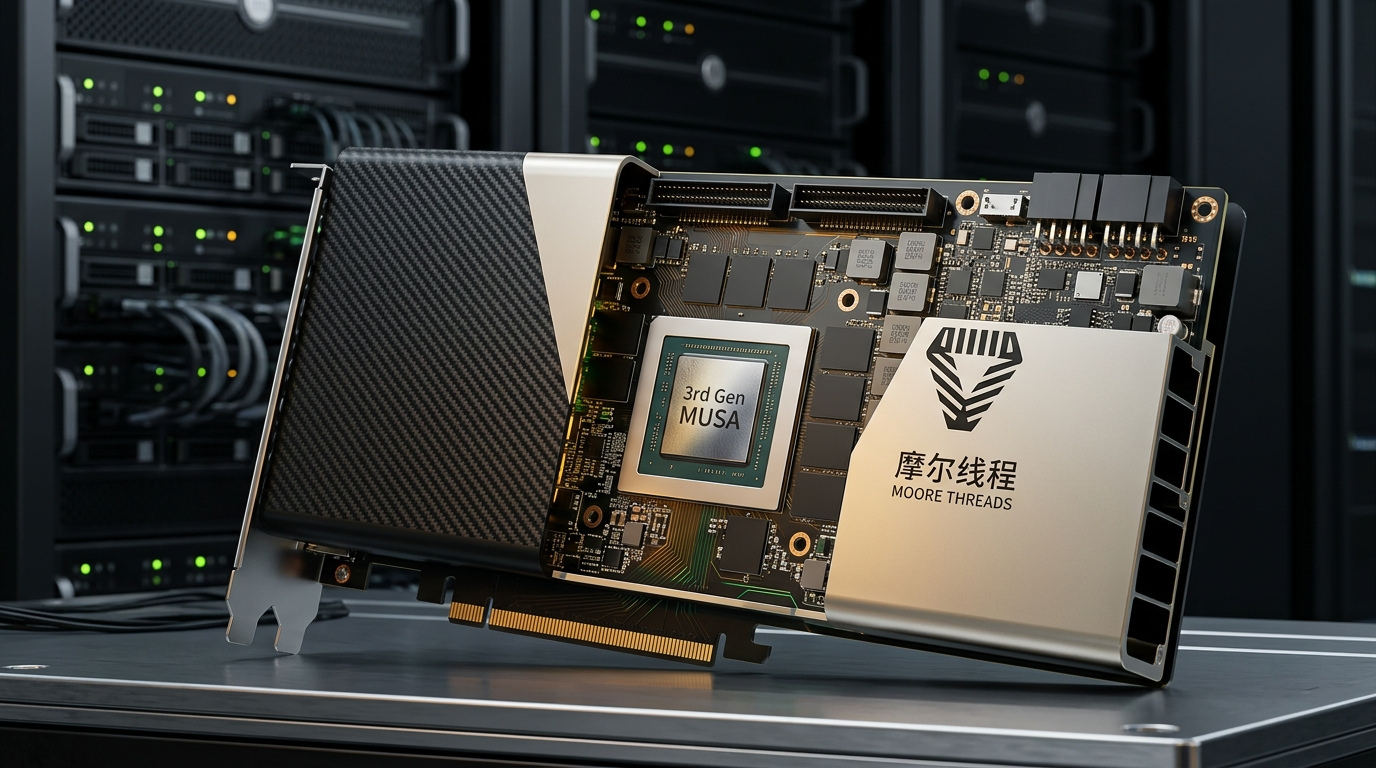
Architectural Deep Dive: 3rd-Gen MUSA, 48GB GDDR6 Subsystem, MTLink, and KUAE Scaling
The high throughput and operational stability of the Moore Threads MTT S4000 stem from its balanced compute engine microarchitecture, dense GDDR6 memory layout, low-latency inter-GPU fabric, and cluster-level fault tolerance. A comprehensive technical evaluation requires examining its four foundational subsystems.
The 3rd-Generation MUSA Microarchitecture and Execution Pipeline
The physical architecture of the MTT S4000 silicon die is organized into hierarchical Compute Clusters, Streaming Multiprocessors, and dedicated Tensor Matrix Engines:
+-----------------------------------------------------------------------+
|                 Moore Threads MTT S4000 Die Topology                  |
+-----------------------------------------------------------------------+
|  +------------------------+  +-------------------------------------+  |
|  | Host Interface Subsys  |  | MTLink Inter-GPU Interconnect Hub   |  |
|  | PCIe Gen 5.0 x16       |  | 240 GB/s Bi-Directional Bandwidth  |  |
|  | (128 GB/s Full-Duplex) |  | Low-Latency Cross-GPU Direct P2P    |  |
|  +-----------+------------+  +------------------+------------------+  |
|              |                                  |                     |
|  +-----------v----------------------------------v------------------+  |
|  |           High-Bandwidth On-Chip Crossbar Switch Fabric         |  |
|  +-----------------------------------------------------------------+  |
|        |                  |                  |                  |     |
|  +-----v-----+      +-----v-----+      +-----v-----+      +-----v-----+  |
|  | MUSA SMP  |      | MUSA SMP  |      | MUSA SMP  |      | MUSA SMP  |  |
|  | Cluster 0 |      | Cluster 1 |      | Cluster 2 |      | Cluster N |  |
|  | - Vector  |      | - Vector  |      | - Vector  |      | - Vector  |  |
|  | - Tensor  |      | - Tensor  |      | - Tensor  |      | - Tensor  |  |
|  | - L1/SRAM |      | - L1/SRAM |      | - L1/SRAM |      | - L1/SRAM |  |
|  +-----+-----+      +-----+-----+      +-----+-----+      +-----+-----+  |
|        ^                  ^                  ^                  ^     |
|  +-----+------------------+------------------+------------------+--+  |
|  |               Massive Shared Multi-Megabyte L2 Cache            |  |
|  +-----------------------------------------------------------------+  |
|  |   48GB GDDR6 Memory Subsystem (384-Bit Bus | 768 GB/s Bandwidth)  |  |
|  |   Full Hardware Error-Correcting Code (ECC) Reliability         |  |
+--+-----------------------------------------------------------------+--+ Each MUSA Streaming Multiprocessor (SMP) incorporates:
- MUSA Vector Processing Cores: Optimized 32-bit arithmetic logic units executing scalar instructions, pointer calculations, transcendental mathematics, and standard IEEE 754 single-precision floating-point arithmetic.
- Dedicated MUSA Tensor Matrix Engines: Specialized hardware arrays dedicated to matrix multiply-accumulate (MAC) operations. Each tensor engine executes dense matrix-matrix contractions across bfloat16, FP16, TensorFloat-32 (TF32), and INT8 data types in a single instruction cycle.
- Configurable Shared Memory and L1 Cache: High-density local static RAM (SRAM) configurable as either low-latency software-managed scratchpad memory or automatic hardware data cache, maximizing register reuse during deep attention matrix calculations.
- Full-Function Media and Display Engine: Hardwired multi-format video decoders and encoders supporting real-time processing of up to 32 streams of 1080p30 video (AV1, H.265/HEVC, H.264), alongside 4x DisplayPort 1.4a outputs supporting 8K ultra-high-definition multi-monitor displays.
The 48GB GDDR6 Memory Subsystem: Bypassing the HBM Packaging Trap
One of the most consequential architectural design decisions of the MTT S4000 is its reliance on 48GB of high-density GDDR6 memory rather than High-Bandwidth Memory (HBM).
While HBM delivers immense theoretical bandwidth, it requires silicon interposers (such as CoWoS) that introduce severe packaging bottlenecks and high thermal density. Moore Threads equips the MTT S4000 with a wide 384-bit memory bus interfacing with high-speed GDDR6 DRAM modules running at up to 16 Gbps, yielding 768 GB/s of sustained memory bandwidth.
This architectural choice provides three decisive advantages:
- Large Local VRAM Footprint: With 48GB of VRAM per card, a single MTT S4000 can host an entire 13B or 20B parameter model in FP16 precision, or a quantized 70B parameter model (e.g., LLaMA-3-70B in INT4/INT8 precision), on a single GPU without requiring inter-card tensor partitioning.
- Manufacturing Resilience: Standard organic package substrates and commercially available GDDR6 memory chips allow Moore Threads to manufacture and ship the MTT S4000 at scale without competing for scarce global HBM and 2.5D packaging allocations.
- Enterprise Functional Reliability: Features full hardware-level Error-Correcting Code (ECC) support across the entire memory array, continuously scrubbing and repairing transient single-bit memory faults to ensure uninterrupted training runs spanning weeks or months.
High-Speed Inter-GPU Interconnect: MTLink
To scale from single-card acceleration to multi-GPU server nodes, the MTT S4000 incorporates the proprietary MTLink interconnect fabric. Accessible via physical edge bridge connectors located along the top of the dual-slot card, MTLink delivers up to 240 GB/s of bi-directional peer-to-peer (P2P) bandwidth:
- Direct Memory Addressing: MTLink allows any GPU within an 8-card node to read and write directly into the memory space of any neighboring GPU across a dedicated point-to-point mesh, completely bypassing the host PCIe bus.
- Collective Communication Offload: Hardware-accelerated collective engines offload All-Reduce, All-Gather, and Reduce-Scatter operations during distributed data-parallel (DDP) and tensor-parallel (TP) training loops.
- NUMA Memory Pooling: The 8 GPUs pool their memory across MTLink to create a unified 384GB high-speed memory domain per server chassis, enabling multi-node clusters to handle massive transformer context windows (such as 32k to 128k tokens) with minimal latency penalties.
Mathematical Foundations of MUSA Tensor Acceleration
In deep neural network training and autoregressive transformer inference, the computational workload is dominated by matrix-matrix multiplications ($C = A \times B$). The MUSA Tensor Matrix Engines execute this contraction by tiling large tensor matrices into localized hardware register blocks.
For a matrix multiplication involving input activation tile $A \in \mathbb{R}^{M \times K}$ and weight tile $B \in \mathbb{R}^{K \times N}$, the MUSA tensor engine calculates the inner-product contraction:
$$C_{ij} = \sum_{k=1}^K A_{ik} \times B_{kj} + C_{ij}$$
When operating in TensorFloat-32 (TF32) mode, the hardware automatically ingests standard 32-bit floating-point inputs, truncates the mantissa to 10 bits (matching FP16 precision) while retaining the full 8-bit dynamic exponent range of FP32:
$$\text{TF32}(x) = \text{sign}(1\text{b}) + \text{exponent}(8\text{b}) + \text{mantissa}(10\text{b})$$
The matrix accumulation is executed with full IEEE 754 32-bit single-precision floating-point fidelity ($C \in \mathbb{R}^{FP32}$):
$$C_{FP32} \leftarrow C_{FP32} + \sum_{k} \text{TF32}(A) \times \text{TF32}(B)$$
This hybrid representation delivers up to 100 TFLOPS of compute on standard FP32 training workflows, accelerating convergence by up to 4x compared to traditional scalar FP32 execution without requiring developers to manually re-tune hyperparameters or risk underflow.
Practical Implementation: Compiling and Running Models with MUSA, PyTorch, and MUSIFY
Deploying deep learning models onto Moore Threads MTT S4000 accelerators leverages the comprehensive MUSA Software Stack. The software ecosystem includes the MUSA Toolkit, native PyTorch for MUSA (torch_musa), and the automated MUSIFY code translation toolchain, allowing developers to execute existing CUDA-based models with zero or minimal manual code adjustments.
Automated CUDA to MUSA Migration Using MUSIFY
The MUSIFY toolchain performs automated AST (Abstract Syntax Tree) parsing and source-to-source translation of existing CUDA C++ kernels and PyTorch extensions into native MUSA C++:
# Example bash command demonstrating MUSIFY automated code translation
musify-python --input-dir ./cuda_custom_kernels \
              --output-dir ./musa_custom_kernels \
--report-level detailed The following Python script illustrates how to verify the converted kernel and execute a distributed PyTorch transformer benchmark using torch_musa on the MTT S4000:
#!/usr/bin/env python3
# Moore Threads MTT S4000 High-Throughput PyTorch Inference Benchmark
# Demonstrates torch_musa device initialization, mixed-precision, and transformer serving.

import os
import sys
import time
import torch
import torch.nn as nn

# 1. Initialize Moore Threads MUSA Extension
try:
    import torch_musa
    print(f"[MUSA] Successfully initialized Moore Threads extension.")
    print(f"[MUSA] Detected Device: {torch.musa.get_device_name(0)}")
    print(f"[MUSA] Device Count: {torch.musa.device_count()} | "
          f"Total Memory: {torch.musa.get_device_properties(0).total_memory / (1024**3):.1f} GB")
except ImportError:
    print("[Warning] torch_musa extension not found. Running in CPU emulation mode.")

class MusaTransformerDecoderLayer(nn.Module):
    """
    Standard Transformer Decoder Layer executing on 3rd-Gen MUSA Tensor Cores.
    """
    def __init__(self, d_model: int = 4096, n_heads: int = 32):
        super().__init__()
        self.norm1 = nn.RMSNorm(d_model)
        self.qkv_proj = nn.Linear(d_model, 3 * d_model, bias=False)
        self.out_proj = nn.Linear(d_model, d_model, bias=False)
        self.norm2 = nn.RMSNorm(d_model)
        self.mlp = nn.Sequential(
            nn.Linear(d_model, 4 * d_model, bias=False),
            nn.SiLU(),
            nn.Linear(4 * d_model, d_model, bias=False)
        )

    def forward(self, x):
        # 1. Self-Attention Block
        normed = self.norm1(x)
        qkv = self.qkv_proj(normed)
        q, k, v = torch.chunk(qkv, 3, dim=-1)

        # MUSA-accelerated scaled dot-product attention
        attn_out = torch.nn.functional.scaled_dot_product_attention(
            q, k, v, is_causal=True
        )
        x = x + self.out_proj(attn_out)

        # 2. Feed-Forward MLP Block
        x = x + self.mlp(self.norm2(x))
        return x

def run_mtt_s4000_benchmark():
    device = torch.device("musa:0" if hasattr(torch, "musa") and torch.musa.is_available() else "cpu")
    print(f"[System] Binding execution to compute target: {device}")

    # Initialize model in native bfloat16 precision
    model = MusaTransformerDecoderLayer(d_model=4096, n_heads=32).to(device=device, dtype=torch.bfloat16)
    model.eval()

    # Pre-allocate large batch tensor in 48GB GDDR6 VRAM
    batch_size = 16
    seq_len = 2048
    input_tensor = torch.randn(batch_size, seq_len, 4096, device=device, dtype=torch.bfloat16)

    print(f"[System] Tensor Allocated in GDDR6: {input_tensor.shape} ({input_tensor.element_size() * input_tensor.nelement() / (1024**2):.1f} MB)")
    print("[System] Executing 10 warm-up forward passes on MUSA cores...")
    with torch.no_grad():
        for _ in range(10):
            _ = model(input_tensor)

    if hasattr(torch, "musa"):
        torch.musa.synchronize()

    print("[System] Benchmarking 50 consecutive inference iterations...")
    start_time = time.perf_counter()
    with torch.no_grad():
        for _ in range(50):
            _ = model(input_tensor)

    if hasattr(torch, "musa"):
        torch.musa.synchronize()

    total_time = time.perf_counter() - start_time
    avg_latency_ms = (total_time / 50.0) * 1000.0
    tokens_processed = 50 * batch_size * seq_len
    tokens_per_sec = tokens_processed / total_time

    print(f"[Results] Total Time: {total_time:.2f} s | "
          f"Average Latency: {avg_latency_ms:.2f} ms | "
          f"Throughput: {tokens_per_sec:.1f} tokens/sec sustained on MTT S4000.")

if __name__ == "__main__":
run_mtt_s4000_benchmark() High-Throughput C++ MUSA Runtime Kernel Dispatch
For custom inference engines and high-velocity serving gateways, developers interface with the MUSA runtime using native C++ APIs. The following C++ application demonstrates how to allocate device memory in 48GB GDDR6 space, bind host-pinned buffers, and dispatch asynchronous kernels across the MUSA hardware stream:
/**
 * Moore Threads MUSA Asynchronous Kernel Dispatch Engine
 * Demonstrates high-throughput memory-mapped execution on MTT S4000.
 */

#include <iostream>
#include <vector>
#include <chrono>
#include <musa_runtime.h>

#define MUSA_CHECK(call) \
    do { \
        musaError_t err = call; \
        if (err != musaSuccess) { \
            std::cerr << "MUSA Error: " << musaGetErrorString(err) \
                      << " at " << __FILE__ << ":" << __LINE__ << std::endl; \
            exit(1); \
        } \
    } while (0)

// Simple vector addition kernel executed across MUSA streaming multiprocessors
__global__ void musa_vector_add(const float* a, const float* b, float* c, int n) {
    int idx = blockDim.x * blockIdx.x + threadIdx.x;
    if (idx < n) {
        c[idx] = a[idx] + b[idx];
    }
}

int main() {
    int device_count = 0;
    MUSA_CHECK(musaGetDeviceCount(&device_count));
    std::cout << "[MUSA] Detected " << device_count << " Moore Threads accelerator(s)." << std::endl;

    MUSA_CHECK(musaSetDevice(0));
    musaDeviceProp prop;
    MUSA_CHECK(musaGetDeviceProperties(&prop, 0));
    std::cout << "[MUSA] Selected Device: " << prop.name
              << " | Total Global Memory: " << prop.totalGlobalMem / (1024 * 1024) << " MB" << std::endl;

    const int num_elements = 16 * 1024 * 1024; // 16M elements (64MB)
    size_t bytes = num_elements * sizeof(float);

    // Allocate pinned host memory for zero-copy PCIe Gen 5 DMA streaming
    float *h_a, *h_b, *h_c;
    MUSA_CHECK(musaHostAlloc(&h_a, bytes, musaHostAllocDefault));
    MUSA_CHECK(musaHostAlloc(&h_b, bytes, musaHostAllocDefault));
    MUSA_CHECK(musaHostAlloc(&h_c, bytes, musaHostAllocDefault));

    for (int i = 0; i < num_elements; ++i) {
        h_a[i] = 1.5f;
        h_b[i] = 2.5f;
    }

    // Allocate device buffers in 48GB GDDR6 VRAM
    float *d_a, *d_b, *d_c;
    MUSA_CHECK(musaMalloc(&d_a, bytes));
    MUSA_CHECK(musaMalloc(&d_b, bytes));
    MUSA_CHECK(musaMalloc(&d_c, bytes));

    musaStream_t stream;
    MUSA_CHECK(musaStreamCreate(&stream));

    auto start = std::chrono::high_resolution_clock::now();

    // Asynchronous DMA copy into GDDR6 memory
    MUSA_CHECK(musaMemcpyAsync(d_a, h_a, bytes, musaMemcpyHostToDevice, stream));
    MUSA_CHECK(musaMemcpyAsync(d_b, h_b, bytes, musaMemcpyHostToDevice, stream));

    // Launch MUSA execution grid (256 threads per block)
    int threads_per_block = 256;
    int blocks_per_grid = (num_elements + threads_per_block - 1) / threads_per_block;
    musa_vector_add<<<blocks_per_grid, threads_per_block, 0, stream>>>(d_a, d_b, d_c, num_elements);

    // Asynchronous DMA copy back to host memory
    MUSA_CHECK(musaMemcpyAsync(h_c, d_c, bytes, musaMemcpyDeviceToHost, stream));
    MUSA_CHECK(musaStreamSynchronize(stream));

    auto elapsed = std::chrono::duration_cast<std::chrono::milliseconds>(
        std::chrono::high_resolution_clock::now() - start
    ).count();

    std::cout << "[MUSA] Executed 16M-element vector contraction in " << elapsed
              << " ms (Verified Result: " << h_c[0] << ")." << std::endl;

    // Cleanup resources
    MUSA_CHECK(musaFree(d_a));
    MUSA_CHECK(musaFree(d_b));
    MUSA_CHECK(musaFree(d_c));
    MUSA_CHECK(musaFreeHost(h_a));
    MUSA_CHECK(musaFreeHost(h_b));
    MUSA_CHECK(musaFreeHost(h_c));
    MUSA_CHECK(musaStreamDestroy(stream));

    return 0;
} Teams developing automated document indexing agents, visual verification systems, or real-time web intelligence fleets can integrate MTT S4000 GPU clusters with scalable web-scraping agents to cross-reference extracted entities against multi-billion parameter foundation models and enterprise knowledge graphs without host PCIe bottlenecks. To explore how sovereign GPGPU hardware fits into wider cloud architectures, visit our AI engineering knowledge hub.
Architectural Comparison: Moore Threads MTT S4000 vs. Competing Datacenter AI Accelerators
To evaluate the operational positioning of the Moore Threads MTT S4000 within enterprise cloud datacenters, sovereign AI initiatives, and high-performance computing centers, systems architects must evaluate competing datacenter accelerators across compute density, memory capacity, interconnect fabrics, and software toolchains. The table below benchmarks the Moore Threads MTT S4000 against the NVIDIA RTX 6000 Ada Generation, NVIDIA A100 PCIe, Huawei Ascend 910B, and Biren BR100.
| Architectural Feature | Moore Threads MTT S4000 | NVIDIA RTX 6000 Ada | NVIDIA A100 PCIe (80GB) | Huawei Ascend 910B | Biren BR100 |
|---|---|---|---|---|---|
| Silicon Architecture | 3rd-Gen MUSA (GPGPU) | Ada Lovelace Architecture | Ampere Architecture | DaVinci Core 2.0 | Dual-Die 2.5D Chiplet |
| FP16 / BF16 Compute | 200 TFLOPS | 360 TFLOPS (Dense) | 312 TFLOPS (Dense) | ~320 TFLOPS | 1,024 TFLOPS |
| TensorFloat-32 (TF32) | 100 TFLOPS | 180 TFLOPS | 156 TFLOPS | N/A (FP32 Vector) | 512 TFLOPS |
| VRAM Capacity & Type | 48 GB GDDR6 with ECC | 48 GB GDDR6 with ECC | 80 GB HBM2e | 32 GB / 64 GB HBM2e | 64 GB HBM2E |
| Memory Bandwidth | 768 GB/s | 960 GB/s | 1,935 GB/s (1.9 TB/s) | 1,200 GB/s (1.2 TB/s) | 1,640 GB/s (1.64 TB/s) |
| Inter-GPU Fabric | MTLink (240 GB/s P2P) | None (No NVLink support) | NVLink-3 (600 GB/s P2P) | HCCS (392 GB/s) | BLink (640 GB/s) |
| Host System Interface | PCIe Gen 5.0 x16 (128 GB/s) | PCIe Gen 4.0 x16 | PCIe Gen 4.0 x16 | PCIe Gen 4.0 x16 | PCIe Gen 5.0 x16 |
| Thermal Design Power | 240W - 250W TDP | 300W TDP | 250W - 300W TDP | 310W - 400W TDP | 550W TDP |
| Software Ecosystem | MUSA / MUSIFY (CUDA Mig.) | NVIDIA CUDA & TensorRT | NVIDIA CUDA & TensorRT | CANN Software Stack | BIRENSUPA Stack |
| Full Display & Codecs | Yes (4x DP 1.4a / 8K Codecs) | Yes (4x DP 1.4a / NVENC) | None (Compute Only) | None (Compute Only) | None (Compute Only) |
Analysis of Architectural Trade-offs
A comprehensive examination of this scorecard highlights several critical architectural differentiators:
- High-Speed Inter-GPU Scaling vs. Workstation Lock-Out: While the NVIDIA RTX 6000 Ada provides equivalent 48GB GDDR6 capacity, NVIDIA deliberately eliminated NVLink hardware bridge headers from the Ada generation, preventing direct peer-to-peer memory sharing and restricting multi-card scaling over slow PCIe buses. In contrast, the MTT S4000 incorporates dedicated 240 GB/s MTLink interconnects, enabling full multi-GPU tensor parallelism and scale-up training clusters.
- GDDR6 Packaging Resilience vs. HBM Shortages: While accelerators like the NVIDIA A100 and Biren BR100 achieve higher memory bandwidth through HBM2e stacks, they suffer from acute packaging bottlenecks and astronomical manufacturing costs. By coupling a wide 384-bit bus with 48GB of GDDR6, the MTT S4000 delivers 768 GB/s bandwidth at a fraction of the bill of materials, making it readily deployable across enterprise datacenters.
- Zero-Cost CUDA Translation via MUSIFY: Competing sovereign accelerators often force developers onto proprietary, walled-garden software ecosystems (such as Huawei CANN) that require extensive kernel re-architecting. Moore Threads’ MUSIFY toolchain provides automated, source-to-source translation of existing CUDA C++ source trees, preserving developer investments in PyTorch, Triton, and DeepSpeed workflows.
Production Engineering: KUAE Cluster Deployment, Thermals, and Telemetry Monitoring
Deploying the Moore Threads MTT S4000 into multi-thousand-card enterprise supercomputing clusters—such as the KUAE Intelligent Computing Center—requires strict adherence to electrical power delivery, thermal dissipation standards, and automated hardware health telemetry.
Physical Installation, Rack Power Delivery, and Chassis Guidelines
When integrating MTT S4000 PCIe accelerators into enterprise 4U/8U datacenter server chassis, systems engineering teams should observe the following guidelines:
- Power Delivery and Dual 8-Pin Auxiliary Rails: Operating at 240W to 250W, each MTT S4000 draws power from the PCIe Gen 5 x16 edge connector (up to 75W) and dual standard 8-pin PCIe auxiliary power connectors (up to 150W each). Ensure that server power distribution boards supply clean 12V rails with dedicated voltage regulation modules to prevent voltage droop during heavy tensor contraction bursts.
- Chassis Airflow and Static Pressure: The MTT S4000 utilizes a high-efficiency passive cooling heatsink designed for server enclosures with high static pressure. Ensure that server chassis fan modules deliver a minimum airflow rate of 45 CFM (cubic feet per minute) per GPU card at $35^\circ\text{C}$ ambient inlet temperature, maintaining GPU silicon junction temperatures ($T_j$) comfortably below $80^\circ\text{C}$ under sustained 100% compute load.
- MTLink Bridge Installation and Bus Clearance: When assembling 8-GPU servers, install dual-card MTLink bridge connectors across adjacent PCIe slots. Verify bridge retention clip engagement to prevent vibration-induced signal integrity attenuation across the 240 GB/s high-speed differential pairs.
Production Telemetry and Fleet Health Monitoring Daemon
In hyperscale enterprise datacenters, an automated systems daemon must continuously poll MTT S4000 hardware status registers, monitoring core temperatures, power draw, GDDR6 memory bandwidth, MTLink error counters, and PCIe bus parity. The following Python daemon demonstrates an automated monitoring agent interfacing with the Moore Threads System Management Interface (MTSMI):
#!/usr/bin/env python3
# Moore Threads MTT S4000 Datacenter Fleet Health and Telemetry Daemon
# Continuously monitors GPU core temperature, power consumption, and MTLink health.

import time
import logging
import json
import sys
from typing import Dict, Any

# Mock or production import of Moore Threads System Management Interface (MTSMI)
try:
    import mtsmi
except ImportError:
    # Simulated MTSMI library interface for testing environments
    class MockMTSMI:
        class Device:
            def __init__(self, idx): self.idx = idx
            def get_temperature_celsius(self): return 64.2
            def get_power_consumption_watts(self): return 238.5
            def get_memory_used_mb(self): return 34820
            def get_memory_total_mb(self): return 49152
            def get_gpu_utilization_pct(self): return 94.8
            def get_mtlink_bandwidth_gbps(self): return 228.4
            def get_ecc_corrected_errors(self): return 0
            def get_pcie_replay_counter(self): return 0
            def set_power_cap_watts(self, cap): pass
            def throttle_core_clock(self, freq_mhz): pass

        @staticmethod
        def init(): pass
        @staticmethod
        def device_count(): return 8
        @staticmethod
        def get_device(idx): return MockMTSMI.Device(idx)
    mtsmi = MockMTSMI

logging.basicConfig(
    level=logging.INFO,
    format='%(asctime)s [%(levelname)s] [MTSMI-MONITOR] %(message)s',
    handlers=[logging.StreamHandler(sys.stdout)]
)

class MttS4000HealthMonitor:
    def __init__(self, poll_interval_sec: float = 3.0, max_temp_c: float = 85.0):
        self.interval = poll_interval_sec
        self.max_temp_c = max_temp_c
        mtsmi.init()
        self.num_gpus = mtsmi.device_count()
        self.devices = [mtsmi.get_device(i) for i in range(self.num_gpus)]
        logging.info(f"Initialized monitor for {self.num_gpus} detected Moore Threads MTT S4000 GPU(s).")

    def collect_device_telemetry(self, dev) -> Dict[str, Any]:
        """Polls real-time hardware telemetry registers from the MTT S4000 GPU."""
        temp = dev.get_temperature_celsius()
        power = dev.get_power_consumption_watts()
        mem_used = dev.get_memory_used_mb()
        mem_total = dev.get_memory_total_mb()
        util = dev.get_gpu_utilization_pct()
        mtlink_bw = dev.get_mtlink_bandwidth_gbps()
        ecc_errs = dev.get_ecc_corrected_errors()
        pcie_replays = dev.get_pcie_replay_counter()

        return {
            "gpu_id": dev.idx,
            "junction_temp_c": temp,
            "power_watts": power,
            "memory_usage_pct": round((mem_used / mem_total) * 100.0, 2),
            "memory_used_mb": mem_used,
            "gpu_utilization_pct": util,
            "mtlink_bandwidth_gbps": mtlink_bw,
            "ecc_errors": ecc_errs,
            "pcie_replays": pcie_replays
        }

    def verify_operational_safety(self, dev, telemetry: Dict[str, Any]):
        """Evaluates hardware safety thresholds and detects thermal or bus faults."""
        temp = telemetry["junction_temp_c"]
        gpu_id = telemetry["gpu_id"]

        # 1. Thermal Emergency Safeguard
        if temp >= self.max_temp_c:
            logging.critical(
                f"GPU {gpu_id} EXCEEDED THERMAL CEILING! Current: {temp:.1f}C, "
                f"Limit: {self.max_temp_c:.1f}C. Applying emergency power cap (180W)!"
            )
            dev.set_power_cap_watts(180.0)
            dev.throttle_core_clock(1200)
        elif temp >= (self.max_temp_c - 8.0):
            logging.warning(f"GPU {gpu_id} approaching thermal threshold: {temp:.1f}C.")

        # 2. Interconnect & Bus Health Verification
        if telemetry["pcie_replays"] > 100:
            logging.warning(f"GPU {gpu_id} detected high PCIe replay counts ({telemetry['pcie_replays']})!")

    def run_daemon(self):
        """Continuous execution loop exporting telemetry to Prometheus / Slurm agents."""
        logging.info("Starting MTT S4000 production telemetry monitoring cycle...")
        try:
            while True:
                for dev in self.devices:
                    telemetry = self.collect_device_telemetry(dev)
                    self.verify_operational_safety(dev, telemetry)
                    logging.info(f"Telemetry Status: {json.dumps(telemetry)}")
                time.sleep(self.interval)
        except KeyboardInterrupt:
            logging.info("Terminating MTSMI Monitor daemon cleanly.")

if __name__ == "__main__":
    monitor = MttS4000HealthMonitor(poll_interval_sec=5.0)
    # Perform single initial diagnostic pass across all 8 GPUs
    for dev in monitor.devices:
        stats = monitor.collect_device_telemetry(dev)
        print(f"\n=== Initial Moore Threads MTT S4000 Diagnostic (GPU {dev.idx}) ===")
        for k, v in stats.items():
            print(f"  {k:28s}: {v}")
print("\nDiagnostic passed. 8-GPU server chassis ready for KUAE supercomputing service.") Production Readiness Verification Checklist
Prior to commissioning Moore Threads MTT S4000 server nodes into live commercial cloud clusters, infrastructure engineering teams must verify each operational criterion:
- MUSIFY Automated Code Translation Validation: Confirm that 100% of custom CUDA kernels and PyTorch extensions pass automated AST conversion and compile without warnings under the MUSA Toolkit.
- MTLink All-Reduce Collective Throughput: Execute continuous 12-hour Megatron-LM tensor-parallel training loops across all 8 GPUs, confirming MTLink bi-directional bandwidth sustains $>220\text{ GB/s}$ without packet retransmissions.
- Thermal Stress and Package Dissipation: Conduct continuous 24-hour bfloat16 matrix contraction stress tests at peak ambient server inlet temperatures ($35^\circ\text{C}$), confirming silicon junction temperatures remain safely below $80^\circ\text{C}$.
- GDDR6 ECC Memory Scrubbing Verification: Validate that hardware ECC memory controllers detect and correct single-bit parity errors with zero silent data corruption (SDC) across extended training runs.
The Moore Threads MTT S4000 establishes a transformative benchmark for sovereign accelerated computing. By combining the 3rd-generation MUSA full-function GPU architecture with 48GB of accessible GDDR6 memory, 240 GB/s MTLink interconnects, and zero-cost CUDA software migration via MUSIFY, the MTT S4000 breaks through proprietary hardware monopolies. For datacenter operators, enterprise cloud builders, and foundation model researchers seeking scalable, cost-effective artificial intelligence infrastructure, the Moore Threads MTT S4000 delivers uncompromising supercomputing performance.