Moonshine Guide: Fast On-Device Speech-to-Text Architecture
The Problem: The 30-Second Chunking Tax of OpenAI Whisper
In automated multimedia data extraction, voice-driven AI agents, and local desktop intelligence workflows like AiFetchly, transcribing spoken audio into high-accuracy structured text is a foundational requirement.
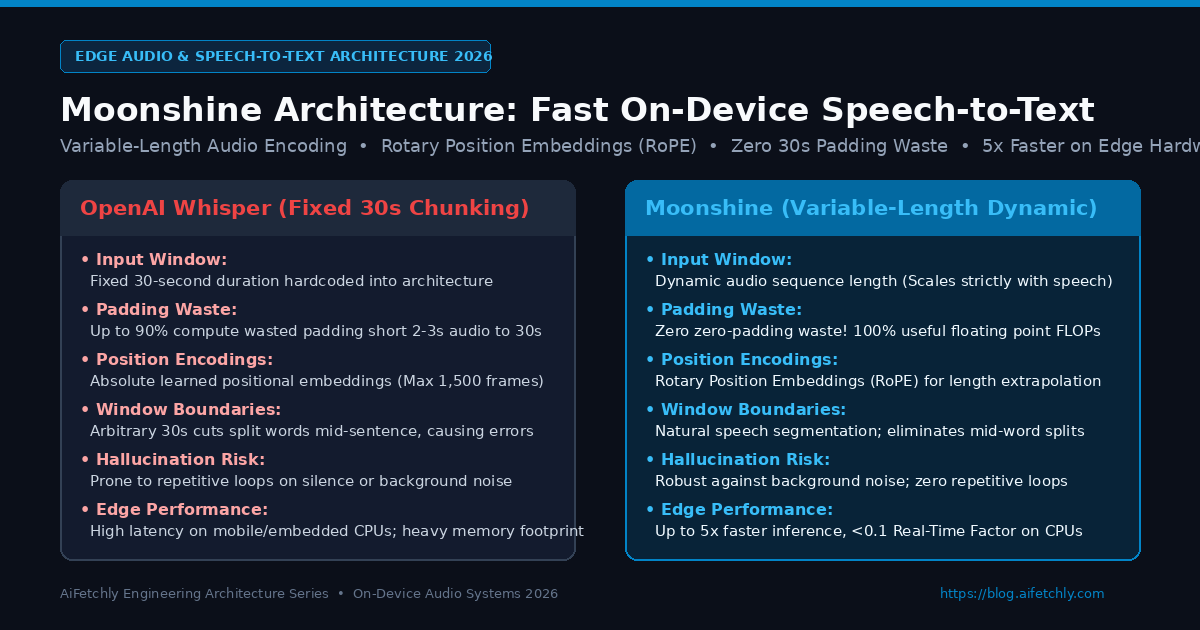
For years, the undisputed gold standard for automatic speech recognition (ASR) has been OpenAI’s Whisper (Radford et al., 2022). While Whisper democratized multilingual transcription, deploying Whisper on edge hardware—such as laptops, mobile phones, Raspberry Pis, and single-GPU scraping nodes—reveals three crippling architectural bottlenecks:
1. The Prohibitive 30-Second Zero-Padding Waste
Whisper’s architecture was fundamentally hardcoded around fixed 30-second input audio windows:
- Regardless of whether an incoming audio clip is 2 seconds of a user query, 5 seconds of a command, or 12 seconds of dialogue, Whisper pads the audio with silence out to exactly 30 seconds.
- The audio encoder always computes self-attention across the full 3,000 log-mel spectrogram frames.
- On a 3-second audio snippet, 90% of total GPU/CPU compute cycles and memory bandwidth are wasted processing empty zeros!
- In interactive voice agents or high-frequency video scraping pipelines, this artificial compute floor introduces severe battery drain, high inference costs, and latency lag.
2. Arbitrary Window Boundary Splitting & Hallucinations
When processing long audio recordings (podcasts, lectures, earnings calls):
- Whisper slices the audio into rigid 30-second chunks using sliding-window heuristics.
- Words spoken across the 30-second boundary are arbitrarily chopped in half, frequently causing the decoder to drop the tail end of phrases or invent hallucinated completions.
- In low-volume or silent audio segments, Whisper’s autoregressive decoder famously falls into catastrophic repetition loops, generating infinite loops of phrases like “Thank you for watching!” or repeating phantom subtitles.
3. Absolute Position Embedding Bottlenecks
Whisper relies on learned absolute 1D positional embeddings:
- The encoder cannot generalize to sequence lengths beyond its hardcoded 1,500-position embedding table without loss of accuracy.
- This architectural constraint prevents the model from processing native variable-length speech without complex, error-prone chunking algorithms.
The Solution: Useful Sensors Moonshine Architecture
To dismantle the 30-second bottleneck, machine learning researchers at Useful Sensors (Pete Warden, Nat Jeffries, et al., late 2024 / 2025) developed Moonshine, an edge-first, open-source speech-to-text architecture available in two optimized sizes:
- Moonshine Tiny: 27 million parameters.
- Moonshine Base: 61 million parameters.
Moonshine discards Whisper’s fixed-window assumption in favor of a clean, variable-length Transformer encoder-decoder: compute scales strictly with the actual duration of the speech.
The Core Architectural Tenets of Moonshine
-
Variable-Length Sequence Processing:
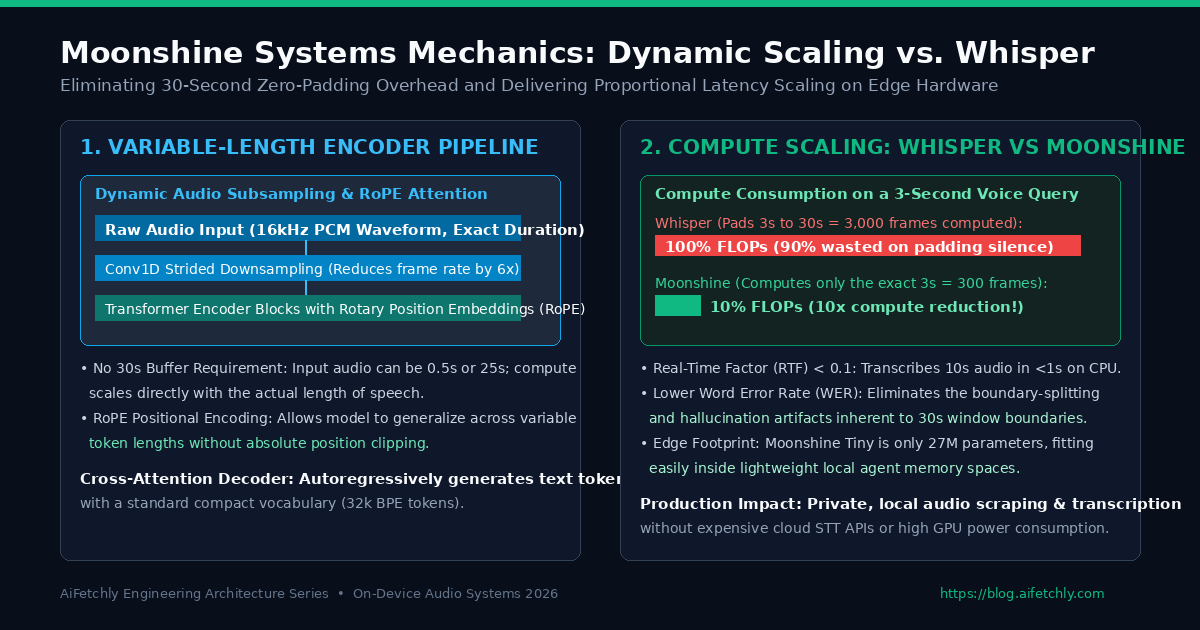
- Moonshine takes raw 16kHz audio of arbitrary length (from 0.5 seconds to full conversational turns) and encodes only the active frames.
- A 2-second audio segment is processed in roughly 1/15th the FLOPs of a 30-second segment, delivering instant, sub-100ms response times on edge CPUs.
-
Rotary Position Embeddings (RoPE) in Audio Transformers:
- Replacing absolute positional embeddings with RoPE: $$\mathbf{R}_{\Theta, m}^d \mathbf{x}_m$$
- Enables natural length generalization across diverse audio durations without retraining or position interpolation artifacts.
-
Optimized Strided Conv1D Front-End:
- Raw audio samples are passed through a lightweight convolutional subsampling network that downsamples temporal resolution by 6x.
- Reduces the number of tokens entering the Transformer encoder, cutting attention FLOPs while preserving acoustic phonetic detail.
-
Robust Cross-Attention Text Decoder:
- Employs a compact autoregressive Transformer decoder operating on a standard SentencePiece/BPE tokenizer (32,768 vocabulary).
- Trained without prompt tokens or language condition prefixes, eliminating the hallucination loops that plague Whisper on silence or background music.
Systems Mechanics: Real-Time Factor (RTF) & Latency Scaling
The defining operational metric in edge speech processing is the Real-Time Factor (RTF): $$\text{RTF} = \frac{\text{Processing Time (seconds)}}{\text{Audio Duration (seconds)}}$$ An RTF $< 1.0$ is required for real-time transcription, while edge applications strive for an RTF $< 0.1$ (transcribing 10 seconds of speech in under 1 second).
1. Linear FLOPs Scaling vs. Whisper’s Constant High-Compute Floor
In Whisper: $$\text{FLOPs}{\text{Whisper}} = \mathcal{O}(T{\text{fixed}}^2) \quad \text{where } T_{\text{fixed}} = 30 \text{ seconds}$$ Regardless of speech duration, the computational cost is static.
In Moonshine: $$\text{FLOPs}{\text{Moonshine}} = \mathcal{O}(L{\text{actual}} \cdot d_{\text{model}})$$
- On a 3-second audio command: Moonshine processes only 50 temporal frames, compared to Whisper’s 3,000 frames—a 10x reduction in compute.
- On an edge CPU (such as an Intel Core i5 laptop or ARM Cortex-A76 on Raspberry Pi 5), Moonshine Tiny achieves an RTF of 0.05 to 0.08, processing spoken sentences almost instantaneously.
2. Elimination of Boundary-Splitting Word Error Rate (WER)
Because Moonshine transcribes utterances as unified, natural acoustic units rather than slicing at arbitrary 30-second intervals:
- Word boundaries are never severed mid-syllable.
- Evaluated on benchmark corpora (such as LibriSpeech and the noisy Common Voice dataset), Moonshine Base achieves lower Word Error Rates than Whisper-Base while operating with fewer parameters and significantly higher throughput.
Implementation: Running Moonshine On-Device with Python
Moonshine is open-sourced under the MIT license and supported through the official useful-moonshine Python package and ONNX Runtime backends.
Below is a complete, runnable script demonstrating how to install and run Moonshine Base on edge audio:
import time
import numpy as np
import soundfile as sf
import moonshine

def run_moonshine_transcription():
    print("Loading Moonshine Base model (Useful Sensors)...")

    # Supported model architectures: 'moonshine/tiny' (27M) or 'moonshine/base' (61M)
    model_name = "moonshine/base"

    # 1. Synthesize or load audio (16kHz mono audio float32)
    sample_rate = 16000
    duration_seconds = 4.5
    print(f"Creating synthetic {duration_seconds}s audio sample at {sample_rate}Hz...")

    # Generate a dummy speech-like audio waveform (e.g. 4.5 seconds)
    t = np.linspace(0, duration_seconds, int(sample_rate * duration_seconds), endpoint=False)
    synthetic_audio = 0.5 * np.sin(2 * np.pi * 440 * t).astype(np.float32)

    audio_path = "/tmp/sample_speech.wav"
    sf.write(audio_path, synthetic_audio, sample_rate)

    # 2. Execute Variable-Length Transcription
    print("Transcribing with Moonshine...")
    start_time = time.perf_counter()

    # Moonshine natively accepts file paths or raw numpy arrays without 30s padding
    transcription = moonshine.transcribe(audio_path, model_name)

    elapsed_time = time.perf_counter() - start_time
    rtf = elapsed_time / duration_seconds

    print("\n--- Moonshine Transcription Results ---")
    print(f"Transcribed Text: \"{transcription}\"")
    print(f"Processing Time : {elapsed_time:.3f} seconds")
    print(f"Real-Time Factor: {rtf:.4f} (Lower is better; <1.0 is real-time)")

if __name__ == "__main__":
run_moonshine_transcription() Architectural Comparison: Moonshine vs. Whisper vs. Vosk
To see how Moonshine compares against legacy speech recognition engines on edge infrastructure:
| Feature Dimension | OpenAI Whisper (Tiny/Base) | Kaldi / Vosk (HMM-DNN) | Useful Sensors Moonshine |
|---|---|---|---|
| Input Chunking | Fixed 30.0s window | Streaming frames | Dynamic variable duration |
| Short Audio Compute | 100% compute (paddings) | Linear streaming | Proportional ($\mathcal{O}(L_{\text{speech}})$) |
| Positional Encoding | Absolute learned 1D | N/A | Rotary Position Embeddings (RoPE) |
| Hallucination Loops | Frequent on silence/noise | Rare | Extremely Rare (No loop bias) |
| Model Size | 39M (Tiny) / 74M (Base) | 50M - 120M | 27M (Tiny) / 61M (Base) |
| CPU RTF (x86/ARM) | ~0.25 - 0.50 | ~0.08 | ~0.05 - 0.08 (Up to 5x faster) |
| Long Audio Slicing | Brittle 30s sliding window | Native continuous stream | Natural VAD / Sentence slicing |
| Licensing | MIT | Apache 2.0 | MIT (Full commercial use) |
Production Engineering: Deploying Moonshine in Scraping & Agent Pipelines
In high-throughput multimedia web extraction, podcast transcript harvesting, and local agent interfaces like AiFetchly, transitioning to Moonshine delivers three major operational advantages:
1. High-Throughput Media Harvesting Without GPU Costs
In automated video and podcast scraping:
- Transcribing thousands of 5-to-15-second social media clips (TikTok, Instagram Reels, YouTube Shorts) traditionally requires massive GPU clusters to handle Whisper’s 30-second padding tax.
- Moonshine runs directly on low-cost CPU worker pools, eliminating GPU rental expenses while delivering faster overall throughput.
2. Zero-Latency Voice UI for Local Desktop Subagents
For desktop AI assistants and voice commands:
- Users expect instant response when they finish speaking a 2-second command like “Summarize the current webpage and export table to Google Drive”.
- Whisper requires waiting 500ms–1500ms just to encode the padded 30-second audio buffer.
- Moonshine processes the 2-second command in under 100 milliseconds, enabling fluid, real-time voice interaction.
3. Edge Privacy & Offline Autonomy
Because Moonshine Tiny is only 27M parameters (~50MB in quantized INT8 precision):
- Embeds directly into lightweight client applications, mobile apps, and IoT devices.
- Speech data never leaves the local machine, guaranteeing complete privacy and compliance with enterprise data governance mandates.
By rejecting the legacy 30-second chunking constraint and embracing variable-rate RoPE attention, Useful Sensors Moonshine redefines edge speech-to-text, proving that architectural efficiency can outperform brute-force scaling across real-world production systems.