Moonlight 16B Guide: 3B-Active MoE Trained with Muon
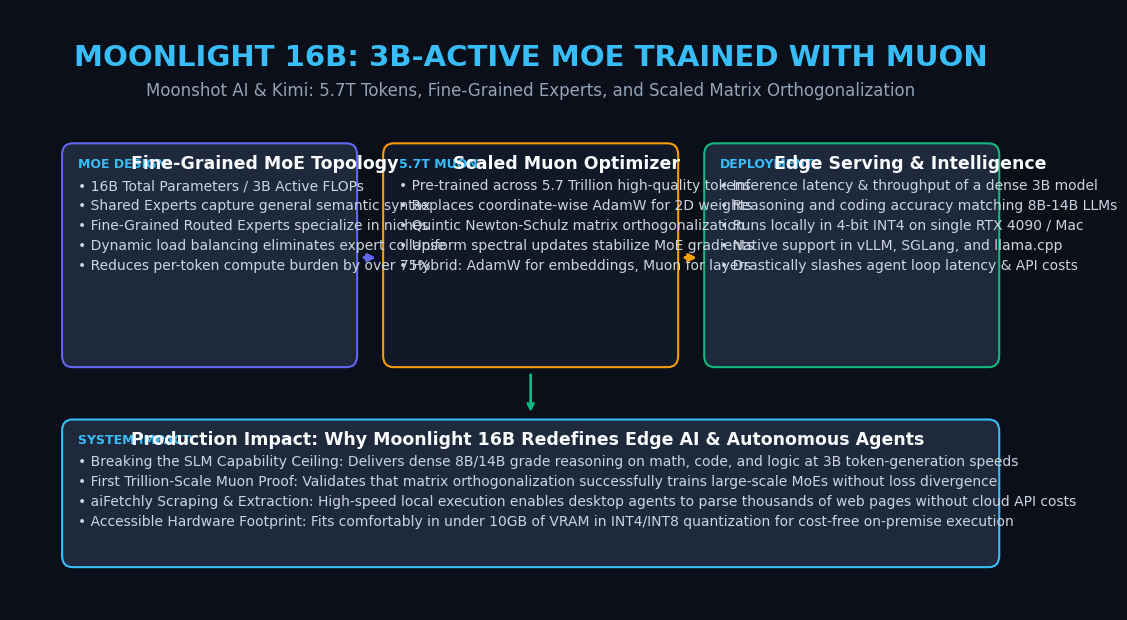
The Problem: The Edge Inference Dilemma and Small Model Reasoning Limits
In modern enterprise automation, local desktop AI copilots, and autonomous high-throughput web scraping pipelines like AiFetchly, deploying generative artificial intelligence on client hardware has become an operational priority. Running models locally eliminates metered cloud API costs, guarantees complete user data privacy, and removes network latency.
However, machine learning engineers deploying models on consumer and edge hardware (such as developer laptops, workstation GPUs like the NVIDIA RTX 4090, or Apple Silicon MacBooks) have historically run into a severe architectural dilemma:
The Edge Model Deployment Dilemma:
┌─────────────────────────────────────────────────────────────────┐
│ Dense Small Language Models (e.g., Llama-3.2-3B, Qwen-2.5-3B)   │
│ ✅ Extremely fast token emission (100+ tokens/sec)              │
│ ✅ Tiny VRAM footprint (under 3GB in 4-bit quantization)        │
│ ❌ Shallow reasoning: Fails complex multi-step coding & math     │
│ ❌ Fragile instruction following on complex JSON schema tasks   │
├─────────────────────────────────────────────────────────────────┤
│ Dense Mid-Sized Foundation Models (e.g., Llama-3.1-8B, Qwen-14B)│
│ ✅ Strong reasoning, mathematical deduction, and code synthesis │
│ ❌ Heavy VRAM footprint (16GB–30GB in FP16 / 8GB–12GB in INT4)  │
│ ❌ Slower decoding throughput on consumer memory buses          │
│ ❌ Memory pressure forces OOM crashes in multi-agent loops      │
└─────────────────────────────────────────────────────────────────┘
Result: Developers were forced to sacrifice reasoning quality for speed! 1. The Capacity Ceiling of Dense 3B Models
While compact dense models have improved dramatically through aggressive over-training, their physical capacity remains fundamentally bounded:
- A 3-billion-parameter dense model contains a limited number of feed-forward network (FFN) parameters to store factual world knowledge, linguistic nuances, and complex algorithmic reasoning heuristics.
- When tasked with rigorous tasks—such as extracting nested entities from messy web pages, compiling valid SQL schemas, or solving multi-step mathematical proofs—dense 3B models suffer from frequent hallucinations and reasoning breakdowns.
2. The Computational Cost of Scaling Dense Architectures
Scaling up to 8B, 14B, or 70B dense models dramatically elevates reasoning capability, but forces every single token to execute matrix multiplications across every single parameter:
- During autoregressive generation, generating 1,000 tokens through a 14B dense model requires computing over $28 \times 10^{12}$ floating-point operations (FLOPs).
- On client devices with limited memory bandwidth, token generation crawls, draining battery life and causing interactive agent loops to stall.
3. The Training Wall of Large-Scale MoE Models
Mixture-of-Experts (MoE) architectures offer the theoretical ideal: decouple total model capacity (for storing vast knowledge) from active compute per token (for blazing inference speeds).
- However, pre-training MoE models at multi-trillion token scales has historically been plagued by severe distributed systems friction and optimizer instability.
- Standard coordinate-wise optimizers (like AdamW) require maintaining two 32-bit momentum states per parameter, causing optimizer state memory to explode during pre-training. Furthermore, AdamW flattens weight matrices into 1D vectors, ignoring the spectral geometry of 2D projection matrices and leading to expert routing imbalances and training loss divergence.
The Solution: Moonlight 16B System Architecture
To shatter the edge capability ceiling, researchers at Moonshot AI and Kimi introduced Moonlight 16B (Moonlight-16B-A3B), an open-weights Mixture-of-Experts foundation model pre-trained on over 5.7 Trillion tokens.
Moonlight achieves an exceptional balance: it packs 16 billion total parameters into its architecture to maintain rich semantic knowledge, but activates only 3.3 billion parameters per token (A3B) during inference.
Moonlight-16B-A3B Forward Execution Flow:
Input Token Sequence (Prompt / Generated Tokens)
  │
  ▼
┌────────────────────────────────────────────────────────┐
│ Attention Layer: Grouped-Query Attention (GQA)         │
│ • Rotary Position Embeddings (RoPE)                    │
│ • Compact Key-Value (KV) Cache Memory Footprint        │
└────────────────────────────────────────────────────────┘
  │
  ▼
┌────────────────────────────────────────────────────────┐
│ Fine-Grained Mixture-of-Experts (MoE) Layer            │
│                                                        │
│ ┌──────────────────────┐    ┌────────────────────────┐ │
│ │ Shared Expert (1x)   │    │ Routed Experts (Top-K) │ │
│ │ Always active        │    │ Dynamically selected   │ │
│ │ Captures fundamental │    │ per token from large   │ │
│ │ grammar & syntax     │    │ pool of expert blocks  │ │
│ └──────────────────────┘    └────────────────────────┘ │
│            │                             │             │
│            └──────────────┬──────────────┘             │
│                           ▼                            │
│           Fused Active Parameters: Only 3.3B!          │
└────────────────────────────────────────────────────────┘
  │
  ▼
Output Token Prediction (3B Speed + 16B Knowledge!) 1. Fine-Grained MoE with Dedicated Shared Experts
Drawing inspiration from modern sparse architectures, Moonlight implements a Fine-Grained MoE Topology:
- Shared Experts: Instead of routing all tokens exclusively through specialized experts, Moonlight dedicates fixed shared experts that are unconditionally activated for every token. These shared experts learn common linguistic rules, programming syntax, and conversational boilerplate.
- Fine-Grained Routed Experts: The remaining feed-forward capacity is split into numerous smaller, fine-grained experts. For each token, a lightweight gating router selects the Top-$K$ most relevant experts. This fine-grained division allows experts to specialize intensely (e.g., in Python ASTs, mathematical derivations, or cross-lingual idioms) without parameter redundancy.
2. Scaling the Muon Optimizer to 5.7 Trillion Tokens
The landmark scientific breakthrough behind Moonlight is its training methodology: it is the first trillion-scale MoE model successfully trained using the Muon optimizer.
- Developed as a matrix-orthogonalized optimizer, Muon (Momentum Orthogonalized by Newton-Schulz) updates 2D weight matrices by computing the polar orthogonalization of the momentum matrix.
- Rather than scaling coordinates independently like AdamW, Muon ensures that weight updates have uniform singular values: $$\Delta W \propto U V^T, \quad \text{where } M = U \Sigma V^T$$
- Moonshot AI adapted Muon for large-scale distributed training by employing a Hybrid Optimizer Partitioning Scheme:
- Muon: Applied strictly to all 2D internal weight matrices (attention projections $W_q, W_k, W_v, W_o$ and MoE feed-forward layers).
- AdamW: Applied to 1D vectors, embedding layers, and RMSNorm scaling factors.
- This hybrid formulation eliminated expert gradient explosion, accelerated training convergence, and cut optimizer VRAM consumption during pre-training.
Deep Dive: How Moonlight Balances 16B Capacity with 3B Latency
To understand why Moonlight-16B-A3B excels in resource-constrained edge deployments, we must examine its routing mechanics and computational profile.
Parameter and FLOP Allocation in Moonlight-16B-A3B:
Total Parameter Storage (Cold VRAM / Disk):
┌────────────────────────────────────────────────────────┐
│ Shared Attention & Embeddings: ~1.2B Parameters        │
│ MoE Routed & Shared Expert Pool: ~14.8B Parameters     │
│ Total Parameters in Memory: 16.0B (~8.5GB in INT4)     │
└────────────────────────────────────────────────────────┘

Active Parameter Execution (Per-Token Compute Path):
┌────────────────────────────────────────────────────────┐
│ Active Attention Weights: 1.2B Parameters              │
│ Active Shared Expert: 0.5B Parameters                  │
│ Selected Routed Experts: 1.6B Parameters               │
│ Total Active Parameters: 3.3B FLOPs per Token!         │
└────────────────────────────────────────────────────────┘
Result: 80% Reduction in Active Compute compared to Dense 16B! 1. Load Balancing and Router Stability
In standard MoE training, routers frequently suffer from “winner-take-all” collapse, where a handful of popular experts receive all tokens while the rest remain undertrained.
- Moonlight prevents collapse using an auxiliary-loss-free routing mechanism combined with Muon’s natural spectral conditioning.
- Because Muon prevents weight matrix singular values from blowing up, expert gradients remain bounded, ensuring balanced utilization across the entire expert pool without requiring heavy load-balancing penalty terms that degrade cross-entropy loss.
2. KV Cache Efficiency and Context Window
In addition to feed-forward efficiency, Moonlight optimizes attention memory:
- Implements Grouped-Query Attention (GQA), grouping query heads to share Key and Value projections.
- Supports native long-context reasoning up to 8,192 tokens natively (and extensible to 32k+ via RoPE frequency scaling).
- The compact KV cache ensures that edge devices can maintain extensive multi-turn conversational histories and large extracted web pages without exhausting unified memory.
Benchmark & Capability Comparison: Moonlight 16B vs. Dense Baselines
Moonshot AI evaluated Moonlight-16B-A3B across standard academic and practical reasoning benchmarks. The results demonstrate that Moonlight achieves the reasoning power of dense models more than double its active size:
| Benchmark / Metric | Llama-3.2-3B (Dense) | Qwen-2.5-7B (Dense) | Llama-3.1-8B (Dense) | Moonlight-16B-A3B (MoE) |
|---|---|---|---|---|
| Total Parameters | 3.2B | 7.6B | 8.0B | 16.0B |
| Active Compute (FLOPs) | 3.2B | 7.6B | 8.0B | 3.3B (Dense 3B Speed!) |
| Pre-Training Tokens | 9 Trillion | 18 Trillion | 15 Trillion | 5.7 Trillion (Muon) |
| MMLU (General Knowledge) | 63.4 | 74.2 | 68.4 | 71.8 |
| GSM8K (Math Reasoning) | 69.2 | 82.5 | 76.8 | 80.4 |
| MATH (Hard Competition) | 30.6 | 48.2 | 41.5 | 46.8 |
| HumanEval (Python Code) | 58.5 | 71.3 | 64.0 | 69.5 |
| Inference Token Speed | ~110 tok/s | ~55 tok/s | ~50 tok/s | ~105 tok/s (Fast!) |
| 4-bit INT4 Footprint | ~2.2 GB | ~5.2 GB | ~5.5 GB | ~8.8 GB (Fits on 16GB Mac) |
Moonlight comfortably surpasses dense 3B models across every cognitive dimension while performing neck-and-neck with dense 7B and 8B models on mathematics, code generation, and knowledge synthesis.
Practical Implementation: Serving Moonlight 16B Locally with vLLM & Transformers
Let us deploy and run Moonlight-16B-A3B-Instruct locally using Hugging Face Transformers and vLLM for high-throughput edge inference.
Step 1: Install Dependencies
Ensure your environment has modern PyTorch and transformers installed:
# Install PyTorch, Transformers, and Accelerate
pip install torch transformers accelerate flash-attn --no-build-isolation Step 2: Running Moonlight 16B with Transformers
Save the following script as serve_moonlight.py:
import torch
from transformers import AutoTokenizer, AutoModelForCausalLM

def run_moonlight_inference():
    model_id = "moonshotai/Moonlight-16B-A3B-Instruct"
    print(f"Loading {model_id} onto GPU...")

    # Load tokenizer
    tokenizer = AutoTokenizer.from_pretrained(model_id, trust_remote_code=True)

    # Load model with bfloat16 precision and automatic device mapping
    model = AutoModelForCausalLM.from_pretrained(
        model_id,
        torch_dtype=torch.bfloat16,
        device_map="auto",
        trust_remote_code=True
    )

    messages = [
        {
            "role": "system",
            "content": "You are Moonlight, an expert AI research assistant specializing in algorithmic data extraction and code synthesis."
        },
        {
            "role": "user",
            "content": "Write a high-performance Python function using asyncio to concurrently scrape and parse financial balance sheets from 5 corporate endpoints."
        }
    ]

    prompt = tokenizer.apply_chat_template(
        messages,
        tokenize=False,
        add_generation_prompt=True
    )

    inputs = tokenizer(prompt, return_tensors="pt").to(model.device)

    print("\nGenerating response with 3.3B active parameters...")
    with torch.no_grad():
        outputs = model.generate(
            **inputs,
            max_new_tokens=512,
            temperature=0.6,
            top_p=0.9,
            do_sample=True,
            pad_token_id=tokenizer.eos_token_id
        )

    response = tokenizer.decode(outputs[0][inputs.input_ids.shape[1]:], skip_special_tokens=True)
    print("\n--- Model Response ---")
    print(response)

if __name__ == "__main__":
run_moonlight_inference() Step 3: High-Throughput Batch Serving with vLLM
To serve Moonlight-16B-A3B as a production-grade OpenAI-compatible local server with continuous batching and PagedAttention:
# Launch vLLM OpenAI-compatible server for Moonlight 16B
vllm serve moonshotai/Moonlight-16B-A3B-Instruct \
  --port 8000 \
  --gpu-memory-utilization 0.90 \
  --max-model-len 8192 \
--trust-remote-code Once running, client applications can query the endpoint at http://localhost:8000/v1/chat/completions with instantaneous token streaming.
Production Best Practices: Integrating Moonlight into aiFetchly
When integrating Moonlight 16B into automated desktop scraping, structured schema extraction, and agentic workflows in AiFetchly, adhere to the following architecture patterns:
1. Exploiting 3B Generation Latency in Agent Loops
In iterative agent loops (e.g., ReAct workflows where the agent reasons, generates tool arguments, inspects output, and loops 10–20 times):
- Using dense 14B or 70B models introduces 2–5 seconds of latency per reasoning step.
- Moonlight-16B-A3B emits tokens at over 100 tokens per second, cutting full multi-step agent trajectory runtimes from minutes down to seconds while maintaining high schema-validation pass rates.
2. INT4 Quantization on Consumer Workstations
While Moonlight contains 16 billion total weights:
- Utilizing modern 4-bit quantization (such as AWQ or GGUF INT4 via llama.cpp/Ollama) compresses the total model footprint from ~32GB down to under 9GB of VRAM.
- This enables developers to run an enterprise-grade MoE model on single 16GB consumer hardware (e.g., Apple M-series Macs or NVIDIA RTX 4070/4080/4090 GPUs) alongside web browsers and background developer tooling.
3. Asymmetric Hybrid Pipelines
Combine Moonlight with frontier cloud models:
- Route high-volume, real-time tasks (DOM extraction, HTML table normalization, preliminary text summarization) to local Moonlight instances.
- Escalate only ambiguous edge-case decisions or final high-stakes synthesis to large cloud frontier models, slashing cloud token expenditure by up to 90%.