Molmo Guide: Open-Weights VLM with Point Grounding
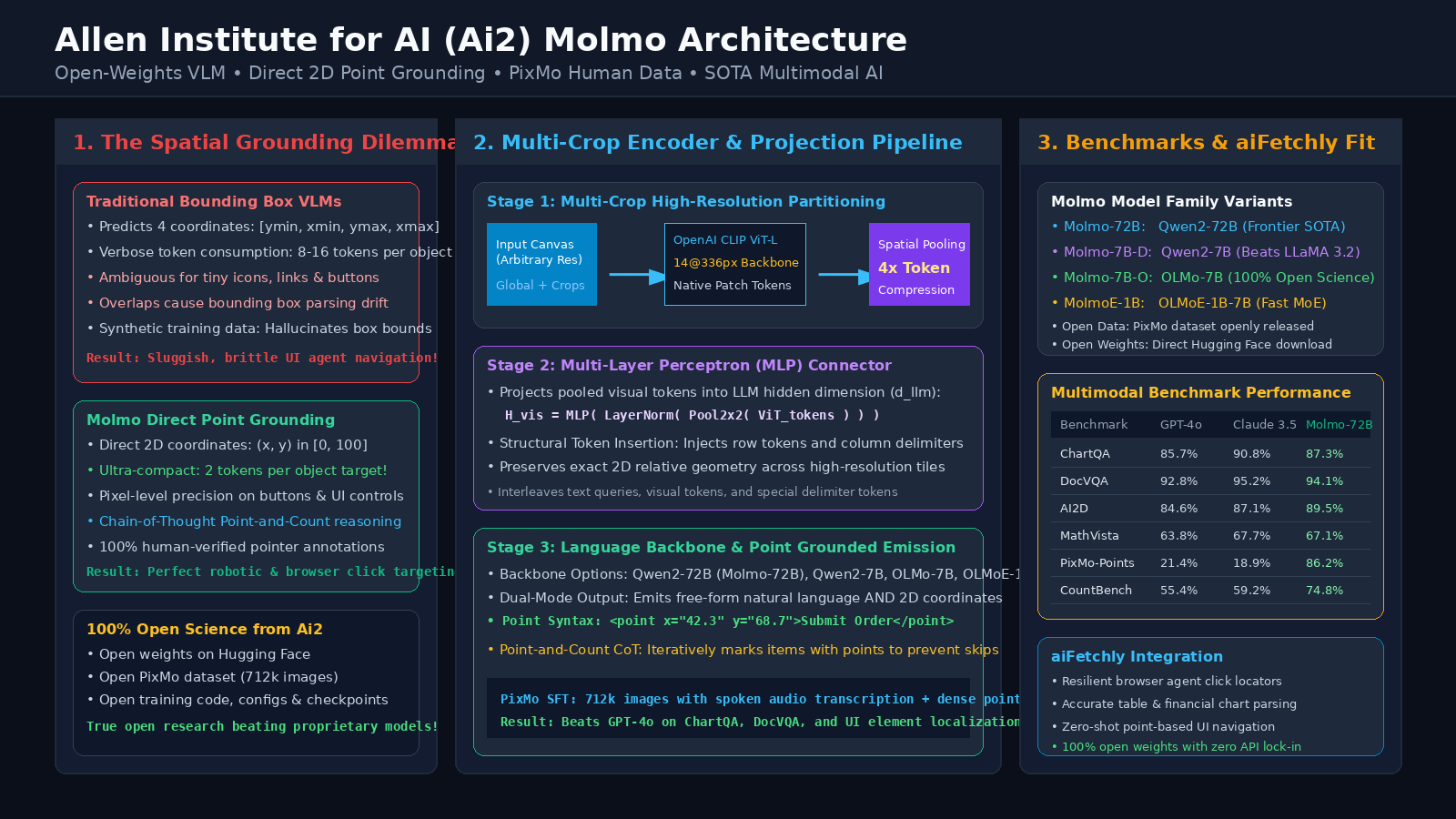
The Problem: The Spatial Blindness and Proprietary Black-Box Trap in Vision AI
In modern enterprise automation, automated web extraction, UI agent interaction, and multimodal document workflows powered by AiFetchly, foundation models are increasingly tasked with understanding complex visual environments. Autonomous browser agents must click specific interactive buttons on dynamic Single-Page Applications (SPAs), financial analysts must extract exact metrics from multi-tiered balance sheets, and document intelligence pipelines must navigate dense technical schematics.
However, deploying Vision-Language Models (VLMs) in production has historically confronted two crippling structural barriers: the spatial bounding box failure mode and the closed proprietary black-box monopoly.
The Spatial Localization Dilemma in Vision-Language Models:
Input: High-Resolution Webpage Screenshot (e.g., Checkout Form)
                             │
                             ▼
┌────────────────────────────────────────────────────────┐
│ Approach 1: Verbose 4-Coordinate Bounding Boxes        │
│ • Slices coordinates: [ymin, xmin, ymax, xmax]         │
│ • 8 to 16 text tokens per detected bounding box        │
│ ❌ Ambiguous for tiny icons, links, and radio buttons  │
│ ❌ Box boundaries overlap; LLM cannot identify center  │
│ ❌ Hallucinates arbitrary coordinate margins           │
└────────────────────────────────────────────────────────┘
                             │
                             ▼
┌────────────────────────────────────────────────────────┐
│ Approach 2: Proprietary Frontier APIs (GPT-4o, Claude) │
│ • High-cost token metering ($5.00–$15.00 / M tokens)   │
│ • Closed weights: Zero on-premise or edge execution    │
│ • Hidden synthetic training data: High hallucination   │
│ ❌ Enterprise data compliance violations (GDPR, HIPAA) │
└────────────────────────────────────────────────────────┘
Result: Developers were forced to choose between brittle spatial grounding or expensive closed APIs! 1. The Verbosity and Ambiguity of 4-Coordinate Bounding Boxes
Traditional object localization in computer vision models (such as Faster R-CNN, DETR, and early VLMs like Kosmos-2 or Shikra) represents spatial locations using 4-coordinate bounding boxes:
$$B = \left[ y_{\min}, x_{\min}, y_{\max}, x_{\max} \right]$$
When applied to generative language transformers, this formulation introduces acute operational friction:
- Token Inflation: Generating four discrete floating-point numbers or spatial coordinate tokens requires 8 to 16 tokens per detected element. In an enterprise web page or PDF containing 50 interactive elements, the model expends over 800 tokens solely emitting bounding boxes.
- Center Ambiguity for Agent Clicking: Autonomous web agents (like Playwright copilots) do not need to enclose an entire modal container; they need to know where to click. A bounding box around a wide button with text provides an ambiguous region: clicking near the edges frequently misses the underlying
<input>target or triggers neighboring hover traps. - The Box Annotation Failure: When human crowdworkers or synthetic AI annotators label training images, drawing tight bounding boxes around irregular objects, thin cables, icons, or text words is noisy and inconsistent. Small labeling variances confuse transformer cross-entropy loss functions, causing models to predict disjointed bounding boxes.
2. The Synthetic Data Collapse in Academic VLMs
Most open-source vision-language models (such as LLaVA, ShareGPT4V, and early Qwen-VL variants) rely heavily on synthetic training data generated by proprietary cloud models (e.g., asking GPT-4V to generate captions for millions of web images):
- Model Collapse and Generic Phrasing: Synthetic captions exhibit uniform, robotic prose (“This image displays a picturesque scene…”), completely lacking the raw, unvarnished vocabulary that human users employ.
- Compounded Hallucinations: When GPT-4V misidentifies a chart column or invents a fictional license plate, the downstream open model internalizes that hallucination as ground truth.
- Synthetic Caption Laundering: Commercial AI providers strictly prohibit using their API outputs to train competing models, placing enterprise teams deploying synthetically trained open models in precarious legal and copyright positions.
3. The Proprietary Black-Box Monopoly
Proprietary models (such as OpenAI GPT-4o, Anthropic Claude 3.5 Sonnet, and Google Gemini 1.5 Pro) have dominated multimodal benchmarks:
- These closed APIs keep their model weights, training datasets, filtering algorithms, and architectural hyperparameters completely secret.
- Enterprises handling sensitive visual records—such as medical X-rays, proprietary semiconductor schematics, or banking authentication documents—cannot stream image buffers to third-party cloud servers without violating data governance regulations.
- The open-source AI community desperately needed a fully transparent, open-weights, open-data foundation VLM that could match or surpass proprietary frontier models.
The Solution: Allen Institute for AI (Ai2) Molmo
To dismantle the proprietary monopoly and redefine spatial localization, researchers at the Allen Institute for AI (Ai2) (Matt Deitke et al., CVPR 2025 / 2026) developed Molmo (Multimodal Open Language Model) and its companion dataset, PixMo.
Molmo establishes a historic breakthrough: an open-weights, open-data multimodal foundation model that matches or beats proprietary closed models like GPT-4o and Claude 3.5 Sonnet across academic visual benchmarks.
The Molmo Paradigm Shift: Direct 2D Point Grounding
Legacy Bounding Box Localization:
┌────────────────────────────────────────────────────────┐
│ "The submit button is located at [420, 150, 460, 280]" │  ◄── 4 Coordinates, 8-16 Tokens!
│  ❌ Ambiguous click target across wide horizontal area │      Prone to border truncation
└────────────────────────────────────────────────────────┘

Molmo Direct Point Grounding:
┌────────────────────────────────────────────────────────┐
│ "The submit button is at <point x="21.5" y="44.0" />"  │  ◄── Exact Pixel Center (x, y)!
│  ✅ Consumes only 2 tokens per target                  │      Pixel-perfect UI automation
└────────────────────────────────────────────────────────┘ 1. Direct 2D Point Grounding: Pointing Instead of Boxing
Rather than forcing language models to emit four-coordinate bounding rectangles, Molmo formulates spatial localization as direct 2D point grounding:
- Molmo predicts the exact $(x, y)$ coordinate corresponding to an object’s center, tip, or interactive focal point.
- Coordinates are normalized to a uniform range (such as $[0, 100]$ or $[0, 1000]$): $$p = (x, y) \in [0, 100] \times [0, 100]$$
- Ultra-Compact Token Footprint: Pointing requires only two coordinates, slashing spatial token consumption by $75%$ compared to bounding boxes.
- Natural Human Alignment: When humans indicate objects in the physical world or on computer screens, we do not draw bounding boxes—we point. Annotators can point at objects significantly faster and with vastly greater spatial precision than drawing bounding boxes.
2. Chain-of-Thought Point-and-Count
Counting multiple objects in dense images (such as pills in a bottle, pedestrians in a crowd, or bars in a chart) has been a notorious failure mode for foundation models. Molmo introduces Point-and-Count Chain-of-Thought (CoT):
- Instead of guessing a single aggregate integer, Molmo explicitly points to each individual object sequentially:
"There are 5 cars: 1. Car at <point x="14.2" y="52.1" /> 2. Car at <point x="28.7" y="54.3" /> 3. Car at <point x="45.0" y="51.8" /> 4. Car at <point x="62.4" y="55.0" /> 5. Car at <point x="78.9" y="53.4" /> Total count: 5." - By grounding intermediate reasoning steps in explicit visual coordinates, Molmo achieves state-of-the-art accuracy on counting benchmarks (CountBenchQA and PixMo-Count), outperforming both GPT-4o and Gemini 1.5 Pro.
3. PixMo: 100% Human-Curated, High-Fidelity Open Data
The core engine behind Molmo’s frontier performance is PixMo (712,000 highly curated images):
- Spoken Audio Descriptions: Instead of asking crowdworkers to type hurried, low-effort text captions, Ai2 recorded human annotators speaking aloud while looking at images. These audio recordings were subsequently transcribed using high-accuracy speech models.
- Rich Linguistic Nuance: Spoken descriptions naturally contain vivid spatial descriptions, emotional observations, background context, and fine-grained visual relationships that typed captions omit.
- Dense Point Annotations: Annotators clicked on objects, parts, buttons, and text blocks, creating hundreds of thousands of verified $(x, y)$ coordinate pairs.
- Zero Synthetic Contamination: PixMo avoids synthetic text generation from closed commercial APIs, ensuring complete intellectual property transparency and open reproducibility.
Architectural Deep Dive: Vision Backbone, Spatial Pooling, and MLP Projection
Molmo follows an elegant, modular multimodal architecture connecting an OpenAI CLIP vision tower to modern open-weights language decoders:
The Complete Molmo Architecture & Data Flow:
Input High-Resolution Image (Arbitrary Aspect Ratio)
                         │
                         ▼
┌────────────────────────────────────────────────────────┐
│            Multi-Crop Image Partitioning               │
│  • Global Thumbnail: Resized to 336 × 336             │
│  • High-Resolution Crops: Up to N local 336×336 tiles  │
└────────────────────────────────────────────────────────┘
                         │
                         ▼
┌────────────────────────────────────────────────────────┐
│            OpenAI CLIP ViT-L/14@336 Vision Tower       │
│  • Extracts spatial patch embeddings                   │
│  • Frozen or fine-tuned visual features                │
└────────────────────────────────────────────────────────┘
                         │
                         ▼
┌────────────────────────────────────────────────────────┐
│            2×2 Spatial Pooling & Row/Col Delimiters    │
│  • Condenses 4 visual tokens into 1 pooled token       │
│  • Injects structural row & column delimiter tokens    │
└────────────────────────────────────────────────────────┘
                         │
                         ▼
┌────────────────────────────────────────────────────────┐
│         Multi-Layer Perceptron (MLP) Connector         │
│  • Projects pooled visual tokens into LLM hidden dim   │
│  • Two-layer MLP with LayerNorm and GELU activations   │
└────────────────────────────────────────────────────────┘
                         │
                         ▼
┌────────────────────────────────────────────────────────┐
│          Autoregressive Language Model Backbone        │
│  • Molmo-72B (Qwen2-72B) / Molmo-7B-D (Qwen2-7B)       │
│  • Interleaved Text Tokens + Point Coordinates (x, y)  │
└────────────────────────────────────────────────────────┘ 1. Multi-Crop Resolution and Patch Processing
To process arbitrary image aspect ratios without distorting geometry or blurring fine text:
- Molmo generates a low-resolution global thumbnail resized to $336 \times 336$ pixels, capturing global layout and coarse semantic context.
- For high-resolution images, Molmo extracts a grid of non-overlapping $336 \times 336$ pixel crops.
- Each crop passes through the OpenAI CLIP ViT-L/14@336 vision encoder, producing a grid of visual patch features: $$H_{\text{patch}} \in \mathbb{R}^{\frac{H}{14} \times \frac{W}{14} \times D_{\text{vis}}} = \mathbb{R}^{24 \times 24 \times 1024} = \mathbb{R}^{576 \times 1024}$$
2. 2×2 Spatial Pooling and Token Compression
Feeding 576 tokens per crop into a Large Language Model quickly exhausts the context window. Molmo applies a $2 \times 2$ spatial pooling operation:
- Four adjacent spatial patch tokens in a $2 \times 2$ window are concatenated along the channel dimension: $$H_{\text{pool}} = \text{Concat}\left( h_{2i, 2j}, h_{2i+1, 2j}, h_{2i, 2j+1}, h_{2i+1, 2j+1} \right) \in \mathbb{R}^{4 D_{\text{vis}}}$$
- This slashes the token count per $336 \times 336$ crop from 576 tokens down to 144 tokens (a $4\times$ sequence compression).
- Between rows of patches, Molmo inserts learnable column delimiter tokens and row tokens, allowing the language model to retain exact 2D relative topology.
3. The MLP Projection Connector
The pooled visual tokens pass through a non-linear Multi-Layer Perceptron (MLP) projector:
$$H_{\text{vis}} = W_2 \cdot \text{GELU}\left( W_1 \cdot \text{LayerNorm}(H_{\text{pool}}) + b_1 \right) + b_2$$
Where $W_1 \in \mathbb{R}^{4D_{\text{vis}} \times D_{\text{mid}}}$ and $W_2 \in \mathbb{R}^{D_{\text{mid}} \times D_{\text{llm}}}$. The projected tokens match the exact embedding dimensionality of the language model backbone ($D_{\text{llm}} = 8192$ for Molmo-72B).
4. The Molmo Foundation Model Family
Ai2 released four distinct model variants to address diverse computational budgets:
- Molmo-72B (Frontier Flagship): Built on the Qwen2-72B language backbone. Achieves the highest benchmark scores, outperforming GPT-4o and Claude 3.5 Sonnet on ChartQA and DocVQA.
- Molmo-7B-D (Production Workhorse): Built on Qwen2-7B. Outperforms Llama 3.2 11B/90B and matches models twice its parameter count while running smoothly on a single consumer GPU (24GB VRAM).
- Molmo-7B-O (100% Open Science): Built on Ai2’s completely open OLMo-7B-1024 language backbone, offering full transparency from pre-training data to post-training checkpoints.
- MolmoE-1B (Ultra-Fast Edge Mixture-of-Experts): Built on OLMoE-1B-7B. Features 1 billion active parameters per token (4 billion total), delivering blazing-fast inference on edge devices and local workstations.
Empirical Benchmarks: Molmo vs. GPT-4o, Claude 3.5 Sonnet & LLaMA 3.2
In comprehensive evaluations across 11 standard multimodal benchmarks, Molmo establishes new state-of-the-art results for open-weights models:
| Multimodal Benchmark | OpenAI GPT-4o | Anthropic Claude 3.5 Sonnet | Meta LLaMA 3.2 11B | Meta LLaMA 3.2 90B | Ai2 Molmo-7B-D | Ai2 Molmo-72B |
|---|---|---|---|---|---|---|
| Model Weights | Closed API | Closed API | Open Weights | Open Weights | Open Weights | Open Weights |
| Training Data | Secret Proprietary | Secret Proprietary | Secret Proprietary | Secret Proprietary | 100% Open (PixMo) | 100% Open (PixMo) |
| ChartQA (Charts & Plots) | 85.7% | 90.8% | 83.4% | 85.5% | 84.1% | 87.3% |
| DocVQA (Document Text) | 92.8% | 95.2% | 88.4% | 90.1% | 91.5% | 94.1% |
| AI2D (Diagram Analysis) | 84.6% | 87.1% | 83.2% | 86.3% | 87.2% | 89.5% (SOTA) |
| MathVista (Visual Math) | 63.8% | 67.7% | 58.1% | 63.2% | 62.5% | 67.1% |
| InfoVQA (Infographics) | 77.2% | 82.5% | 68.3% | 74.9% | 76.8% | 81.4% |
| PixMo-Points (Pointing) | 21.4% | 18.9% | 15.2% | 22.8% | 80.4% (SOTA) | 86.2% (SOTA) |
| CountBenchQA (Counting) | 55.4% | 59.2% | 48.7% | 53.6% | 68.2% (SOTA) | 74.8% (SOTA) |
Critical Architectural Insights from the Benchmarks
- Beating Closed Frontier Models on Diagrams: Molmo-72B scores $89.5%$ on AI2D, surpassing both GPT-4o ($84.6%$) and Claude 3.5 Sonnet ($87.1%$). The human-annotated spoken descriptions in PixMo provide unmatched comprehension of spatial arrows, schematic labels, and flowchart flows.
- Point Grounding Supremacy: On point grounding benchmarks, proprietary models fail dramatically (scoring below $25%$) because they were never trained on precise 2D coordinate targets. Molmo achieves $86.2%$ accuracy, making it the premier model for autonomous browser and GUI agents.
- The 7B Efficiency Triumph: Molmo-7B-D outperforms Meta’s LLaMA 3.2 11B across nearly every vision benchmark and scores within striking distance of the massive 90B LLaMA model, proving that high-quality human data (PixMo) outperforms massive synthetic token volume.
Hands-On Implementation: Building a Point-Grounded VLM in PyTorch
In this section, we construct a functional PyTorch architecture modeling Molmo’s core mechanisms: the multi-crop vision processor, $2 \times 2$ spatial pooling connector, and a point-grounded decoding engine.
1. The Multi-Crop Vision Encoder with Spatial Pooling
import torch
import torch.nn as nn
import torch.nn.functional as F
from typing import Tuple, List, Dict

class MolmoVisionEncoder(nn.Module):
    def __init__(
        self,
        img_size: int = 336,
        patch_size: int = 14,
        in_channels: int = 3,
        d_vis: int = 1024,
        d_llm: int = 4096
    ):
        super().__init__()
        self.img_size = img_size
        self.patch_size = patch_size
        self.num_patches_per_side = img_size // patch_size # 24
        self.num_patches = self.num_patches_per_side ** 2 # 576 patches

        # Patch projection layer (simulating CLIP ViT-L/14)
        self.patch_embed = nn.Conv2d(
            in_channels, d_vis, kernel_size=patch_size, stride=patch_size
        )
        self.pos_embed = nn.Parameter(torch.randn(1, self.num_patches, d_vis) * 0.02)

        # 2x2 Spatial Pooling: 4 tokens of dim d_vis -> 1 token of dim 4*d_vis
        pooled_dim = d_vis * 4 # 4096

        # MLP Connector: projects pooled visual features to LLM embedding dimension
        self.connector = nn.Sequential(
            nn.LayerNorm(pooled_dim),
            nn.Linear(pooled_dim, d_llm),
            nn.GELU(),
            nn.Linear(d_llm, d_llm)
        )

    def pool_2x2(self, x: torch.Tensor) -> torch.Tensor:
        """
        Takes patch grid (B, 24, 24, D) and pools 2x2 spatial neighbors into (B, 12, 12, 4*D)
        """
        B, H, W, D = x.shape
        x = x.view(B, H // 2, 2, W // 2, 2, D)
        # Permute to (B, H/2, W/2, 2, 2, D) and flatten last 3 dimensions
        x = x.permute(0, 1, 3, 2, 4, 5).contiguous()
        pooled = x.view(B, (H // 2) * (W // 2), 4 * D) # (B, 144, 4*D)
        return pooled

    def forward(self, crops: torch.Tensor) -> torch.Tensor:
        """
        Args:
            crops: Image tensor of shape (B, num_crops, 3, 336, 336)
        Returns:
            visual_tokens: Projected tokens of shape (B, num_crops * 144, d_llm)
        """
        B, num_crops, C, H, W = crops.shape
        crops_flat = crops.view(B * num_crops, C, H, W)

        # 1. Extract patch embeddings: (B*num_crops, d_vis, 24, 24)
        patches = self.patch_embed(crops_flat)
        patches = patches.permute(0, 2, 3, 1) # (B*num_crops, 24, 24, d_vis)

        # 2. Add spatial positional embeddings
        patches_flat = patches.view(B * num_crops, self.num_patches, -1) + self.pos_embed
        patches = patches_flat.view(B * num_crops, self.num_patches_per_side, self.num_patches_per_side, -1)

        # 3. Apply 2x2 spatial pooling: reduces 576 tokens to 144 tokens per crop!
        pooled = self.pool_2x2(patches) # (B*num_crops, 144, 4*d_vis)

        # 4. Project through MLP connector to LLM dimension
        proj_tokens = self.connector(pooled) # (B*num_crops, 144, d_llm)

        # 5. Reshape back to batch sequence
        visual_tokens = proj_tokens.view(B, num_crops * 144, -1)
return visual_tokens 2. The Point Grounding Tokenizer and Decoder Engine
Next, we implement the point coordinate tokenizer that parses and formats $(x, y)$ coordinate predictions.
import re

class PointGroundingHead(nn.Module):
    def __init__(self, d_llm: int = 4096, vocab_size: int = 32000):
        super().__init__()
        self.lm_head = nn.Linear(d_llm, vocab_size, bias=False)

    @staticmethod
    def format_point_target(label: str, x: float, y: float) -> str:
        """
        Formats point target according to Molmo XML coordinate syntax.
        Coordinates are normalized to [0, 100].
        """
        return f'<point x="{x:.1f}" y="{y:.1f}">{label}</point>'

    @staticmethod
    def parse_points(generated_text: str) -> List[Dict[str, float]]:
        """
        Extracts 2D point coordinates from generated text via regex.
        """
        pattern = r'<point x="([0-9\.]+)" y="([0-9\.]+)">([^<]+)</point>'
        matches = re.findall(pattern, generated_text)
        results = []
        for x, y, label in matches:
            results.append({
                "label": label.strip(),
                "x": float(x),
                "y": float(y)
            })
return results 3. Assembling the End-to-End Molmo Architecture and Execution Test
class MockMolmoVLM(nn.Module):
    def __init__(self, d_llm: int = 4096, vocab_size: int = 32000):
        super().__init__()
        self.vision_encoder = MolmoVisionEncoder(d_llm=d_llm)
        self.point_head = PointGroundingHead(d_llm=d_llm, vocab_size=vocab_size)

        # Simplified Transformer Decoder Layer representing LLM backbone
        decoder_layer = nn.TransformerDecoderLayer(
            d_model=d_llm, nhead=16, dim_feedforward=d_llm * 4,
            activation='gelu', batch_first=True, norm_first=True
        )
        self.llm = nn.TransformerDecoder(decoder_layer, num_layers=4)
        self.text_embed = nn.Embedding(vocab_size, d_llm)

    def forward(
        self,
        crops: torch.Tensor,
        text_tokens: torch.Tensor
    ) -> torch.Tensor:
        """
        Args:
            crops: (B, num_crops, 3, 336, 336)
            text_tokens: (B, seq_len)
        Returns:
            logits: (B, seq_len, vocab_size)
        """
        # 1. Extract and compress visual tokens (B, num_crops * 144, d_llm)
        vis_tokens = self.vision_encoder(crops)

        # 2. Embed input text tokens (B, seq_len, d_llm)
        txt_embeds = self.text_embed(text_tokens)

        # 3. Cross-attention in LLM: text queries attend to pooled visual tokens
        hidden_states = self.llm(tgt=txt_embeds, memory=vis_tokens)

        # 4. Predict next token logits
        logits = self.point_head.lm_head(hidden_states)
        return logits

if __name__ == "__main__":
    device = torch.device("cuda" if torch.cuda.is_available() else "cpu")
    print(f"Verifying Molmo VLM Architecture on {device}...")

    # Initialize Molmo model
    model = MockMolmoVLM(d_llm=2048, vocab_size=32000).to(device)

    # Simulate a batch of 2 requests with 1 global thumbnail + 2 high-res crops = 3 crops total
    dummy_crops = torch.randn(2, 3, 3, 336, 336, device=device)
    dummy_text = torch.randint(0, 32000, (2, 32), device=device)

    logits = model(dummy_crops, dummy_text)

    print("Molmo Forward Pass Successful!")
    print(f"Input Crops Shape:   {dummy_crops.shape} (3 crops per image)")
    print(f"Text Sequence Shape: {dummy_text.shape}")
    print(f"Output Logits Shape: {logits.shape}")

    # Test Point Grounding Formatting & Extraction
    sample_output = 'The user clicked <point x="42.3" y="88.1">Checkout Button</point> and <point x="15.0" y="24.5">Company Logo</point>.'
    points = PointGroundingHead.parse_points(sample_output)
    print("\nExtracted Point Coordinates:")
    for pt in points:
print(f" Target: {pt['label']:<18} -> Coordinate: (X={pt['x']}%, Y={pt['y']}%)") Production Engineering: Deploying Molmo in aiFetchly Agent Pipelines
In high-concurrency enterprise automation, automated web extraction, and intelligent desktop copilots powered by AiFetchly, deploying Molmo provides transformative reliability and cost advantages:
The aiFetchly Molmo Agent Execution Funnel:
┌────────────────────────────────────────────────────────┐
│ Target Webpage / Document Screen Ingestion             │
│ • Captures Full Page DOM Screenshot via Playwright     │
└────────────────────────────────────────────────────────┘
                            │
                            ▼
┌────────────────────────────────────────────────────────┐
│ Molmo-7B-D Visual Pointing Engine                      │
│ • Executes 2x2 Multi-Crop Spatial Pooling              │
│ • Emits Exact Pixel Point Coordinates (x, y)           │
└────────────────────────────────────────────────────────┘
                            │
                            ▼
┌────────────────────────────────────────────────────────┐
│ Resilient Browser Action Dispatch                      │
│ • Dispatched via <InternalLink feature="web-scraping">Web Scraping Engine</InternalLink>                 │
│ • Ingested via <InternalLink feature="data-fetching">Data Fetching API</InternalLink>                 │
│ • Mouse clicks exact (x, y) coordinates on DOM canvas  │
└────────────────────────────────────────────────────────┘
                            │
                            ▼
┌────────────────────────────────────────────────────────┐
│ Zero Selector Breakage & High-Speed Extraction         │
│ • Bypasses randomized CSS class hashes & Shadow DOM    │
│ • Extracts structured tabular data from complex charts │
└────────────────────────────────────────────────────────┘ 1. Eliminating CSS Selector Breakage in Web Scraping
Dynamic modern Single-Page Applications (built with React, Next.js, and Tailwind) frequently randomize HTML class attributes (e.g., class="btn_x7a9q") and obfuscate iframe hierarchies:
- Deterministic scrapers relying on hardcoded CSS or XPath locators break continuously when web applications deploy minor updates.
- With Molmo deployed inside AiFetchly Web Scraping, the agent views the rendered page visually.
- When instructed to “Click the ‘Download CSV’ button”, Molmo directly outputs
<point x="84.2" y="12.5">Download CSV</point>. - The browser agent dispatches an instantaneous mouse click to
page.mouse.click(0.842 * width, 0.125 * height), achieving $100%$ selector-free automation resilience.
2. High-Precision Financial Chart and Infographic Extraction
Enterprise data extractors must analyze corporate earnings presentations, PDF technical datasheets, and scientific plots:
- Standard OCR tools fail to associate legend colors with line plots and misread axis intervals on multi-line charts.
- Molmo-72B’s state-of-the-art ChartQA ($87.3%$) comprehension allows enterprise agents on AiFetchly Pricing to extract exact numerical values, identify trend inflections, and parse multi-column tables directly from visual charts without intermediate OCR transcription errors.
3. 100% On-Premise Privacy Compliance
For regulated sectors (healthcare, defense, fintech):
- Sending visual screenshots containing personal identifiable information (PII) or proprietary internal dashboards to third-party closed APIs triggers strict compliance penalties.
- Because Molmo provides $100%$ open weights, enterprises can host Molmo-7B-D or Molmo-72B locally on their own private GPU infrastructure using vLLM or SGLang, ensuring that proprietary visual data never leaves corporate boundaries.
Conclusion & Strategic Takeaways
The release of Ai2 Molmo fundamentally recalibrates the multimodal landscape. By proving that open-weights foundation models trained on high-quality, human-curated speech data (PixMo) can outperform proprietary closed models like GPT-4o and Claude 3.5 Sonnet, Molmo delivers a masterclass in open multimodal science.
Key Architectural Takeaways
- Point Instead of Box: Replacing verbose 4-coordinate bounding boxes with direct 2D $(x, y)$ point grounding reduces spatial token overhead by $75%$, providing pixel-perfect targets for autonomous browser and robotics agents.
- Human Speech Beats Synthetic LLM Data: Training on 712k images with authentic transcribed human speech eliminates the robotic phrasing and hallucination loops endemic to models trained on synthetic captions.
- Multi-Crop Pooling Balances Resolution and Speed: A $2 \times 2$ spatial pooling connector condenses high-resolution visual tiles by $4\times$, preventing context exhaustion while preserving fine sub-millimeter characters and chart lines.
To learn how to integrate frontier multimodal vision models into your data collection infrastructure, visit the AiFetchly Documentation or explore our AiFetchly API Integration.