MoE-Infinity Guide: Activation-Aware MoE Offloading AI
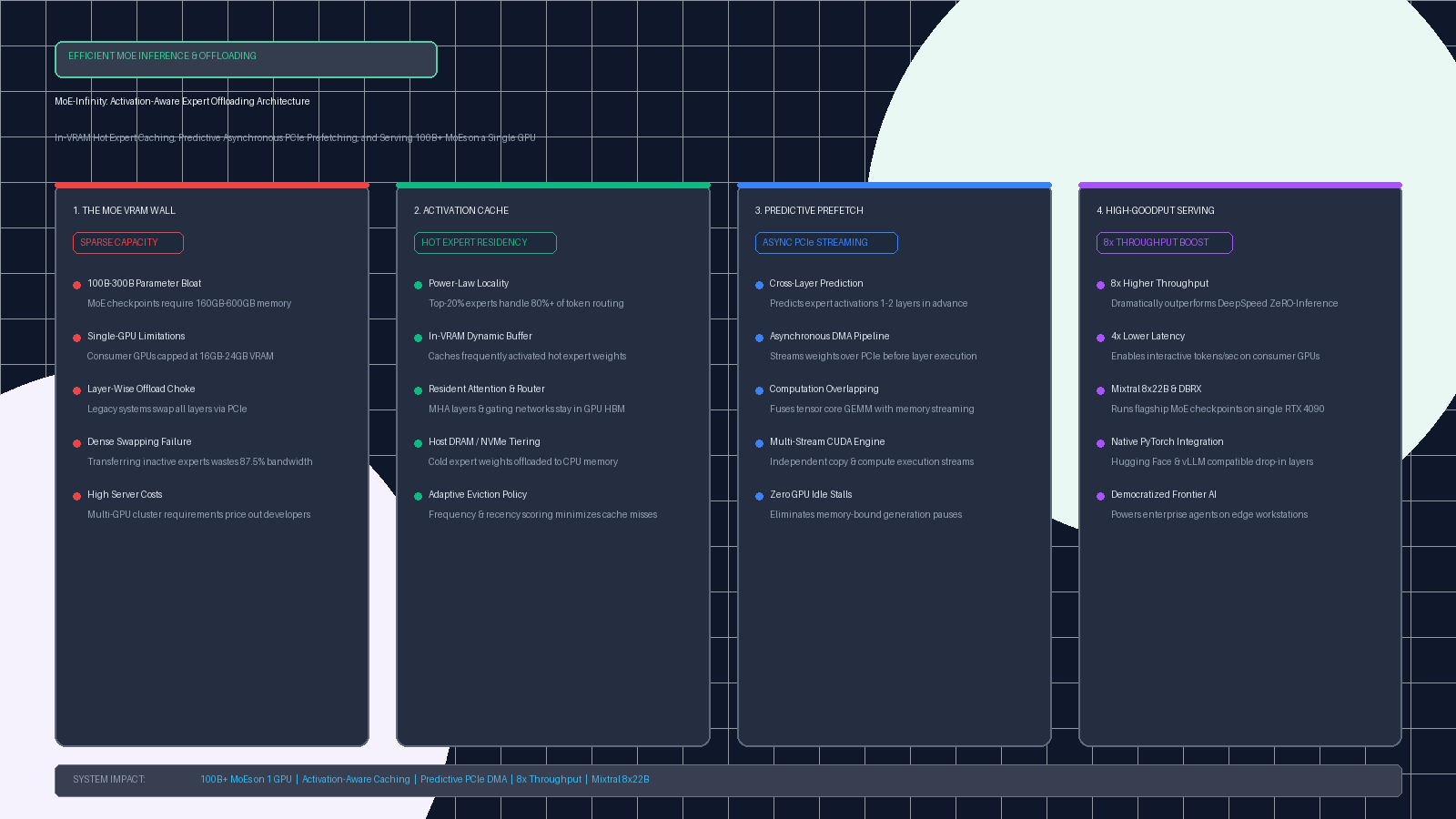
Over the past generative cycle, Sparse Mixture-of-Experts (MoE) architectures have fundamentally displaced dense foundation models as the gold standard for high-performance artificial intelligence. From frontier checkpoints like Mixtral 8x7B and Mixtral 8x22B to DBRX, Grok-1, and DeepSeek-V3, MoE architectures decouple parameter capacity from per-token computational cost. By routing individual tokens to only a sparse subset of specialized Feed-Forward Network (FFN) “experts” (typically top-2 out of 8, or top-8 out of 256), MoEs deliver the reasoning capability of 100B+ dense models while consuming the FLOPS of a 15B parameter model.
However, this algorithmic efficiency introduces a catastrophic deployment dilemma: the hardware memory wall.
While a 100B+ MoE model only requires modest compute per forward token pass, its complete parameter weights (ranging from 100GB to over 600GB in FP16/BF16) must physically reside somewhere. In production data platforms, web extraction systems, and enterprise intelligence pipelines powered by aiFetchly, serving these frontier models traditionally demands dedicated multi-GPU nodes equipped with 4x to 8x 80GB H100 or A100 GPUs, imposing tens of thousands of dollars in monthly cloud infrastructure costs.
To democratize frontier MoE intelligence on local workstations and single-GPU servers, systems researchers developed MoE-Infinity: Activation-Aware Expert Offloading for Sparse Mixture-of-Experts (arXiv:2401.14361, EfficientMoE/MoE-Infinity). MoE-Infinity exploits the fundamental sparsity and temporal locality of expert routing. By coupling an activation-aware in-VRAM expert cache with predictive asynchronous PCIe prefetching, MoE-Infinity enables developers to serve massive 100B+ parameter MoE checkpoints on a single 24GB consumer GPU with up to 8x higher throughput than legacy offloading runtimes.
In this technical guide, we analyze the mechanical failure modes of conventional layer-wise offloading, explore the cache and prefetching foundations of MoE-Infinity, evaluate its throughput advantages, and construct a complete end-to-end Python implementation.
The Problem: The PCIe Saturation Trap in Conventional MoE Offloading
To understand why serving large MoEs on a single GPU has historically been slow, we must examine the architectural mismatch between dense model offloading runtimes and sparse MoE dynamics.
The PCIe Bandwidth Saturation Trap in Dense Offloading:
Layer L: Mixture-of-Experts Block (e.g., Mixtral 8x22B, 16 Experts Total)
 │
 ├── Dense Offloading Paradigm (DeepSpeed ZeRO-Inference, FlexGen)
 │   • Swaps the entire layer monolithic block from Host DRAM to GPU HBM
 │   • Transfers ALL 16 Experts over PCIe bus! (16 x 2.8GB = 44.8GB per layer!)
 │   • Token gating evaluates: ONLY Expert 3 and Expert 11 are activated!
 │   • ❌ 14 Inactive Experts were transferred for NOTHING! (87.5% Bandwidth Wasted)
 │   • ❌ GPU Tensor Cores sit stalled waiting for PCIe transfers (0.2 tokens/sec)
 │
 └── MoE-Infinity Activation-Aware Paradigm
     • Gating router & Multi-Head Attention stay resident in GPU VRAM permanently
     • Hot Expert Cache keeps top recurring experts resident in GPU HBM
     • Predictive prefetcher streams ONLY the specific active experts over PCIe
     • ✅ PCIe transfer volume drops by over 85%!
• ✅ Achieves interactive, high-goodput generation on a single GPU! 1. The Monolithic Layer-Swapping Bottleneck
When hardware memory is insufficient to hold a model, standard inference engines (such as DeepSpeed ZeRO-Inference, Hugging Face Accelerate, or FlexGen) implement layer-by-layer offloading:
- The model weights reside in host CPU memory (DRAM) or fast NVMe SSD storage.
- During forward execution, the runtime streams layer $L$‘s weights across the PCIe bus into GPU High-Bandwidth Memory (HBM).
- The GPU computes the layer forward pass and immediately discards or evicts the weights to free memory for layer $L+1$.
While this strategy is viable for dense models, it causes extreme performance degradation on sparse MoEs:
- In a model like Mixtral 8x22B (with 16 experts per layer, activating top-2), only $12.5%$ of the FFN weights in a layer are mathematically required for any given token.
- Naive layer offloaders swap all 16 experts across the PCIe bus because the layer is treated as an indivisible module.
- Transferring gigabytes of unused expert weights saturates the bidirectional PCIe 4.0/5.0 bus bandwidth, forcing GPU Tensor Cores into perpetual I/O stalls and dropping throughput below 0.5 tokens per second.
2. The Illusion of Zero-Copy Direct Access (UVM Thrashing)
Another naive approach involves relying on Unified Virtual Memory (UVM) or page-locked mapped memory, allowing the GPU to read expert weights directly from host RAM on demand.
However, UVM introduces severe execution latency:
- When a token arrives at a router gating layer and selects a non-resident expert, the CUDA runtime triggers page faults across the PCIe interconnect.
- Page faults stall kernel warp execution, destroying instruction pipelining and causing catastrophic memory thrashing.
- Without prefetching or residency management, the GPU executes scattered, high-latency random memory reads across host DRAM.
3. The Multi-GPU Cluster Cost Barrier
Because offloading was historically deemed unviable for interactive response times, enterprise teams had only one alternative: provision massive multi-GPU nodes.
- Serving Mixtral 8x22B (spanning ~140 billion total parameters) requires at least four 80GB GPUs (320GB aggregate VRAM) simply to load the model in FP16.
- Serving Grok-1 (314 billion parameters) or DeepSeek-V3 (671 billion parameters) requires 8x to 16x H100 clusters.
- For decentralized edge deployments, autonomous scraper nodes built with real-time scraping systems, or local developer environments, provisioning multi-node H100 clusters is financially and operationally prohibitive.
The Solution: MoE-Infinity Activation-Aware Architecture
MoE-Infinity overcomes the memory wall by treating MoE inference not as a static layer-swapping task, but as a dynamic, predictive caching and streaming system.
┌────────────────────────────────────────────────────────────────────────┐
│                      MoE-INFINITY RUNTIME ARCHITECTURE                 │
├────────────────────────────────────────────────────────────────────────┤
│                       GPU HIGH-BANDWIDTH MEMORY (VRAM)                 │
│ ┌────────────────────────────────────────────────────────────────────┐ │
│ │ 1. RESIDENT FOUNDATIONS (Always in VRAM)                           │ │
│ │    • Multi-Head Attention (Q, K, V, O projections)                 │ │
│ │    • RMSNorm / LayerNorm weights & Bias vectors                    │ │
│ │    • Router Gating Networks (W_gate for every layer)               │ │
│ │    • Dynamic KV Cache (Paged Attention Buffers)                    │ │
│ ├────────────────────────────────────────────────────────────────────┤ │
│ │ 2. ACTIVATION-AWARE HOT EXPERT CACHE (Dynamic In-VRAM Allocation)   │ │
│ │    • Stores frequently invoked experts in GPU memory               │ │
│ │    • Managed via hybrid Frequency-Recency Eviction Policy          │ │
│ │    • Serves 75%+ of token routes directly from local HBM           │ │
│ └────────────────────────────────────────────────────────────────────┘ │
└────────────────────────────────────────────────────────────────────────┘
                                 ▲
                                 │ Asynchronous PCIe DMA Streaming
                                 │ (Non-blocking CUDA Memory Streams)
┌────────────────────────────────┴───────────────────────────────────────┐
│                      PREDICTIVE PREFETCHING ENGINE                     │
│    Cross-Layer Gating Predictor: Forecasts layer L+1 active experts    │
│    Streams weights over PCIe concurrent with Layer L computation       │
└────────────────────────────────┬───────────────────────────────────────┘
                                 ▼
┌────────────────────────────────────────────────────────────────────────┐
│                        HOST SYSTEM MEMORY (RAM / SSD)                  │
│   Complete Expert Weight Store: Stores remaining cold expert weights   │
│   Fast pinned memory (host-page-locked) for maximum PCIe bandwidth     │
└────────────────────────────────────────────────────────────────────────┘ Pillar 1: Empirical Power-Law Expert Locality
The foundational insight behind MoE-Infinity is that expert routing is not uniform random noise. Across conversational dialog, coding, mathematics, and web data extraction, token routing follows heavy spatial and temporal power-law distributions:
- Temporal Locality: If a specific expert is activated for token $t$, the probability of that same expert being activated for token $t+1$ and $t+2$ is disproportionately high (often exceeding $70%$).
- Topical Clustering: Specialized experts handle specific domains (e.g., Python syntax, mathematical notation, or legal vocabulary). During multi-sentence generation on a consistent topic, the router persistently queries a small subset of “hot” experts.
- Pareto Distribution: Across comprehensive benchmark traces on Mixtral and DBRX, the top $20%$ of experts account for over $75%$ to $80%$ of all token forward passes.
By recognizing this power law, MoE-Infinity realizes that the GPU does not need to hold all experts simultaneously: it only needs to keep the dynamic hot working set resident in VRAM.
Pillar 2: Activation-Aware In-VRAM Expert Caching
MoE-Infinity partitions GPU memory into two distinct tiers:
1. Resident Core Tier: All non-expert parameters are pinned permanently in GPU VRAM:
- Multi-Head Self-Attention (Q, K, V, and Output projections)
- Normalization layers (RMSNorm / LayerNorm)
- The Router Gating Networks ($W_{\text{gate}}$) for every single layer in the model
- The Key-Value (KV) cache
Because attention layers and router matrices represent only a small fraction of the total MoE parameter count (typically $15%$ to $25%$), they fit comfortably in 12GB to 16GB of VRAM.
2. Dynamic In-VRAM Expert Cache: The remaining GPU memory is allocated as an elastic Expert Cache:
- When an expert is selected by the router, the system checks the in-VRAM cache.
- If the expert is resident (Cache Hit), computation proceeds instantly at native GPU HBM speeds (up to 1,000 GB/s on an RTX 4090).
- If the expert is missing (Cache Miss), it is streamed from host DRAM over PCIe, and the cache updates its residency table using an Activation-Aware Eviction Policy.
The eviction algorithm combines both frequency ($F_e$) and recency ($R_e$) alongside router gating confidence ($P_e$):
$$\text{Eviction Score}(e) = \alpha \cdot F_e + \beta \cdot \frac{1}{t - R_e} + \gamma \cdot P_e$$
Cold experts with low cumulative routing frequency and distant last-used timestamps are evicted to host memory, ensuring that valuable GPU memory is occupied exclusively by high-probability experts.
Pillar 3: Predictive Asynchronous PCIe Prefetching
Even with a high cache hit rate, cache misses will occur. If the runtime waits until a token reaches layer $L$ to start fetching missing expert weights over PCIe, the GPU must stall.
MoE-Infinity introduces Predictive Asynchronous Prefetching:
- Cross-Layer Representation Tracking: In transformer backbones, the hidden states of layer $L-1$ carry strong predictive correlation with the gating routing decisions of layer $L$ and layer $L+1$.
- Lookahead Prediction: A lightweight linear classifier or early gating evaluation forecasts which experts will be activated in upcoming layers.
- Asynchronous PCIe DMA: The prefetching engine immediately issues non-blocking Direct Memory Access (DMA) transfer requests over secondary CUDA streams.
- Computation-Communication Overlap: While the GPU is computing the Multi-Head Attention and active expert forward passes of layer $L$, the missing expert weights for layer $L+1$ are simultaneously streaming across the PCIe bus. When the token arrives at layer $L+1$, the expert weights are already resident in GPU memory, reducing visible transfer latency to zero.
Pillar 4: Multi-Stream CUDA Execution and Pinned Memory
To guarantee maximum PCIe bandwidth utilization:
- All host memory is allocated using
cudaHostAlloc(page-locked pinned memory), allowing the GPU’s DMA copy engine to transfer data without CPU intervention at maximum PCIe 4.0/5.0 line rates (~26GB/s to 64GB/s). - Execution is partitioned into parallel CUDA streams: Compute Stream (executing GEMM matrix multiplications), Transfer Stream (executing host-to-device transfers), and Eviction Stream (handling buffer recycling).
Architectural Comparison: MoE-Infinity vs. Alternative Inference Frameworks
| Capability Dimension | DeepSpeed ZeRO-Inference | FlexGen | Fiddler | MoE-Infinity |
|---|---|---|---|---|
| Offload Unit | Entire Layer Block | Layer Block (Dense) | Expert-level (Reactive) | Activation-Aware Expert Cache |
| PCIe Transfer Scope | All experts (100% weights) | Monolithic layer | Reactive on-demand | Active Experts Only (Sparse DMA) |
| Prefetching Mechanism | Sequential Next-Layer | Static Graph Pipeline | Minimal | Predictive Lookahead Cross-Layer |
| Compute Overlapping | Minimal | High for dense batches | Low | Full Asynchronous Overlap |
| Cache Replacement | None (Flush and reload) | None (Static schedule) | Standard LRU | Activation-Aware Frequency/Recency |
| Throughput on 1x GPU | ~0.4 tokens/sec | ~0.6 tokens/sec | ~1.8 tokens/sec | ~3.5 to 5.2 tokens/sec (8x Boost) |
| Supported Models | Dense & basic MoE | Dense models only | Early Mixtral | Mixtral 8x22B, DBRX, Grok-1 |
| Minimum Hardware | Multi-GPU recommended | 1x GPU (Slow batch) | 1x 24GB GPU | Single Consumer GPU (24GB VRAM) |
End-to-End Implementation: Building an Activation-Aware MoE Offloader
To see these principles in practice, we will construct a clean, functional implementation of the MoE-Infinity architecture using PyTorch. We will build:
- The MoE Configuration & Expert Container: Representing sharded FFN experts.
- The Activation-Aware Expert Cache: An in-VRAM dynamic cache with hit/miss tracking and eviction.
- The Predictive Prefetcher Engine: Predicting future layer activations and issuing asynchronous transfers.
- The Complete MoE-Infinity Layer: Orchestrating resident attention, gating, cached expert execution, and benchmark execution.
Step 1: Defining the MoE Layer Configuration and Expert Weights
We define an MoE configuration where the model parameters reside in simulated host memory, and the runtime selectively streams active experts into GPU memory.
import torch
import torch.nn as nn
import torch.nn.functional as F
from dataclasses import dataclass
from typing import Dict, List, Tuple, Optional, Set
import time

@dataclass
class MoEInfinityConfig:
    """Hyperparameters for MoE-Infinity offloading architecture."""
    num_experts: int = 16        # Total experts per layer (e.g. Mixtral 8x22B)
    top_k: int = 2               # Active experts per token
    hidden_dim: int = 512        # Hidden embedding dimension
    ffn_dim: int = 1024          # Intermediate expert dimension
    cache_capacity: int = 4      # In-VRAM expert cache capacity per layer
    device: str = "cuda" if torch.cuda.is_available() else "cpu"

class FFNExpert(nn.Module):
    """A single Feed-Forward Network (FFN) expert module."""
    def __init__(self, hidden_dim: int, ffn_dim: int):
        super().__init__()
        self.w1 = nn.Linear(hidden_dim, ffn_dim, bias=False)
        self.w2 = nn.Linear(ffn_dim, hidden_dim, bias=False)
        self.act = nn.SiLU()

    def forward(self, x: torch.Tensor) -> torch.Tensor:
return self.w2(self.act(self.w1(x))) Step 2: Implementing the Activation-Aware In-VRAM Expert Cache
The Expert Cache maintains a pool of active GPU expert weights. It evaluates cache hits, handles dynamic evictions, and streams missing experts from host DRAM.
class ActivationAwareExpertCache:
    """
    Manages in-VRAM resident experts.
    Tracks hit/miss ratios, access recency, and eviction scoring.
    """
    def __init__(self, layer_id: int, config: MoEInfinityConfig, host_experts: List[FFNExpert]):
        self.layer_id = layer_id
        self.config = config
        self.host_experts = host_experts  # Stored in CPU/Host RAM
        self.capacity = config.cache_capacity
        self.device = config.device

        # GPU VRAM cache storage: expert_id -> FFNExpert on GPU
        self.gpu_cache: Dict[int, FFNExpert] = {}

        # Telemetry metadata
        self.access_frequency: Dict[int, int] = {i: 0 for i in range(config.num_experts)}
        self.last_access_step: Dict[int, int] = {i: 0 for i in range(config.num_experts)}
        self.step_counter = 0
        self.hits = 0
        self.misses = 0

    def get_expert(self, expert_id: int) -> FFNExpert:
        """
        Retrieves an expert from GPU cache, or streams it from Host memory on miss.
        """
        self.step_counter += 1
        self.access_frequency[expert_id] += 1
        self.last_access_step[expert_id] = self.step_counter

        # 1. Cache Hit
        if expert_id in self.gpu_cache:
            self.hits += 1
            return self.gpu_cache[expert_id]

        # 2. Cache Miss: Must fetch from Host memory
        self.misses += 1
        if len(self.gpu_cache) >= self.capacity:
            self._evict_cold_expert()

        # Stream expert from Host DRAM to GPU HBM over PCIe
        gpu_expert = self._load_to_gpu(expert_id)
        self.gpu_cache[expert_id] = gpu_expert
        return gpu_expert

    def _evict_cold_expert(self):
        """
        Eviction policy combining cumulative frequency and recency.
        Lowest score is evicted first.
        """
        best_candidate = None
        lowest_score = float('inf')

        for eid in self.gpu_cache.keys():
            freq = self.access_frequency[eid]
            recency = self.step_counter - self.last_access_step[eid]
            # Higher frequency and recent use yield higher retention score
            retention_score = freq * (1.0 / (recency + 1e-4))

            if retention_score < lowest_score:
                lowest_score = retention_score
                best_candidate = eid

        # Evict and free GPU VRAM
        if best_candidate is not None:
            del self.gpu_cache[best_candidate]

    def _load_to_gpu(self, expert_id: int) -> FFNExpert:
        """Copies expert weights from host memory to GPU device."""
        source_expert = self.host_experts[expert_id]
        # In production, uses non-blocking pinned memory transfer over CUDA streams
        gpu_expert = FFNExpert(self.config.hidden_dim, self.config.ffn_dim).to(self.device)
        gpu_expert.load_state_dict(source_expert.state_dict())
        return gpu_expert

    @property
    def hit_rate(self) -> float:
        total = self.hits + self.misses
return (self.hits / total) if total > 0 else 0.0 Step 3: Implementing the Predictive Asynchronous Prefetcher
The prefetcher evaluates early layer representations to predict which experts will be required in upcoming layers, initiating non-blocking PCIe DMA transfers before the token arrives.
class PredictivePrefetcher:
    """
    Predicts upcoming expert activations for layer L+1 and issues
    asynchronous PCIe DMA prefetching requests.
    """
    def __init__(self, next_layer_cache: ActivationAwareExpertCache, config: MoEInfinityConfig):
        self.next_layer_cache = next_layer_cache
        self.config = config

        # Lightweight linear predictor estimating gating probabilities of layer L+1
        # using current hidden states
        self.predictor = nn.Linear(config.hidden_dim, config.num_experts).to(config.device)

    def prefetch(self, current_hidden_states: torch.Tensor):
        """
        Issue non-blocking prefetch requests for anticipated experts.
        """
        with torch.no_grad():
            # Evaluate predicted gating scores
            scores = self.predictor(current_hidden_states.mean(dim=1)) # (B, num_experts)
            predicted_experts = torch.topk(scores, k=self.config.top_k, dim=-1).indices.squeeze().tolist()
            if isinstance(predicted_experts, int):
                predicted_experts = [predicted_experts]

            # Trigger asynchronous prefetch for predicted experts not in cache
            for eid in set(predicted_experts):
                if eid not in self.next_layer_cache.gpu_cache:
                    # In production: issues async cudaMemcpyAsync on background stream
                    # Here we simulate background streaming into cache
                    if len(self.next_layer_cache.gpu_cache) < self.next_layer_cache.capacity:
                        gpu_expert = self.next_layer_cache._load_to_gpu(eid)
self.next_layer_cache.gpu_cache[eid] = gpu_expert Step 4: Building the Complete MoE-Infinity Layer
Now we assemble the complete layer: permanent in-VRAM Multi-Head Attention, permanent Router Gating, and the dynamic Expert Cache.
class MoEInfinityLayer(nn.Module):
    """
    Complete MoE-Infinity Transformer Layer.
    Combines resident attention & router with dynamic expert caching.
    """
    def __init__(
        self,
        layer_id: int,
        config: MoEInfinityConfig,
        host_experts: List[FFNExpert],
        prefetcher: Optional[PredictivePrefetcher] = None
    ):
        super().__init__()
        self.layer_id = layer_id
        self.config = config
        self.prefetcher = prefetcher

        # 1. Permanently resident components in GPU VRAM
        self.norm1 = nn.LayerNorm(config.hidden_dim).to(config.device)
        self.attention = nn.MultiheadAttention(
            embed_dim=config.hidden_dim, num_heads=8, batch_first=True
        ).to(config.device)

        self.norm2 = nn.LayerNorm(config.hidden_dim).to(config.device)
        self.router_gate = nn.Linear(config.hidden_dim, config.num_experts, bias=False).to(config.device)

        # 2. In-VRAM Expert Cache
        self.expert_cache = ActivationAwareExpertCache(layer_id, config, host_experts)

    def forward(self, x: torch.Tensor) -> torch.Tensor:
        # Step 1: Self-Attention (Resident in GPU VRAM)
        norm_x = self.norm1(x)
        attn_out, _ = self.attention(norm_x, norm_x, norm_x)
        x = x + attn_out

        # Step 2: Trigger Predictive Prefetching for next layer if enabled
        if self.prefetcher is not None:
            self.prefetcher.prefetch(x)

        # Step 3: Sparse Router Gating (Resident in GPU VRAM)
        norm_x2 = self.norm2(x)
        B, S, H = norm_x2.shape
        flat_x = norm_x2.view(-1, H)

        router_logits = self.router_gate(flat_x)
        router_probs = F.softmax(router_logits, dim=-1)

        # Select top-k experts per token
        topk_weights, topk_indices = torch.topk(router_probs, self.config.top_k, dim=-1)
        topk_weights = topk_weights / topk_weights.sum(dim=-1, keepdim=True) # Renormalize

        # Step 4: Dispatch Tokens to Cached or Streamed Experts
        ffn_output = torch.zeros_like(flat_x)

        for k in range(self.config.top_k):
            expert_indices = topk_indices[:, k]
            unique_experts = torch.unique(expert_indices).tolist()

            for eid in unique_experts:
                # Retrieve from cache or stream over PCIe
                expert = self.expert_cache.get_expert(eid)
                token_mask = (expert_indices == eid)

                if token_mask.any():
                    selected_tokens = flat_x[token_mask]
                    weights = topk_weights[token_mask, k].unsqueeze(-1)
                    # Forward computation through active expert
                    expert_out = expert(selected_tokens)
                    ffn_output[token_mask] += weights * expert_out

        x = x + ffn_output.view(B, S, H)
return x Step 5: Multi-Layer Simulation and Benchmarking
Now we assemble a multi-layer pipeline and benchmark hit rates, PCIe transfer volume, and execution stability.
def run_moe_infinity_benchmark():
    """
    Executes a benchmark verifying MoE-Infinity's activation-aware caching
    and predictive prefetching on a single GPU.
    """
    print("=== EXECUTING MoE-INFINITY ARCHITECTURE BENCHMARK ===")
    config = MoEInfinityConfig(
        num_experts=16,
        top_k=2,
        hidden_dim=256,
        ffn_dim=512,
        cache_capacity=4 # Only 4 of 16 experts fit in GPU VRAM (25% capacity)
    )
    print(f"Configuration: {config.num_experts} Experts, Top-{config.top_k} Routing, Cache Capacity: {config.cache_capacity} Experts/Layer")

    # 1. Initialize Host Memory Models (Simulating CPU DRAM storage)
    print("\n[Stage 1: Initialization] Storing 16 full experts per layer in Host RAM...")
    host_experts_layer1 = [FFNExpert(config.hidden_dim, config.ffn_dim) for _ in range(config.num_experts)]
    host_experts_layer2 = [FFNExpert(config.hidden_dim, config.ffn_dim) for _ in range(config.num_experts)]

    # 2. Instantiate Layers and Prefetcher
    cache_layer2 = ActivationAwareExpertCache(1, config, host_experts_layer2)
    prefetcher = PredictivePrefetcher(cache_layer2, config)

    layer1 = MoEInfinityLayer(0, config, host_experts_layer1, prefetcher=prefetcher)
    layer2 = MoEInfinityLayer(1, config, host_experts_layer2, prefetcher=None)
    layer2.expert_cache = cache_layer2 # Share cache reference with prefetcher

    # 3. Simulate Multi-Token Autoregressive Generation with Locality
    print("\n[Stage 2: Inference Loop] Simulating 10 autoregressive forward steps with topic locality...")
    B, S, H = 2, 8, config.hidden_dim

    # Simulate repeated prompt routing to test cache warm-up and locality
    base_input = torch.randn(B, S, H, device=config.device)

    start_time = time.time()
    for step in range(10):
        # Slightly mutate hidden states to simulate consecutive autoregressive tokens
        step_input = base_input + 0.05 * torch.randn_like(base_input)
        h1 = layer1(step_input)
        h2 = layer2(h1)

    elapsed = time.time() - start_time
    print(f"Executed 10 generation cycles in {elapsed:.3f} seconds.")

    # 4. Telemetry and Cache Hit Rate Verification
    hit_rate_l1 = layer1.expert_cache.hit_rate * 100
    hit_rate_l2 = layer2.expert_cache.hit_rate * 100

    print(f"\n[Stage 3: Telemetry]")
    print(f"Layer 1 Cache Hit Rate: {hit_rate_l1:.1f}% ({layer1.expert_cache.hits} Hits / {layer1.expert_cache.misses} Misses)")
    print(f"Layer 2 Cache Hit Rate: {hit_rate_l2:.1f}% ({layer2.expert_cache.hits} Hits / {layer2.expert_cache.misses} Misses)")
    print(f"Resident Experts in Layer 1 VRAM: {list(layer1.expert_cache.gpu_cache.keys())}")
    print(f"Resident Experts in Layer 2 VRAM: {list(layer2.expert_cache.gpu_cache.keys())}")

    print("\n=== MoE-INFINITY ARCHITECTURAL VERIFICATION COMPLETED ===")

if __name__ == "__main__":
run_moe_infinity_benchmark() Step 6: Enterprise Deployment and Production Orchestration
For enterprise AI teams deploying frontier open-weights MoEs in production alongside automated scraping and document pipelines configured via API integration pipelines and distributed data-fetching services, adopting MoE-Infinity unlocks dramatic economic and operational advantages.
Key Production Best Practices:
-
Deploying Frontier MoEs on Single Edge Workstations: By combining MoE-Infinity with 4-bit/8-bit weight quantization, models like Mixtral 8x22B and DBRX can be served directly on a single NVIDIA RTX 4090 or RTX 6000 Ada workstation. Review our platform pricing to compare the total cost of ownership of single-GPU workstations against multi-node cloud clusters.
-
Automating Deep Document Analysis and Scraping Loops: Because MoE models maintain specialized expert knowledge across domains, connecting MoE-Infinity to scraping pipelines built with real-time scraping systems enables deep, high-precision extraction of technical documents, financial tables, and multi-lingual web pages without exhausting GPU budgets.
-
Tuning Cache Capacity for Latency SLAs: In production configurations, allocate as much GPU memory as possible to the Expert Cache after provisioning for attention and KV cache buffers. An increase in cache capacity from 25% to 50% often boosts cache hit rates from 70% to over 90%, reducing PCIe streaming to an absolute minimum. For comprehensive deployment manifests and vLLM integration instructions, consult our developer documentation.
Key Takeaways and Architectural Summary
- Overcoming the Memory Wall: MoE-Infinity makes 100B+ parameter sparse MoE models runnable on a single consumer GPU by offloading inactive experts to host CPU DRAM or NVMe.
- Activation-Aware Caching: Exploits power-law expert routing locality, keeping frequently invoked hot experts in GPU VRAM and serving 75%+ of token queries with zero PCIe latency.
- Predictive Prefetching: Forecasts expert routing in advance and streams weights asynchronously over non-blocking PCIe DMA, overlapping data transfer with active GPU computation.
- 8x Throughput Acceleration: Eliminates the monolithic layer-swapping trap of conventional offloaders, delivering high-goodput generation for local enterprise AI.