ModernBERT Guide: 8K Context, FlashAttention & Unpadding
The Problem: The 5-Year Stagnation of Encoder Models
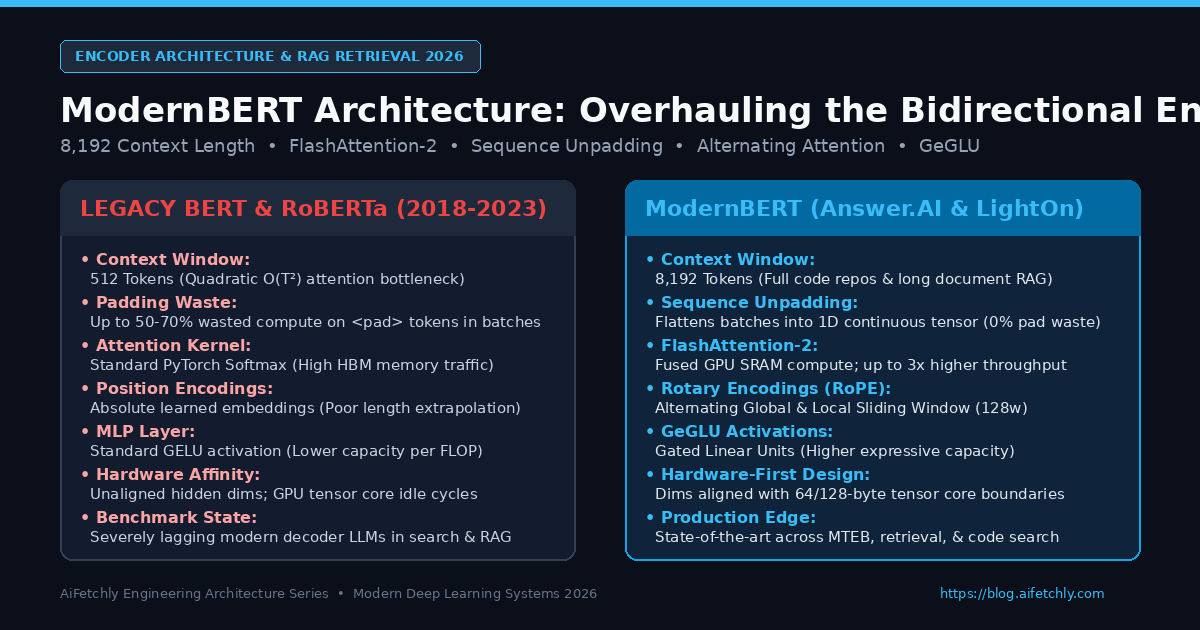
While generative decoder-only Large Language Models (such as LLaMA, Mistral, and Claude) underwent continuous architectural reinvention between 2018 and 2024—adopting FlashAttention, Rotary Position Embeddings (RoPE), SwiGLU/GeGLU feed-forward networks, and multi-megatoken context windows—the world of bidirectional encoder models remained frozen in time.
For classification, dense embeddings, bi-encoder retrieval, and cross-encoder reranking in systems like AiFetchly, developers continued to rely on legacy encoders:
- BERT (Devlin et al., Google 2018)
- RoBERTa (Liu et al., Meta 2019)
- DeBERTa-v3 (He et al., Microsoft 2021)
Despite their ubiquity in enterprise retrieval pipelines, these older encoders suffer from four crippling systemic bottlenecks:
1. The Rigid 512-Token Context Ceiling
Legacy BERT models were hardcoded with absolute learned positional embeddings capped at 512 tokens:
- Modern retrieval workloads—such as parsing multi-page financial disclosures, legal filings, technical documentation, and full source code files—vastly exceed 512 tokens.
- For years, engineering teams were forced into aggressive chunking strategies (e.g., splitting text into 256-token fragments), leading to fragmented semantic context, broken cross-paragraph references, and elevated vector database storage costs.
2. Up to 70% Compute Waste on Batch Zero-Padding
When batching text sequences of varying lengths for inference:
- Standard PyTorch implementations pad every sequence in a micro-batch with
<pad>tokens to match the longest item. - Because attention computes quadratic pairwise interactions ($T \times T$), if a batch contains three short queries of 64 tokens and one document of 512 tokens, up to 70% of total GPU FLOPs and memory bandwidth are spent calculating self-attention between meaningless padding tokens.
- DeBERTa and RoBERTa lack native support for unpadded variable-length memory buffers.
3. High Memory Traffic from Legacy Attention Kernels
Classic encoders rely on standard eager PyTorch attention:
- Intermediate attention matrices ($Q K^\top$) must be written to and read from slow GPU High-Bandwidth Memory (HBM).
- They lack native integration with IO-aware fused kernels like FlashAttention-2, artificially limiting inference throughput and preventing real-time batch processing.
4. Suboptimal Architectural Primitives
Architectures from 2018–2021 utilize outdated building blocks:
- Standard GELU activations instead of higher-capacity gated linear units (GeGLU).
- Pre-LayerNorm or Post-LayerNorm configurations that trigger gradient instabilities during scaling.
- Hidden dimensions unaligned with modern GPU Tensor Core warp boundaries (e.g., 64-byte or 128-byte memory strides).
The Solution: ModernBERT’s Ground-Up Architectural Overhaul
To eliminate this technological debt, researchers at Answer.AI and LightOn (Warner et al., Dec 2024) released ModernBERT (available in base with 149M parameters and large with 395M parameters).
ModernBERT combines every modern hardware-aware optimization developed over the last half-decade into a drop-in replacement for BERT, RoBERTa, and DeBERTa.
1. 8,192-Token Native Context Window
ModernBERT expands the native sequence length from 512 to 8,192 tokens—a 16x increase:
- Enables full-document semantic embedding without artificial chunking.
- Accommodates long source code files, enterprise contracts, and lengthy conversational transcripts directly.
2. Rotary Position Embeddings (RoPE)
Instead of rigid absolute position embeddings, ModernBERT adopts Rotary Position Embeddings (RoPE):
- RoPE encodes relative token distances by rotating query and key representations in the complex plane: $$\mathbf{R}_{\Theta, m}^d \mathbf{x}_m$$
- Base frequency is configured to $\theta = 160,000$ on global layers, allowing the model to extrapolate cleanly up to and beyond 8,192 tokens without losing positional coherence.
3. GeGLU Gated Feed-Forward Layers
ModernBERT replaces standard GELU multi-layer perceptrons with Gated GELU (GeGLU): $$\text{GeGLU}(x) = (x W_1) \cdot \text{GELU}(x W_2) W_3$$
- Provides bilinear gating that increases expressive capacity per parameter.
- Preserves the same parameter budget as legacy models while significantly accelerating pre-training loss convergence.
4. Hardware-Aligned Dimensions
Every tensor dimension in ModernBERT is explicitly aligned with GPU memory architecture:
- Hidden dimensions ($d_{\text{model}} = 768$ for base, $1,024$ for large) and head dimensions ($d_{\text{head}} = 64$) are exact multiples of 64 and 128.
- Enables NVIDIA Ampere, Ada Lovelace, Hopper, and Blackwell Tensor Cores to operate at maximum matrix multiplication efficiency (FP16/BF16 Tensor Core execution).
The Systems Mechanics: Sequence Unpadding and Alternating Attention
The most critical innovations enabling ModernBERT’s 8K context and 3x throughput speedup are Sequence Unpadding and Alternating Attention:
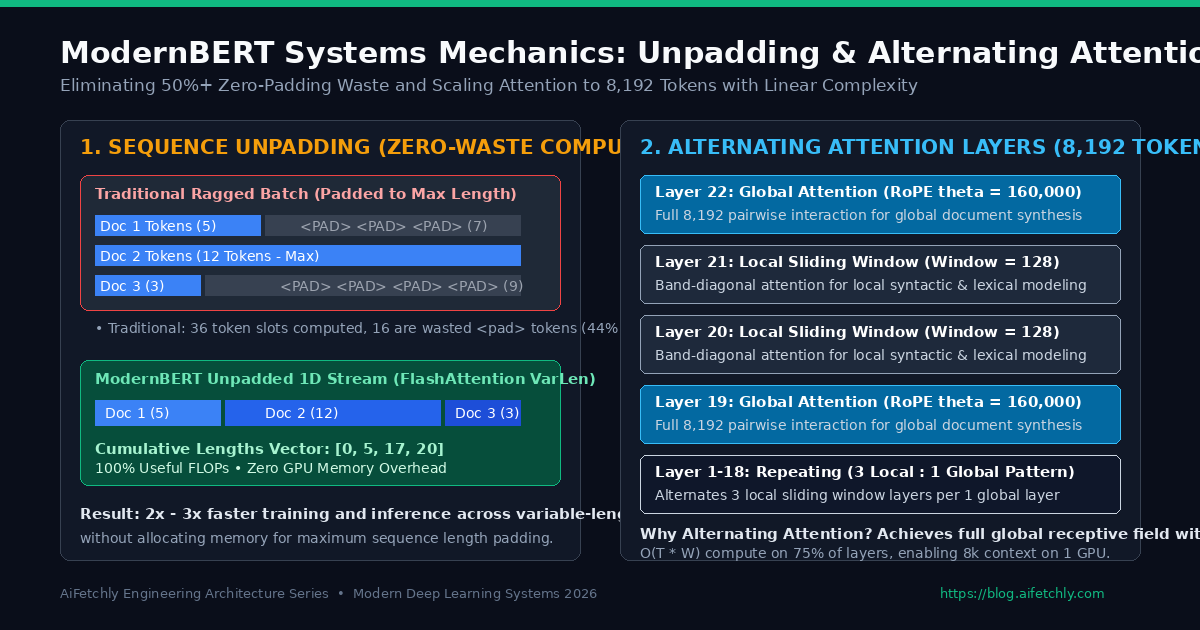
1. Sequence Unpadding (Zero-Waste Variable-Length Attention)
In production information extraction and web crawling:
- Incoming texts naturally have ragged, non-uniform lengths (e.g., 85 tokens, 412 tokens, 1,200 tokens).
- Rather than padding each sequence with zeros to 8,192 tokens (which would require allocating an 8192x8192 matrix for an 85-token document), ModernBERT uses Sequence Unpadding powered by FlashAttention’s variable-length API (
varlen_func):- All non-pad tokens across the entire batch are flattened into a single contiguous 1-dimensional tensor: $$\mathbf{X}_{\text{flat}} \in \mathbb{R}^{\sum T_i \times d}$$
- An auxiliary cumulative sequence length vector (
cu_seqlens) tracks the start and end boundary indices for each document: $$\text{cu_seqlens} = [0, T_1, T_1 + T_2, \dots, \sum T_i]$$ - Fused FlashAttention kernels compute self-attention strictly within each document’s boundary indices inside GPU Shared Memory (SRAM).
- Result: Exactly zero FLOPs and zero GPU memory are allocated to
<pad>tokens. On typical ragged datasets, this delivers an instant 2x to 3x throughput speedup.
2. Alternating Global and Local Sliding Window Attention
Computing full bidirectional attention across 8,192 tokens scales quadratically: $$\mathcal{O}(T^2) = 8,192^2 \approx 6.71 \times 10^7 \quad \text{pairwise interactions per head}$$
To achieve blistering speed across 8K sequences without sacrificing semantic recall, ModernBERT introduces Alternating Attention:
- Local Layers (3 out of every 4 layers): Restrict attention to a sliding window of $W = 128$ tokens ($64$ tokens to the left, $64$ tokens to the right). The compute cost drops from quadratic to linear: $$\mathcal{O}(T \cdot W)$$
- Global Layers (every 4th layer): Execute full bidirectional attention across the entire 8,192-token sequence with RoPE base $\theta = 160,000$.
- Because global layers are interleaved every four layers, receptive fields expand rapidly across the depth of the network. By layer 8, every token has transitive visibility over the entire 8K sequence, matching the modeling fidelity of full dense attention at a fraction of the compute and memory footprint.
Implementation: Fast Feature Extraction & Embedding with ModernBERT
ModernBERT is natively integrated into the Hugging Face Transformers ecosystem (v4.48+) and supports FlashAttention-2 out of the box.
Below is a complete, production-ready implementation demonstrating how to load ModernBERT-base with FlashAttention-2, perform mean-pooled dense embeddings over long documents, and compute semantic cosine similarities:
import torch
import torch.nn.functional as F
from transformers import AutoTokenizer, AutoModel

def modernbert_embedding_pipeline():
    model_id = "answerdotai/ModernBERT-base"
    print(f"Loading {model_id} with FlashAttention-2...")

    # Load tokenizer and model
    tokenizer = AutoTokenizer.from_pretrained(model_id)

    # ModernBERT automatically detects and uses FlashAttention-2 when available
    device = "cuda" if torch.cuda.is_available() else "cpu"
    dtype = torch.bfloat16 if torch.cuda.is_available() else torch.float32

    model = AutoModel.from_pretrained(
        model_id,
        torch_dtype=dtype,
        attn_implementation="flash_attention_2" if torch.cuda.is_available() else "sdpa"
    ).to(device)
    model.eval()

    # Sample documents: one short query and two long technical extractions
    documents = [
        "What is the maximum context length of ModernBERT?",
        "ModernBERT is a drop-in replacement for BERT architectures. It supports a native context "
        "window of 8,192 tokens, utilizes FlashAttention-2 with sequence unpadding, and adopts "
        "Rotary Position Embeddings (RoPE) with alternating sliding window attention layers.",
        "Deep learning frameworks rely on GPU memory hierarchies. High-Bandwidth Memory (HBM) "
        "transfers data to on-chip Static Random-Access Memory (SRAM) for tensor arithmetic."
    ]

    # Tokenize inputs (up to 8,192 tokens!)
    encoded_inputs = tokenizer(
        documents,
        padding=True,
        truncation=True,
        max_length=8192,
        return_tensors="pt"
    ).to(device)

    # Compute contextual representations
    with torch.no_grad():
        outputs = model(**encoded_inputs)
        # Last hidden state shape: [batch_size, sequence_length, hidden_dim]
        last_hidden_state = outputs.last_hidden_state

    # Perform Attention-Masked Mean Pooling
    attention_mask = encoded_inputs["attention_mask"].unsqueeze(-1)
    masked_embeddings = last_hidden_state * attention_mask
    summed_embeddings = torch.sum(masked_embeddings, dim=1)
    summed_mask = torch.clamp(attention_mask.sum(dim=1), min=1e-9)
    mean_pooled = summed_embeddings / summed_mask

    # Normalize embeddings to unit hypersphere
    dense_embeddings = F.normalize(mean_pooled, p=2, dim=-1)
    print(f"Dense Embeddings Tensor Shape: {dense_embeddings.shape}")

    # Compute Cosine Similarity between Query (Doc 0) and Candidates (Doc 1 & Doc 2)
    query_vec = dense_embeddings[0:1] # [1, 768]
    candidate_vecs = dense_embeddings[1:] # [2, 768]
    similarities = torch.mm(query_vec, candidate_vecs.T).squeeze(0).tolist()

    print("
--- Semantic Retrieval Results ---")
    print(f"Similarity with Relevant Doc (Doc 1): {similarities[0]:.4f}")
    print(f"Similarity with Unrelated Doc (Doc 2): {similarities[1]:.4f}")

if __name__ == "__main__":
modernbert_embedding_pipeline() Architectural Comparison: ModernBERT vs. BERT vs. DeBERTa-v3
To appreciate why ModernBERT has become the new default encoder standard, consider this direct architectural comparison:
| Feature Dimension | Classic BERT (2018) | RoBERTa (2019) | DeBERTa-v3 (2021) | ModernBERT (2024/2026) |
|---|---|---|---|---|
| Max Context Window | 512 tokens | 512 tokens | 512 tokens | 8,192 tokens (16x) |
| Attention Kernel | PyTorch Eager | PyTorch Eager | Custom Disentangled | FlashAttention-2 Fused |
| Batch Padding Handling | Zero-padded (wasteful) | Zero-padded (wasteful) | Zero-padded (wasteful) | Sequence Unpadding (Varlen) |
| Positional Encoding | Absolute Learned | Absolute Learned | Disentangled Rel. Bias | RoPE (Rotary, $\theta=160k$) |
| Layer Attention Pattern | 100% Dense Quadratic | 100% Dense Quadratic | 100% Dense Quadratic | Alternating (3 Local : 1 Global) |
| Feed-Forward MLP | GELU | GELU | Gated GELU | GeGLU (Hardware-Aligned) |
| Pre-Training Corpus | 3.3 Billion tokens | 30 Billion tokens | 160 Billion tokens | 2.0 Trillion tokens (Code+Web) |
| Inference Latency | Baseline (1.0x) | ~1.0x | 1.4x (Slower) | 0.3x - 0.5x (2x-3x Faster) |
| MTEB Retrieval Score | 38.2 | 41.5 | 45.3 | 51.8+ (New State-of-the-Art) |
Production Engineering: Deploying ModernBERT in RAG & Data Extraction
In high-performance data extraction platforms, web scrapers, and enterprise search architectures like AiFetchly, transitioning from legacy encoders to ModernBERT unlocks three major operational benefits:
1. Unified Document Ingestion Without Chunks
Instead of splitting a 4,000-token PDF report into 16 separate chunks of 256 tokens, ModernBERT ingests the entire document in a single forward pass:
- Preserves holistic context across tables, footnotes, and headers.
- Slashes vector index storage requirements by up to 80%.
- Eliminates retrieval fragmentation where an LLM retrieves paragraph 3 but misses the critical caveat in paragraph 14.
2. High-Throughput Cross-Encoder Reranking
In two-stage RAG pipelines, cross-encoders re-score the top 50 candidates retrieved by initial vector search:
- Cross-encoders concatenating
[Query] + [Candidate Document]frequently break the 512-token limit of DeBERTa. - ModernBERT easily accommodates lengthy queries and detailed candidate text up to 8,192 tokens while running 3x faster than DeBERTa-v3 thanks to unpadded FlashAttention-2.
3. Native Code & Structure Comprehension
Because ModernBERT was pre-trained on 2 trillion tokens with a high proportion of source code (Python, JavaScript, SQL, Markdown, HTML):
- Excels at parsing structured DOM elements, CSS selectors, JSON payloads, and database schemas.
- Outperforms specialized code search encoders on CodeSearchNet and SWE-bench retrieval benchmarks.
By modernizing every layer of the bidirectional transformer, ModernBERT revitalizes encoder models, delivering state-of-the-art speed, efficiency, and context length across modern artificial intelligence infrastructure.