Model Merging: Combining Expert LLMs Without Retraining
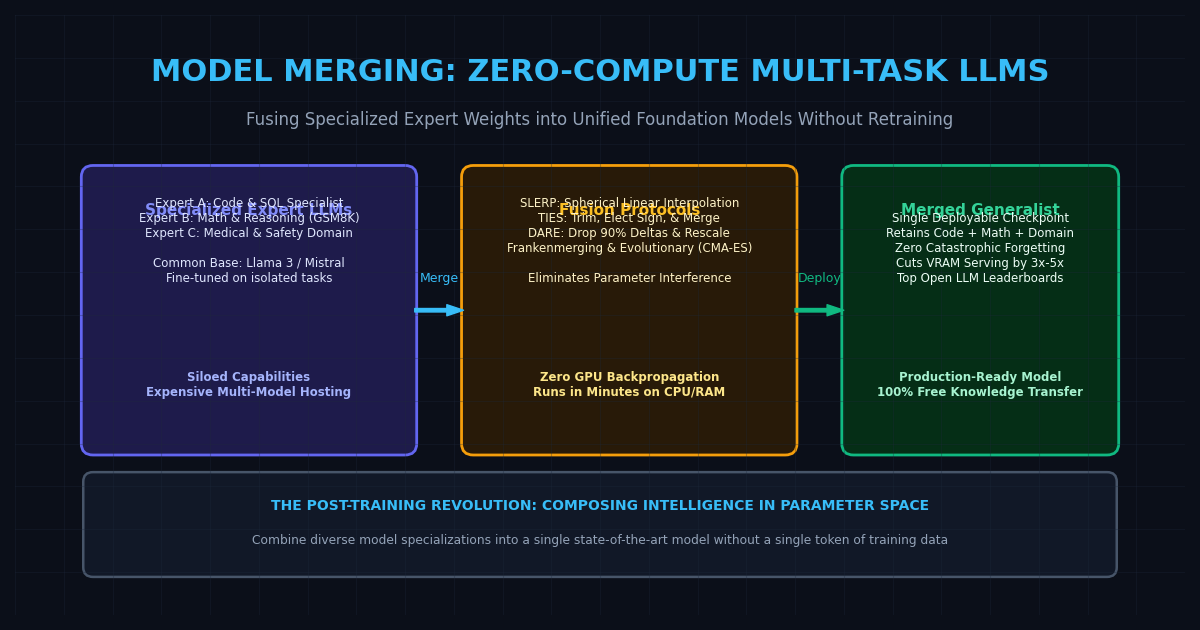
The Problem: The Post-Training Dilemma and Multi-Model Hosting Tax
In modern enterprise artificial intelligence—including automated data pipelines in AiFetchly—engineering teams frequently encounter a difficult trade-off when tailoring Large Language Models (LLMs) to specialized domains.
When an organization fine-tunes a base foundation model (such as Llama 3.3 70B, Mistral 7B, or Qwen 2.5), the resulting models become isolated specialists:
- Model A is fine-tuned on code generation and structured SQL query extraction.
- Model B is fine-tuned on multi-step mathematical reasoning and symbolic logic.
- Model C is aligned with strict domain-specific compliance, safety guardrails, and roleplay tone.
Attempting to unify these distinct capabilities using traditional training workflows exposes three severe bottlenecks:
1. Catastrophic Forgetting
When a model is fine-tuned sequentially (e.g., training on Code, then training on Math, then training on Legal compliance), the gradient updates on later tasks overwrite the parameter manifolds learned during earlier tasks. The model excels at the newest task while suffering dramatic capability regressions on previous skills.
2. Multi-Task Data Mixing Bottlenecks
To prevent catastrophic forgetting during training, teams attempt multi-task joint fine-tuning. However, balancing heterogeneous datasets requires complex dataset weighting, hyperparameter tuning, and hundreds of thousands of dollars in cloud GPU compute clusters. Even minor gradient imbalances lead to optimization collapse.
3. The Multi-Model Hosting Tax
If an enterprise opts not to train a generalist and instead deploys separate fine-tuned models for each task, infrastructure costs explode. Serving three separate 70B parameter models requires tripling GPU cluster instances, managing complex routing proxies, and enduring severe memory-bandwidth fragmentation.
To escape this training bottleneck, open-source AI researchers and enterprise engineers have standardized on Model Merging.
The Solution: Fusing Intelligence Directly in Weight Space
Model Merging operates on a simple yet radical premise: combine the parameter tensors of multiple trained models directly in weight space without running a single step of gradient backpropagation or consulting a single token of training data.
Instead of viewing weights as fixed black boxes, merging treats the fine-tuned parameters as directional offsets (task vectors) within a continuous loss landscape.
Given a shared pre-trained base model with parameters $\theta_{\text{base}}$ and $K$ fine-tuned specialist models with parameters $\theta_1, \theta_2, \dots, \theta_K$, each model can be defined by its task vector:
$$\tau_k = \theta_k - \theta_{\text{base}}$$
A model merging algorithm computes a unified parameter tensor:
$$\theta_{\text{merged}} = \theta_{\text{base}} + \mathcal{F}(\tau_1, \tau_2, \dots, \tau_K)$$
Where $\mathcal{F}$ is a geometric aggregation function designed to eliminate destructive weight interference.
Core Merging Paradigms: Eliminating Parameter Interference
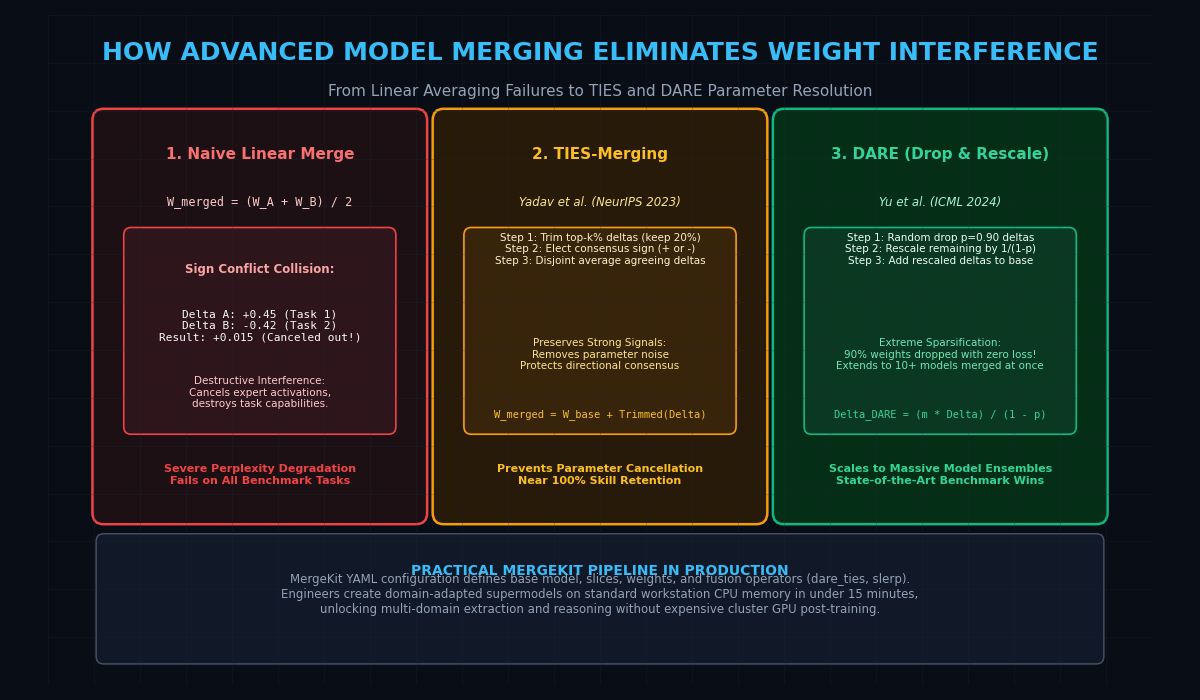
Early attempts at model merging relied on simple linear weight averaging ($\theta_{\text{merged}} = \frac{1}{2}\theta_A + \frac{1}{2}\theta_B$). While linear averaging works for identical models trained with different random seeds on identical data, it fails catastrophically when combining models fine-tuned on diverse tasks.
When two task vectors conflict—for instance, if Model A updates a weight by $+0.45$ to encode a Python syntax rule while Model B updates the same weight by $-0.42$ for medical reasoning—linear averaging produces $+0.015$, effectively canceling out both capabilities (destructive sign interference).
Modern model merging overcomes this through advanced geometric and statistical algorithms:
1. SLERP (Spherical Linear Interpolation)
Linear interpolation travels along a straight Euclidean chord between two weight vectors, which cuts through the interior of the hypersphere and alters vector magnitude:
$$\text{LERP}(\theta_A, \theta_B, t) = (1 - t)\theta_A + t\theta_B$$
SLERP instead interpolates along the spherical surface of the high-dimensional weight space, preserving vector magnitude and rotational geometry:
$$\text{SLERP}(\theta_A, \theta_B, t) = \frac{\sin((1 - t)\Omega)}{\sin(\Omega)}\theta_A + \frac{\sin(t\Omega)}{\sin(\Omega)}\theta_B$$
Where $\Omega = \arccos\left(\frac{\theta_A \cdot \theta_B}{|\theta_A| |\theta_B|}\right)$ is the angle between the two parameter vectors. SLERP is particularly effective for blending two models with different base styles or fine-tuning objectives.
2. TIES-Merging (Trimming, Electing Sign, & Merging)
Developed by Yadav et al. (NeurIPS 2023), TIES-Merging explicitly identifies and resolves destructive parameter interference across multiple task vectors via three sequential steps:
- Trimming (Denoising): For each model $k$, retain only the top $p%$ largest magnitude parameter deltas in task vector $\tau_k$ (e.g., $p = 20%$). The remaining $80%$ of subtle weight fluctuations are reset to zero, eliminating parameter noise.
- Elect Sign (Resolving Directional Conflict): For each individual parameter index $j$, compute the sum of signs across all active models. The majority sign becomes the elected consensus sign: $$\gamma_j = \text{sgn}\left(\sum_{k=1}^K \tau_{k, j}\right)$$
- Disjoint Merge (Consensus Averaging): Only models whose task deltas share the elected sign ($\text{sgn}(\tau_{k, j}) = \gamma_j$) are retained for parameter $j$. Opposing deltas are dropped, and the agreeing values are averaged.
TIES-Merging prevents parameter cancellation, allowing models to retain over 95% of their specialized capabilities simultaneously.
3. DARE (Drop And REscale)
Introduced by Yu et al. (ICML 2024), DARE leverages the extreme parameter redundancy of deep neural networks. DARE demonstrates that up to 90% to 99% of fine-tuned weight deltas can be dropped entirely at random without degrading performance, provided the surviving weights are rescaled:
$$\hat{\tau}{k, j} = \frac{m{k, j}}{1 - p} \cdot \tau_{k, j}$$
Where $m_{k, j} \sim \text{Bernoulli}(1 - p)$ is a random binary mask and $p \in [0.7, 0.99]$ is the drop probability.
By creating ultra-sparse task vectors, DARE virtually eliminates overlapping parameter collisions. When combined with TIES (dare_ties), DARE enables the simultaneous fusion of dozens of specialized models into a single high-performance checkpoint.
Model Merging Algorithmic Comparison
| Dimension | Naive Linear Averaging | SLERP (Spherical) | TIES-Merging | DARE (Drop & Rescale) | Evolutionary Merging |
|---|---|---|---|---|---|
| Max Models Merged | 2 to 3 | Strictly 2 per operation | 3 to 10+ | 10 to 30+ | Any arbitrary set |
| Interference Handling | None (Severe collisions) | Magnitude preservation | Sign election & trimming | Extreme random sparsity | Automated search |
| Compute Requirement | < 5 min (CPU) | < 5 min (CPU) | ~10 min (CPU / RAM) | ~10 min (CPU / RAM) | 12–48 hrs (GPU eval) |
| Multi-Domain Retention | Poor (< 60%) | Moderate (75–85%) | High (90–95%) | Exceptional (95–99%) | State-of-the-Art |
| Primary Use Case | Seed model averaging | 2-model style/reasoning | Multi-task specialization | Massive model ensembles | Frontier benchmark push |
Practical Implementation: Building Merged Models with MergeKit
The open-source standard for model merging is Charles Goddard’s MergeKit. MergeKit executes complex merges out-of-core, allowing engineers to merge 70B parameter models on a workstation with 64GB of CPU RAM without requiring expensive GPU compute.
1. Production Merge Configuration (dare_ties.yml)
Below is a declarative YAML configuration combining a base generalist with a coding specialist and a mathematical reasoning model using DARE-TIES:
# MergeKit Configuration: Multi-Task Specialist Fusion
base_model: meta-llama/Meta-Llama-3-8B-Instruct
merge_method: dare_ties
dtype: bfloat16
parameters:
  int8_mask: true
models:
  - model: meta-llama/Meta-Llama-3-8B-Instruct
    # Base model acts as the architectural anchor
    parameters:
      weight: 0.2
  - model: cognitivecomputations/dolphin-2.9-llama3-8b
    # System prompt compliance and conversational alignment
    parameters:
      weight: 0.3
      density: 0.6
  - model: WizardLM/WizardCoder-Python-7B-V1.0
    # Deep code syntax and algorithmic execution
    parameters:
      weight: 0.5
density: 0.7 2. Python Reference: Task Vector Arithmetic and DARE
To understand the underlying tensor manipulation, here is an educational PyTorch script performing DARE task-vector extraction and rescaling:
import torch
from typing import Dict

def dare_merge_tensors(
    base_tensor: torch.Tensor,
    task_tensors: list[torch.Tensor],
    weights: list[float],
    drop_rate: float = 0.90
) -> torch.Tensor:
    """
    Executes DARE (Drop And REscale) merging across multiple fine-tuned tensors.
    """
    merged_delta = torch.zeros_like(base_tensor)

    for tensor, weight in zip(task_tensors, weights):
        # 1. Compute task delta
        delta = tensor - base_tensor

        # 2. Generate random Bernoulli mask
        mask = torch.bernoulli(torch.full_like(delta, 1.0 - drop_rate))

        # 3. Rescale surviving parameters by 1 / (1 - p)
        rescaled_delta = (mask * delta) / (1.0 - drop_rate)

        # 4. Accumulate weighted delta
        merged_delta += weight * rescaled_delta

    # 5. Add fused deltas back to original base
    return base_tensor + merged_delta

if __name__ == "__main__":
    torch.manual_seed(42)
    # Simulate a layer weight matrix [4096, 4096]
    w_base = torch.randn(4096, 4096)
    w_code = w_base + torch.randn(4096, 4096) * 0.05
    w_math = w_base + torch.randn(4096, 4096) * 0.05

    w_merged = dare_merge_tensors(
        base_tensor=w_base,
        task_tensors=[w_code, w_math],
        weights=[0.5, 0.5],
        drop_rate=0.90
    )

    diff = torch.norm(w_merged - w_base).item()
    print("--- DARE Merge Execution Successful ---")
    print(f"Base Tensor Shape:    {list(w_base.shape)}")
    print(f"Merged Tensor Shape:  {list(w_merged.shape)}")
    print(f"Cumulative Delta Norm: {diff:.4f}")
print("Successfully fused coding and mathematical capabilities with 90% parameter sparsity.") Production Scaling: Merged Models in aiFetchly
In automated web harvesting and unstructured document transformation platforms like AiFetchly, deploying merged models unlocks decisive operational advantages:
1. Unified Multi-Task Extraction
In a single extraction pipeline, an agent must parse noisy raw DOM trees, extract deeply nested JSON schemas, translate international currency values, and sanitize markdown tables.
Rather than deploying a brittle chain of multiple micro-models or calling expensive closed-source commercial APIs, engineering teams merge an open instruction-tuned model with a specialized coding model and an extraction-focused model. The single merged model executes all tasks in one inference pass.
2. Zero-Dollar Knowledge Transfer
Model merging decouples innovation from compute budgets. When open-source communities publish specialized domain models (for legal review, medical coding, or cybersecurity analysis), enterprise teams can integrate those capabilities into internal infrastructure within minutes using MergeKit—without provisioning GPU training clusters or labeling private datasets.
By operating directly in parameter space, model merging represents the foundation of modular, composable, and cost-effective AI engineering in 2026.