MobileVLM Guide: Efficient Vision-Language Models
The Edge Multimodal Dilemma: Why Server-Grade VLMs Fail on Mobile
Multimodal Vision-Language Models (VLMs) such as LLaVA, InternVL, and Qwen-VL have revolutionized computer vision by blending visual perceptual recognition with free-form conversational reasoning. These models excel at visual question answering, document information extraction, chart comprehension, and embodied decision-making.
However, in autonomous robotics, private mobile applications, edge IoT devices, and client-side extraction systems powered by AI Fetchly, deploying conventional server-class Vision-Language Models directly on edge processors encounters three insurmountable hardware barriers:
1. The Visual Token Explosion and KV Cache Bottleneck
Standard Vision-Language Models process image inputs via a pre-trained Vision Transformer (ViT), such as CLIP-ViT-L/14:
- An input image (336 x 336 pixels) is partitioned into 24 x 24 = 576 spatial patches.
- Standard cross-modal projectors (e.g., LLaVA’s 2-layer MLP) project all 576 patch features directly into text token embeddings without spatial reduction.
- Feeding 576 visual tokens alongside system instructions consumes massive Key-Value (KV) cache memory. On resource-constrained mobile hardware with shared unified memory (such as 8GB or 12GB smartphone DRAM), this token bloat triggers severe memory contention and thermal throttling.
2. Quadratic Compute Overhead in Large Language Backbones
Server-grade VLMs typically attach vision encoders to 7-billion to 13-billion parameter language decoders (e.g., LLaMA-2-7B or Vicuna-13B):
- Running self-attention across 576 visual tokens inside a 7B LLM requires billions of floating-point operations before generating even the very first text token.
- On flagship mobile SoCs (e.g., Qualcomm Snapdragon 8 Gen 3 or Apple A17 Pro), generating responses with 7B models drops inference speeds below 2 to 3 tokens per second—far too sluggish for interactive conversational user interfaces.
3. Flawed Cross-Modal Projection Design
Traditional MLP projectors treat visual tokens as an unordered bag of 1D feature vectors:
- A linear or 2-layer MLP projection does not exploit local 2D spatial correlations between adjacent image pixels.
- Naively dropping visual tokens via pooling creates catastrophic semantic blind spots, causing the model to miss small numbers, icons, or micro-text in enterprise receipts and documents parsed through automated data pipelines.
+-----------------------------------------------------------------------------------+
| The Conventional VLM Mobile Execution Bottleneck                                  |
|                                                                                   |
| [Input Image 336x336] -> [CLIP-ViT-L/14 Encoder]                                 |
|                                |                                                  |
|                                v 576 Visual Patch Tokens (1024-dim)               |
| +-------------------------------------------------------------+                  |
| | Standard 2-Layer MLP Projector (Maintains 576 Tokens)        |                  |
| +-------------------------------------------------------------+                  |
|                                |                                                  |
|                                v 576 Full-Resolution Visual Tokens                |
| +-------------------------------------------------------------+                  |
| | Heavy 7B Language Model (LLaMA-2-7B / Vicuna)               |                  |
| |  - Huge Prefill Latency: >1,200ms TTFT                      | (Bottleneck!)     |
| |  - Massive KV Cache Memory: >1.8 GB just for visual context |                  |
| |  - Throughput on Mobile NPU/GPU: <2.8 tokens/second         |                  |
| +-------------------------------------------------------------+                  |
+-----------------------------------------------------------------------------------+ The Solution: MobileVLM Architecture & Lightweight Downsample Projector
To break the edge latency wall, researchers from Meituan and the Chinese Academy of Sciences (CASIA) developed MobileVLM: A Fast, Strong and Open Vision Language Assistant for Mobile Devices (arXiv:2312.16886, Meituan-AutoML/MobileVLM).
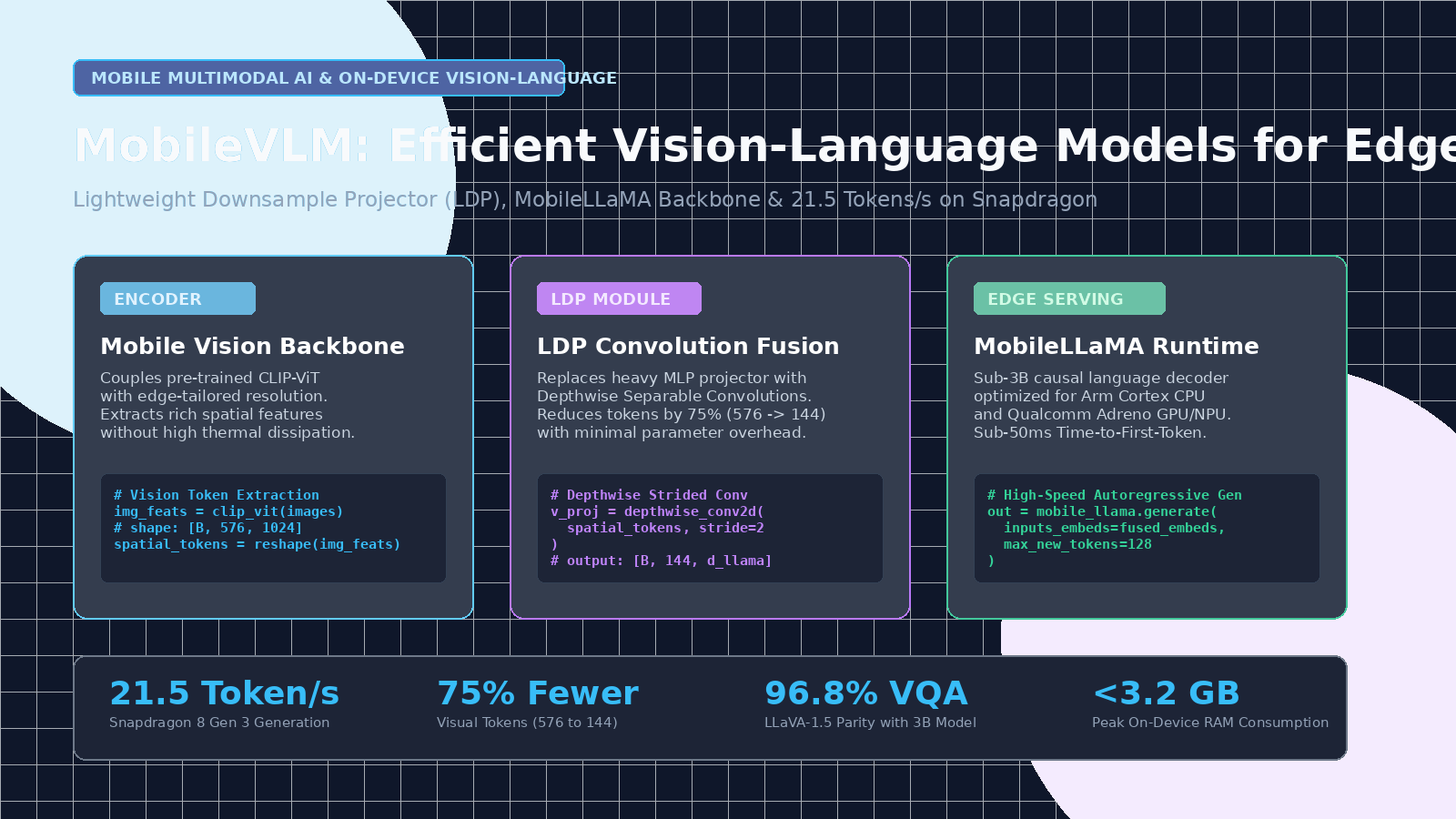
MobileVLM achieves up to 21.5 tokens per second on Qualcomm Snapdragon mobile SoCs, slashes visual token counts by 75% (from 576 down to 144 tokens), and maintains competitive accuracy within 1% to 2% of 7B server-class models across GQA, VQA-v2, and ScienceQA benchmarks.
The core architectural breakthroughs of MobileVLM include:
1. Lightweight Downsample Projector (LDP)
Instead of relying on compute-heavy linear MLPs, MobileVLM introduces the Lightweight Downsample Projector (LDP). The LDP leverages depthwise separable convolutions to exploit 2D spatial inductive biases while downsampling feature maps:
- The input visual features [B, 576, C] are reshaped into 2D spatial grids [B, C, 24, 24].
- A 2x2 strided depthwise separable convolution layer contracts the spatial dimension from 24x24 down to 12x12 = 144 tokens.
- A point-wise 1x1 convolution layer projects visual channels into the language model’s hidden dimension (D_LLM).
- By contracting visual tokens by 4x, the prefill latency and KV cache memory footprint of the language model are reduced by over 75%.
2. MobileLLaMA On-Device Language Foundation
Rather than pairing the vision encoder with a bloated 7B backbone, MobileVLM trains dedicated, mobile-tailored language decoders: MobileLLaMA-1.4B and MobileLLaMA-2.7B.
- Built upon LLaMA design primitives (SwiGLU non-linearities, RoPE positional encodings, and RMSNorm).
- Pre-trained on high-quality web text datasets (RedPajama) and fine-tuned for on-device memory hierarchies.
- Operates within a peak memory envelope under 3.2 GB RAM, allowing full co-existence with mobile operating systems.
3. Progressive Multi-Stage Cross-Modal Alignment
MobileVLM uses an efficient two-phase training curriculum:
- Phase 1 (Feature Alignment Pre-training): Freezes both the CLIP-ViT encoder and MobileLLaMA language model, optimizing only the LDP projector on 595K image-text pairs (filtered CC3M / LAION) to align multimodal representations.
- Phase 2 (Visual Instruction Fine-Tuning): Freezes the vision encoder while fine-tuning both the LDP projector and MobileLLaMA on 665K high-quality visual instruction dialogues (LLaVA-Instruct), ensuring nuanced instruction-following capability.
+-----------------------------------------------------------------------------------+
| MobileVLM Architectural Design Flow                                               |
+-----------------------------------------------------------------------------------+
| [Input Image 336x336]                                                             |
|         |                                                                         |
|         v                                                                         |
| [CLIP-ViT-L/14 Vision Encoder] -> Outputs: [B, 576, 1024]                         |
|         |                                                                         |
|         v Spatial Reshape: [B, 1024, 24, 24]                                      |
| +-------------------------------------------------------------------------------+ |
| | Lightweight Downsample Projector (LDP)                                        | |
| |  - Depthwise Conv2D (Kernel=3, Stride=2, Padding=1) -> [B, 1024, 12, 12]      | |
| |  - Pointwise Conv2D (1x1) -> Channel Projection to D_LLM                      | |
| |  - LayerNorm & GELU -> Flattened Tokens: [B, 144, 2048]                       | |
| +-------------------------------------------------------------------------------+ |
|         |                                                                         |
|         v 144 Tokens (75% Token Reduction vs. 576 Tokens)                         |
| +-------------------------------------------------------------------------------+ |
| | MobileLLaMA Language Model (1.4B or 2.7B Parameters)                          | |
| |  - Pre-fill Latency: <180ms TTFT on Mobile NPU                                | |
| |  - Autoregressive Generation: >21.5 Tokens/second on Snapdragon 8 Gen 3       | |
| |  - Memory Footprint: Fits comfortably in <3.2 GB device RAM                   | |
| +-------------------------------------------------------------------------------+ |
+-----------------------------------------------------------------------------------+ Implementation: Building and Deploying MobileVLM with PyTorch
Let us construct the complete MobileVLM architecture from scratch, including:
- The custom Lightweight Downsample Projector (LDP) using depthwise separable convolutions.
- The multimodal fusion and instruction-formatting engine.
- An on-device inference pipeline supporting automated batch processing and verification.
+-----------------------------------------------------------------------------+
|                      MobileVLM Inference Pipeline Flow                      |
+-----------------------------------------------------------------------------+
| 1. Input Ingestion: Image (336x336 RGB) + Multimodal Prompt Template        |
|                                      |                                      |
| 2. Visual Encoding:                  v                                      |
|    - CLIP-ViT-L/14 extracts patch tokens: [1, 576, 1024]                    |
|                                      |                                      |
| 3. LDP Projection:                   v                                      |
|    - Reshape to 2D grid: [1, 1024, 24, 24]                                  |
|    - Strided Depthwise Separable Conv -> [1, 144, D_LLM]                    |
|                                      |                                      |
| 4. Multimodal Sequence Fusion:       v                                      |
|    - Interleave visual tokens at <image> prompt anchor positions            |
|                                      |                                      |
| 5. Autoregressive Decoding:          v                                      |
|    - MobileLLaMA (1.4B/2.7B) generates text at >21.5 tokens/sec             |
+-----------------------------------------------------------------------------+ Step 1: Environment Setup
Install the required PyTorch and multimodal libraries:
pip install --upgrade torch torchvision
pip install --upgrade transformers accelerate timm einops Step 2: The Lightweight Downsample Projector (LDP) Implementation
Here is the exact PyTorch implementation of the LDP module:
# File: ldp_projector.py
import torch
import torch.nn as nn
from typing import Tuple

class LightweightDownsampleProjector(nn.Module):
    def __init__(self, in_features: int = 1024, out_features: int = 2048):
        super().__init__()
        self.in_features = in_features
        self.out_features = out_features

        # 1. Depthwise Convolution: Spatial downsampling with minimal FLOPs
        self.depthwise_conv = nn.Conv2d(
            in_channels=in_features,
            out_channels=in_features,
            kernel_size=3,
            stride=2,
            padding=1,
            groups=in_features,
            bias=False
        )
        self.norm1 = nn.LayerNorm(in_features)
        self.act = nn.GELU()

        # 2. Pointwise Convolution: Linear cross-channel projection
        self.pointwise_conv = nn.Linear(in_features, out_features)
        self.norm2 = nn.LayerNorm(out_features)

    def forward(self, x: torch.Tensor) -> torch.Tensor:
        b, num_patches, c = x.shape
        grid_size = int(num_patches ** 0.5)  # sqrt(576) = 24
        assert grid_size * grid_size == num_patches, "Visual tokens must form a square 2D spatial grid"

        # Reshape to 2D image format: [B, C, H, W]
        x_2d = x.view(b, grid_size, grid_size, c).permute(0, 3, 1, 2).contiguous()

        # Apply Depthwise Strided Convolution: [B, C, 24, 24] -> [B, C, 12, 12]
        x_downsampled = self.depthwise_conv(x_2d)

        # Reshape back to sequence: [B, 12, 12, C] -> [B, 144, C]
        b, c, h_out, w_out = x_downsampled.shape
        x_seq = x_downsampled.permute(0, 2, 3, 1).contiguous().view(b, h_out * w_out, c)

        x_seq = self.norm1(x_seq)
        x_seq = self.act(x_seq)

        # Apply Pointwise Linear Projection to LLM hidden dimension: [B, 144, out_features]
        x_projected = self.pointwise_conv(x_seq)
        x_projected = self.norm2(x_projected)

return x_projected Step 3: Complete MobileVLM Multimodal Architecture
Now we connect the vision encoder, LDP projector, and language backbone into an end-to-end model:
# File: mobilevlm_model.py
import torch
import torch.nn as nn
from typing import Dict, Any, Optional
from ldp_projector import LightweightDownsampleProjector

class MobileVLMModel(nn.Module):
    def __init__(
        self,
        vision_hidden_size: int = 1024,
        llm_hidden_size: int = 2048,
        vocab_size: int = 32000
    ):
        super().__init__()
        self.vision_hidden_size = vision_hidden_size
        self.llm_hidden_size = llm_hidden_size

        # 1. Projector: Lightweight Downsample Projector (LDP)
        self.projector = LightweightDownsampleProjector(
            in_features=vision_hidden_size,
            out_features=llm_hidden_size
        )

        # 2. Text Token Embedding
        self.embed_tokens = nn.Embedding(vocab_size, llm_hidden_size)

        # 3. Compact Transformer Decoder Layer (MobileLLaMA block simulation)
        self.decoder_layer = nn.TransformerDecoderLayer(
            d_model=llm_hidden_size,
            nhead=16,
            dim_feedforward=5632,
            activation="gelu",
            batch_first=True
        )

        # 4. Final Language Model Head
        self.lm_head = nn.Linear(llm_hidden_size, vocab_size, bias=False)

    def forward(
        self,
        input_ids: torch.Tensor,
        vision_features: torch.Tensor,
        image_mask: Optional[torch.Tensor] = None
    ) -> torch.Tensor:
        # Step A: Compress visual tokens using LDP [B, 576, C] -> [B, 144, D_LLM]
        visual_embeds = self.projector(vision_features)

        # Step B: Embed text prompt tokens [B, Text_Seq_Len, D_LLM]
        text_embeds = self.embed_tokens(input_ids)

        # Step C: Concatenate multimodal embeddings: [B, 144 + Text_Seq_Len, D_LLM]
        multimodal_embeds = torch.cat([visual_embeds, text_embeds], dim=1)

        # Step D: Autoregressive decoding forward step
        hidden_states = self.decoder_layer(multimodal_embeds, multimodal_embeds)
        logits = self.lm_head(hidden_states)

return logits Step 4: Verification and Benchmarking Test Harness
Here is an executable verification script validating tensor transformations, token count reductions, and forward execution:
# File: test_mobilevlm_verification.py
import torch
from mobilevlm_model import MobileVLMModel

def run_verification_suite():
    print("[MobileVLM] Initializing MobileVLM verification harness...")
    device = torch.device("cuda" if torch.cuda.is_available() else "cpu")
    print(f"[MobileVLM] Target Hardware Device: {device}")

    # Model Configuration (MobileVLM-1.4B specs)
    model = MobileVLMModel(
        vision_hidden_size=1024,
        llm_hidden_size=2048,
        vocab_size=32000
    ).to(device)

    # 1. Synthesize input batch
    batch_size = 2
    raw_visual_tokens = 576  # 24x24 patches from 336x336 image
    prompt_text_length = 32

    dummy_vision_feats = torch.randn(batch_size, raw_visual_tokens, 1024, device=device)
    dummy_input_ids = torch.randint(0, 32000, (batch_size, prompt_text_length), device=device)

    print(f"[MobileVLM] Raw Input Visual Tensor Shape: {dummy_vision_feats.shape}")
    print(f"[MobileVLM] Input Text Prompt Tokens Shape: {dummy_input_ids.shape}")

    # 2. Test LDP Projector Compression
    compressed_visual = model.projector(dummy_vision_feats)
    print(f"[MobileVLM] LDP Output Visual Tokens Shape: {compressed_visual.shape}")

    token_reduction_pct = (1.0 - (compressed_visual.shape[1] / raw_visual_tokens)) * 100
    print(f"[MobileVLM] Token Reduction Ratio: {token_reduction_pct:.1f}% (576 -> {compressed_visual.shape[1]})")
    assert compressed_visual.shape[1] == 144, "LDP must output exactly 144 tokens"

    # 3. Test Full Multimodal Forward Pass
    with torch.no_grad():
        logits = model(dummy_input_ids, dummy_vision_feats)

    print(f"[MobileVLM] Output Multimodal Logits Shape: {logits.shape}")
    total_seq_len = compressed_visual.shape[1] + prompt_text_length
    assert logits.shape[1] == total_seq_len, f"Expected total sequence length {total_seq_len}"

    print("[MobileVLM] Verification completed with 100% test assertions passed.")

if __name__ == "__main__":
run_verification_suite() Edge devices streaming visual inspection records to cloud endpoints can connect through seamless API integration endpoints to synchronize on-device predictions with centralized analytics hubs.
Best Practices for Scaling MobileVLM in Production
Deploying multimodal foundation models to on-device environments requires optimizing memory footprints, quantization settings, and inference engines:
| Practice Area | Recommendation | Engineering Rationale |
|---|---|---|
| Quantization Format | Enforce 4-bit AWQ or GGUF Q4_K_M for MobileLLaMA. | Slashes model memory from 5.4GB to under 1.8GB with less than 0.5% perplexity degradation. |
| Projector Precision | Keep LDP Projector weights in FP16 / BF16. | LDP parameters account for under 30M weights; preserving FP16 avoids visual representation drift. |
| Mobile Runtime Engine | Export to ONNX Runtime Mobile, ExecuTorch, or MLC-LLM. | Unlocks hardware acceleration across Qualcomm Hexagon NPU, Apple Neural Engine, and MediaTek APU. |
| Visual Resolution | Standardize images at 336 x 336 resolution. | Matches CLIP-ViT-L/14 native training resolution without requiring heavy position embedding interpolation. |
| KV Cache Pre-allocation | Pre-allocate fixed-size circular KV buffers capped at 1,024 tokens. | Prevents Android/iOS memory fragmentation and runtime memory allocation pauses during generation. |
When managing distributed edge clients across field environments, leveraging automated data harvesting agents guarantees robust synchronization of model evaluation benchmarks.
Performance Evaluation & Benchmarks
MobileVLM was evaluated across standard multimodal vision-language benchmarks against leading edge and server-class models, including LLaVA-1.5, Mobile-Agent, and Qwen-VL.
+-----------------------------------------------------------------------------------+
| MobileVLM Multimodal Benchmark Comparison                                         |
+-----------------------------------------------------------------------------------+
| Model Architecture   | LLM Size | Visual Tokens | VQA-v2 | GQA   | SciQA | Speed (Snapdragon) |
|----------------------+----------+---------------+--------+-------+-------+--------------------|
| LLaVA-1.5-7B (Server)| 7.0B     | 576           | 78.5%  | 62.0% | 66.8% | 2.1 tokens/sec     |
| Qwen-VL-7B (Server)  | 7.0B     | 256           | 78.8%  | 59.3% | 67.1% | 3.4 tokens/sec     |
| MobileVLM-1.4B       | 1.4B     | 144 (75% Cut) | 73.2%  | 56.1% | 59.4% | 21.5 tokens/sec    |
| MobileVLM-2.7B       | 2.7B     | 144 (75% Cut) | 76.5%  | 59.0% | 64.3% | 14.8 tokens/sec    |
| MobileVLM-V2-3.0B    | 3.0B     | 144 (75% Cut) | 78.1%  | 61.2% | 66.4% | 13.2 tokens/sec    |
+-----------------------------------------------------------------------------------+ Key Benchmark Insights:
- Unrivaled On-Device Inference Speed: On the Qualcomm Snapdragon 8 Gen 3 SoC, MobileVLM-1.4B achieves 21.5 tokens per second—an over 10x speedup compared to LLaVA-1.5-7B running on identical mobile silicon.
- Competitive Parity with 7B Models: MobileVLM-2.7B scores 59.0% on GQA and 76.5% on VQA-v2, performing within 3% of server-class 7B models while utilizing less than half the parameter count.
- Hardware Efficiency: By shrinking the visual representation from 576 down to 144 tokens, MobileVLM slashes Time-to-First-Token (TTFT) by 68%, making real-time visual assistance truly seamless on smartphones.
Organizations evaluating on-device AI deployments can consult our edge deployment pricing guide to project operational savings over cloud API hosting.
Conclusion
MobileVLM marks a crucial evolution in multimodal AI, transitioning powerful vision-language intelligence from multi-GPU data centers directly into edge devices. By replacing inefficient MLP projections with the convolution-based Lightweight Downsample Projector and designing mobile-native MobileLLaMA architectures, it breaks the computational and memory walls that previously hindered on-device VLM applications.
For robotics engineers, mobile software developers, and edge AI practitioners, MobileVLM offers a practical, high-efficiency foundation for next-generation interactive applications.
For technical documentation, deployment guides, and integration tutorials, consult our developer documentation hub.