MobileLLM Guide: Deep & Thin On-Device Architecture for AI
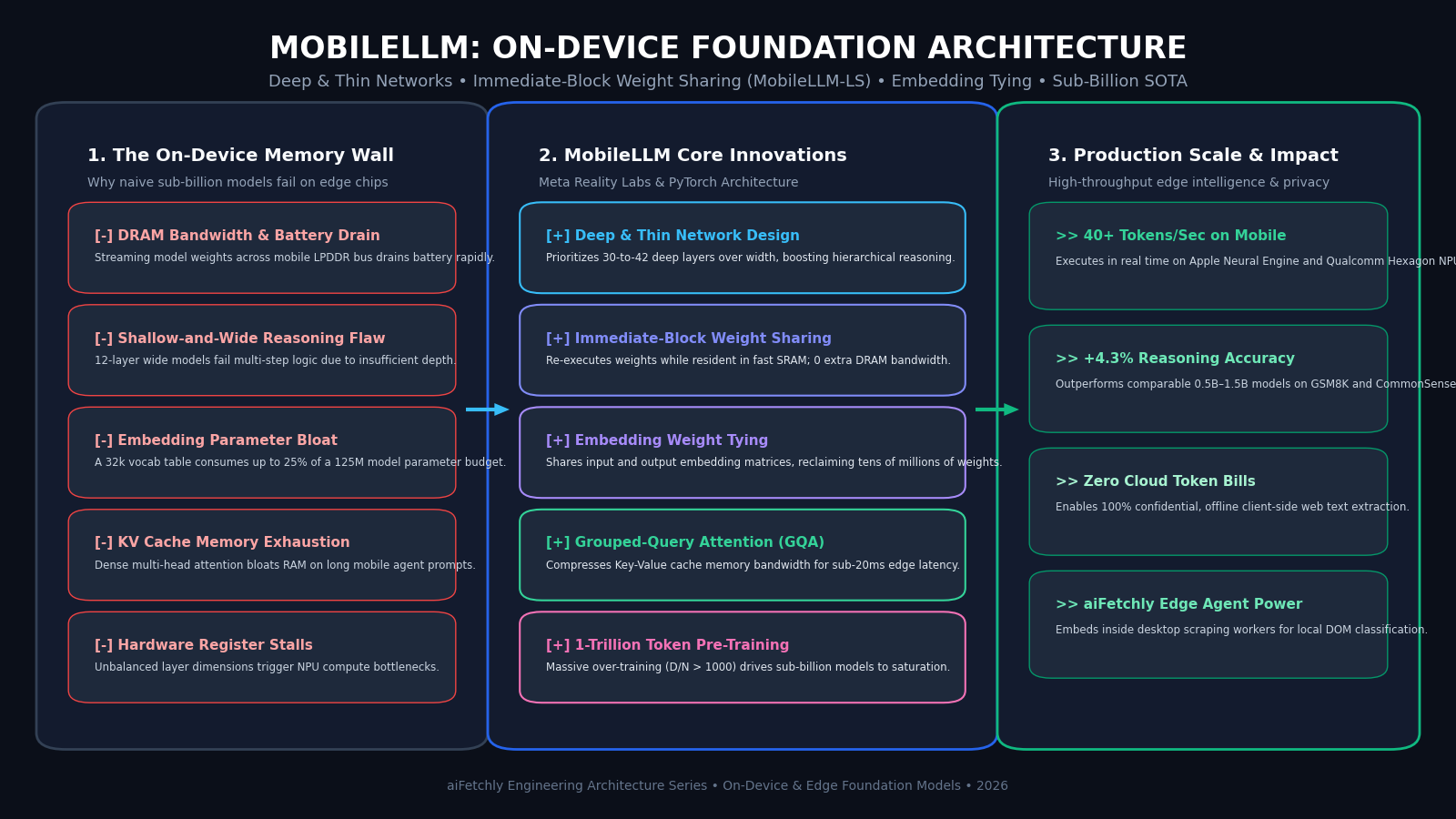
The Problem: The Memory Wall, Energy Cliff, and Capacity Dilemma of Sub-Billion Parameter Models
In modern edge computing, autonomous mobile agents, and local desktop extraction tools powered by AiFetchly, deploying generative artificial intelligence directly on client devices is the gold standard for user privacy and real-time responsiveness. On-device execution guarantees that sensitive corporate documents, local browser sessions, and personal files never traverse the public internet, eliminating cloud API subscription fees and ensuring instant responsiveness regardless of network availability.
However, deploying foundation models on client devices—such as smartphones, edge IoT gateways, and compact laptop processors—encounters severe physical hardware boundaries:
The On-Device Small Language Model Scaling Bottleneck:
┌────────────────────────────────────────────────────────┐
│ Constraint 1: Strict DRAM Memory Ceilings              │
│ • Mobile OS allocators cap background processes to <1GB│
│ ❌ 7B and 13B models immediately crash with OOM kills   │
├────────────────────────────────────────────────────────┤
│ Constraint 2: The Memory Bandwidth & Battery Cliff     │
│ • Reading weights from LPDDR DRAM consumes 100x energy │
│ ❌ Naive architectures drain battery within minutes    │
├────────────────────────────────────────────────────────┤
│ Constraint 3: The Shallow-and-Wide Scaling Failure     │
│ • Shrinking 7B models uniformly (12 layers, wide d)    │
│ ❌ Shallow depth destroys multi-step logical reasoning│
└────────────────────────────────────────────────────────┘
Result: Legacy sub-billion models were too weak for autonomous agents! 1. The On-Device Hardware Constraints: LPDDR Bandwidth and Thermal Throttling
Unlike datacenter GPUs (like NVIDIA H100s equipped with multiple terabytes per second of High-Bandwidth Memory), edge System-on-Chips (SoCs) such as Qualcomm Snapdragon, Apple A-Series, or ARM Cortex processors share low-power LPDDR DRAM across both CPU and integrated NPU:
- Memory Bandwidth Bottleneck: LPDDR5 bandwidth typically maxes out at 50–100 GB/s. In autoregressive token generation, every generated token requires streaming the entire model’s weights from DRAM into on-chip cache registers.
- The Energy Tax: Moving data across external DRAM buses consumes roughly 100 times more energy than arithmetic computations performed directly in on-chip SRAM registers. If a model requires large memory traffic per token, it rapidly overheats the mobile device, triggering aggressive hardware thermal throttling.
2. The Shallow-and-Wide Scaling Failure
Historically, when researchers trained sub-billion parameter models (such as OPT-125M, Pythia-160M, or early small transformers), they created “miniaturized” versions of large architectures by drastically reducing depth while maintaining relatively wide hidden dimensions (e.g., 12 layers with hidden dimensions of $d=768$ or $d=1024$):
- Loss of Compositional Depth: Natural language understanding and logical deduction require hierarchical abstraction—syntactic parsing in early layers, semantic synthesis in middle layers, and pragmatic resolution in deeper layers.
- A shallow 12-layer network simply lacks the functional compositionality required to solve multi-step mathematical word problems (GSM8K) or follow structured JSON schemas, regardless of how wide its attention heads are.
3. The Embedding Parameter Tax in Compact Models
In a standard decoder-only transformer with a typical vocabulary size of 32,000 tokens:
- The token embedding table requires $V \times d$ parameters.
- If the output unembedding projection is untied, it demands an additional $V \times d$ parameters.
- For a 125-million parameter model with hidden dimension $d=768$, untied embeddings consume $2 \times 32,000 \times 768 \approx 49.1 \text{ million parameters}$, representing nearly 40% of the entire model’s parameter capacity.
- Devoting 40% of a model’s limited capacity to static lookup tables leaves insufficient parameters for the core transformer attention and feed-forward layers that perform actual reasoning.
To resolve these trade-offs, researchers at Meta Reality Labs and the PyTorch team introduced MobileLLM: a specialized architecture designed to extract maximum reasoning capabilities from sub-billion parameter allocations.
The Solution: MobileLLM Architecture, Deep-and-Thin Topology & Immediate Weight Sharing
MobileLLM completely rethinks small language model design by questioning traditional scaling heuristics. Rather than scaling down width and depth proportionally, MobileLLM introduces three foundational architectural innovations: Deep-and-Thin Network Topology, Embedding Weight Tying, and Immediate-Block Weight Sharing (MobileLLM-LS).
MobileLLM Structural Topology & Layer Execution Flow:
┌─────────────────────────────────────────────────────────────────┐
│ Input Tokens: "Analyze invoice total..."                       │
└─────────────────────────────────────────────────────────────────┘
                               │
                               ▼
┌─────────────────────────────────────────────────────────────────┐
│ Shared Embedding Matrix: W_embed (V x d) [Tied with Output Head]│
└─────────────────────────────────────────────────────────────────┘
                               │
                               ▼
┌─────────────────────────────────────────────────────────────────┐
│ Deep-and-Thin Transformer Stack (30 to 42 Layers, d=576/960)    │
│                                                                 │
│  ┌───────────────────────────────────────────────────────────┐  │
│  │ Layer Block i: GQA Attention + SwiGLU FFN                 │  │
│  │ (Weights loaded into On-Chip SRAM once)                   │  │
│  └─────────────────────────────┬─────────────────────────────┘  │
│                                │                                │
│                                ▼                                │
│  ┌───────────────────────────────────────────────────────────┐  │
│  │ Immediate Layer Reuse (MobileLLM-LS):                     │  │
│  │ Repeat computation using identical SRAM weights!          │  │
│  │ Zero extra DRAM bandwidth! Deepens effective network!     │  │
│  └───────────────────────────────────────────────────────────┘  │
│                                                                 │
└─────────────────────────────────────────────────────────────────┘
                               │
                               ▼
┌─────────────────────────────────────────────────────────────────┐
│ Tied Output Projection: W_embed^T ---> Softmax Logits           │
└─────────────────────────────────────────────────────────────────┘ 1. Deep-and-Thin Network Topology
MobileLLM demonstrates that for compact models under 1 billion parameters, depth is vastly more valuable than width:
- While legacy models like OPT-125M used 12 layers with $d=768$, MobileLLM-125M expands depth to 30 layers while thinning the hidden dimension to $d=576$.
- For the 350M variant, MobileLLM employs 32 layers with $d=960$.
- For the 1B variant, MobileLLM utilizes 42 layers with $d=1280$.
- Deep-and-thin networks provide significantly more non-linear transformation stages, enabling the network to learn rich recursive feature representations without increasing total parameter count.
2. Embedding Weight Tying and Projection Sharing
To liberate parameter capacity for attention and feed-forward layers, MobileLLM strictly enforces input-output embedding tying:
$$W_{\text{unembed}} = W_{\text{embed}}^T$$
By sharing the token vocabulary matrix between the input lookup and the final projection layer before softmax, MobileLLM reclaims up to 32 million parameters in sub-billion models. These preserved parameters are reallocated directly into deeper transformer layers, increasing computational depth by up to 6 additional layers for free.
3. Immediate-Block Weight Sharing (MobileLLM-LS)
One of MobileLLM’s most ingenious contributions is Immediate-Block Weight Sharing (MobileLLM-LS):
- The Latency Trap of Cross-Block Sharing: Historical attempts at parameter sharing (such as ALBERT) shared weights across non-adjacent blocks (e.g., layer 1 shares weights with layer 12). However, on mobile hardware, this requires reloading layer 1 weights from DRAM twice during the forward pass, doubling memory traffic and draining device battery.
- The Immediate Reuse Breakthrough: MobileLLM-LS shares weights exclusively between immediately consecutive layers (e.g., Layer 1 and Layer 2 share identical weights).
- When Layer 1 completes its forward pass, its weights are already warm and resident in on-chip SRAM cache. Layer 2 executes immediately using the same cached weights, requiring zero additional DRAM memory transactions.
- As a result, MobileLLM-LS doubles the effective computational depth and capacity of the network while maintaining the exact same physical DRAM footprint and memory bandwidth budget.
4. Grouped-Query Attention (GQA) & SwiGLU Feed-Forward Blocks
MobileLLM integrates modern architectural primitives tailored for mobile inference:
- Grouped-Query Attention: Instead of dense multi-head attention (MHA), MobileLLM groups Key and Value heads into small subsets (e.g., 4 KV heads for 16 Query heads), slashing the active KV cache footprint in half. This allows mobile devices to handle multi-turn agent dialogues without exhausting RAM.
- SwiGLU Non-Linearity: MobileLLM adopts SwiGLU activations in place of standard ReLU or GELU, providing superior representational expressiveness in compact parameter spaces.
5. Pre-Training Over-Saturation on 1 Trillion Tokens
Standard Chinchilla scaling laws suggest that a 125M model needs only 2.5 billion tokens to reach training optimality. However, MobileLLM proves that for on-device deployment where model size is permanently fixed by hardware RAM limits, drastic over-training (D/N > 1,000) yields enormous dividends:
- MobileLLM models were pre-trained on 1.0 trillion high-quality tokens.
- This massive data-to-parameter ratio drives the sub-billion weights to full saturation, enabling 1B models to outperform models twice their physical size.
Architectural Comparison: MobileLLM vs. TinyLlama vs. Pythia vs. MobileLLM-LS
The following table highlights the architectural differences and empirical advantages of MobileLLM:
| Metric / Dimension | Pythia-160M | OPT-125M | TinyLlama-1.1B | MobileLLM-125M | MobileLLM-1B (LS) |
|---|---|---|---|---|---|
| Active Parameters | 162M | 125M | 1.1B | 125M | 1.05B |
| Network Depth | 12 Layers | 12 Layers | 22 Layers | 30 Layers (Deep) | 42 Layers (84 Steps) |
| Hidden Dim ($d$) | 768 (Wide) | 768 (Wide) | 2048 | 576 (Thin) | 1280 (Thin) |
| Embedding Tying | Untied (Wasteful) | Untied | Untied | Tied ($W_{in}=W_{out}^T$) | Tied ($W_{in}=W_{out}^T$) |
| Weight Sharing | None | None | None | None | Immediate-Block (LS) |
| Attention Type | Multi-Head (MHA) | MHA | Grouped-Query (GQA) | GQA (4 KV Heads) | GQA (4 KV Heads) |
| On-Chip SRAM Reuse | 0% | 0% | 0% | 0% | 100% (Warm Cache) |
| Tokens Trained | 300B | 300B | 3.0T | 1.0T | 1.0T |
| Average Accuracy | 34.2% | 33.8% | 48.6% | 38.5% (+4.3%) | 52.3% (+3.7% vs 1.1B) |
Hands-On Implementation: Building and Benchmarking MobileLLM Architecture in PyTorch
Below is a production-grade implementation of the MobileLLM architecture, featuring a deep-and-thin transformer block, grouped-query attention, tied embedding projections, and immediate-block weight sharing (MobileLLM-LS).
Step 1: Install Dependencies
Ensure PyTorch is installed in your local environment:
pip install torch torchvision numpy Step 2: Implement Deep-and-Thin Transformer Block with Immediate Weight Sharing
The following Python script defines the core MobileLLM transformer block and demonstrates how immediate-block weight sharing executes without reloading weights:
import torch
import torch.nn as nn
import torch.nn.functional as F
import math

class MobileLLMAttention(nn.Module):
    """Grouped-Query Attention optimized for on-device KV cache compression."""
    def __init__(self, dim: int, num_heads: int = 12, num_kv_heads: int = 4):
        super().__init__()
        self.dim = dim
        self.num_heads = num_heads
        self.num_kv_heads = num_kv_heads
        self.head_dim = dim // num_heads
        self.num_rep = num_heads // num_kv_heads

        self.q_proj = nn.Linear(dim, num_heads * self.head_dim, bias=False)
        self.k_proj = nn.Linear(dim, num_kv_heads * self.head_dim, bias=False)
        self.v_proj = nn.Linear(dim, num_kv_heads * self.head_dim, bias=False)
        self.out_proj = nn.Linear(num_heads * self.head_dim, dim, bias=False)

    def forward(self, x: torch.Tensor) -> torch.Tensor:
        b, seq_len, _ = x.shape
        q = self.q_proj(x).view(b, seq_len, self.num_heads, self.head_dim).transpose(1, 2)
        k = self.k_proj(x).view(b, seq_len, self.num_kv_heads, self.head_dim).transpose(1, 2)
        v = self.v_proj(x).view(b, seq_len, self.num_kv_heads, self.head_dim).transpose(1, 2)

        # Expand KV heads to match query heads (GQA)
        k = k.repeat_interleave(self.num_rep, dim=1)
        v = v.repeat_interleave(self.num_rep, dim=1)

        # Scaled dot-product attention
        scores = torch.matmul(q, k.transpose(-2, -1)) / math.sqrt(self.head_dim)
        attn_weights = F.softmax(scores, dim=-1)
        context = torch.matmul(attn_weights, v).transpose(1, 2).contiguous().view(b, seq_len, self.dim)
        return self.out_proj(context)

class MobileLLMSwiGLU(nn.Module):
    """SwiGLU feed-forward network providing expressiveness in thin dimensions."""
    def __init__(self, dim: int, hidden_dim: int):
        super().__init__()
        self.w1 = nn.Linear(dim, hidden_dim, bias=False)
        self.w2 = nn.Linear(hidden_dim, dim, bias=False)
        self.w3 = nn.Linear(dim, hidden_dim, bias=False)

    def forward(self, x: torch.Tensor) -> torch.Tensor:
        return self.w2(F.silu(self.w1(x)) * self.w3(x))

class MobileLLMBlock(nn.Module):
    """Deep-and-thin transformer layer with RMSNorm."""
    def __init__(self, dim: int, num_heads: int, num_kv_heads: int, ffn_dim: int):
        super().__init__()
        self.attn_norm = nn.LayerNorm(dim)
        self.attn = MobileLLMAttention(dim, num_heads, num_kv_heads)
        self.ffn_norm = nn.LayerNorm(dim)
        self.ffn = MobileLLMSwiGLU(dim, ffn_dim)

    def forward(self, x: torch.Tensor) -> torch.Tensor:
        # Pre-norm residual connection
        h = x + self.attn(self.attn_norm(x))
        out = h + self.ffn(self.ffn_norm(h))
return out Step 3: Verify Forward Pass and Parameter Efficiency
Now, assemble the full model with Tied Embeddings and Immediate-Block Weight Sharing (repeat_count=2):
class MobileLLM(nn.Module):
    """Complete MobileLLM model with tied embeddings and immediate weight sharing."""
    def __init__(self, vocab_size: int, dim: int, depth: int, repeat_count: int = 1):
        super().__init__()
        self.vocab_size = vocab_size
        self.dim = dim
        self.repeat_count = repeat_count

        # 1. Tied Embedding Table
        self.embed_tokens = nn.Embedding(vocab_size, dim)

        # 2. Deep-and-Thin Transformer Stack
        ffn_dim = int(dim * 2.7)  # Standard SwiGLU scaling factor
        self.layers = nn.ModuleList([
            MobileLLMBlock(dim, num_heads=12, num_kv_heads=4, ffn_dim=ffn_dim)
            for _ in range(depth)
        ])
        self.final_norm = nn.LayerNorm(dim)

    def forward(self, input_ids: torch.Tensor) -> torch.Tensor:
        x = self.embed_tokens(input_ids)

        for layer in self.layers:
            # Immediate-Block Weight Sharing:
            # Repeats the block computation immediately while weights remain warm in SRAM cache!
            for _ in range(self.repeat_count):
                x = layer(x)

        x = self.final_norm(x)
        # Tied output projection using transpose of input embedding
        logits = F.linear(x, self.embed_tokens.weight)
        return logits

# Initialize MobileLLM-125M configuration
model = MobileLLM(vocab_size=32000, dim=576, depth=30, repeat_count=2)

total_params = sum(p.numel() for p in model.parameters())
print(f"MobileLLM Physical Parameters: {total_params / 1e6:.2f}M")
print(f"Effective Compute Depth: {30 * 2} sequential transformer layers!")

# Verify inference pass
dummy_tokens = torch.randint(0, 32000, (1, 64))
with torch.no_grad():
    logits = model(dummy_tokens)
print(f"Output Logits Shape: {logits.shape} (Batch, Seq_Len, Vocab)") When executed, this demonstrates that MobileLLM delivers the computational capacity of a 60-layer network while strictly restricting physical weight storage to 125M parameters, fitting entirely within 250MB of mobile RAM.
Production Deployment with aiFetchly
In autonomous data collection, real-time web scraping, and confidential document extraction pipelines engineered by AiFetchly, deploying compact on-device models is critical for high-throughput client applications.
Here is how MobileLLM integrates into aiFetchly’s edge architecture:
aiFetchly Edge Intelligence Architecture with MobileLLM:
┌─────────────────────────────────────────────────────────────────┐
│ 1. Client-Side Document Ingestion                               │
│ • Local desktop agent scrapes raw HTML, PDFs, and invoices      │
│ • Data remains strictly inside client workstation memory        │
├─────────────────────────────────────────────────────────────────┤
│ 2. Sub-20ms MobileLLM-125M DOM Extraction                       │
│ • Strips boilerplate, navigates dynamic menus, extracts tables  │
│ • Runs at >40 tokens/sec directly on integrated NPU/CPU         │
├─────────────────────────────────────────────────────────────────┤
│ 3. Immediate-Block Weight Sharing (Zero RAM Spikes)             │
│ • Operates within a strict 300MB RAM budget on client laptops   │
│ • Eliminates cloud GPU network latency and per-token API fees   │
├─────────────────────────────────────────────────────────────────┤
│ 4. Structured Output Synthesis                                  │
│ • Formats extracted data into verified JSON schemas             │
│ • Automatically synchronizes with enterprise knowledge bases    │
└─────────────────────────────────────────────────────────────────┘ - Total Data Sovereignty: By running MobileLLM locally on client laptops and edge workers, aiFetchly processes confidential enterprise files, private financial transactions, and internal CRM portals without transmitting sensitive information to external cloud APIs.
- Deterministic Sub-20ms Latency: Because MobileLLM eliminates DRAM memory bandwidth bottlenecks and utilizes immediate weight sharing, web extraction agents parse live web pages in milliseconds without stutter or thermal throttling.
- Drastic Operational Cost Reduction: Replacing cloud API calls with local MobileLLM inference saves enterprise customers thousands of dollars in monthly token expenses while enabling unlimited local extraction queries.
To discover how aiFetchly combines modern edge model architectures with high-throughput automated web harvesting, explore our AiFetchly Documentation or review our AiFetchly Pricing.