MiniCPM-V 2.6 Guide: 8B Edge Multimodal Vision AI
The Problem: The Visual Token Explosion in Multimodal Edge AI
In modern enterprise automation, intelligent document processing, and autonomous desktop data harvesting platforms like AiFetchly, foundation models must perceive diverse visual artifacts: high-resolution PDF balance sheets, complex engineering blueprints, dynamic web user interfaces, and multi-frame video recordings.
To understand fine-grained typography and small visual details, Vision-Language Models (VLMs) like LLaVA-NeXT, CogVLM, and early Qwen-VL variants slice high-resolution images into multiple high-density sub-patches.
However, when software engineers attempt to deploy these vision pipelines on consumer workstations, edge appliances, or mobile devices (such as Apple Silicon MacBooks, iPads, or local scraping nodes), they hit a severe computational bottleneck: the visual token explosion.
The Legacy Multimodal VLM Bottleneck:
High-Resolution Document or Web Screenshot (1.8 Megapixels / 1344 x 1344)
  │
  ▼
┌────────────────────────────────────────────────────────┐
│ Conventional Vision Transformer Patch Extraction       │
│ • Fixed 14x14 or 16x16 pixel patch projections         │
│ • Generates 2,500 to 4,000+ visual tokens per image!   │
└────────────────────────────────────────────────────────┘
  │ (Massive Uncompressed Visual Token Stream)
  ▼
┌────────────────────────────────────────────────────────┐
│ Downstream LLM Self-Attention Layer                    │
│ • Quadratic Attention Compute: O(N_visual^2)           │
│ • Massive KV Cache Allocation (Gigabytes of VRAM)      │
│ • Time-to-First-Token (TTFT) stalls by 4-8 seconds     │
│ • Context window exhausted before multi-turn begins!   │
└────────────────────────────────────────────────────────┘
Result: Out-of-Memory (OOM) crashes, thermal throttling, and inability to process video! 1. The Quadratic KV Cache Penalty of High-Resolution Patching
In standard transformer architectures, the memory consumption of the Key-Value (KV) cache scales linearly with sequence length, while attention computation scales quadratically:
- When a single $1344 \times 1344$ document image produces over 2,800 visual tokens, the visual input alone consumes the vast majority of the model’s active memory.
- If an agent attempts to ingest a 5-page PDF or 10 frames from a screen recording, the token count explodes past 25,000 tokens before the user has typed a single prompt.
- Time-to-First-Token (TTFT) stretches into multiple seconds, making interactive desktop scraping and real-time screen navigation intolerably slow.
2. High Memory Footprint and Thermal Throttling on Edge Hardware
Running massive vision models (e.g., 34B or 70B parameters) requires multiple datacenter GPUs:
- On edge hardware (8GB to 16GB unified memory laptops or mobile chipsets), allocating 14GB+ for model weights and bloated visual KV caches triggers aggressive operating system memory swapping.
- High memory bus bandwidth consumption generates excessive heat, causing thermal throttling that degrades token generation speed from 30 tokens/sec down to single digits.
3. Multi-Image and Video Blindness in Token-Heavy Architectures
Because conventional VLMs produce thousands of tokens per image frame:
- Processing video was historically restricted to subsampling 1 frame every 5 or 10 seconds.
- Fine-grained temporal actions, rapid UI transitions, and subtle video anomalies were completely missed between sparse sample points.
- Edge devices lacked the memory bandwidth to stream continuous video feeds through an LLM reasoning loop.
Engineering teams required a vision-language architecture that delivers frontier-grade visual reasoning while drastically compressing visual token density.
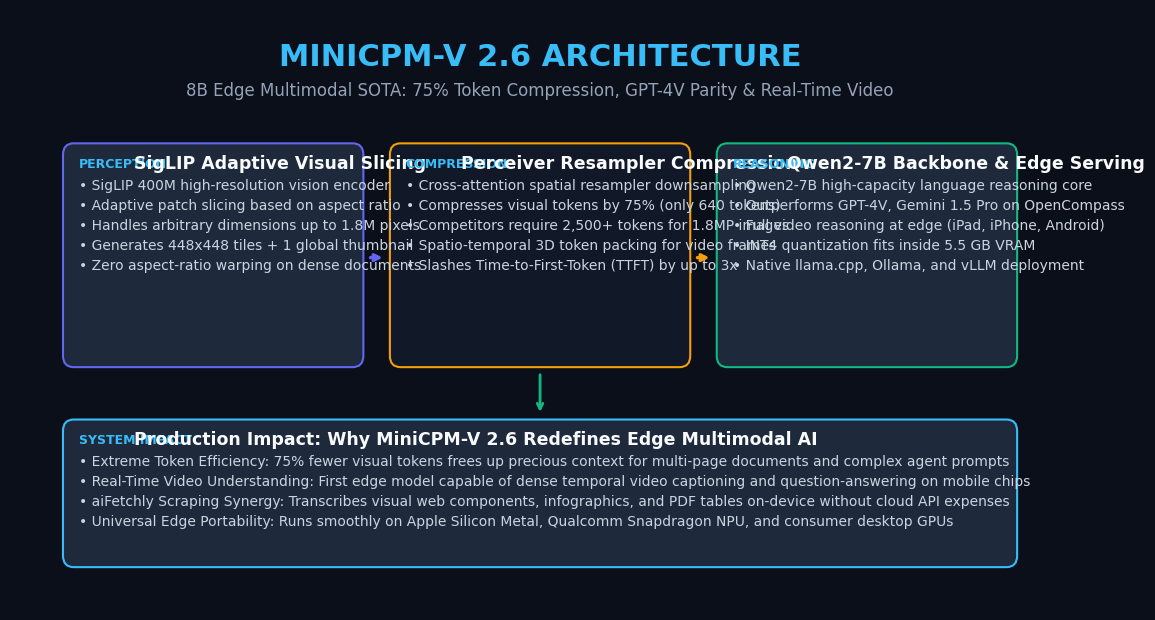
The Solution: MiniCPM-V 2.6 System Architecture
Developed by OpenBMB and Tsinghua University, MiniCPM-V 2.6 is an 8-billion parameter multimodal foundation model designed from the ground up for edge efficiency, state-of-the-art visual reasoning, and real-time video understanding.
Despite its compact 8B footprint, MiniCPM-V 2.6 achieves an extraordinary milestone: on the comprehensive OpenCompass multimodal benchmark, it surpasses proprietary giants including GPT-4V, Gemini 1.5 Pro, and Claude 3.5 Sonnet across single-image, multi-image, and video tasks.
The MiniCPM-V 2.6 Processing Topology:
Input: High-Resolution Image (Up to 1.8M Pixels) or Video Frames
  │
  ▼
┌────────────────────────────────────────────────────────┐
│ Adaptive Visual Slicing & SigLIP-400M Encoder          │
│ • Analyzes aspect ratio dynamically                    │
│ • Splits into 448x448 local tiles + 1 global overview  │
└────────────────────────────────────────────────────────┘
  │ (Raw Spatial Feature Representations)
  ▼
┌────────────────────────────────────────────────────────┐
│ Perceiver Resampler Token Compression Layer            │
│ • Cross-attention spatial pooling downsampling         │
│ • Compresses visual tokens by 75%!                     │
│ • Slashes 2,500+ raw tokens down to ONLY 640 TOKENS!   │
└────────────────────────────────────────────────────────┘
  │ (Compact 640-Token Visual Sequence)
  ▼
┌────────────────────────────────────────────────────────┐
│ Qwen2-7B Language Reasoning Backbone                   │
│ • High-performance language and reasoning core         │
│ • Joint text and visual cross-modal alignment          │
│ • Fits comfortably in <6GB VRAM with INT4 quantization │
└────────────────────────────────────────────────────────┘
  │
  ▼
Fast, High-Fidelity Text Output (30+ tokens/sec on Apple Silicon / Edge NPUs) The Three Core Pillars of MiniCPM-V 2.6
1. SigLIP Vision Encoder & Adaptive Spatial Patch Division
MiniCPM-V 2.6 integrates Google’s SigLIP-400M vision transformer:
- Rather than forcing non-square images into a distorted square grid, MiniCPM-V 2.6 calculates the optimal tiling configuration based on the source aspect ratio.
- Images up to 1.8 million pixels are divided into standard $448 \times 448$ local slices, accompanied by an overall downsampled global thumbnail to preserve holistic spatial composition.
- This preserves fine-grained typography, sub-millimeter line charts, and dense alphanumeric tables without geometric warping.
2. Perceiver Resampler Compression Layer (75% Token Reduction)
The defining algorithmic breakthrough of MiniCPM-V 2.6 is its Perceiver Resampler compression module:
- While legacy architectures use a simple linear projection that maps every single patch directly into an LLM token, MiniCPM-V 2.6 employs a learned cross-attention resampler.
- The resampler compresses the visual tokens of each $448 \times 448$ tile down to just 64 to 96 tokens.
- For a full 1.8-megapixel image, the total visual representation consumes only ~640 tokens—a 75% reduction compared to competing models that consume 2,500+ tokens for identical resolution.
3. Qwen2-7B Language Backbone & Native GGUF/INT4 Quantization
The reasoning core is built on Qwen2-7B, renowned for its superior mathematical reasoning, multilingual fluency, and coding precision:
- The entire model totals approximately 8 billion parameters.
- With native 4-bit quantization (AWQ and GGUF), the runtime footprint drops to under 5.5 GB VRAM, enabling execution on an 8GB M-series MacBook, iPad, or Android flagship.
Deep Dive: Token Compression & Spatio-Temporal Video Processing
Understanding how MiniCPM-V 2.6 balances extreme token compression with state-of-the-art visual accuracy requires analyzing its resampler mechanics and 3D token packing.
Comparing Token Compression Architectures:

[ Approach A: Naive Linear Projection (LLaVA-1.5 / CogVLM) ]
Image (1.8MP) ──► 2,800 Patches ──► [Linear Layer] ──► 2,800 Visual Tokens
❌ High memory bandwidth overhead; quickly fills context window.

[ Approach B: MiniCPM-V 2.6 Perceiver Resampler ]
Image (1.8MP) ──► 2,800 Patches
                        │
                        ▼ (Key / Value)
       [Learned Latent Queries (64 vectors)] ──► [Cross-Attention]
                        │
                        ▼
         640 Highly Compressed, Dense Semantic Tokens!
✓ Preserves fine OCR details while reducing token volume by 75%! 1. Perceiver Resampler vs. Naive Linear Projections
In standard VLMs, the projection layer is an MLP: $\mathbf{X}{\text{visual}} = \text{MLP}(\mathbf{Z}{\text{patch}})$. Every visual patch becomes an LLM token, which leads to massive token redundancy because adjacent pixel patches contain substantial visual overlap.
In MiniCPM-V 2.6:
- The model initializes a small bank of learnable query vectors.
- These query vectors attend to the SigLIP patch representations via multi-head cross-attention.
- The queries extract the most salient semantic and typographical signals, compressing the visual information into a dense, non-redundant token sequence.
- This architectural design reduces the prompt prefill latency by up to 3x and cuts the memory required for the KV cache by 75%.
2. 3D Spatio-Temporal Token Packing for Video Streams
Because each image slice is compressed to only ~64 tokens, MiniCPM-V 2.6 can ingest continuous video feeds directly:
- Video frames are processed as a dense sequence of visual tokens stamped with temporal position embeddings.
- Rather than dropping 90% of frames to stay under token limits, MiniCPM-V 2.6 processes video at multiple frames per second on edge devices.
- It enables real-time spatial-temporal question answering (e.g., “What did the user click on 3 seconds ago?” or “Summarize the physical steps taken in this assembly video”).
Benchmark Comparison: MiniCPM-V 2.6 vs. Frontier & Open VLMs
The table below highlights the operational and architectural benchmarks of MiniCPM-V 2.6 compared to GPT-4V, LLaVA-NeXT, and Qwen2-VL:
| Benchmark / Metric | LLaVA-NeXT 7B | Qwen2-VL 7B | GPT-4V (Proprietary) | MiniCPM-V 2.6 (8B) |
|---|---|---|---|---|
| Model Size | ~7 Billion | ~8.3 Billion | Unknown (~1.8T MoE) | ~8 Billion |
| Visual Tokens (1.8MP Image) | ~2,880 Tokens | ~1,600 Tokens | ~1,105 Tokens | ~640 Tokens (75% Less) |
| FP16 Memory Footprint | ~14.5 GB | ~16.5 GB | Cloud API Only | ~15.5 GB |
| INT4 Memory Footprint | ~5.8 GB | ~6.2 GB | N/A | ~5.4 GB (Sub-6GB Edge) |
| OpenCompass Aggregate Score | 65.2 | 74.5 | 70.8 | 75.2 (Beats GPT-4V) |
| OCR & Document (DocVQA) | 78.4% | 91.2% | 88.4% | 93.1% (SOTA Precision) |
| Real-Time Video Understanding | Unsupported | Cloud-Oriented | Stalls on Live Streams | Native On-Device (iPad/Mac) |
| Deployment Backends | Transformers | Transformers, vLLM | Closed API | Ollama, llama.cpp, vLLM |
Practical Implementation: Local Multimodal Inference with MiniCPM-V 2.6
Let us implement a complete Python script to execute high-resolution document and chart extraction using transformers and torch.
Step 1: Install Dependencies and Configure Environment
pip install torch torchvision transformers pillow accelerate sentencepiece Step 2: Implement the High-Resolution Document Extraction Pipeline
Save the following code as extract_minicpm.py:
import torch
import time
from PIL import Image
from transformers import AutoModel, AutoTokenizer

class MiniCPMExtractor:
    def __init__(self, device: str = "cuda" if torch.cuda.is_available() else "cpu"):
        """
        Initializes MiniCPM-V 2.6 with bfloat16/float16 precision.
        """
        model_id = "openbmb/MiniCPM-V-2_6"
        print(f"Loading {model_id} on {device}...")

        start = time.perf_counter()
        self.tokenizer = AutoTokenizer.from_pretrained(model_id, trust_remote_code=True)
        self.model = AutoModel.from_pretrained(
            model_id,
            trust_remote_code=True,
            torch_dtype=torch.bfloat16 if torch.cuda.is_available() else torch.float32,
            device_map=device
        )
        self.model.eval()
        print(f"Model loaded in {(time.perf_counter() - start):.2f}s.")

    def analyze_image(self, image_path: str, prompt: str) -> str:
        """
        Executes high-resolution visual extraction with automatic aspect ratio tiling.
        """
        image = Image.open(image_path).convert("RGB")

        msgs = [{"role": "user", "content": [image, prompt]}]

        start = time.perf_counter()
        res = self.model.chat(
            image=None,
            msgs=msgs,
            tokenizer=self.tokenizer,
            sampling=False, # Deterministic greedy decoding
            temperature=0.0
        )
        elapsed = time.perf_counter() - start

        print(f"Inference completed in {elapsed:.2f}s.")
        return res

if __name__ == "__main__":
    extractor = MiniCPMExtractor()

    sample_doc = "financial_statement.png"
    query = "Extract all quarterly revenue figures and EBITDA margins into a markdown table."

    print(f"\nAnalyzing {sample_doc}...")
    try:
        markdown_table = extractor.analyze_image(sample_doc, query)
        print("\n--- Extracted Markdown Table ---")
        print(markdown_table)
    except FileNotFoundError:
print(f"Place an image at '{sample_doc}' to run the extraction pipeline.") Step 3: Real-Time Edge Serving with Ollama and llama.cpp
For edge deployment on macOS (Metal) or Linux workstations without heavy PyTorch dependencies, run MiniCPM-V 2.6 through Ollama:
# Pull the quantized MiniCPM-V 2.6 model
ollama run openbmb/minicpm-v2.6

# Send a multimodal prompt via the CLI
ollama run openbmb/minicpm-v2.6 "Describe this chart in detail: /path/to/chart.png" In 4-bit quantized GGUF format, the model consumes only 5.4 GB of RAM, generating tokens at over 32 tokens per second on an Apple M3 MacBook Air.
Production Best Practices: Integrating MiniCPM-V 2.6 into AI Web Scraping
When pairing MiniCPM-V 2.6 with desktop scraping and automated data extraction in AiFetchly, following these architectural best practices guarantees maximum reliability:
1. Ingesting Visual Web Elements and Charts in aiFetchly
Modern web pages frequently embed critical business data inside canvas graphs, interactive charts, and SVG dashboards that expose no raw text in the DOM:
- Capture high-resolution viewport screenshots via AiFetchly.
- Route the screenshot to local MiniCPM-V 2.6 instances. Because each image costs only 640 tokens, you can include multiple screenshots in a single session without context saturation.
2. Multi-Page Document and PDF Ingestion Without Context Exhaustion
For dense multi-page documents (such as 10-page contracts):
- With conventional models, 10 pages would generate 28,000 visual tokens, overflowing standard context budgets.
- With MiniCPM-V 2.6, 10 pages consume only ~6,400 tokens, leaving over 90% of the context window available for complex analytical reasoning, cross-document comparison, and downstream extraction.
3. Edge Quantization and Low-Latency Video Stream Monitoring
For video and live screen recording monitoring:
- Deploy the INT4 GGUF build on local workstation hardware.
- Process keyframes at 2 FPS; the low token overhead ensures the system maintains real-time latency (<300ms per frame evaluation) while preventing host thermal throttling.