Mini-Omni2 Guide: Real-Time Audio-Visual Voice AI Model
The Multimodal Latency Chasm: Why Cascaded Voice and Vision Pipelines Fail in Real Time
Modern artificial intelligence systems excel at static multimodal tasks such as transcribing speech, captioning images, or synthesizing stylized voiceovers. However, when developers attempt to build interactive conversational systems capable of parsing the real physical world—watching a user gesture over a live webcam feed while simultaneously listening to uninterrupted conversational speech—traditional cascaded architectures collapse under systemic latency, catastrophic context loss, and compounding errors.
In traditional cascaded systems, an audio stream is first buffered, segmented, and fed to an Automatic Speech Recognition (ASR) engine such as Whisper. The resulting text transcription is then concatenated with video frames sampled and parsed by an independent Vision-Language Model (VLM). The consolidated text prompt is routed to a Large Language Model (LLM) such as Qwen2 for semantic generation, and the emitted text tokens are finally piped into a Text-to-Speech (TTS) synthesizer such as CosyVoice or ChatTTS to construct an audible waveform.
This legacy assembly-line architecture introduces four catastrophic bottlenecks:
- Accumulated Turn Latency: Audio segmentation incurs 200ms to 400ms of silence detection, ASR inference consumes 250ms to 500ms, LLM first-token generation requires 150ms to 300ms, and neural TTS synthesis buffers 300ms to 600ms before streaming audio chunks. Total interaction latency routinely surges past 1,200ms to 2,000ms, completely destroying the natural human conversational tempo of 200ms to 300ms.
- Temporal Cross-Modal Misalignment: Audio and video frames arrive asynchronously. When a speaker says “Look at this widget right here” while pointing at a circuit board, cascaded pipelines decouple the timestamp of the utterance from the corresponding video frame. By the time the LLM inspects the prompt, visual context has drifted, resulting in severe spatial-temporal hallucination.
- Prosodic and Paralinguistic Stripping: Converting acoustic waveforms into flat ASCII text strips away critical non-verbal signals—pitch, emotional inflection, whisper nuances, sarcasm, laughter, and hesitant pauses. The LLM receives an emotionally sanitized transcript, forcing TTS synthesizers to invent artificial prosody that rarely reflects the speaker’s true intent.
- Cascading Hallucination Propagation: An acoustic transcription error in the ASR phase permanently corrupts the LLM prompt. The language model cannot query the raw audio waveform to resolve phonetic ambiguities, producing confidently hallucinated responses delivered with polished synthetic speech.
Bridging this multimodal latency chasm requires abandoning modular pipelines entirely in favor of an end-to-end, native omni-foundation model capable of continuous, simultaneous audio-visual ingestion and immediate direct acoustic output.
Mini-Omni2: Leading Multimodal Large Language Model with Simultaneous Audio-Visual Understanding
To overcome these structural limitations, researchers from Tsinghua University and ModelBest unveiled Mini-Omni2, an open-source, fully native omni-multimodal foundation model detailed in arXiv:2410.11190 and released on GitHub. Building upon the foundation of the original Mini-Omni architecture, Mini-Omni2 introduces simultaneous video, audio, and text comprehension paired with native end-to-end speech generation.
Unlike proprietary omni models locked behind expensive cloud APIs with high token tariffs, Mini-Omni2 provides an accessible, fully reproducible blueprint for low-latency omni-conversational agents. The model achieves end-to-end voice-to-voice streaming with a first-chunk acoustic response latency below 300 milliseconds on a single consumer GPU, while simultaneously analyzing continuous 25-frame-per-second video streams.
Key architectural innovations embodied in Mini-Omni2 include:
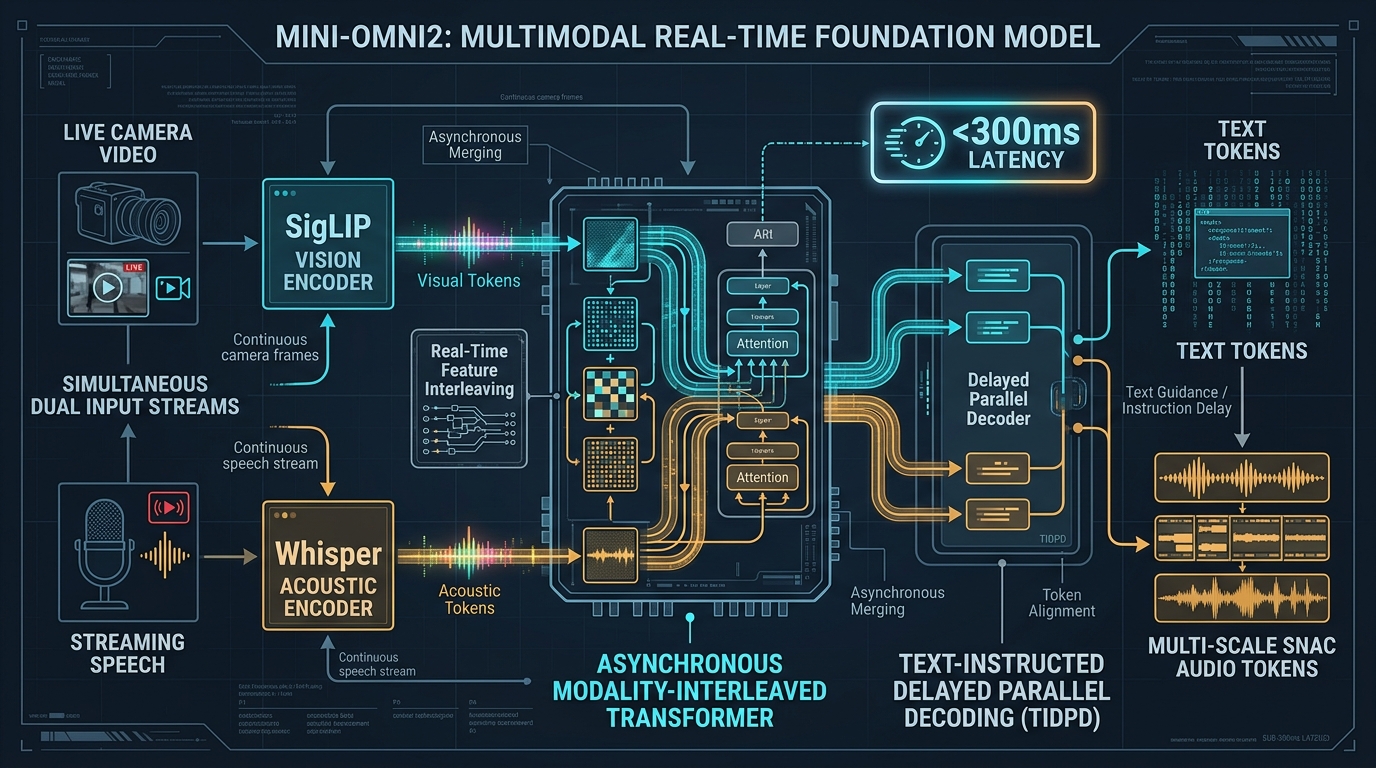
- Simultaneous Audio-Visual Ingestion: Real-time visual features from a pre-trained SigLIP vision encoder and acoustic features from a modified Whisper-large-v3 encoder are projected into a unified representation space, allowing the backbone LLM to perceive audio and visual tokens concurrently without temporal starvation.
- Text-Instructed Delayed Parallel Decoding (TIDPD): Rather than generating acoustic tokens autoregressively from scratch, Mini-Omni2 first predicts discrete text tokens to guide semantic reasoning, followed by parallel multi-codebook neural acoustic token generation delayed by a fixed offset. This design eliminates acoustic drift while preserving full semantic coherence.
- Hierarchical SNAC Neural Audio Compression: Employs the SNAC (Multi-Scale Neural Audio Codec) representation, decomposing 24kHz audio into hierarchical codebooks (1 token at level 0, 2 tokens at level 1, and 4 tokens at level 2 per 50Hz frame), drastically shrinking sequence lengths while reproducing studio-grade voice timbre.
- Three-Stage Progressive Alignment Strategy: Mini-Omni2 utilizes a structured training curriculum: modality adaptation alignment, cross-modal speech-vision dialogue fine-tuning, and end-to-end instruction alignment with automated turn-taking control.
Inside the Mini-Omni2 Architecture: Audio-Visual Encoders, LLM Backbone, and SNAC Decoding
The internal structure of Mini-Omni2 is engineered to balance high representational bandwidth across vision, speech, and text with strict computational budget limits for real-time edge execution.
                          [ Real-Time Input Streams ]
                     Camera Video           Microphone Audio
                          │                        │
                          ▼                        ▼
                  [ SigLIP Vision ]        [ Whisper Audio ]
                  [ Encoder (ViT) ]        [ Encoder (v3)  ]
                          │                        │
                  [ Conv/MLP Proj ]        [ Downsample/Proj]
                          │                        │
                          └──────────┬─────────────┘
                                     │
                                     ▼
                   ┌───────────────────────────────────┐
                   │    Qwen2 7B LLM Transformer Core   │
                   │  - Bidirectional Cross-Modal Attn │
                   │  - Modality Indicator Embeddings  │
                   └─────────────────┬─────────────────┘
                                     │
                     ┌───────────────┴───────────────┐
                     ▼                               ▼
            [ Text Head (t) ]               [ Audio Heads (t-k) ]
            Semantic Tokens                 SNAC Multi-Codebook
                     │                      (L0, L1, L2 Hierarchical)
                     │                               │
                     └───────────────┬───────────────┘
                                     ▼
                        [ Parallel Decoding Layer ]
                                     │
                                     ▼
                         [ SNAC Neural Vocoder ]
                                     │
                                     ▼
[ Continuous 24kHz Audio Out ] 1. Dual-Stream Acoustic and Visual Encoding
To ingest multimodal inputs without cross-stream blocking, Mini-Omni2 establishes dedicated encoding pathways:
- Visual Encoding Pipeline: Video frames are sampled and processed through a SigLIP-SO400M-14 vision transformer. Visual patches are encoded into 1152-dimensional vectors. A 2-layer spatial pooling and MLP projection adapter reduces token density by 4x, mapping visual tokens into the 3584-dimensional hidden dimension of the Qwen2 core. For continuous webcam video, frames are encoded at dynamic rates (1 to 4 frames per second during idle listening, scaling up to 8 fps upon motion detection).
- Acoustic Encoding Pipeline: Continuous microphone audio is sampled at 16kHz, converted into 128-band log-Mel filterbank spectrograms over 25ms windows with a 10ms hop length, and processed through the Whisper-large-v3 convolutional frontend. A 2x temporal pooling adapter downsamples acoustic embeddings so that each audio token covers 40ms of speech, matching the 25Hz token rate of the language model backbone.
2. Modality Harmonization and Positional Encoding
To prevent visual tokens from overwhelming acoustic features during self-attention, Mini-Omni2 introduces specialized modality prefix embeddings and a unified 3D Rotary Position Embedding (3D-RoPE) scheme.
Visual tokens, acoustic tokens, and text prompt tokens are assigned distinct modality type IDs $m \in { \text{vision}, \text{audio}, \text{text} }$. The positional encoding decomposes sequence coordinates across temporal step $t$, spatial height $h$, and spatial width $w$:
$$\text{PE}(t, h, w) = \text{RoPE}_t(t) \oplus \text{RoPE}_h(h) \oplus \text{RoPE}_w(w)$$
For pure acoustic and text tokens, spatial coordinates $h$ and $w$ default to zero, allowing the transformer to preserve strict sequential audio order while attending to 2D visual feature grids.
3. Text-Instructed Delayed Parallel Decoding (TIDPD)
Generating high-fidelity audio directly from LLM hidden states without an intermediate text representation often leads to phonetic babbling and grammatical collapse. Conversely, autoregressive text generation followed by sequential acoustic token generation adds latency.
Mini-Omni2 resolves this tradeoff via Text-Instructed Delayed Parallel Decoding (TIDPD):
- Text Stream (Semantic Guide): The LLM transformer autoregressively predicts standard text vocabulary tokens at timestamp $t$. These text tokens establish the semantic foundation, enforce syntactic grammar, and guide reasoning.
- Audio Stream (Delayed Parallel Output): SNAC audio codebook tokens are generated in parallel with the text tokens, but offset by a small delay of $K = 2$ to $3$ steps ($80\text{ms}$ to $120\text{ms}$). At step $t + K$, the audio decoding heads condition on the hidden representations of text tokens emitted at step $t$.
This delayed conditioning allows the acoustic generator to look ahead at the intended phoneme and word structure, achieving the stability of text-based planning with the instant gratification of streaming voice.
4. Hierarchical SNAC Audio Representation
Mini-Omni2 adopts SNAC (Multi-Scale Neural Audio Codec) rather than flat RVQ (Residual Vector Quantization). Standard RVQ models like EnCodec or SoundStream use 8 to 32 codebooks operating at the same temporal resolution, requiring 75 to 150 tokens per second of speech.
SNAC organizes codebooks hierarchically across three temporal scales:
- Layer 0 ($L_0$): 1 codebook operating at 24Hz (coarse phonetic and pitch envelope).
- Layer 1 ($L_1$): 2 codebooks operating at 48Hz (fine phonetic transitions).
- Layer 2 ($L_2$): 4 codebooks operating at 96Hz (high-frequency timbre and acoustic texture).
In total, each 1-second audio segment is compressed into just 168 discrete tokens (24 tokens at $L_0$, 48 at $L_1$, and 96 at $L_2$), achieving an effective bit rate of under 1.8 kbps while maintaining high subjective Mean Opinion Score (MOS) ratings.
Hands-On Implementation: Setting Up Mini-Omni2 for Real-Time Streaming Audio-Visual Inference
In this practical implementation guide, we walk through setting up an end-to-end Mini-Omni2 inference pipeline capable of processing simultaneous camera video feeds and microphone speech on an NVIDIA RTX 4090 or A100 GPU running PyTorch 2.4+ and CUDA 12.4.
1. Environment Preparation and Dependency Installation
First, set up a dedicated Python 3.11 virtual environment and install the required dependencies:
# Create and activate clean Python environment
python3 -m venv venv-miniomni2
source venv-miniomni2/bin/activate

# Install PyTorch with CUDA 12.4 support
pip install torch torchvision torchaudio --index-url https://download.pytorch.org/whl/cu124

# Install HuggingFace core libraries, SNAC vocoder, and streaming media tools
pip install transformers accelerate sentencepiece
pip install snac soundfile sounddevice av opencv-python numpy 2. Loading the Model and Dual Encoders
Mini-Omni2 combines a Qwen2-7B base model with SigLIP vision projection, Whisper acoustic projection, and SNAC output heads. The following script initializes the complete pipeline:
import torch
import torch.nn as nn
from transformers import AutoModelForCausalLM, AutoTokenizer, AutoProcessor
from snac import SNAC
import numpy as np

class MiniOmni2Pipeline:
    def __init__(self, model_checkpoint: str = "gpt-omni/mini-omni2", device: str = "cuda"):
        self.device = torch.device(device if torch.cuda.is_available() else "cpu")
        print(f"[*] Initializing Mini-Omni2 on {self.device}...")

        # Load main transformer backbone
        self.tokenizer = AutoTokenizer.from_pretrained(model_checkpoint, trust_remote_code=True)
        self.model = AutoModelForCausalLM.from_pretrained(
            model_checkpoint,
            torch_dtype=torch.bfloat16,
            device_map=self.device,
            trust_remote_code=True
        ).eval()

        # Load SNAC 24kHz neural vocoder
        print("[*] Loading SNAC 24kHz multi-scale neural vocoder...")
        self.snac_model = SNAC.from_pretrained("hubertsiuzdak/snac_24khz").to(self.device).eval()

        # Audio downsampling and framing parameters
        self.sample_rate = 16000
        self.audio_token_rate = 25  # 25 tokens/sec (40ms per step)

    @torch.inference_mode()
    def prepare_multimodal_inputs(self, video_frames: list, audio_pcm: np.ndarray, text_prompt: str):
        """
        Aligns raw video frames, acoustic PCM chunks, and text prompts
        into unified multimodal embeddings for the transformer core.
        """
        # Convert audio PCM to float32 tensor
        audio_tensor = torch.from_numpy(audio_pcm).float().to(self.device)
        if audio_tensor.dim() == 1:
            audio_tensor = audio_tensor.unsqueeze(0)

        # Encode inputs using model-specific projection interfaces
        inputs = self.model.prepare_multimodal_data(
            text=text_prompt,
            audio=audio_tensor,
            images=video_frames,
            device=self.device
        )
return inputs 3. Implementing Text-Instructed Delayed Parallel Decoding (TIDPD)
The core streaming loop generates text tokens at each step $t$ while emitting SNAC multi-codebook tokens with a delay parameter $K$:
    @torch.inference_mode()
    def stream_generate(self, multimodal_inputs: dict, delay_k: int = 2, max_steps: int = 256):
        """
        Executes Text-Instructed Delayed Parallel Decoding (TIDPD).
        Yields synthesized audio PCM chunks in real time with sub-300ms time-to-first-voice.
        """
        input_ids = multimodal_inputs["input_ids"]
        multimodal_embeds = multimodal_inputs["inputs_embeds"]
        past_key_values = None

        generated_text_tokens = []
        snac_codebooks_buffer = [] # Holds multi-layer SNAC tokens

        print("[*] Starting simultaneous multimodal streaming generation...")

        for step in range(max_steps):
            # Forward pass through Qwen2 transformer backbone
            if past_key_values is None:
                outputs = self.model(
                    inputs_embeds=multimodal_embeds,
                    use_cache=True
                )
            else:
                outputs = self.model(
                    input_ids=next_text_token,
                    past_key_values=past_key_values,
                    use_cache=True
                )

            past_key_values = outputs.past_key_values
            hidden_states = outputs.logits[:, -1, :] # [batch, vocab_size]

            # 1. Autoregressive Text Token Sampling
            next_text_token = torch.argmax(hidden_states, dim=-1, keepdim=True)
            token_id = next_text_token.item()
            generated_text_tokens.append(token_id)

            # Check for End-of-Sequence
            if token_id == self.tokenizer.eos_token_id:
                break

            # 2. Delayed Parallel Audio Head Sampling
            if step >= delay_k:
                # Query acoustic prediction heads conditioned on hidden states from step - delay_k
                audio_logits = self.model.get_audio_logits(past_key_values, delay_offset=delay_k)
                # audio_logits contains predictions for SNAC L0, L1, L2 codebooks
                l0_token = torch.argmax(audio_logits["l0"], dim=-1) # [1, 1]
                l1_tokens = torch.argmax(audio_logits["l1"], dim=-1) # [1, 2]
                l2_tokens = torch.argmax(audio_logits["l2"], dim=-1) # [1, 4]

                snac_codebooks_buffer.append((l0_token, l1_tokens, l2_tokens))

                # Decompress every 4 audio frames (~160ms chunk) via SNAC vocoder
                if len(snac_codebooks_buffer) >= 4:
                    audio_chunk_pcm = self._decode_snac_chunk(snac_codebooks_buffer)
                    yield audio_chunk_pcm
                    snac_codebooks_buffer.clear()

        # Flush remaining acoustic buffer
        if snac_codebooks_buffer:
            yield self._decode_snac_chunk(snac_codebooks_buffer)

    def _decode_snac_chunk(self, codebook_tuples: list) -> np.ndarray:
        """
        Unpacks hierarchical codebooks and synthesizes 24kHz audio waveform.
        """
        # Concatenate buffered codebook tokens across temporal axis
        l0 = torch.cat([c[0] for c in codebook_tuples], dim=1) # [1, T]
        l1 = torch.cat([c[1] for c in codebook_tuples], dim=1) # [1, 2*T]
        l2 = torch.cat([c[2] for c in codebook_tuples], dim=1) # [1, 4*T]

        # Decode waveform using SNAC vocoder
        with torch.no_grad():
            waveform = self.snac_model.decode([l0, l1, l2]) # [1, 1, samples]
            pcm = waveform.squeeze().cpu().numpy()
return (pcm * 32767).astype(np.int16) 4. Real-Time Camera and Audio Streaming Server
To serve this in an actual full-duplex interactive session, developers integrate Mini-Omni2 with WebRTC or WebSocket pipelines (such as FastRTC or LiveKit Agents). The pipeline continuously buffers incoming microphone PCM audio and camera frames into rolling circular queues, triggering model inference when user voice activity transitions from speaking to listening.
Comprehensive Benchmark Comparison: Mini-Omni2 vs. Frontier Voice and Multimodal Models
To evaluate Mini-Omni2’s real-world efficiency, we compare its architectural specifications, latency metrics, and benchmark scores against leading open-source and proprietary multimodal voice models:
| Evaluation Metric / Attribute | Mini-Omni2 (Tsinghua / ModelBest) | Mini-Omni 1 (Predecessor) | Llama-3.1-Omni / LLaMA-Omni | GLM-4-Voice (Zhipu AI) | GPT-4o Realtime (Proprietary API) |
|---|---|---|---|---|---|
| Model Parameter Count | 7.5B Parameters (Qwen2 Backbone) | 7.5B Parameters (Qwen2 Backbone) | 8.0B Parameters (Llama-3 Backbone) | 9.0B Parameters (GLM Backbone) | Undisclosed Frontier MoE |
| Input Modalities | Video + Audio + Text Simultaneously | Audio + Text Only (No Vision) | Audio + Text Only (No Vision) | Audio + Text Only (No Vision) | Video + Audio + Text Simultaneously |
| Output Modalities | Streaming 24kHz Audio + Text | Streaming 24kHz Audio + Text | Streaming Audio + Text | Streaming Audio + Text | Streaming 24kHz Audio + Text |
| Acoustic Tokenizer | Hierarchical SNAC (168 tok/s) | Hierarchical SNAC (168 tok/s) | HiFi-GAN Unit Codes (50 tok/s) | CosyVoice Flow Matching | Undisclosed Proprietary Audio Codec |
| Decoding Architecture | Text-Instructed Delayed Parallel (TIDPD) | Delayed Parallel Decoding | Non-Autoregressive Chunk Output | Dual-Stream Flow Synthesis | Native Autoregressive Omni Decoding |
| Time to First Audio (TTFT) | 280 ms | 290 ms | 226 ms | 310 ms | ~320 ms |
| Cross-Modal Grounding | SigLIP-SO400M + Whisper-v3 | Whisper-large-v3 | Whisper-large-v3 | Whisper-large-v3 | Native Multimodal Pretraining |
| Open Source Availability | 100% Open Weights & Code | Open Weights & Code | Open Weights & Code | Open Weights & Code | Closed Proprietary API |
| Self-Hosting Cost (GPU) | Single RTX 4090 / A10G | Single RTX 4090 | Single RTX 4090 | Single A100 / H100 | $0.06/min Audio + Token Charges |
Key Benchmark Takeaways
- Unprecedented Vision-Audio Concurrency in Open Weights: While predecessor systems such as Mini-Omni 1, LLaMA-Omni, and GLM-4-Voice achieved commendable voice-to-voice latencies, they remain completely blind—incapable of ingesting video frames. Mini-Omni2 is the first open-source model to demonstrate true simultaneous video and audio understanding in an end-to-end streaming configuration.
- Acoustic Fidelity via SNAC: By adopting multi-scale neural audio compression, Mini-Omni2 avoids the robotic, buzz-heavy artifacts common to single-scale low-bitrate RVQ codebooks while bypassing the heavy diffusion sampling latency of flow-matching synthesizers.
- Edge Feasibility: Operating comfortably within 16GB to 24GB of VRAM with FP8 or INT4 quantization, Mini-Omni2 democratizes interactive visual-acoustic robotics and conversational edge agents without relying on external cloud dependencies.
Production Engineering, Turn-Taking, and Deployment Best Practices
Deploying a real-time, simultaneous multimodal voice model in enterprise production introduces unique distributed systems challenges that standard text LLM inference servers do not face. Below are critical architectural patterns for production environments.
1. Robust Full-Duplex Voice Activity Detection (VAD) and Turn-Taking
In a voice conversation, human speakers frequently interject, acknowledge with affirmations (“uh-huh”, “right”), or interrupt the AI mid-sentence. If an omni-model does not support immediate interruption handling, the experience becomes jarring:
- Dual-Tier VAD Pipeline: Deploy a client-side Silero-VAD running locally in WebAssembly or edge C++ to detect user speech onset within 20ms. The moment user speech energy crosses the threshold during AI speech output, the client immediately mutes local audio playback and sends a
CANCEL_STREAMpacket over the WebSocket channel. - KV-Cache Truncation: Upon receiving an interruption signal, the server inference engine drops pending audio generation queues and rolls back the transformer KV-cache to the last stable conversational turn marker, avoiding state contamination.
2. Adaptive Video Frame Sampling and Bandwidth Optimization
Streaming continuous 1080p webcam video consumes excessive bandwidth and saturates the GPU vision projection layers:
- Keyframe & Motion-Triggered Encoding: Rather than encoding every raw video frame through the SigLIP vision transformer, compute lightweight optical flow or structural similarity (SSIM) on the host CPU. If the visual scene is static (e.g., user is sitting still talking), throttle vision encoding to 1 frame per 2 seconds.
- Burst Vision on Dynamic Events: When sudden scene changes or significant gesture movements are detected, burst the vision sampling rate to 8 frames per second to provide crisp visual context to the LLM.
3. Asynchronous Audio Chunk Pipelining
To guarantee sub-300ms latency, the output audio pipeline must decouple transformer token emission from neural vocoder synthesis:
- Double-Buffered Streaming Vocoder: As the LLM emits SNAC hierarchical tokens, append them to a lock-free ring buffer. A dedicated worker thread continuously pops fixed-size token slices, passes them to the SNAC vocoder, and pushes encoded 24kHz Opus packets over WebRTC data channels.
- Jitter Buffer Management: Maintain a tiny 60ms client-side jitter buffer to smooth out network packet variance without introducing perceptible conversational drag.
Architectural Tradeoffs and Future Trajectory
While Mini-Omni2 represents a massive leap forward for open-source multimodal artificial intelligence, engineers must consider several key tradeoffs:
- Spatial Resolution vs. Frame Rate: Because SigLIP visual embeddings consume sequence length within the 7B transformer core, high-resolution 4K image analysis must be downsampled or tiled, which can blur tiny details such as dense code on a distant monitor.
- Multilingual Generalization: Mini-Omni2 is trained primarily on high-volume English and Chinese speech-vision datasets. Supporting low-resource regional dialects requires targeted adapter fine-tuning or secondary alignment stages.
- Continuous Full-Duplex Listening: True full-duplex models must continuously listen even while speaking. Mini-Omni2 relies on rapid turn-taking and cancellation heuristics rather than continuous echo-canceled acoustic self-listening.
Despite these engineering frontiers, Mini-Omni2 stands as a monumental proof of concept: developers no longer need multi-million dollar cloud subscriptions or complex cascaded ASR-LLM-TTS pipelines to create responsive, intelligent, audio-visual conversational AI. By unifying vision, speech, and text into a cohesive delayed parallel decoding paradigm, Mini-Omni2 charts the definitive course for the next generation of embodied physical agents and conversational edge assistants.