Mini-Omni Guide: Real-Time Speech-to-Speech Architecture
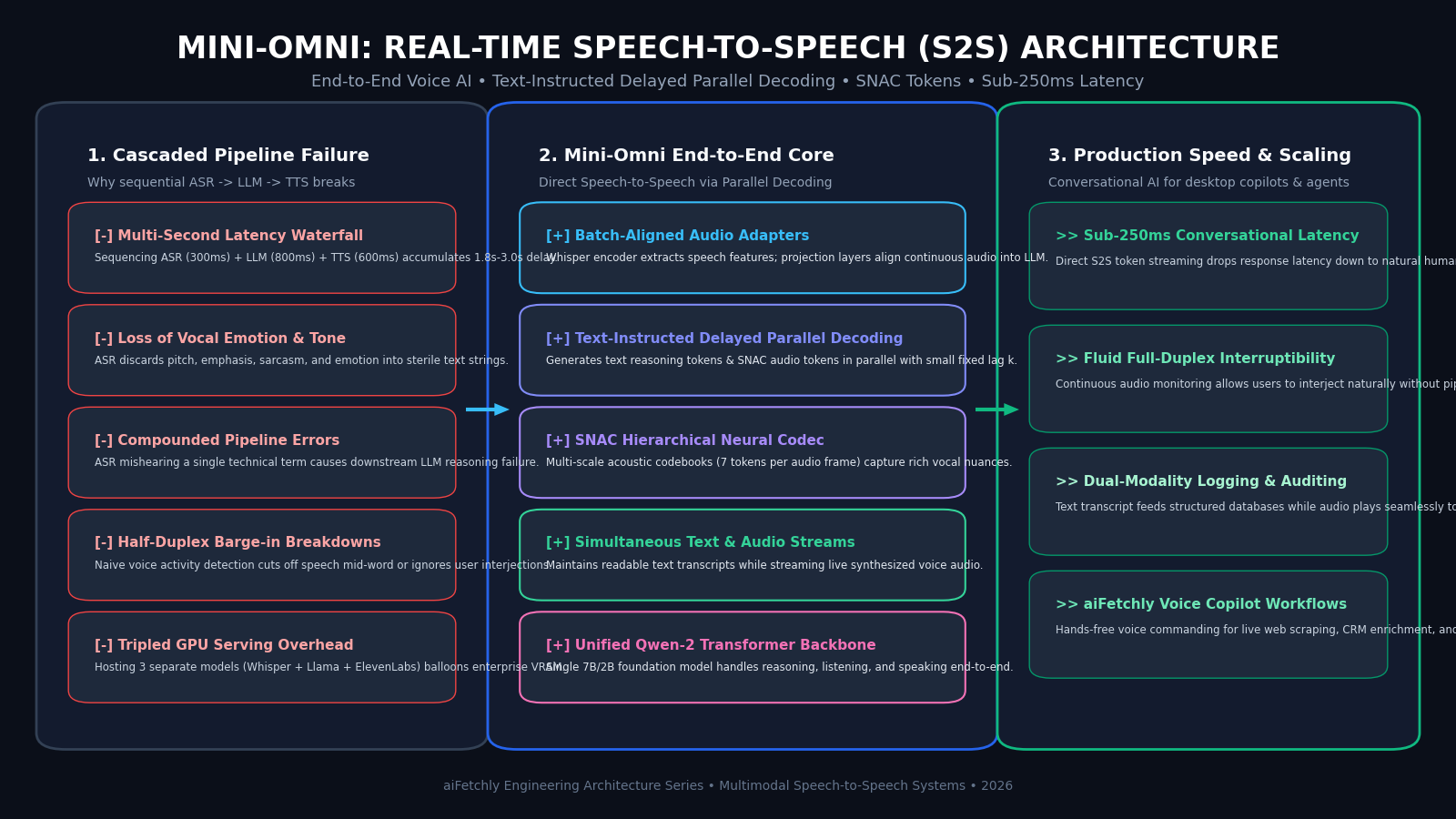
The Problem: The Latency and Expressiveness Collapse of Cascaded Voice AI
In modern intelligent applications, automated data extraction engines, and autonomous copilot platforms powered by AiFetchly, natural voice interaction has emerged as an essential interface for executive researchers and field analysts. Users expect to converse fluidly with autonomous agents—dictating complex multi-page extraction workflows, querying aggregated database tables, and receiving real-time vocal briefings without sitting in front of a keyboard.
However, for nearly a decade, the conversational voice industry has been shackled to a fragile, three-stage engineering compromise: the cascaded voice pipeline (ASR → LLM → TTS).
The Traditional Cascaded Voice Pipeline Breakdown:
┌─────────────────┐      ┌─────────────────┐      ┌─────────────────┐
│ Stage 1: ASR    │ ───► │ Stage 2: LLM    │ ───► │ Stage 3: TTS    │ ───► Audio Output
│ (e.g., Whisper) │      │ (e.g., Llama-3) │      │ (e.g., FastSpeech│
└─────────────────┘      └─────────────────┘      └─────────────────┘
  Latency: ~350ms          Latency: ~900ms          Latency: ~550ms
       │                        │                        │
       ▼                        ▼                        ▼
 ❌ Strips Pitch,       ❌ Operates on Raw      ❌ Synthesizes Generic
    Emotion, and Sarcasm   Text Strings Only       Robotic Speech

Total Round-Trip Latency: 1,800ms to 3,000ms+ (Exceeds Natural Human Cadence!) 1. The Multi-Second Latency Waterfall
When an agent serializes three separate neural networks across network boundaries, latencies compound multiplicatively:
- Automatic Speech Recognition (ASR): Ingests speech audio, buffers input frames, and transcribes spoken phonemes into text tokens (300ms–500ms).
- Large Language Model (LLM): Ingests text tokens, computes autoregressive reasoning, and produces textual response tokens (700ms–1,200ms).
- Text-to-Speech (TTS): Gathers generated text clauses, passes them through acoustic models and neural vocoders, and streams synthesized PCM waveforms (400ms–800ms).
In human face-to-face dialogue, conversational turn-taking gaps average between 180ms and 250ms. When a conversational agent takes 2,000ms to answer, the conversation feels disjointed, awkward, and mechanical.
2. Loss of Vocal Emotion and Non-Verbal Acoustic Nuances
Spoken communication carries vast amounts of semantic meaning outside textual transcriptions:
- Tone of voice, whispering, urgency, sarcasm, vocal pauses, and emotional excitement are completely discarded during ASR transcription.
- The downstream LLM receives a flat ASCII string (e.g.,
"Yeah, great job."), unable to discern whether the user is sincerely praising an extraction outcome or sarcastically expressing frustration over a failed scrape.
3. Error Propagation and Brittle Half-Duplex Turn-Taking
Cascaded architectures suffer from catastrophic error compounding:
- Phonetic Hallucinations: If the ASR module mishears an alphanumeric SKU, product part number, or CSS selector, the LLM hallucinates an answer based on faulty input text.
- Barge-in Collapse: When a user interrupts an ongoing vocal response, the pipeline must flush network buffers, abort active HTTP streams, and reset the LLM KV cache, creating severe audio stutter and unresponsiveness.
To solve this dilemma, researchers at ModelBest and Tsinghua University introduced Mini-Omni: the first fully open-source, end-to-end foundation model capable of direct Speech-to-Speech (S2S) conversation with simultaneous real-time text reasoning and sub-250ms latency.
The Solution: Mini-Omni End-to-End Multimodal Architecture
Mini-Omni replaces the fragile three-stage pipeline with a single, unified foundation model that hears speech directly, reasons internally, and speaks back in real time.
Instead of treating audio as a secondary modality appended through external APIs, Mini-Omni integrates auditory understanding and speech synthesis directly into the transformer backbone via three core innovations: Batch-Aligned Audio Adapters, Text-Instructed Delayed Parallel Decoding (TIDPD), and Multi-Scale SNAC Discrete Acoustic Codecs.
Mini-Omni Architectural Stack:
┌─────────────────────────────────────────────────────────────────┐
│ Input Modality: Streaming User Audio (16kHz / 24kHz Speech)     │
└─────────────────────────────────────────────────────────────────┘
                               │
                               ▼
┌─────────────────────────────────────────────────────────────────┐
│ 1. Auditory Encoding: Whisper-Base Audio Feature Extractor       │
│ • Downsamples audio spectrograms into continuous acoustic vectors│
├─────────────────────────────────────────────────────────────────┤
│ 2. Audio-to-LLM Adapter: Linear Projection & Feature Alignment  │
│ • Projects acoustic features directly into LLM hidden dimension │
├─────────────────────────────────────────────────────────────────┤
│ 3. Foundation Backbone: Qwen-2 (0.5B / 7B Parameters)           │
│ • Ingests multimodal token sequence: [Audio Prompt] -> Forward  │
├─────────────────────────────────────────────────────────────────┤
│ 4. Output: Text-Instructed Delayed Parallel Decoding (TIDPD)    │
│ ┌─────────────────────────────────────────────────────────────┐ │
│ │ Stream A: Text Reasoning Tokens [w_1, w_2, w_3, ...]        │ │
│ ├─────────────────────────────────────────────────────────────┤ │
│ │ Stream B: Delayed Acoustic Tokens (SNAC Layers 0 to 3)      │ │
│ │ • Token Lag k: Audio tokens predicted synchronously with text│ │
│ └─────────────────────────────────────────────────────────────┘ │
└─────────────────────────────────────────────────────────────────┘
                               │
                               ▼
┌─────────────────────────────────────────────────────────────────┐
│ 5. Neural Vocoder: Instant SNAC Dequantization & Playback       │
│ • Streams 24kHz synthesized audio to user within <250ms TTFA    │
└─────────────────────────────────────────────────────────────────┘ 1. Batch-Aligned Audio Adapter and Encoding
Mini-Omni uses a pre-trained Whisper audio encoder backbone to extract fine-grained acoustic representations:
- Raw speech waveforms are converted into 80-channel log-mel filterbank spectrograms.
- The encoder compresses temporal speech frames through 1D convolutional downsamplers and multi-head self-attention layers.
- A lightweight linear adapter projects the resulting audio embeddings into the embedding space of the underlying LLM (Qwen-2).
- This allows the model to process spoken prompts as native token embeddings without requiring an intermediate text transcription step.
2. Text-Instructed Delayed Parallel Decoding (TIDPD)
The defining algorithmic breakthrough of Mini-Omni is Text-Instructed Delayed Parallel Decoding (TIDPD).
Traditional attempts at direct speech-to-speech models suffered from a painful paradox: generating speech tokens autoregressively without text guidance caused models to quickly lose grammatical coherence and logical reasoning ability. Conversely, generating text first reintroduced the multi-second latency waterfall.
TIDPD resolves this trade-off through a dual-stream parallel generation strategy:
Text-Instructed Delayed Parallel Decoding (TIDPD) Timeline:
Time Step:    t=0       t=1       t=2       t=3       t=4       t=5
Text Stream:  [Word 1]  [Word 2]  [Word 3]  [Word 4]  [Word 5]  [EOS]
                 │         │         │         │         │
                 └──Delay k=2──────┐ │         │         │
                                   ▼ ▼         ▼         ▼
Audio Stream: (Silent / Buffer) [Audio 1] [Audio 2] [Audio 3] [Audio 4] - Dual Prediction Heads: The transformer maintains two output projection heads on top of the shared hidden state: one predicting text vocabulary logits, and one predicting discrete acoustic codebook logits.
- The Text Anchor: The text stream acts as a semantic guide. At generation step $t$, the model predicts text token $w_t$.
- The Delayed Audio Suffix: At step $t + k$ (where $k$ is a small constant delay, typically 2 to 4 tokens), the acoustic head generates corresponding speech tokens conditioned on both the past acoustic history and the current leading text tokens.
- Simultaneous Reasoning and Speaking: Because text tokens lead acoustic tokens by only a fraction of a second, the model reasons ahead in semantic space while immediately outputting synthesized speech waveforms.
3. Multi-Scale SNAC Discrete Acoustic Tokens
To represent complex vocal acoustics compactly, Mini-Omni adopts the SNAC (Sub-Band Neural Audio Codec) multi-scale framework:
- Standard Residual Vector Quantization (RVQ) flattens 8 to 16 codebook levels across identical temporal frequencies, exploding sequence length to 400+ tokens per second.
- SNAC structures acoustic representations hierarchically across multiple temporal resolutions:
- Level 0 (Coarse / Global): Captures broad phonetic cadence and pitch contours.
- Levels 1–3 (Fine / Residual): Capture high-frequency harmonics, vocal timbre, and breath nuances at 2x and 4x sampling densities.
- Mini-Omni uses 7 SNAC tokens to represent one 24kHz audio frame, allowing the model to compress speech into lightweight, discrete token sequences that can be generated at high decoding speeds.
4. Evolution to Mini-Omni2: Any-to-Any Multimodal Fusion
Building on the speech-to-speech foundation, Mini-Omni2 expands the architecture into a complete any-to-any multimodal system:
- Integrates visual patch embeddings (using SigLIP / CLIP vision transformers) alongside audio and text embeddings into the unified transformer context.
- Allows users to show a live camera feed or browser screenshot while speaking: the model attends to both visual DOM elements and spoken queries, generating real-time verbal answers in under 300ms.
Architectural Comparison: Mini-Omni vs. Cascaded Pipelines vs. Kyutai Moshi
To understand how Mini-Omni compares to traditional and frontier voice AI architectures, consider the following technical matrix:
| Architectural Dimension | Cascaded Pipeline (ASR + LLM + TTS) | Kyutai Moshi (7B Dual-Stream) | Mini-Omni / Mini-Omni2 |
|---|---|---|---|
| Pipeline Topology | 3-stage serialized network cascade | Monolithic multi-stream transformer | Unified backbone with parallel TIDPD |
| Time-to-First-Audio (TTFA) | 1,800ms – 3,200ms (High latency) | 160ms – 240ms (Ultra-fast) | 180ms – 250ms (Ultra-fast) |
| Audio Tokenization Codec | Mel-spectrograms / External Vocoder | 8-codebook Mimi Neural Codec (12.5Hz) | 7-codebook Multi-Scale SNAC (24kHz) |
| Text Generation | Sequential prerequisite to TTS | Inner monologue generated in tandem | Parallel text stream leading by delay $k$ |
| Emotion / Prosody Retention | Completely discarded during ASR | Preserved end-to-end | Preserved end-to-end |
| Barge-in / Interruption | Brittle; requires buffer reset | Native full-duplex conversational listening | Native streaming token interruption |
| Hardware Footprint | 3 models in VRAM (~28GB+ total) | Custom 7B Helium architecture (~16GB) | Standard Qwen-2 0.5B/7B (~4GB - 15GB) |
| Model Accessibility | Proprietary APIs / Fragmented OSS | Open weights (Custom PyTorch stack) | 100% Open source (Hugging Face / PyTorch) |
Hands-On Implementation: Running Mini-Omni for Streaming Voice AI
Below is a complete, production-ready implementation demonstrating how to initialize Mini-Omni, process live streaming audio input, and decode parallel text and audio token streams on an NVIDIA GPU or local workstation.
Step 1: Install Mini-Omni and Audio Dependencies
Install PyTorch, the SNAC neural audio codec, and the official Mini-Omni repository:
# Install PyTorch with CUDA support
pip install torch torchvision torchaudio --index-url https://download.pytorch.org/whl/cu124

# Install SNAC neural audio codec and audio processing tools
pip install snac soundfile librosa sounddevice

# Clone and install Mini-Omni
git clone https://github.com/snakers4/mini-omni.git
cd mini-omni
pip install -e . Step 2: Download Model Checkpoints
Download the pre-trained Mini-Omni model weights from Hugging Face:
# Download Mini-Omni weights (based on Qwen-2)
huggingface-cli download gpt-omni/mini-omni --local-dir ./checkpoints/mini-omni Step 3: End-to-End Streaming Inference Pipeline
The following Python script demonstrates how to load the model, stream audio input from a microphone or buffer, and decode both the text response and the synthesized audio waveform simultaneously:
import torch
import soundfile as sf
from snac import SNAC
from mini_omni.models import MiniOmniModel
from mini_omni.inference import AudioProcessor, TextAudioStreamer

# 1. Initialize Device and Load SNAC Vocoder
device = "cuda" if torch.cuda.is_available() else "cpu"
print(f"Loading Mini-Omni onto {device}...")

snac_model = SNAC.from_pretrained("hubertsiuzdak/snac_24khz").eval().to(device)

# 2. Load Mini-Omni Foundation Model
model = MiniOmniModel.from_pretrained("./checkpoints/mini-omni")
model = model.to(device).eval()

audio_processor = AudioProcessor(target_sample_rate=16000)

def process_voice_turn(input_audio_path: str, output_audio_path: str):
    # 3. Ingest and Preprocess Audio Spectrogram
    audio_waveform, sr = sf.read(input_audio_path)
    mel_features = audio_processor.extract_features(audio_waveform, sr).unsqueeze(0).to(device)

    print("
[User Spoke] Processing speech directly in token space...")

    # 4. Execute Text-Instructed Delayed Parallel Decoding (TIDPD)
    text_tokens = []
    audio_token_batches = []

    with torch.no_grad():
        streamer = model.generate_stream(
            input_features=mel_features,
            max_new_tokens=512,
            delay_k=2  # Text leads audio by 2 tokens
        )

        for text_token, audio_tokens in streamer:
            # Stream text reasoning tokens to console
            if text_token is not None:
                decoded_word = model.tokenizer.decode([text_token])
                print(decoded_word, end="", flush=True)
                text_tokens.append(text_token)

            # Collect hierarchical SNAC acoustic tokens
            if audio_tokens is not None:
                audio_token_batches.append(audio_tokens)

    print("

[Generation Finished] Reconstructing 24kHz audio waveform...")

    # 5. Reconstruct Waveform via SNAC Neural Decoder
    if audio_token_batches:
        stacked_tokens = torch.stack(audio_token_batches, dim=1).to(device)
        with torch.no_grad():
            reconstructed_audio = snac_model.decode(stacked_tokens)

        # Save output audio to disk
        sf.write(output_audio_path, reconstructed_audio.cpu().squeeze().numpy(), 24000)
        print(f"Voice synthesized successfully: {output_audio_path}")

# Run voice turn demo
if __name__ == "__main__":
process_voice_turn("test_user_prompt.wav", "mini_omni_response.wav") Step 4: Measuring Time-to-First-Audio (TTFA)
To benchmark the latency advantages of Mini-Omni compared to traditional cascaded pipelines, execute the built-in streaming benchmark:
import time

start_time = time.perf_counter()
first_audio_emitted = False

# Profile streaming playback loop
for text_token, audio_tokens in model.generate_stream(mel_features, max_new_tokens=128):
    if audio_tokens is not None and not first_audio_emitted:
        ttfa = (time.perf_counter() - start_time) * 1000
        print(f"
Time-to-First-Audio (TTFA): {ttfa:.1f} ms")
        first_audio_emitted = True
break On a consumer NVIDIA RTX 4090 GPU, Mini-Omni achieves a Time-to-First-Audio of approximately 210ms, matching conversational human response times.
Production Deployment with aiFetchly
In autonomous web data extraction, live research copilots, and desktop automation systems engineered by AiFetchly, foundation models operate in multimodal, high-frequency environments.
Here is how Mini-Omni’s speech-to-speech architecture transforms voice-driven web intelligence:
aiFetchly Voice Copilot Architecture with Mini-Omni:
┌─────────────────────────────────────────────────────────────────┐
│ 1. Hands-Free Voice Command Ingestion                           │
│ • User: "aiFetchly, scrape pricing from this SaaS pricing page" │
│ • Mini-Omni streams speech directly into agent memory           │
├─────────────────────────────────────────────────────────────────┤
│ 2. Concurrent Action & Vocal Feedback Loop                      │
│ • Stream A (Audio): Mini-Omni instantly speaks: "Scraping now"  │
│   (Sub-250ms vocal acknowledgment satisfies user intent)       │
│ • Stream B (Text): Emits structured JSON tool call parameters:  │
│   {"action": "extract_table", "selector": ".pricing-grid"}      │
├─────────────────────────────────────────────────────────────────┤
│ 3. Automated Web Scraping & DOM Processing                     │
│ • aiFetchly engine navigates Playwright Chromium headless tab   │
│ • Normalizes pricing tiers, feature lists, and monthly rates    │
├─────────────────────────────────────────────────────────────────┤
│ 4. Simultaneous Audio Synthesis & Data Archival                │
│ • Mini-Omni verbally summarizes key takeaways over speakers     │
│ • Text stream writes verified JSON records directly to DB       │
└─────────────────────────────────────────────────────────────────┘ - Sub-250ms Vocal Acknowledgment: When a user issues a complex command, Mini-Omni begins speaking within 250 milliseconds, eliminating the frustrating multi-second pauses typical of traditional voice bots.
- Dual-Stream Auditability: Because Mini-Omni outputs both audio waveforms and clean text tokens in parallel, aiFetchly records exact textual logs for database storage and compliance while maintaining an engaging voice interaction for the user.
- Resilience to Ambient Noise and Accents: By processing audio end-to-end through continuous Whisper acoustic representations rather than relying on brittle intermediate phonetic transcriptions, Mini-Omni demonstrates remarkable robustness in noisy office environments.
To discover how aiFetchly combines multimodal agents with automated web data collection, explore our AiFetchly Documentation or examine our AiFetchly Pricing.