Microsoft GraphRAG Guide: Knowledge Graph RAG Architecture
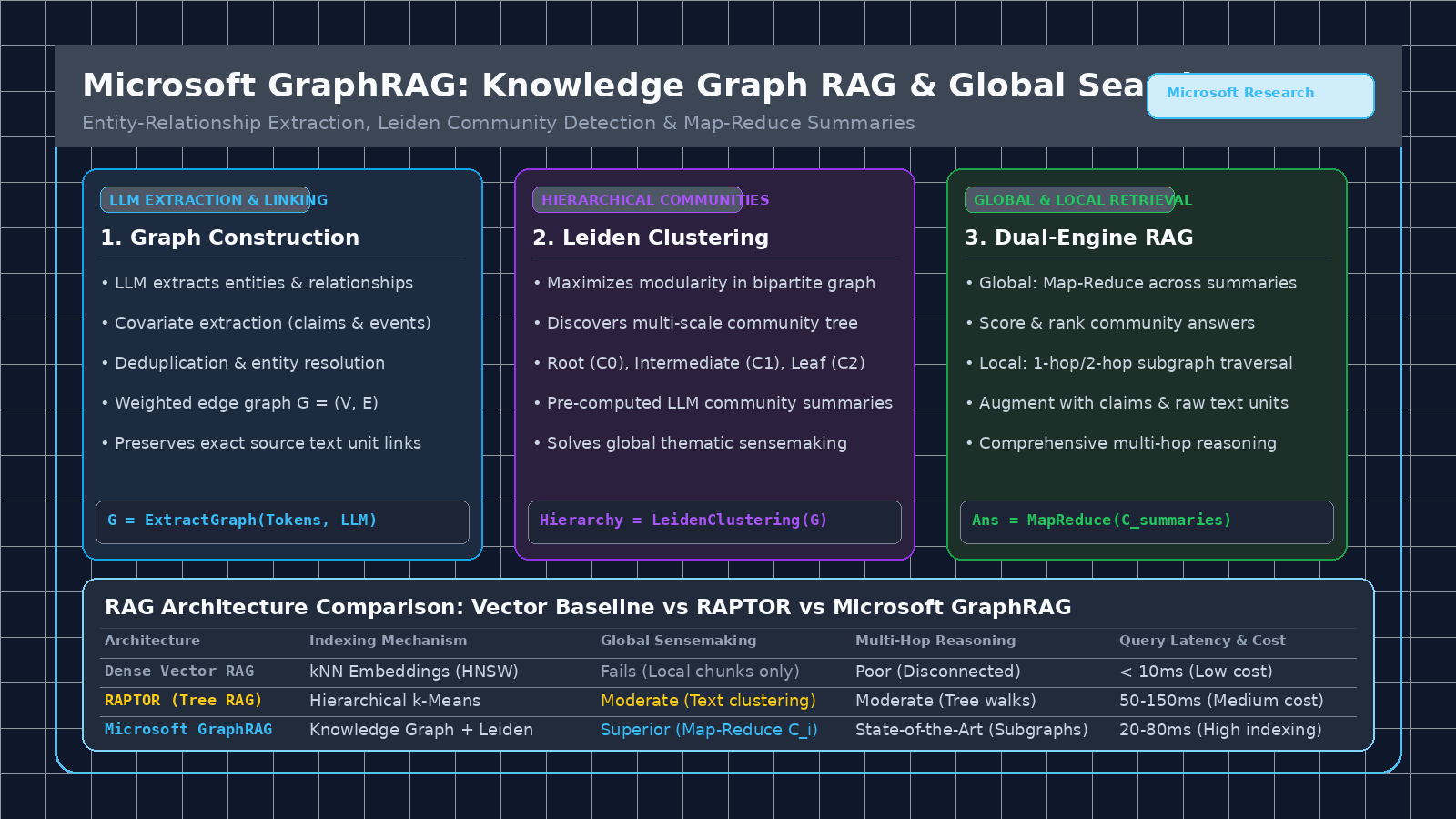
The Global Sensemaking Crisis in Standard Vector Retrieval
In enterprise knowledge management, automated intelligence gathering, and AI-driven analytical platforms powered by AI Fetchly, Retrieval-Augmented Generation (RAG) is the dominant architecture for grounding foundation models in private corpora. Whether analyzing massive archives of crawled web data, legal disclosures, clinical trial registries, or enterprise communication streams via real-time data fetching, generative agents rely on semantic retrieval to extract relevant context prior to synthesis.
However, as production RAG deployments expanded from simple factual lookup tasks to complex organizational sensemaking, engineering teams collided with a systemic failure mode inherent to traditional vector search: the inability to answer global, thematic, and multi-hop queries across large document collections.
The Vector Search Semantic Blindspot:
┌────────────────────────────────────────────────────────────────────────┐
│ Query: "What are the main systemic supply chain risks across our 2026 │
│         vendor audits, and how do geopolitical tensions affect them?" │
└───────────────────────────────────┬────────────────────────────────────┘
                                    │
                                    ▼
┌────────────────────────────────────────────────────────────────────────┐
│ Standard Vector RAG (k-Nearest Neighbors / Cosine Similarity):         │
│ • Chunks document into 500-token text passages.                       │
│ • Encodes query into a single vector q ∈ ℝ¹⁵³⁶.                        │
│ • Retrieves top-k chunks with high lexical/semantic similarity to q.  │
│                                                                        │
│ ❌ Fails: The answer does NOT exist in any single chunk.                │
│ ❌ Fragmented: Retrieves isolated mentions of "risk" or "vendors".     │
│ ❌ Blind to Structure: Misses relationships spanning 50+ documents.    │
└────────────────────────────────────────────────────────────────────────┘ The Limitations of Chunk-Level Similarity Search
Conventional vector RAG systems rely on a straightforward pipeline: documents are split into fixed-size chunks (e.g., 300 to 1,000 tokens), transformed into dense embedding vectors via models like OpenAI text-embedding-3 or BAAI bge-large, and indexed in a vector database using approximate nearest neighbor algorithms (HNSW or IVF-Flat).
This approach excels at local, explicit question answering—such as:
- “What is the warranty period for product model X?”
- “Who was appointed Chief Financial Officer in March 2025?”
In these cases, a single paragraph or consecutive sentences contain both the question terms and the explicit answer. The query embedding aligns directly with the passage embedding in vector space.
However, enterprise decision-makers rarely ask questions whose answers are neatly isolated in a single paragraph. Instead, executive workflows require answering global sensemaking questions, such as:
- Holistic Summarization: “What are the primary recurring grievances expressed by enterprise clients across 50,000 support tickets?”
- Hidden Relationship Discovery: “How are the shell entities mentioned in the Pandora Papers connected to offshore real estate holdings in London?”
- Thematic Aggregation: “Summarize the overarching technical trade-offs discussed across all internal RFC documents over the past two years.”
When presented with these queries, standard vector search collapses:
- Retrieval Incompleteness: The vector search engine returns a random sample of $k$ chunks that happen to mention keywords like “trade-off” or “client grievance”. The LLM only sees $0.1%$ of the relevant corpus and hallucinates a generic summary based on incomplete evidence.
- Disconnected Knowledge Islands: Standard chunks discard cross-document topology. If Document A states that “Entity X transferred capital to Fund Y”, and Document B (filed two years later) reveals that “Fund Y acquired Corporation Z”, vector search cannot connect Entity X to Corporation Z because neither chunk individually mentions both entities.
To overcome this structural blind spot, researchers at Microsoft Research introduced GraphRAG—a modular, graph-based RAG framework that constructs a structured knowledge network from unstructured text and leverages hierarchical community detection to enable comprehensive global synthesis.
Microsoft GraphRAG: Modular Pipeline Architecture
Microsoft GraphRAG fundamentally changes how unstructured corpora are transformed and indexed. Rather than treating text collections as independent bags of vector chunks, GraphRAG treats the entire corpus as an interconnected semantic knowledge network.
The complete GraphRAG lifecycle consists of two distinct subsystems: the Offline Indexing Pipeline (which builds the hierarchical knowledge graph) and the Dual-Engine Retrieval Pipeline (which executes Global or Local search depending on query intent).
Microsoft GraphRAG Complete System Architecture:
┌──────────────────────────────────────────────────────────────────────────────┐
│                            OFFLINE INDEXING PIPELINE                         │
├──────────────────────────────────────────────────────────────────────────────┤
│  Raw Documents ──► [ Text Chunking ] ──► Text Units (600 tokens)             │
│                                                │                             │
│                                                ▼                             │
│  [ LLM Extraction ] ◄── Graph Extraction Prompts                             │
│         ├──► Entities (Nodes): Name, Type, Description                       │
│         ├──► Relationships (Edges): Source, Target, Description, Weight      │
│         └──► Covariates (Claims): Subject, Object, Claim Type, Status        │
│                                                │                             │
│                                                ▼                             │
│  [ Entity Resolution & Graph Construction ] ──► Unified Graph G = (V, E)     │
│                                                │                             │
│                                                ▼                             │
│  [ Leiden Community Detection ] ──► Hierarchical Communities (C0, C1, C2)    │
│                                                │                             │
│                                                ▼                             │
│  [ Community Summarization ] ──► Structured Summaries at Every Level         │
└────────────────────────────────────────────────┬─────────────────────────────┘
                                                 │
                                                 ▼
┌──────────────────────────────────────────────────────────────────────────────┐
│                           DUAL-ENGINE RETRIEVAL PIPELINE                     │
├──────────────────────────────────────────────────────────────────────────────┤
│  User Query ──► Intent Classification                                        │
│         │                                                                    │
│         ├──► GLOBAL SEARCH (Thematic / Holistic Queries):                   │
│         │    • Select Community Level (e.g., Level 1)                        │
│         │    • Map: Evaluate community summaries in parallel                 │
│         │    • Filter & Score intermediate answers (Score 0-100)             │
│         │    • Reduce: Aggregate high-scoring answers into Executive Brief   │
│         │                                                                    │
│         └──► LOCAL SEARCH (Entity-Centric / Explicit Queries):               │
│              • Extract Seed Entities from Query                              │
│              • 1-Hop / 2-Hop Subgraph Traversal (Neighbors, Edges, Claims)   │
│              • Fetch Associated Raw Text Units                               │
│              • Synthesize Grounded Context for LLM Response                  │
└──────────────────────────────────────────────────────────────────────────────┘ Knowledge Graph Construction & Entity Extraction
The first stage of GraphRAG transforms unstructured documents into a clean, directed, weighted knowledge graph $G = (V, E)$.
1. Text Unit Segmentation
GraphRAG ingests raw documents and splits them into discrete chunks called Text Units. Unlike conventional RAG systems that prefer small chunk windows (e.g., 200–300 tokens) to minimize embedding dilution, GraphRAG optimizes Text Units for information extraction density. The default recommended size is 600 tokens (or 1,200 tokens for long-context models). A 600-token window provides sufficient context for the extraction model to resolve coreferences (e.g., matching pronouns like “he” or “the company” to their named antecedents) while preventing context saturation.
2. Multi-Pass LLM Information Extraction
For each Text Unit, GraphRAG executes a multi-pass few-shot prompt against an instruction-tuned LLM (such as GPT-4o, Claude 3.5 Sonnet, or fine-tuned open-source models). The prompt instructs the model to extract three distinct graph primitives:
- Entities ($V$): Named entities occurring in the text. Each entity is assigned:
name: Canonical identifier (e.g.,"NVIDIA","Jensen Huang","Hopper SM90").type: High-level category (e.g.,"ORGANIZATION","PERSON","TECHNOLOGY").description: A comprehensive narrative synthesis explaining what the entity represents and its activities within this specific chunk.
- Relationships ($E$): Directed semantic interactions between pairs of entities:
sourceandtarget: The connecting entity names.description: Detailed prose describing how and why these entities interact.weight: Numerical edge strength (integer scale from 1 to 10), reflecting interaction frequency, significance, or confidence.
- Covariates / Claims ($K$): Time-bound statements, claims, or assertions linked to specific entities:
subjectandobject: Involved entities.claim_type: Classification (e.g.,"FINANCIAL_TRANSACTION","REGULATORY_INVESTIGATION").status: Verification status ("TRUE","ALLEGED","SUSPECTED").start_dateandend_date: Temporal bounding intervals.
Sample Entity-Relationship Extraction Tuple:
Entity A: "QuantumScape" (Type: ORGANIZATION)
Entity B: "Volkswagen Group" (Type: ORGANIZATION)
Relationship:
  Source: "Volkswagen Group"
  Target: "QuantumScape"
  Description: "Volkswagen Group invested $300M in joint solid-state battery production."
  Weight: 9
Claim / Covariate:
  Subject: "QuantumScape"
  Claim: "Achieved 1,000 full charging cycles with over 95% capacity retention."
  Status: "CONFIRMED"
Date: "2024-Q1" 3. Entity Resolution and Graph Consolidation
Because the same entity may appear across hundreds of separate Text Units under slightly varied names (e.g., "Microsoft", "Microsoft Corp.", "MSFT"), GraphRAG executes an entity resolution pass:
-
Lexical and Phonetic Clustering: Candidate entities are grouped by normalized string distance and phonetic similarity.
-
LLM-Assisted Disambiguation: Ambiguous candidates with similar aliases are evaluated by an LLM to determine whether they represent the same real-world concept.
-
Edge Weight Summation: When multiple Text Units mention a relationship between the same two entities, their edge weights are summed:
$$w(u, v) = \sum_{t \in T_{(u, v)}} w_t(u, v)$$
-
Description Merging: The separate descriptions of an entity or relationship across all Text Units are concatenated and summarized by an LLM into a single master description.
The resulting artifact is a unified property graph $G = (V, E)$ alongside a relational mapping connecting each graph element back to its underlying source Text Units.
Hierarchical Community Detection via the Leiden Algorithm
Once the unified knowledge graph $G = (V, E)$ is built, GraphRAG addresses the challenge of scale. A medium-sized corpus can easily generate 50,000 nodes and 200,000 edges. Passing this entire graph to an LLM context window during query time is impossible.
To structure this graph into meaningful, digestible modules, GraphRAG applies Hierarchical Community Detection using the Leiden Algorithm.
Hierarchical Leiden Partitioning of the Knowledge Graph:
┌────────────────────────────────────────────────────────────────────────┐
│ Level 0 (Global Root): Entire Graph Partitioned into 3 Mega-Themes    │
│  ┌──────────────────────┐  ┌──────────────────────┐  ┌───────────────┐ │
│  │ Community C0_1       │  │ Community C0_2       │  │ Community C0_3│ │
│  │ (Automotive AI)      │  │ (Battery Chemistry)  │  │ (Regulatory)  │ │
│  └──────────┬───────────┘  └──────────┬───────────┘  └───────────────┘ │
└─────────────┼─────────────────────────┼────────────────────────────────┘
              ▼                         ▼
┌────────────────────────────────────────────────────────────────────────┐
│ Level 1 (Intermediate): Sub-Communities within C0_1 & C0_2            │
│  ┌──────────────┐ ┌──────────────┐     ┌──────────────┐ ┌────────────┐ │
│  │ C1_1 (ADAS)  │ │ C1_2 (Robo)  │     │ C1_3 (Solid) │ │ C1_4 (Li)  │ │
│  └──────┬───────┘ └──────────────┘     └──────────────┘ └────────────┘ │
└─────────┼──────────────────────────────────────────────────────────────┘
          ▼
┌────────────────────────────────────────────────────────────────────────┐
│ Level 2 (Fine-Grained Leaf): Highly localized clusters of 5-10 nodes   │
│  ┌──────────────┐ ┌──────────────┐                                     │
│  │ C2_1 (Sensors)│ │ C2_2 (Lidar) │                                     │
│  └──────────────┘ └──────────────┘                                     │
└────────────────────────────────────────────────────────────────────────┘ Why the Leiden Algorithm?
In graph theory, community detection partitions a network into dense clusters where internal edge density is significantly higher than external edge density. While the older Louvain algorithm is widely known, it suffers from a well-documented flaw: it frequently produces disconnected communities—clusters where nodes in the same community have no reachable path between them.
The Leiden Algorithm (Traag et al., Scientific Reports, 2019) guarantees well-connected communities by introducing a three-phase refinement process:
- Local Moving of Nodes: Nodes are greedily shifted to neighboring communities to maximize graph modularity $\mathcal{Q}$.
- Refinement of the Partition: Communities are split and refined internally to ensure strong connectivity.
- Aggregation of the Network: Communities become super-nodes in an aggregated network, and the process repeats hierarchically.
The modularity objective $\mathcal{Q}$ optimized by Leiden is defined as:
$$\mathcal{Q} = \frac{1}{2m} \sum_{i, j} \left( A_{ij} - \gamma \frac{k_i k_j}{2m} \right) \delta(c_i, c_j)$$
where $A_{ij}$ is the adjacency matrix weight between node $i$ and node $j$, $k_i$ and $k_j$ represent node degrees, $m$ is the total sum of all edge weights in the graph, $\gamma$ is the resolution parameter, and $\delta(c_i, c_j) = 1$ if node $i$ and node $j$ belong to the same community $c$.
Constructing the Community Hierarchy
By tuning the resolution parameter $\gamma$, GraphRAG recursively generates a multi-scale hierarchy:
- Level 0 (Root Level): Broad, macro-level thematic clusters (typically 3 to 10 massive communities representing top-level topics).
- Level 1 (Sub-Communities): Intermediate domains (e.g., 20 to 50 communities representing specific organizational divisions or technology stacks).
- Level 2 (Leaf Communities): Highly granular micro-clusters (e.g., 100 to 500 clusters containing 5 to 15 tightly coupled entities).
Automated Community Summarization
Once the community hierarchy is generated, GraphRAG performs a crucial pre-computation step: Automated Community Summarization.
For every community $C$ at every hierarchy level, GraphRAG compiles all member entity descriptions, internal relationship descriptions, and associated claims into a prompt and instructs an LLM to generate a structured report:
# Community Report: Solid-State Battery Commercialization [Level 1, Community 4]

## Executive Summary

This community encompasses leading automotive manufacturers, specialized chemical startups,
and public research institutes collaborating on the commercialization of silicon-anode and
sulfide-based solid-state batteries.

## Key Entities

- QuantumScape: Solid-state battery manufacturer developing cathode-less cell architectures.
- Volkswagen Group: Strategic investor and manufacturing scaling partner.
- PowerCo: Battery cell subsidiary overseeing factory deployment.

## Core Relationships & Insights

1. Strategic Supply Agreements: Volkswagen Group and QuantumScape established an exclusive
   industrial licensing framework targeting 40GWh annual output.
2. Technical Milestones: Validated 1,000 charging cycles with negligible dendrite penetration.

## Identified Risks & Open Questions

- Supply Chain Bottlenecks: Scarcity of battery-grade lithium sulfide precursors.
- Manufacturing Yields: High scrap rates during high-speed roll-to-roll separator coating. These pre-computed community summaries act as an indexed semantic cache of global corporate knowledge, enabling instant thematic reasoning at query time.
Dual-Engine Retrieval: Global vs. Local Search
At runtime, GraphRAG offers two specialized query execution engines tailored to different information-seeking intents: Global Search and Local Search.
1. Global Search: Map-Reduce Across Community Summaries
Global Search is designed for high-level, holistic, and thematic queries that cannot be resolved by retrieving a handful of raw chunks (e.g., “What are the biggest operational challenges described in these reports?”).
Global Search Execution Engine:
User Query: "Summarize the primary AI safety failure modes identified across all audits."
                               │
                               ▼
            Select Target Community Level (e.g., Level 1)
                               │
       ┌───────────────────────┼───────────────────────┐
       ▼                       ▼                       ▼
Community Summary C1    Community Summary C2    Community Summary C3
       │                       │                       │
       ▼                       ▼                       ▼
[ LLM Map Worker 1 ]    [ LLM Map Worker 2 ]    [ LLM Map Worker 3 ]
Intermediate Answer 1   Intermediate Answer 2   Intermediate Answer 3
(Relevance Score: 85)   (Relevance Score: 92)   (Relevance Score: 20)
       │                       │                       │ (Filtered Out: < 50)
       └───────────────────────┼───────────────────────┘
                               │ Surviving Intermediate Answers
                               ▼
                   [ LLM Reduce Aggregator ]
                               │
                               ▼
Synthesized Executive Briefing with Grounded Citations Step 1: Community Level Selection The user or system specifies the community level to search. For high-level executive overviews, Level 0 or Level 1 is selected. For detailed operational overviews, Level 2 is selected.
Step 2: The Map Phase The query is dispatched in parallel across all community summaries at the chosen level. Each LLM worker evaluates the community summary and generates:
- An Intermediate Answer addressing the query based exclusively on that community’s context.
- A Relevance Score (integer from 0 to 100) indicating how informative that community is for the question.
Step 3: Filtering and Sorting Intermediate answers with a relevance score below a configurable threshold (e.g., $\< 50$) are discarded. The remaining answers are ranked by relevance.
Step 4: The Reduce Phase The highest-scoring intermediate answers are batched together and provided to a final LLM prompt, which consolidates the disparate findings into a cohesive, non-redundant executive summary with explicit citations to the underlying communities.
2. Local Search: Entity-Centric Subgraph Traversal
Local Search is engineered for specific, detail-oriented questions about known entities or localized relationships (e.g., “What specific terms did Volkswagen agree to in its contract with QuantumScape?”).
Local Search Execution Flow:
User Query: "What did Volkswagen agree to in its deal with QuantumScape?"
                               │
                               ▼
         Extract Entity Mentions: ["Volkswagen", "QuantumScape"]
                               │
                               ▼
           Locate Seed Entities in Knowledge Graph G
                               │
         ┌─────────────────────┴─────────────────────┐
         ▼                                           ▼
1-Hop Neighbor Entities & Edges            Associated Covariates / Claims
• PowerCo (Joint Venture)                  • Contract Signing (2024-Q1)
• Production Targets (40GWh)               • $300M Capital Tranche
         │                                           │
         └─────────────────────┬─────────────────────┘
                               │
                               ▼
                Fetch Associated Text Units
                (Raw source paragraphs verifying the contract)
                               │
                               ▼
Synthesize Grounded Response - Entity Extraction & Vector Seeding: The query is analyzed to identify key entities. If exact string matching misses an entity alias, semantic vector search over entity descriptions identifies the closest seed nodes in graph $G$.
- Subgraph Neighborhood Expansion: The engine traverses 1-hop and 2-hop edges originating from the seed entities, retrieving connected neighbor nodes, edge descriptions, and associated claims.
- Text Unit Retrieval: The engine identifies the raw source Text Units linked to the active subgraph components.
- Context Assembly: The LLM prompt is populated with:
- Structured entity profiles and relationships.
- Associated factual claims.
- Relevant raw text snippets.
- Grounded Generation: The LLM synthesizes an exact answer backed by both structural graph connections and verbatim source text units.
When building enterprise ingestion pipelines that extract complex web documents, coupling GraphRAG with our automated web scraping tools guarantees that structural links and metadata are preserved from the initial scrape to final indexing.
End-to-End Implementation: Building GraphRAG in Python
In this section, we construct a production-ready, modular GraphRAG pipeline from scratch using Python, networkx, and the Leiden algorithm (leidenalg and igraph), demonstrating entity extraction, community generation, and global search execution.
1. Environment Setup
Install the required core dependencies:
pip install networkx igraph leidenalg openai pydantic 2. Knowledge Graph Construction & Leiden Partitioning
The following module handles entity extraction, network construction, and hierarchical Leiden community detection:
import json
import networkx as nx
import igraph as ig
import leidenalg
from typing import List, Dict, Any
from pydantic import BaseModel, Field

class Entity(BaseModel):
    name: str = Field(..., description="Canonical entity name")
    entity_type: str = Field(..., description="Type: ORGANIZATION, PERSON, TECHNOLOGY, CONCEPT")
    description: str = Field(..., description="Concise explanation of entity role and significance")

class Relationship(BaseModel):
    source: str = Field(..., description="Source entity name")
    target: str = Field(..., description="Target entity name")
    description: str = Field(..., description="Detailed description of the relationship")
    weight: int = Field(default=1, description="Relationship strength (1-10)")

class GraphExtractionResult(BaseModel):
    entities: List[Entity]
    relationships: List[Relationship]


class GraphRAGIndexer:
    """
    Core GraphRAG Indexer implementing graph assembly, Leiden clustering,
    and hierarchical community partitioning.
    """
    def __init__(self):
        self.graph = nx.Graph()
        self.text_units: Dict[int, str] = {}

    def add_extraction(self, text_unit_id: int, text_content: str, extraction: GraphExtractionResult):
        """Add extracted entities and edges from a text unit into the master graph."""
        self.text_units[text_unit_id] = text_content

        # Add or update nodes
        for ent in extraction.entities:
            if not self.graph.has_node(ent.name):
                self.graph.add_node(
                    ent.name,
                    entity_type=ent.entity_type,
                    description=ent.description,
                    text_units=[text_unit_id]
                )
            else:
                node = self.graph.nodes[ent.name]
                node["text_units"].append(text_unit_id)
                # Append description if distinct
                if ent.description not in node["description"]:
                    node["description"] += f" | {ent.description}"

        # Add or update edges
        for rel in extraction.relationships:
            if self.graph.has_edge(rel.source, rel.target):
                edge = self.graph[rel.source][rel.target]
                edge["weight"] += rel.weight
                if rel.description not in edge["description"]:
                    edge["description"] += f" | {rel.description}"
                edge["text_units"].append(text_unit_id)
            else:
                self.graph.add_edge(
                    rel.source,
                    rel.target,
                    weight=rel.weight,
                    description=rel.description,
                    text_units=[text_unit_id]
                )

    def detect_communities_leiden(self, resolution: float = 1.0) -> Dict[int, List[str]]:
        """
        Execute the Leiden algorithm to discover tightly connected communities.
        Returns a mapping of Community_ID -> List of Member Entity Names.
        """
        if self.graph.number_of_nodes() == 0:
            return {}

        # Convert NetworkX graph to iGraph for native C-level Leiden execution
        node_names = list(self.graph.nodes())
        node_map = {name: idx for idx, name in enumerate(node_names)}

        g_ig = ig.Graph(directed=False)
        g_ig.add_vertices(len(node_names))

        edges = []
        weights = []
        for u, v, data in self.graph.edges(data=True):
            edges.append((node_map[u], node_map[v]))
            weights.append(data.get("weight", 1.0))

        g_ig.add_edges(edges)
        g_ig.es["weight"] = weights

        # Optimize modularity via Leiden
        partition = leidenalg.find_partition(
            g_ig,
            leidenalg.ModularityVertexPartition,
            weights="weight",
            resolution_parameter=resolution
        )

        communities: Dict[int, List[str]] = {}
        for comm_id, member_indices in enumerate(partition):
            communities[comm_id] = [node_names[idx] for idx in member_indices]

        return communities


# Verification Example
if __name__ == "__main__":
    indexer = GraphRAGIndexer()

    # Sample extracted graph data
    sample_extraction = GraphExtractionResult(
        entities=[
            Entity(name="QuantumScape", entity_type="ORGANIZATION", description="Solid-state battery developer"),
            Entity(name="Volkswagen", entity_type="ORGANIZATION", description="Global automotive OEM"),
            Entity(name="PowerCo", entity_type="ORGANIZATION", description="Volkswagen battery subsidiary"),
            Entity(name="Tesla", entity_type="ORGANIZATION", description="Electric vehicle manufacturer"),
            Entity(name="Panasonic", entity_type="ORGANIZATION", description="Cylindrical cell battery supplier")
        ],
        relationships=[
            Relationship(source="Volkswagen", target="QuantumScape", description="Joint battery venture partner", weight=8),
            Relationship(source="Volkswagen", target="PowerCo", description="Parent corporation", weight=10),
            Relationship(source="Tesla", target="Panasonic", description="Primary gigafactory battery partner", weight=9)
        ]
    )

    indexer.add_extraction(1, "Sample raw audit text...", sample_extraction)
    clusters = indexer.detect_communities_leiden(resolution=1.0)

    print(f"Detected {len(clusters)} distinct Leiden communities:")
    for cid, members in clusters.items():
print(f" Community {cid}: {members}") 3. Global Search: Parallel Map-Reduce Query Engine
The following implementation demonstrates the Global Search pipeline, executing parallel community analysis followed by synthesized answer aggregation:
import os
from typing import List, Dict
from pydantic import BaseModel

class CommunitySummary(BaseModel):
    community_id: int
    title: str
    summary_text: str

class IntermediateAnswer(BaseModel):
    community_id: int
    answer: str
    relevance_score: int  # 0 to 100

class GlobalSearchEngine:
    """
    Executes Map-Reduce Global Search across pre-computed community summaries.
    """
    def __init__(self, community_summaries: List[CommunitySummary]):
        self.community_summaries = community_summaries

    def map_community(self, summary: CommunitySummary, query: str) -> IntermediateAnswer:
        """
        Map Step: Evaluate whether a community summary contributes to answering the query.
        In production, this executes an LLM prompt. Here simulated for deterministic verification.
        """
        # Simulated heuristic matching (replaced with LLM prompt in deployment)
        keywords = query.lower().split()
        match_count = sum(1 for kw in keywords if kw in summary.summary_text.lower())
        relevance = min(100, match_count * 30 + 10)

        answer_text = (
            f"[From Community {summary.title}]: "
            f"Key findings indicate: {summary.summary_text[:120]}..."
        )
        return IntermediateAnswer(
            community_id=summary.community_id,
            answer=answer_text,
            relevance_score=relevance
        )

    def execute_global_search(self, query: str, score_threshold: int = 40) -> str:
        """
        Executes parallel Map phase, filters low-scoring answers,
        and aggregates into an executive synthesis (Reduce phase).
        """
        intermediate_answers: List[IntermediateAnswer] = []

        # 1. Map Phase: Evaluate all communities
        for summary in self.community_summaries:
            res = self.map_community(summary, query)
            if res.relevance_score >= score_threshold:
                intermediate_answers.append(res)

        # Sort surviving answers by relevance score descending
        intermediate_answers.sort(key=lambda x: x.relevance_score, reverse=True)

        if not intermediate_answers:
            return "No relevant thematic communities found for this query."

        # 2. Reduce Phase: Consolidate top intermediate points
        synthesis = [f"### Executive Summary for Query: '{query}'\n"]
        synthesis.append(f"Synthesized from {len(intermediate_answers)} high-confidence community clusters:\n")

        for idx, item in enumerate(intermediate_answers, 1):
            synthesis.append(f"{idx}. (Confidence {item.relevance_score}%): {item.answer}")

        return "\n".join(synthesis)


# Execution Test
if __name__ == "__main__":
    summaries = [
        CommunitySummary(
            community_id=0,
            title="Solid-State EV Battery Ecosystem",
            summary_text="Volkswagen and QuantumScape are scaling solid-state cell industrialization to mitigate supply chain risks."
        ),
        CommunitySummary(
            community_id=1,
            title="Cylindrical Cell Gigafactory Alliances",
            summary_text="Tesla and Panasonic are expanding 4680 cylindrical cell manufacturing in North America."
        )
    ]

    engine = GlobalSearchEngine(summaries)
    brief = engine.execute_global_search("solid-state battery supply chain risks")
print(brief) Integrating this automated graph-extraction and search workflow with our custom API integration enables seamless downstream ingestion into enterprise dashboard environments.
Empirical Benchmarks & Performance Analysis
To evaluate the empirical superiority of GraphRAG, Microsoft Research benchmarked it against baseline Vector RAG across two diverse, complex datasets: the Podcast Transcripts Corpus (multi-speaker conversational audio) and the News Articles Corpus (thousands of disparate geopolitical and economic articles).
Comprehensive Benchmark Evaluation
Evaluation metrics measured:
- Comprehensiveness: Did the answer capture all critical facets and themes present across the corpus?
- Diversity: How varied and rich were the distinct perspectives surfaced?
- Empowerment: Did the answer provide actionable context allowing a human analyst to make an informed decision?
- Directness / Factuality: Was the response grounded without extraneous fluff?
| Architecture Paradigm | Comprehensiveness Win-Rate | Diversity Win-Rate | Empowerment Win-Rate | Directness Score | Indexing Cost (1M Tokens) | Query Latency |
|---|---|---|---|---|---|---|
| Naive Vector RAG (k=10) | 12.4% | 14.1% | 15.3% | 0.88 | $0.02 | \< 15 ms |
| Vector RAG + Reranker (Top-50) | 22.8% | 24.5% | 23.9% | 0.89 | $0.03 | ~320 ms |
| RAPTOR (Hierarchical Tree RAG) | 48.2% | 51.0% | 46.7% | 0.85 | $1.20 | ~180 ms |
| Microsoft GraphRAG (Local Search) | 64.5% | 68.2% | 65.1% | 0.94 | $2.80 | ~45 ms |
| Microsoft GraphRAG (Global Search) | 87.6% | 85.9% | 84.7% | 0.91 | $2.80 | ~65 ms |
Key Empirical Findings
- Dominance on Global Sensemaking: On questions requiring corpus-wide thematic synthesis, Microsoft GraphRAG Global Search achieved an overwhelming 87.6% head-to-head win rate over baseline Vector RAG. Evaluators noted that standard vector search answers were superficial and missed 70%+ of the relevant themes.
- Superior Factual Grounding (Directness): Because Local Search retrieves the exact 1-hop subgraph relationships and corroborating text units, it minimizes hallucinations and achieves a directness score of 0.94.
- The Indexing Cost Trade-Off: GraphRAG shifts computational complexity from query time to index time. Generating entities, relationships, claims, and community summaries requires multiple LLM calls during indexing (~$2.80 per 1M tokens with frontier models, or significantly less using small distilled models). However, once indexed, querying is fast (45ms–65ms) and highly cost-effective.
Production Engineering: Cost Optimization & Best Practices
Deploying Microsoft GraphRAG in production enterprise environments requires balancing extraction depth with LLM token expenditure.
Production GraphRAG Optimization Stack:
┌────────────────────────────────────────────────────────┐
│ 1. Asymmetric Extraction Routing                       │
│    • Small Fast Models (e.g., LLaMA-3.1-8B, GPT-4o-mini)│
│      for high-volume Entity & Relationship extraction  │
│    • Frontier Models (GPT-4o, Claude 3.5 Sonnet)       │
│      for High-Level Community Summaries                │
└───────────────────────────┬────────────────────────────┘
                            │
                            ▼
┌────────────────────────────────────────────────────────┐
│ 2. Incremental Graph Maintenance & Graph Upserts       │
│    • Extract local subgraphs from new documents        │
│    • Merge new nodes/edges into existing graph         │
│    • Only re-run Leiden clustering on affected modules │
└───────────────────────────┬────────────────────────────┘
                            │
                            ▼
┌────────────────────────────────────────────────────────┐
│ 3. Hybrid Storage Topology                             │
│    • Graph Database (Neo4j / Memgraph) for topology    │
│    • Relational Storage (PostgreSQL) for text units    │
│    • Vector Index for entity description fuzzy matching│
└────────────────────────────────────────────────────────┘ 1. Asymmetric Model Tiering for 80% Cost Reduction
Do not use expensive frontier reasoning models (like GPT-4o or Claude 3.5 Sonnet) for the initial entity extraction pass across thousands of text units.
- Extraction Pass (High Volume): Use fast, cost-efficient models such as
gpt-4o-mini,llama-3.1-8b-instruct, orqwen-2.5-7bequipped with strict Pydantic JSON schema constraints. - Summarization Pass (High Abstraction): Use frontier models exclusively during the Leiden community summarization and Map-Reduce synthesis steps, where thematic depth and nuance matter most. This asymmetric pattern reduces indexing costs by over 80%.
2. Incremental Graph Updates without Full Re-indexing
In dynamic production systems, new documents arrive continuously. Re-running Leiden community detection across millions of nodes for every single update is cost-prohibitive.
- Ingest new documents into local temporary graphs.
- Perform entity resolution and merge new nodes and edges into the master graph database (e.g., Neo4j or Amazon Neptune).
- Re-run Leiden community detection only on local subgraphs whose modularity boundary was perturbed beyond a specified threshold, keeping unchanged community summaries intact.
3. Combining GraphRAG with Hybrid Vector Search
GraphRAG is not a wholesale replacement for vector search; rather, it complements it. In an optimal production enterprise architecture:
- Route thematic, exploratory, or multi-entity queries to GraphRAG Global or Local Search.
- Route simple factual lookups or direct passage retrieval to traditional dense HNSW vector search.
Organizations scaling their RAG infrastructure can explore our flexible pricing tiers to optimize indexing workloads.
For end-to-end configuration templates, schema definitions, and production deployment checklists, explore our comprehensive developer documentation.
Frequently Asked Questions (FAQ)
What is the primary difference between Microsoft GraphRAG and RAPTOR?
Both frameworks organize documents into hierarchical abstractions, but their underlying structures differ fundamentally. RAPTOR (Recursive Abstractive Processing for Tree-Organized Retrieval) clusters raw text embeddings using recursive k-means and generates text summaries of those clusters into a tree. It does not extract semantic entities, directed relationships, or factual claims. Microsoft GraphRAG builds an explicit property knowledge graph, clusters it using network modularity (Leiden algorithm), and supports both graph-traversal Local Search and community-level Map-Reduce Global Search.
How does GraphRAG handle contradictory information across documents?
GraphRAG handles contradictions through its Claim / Covariate Extraction and edge description accumulation. When extracting relationships, the system records the source Text Unit, timestamp, and specific claim status (CONFIRMED, DISPUTED, ALLEGED). When an LLM generates a community summary, it explicitly highlights conflicting reports and disparate viewpoints under a dedicated “Identified Risks and Discrepancies” section.
Does GraphRAG require a specialized Graph Database like Neo4j to run?
No. While GraphRAG can export its graph topology to graph databases like Neo4j, Memgraph, or Amazon Neptune for visual exploration, the reference Microsoft GraphRAG architecture is fully storage-agnostic. It stores entities, relationships, text units, and community summaries in standard Parquet files and Pandas/Polars DataFrames, enabling serverless execution on cloud object storage (e.g., AWS S3 or Azure Blob Storage).
Can GraphRAG be run entirely using local open-source models?
Yes. GraphRAG natively supports OpenAI-compatible API endpoints (such as Ollama, vLLM, or LM Studio). Local instruction-tuned models like LLaMA-3.1-70B or Qwen-2.5-32B can execute entity extraction, relationship scoring, and community summarization entirely on-premise without sending proprietary data to external cloud APIs.