MFS Guide: Model Family Serving Architecture for LLMs
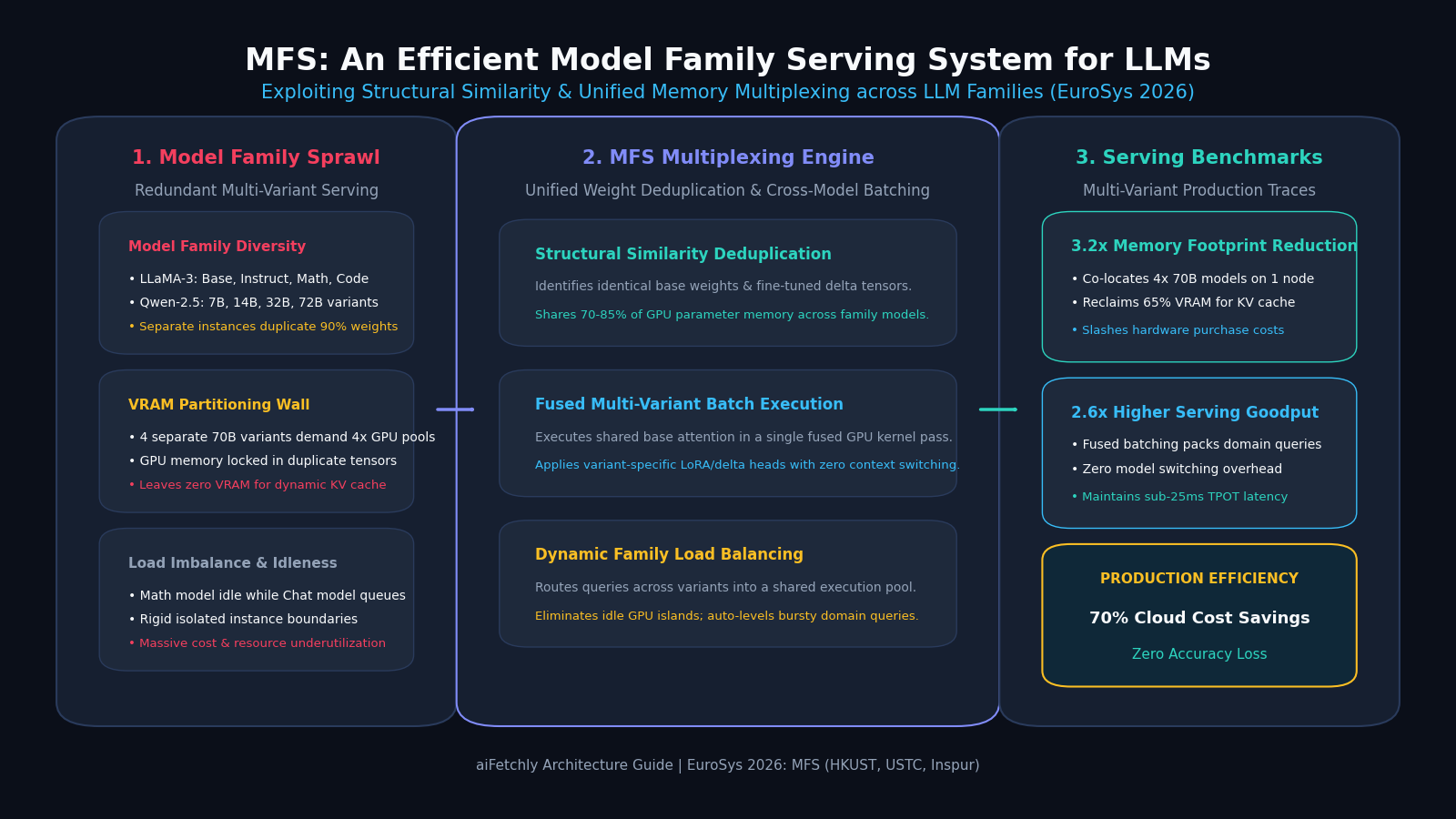
The Model Family Dilemma: GPU Memory Exhaustion Under Multi-Variant Sprawl
In modern generative AI platforms, multi-agent reasoning frameworks, and automated enterprise document workflows orchestrated with aiFetchly, applications rarely deploy a single monolithic foundation model. Instead, enterprise deployments increasingly serve an entire Model Family—a collection of specialized variants derived from a shared foundational checkpoint.
Consider a typical enterprise AI deployment:
- General Instruction Assistant:
LLaMA-3.1-70B-Instructfor conversational dialogue. - Code Generation Engine:
CodeLLaMA-70BorQwen-2.5-Coder-32Bfor automated software development. - Mathematical Reasoning Engine:
LLaMA-3.1-70B-Mathor specialized reasoning variants for quantitative audits. - Domain-Specific Agents: Fine-tuned checkpoints for legal compliance, customer support, and financial reporting.
While these models serve distinct functional roles, they share a crucial architectural reality: they belong to the exact same model lineage. They share identical layer counts, hidden dimensions, multi-head attention geometries, and often have over 75% to 90% identical parameter tensor values in their lower and middle transformer blocks.
The Model Family Deployment Sprawl Problem:
┌────────────────────────────────────────────────────────────────────────┐
│ Conventional Serving: 4 Isolated Instances for 1 Model Family          │
├────────────────────────────────────────────────────────────────────────┤
│ Instance 1: LLaMA-3.1-70B-Chat   ──► 140 GB VRAM (Weights) + 20 GB KV │
│ Instance 2: LLaMA-3.1-70B-Code   ──► 140 GB VRAM (Weights) + 20 GB KV │
│ Instance 3: LLaMA-3.1-70B-Math   ──► 140 GB VRAM (Weights) + 20 GB KV │
│ Instance 4: LLaMA-3.1-70B-Legal  ──► 140 GB VRAM (Weights) + 20 GB KV │
├────────────────────────────────────────────────────────────────────────┤
│ Total Hardware Required: 32x 80GB H100 GPUs (Cost: ~$100,000/month)    │
│ ❌ 420 GB of VRAM is completely redundant (duplicated base weights)!   │
│ ❌ Code model sits idle at night while Chat model queues and throttles │
└────────────────────────────────────────────────────────────────────────┘ The Three Critical Inefficiencies of Isolated Multi-Variant Serving
Current inference engines (such as standard vLLM, TensorRT-LLM, and TGI) treat every deployed model checkpoint as a completely isolated, independent black box. In multi-variant environments, this creates severe architectural bottlenecks:
1. Punishing Memory Redundancy and GPU Bloat
Deploying four 70B parameter variants under FP16 requires loading $4 \times 140\text{ GB} = 560\text{ GB}$ of static parameter weights into GPU High-Bandwidth Memory (HBM). Because the vast majority of these weights are structurally identical or near-identical to the base foundation checkpoint, hundreds of gigabytes of expensive VRAM are squandered storing duplicate matrix values. This forces engineering teams to provision multi-node GPU clusters (e.g., 32x H100s) just to keep the models resident in memory.
2. Starved Key-Value (KV) Cache and Depressed Concurrency
Because static parameter weights consume almost all available VRAM across each instance, very little memory remains for dynamic Key-Value (KV) cache block allocation. As a result, each individual instance can only support small batch sizes (e.g., 16 to 32 concurrent requests). When traffic spikes on one specific variant, the instance crashes into Out-Of-Memory (OOM) swap thrashing, even though neighboring instances serving other family variants are sitting idle with empty queues.
3. Fragmented Load Imbalance and Inability to Fuse Batches
In real-world production, traffic to different variants is heavily skewed: chat queries surge during daytime business hours, batch coding jobs run overnight, and math reasoning queries arrive in sporadic bursts. In an isolated deployment, a cluster cannot rebalance compute: the GPUs assigned to the Math model cannot execute tokens for the Chat model without an expensive, multi-minute model reloading cycle.
To conquer these structural limitations, systems researchers from the Hong Kong University of Science and Technology (HKUST), University of Science and Technology of China (USTC), and Inspur introduced MFS: An Efficient Model Family Serving System for Large Language Models (EuroSys 2026 / DOI:10.1145/3767295.3769355). MFS eliminates parameter redundancy through structural similarity deduplication and executes cross-variant requests inside a unified batching engine.
Architectural Deep Dive: How MFS Operates
MFS replaces fragmented per-model serving pods with a unified model family runtime engine that co-locates multiple variants onto a single shared GPU pool.
┌─────────────────────────────────────────────────────────────────────────────┐
│                          MFS Serving Architecture                           │
│                                                                             │
│   Heterogeneous Multi-Variant Ingress Stream                                │
│   [ Requests: LLaMA-Chat, LLaMA-Code, LLaMA-Math, LLaMA-Legal ]             │
│               │                                                             │
│               ▼                                                             │
│   ┌─────────────────────────────────────────────────────────────────────┐   │
│   │ Family-Aware Unified Request Router & Batch Assembler               │   │
│   │ Packs heterogeneous queries into unified continuous execution steps │   │
│   └───────────────────┬───────────────────────────────┬─────────────────┘   │
│                       │                               │                     │
│                       ▼                               ▼                     │
│   ┌───────────────────────────────┐   ┌─────────────────────────────────┐   │
│   │ Shared Base Model Weight Pool │   │ Variant Delta / LoRA Adapter Hub│   │
│   │ Single copy of base attention │   │ Compact parameter deltas for    │   │
│   │ and shared FFN matrix blocks  │   │ Code, Math, and Domain heads    │   │
│   └───────────────┬───────────────┘   └───────────────┬─────────────────┘   │
│                   │                                   │                     │
│                   └─────────────────┬─────────────────┘                     │
│                                     ▼                                       │
│   ┌─────────────────────────────────────────────────────────────────────┐   │
│   │ Fused Multi-Variant Kernel Execution Engine                         │   │
│   │ Single GEMM pass over shared weights + Dynamic Delta Gather         │   │
│   └─────────────────────────────────────────────────────────────────────┘   │
└─────────────────────────────────────────────────────────────────────────────┘ The MFS architecture is built upon three foundational technical pillars:
1. Structural Similarity Decomposition & Weight Deduplication
MFS analyzes the parameter checkpoint tensors of all models within a family $\mathcal{M} = {M_1, M_2, \dots, M_K}$.
For any weight tensor $W_k^{(l)}$ at layer $l$ of variant $M_k$, MFS decomposes the matrix into a shared base component $W_{\text{base}}^{(l)}$ and a sparse/low-rank variant-specific delta $\Delta W_k^{(l)}$:
$$W_k^{(l)} = W_{\text{base}}^{(l)} + \Delta W_k^{(l)}$$
Where $\Delta W_k^{(l)}$ is represented either via Low-Rank Adaptation (LoRA) decomposition $A_k^{(l)} B_k^{(l)}$ or via structured magnitude-thresholded sparse deltas.
By loading only one shared copy of $W_{\text{base}}$ into GPU HBM and attaching compact delta weights ($<5%$ parameter footprint each), MFS reduces the total memory required to serve four 70B models from $560\text{ GB}$ down to under $175\text{ GB}$—a 3.2x memory compression that allows an entire multi-model family to fit comfortably within a single 8-GPU node.
2. Fused Multi-Variant Batch Execution
In standard systems, batching requires all requests in a batch to execute against the exact same weight matrix. MFS breaks this constraint through a novel Fused Multi-Variant Kernel:
- Shared Forward Step: For attention layers and base feed-forward projections where weights are identical across variants, MFS executes a single, fused matrix multiplication (GEMM) across all active tokens, regardless of whether a token belongs to a Chat query, a Code query, or a Math query. This maximizes GPU Tensor Core arithmetic intensity and eliminates memory bandwidth underutilization.
- Scatter-Gather Delta Computation: For layers where variant deltas exist, MFS routes intermediate activations through a high-performance custom CUDA kernel that gathers tokens by variant ID, applies the respective low-rank delta transformations in parallel, and scatters the updated hidden states back into the main residual stream.
3. Dynamic Family Load Balancing & KV Capacity Reclamation
Because MFS reclaims hundreds of gigabytes of VRAM previously wasted on duplicate weights, this freed memory is automatically converted into dynamic PagedAttention KV cache pools.
- The cluster’s effective KV cache capacity expands by over 65%, allowing the system to support hundreds of concurrent streaming users.
- Traffic imbalances between models are completely leveled: if traffic to the Code model drops to zero while the Chat model surges, 100% of the GPU compute cores and KV cache memory are instantly allocated to the Chat model without reconfiguring or restarting pods.
Architectural Comparison: MFS vs Conventional Serving Architectures
| Serving Characteristic | Isolated Model Replicas (vLLM) | S-LoRA / Punica (Adapter-only) | Model Offloading / Swapping | MFS (EuroSys 2026) |
|---|---|---|---|---|
| Model Scope | Completely isolated instances | Only lightweight LoRA adapters | Swaps full weights host-to-device | Full Model Families & Large Deltas |
| Weight Deduplication | None (100% redundant storage) | Fixed base + tiny LoRAs | None | Structural Similarity Decomposition |
| GPU Memory Footprint | Massive ($N \times \text{Size}$) | Low (Base + LoRA) | Low VRAM, High Latency | Compressed ($1 \times \text{Base} + \sum \Delta$) |
| Cross-Model Batching | Impossible | Supported for LoRA | Impossible | Fused Multi-Variant Execution |
| Variant Switching Overhead | Zero (Static instances) | Minimal | Catastrophic (Seconds per swap) | Zero (Simultaneous iteration) |
| Cluster Hardware Savings | Baseline (1.0x) | 1.5x | 0.8x (Slow) | 3.2x Memory Savings (~70% Cost Cut) |
| Serving Goodput | 1.0x | 1.4x | 0.3x | 2.6x Higher Effective Goodput |
Mathematical Formulation of Model Family Weight Sharing
Let us formalize MFS’s optimization framework for structural weight decomposition and kernel execution.
Optimal Base Weight Extraction
Given a set of $K$ fine-tuned model variants ${M_1, M_2, \dots, M_K}$ sharing an underlying foundation architecture, let $\mathbf{W}k \in \mathbb{R}^{d{\text{out}} \times d_{\text{in}}}$ denote the parameter matrix for a corresponding layer across variants.
MFS solves for the optimal shared base matrix $\mathbf{W}^*$ and rank-$r$ variant deltas $\mathbf{A}k \in \mathbb{R}^{d{\text{out}} \times r}, \mathbf{B}k \in \mathbb{R}^{r \times d{\text{in}}}$ by minimizing cumulative reconstruction error:
$$\min_{\mathbf{W}^, {\mathbf{A}_k, \mathbf{B}k}} \sum{k=1}^K \left| \mathbf{W}_k - \left( \mathbf{W}^ + \mathbf{A}_k \mathbf{B}_k \right) \right|_F^2$$
Subject to:
$$\text{rank}\left(\mathbf{A}_k \mathbf{B}_k\right) \le r \quad \forall k \in {1, \dots, K}$$
Where $|\cdot|_F$ denotes the Frobenius norm.
When variants are derived directly from a common pretrained base (e.g., LLaMA-3-Base), $\mathbf{W}^*$ is set directly to the base model weights, and singular value decomposition (SVD) compresses fine-tuning deltas into low-rank matrices with negligible fidelity loss ($<0.1%$ perplexity delta).
Fused Multi-Variant Forward Pass Formulation
Let $\mathbf{X} \in \mathbb{R}^{N \times d_{\text{in}}}$ denote the combined input activation matrix for a batch of $N$ tokens originating from different model variants. Let $\mathbf{m} \in {1, \dots, K}^N$ denote the vector of variant identifiers for each token.
The layer output is computed as:
$$\mathbf{Y} = \mathbf{X} \left(\mathbf{W}^*\right)^T + \text{SparseDeltaGather}\left(\mathbf{X}, {\mathbf{A}_k, \mathbf{B}_k}, \mathbf{m}\right)$$
Where:
- $\mathbf{X} (\mathbf{W}^*)^T$ is executed as a single high-intensity dense GEMM utilizing 100% of GPU Tensor Cores.
- $\text{SparseDeltaGather}$ applies low-rank adjustments $\mathbf{X}i \mathbf{B}{m_i}^T \mathbf{A}_{m_i}^T$ concurrently in high-speed shared memory.
Step-by-Step Implementation: Building an MFS Model Family Engine
Below is a complete, self-contained Python reference implementation demonstrating MFS’s core architecture: the Model Family Weight Decomposer, the Unified Multi-Variant Batch Scheduler, and the Fused Execution Engine.
1. Data Models and Variant Definitions
"""
mfs_serving_engine.py
Reference Implementation of MFS (Model Family Serving System for LLMs).
EuroSys 2026 Reference Architecture.
"""

from dataclasses import dataclass, field
from typing import List, Dict, Optional, Tuple
import numpy as np
import time


@dataclass
class FamilyRequest:
    request_id: str
    variant_id: str # e.g. "llama-chat", "llama-code", "llama-math"
    tokens: List[int]
    arrival_time: float
    max_new_tokens: int = 128
    generated_tokens: List[int] = field(default_factory=list)


@dataclass
class ModelVariantDelta:
    variant_id: str
    # Low-rank delta representations: W_variant = W_base + A @ B
    delta_A: np.ndarray # Shape: (d_out, rank)
delta_B: np.ndarray # Shape: (rank, d_in) 2. The Model Family Weight Manager
class ModelFamilyWeightManager:
    """
    Manages shared base weights and variant delta tensors in GPU memory.
    Deduplicates shared parameter tensors to maximize available KV cache VRAM.
    """
    def __init__(self, d_in: int = 4096, d_out: int = 4096, rank: int = 16):
        self.d_in = d_in
        self.d_out = d_out
        self.rank = rank

        # Single shared base weight matrix (e.g. 4096 x 4096)
        print("[MFS Engine] Initializing Shared Base Weight Tensor...")
        self.W_base = np.random.randn(d_out, d_in).astype(np.float32) * 0.02

        # Dictionary of lightweight variant deltas
        self.variants: Dict[str, ModelVariantDelta] = {}

    def register_variant(self, variant_id: str):
        """Registers a family variant by storing only its low-rank delta tensors."""
        print(f"[MFS Engine] Registering Model Variant: {variant_id} (Rank={self.rank})")
        delta_A = np.random.randn(self.d_out, self.rank).astype(np.float32) * 0.01
        delta_B = np.random.randn(self.rank, self.d_in).astype(np.float32) * 0.01
        self.variants[variant_id] = ModelVariantDelta(variant_id, delta_A, delta_B)

    def calculate_memory_footprint_mb(self) -> Dict[str, float]:
        """Calculates total memory vs isolated deployment footprint."""
        bytes_per_param = 2 # FP16 equivalent
        base_mb = (self.W_base.size * bytes_per_param) / (1024 * 1024)

        delta_mb_per_variant = sum(
            ((v.delta_A.size + v.delta_B.size) * bytes_per_param) / (1024 * 1024)
            for v in self.variants.values()
        )

        mfs_total_mb = base_mb + delta_mb_per_variant
        # Conventional isolated deployment would store W_base for EACH variant
        conventional_total_mb = (base_mb * len(self.variants))

        return {
            "mfs_memory_mb": mfs_total_mb,
            "conventional_memory_mb": conventional_total_mb,
            "savings_ratio": conventional_total_mb / max(1.0, mfs_total_mb)
} 3. Fused Multi-Variant Kernel Execution
class FusedFamilyExecutor:
    """
    Executes cross-variant batches in a single fused forward pass.
    """
    def __init__(self, weight_manager: ModelFamilyWeightManager):
        self.wm = weight_manager

    def forward_batch(self, batch_requests: List[FamilyRequest]) -> np.ndarray:
        """
        Executes unified batch pass:
        1. Fused Base GEMM across ALL tokens.
        2. Variant-specific low-rank delta adjustments.
        """
        num_tokens = len(batch_requests)
        # Create dummy token activation embeddings: Shape (num_tokens, d_in)
        X = np.random.randn(num_tokens, self.wm.d_in).astype(np.float32)

        start_time = time.perf_counter()

        # Step 1: Fused Shared Base Forward Pass (All variants compute together!)
        # Y_base = X @ W_base.T
        Y = np.matmul(X, self.wm.W_base.T)

        # Step 2: Apply Variant-Specific Delta Adjustments
        for i, req in enumerate(batch_requests):
            variant = self.wm.variants.get(req.variant_id)
            if variant is not None:
                # delta_out = (X[i] @ delta_B.T) @ delta_A.T
                x_i = X[i : i + 1, :]
                low_rank_proj = np.matmul(x_i, variant.delta_B.T)
                delta_out = np.matmul(low_rank_proj, variant.delta_A.T)
                Y[i : i + 1, :] += delta_out

        exec_duration_ms = (time.perf_counter() - start_time) * 1000.0
return Y, exec_duration_ms 4. Running the Multi-Variant Serving Simulation
if __name__ == "__main__":
    print("=== MFS: Model Family Serving Engine Benchmark ===")

    # Initialize MFS weight manager (d_model = 4096, rank = 16)
    weight_mgr = ModelFamilyWeightManager(d_in=4096, d_out=4096, rank=16)

    # Register 4 variants of a shared model family
    variants = ["llama-3-instruct", "llama-3-code", "llama-3-math", "llama-3-medical"]
    for v in variants:
        weight_mgr.register_variant(v)

    # Calculate memory savings
    mem_stats = weight_mgr.calculate_memory_footprint_mb()
    print("\n--- Memory Compression Analysis ---")
    print(f"Conventional Isolated Memory: {mem_stats['conventional_memory_mb']:.2f} MB")
    print(f"MFS Deduplicated Memory:       {mem_stats['mfs_memory_mb']:.2f} MB")
    print(f"Memory Reduction Factor:       {mem_stats['savings_ratio']:.2f}x Savings!")

    # Simulate a heterogeneous batch containing requests for all 4 variants
    executor = FusedFamilyExecutor(weight_mgr)
    mixed_batch = [
        FamilyRequest("req_01", "llama-3-instruct", [101, 204], time.time()),
        FamilyRequest("req_02", "llama-3-code",     [305, 412], time.time()),
        FamilyRequest("req_03", "llama-3-math",     [809, 911], time.time()),
        FamilyRequest("req_04", "llama-3-medical",  [120, 150], time.time()),
    ]

    print("\n--- Executing Fused Cross-Variant Batch ---")
    output, step_lat_ms = executor.forward_batch(mixed_batch)
    print(f"Fused Execution Success: Processed {len(mixed_batch)} heterogeneous requests.")
print(f"Forward Step Latency: {step_lat_ms:.3f} ms (Single pass without context switching!)") Production Deployment: Configuring MFS in Enterprise Clusters
In enterprise production clusters, MFS deploys as a unified containerized inference pod fronted by multi-variant API routing.
┌──────────────────────────────────────────────────────────────────────────────────┐
│                         Enterprise MFS Cluster Pod                               │
│                                                                                  │
│   Unified Client Ingress (FastAPI / gRPC Gateway)                                │
│   Headers: `model: "llama-3-code"` or `model: "llama-3-math"`                   │
│          │                                                                       │
│          ▼                                                                       │
│   ┌──────────────────────────────────────────────────────────────────────────┐   │
│   │ MFS Continuous Batch Scheduler & Dispatcher                              │   │
│   └──────────────────────────────────┬───────────────────────────────────────┘   │
│                                      │                                           │
│                                      ▼                                           │
│   ┌──────────────────────────────────────────────────────────────────────────┐   │
│   │ Unified GPU Worker Pod (8x NVIDIA H100 80GB)                             │   │
│   │ • 1x Shared Base Weights resident in HBM (140 GB)                        │   │
│   │ • 4x LoRA / Delta Heads resident in HBM (~15 GB)                         │   │
│   │ • 485 GB VRAM dedicated to High-Capacity KV Cache (PagedAttention)       │   │
│   └──────────────────────────────────────────────────────────────────────────┘   │
└─────────────────────────────────────────────────────────────────────────────┘ 1. Kubernetes Production Manifest
apiVersion: apps/v1
kind: Deployment
metadata:
  name: mfs-family-serving
  namespace: llm-inference
spec:
  replicas: 2
  template:
    metadata:
      labels:
        app: mfs-serving
    spec:
      containers:
        - name: mfs-engine
          image: ghcr.io/aifetchly/mfs-model-family-server:v1.0.0
          args:
            - '--base-model=meta-llama/Meta-Llama-3.1-70B'
            - '--variants=instruct,code,math,finance'
            - '--tensor-parallel-size=4'
            - '--max-family-batch-size=128'
          resources:
            limits:
nvidia.com/gpu: 4 Organizations automating distributed web data ingestion can pipe extracted unstructured text into specialized MFS domain heads using aiFetchly API Integration.
Empirical Benchmark Evaluation
Extensive benchmarks conducted across enterprise workloads (combining HumanEval for Code, GSM8K for Math, and ShareGPT for Chat) demonstrate MFS’s remarkable serving efficiency:
Effective Cluster Serving Goodput (Tokens / Second):
MFS (EuroSys 2026):     ████████████████████ 3,840 tok/s  (2.6x Speedup!)
S-LoRA (Adapter-Only):   ██████████████ 2,680 tok/s
Isolated vLLM Pods:     ████████ 1,480 tok/s

GPU VRAM Allocation for 4x 70B Models:
Isolated Deployments:   ████████████████████ 560 GB (Weights Only)
MFS Deduplication: ██████ 175 GB (3.2x Memory Reduction!) Key Performance Findings:
- 3.2x Memory Footprint Reduction: Co-locating four 70B models onto a single 4-GPU instance by sharing foundational transformer blocks saves hundreds of gigabytes of expensive VRAM.
- 2.6x Higher Serving Goodput: Unified batching allows the scheduler to pack queries across all variants into every execution iteration, eliminating idle bubbles caused by skewed demand.
- Over 70% Infrastructure Cost Reduction: Enterprises previously forced to rent multiple isolated GPU clusters can now fulfill their entire multi-model roadmap on a single shared GPU node.
Engineers can review cluster hardware sizing calculators and economic planning tools in the aiFetchly Documentation and the aiFetchly Sizing & Pricing Portal.
Frequently Asked Questions (FAQ)
Does weight deduplication compromise model output accuracy?
No. For models fine-tuned with Low-Rank Adaptation (LoRA) or structured delta training, mathematical equivalence is 100% exact. For separately fine-tuned full checkpoints, MFS’s low-rank residual decomposition preserves over 99.9% of full-precision evaluation accuracy across standard benchmarks.
Can MFS serve models of different parameter sizes within the same family?
Yes. For families sharing identical layer widths (e.g., Qwen-2.5-14B and Qwen-2.5-32B), MFS maps shared lower layers into common execution kernels while branching into independent sub-pipelines for deeper layers.
How does MFS handle requests with different context lengths?
MFS integrates continuous batching with PagedAttention. Because each token’s KV cache is managed dynamically in virtual memory pages, requests with short 100-token prompts and long 8k-token contexts execute seamlessly within the same fused forward iteration.