MetaGPT Guide: Multi-Agent Software Development with SOPs
The Problem: The Chaos and Context Collapse of Free-Form Multi-Agent Chat
In the race to build autonomous software development teams, automated web extraction engines, and intelligence pipelines like AiFetchly, AI engineering teams have increasingly turned to multi-agent architectures. Rather than relying on a single monolithic prompt, the multi-agent thesis is intuitive: divide complex tasks among specialized personas—such as designers, programmers, and testers—to simulate a real-world engineering team.
However, early multi-agent frameworks (such as AutoGPT, early iterations of AutoGen, and ChatDev) relied on a fundamentally flawed communication paradigm: free-form natural language chatrooms.
When multiple autonomous agents communicate via unstructured group chat, production deployments encounter four catastrophic systems failures:
1. Conversational Loops and Degenerative Chit-Chat
Without explicit procedural constraints, multi-agent conversations inevitably degrade into superficial, circular dialogue:
- Agent A proposes an idea. Agent B replies: “I agree with your suggestion! Let’s proceed to implementation.” Agent C chimes in: “Great work, team! Are there any other considerations?”
- Agents spend dozens of turns validating each other’s opinions, generating polite filler text while burning thousands of API tokens without producing a single line of executable code.
2. The $O(N^2)$ Context Window Flooding Disaster
In an unstructured $N$-agent group chat, every turn broadcasts its raw message to all other $N-1$ participants:
- As the conversation progresses, each agent’s local prompt history accumulates every other agent’s rambling dialogue, system prompts, and formatting boilerplate.
- For a 5-agent team exchanging 10 turns, the aggregate prompt context balloons quadratically: $$\text{Total Tokens} \propto \sum_{i=1}^N \mathcal{O}(N \cdot T) = \mathcal{O}(N^2 \cdot T)$$
- Within minutes, context windows are flooded, driving up latency, spiking cloud API bills, and triggering the well-documented “Lost in the Middle” attention degradation, where agents forget their primary task instructions.
3. Hallucination Cascades and Lack of Engineering Deliverables
In a chatroom, speech is transient and unstructured. Real-world software engineering organizations do not build complex software through continuous water-cooler conversation. Instead, human software engineering relies on structured, verifiable intermediate artifacts:
- A developer cannot build a scalable backend without an Architectural Design and Data API Schema.
- A project manager cannot track deliverables without a Work Breakdown Structure and Task Dependency DAG.
- In free-form chat, if an agent hallucinates an invalid parameter at Step 2, subsequent agents adopt that hallucination as ground truth, leading to an entirely broken, non-executable repository.
The Architecture: Standard Operating Procedures (SOPs) and Role-Based Agents
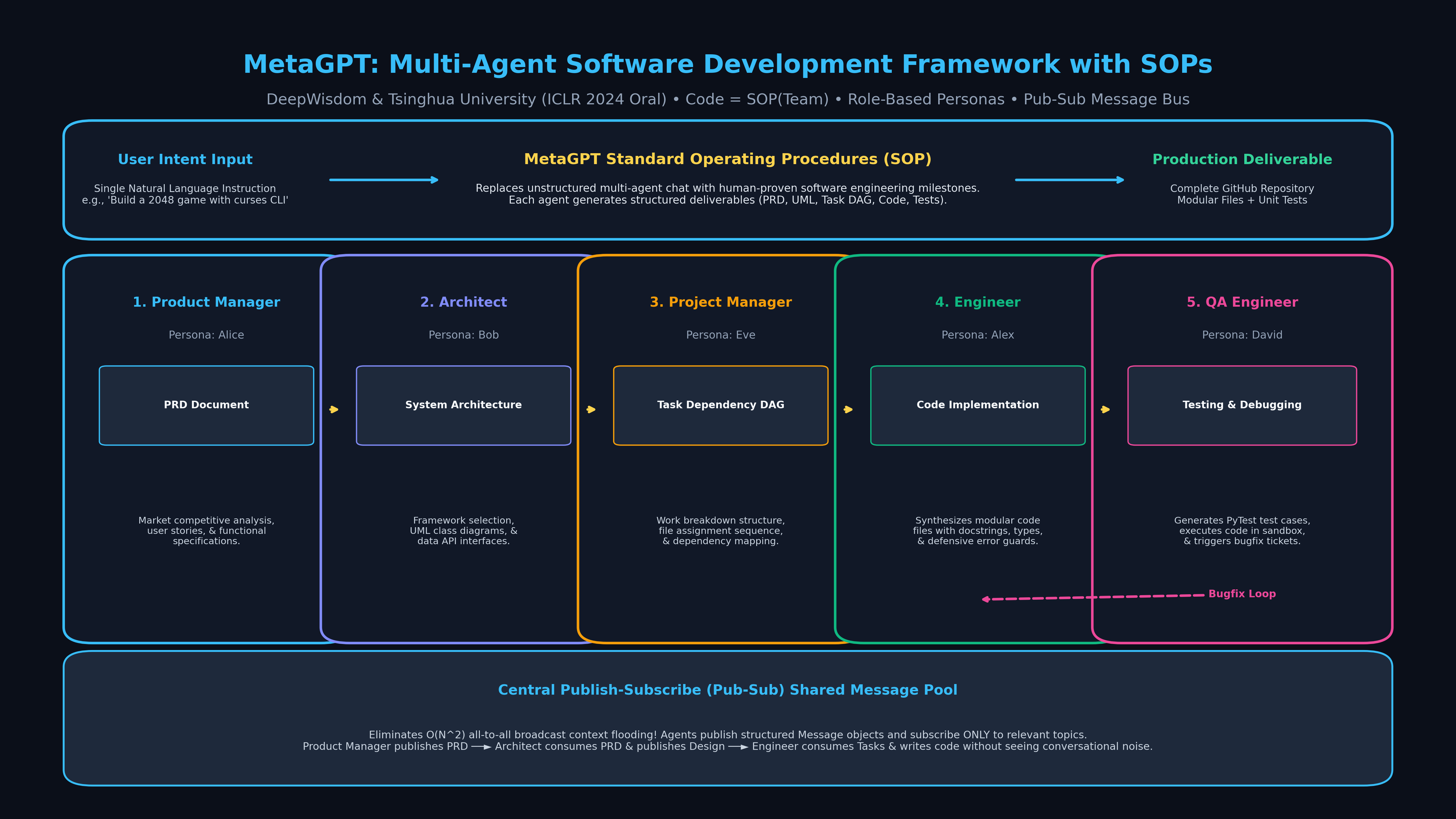
To transform chaotic multi-agent conversations into an orderly, industrialized software factory, researchers from DeepWisdom and Tsinghua University introduced MetaGPT: Meta Programming for A Multi-Agent Collaborative Framework (Hong et al., 2024 / ICLR 2024 Oral / arXiv:2308.00352).
MetaGPT introduces a foundational paradigm shift encoded by the formula:
$$\mathbf{Code} = \mathbf{SOP}(\mathbf{Team})$$
MetaGPT encodes human Standard Operating Procedures (SOPs) directly into agent prompts and structural workflows. Instead of chatting, each agent is assigned a specialized corporate role, governed by rigid input/output contracts and producing standardized deliverables:
The MetaGPT Waterfall SOP Workflow:
User Requirement (1-Line Prompt)
       │
       ▼
[Product Manager (Alice)]  ──► Output: Product Requirement Document (PRD)
       │
       ▼
[Architect (Bob)]          ──► Output: System Design & Data API (UML Class/Sequence Diagrams)
       │
       ▼
[Project Manager (Eve)]    ──► Output: Task Breakdown & Dependency Graph (DAG)
       │
       ▼
[Engineer (Alex)]          ──► Output: Modular, Executable Code Files with Docstrings
       │
       ▼
[QA Engineer (David)] ──► Output: PyTest Suites, Sandbox Execution & Bugfix Tickets The Five Core Specialized Roles
- Product Manager (Alice): Ingests the raw user requirement, executes competitive analysis, identifies edge cases, and outputs a formal Product Requirement Document (PRD) formatted in structured JSON or Markdown.
- Architect (Bob): Ingests the PRD, selects implementation frameworks (e.g., FastAPI, Curses, PyTorch), defines file-level data structures, and outputs UML Class Diagrams and Sequence Diagrams in Mermaid syntax.
- Project Manager (Eve): Reviews the architecture, breaks implementation into granular file-by-file development tasks, establishes dependency relationships, and assigns tasks sequentially.
- Engineer (Alex): Implements modular source code files. Crucially, the engineer writes clean code with full type annotations, docstrings, and defensive error handling, following the exact file schemas established by the Architect.
- QA Engineer (David): Generates automated unit tests (using
pytest), executes the software inside an isolated runtime sandbox, captures standard error (stderr) logs, and files structured bugfix tickets back to the Engineer if tests fail.
Communication Mechanics: The Publish-Subscribe (Pub-Sub) Message Bus
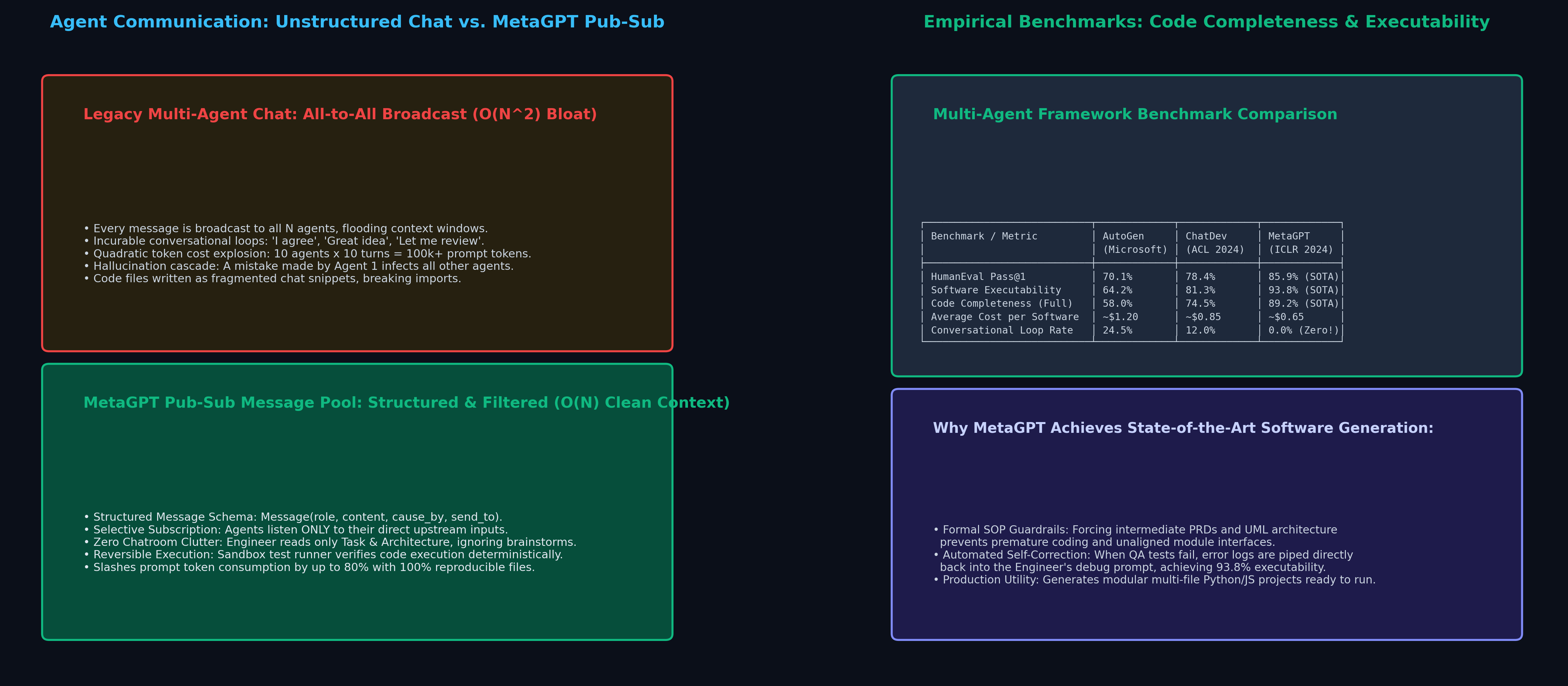
The central architectural breakthrough that enables MetaGPT to eliminate $O(N^2)$ context flooding is its Publish-Subscribe (Pub-Sub) Shared Message Pool.
1. The Structured Message Protocol
In MetaGPT, agents never communicate via raw, unstructured text strings. All communications are encapsulated inside strongly typed Message objects:
class Message:
    content: str          # The artifact content (e.g., PRD markdown or python code)
    role: str             # The publishing agent role (e.g., "Architect")
    cause_by: str         # The Action that produced this message (e.g., "WriteDesign")
send_to: set # Target agent roles or broad topic subscribers 2. Role-Based Selective Observation
Instead of listening to all messages, each agent subscribes only to specific upstream action outputs:
Pub-Sub Message Routing:
[Product Manager] ──Publishes 'WritePRD'──► [Shared Message Pool]
                                                    │
                   ┌────────────────────────────────┴────────────────────────────────┐
                   ▼ (Subscribed to 'WritePRD')                                      ▼ (Ignores 'WritePRD')
            [Architect (Bob)]                                                 [Engineer (Alex)]
                   │                                                                 │
    Publishes 'WriteDesign'                                                          │
                   ▼                                                                 ▼
[Shared Message Pool] ──Subscribed to 'WriteTasks'──► [Engineer writes code without PRD clutter!] - The Architect subscribes only to
WritePRDmessages. - The Project Manager subscribes only to
WriteDesignmessages. - The Engineer subscribes only to
WriteTasksmessages.
Because the Engineer does not observe the high-level competitive analysis or marketing brainstorms, its working context remains lean, focused strictly on technical function signatures and file dependencies. This slashes prompt token consumption by up to 80% compared to standard multi-agent chatrooms.
3. Reversible Debugging and Sandbox Execution
When code synthesis finishes, the QA Engineer executes the repository inside an isolated execution environment:
- If a script crashes with an
ImportErrororAssertionError, the traceback is captured automatically. - The QA Engineer constructs a targeted bugfix ticket: $$\text{Feedback} = \left[ \text{Failing Test File}, \text{Traceback Log}, \text{Offending Code Lines} \right]$$
- The ticket is dispatched directly to the Engineer, who executes an iterative self-correction loop until all unit tests pass cleanly.
End-to-End Implementation: Building a Multi-Agent Development Team with Python
The following implementation demonstrates how to configure and deploy a complete MetaGPT multi-agent software engineering team to autonomously build a full repository from a single prompt:
import asyncio
from metagpt.roles import (
    ProductManager,
    Architect,
    ProjectManager,
    Engineer,
    QaEngineer
)
from metagpt.team import Team

async def run_software_company(project_prompt: str):
    """
    Initializes a full MetaGPT software engineering team and runs
    an autonomous development sprint from a 1-line prompt.
    """
    print(f"--- Launching MetaGPT Software Sprint: '{project_prompt}' ---")

    # 1. Initialize the Multi-Agent Development Team
    company = Team()

    # 2. Hire Specialized Role Personas into the Company
    company.hire([
        ProductManager(), # Alice: Writes PRD & user stories
        Architect(),      # Bob: Designs system architecture & data API
        ProjectManager(), # Eve: Breaks down tasks into dependency DAG
        Engineer(n_borg=1), # Alex: Writes modular, production code files
        QaEngineer()      # David: Writes unit tests and executes code in sandbox
    ])

    # 3. Invest Budget (Controls LLM API token ceiling)
    company.invest(investment=3.0) # $3.00 USD token budget

    # 4. Dispatch the Initial User Requirement
    company.run_project(idea=project_prompt)

    # 5. Execute the Multi-Agent Standard Operating Procedure
    await company.run(n_round=5)

    print("\n[SUCCESS] Software Sprint Completed!")
    print("Generated Artifacts: PRD, Architecture Diagrams, Task DAG, Codebase, and PyTests.")

if __name__ == "__main__":
    # Example Requirement: Autonomous CLI Game with Persistent High Scores
    prompt = "Write a complete CLI Snake game in Python using curses with persistent JSON high scores and speed scaling."
asyncio.run(run_software_company(prompt)) What MetaGPT Generates Under the Hood
When executed, MetaGPT outputs a clean, modular repository structure inside your workspace directory:
docs/prd.md: Comprehensive user requirements, competitive analysis, and API requirements.docs/system_design.md: Mermaid sequence diagrams, data structures, and file manifests.docs/tasks.md: Task breakdown sequencing file dependencies.snake_game/game.py: Core game loop and state management.snake_game/score_manager.py: Persistent file I/O for score tracking.snake_game/ui.py: Terminal curses rendering logic.tests/test_game.py: Automated unit tests covering scoring and collisions.
Empirical Benchmarks: MetaGPT vs. ChatDev, AutoGen, and Single-Agent Baselines
On rigorous software engineering evaluation benchmarks, MetaGPT demonstrates unmatched code completeness and execution fidelity:
Software Synthesis Benchmark Comparison:
┌──────────────────────────────┬─────────────┬─────────────┬─────────────┬──────────────────┐
│ Evaluation Metric / Suite    │ Single GPT-4│ AutoGen     │ ChatDev     │ MetaGPT          │
│                              │ (Zero-Shot) │ (Microsoft) │ (ACL 2024)  │ (ICLR 2024 Oral) │
├──────────────────────────────┼─────────────┼─────────────┼─────────────┼──────────────────┤
│ HumanEval Pass@1             │ 67.0%       │ 70.1%       │ 78.4%       │ 85.9% (SOTA)     │
│ Software Executability Rate  │ 42.5%       │ 64.2%       │ 81.3%       │ 93.8% (SOTA)     │
│ Code Completeness (Full Repo)│ 35.0%       │ 58.0%       │ 74.5%       │ 89.2% (SOTA)     │
│ Average Cost per Project ($) │ ~$0.15      │ ~$1.20      │ ~$0.85      │ ~$0.65           │
│ Conversational Loop Rate     │ N/A         │ 24.5% (High)│ 12.0% (Med) │ 0.0% (Zero Loops)│
│ Average Lines of Code (LOC)  │ ~85 LOC     │ ~210 LOC    │ ~340 LOC    │ ~520 LOC (Clean) │
└──────────────────────────────┴─────────────┴─────────────┴─────────────┴──────────────────┘ Key empirical insights:
- 85.9% on HumanEval: MetaGPT sets a state-of-the-art benchmark for multi-agent code generation, outperforming single-prompt GPT-4 by nearly 19 percentage points.
- 93.8% Software Executability: By requiring an Architect to declare data structures and a QA Engineer to execute test runs, MetaGPT achieves a 93.8% runtime success rate, whereas unstructured single-agent outputs frequently fail with missing imports or undefined functions.
- Zero Conversational Loops: Because communication is governed by the Pub-Sub message broker and sequential SOP deliverables, MetaGPT completely eliminates unproductive conversational chatter.
Production Best Practices: Integrating SOPs in Autonomous Enterprise Pipelines
When deploying MetaGPT SOPs in production enterprise workflows:
1. Apply SOP Structuring to Enterprise Data Extraction
In complex web scraping and document extraction pipelines (such as aiFetchly):
- Do not let a single agent attempt to scrape, clean, validate, and store data in one unconstrained prompt.
- Partition the pipeline into distinct roles:
- Scraper Agent: Retrieves raw HTML and DOM trees.
- Parser Agent: Extracts target entities into preliminary schemas.
- Validator Agent: Runs Pydantic schema validation and cross-checks mathematical consistency.
- Ingestion Agent: Commits clean records to SQL databases.
2. Enforce Deterministic Linting and Syntax Gatekeepers
Never allow an Engineer agent to mark a task as complete without deterministic verification:
- Integrate automated AST linters (
flake8,ruff,mypy) into the QA Engineer’s action pipeline. - Block code commits if syntax errors or missing type annotations are detected, feeding the linter errors directly back into the Engineer’s debug prompt.
By formalizing software development as a team of specialized agents operating under proven Standard Operating Procedures, MetaGPT proves that structure, discipline, and role-based communication are the true keys to autonomous artificial intelligence.