Meta Chameleon Guide: Early-Fusion Mixed-Modal Models
The Problem: The Structural Divide of Late-Fusion Multimodal Models
In modern enterprise automation, automated web extraction engines, and autonomous visual document workflows like AiFetchly, foundation models must process documents where language and visual illustrations are inherently intertwined.
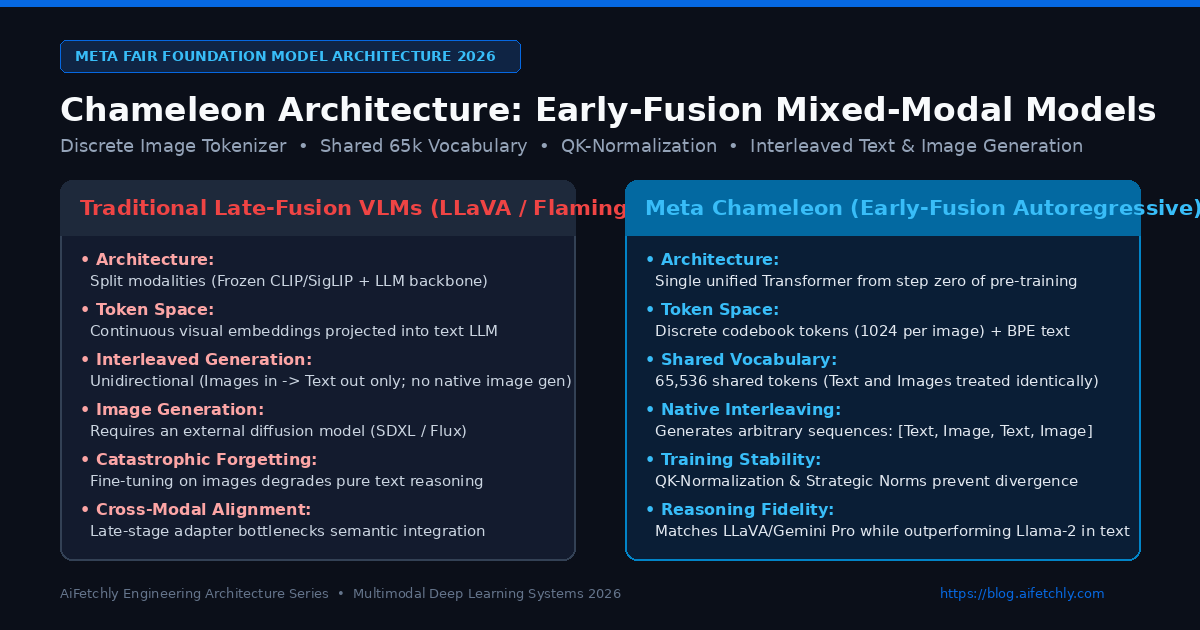
For years, the industry approached multimodal intelligence through late-fusion architectures (such as LLaVA, Flamingo, BLIP-2, and standard GPT-4V pipelines). In late-fusion:
- A pre-trained visual encoder (such as OpenAI CLIP or SigLIP) processes pixels into continuous visual feature vectors.
- A linear projection layer or cross-attention adapter injects those vectors into the hidden layers of a frozen or fine-tuned text LLM.
- If the model must generate an image, it delegates the task to a separate downstream diffusion backbone (such as Stable Diffusion or Flux).
While late-fusion produced rapid benchmark milestones, it imposes four fundamental architectural limitations:
1. The Asymmetric Modality Ceiling (Input-Only Vision)
Late-fusion models are structurally one-directional:
- They can ingest images to generate text, but their autoregressive language backbone cannot natively output pixels.
- When generating complex documents (such as technical research reports, financial market breakdowns, or UI wireframes), the model cannot decide mid-sentence to illustrate a concept with an inline diagram.
- Generating text-image interleaved documents requires awkward orchestration pipelines where an LLM calls an external image generation API, destroying latency and context continuity.
2. Catastrophic Forgetting of Pure Language Capabilities
When training late-fusion adapters:
- Fine-tuning a language model on paired image-caption datasets frequently damages its internal text representations.
- Standard late-fusion models exhibit marked performance degradation on pure language tasks—such as Python code synthesis, multi-step math problem solving, and nuanced logical reasoning—compared to their unimodal base models.
3. The Bottleneck of Continuous Feature Injection
Injecting continuous visual vectors directly into discrete text token streams creates an optimization mismatch:
- Continuous patch embeddings lack discrete symbolic structure, making cross-modal associative binding brittle.
- Because visual tokens occupy large context spans (often 576 to 2,880 tokens per image), Key-Value (KV) cache memory explodes, severely bounding the remaining context window for multi-turn conversations.
The Solution: Meta Chameleon’s Early-Fusion Unified Architecture
To overcome the fragmentation of late-fusion, researchers at Meta FAIR (Chameleon Team, May 2024 / released open weights late 2024) introduced Chameleon, a family of mixed-modal foundation models available in 7B and 34B parameter scales.
Chameleon represents a return to first principles: treat images and text as fundamentally equivalent sequences of discrete tokens within a single autoregressive Transformer from the very first step of pre-training.
The Core Architectural Pillars of Chameleon
-
Discrete Image Tokenization (VQ-VAE):
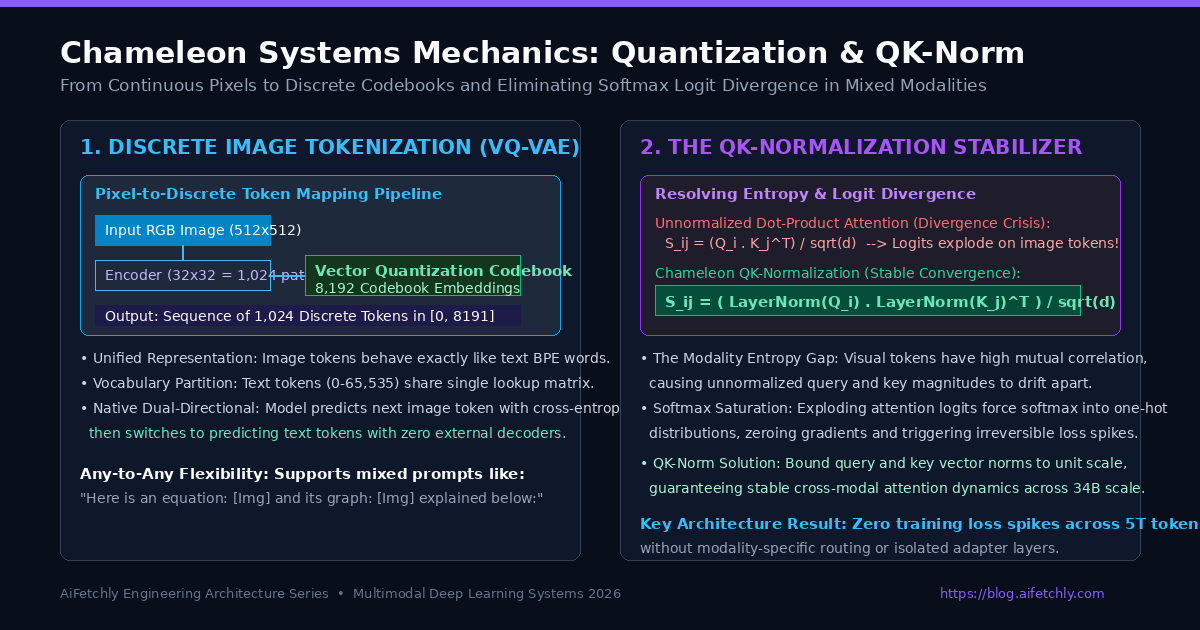
- Chameleon trains an image tokenizer that quantizes an RGB image of resolution $512 \times 512$ into a grid of $32 \times 32 = 1,024$ discrete codebook tokens.
- The codebook contains 8,192 distinct visual token indices.
- Text is tokenized using a customized BPE tokenizer with a vocabulary of 65,536 tokens.
-
Unified Shared Vocabulary Space:
- Both text words and visual codebook indices are mapped into a single, unified embedding matrix $V \in \mathbb{R}^{65,536 \times d}$.
- To the attention mechanism, an image token and an English word token are structurally indistinguishable: both are represented as $d$-dimensional embedding vectors.
-
Pure Autoregressive Next-Token Prediction:
- Chameleon minimizes a standard Cross-Entropy Loss over mixed-modal sequences: $$\mathcal{L} = - \sum_{t=1}^T \log P(x_t \mid x_{<t}; \theta)$$
- The sequence can be purely textual, purely visual, or an arbitrary interleaved sequence: $$\mathbf{X} = \left[ \text{text}_1, \dots, \text{text}k, \text{img}1, \dots, \text{img}{1024}, \text{text}{k+1}, \dots \right]$$
- When generating an image, the model predicts 1,024 visual tokens autoregressively, which the discrete image decoder converts back into a $512 \times 512$ RGB image.
Systems Mechanics: The QK-Normalization Breakthrough
Historically, attempts to train early-fusion mixed-modal transformers failed due to catastrophic training instability: models suffered severe loss divergence, NaN gradients, and benchmark collapse past 10B parameters.
Meta FAIR identified the root cause: the Modality Entropy Gap and Attention Logit Divergence.
1. The Modality Entropy Gap
Text tokens and visual codebook tokens have radically different information structures:
- Language Tokens: High entropy, low mutual information. Text is sparse, discrete, and semantic.
- Image Tokens: Lower entropy, high spatial correlation. Adjacent pixels and patches in an image share enormous mutual information, causing visual token representations to cluster tightly with high vector norms.
When unnormalized query and key projections are computed in standard Multi-Head Attention: $$S_{ij} = \frac{\mathbf{q}_i^\top \mathbf{k}_j}{\sqrt{d}}$$
- The high norm of visual vectors causes dot-product logits $S_{ij}$ to explode in magnitude.
- In the softmax operator, extreme logits squash the probability distribution into a one-hot vector (softmax saturation).
- Gradients vanish or explode, triggering catastrophic loss spikes that derail distributed training clusters.
2. The QK-Normalization Architecture
To eliminate logit explosion, Chameleon introduces Query-Key Normalization (QK-Norm):
- Before computing the attention inner product, both Query and Key vectors are passed through an internal LayerNorm layer: $$S_{ij} = \frac{\text{LayerNorm}(\mathbf{q}_i)^\top \text{LayerNorm}(\mathbf{k}_j)}{\sqrt{d}}$$
- Because $\text{LayerNorm}$ bounds the vector norms to $\mathcal{O}(1)$, the dot-product logits are strictly constrained, regardless of whether the attention head is processing text tokens or dense visual codebook tokens.
- Result: Chameleon successfully trained across 5 Trillion mixed-modal tokens at 34B scale without a single loss divergence or training restart.
3. Strategic LayerNorm Positioning & SwiGLU
In addition to QK-Norm, Chameleon redesigns the normalization topology:
- Places additional LayerNorm layers immediately after the attention projection and MLP blocks (sandwich-style normalization).
- Adopts SwiGLU feed-forward networks with hidden dimensions aligned to 128-byte GPU memory transactions.
Implementation: Inspecting and Generating with Chameleon
Meta Chameleon is officially available on the Hugging Face Hub (facebook/chameleon-7b and facebook/chameleon-30b).
Below is a complete implementation demonstrating how to load Chameleon-7B, process an interleaved text-and-image prompt, and generate unified autoregressive text completions:
import torch
from PIL import Image
from transformers import ChameleonProcessor, ChameleonForConditionalGeneration

def run_chameleon_inference():
    model_id = "facebook/chameleon-7b"
    print(f"Loading {model_id} in bfloat16...")

    # Load processor and unified autoregressive model
    processor = ChameleonProcessor.from_pretrained(model_id)

    device = "cuda" if torch.cuda.is_available() else "cpu"
    dtype = torch.bfloat16 if torch.cuda.is_available() else torch.float32

    model = ChameleonForConditionalGeneration.from_pretrained(
        model_id,
        torch_dtype=dtype,
        device_map="auto" if torch.cuda.is_available() else None
    )
    model.eval()

    # Create dummy RGB image (simulating an architectural diagram)
    dummy_image = Image.new("RGB", (512, 512), color=(41, 128, 185))

    # Formulate interleaved text and image prompt
    # In Chameleon, image tokens are injected natively as special sentinel markers
    prompt = "Below is an architectural diagram of a neural network: <image>\nExplain the role of QK-normalization in this design:"

    print("Tokenizing mixed-modal inputs into discrete sequence...")
    inputs = processor(
        text=prompt,
        images=dummy_image,
        return_tensors="pt"
    ).to(device, dtype=dtype)

    print(f"Unified Input Token IDs Shape: {inputs['input_ids'].shape}")

    print("Generating autoregressive completion...")
    with torch.no_grad():
        generated_ids = model.generate(
            **inputs,
            max_new_tokens=128,
            temperature=0.7,
            do_sample=True
        )

    # Decode unified output tokens back into natural text
    decoded_text = processor.decode(generated_ids[0], skip_special_tokens=True)
    print("\n--- Chameleon-7B Output ---")
    print(decoded_text)

if __name__ == "__main__":
    if torch.cuda.is_available():
        run_chameleon_inference()
    else:
print("CUDA GPU with bfloat16 support recommended for Chameleon inference.") Architectural Comparison: Chameleon vs. LLaVA-1.5 vs. Gemini Pro vs. GPT-4V
To evaluate Chameleon’s paradigm shift, examine how early-fusion compares against the industry’s dominant multimodal models:
| Architectural Feature | LLaVA-1.5 / LLaVA-NeXT | Gemini Pro (1.0) | GPT-4V (Preview) | Meta Chameleon-34B |
|---|---|---|---|---|
| Fusion Paradigm | Late-Fusion (Projection) | Late-Fusion | Late-Fusion | Early-Fusion (Unified) |
| Visual Representation | Continuous CLIP vectors | Continuous embeddings | Continuous embeddings | Discrete Codebook (1,024) |
| Vocabulary Matrix | Text-only vocabulary | Modality partition | Modality partition | Shared 65k Unified Matrix |
| Native Image Output | No (Text output only) | No (Text output only) | No (Separate DALL-E) | Native Autoregressive |
| Interleaved Sequences | Unidirectional Ingest | Input interleaving only | Input interleaving only | Arbitrary Input & Output |
| Training Stabilizers | Standard Pre-Norm | Proprietary Normalizers | Proprietary Normalizers | QK-Norm + Sandwich Norms |
| Text Degradation | Noticeable drop vs Llama | Minor degradation | Minimal degradation | Zero Drop (Beats Llama-2) |
| Open Weights | Yes | Closed / API only | Closed / API only | Yes (Research Weights) |
Production Engineering: Deploying Early-Fusion in Enterprise Workflows
In automated visual scraping, rich document generation, and enterprise agentic platforms like AiFetchly, Chameleon unlocks transformative production capabilities:
1. True Interleaved Document Generation
Traditional document generation systems require complex multi-model pipelines: an LLM drafts paragraphs, a Python script inserts layout tables, and a diffusion model generates figures.
- Chameleon natively outputs interleaved text and images in a single streaming session.
- An autonomous research agent can author an entire blog post, generating explanatory text, followed by an inline diagram token sequence, followed by concluding analysis.
2. Elimination of Multi-Model Serving Latency
In edge deployments:
- Serving a separate CLIP vision tower, a 70B language model, and a 12B diffusion pipeline requires massive VRAM and introduces inter-model serialized communication bottlenecks.
- Chameleon consolidates all visual comprehension and visual generation capabilities into a single model checkpoint, dramatically lowering infrastructure serving overhead.
3. Resilient OCR and Layout Understanding
Because visual codebook tokens are trained jointly with language semantics from token zero:
- Chameleon develops deep geometric alignment between textual labels and visual shapes.
- Outperforms traditional pipeline OCR when parsing dense financial tables, unstructured receipts, and complex web screenshots.
By shattering the barrier between pixels and words, Meta Chameleon proves that unifying vision and language under early-fusion autoregression is the definitive path toward true generalized artificial intelligence.