MemGPT Architecture: OS-Inspired Agent Memory Management
The Problem: The Fixed-Context Paradox and Stateless LLM Agent Amnesia
In modern enterprise workflows, long-running research agents, and autonomous data extraction pipelines like AiFetchly, deploying AI systems that interact with humans over weeks, months, or years requires continuous memory. Whether remembering user-specific authentication rules, tracking changing DOM selectors across dynamic web targets, or maintaining persona consistency across tens of thousands of conversational turns, intelligent agents must remember past experiences.
However, transformer-based foundation models operate under a fundamental architectural constraint: the finite context window.
While frontier models have expanded context windows from 8k to 128k or 1M tokens, attempting to solve long-term agent persistence by merely stuffing entire conversation histories into prompt context introduces three catastrophic engineering failure modes:
1. The Quadratic Compute Tax and Token Bloat
In standard autoregressive transformers, self-attention scales quadratically with sequence length: $$\mathcal{O}(N^2) \quad \text{in compute and Key-Value (KV) cache memory}$$
- As an agent’s history grows to 100,000 tokens, every single reasoning step requires re-processing the massive prompt prefix.
- Time-to-First-Token (TTFT) degrades from 200 milliseconds to several seconds.
- Cloud API bills scale linearly with every turn: transmitting 100k input tokens for a 50-token response costs orders of magnitude more than the useful computation performed.
2. Attention Degradation and the “Lost in the Middle” Dilemma
Empirical studies on long-context language models repeatedly demonstrate that retrieval accuracy is not uniform across the context window:
- Transformers attend strongly to the immediate beginning (system prompt) and the immediate end (recent turns) of the prompt, but suffer severe recall degradation in the middle 80% of the token sequence.
- When an agent searches for a nuanced constraint stated 40 turns ago, it routinely fails to retrieve the fact, leading to repeated questions, broken state, and hallucinated responses.
3. The Stateless Session Boundary (Catastrophic Amnesia)
Standard generative architectures treat LLMs as stateless function calls: $$\text{Output} = f_\theta(\text{Prompt})$$
- Once the token window is saturated, developers typically truncate the oldest messages or apply crude sliding-window buffers.
- When messages are discarded, critical facts—such as the user’s name, API keys, operational parameters, and error recovery history—are permanently erased from the agent’s cognition.
- The agent effectively suffers from permanent anterograde amnesia, incapable of forming lasting relationships or accumulating domain expertise.
The Solution: MemGPT’s Operating System Memory Paradigm
To overcome context window boundaries, researchers at UC Berkeley (Packer et al.) introduced MemGPT (now developed within the Letta framework).
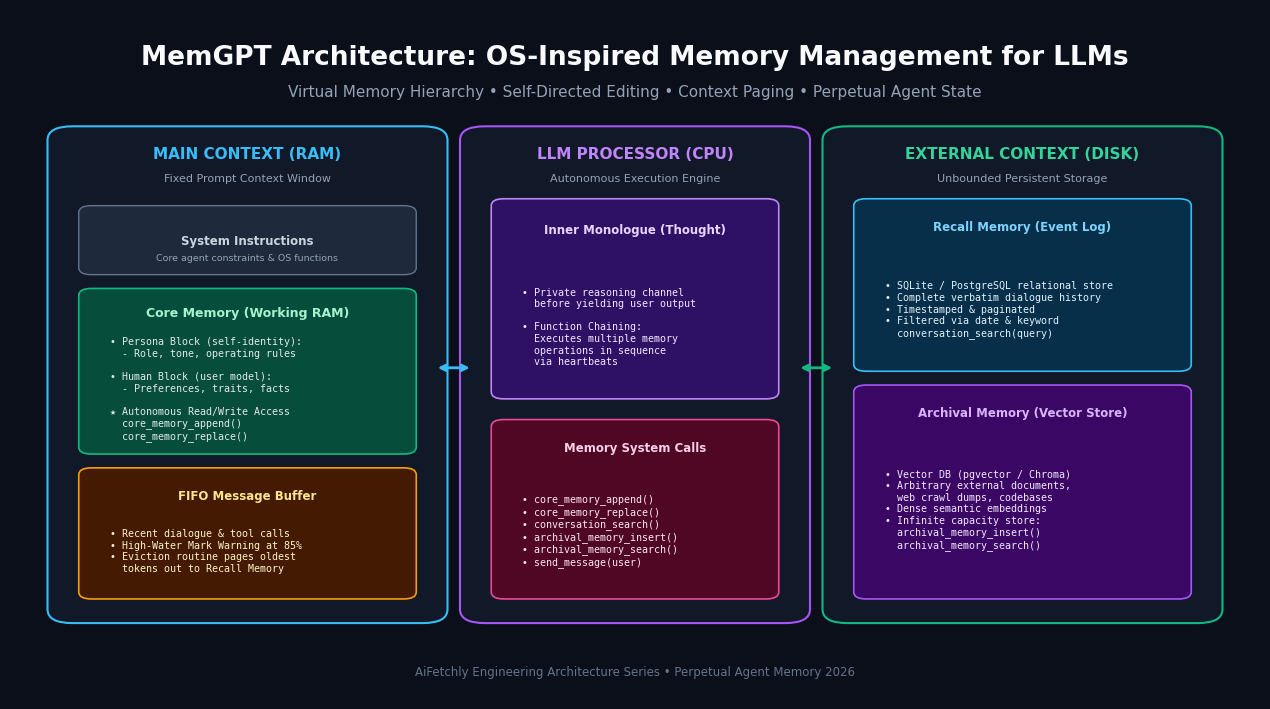
Rather than waiting for infinite physical context windows, MemGPT draws a direct architectural analogy between Large Language Models and classical Computer Operating Systems (OS):
| Computer OS Component | MemGPT Multi-Tier Agent Equivalent | Architectural Characteristics |
|---|---|---|
| Physical RAM | Main Context Window | Fast, high-attention, strictly bounded token capacity |
| Disk Storage / SSD | External Context (Database & Vectors) | High-capacity, persistent, requires explicit I/O operations |
| CPU Processor | Foundation LLM (Inference Engine) | Executes reasoning, generates text, issues memory system calls |
| MMU (Memory Management Unit) | Context Paging Controller | Monitors token thresholds and pages expired context out to disk |
| Hardware Interrupts | Agent Heartbeats & Yields | Orchestrates autonomous multi-step execution loops |
Under this paradigm, the agent’s context window is not a dumping ground for raw text; it is an active working memory buffer dynamically managed by the agent itself.
1. Main Context: The Active RAM Layer
The Main Context represents everything physically injected into the LLM prompt during an inference pass. MemGPT strictly partitions this space into three deterministic segments:
System Instructions: Immutable behavioral guardrails and functional documentation detailing how the agent should manage its internal memory.
Core Memory Blocks: The active working memory of the agent, divided into structured, text-editable sections:
persona: Defines who the agent is, its communication style, mission objectives, and operational heuristics.human: Stores critical facts about the user (e.g., identity, technical preferences, project goals, system configurations).
FIFO Working Message Queue: A rolling buffer of recent interaction turns, user prompts, system events, and function execution results.
2. External Context: The Persistent Disk Layer
When data exceeds the working RAM, it is persisted across two specialized storage backends outside the model’s immediate prompt:
Recall Memory (Conversational Event Log):
- Implemented via relational databases (PostgreSQL or SQLite).
- Stores the complete, uncompressed, verbatim history of every message, tool invocation, and inner monologue thought.
- Indexed by timestamp, session ID, and role.
- Accessible via text and date-filtered queries using the
conversation_searchfunction.
Archival Memory (Dense Semantic Vector Store):
- Implemented via vector databases (e.g., pgvector, Chroma, or Qdrant).
- Houses external documents, ingested PDF manuals, code repositories, and long-term narrative summaries.
- Accessible via semantic embedding similarity using
archival_memory_insertandarchival_memory_search.
The Mechanics: Self-Directed Memory Editing and Context Paging
The revolutionary differentiator of MemGPT is that the language model itself acts as the memory controller. External scripts do not guess what to remember or delete; the agent actively edits its own memory via structured function calls.
1. Autonomous Self-Directed Memory System Calls
MemGPT exposes dedicated memory modification functions directly to the agent’s function-calling interface:
# 1. Append a newly learned fact to the human persona block
core_memory_append(name="human", content="Prefers PostgreSQL over MongoDB for data persistence.")

# 2. Overwrite outdated information in the persona block
core_memory_replace(name="persona", old_content="Status: Analyzing initial DOM", new_content="Status: Scraping page 4")

# 3. Store high-density knowledge into the archival vector database
archival_memory_insert(content="Target SaaS API requires Bearer authentication rotated every 60 minutes.")

# 4. Search archival knowledge when answering user requests
archival_memory_search(query="rate limit fallback headers", page=0) By invoking these tools during normal operation, the agent autonomously updates its mental model of the world and the user in real time.
2. Multi-Turn Function Chaining and Inner Monologue
Traditional function-calling architectures enforce a rigid ping-pong dynamic: User speaks $\to$ Model calls tool $\to$ Tool responds $\to$ Model speaks to User.
MemGPT breaks this constraint through Heartbeats and Function Chaining:
- When the agent executes a memory function, it can set the control flag
request_heartbeat=True. - This signals the MemGPT runtime not to yield control back to the user, but to immediately feed the function execution result back into the prompt for another inference cycle.
- Inner Monologue: MemGPT enforces an internal monologue channel where the agent reasons privately before deciding whether to update memory, call an external tool, or speak to the user:
\{
  "thought": "The user mentioned they moved to Tokyo. I must update my core memory block for the user.",
  "function": "core_memory_replace",
  "arguments": \{
    "name": "human",
    "old_content": "Location: San Francisco",
    "new_content": "Location: Tokyo, Japan"
  \}
\}
3. The Context Paging and Eviction Lifecycle
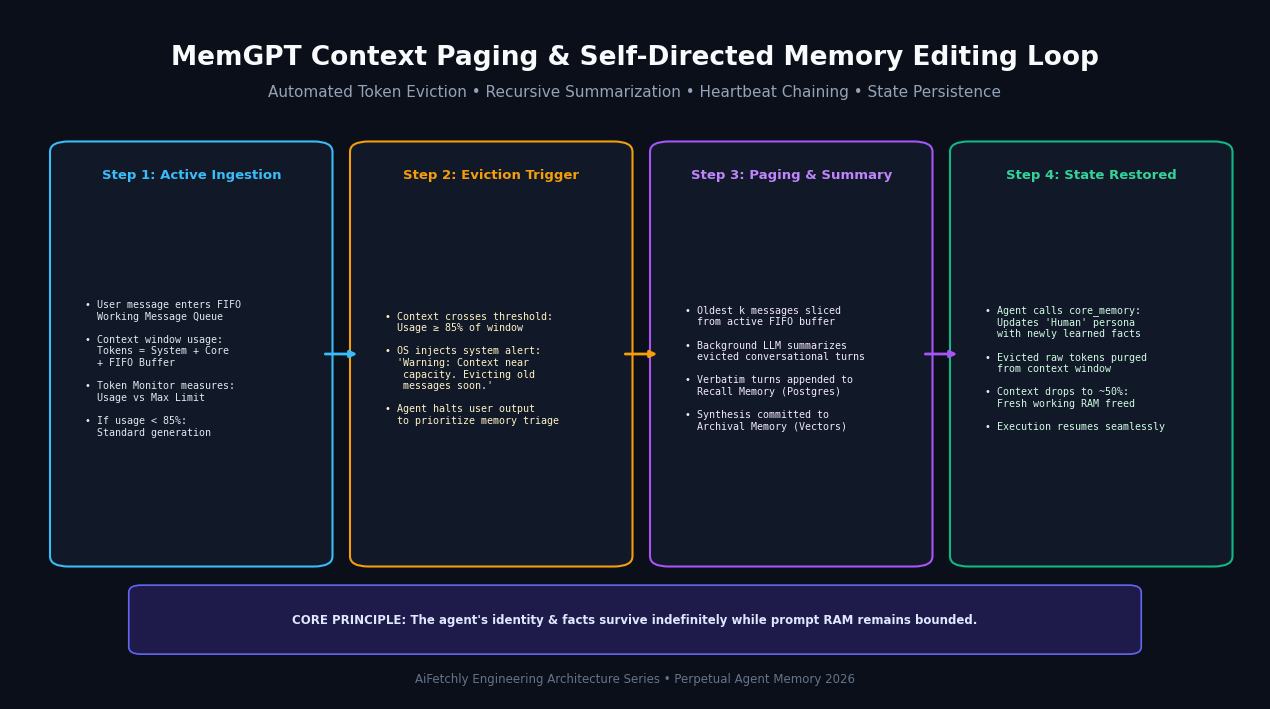
To prevent context window overflow while preserving critical insights, MemGPT implements automated Context Paging:
Token High-Water Mark: The runtime continuously monitors token consumption. When the active prompt exceeds a defined threshold (e.g., 85% of total context capacity), MemGPT initiates memory compaction.
Preemptive Eviction Interrupt: The system injects a specialized system message into the FIFO queue:
[System Warning]: Context window approaching limit. Truncating oldest messages soon. Commit any vital facts to core or archival memory now.
Recursive Summarization & Paging:
- The oldest $k$ messages in the FIFO queue are extracted.
- A background summarization routine compresses these turns into a concise factual summary.
- The verbatim turns remain safely persisted in Recall Memory (relational database).
- The summary is embedded and stored into Archival Memory (vector database).
- The raw tokens are purged from the Main Context, instantly dropping prompt usage back down to ~50% capacity.
Through this continuous paging loop, an agent can run for years without ever crashing or forgetting foundational core facts.
Implementation: Building a Stateful Perpetual Agent with Letta
Let us build a production-grade, stateful autonomous agent using the Letta (MemGPT) Python SDK. This agent maintains persistent core memory, autonomously updates user preferences, and queries archival documentation across sessions.
import os
from letta import create_client, EmbeddingConfig, LLMConfig

# 1. Initialize Letta Client (Local SQLite or Remote Enterprise Server)
client = create_client()

# 2. Define Initial Core Memory Blocks
persona_block = """
You are an elite data extraction assistant deployed within aiFetchly.
Your goal is to autonomously monitor enterprise web endpoints, extract schema-validated
datasets, and maintain accurate state across months of operations.
Never guess when data is missing; search your archival memory first.
"""

human_block = """
User Name: Alex Rivera
Role: Head of Data Engineering
Preferred Format: Strict JSON
Active Projects: SaaS Competitor Pricing Tracker
"""

# 3. Create the Persistent MemGPT Agent
agent_state = client.create_agent(
    name="aifetchly-perpetual-extractor",
    memory={
        "persona": persona_block,
        "human": human_block
    },
    llm_config=LLMConfig.default_config("gpt-4o"),
    embedding_config=EmbeddingConfig.default_config("text-embedding-3-small")
)

print(f"--- Agent Created with ID: {agent_state.id} ---")

# 4. Ingest Domain Documentation into Archival Memory
knowledge_documents = [
    "Enterprise Target A: API rate limit is 120 req/min. Requires custom X-Fetch-Token header.",
    "Target B DOM Architecture: Pricing table is rendered inside a shadow DOM element '#pricing-shadow'.",
    "Data Retention Policy: Raw HTML payloads must be purged after 48 hours; extracted JSON is permanent."
]

for doc in knowledge_documents:
    client.insert_archival_memory(agent_id=agent_state.id, memory=doc)

print("Archival Memory Ingested Successfully.")

# 5. Execute Multi-Turn Interactions Demonstrating Autonomous Memory Self-Editing
conversation_turns = [
    "Hey! Just wanted to let you know I changed my email to alex.rivera@enterprise.io and we switched our preferred format from JSON to Parquet.",
    "What is the rate limit and header requirement for Enterprise Target A?",
    "Can you check what my current preferred output format is?"
]

for turn in conversation_turns:
    print(f"\n[User]: {turn}")
    response = client.send_message(
        agent_id=agent_state.id,
        role="user",
        message=turn
    )

    # Inspect Agent Inner Thoughts and Response
    for msg in response.messages:
        if msg.message_type == "internal_monologue":
            print(f"  [Inner Monologue]: {msg.internal_monologue}")
        elif msg.message_type == "function_call":
            print(f"  [Tool Call]: {msg.function_name}({msg.arguments})")
        elif msg.message_type == "assistant_message":
            print(f"  [Agent]: {msg.message}")

# 6. Verify Updated Core Memory on Disk
updated_agent = client.get_agent(agent_id=agent_state.id)
print("\n--- Current Core Memory State ---")
print(f"Human Persona Block:\n{updated_agent.memory.get_block('human').value}") Architectural Comparison: Agent Memory Frameworks
Understanding how MemGPT compares to other memory architectures in 2026 is critical when architecting production AI systems:
| Dimension | Standard Vector RAG | LangGraph Checkpointing | Mem0 (Memory Layer) | MemGPT / Letta |
|---|---|---|---|---|
| Core Philosophy | Static document retrieval | State graph persistence | Key-value semantic entity store | Operating System Virtual Memory |
| Active Memory (RAM) | Ephemeral top-$k$ chunks | TypedDict graph state | External injected memory string | Editable Core Memory (Persona/Human) |
| Memory Control | Hard-coded retrieval script | Developer graph edges | Automated background extraction | Autonomous Agent Function Calls |
| Context Compaction | Truncation / Sliding window | State replacement per node | Asynchronous entity merging | Automated Context Paging & Eviction |
| Reasoning Transparency | Opaque prompt expansion | Node execution trace | Blackbox API extraction | Explicit Inner Monologue Channel |
| Storage Architecture | Vector Database only | Relational Checkpoints (SQL) | Vector DB + Graph DB | Tiered: Prompt + SQL + Vector DB |
| Primary Use-Case | Q&A on static documents | Deterministic multi-step graphs | Fast user-preference personalization | Perpetual, self-evolving autonomous agents |
While LangGraph provides unmatched control over multi-agent state machines and Mem0 delivers lightweight preference extraction, MemGPT is the definitive architecture for building perpetual agents capable of autonomous self-reflection and multi-tiered memory governance.
Production Engineering: Enterprise Best Practices
When deploying MemGPT and Letta architectures at scale across high-concurrency environments, enterprise engineering teams should implement four best practices:
1. Structuring Core Memory Blocks for Predictable Mutability
Do not allow the model to treat Core Memory as an unconstrained text blob:
- Partition the
humanblock into explicit, labeled sections (e.g.,User Profile,Technical Environment,Active Constraints). - In your system instructions, provide few-shot examples demonstrating atomic edits via
core_memory_replace, preventing the model from unintentionally wiping out adjacent facts.
2. Managing Function Chaining Rate Limits
Heartbeat chaining allows agents to execute multiple memory searches in a loop before speaking to the user:
- Cap maximum heartbeat loops (e.g.,
max_chaining_steps = 8) to prevent runaway recursive search loops when a query fails to match archival documents. - Implement exponential backoff on database search calls to protect underlying vector indexes from latency spikes during high concurrency.
3. Decoupling Embedding Models from Archival Storage
Archival memory stores embeddings generated across months of operation:
- Standardize on a high-stability embedding model (such as
text-embedding-3-smallor domain-specific HuggingFace encoders). - Never switch embedding model architectures without running an offline re-indexing migration on your pgvector tables; mismatched embedding spaces destroy semantic recall across historical memories.
4. Hybrid Integration with Desktop Agent runtimes
In intelligent desktop tools like AiFetchly:
- Combine MemGPT’s self-directed core memory with local OS file watchers.
- When an agent observes a user modifying a local configuration file or rotating an API credential, the host platform triggers a background system event that updates the agent’s Core Memory block without requiring manual prompting.
By moving beyond passive, static context windows and embracing operating-system-inspired memory hierarchies, AI engineering teams can build truly autonomous agents that remember, adapt, and grow alongside their users.