Megatron-Core Guide: 5D Distributed Training Architecture
The Problem: The Memory and Communication Bottlenecks in Frontier LLM Pre-Training
In modern enterprise AI systems, autonomous data collection infrastructure, and custom foundation model training pipelines like AiFetchly, machine learning teams frequently pre-train or continuously adapt domain-specific Large Language Models (LLMs) on massive proprietary corpora. Frontier models have expanded from 7 billion parameters to 70B, 405B (such as Meta’s Llama 3.1 405B), and over 671 billion parameters (such as DeepSeek-V3).
However, scaling foundation model training across hundreds or thousands of datacenter GPUs encounters three crippling physical barriers: the static memory wall, pipeline synchronization bubbles, and long-context activation explosions.
The Trillion-Parameter Distributed Training Wall:
┌────────────────────────────────────────────────────────┐
│ Barrier 1: The Static Memory Explosion                 │
│ • Model weights (BF16): 2 bytes / param                │
│ • Gradients (BF16): 2 bytes / param                    │
│ • Adam Optimizer States (FP32): 12 bytes / param       │
│ ❌ Total Static Memory: 16 bytes per parameter!        │
│ ❌ A 70B model requires 1.12 Terabytes of GPU memory!  │
├────────────────────────────────────────────────────────┤
│ Barrier 2: The Pipeline Idle Bubble Tax                │
│ • Naive pipeline parallelism divides layers by nodes   │
│ • GPUs sit idle waiting for forward/backward passes    │
│ ❌ Pipeline Bubble Ratio: (P - 1) / M                  │
│ ❌ Up to 40% of expensive GPU compute wasted idling!   │
├────────────────────────────────────────────────────────┤
│ Barrier 3: Long-Context Activation Memory Explosion    │
│ • Context lengths scaling from 4k to 128k+ tokens      │
│ • Self-attention activations scale with O(S^2)         │
│ ❌ Standard DDP crashes with OutOfMemory on long prompts│
└────────────────────────────────────────────────────────┘
Result: Training frontier models was hindered by massive memory bottlenecks and low GPU efficiency! 1. The Static Memory Wall: 16 Bytes per Parameter
Standard deep learning frameworks store training state across three components:
- Model Weights: In 16-bit precision (BF16 or FP16), weights require $2 \times \text{Parameters}$ bytes.
- Gradients: Backpropagation accumulates gradients requiring $2 \times \text{Parameters}$ bytes.
- Adam Optimizer States: Standard Adam stores first moments ($m$, 4 bytes in FP32), second moments ($v$, 4 bytes in FP32), and a master weight copy (4 bytes in FP32), consuming $12 \times \text{Parameters}$ bytes.
- Combined Baseline: Every parameter demands 16 bytes of static memory. For a 70B parameter model, static state consumes 1,120 GB (1.12 TB) of memory before accounting for a single token’s dynamic activation memory. No single GPU on earth (even an 80 GB or 141 GB H100/H200) can hold this state in memory.
2. The Pipeline Idle Bubble Tax
When models cannot fit on a single server node, engineering teams split transformer layers across nodes using Pipeline Parallelism (PP):
- In naive pipeline execution, node 1 computes the forward pass of layers 1–10, sends activations to node 2, which computes layers 11–20, and so on.
- During this sequential handoff, downstream GPUs sit completely idle waiting for activations to arrive, while upstream GPUs sit idle waiting for backward gradients to propagate back.
- This idle time—termed the pipeline bubble—scales as $\frac{P - 1}{M}$ (where $P$ is the pipeline depth and $M$ is the number of micro-batches). On deep pipelines, over 35% to 45% of GPU cycles are wasted idling.
3. Long-Context Activation Memory Explosions
Modern AI agents and document parsing platforms require long context windows (32k, 128k, or 1M tokens):
- While model weights remain fixed regardless of context length, intermediate activation tensors (the outputs of attention projections, LayerNorms, and feed-forward activations) scale linearly with batch size and quadratically with sequence length ($S^2$).
- Even with activation checkpointing (discarding intermediate tensors and recomputing them during backward passes), intermediate activations for a 128k sequence length quickly overwhelm GPU memory, causing fatal OutOfMemory crashes.
The Solution: NVIDIA Megatron-Core’s 5D Parallelism Matrix
To resolve these distributed scaling bottlenecks, NVIDIA developed Megatron-Core, a modular, high-performance library engineered to train multi-billion and trillion-parameter foundation models at peak hardware efficiency.
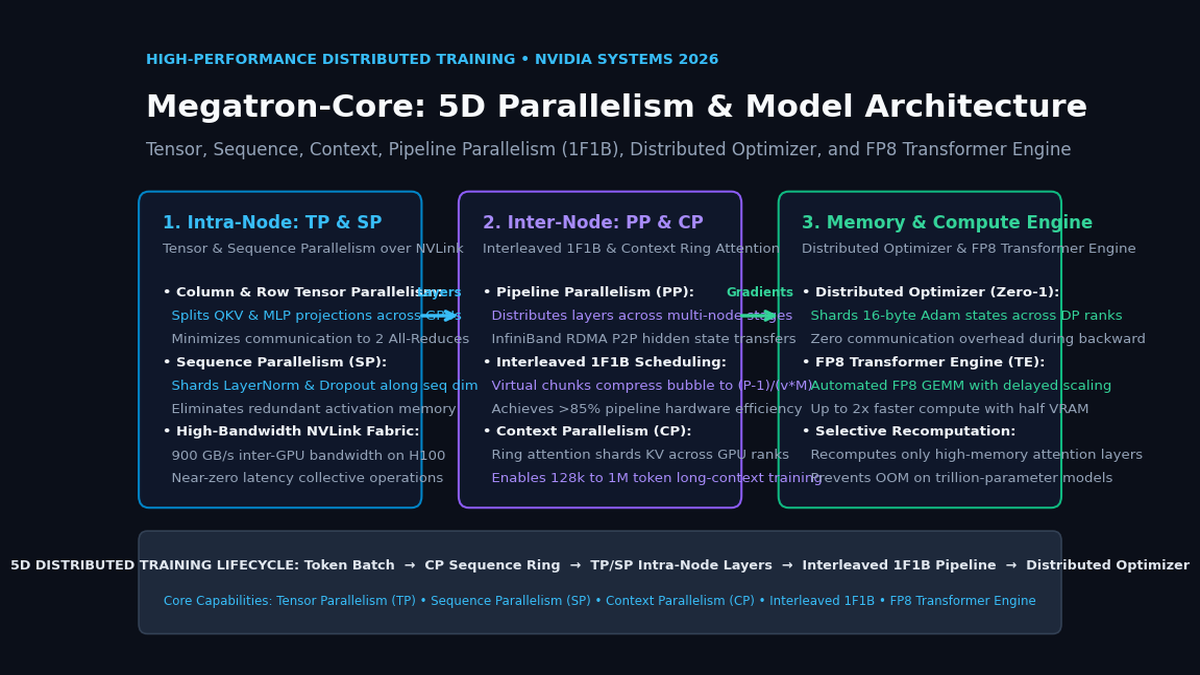
Megatron-Core coordinates a 5D Parallelism Matrix that systematically partitions computation and memory across five orthogonal hardware dimensions: Tensor Parallelism (TP), Sequence Parallelism (SP), Context Parallelism (CP), Interleaved 1F1B Pipeline Parallelism (PP), and Data Parallelism (DP) with the Distributed Optimizer.
Megatron-Core 5D Parallelism Topology:
┌─────────────────────────────────────────────────────────────────────────┐
│ Input Sequence Batch (e.g., 128k Tokens, Batch Size B)                  │
└────────────────────────────────────┬────────────────────────────────────┘
                                     │ (Context Parallelism: CP Ring Attention)
                                     ▼
┌─────────────────────────────────────────────────────────────────────────┐
│ 1. Inter-Node: Context Parallelism (CP)                                 │
│ • Shards 128k sequence length across GPUs via Ring Attention or All-to-All│
│ • Memory footprint scales linearly: O(S / CP) per GPU rank             │
└────────────────────────────────────┬────────────────────────────────────┘
                                     │
                    ┌────────────────┴────────────────┐
                    ▼                                 ▼
┌───────────────────────────────────────┐ ┌───────────────────────────────────────┐
│ 2. Intra-Node: Tensor Parallelism (TP)│ │ 3. Intra-Node: Sequence Parallelism   │
│ • Column-Parallel QKV & MLP Projections│ │ • Shards LayerNorm & Dropout across TP│
│ • Row-Parallel Output Projections     │ │ • Replaces All-Reduce with            │
│ • Fast All-Reduce over NVLink         │ │   Reduce-Scatter & All-Gather         │
└───────────────────┬───────────────────┘ └───────────────────┬───────────────────┘
                    │                                         │
                    └────────────────────┬────────────────────┘
                                         ▼
┌─────────────────────────────────────────────────────────────────────────┐
│ 4. Inter-Node: Pipeline Parallelism (PP) & Interleaved 1F1B             │
│ • Partitions layers across nodes via InfiniBand RDMA P2P                │
│ • Virtual chunks compress pipeline bubble: Bubble = (P-1) / (v * M)     │
└────────────────────────────────────┬────────────────────────────────────┘
                                     │
                                     ▼
┌─────────────────────────────────────────────────────────────────────────┐
│ 5. Memory Engine: Distributed Optimizer (Zero-1) & FP8 Transformer Engine│
│ • Shards 12-byte Adam states across DP ranks (Zero backward comm tax!)  │
│ • Native FP8 GEMMs via Transformer Engine (2x compute throughput)       │
└─────────────────────────────────────────────────────────────────────────┘ The Architectural Pillars of Megatron-Core
- Intra-Node Tensor Parallelism (TP): Megatron-Core splits multi-head attention and feed-forward weight matrices across GPUs within the same server node. By sharding projection matrices column-wise and output matrices row-wise, it requires only two All-Reduce communication operations per transformer layer, executed over ultra-high-speed NVLink interconnects (900 GB/s per GPU on NVIDIA H100).
- Sequence Parallelism (SP): In standard Tensor Parallelism, LayerNorm, Dropout, and residual connections are duplicated identically across all TP ranks. Megatron-Core’s Sequence Parallelism shards these operations along the sequence length dimension. By replacing the All-Reduce with a Reduce-Scatter before LayerNorm and an All-Gather after Dropout, SP slashes activation memory by up to $5\times$ with zero additional communication overhead.
- Context Parallelism (CP): For ultra-long context windows (32k to 1M tokens), Megatron-Core distributes the sequence dimension across multiple GPUs using Ring Attention. Each GPU computes attention on its local query block while asynchronously rotating Key-Value blocks around a ring topology, keeping activation memory completely bounded.
- Interleaved 1F1B Pipeline Parallelism (PP): Standard pipeline parallelism schedules one forward pass followed by one backward pass per micro-batch (1F1B). Megatron-Core introduces Interleaved 1F1B, where each physical GPU manages $v$ smaller virtual model chunks. This interleaving shrinks the idle pipeline bubble by a factor of $v$, boosting Model Flops Utilization (MFU) above 55% to 60%.
- Distributed Optimizer (Zero-1): Rather than replicating the 12-byte Adam optimizer states across all Data Parallel (DP) ranks, Megatron-Core shards optimizer states across the DP group. Gradients are gathered via a Reduce-Scatter operation, and updated weights are synced via an All-Gather, eliminating 75% of optimizer VRAM consumption.
- Native Transformer Engine (TE) Integration: Megatron-Core embeds the NVIDIA Transformer Engine directly into its layer definitions, supporting automated FP8 mixed-precision matrix multiplications with delayed scaling algorithms and FP8 KV caching.
Comparing Distributed Training Frameworks
The table below contrasts Megatron-Core against standard PyTorch Distributed Data Parallel (DDP), DeepSpeed ZeRO-3, and PyTorch FSDP2:
Distributed Training Framework Comparison:
┌───────────────────────────┬───────────────────────────────┬───────────────────────────────┬───────────────────────────────┐
│ Feature                   │ PyTorch DDP                   │ DeepSpeed ZeRO-3              │ NVIDIA Megatron-Core          │
├───────────────────────────┼───────────────────────────────┼───────────────────────────────┼───────────────────────────────┤
│ Max Scalable Model Size   │ ~14B parameters (Single node) │ 100B+ parameters              │ Trillion+ parameters (405B+)  │
│ Parallelism Dimensions    │ 1D (Data Parallelism only)    │ 1D/2D (ZeRO Sharding + PP)    │ 5D (TP, SP, CP, PP, DP)       │
│ Tensor Parallelism (TP)   │ ❌ Not supported              │ Experimental / Megatron fork  │ ✅ Native & NVLink-Optimized  │
│ Sequence Parallelism (SP) │ ❌ Not supported              │ ❌ Not supported              │ ✅ Native (Reduce-Scatter)    │
│ Context Parallelism (CP)  │ ❌ Not supported              │ Limited                       │ ✅ Native (Ring Attention)    │
│ Pipeline Schedule         │ ❌ None                       │ Standard 1F1B                 │ Interleaved 1F1B (Virtual)    │
│ Optimizer State Sharding  │ ❌ Replicated on all ranks    │ Sharded (Zero-3)              │ Distributed Optimizer (Zero-1)│
│ Transformer Engine (FP8)  │ ❌ Requires manual plumbing   │ Third-party plugin            │ ✅ Native First-Class Support │
│ Typical Model Flops (MFU) │ 30%–38%                       │ 35%–45%                       │ 50%–60%+ (Peak Industrial)    │
└───────────────────────────┴───────────────────────────────┴───────────────────────────────┴───────────────────────────────┘ Deep Dive into Megatron-Core Core Subsystems & Mathematical Formulations
To understand how Megatron-Core trains trillion-parameter models at near-linear scale, let’s analyze the mathematical formulations behind its core subsystems: Tensor & Sequence Parallelism, Context Parallelism, and Interleaved 1F1B Pipeline Scheduling.
Megatron-Core Subsystem Matrix:
Megatron-Core
 ├──► 1. Intra-Node TP/SP: Column/Row matrix splitting with sequence-sharded LayerNorm
 ├──► 2. Context Parallelism: Ring Attention communication for 128k+ token sequences
 ├──► 3. Interleaved 1F1B: Virtual stage pipeline scheduling compressing bubble ratios
 ├──► 4. Distributed Optimizer: Zero-1 Adam state sharding across data parallel ranks
└──► 5. Transformer Engine: FP8 delayed scaling GEMMs and native FP8 KV cache 1. Tensor & Sequence Parallelism: The Intra-Node Engine
A standard Transformer layer consists of a Multi-Head Attention (MHA) block followed by a Multi-Layer Perceptron (MLP) block:
Multi-Head Attention Tensor Parallelism: The Query, Key, and Value projection weight matrix $\mathbf{W}_{\text{QKV}}$ is partitioned column-wise across $N$ tensor parallel GPUs:
$$\mathbf{W}{\text{QKV}} = \begin{bmatrix} \mathbf{W}{\text{QKV}, 1} & \mathbf{W}{\text{QKV}, 2} & \cdots & \mathbf{W}{\text{QKV}, N} \end{bmatrix}$$
Each GPU computes local attention: $\mathbf{Z}i = \text{Attention}(\mathbf{X} \mathbf{W}{\text{QKV}, i})$. The attention output projection matrix $\mathbf{W}_{\text{out}}$ is partitioned row-wise:
$$\mathbf{W}{\text{out}} = \begin{bmatrix} \mathbf{W}{\text{out}, 1} \ \mathbf{W}{\text{out}, 2} \ \vdots \ \mathbf{W}{\text{out}, N} \end{bmatrix}$$
The final attention output is computed as:
$$\mathbf{Y}{\text{attn}} = \sum{i=1}^N \mathbf{Z}i \mathbf{W}{\text{out}, i}$$
This summation requires a single All-Reduce communication call across the $N$ tensor parallel GPUs.
Sequence Parallelism Communication Optimization: In standard TP, the input tensor $\mathbf{X}$ is duplicated identically across all $N$ GPUs during LayerNorm and Dropout:
- Megatron-Core’s Sequence Parallelism splits $\mathbf{X} \in \mathbb{R}^{B \times S \times D}$ along the sequence length dimension $S$, giving each GPU a slice $\mathbf{X}_i \in \mathbb{R}^{B \times (S/N) \times D}$.
- Instead of computing an All-Reduce at the end of the row-parallel projection, Megatron-Core replaces it with a Reduce-Scatter operation. Each GPU receives only its portion of the sequence ($S/N$).
- LayerNorm and Dropout are computed locally on this slice.
- Before entering the next column-parallel linear projection, an All-Gather operation reconstructs the full sequence.
- Zero Overhead: Because $\text{Cost}(\text{Reduce-Scatter}) + \text{Cost}(\text{All-Gather}) = \text{Cost}(\text{All-Reduce})$, Sequence Parallelism completely eliminates activation redundancy without adding any communication overhead.
2. Context Parallelism (CP) & Ring Attention
For sequence lengths exceeding 64k or 128k tokens, storing Key-Value tensors across all layers exceeds single-GPU VRAM:
- Megatron-Core introduces Context Parallelism (CP): the sequence of length $S$ is divided into $K$ chunks across $K$ context parallel GPUs.
- Each GPU holds Query $\mathbf{Q}_k$, Key $\mathbf{K}_k$, and Value $\mathbf{V}_k$ of length $S/K$.
- Ring Attention Protocol:
- Each GPU computes attention using its local $\mathbf{Q}_k$ and local $\mathbf{K}_k, \mathbf{V}_k$.
- Simultaneously, using non-blocking peer-to-peer CUDA streams over NVLink or InfiniBand, each GPU sends its $\mathbf{K}k, \mathbf{V}k$ block to rank $(k+1) \pmod K$ and receives $\mathbf{K}{k-1}, \mathbf{V}{k-1}$ from rank $(k-1) \pmod K$.
- The local query computes attention against the incoming remote KV block.
- The communication of step $i+1$ is completely hidden behind the matrix multiplication of step $i$.
- This enables training on 1M-token contexts with constant per-GPU activation memory.
3. Interleaved 1F1B Pipeline Scheduling
In standard Pipeline Parallelism with $P$ stages and $M$ micro-batches, the pipeline bubble fraction is:
$$F_{\text{standard}} = \frac{P - 1}{M}$$
If $P = 8$ and $M = 16$, $F = 7 / 16 \approx 43.75%$ idle time.
Standard 1F1B vs. Megatron-Core Interleaved 1F1B:
Standard 1F1B Schedule:
Rank 1: [F1][F2][F3][F4][B1][B2][B3][B4] ──────► Massive startup and cooldown bubble!
Rank 2: ───►[F1][F2][F3][B1][B2][B3]──── ──────► GPUs wait idle for micro-batches!

Megatron-Core Interleaved 1F1B Schedule (v = 2 Virtual Stages):
Rank 1: [F1_v1][F2_v1][F1_v2][B1_v1][F3_v1]... ──► Shorter micro-batches interleave!
Rank 2: ───►[F1_v1][F2_v1][B1_v1][F1_v2]... ──► Bubble compressed by factor of v! - In Megatron-Core’s Interleaved 1F1B, each physical GPU manages $v$ virtual stages (e.g., $v = 2$ or $v = 4$).
- For example, Rank 1 manages Layer 1 (Virtual Stage 1) and Layer 9 (Virtual Stage 2).
- The pipeline bubble fraction is compressed to:
$$F_{\text{interleaved}} = \frac{P - 1}{v \cdot M}$$
- With $v = 2$, the bubble drops from 43.75% to 21.8%; with $v = 4$, it drops to 10.9%, dramatically increasing training efficiency across multi-node clusters.
Hands-On Implementation: Configuring and Launching a Megatron-Core Model
Let’s walk through configuring a Megatron-Core model in Python, defining the 5D parallelism matrix, and launching distributed training with torchrun.
1. Environment Setup
Install megatron-core and the NVIDIA transformer-engine:
# Ensure CUDA 12.4+ and PyTorch 2.4+ are installed
pip install ninja packaging wheel
pip install transformer-engine[pytorch]
pip install megatron-core 2. Defining the 5D Parallelism Configuration in Python
Create the training script (train_megatron_gpt.py) using Megatron-Core’s modular configuration classes:
import torch
from megatron.core import parallel_state
from megatron.core.transformer.transformer_config import TransformerConfig
from megatron.core.models.gpt.gpt_model import GPTModel
from megatron.core.models.gpt.gpt_layer_specs import get_gpt_layer_with_transformer_engine_spec
import os

def initialize_megatron_distributed(
    tensor_model_parallel_size=2,
    pipeline_model_parallel_size=2,
    context_parallel_size=2,
    virtual_pipeline_model_parallel_size=2
):
    """Initializes Megatron-Core's 5D parallelism process groups."""
    torch.distributed.init_process_group(backend="nccl")

    # Initialize TP, PP, CP, and DP communicators
    parallel_state.initialize_model_parallel(
        tensor_model_parallel_size=tensor_model_parallel_size,
        pipeline_model_parallel_size=pipeline_model_parallel_size,
        virtual_pipeline_model_parallel_size=virtual_pipeline_model_parallel_size,
        context_parallel_size=context_parallel_size
    )

    rank = torch.distributed.get_rank()
    print(f"[Rank {rank}] Initialized: TP={tensor_model_parallel_size}, "
          f"PP={pipeline_model_parallel_size}, CP={context_parallel_size}")

def build_megatron_model():
    """Builds a high-performance GPT foundation model with Transformer Engine specs."""
    # Define transformer architecture and parallelism flags
    config = TransformerConfig(
        num_layers=16,
        hidden_size=2048,
        num_attention_heads=16,
        seq_length=8192,
        max_position_embeddings=8192,
        tensor_model_parallel_size=2,
        pipeline_model_parallel_size=2,
        virtual_pipeline_model_parallel_size=2,
        context_parallel_size=2,
        sequence_parallel=True,           # Enable Sequence Parallelism (SP)
        use_cpu_initialization=False,
        fp16=False,
        bf16=True                         # Native BF16 mixed-precision
    )

    # Use native NVIDIA Transformer Engine layer specifications (FP8 ready)
    transformer_layer_spec = get_gpt_layer_with_transformer_engine_spec()

    # Instantiate the modular GPT model
    model = GPTModel(
        config=config,
        transformer_layer_spec=transformer_layer_spec,
        vocab_size=50304,
        max_sequence_length=8192,
        pre_process=parallel_state.is_pipeline_first_stage(),
        post_process=parallel_state.is_pipeline_last_stage()
    )

    return model

if __name__ == "__main__":
    initialize_megatron_distributed()
    model = build_megatron_model()
print("Megatron-Core model successfully constructed and sharded across 5D grid!") 3. Launching Distributed Training with torchrun
Launch multi-GPU execution across 8 local GPUs using torchrun:
torchrun --nproc_per_node=8 \
  --nnodes=1 \
  --node_rank=0 \
  --master_addr="127.0.0.1" \
  --master_port=29500 \
train_megatron_gpt.py Production Architecture & Integration for aiFetchly
In large-scale enterprise data extraction, automated web synthesis, and private foundation model development powered by AiFetchly, Megatron-Core provides the industrial infrastructure needed to pre-train and fine-tune specialized domain models.
aiFetchly Foundation Model Lifecycle Topology:
┌─────────────────────────────────────────────────────────────────┐
│ aiFetchly Web Extraction & Enterprise Document Pipeline        │
└────────────────────────────────────┬────────────────────────────┘
                                     │ (Tokenizes Massive Multi-Terabyte Corpus)
                                     ▼
┌─────────────────────────────────────────────────────────────────┐
│ Megatron-Core Pre-Training & Continual Pre-Training Cluster     │
│ • 5D Parallelism: TP + SP + CP + Interleaved 1F1B + Zero-1      │
│ • Transformer Engine: Automated FP8 Mixed-Precision Training    │
│ • Produces Base Domain Models (8B / 70B Specialized Extractors) │
└───────────────────┬─────────────────────────────────┬───────────┘
                    │                                 │
     (Post-Training Alignment via TRL)     (High-Throughput Serving Deployment)
                    ▼                                 ▼
┌───────────────────────────────────────┐ ┌───────────────────────────────┐
│ Hugging Face TRL Alignment            │ │ High-Performance Serving     │
│ • GRPO Reasoning Reinforcement        │ │ • Cloud Serving: vLLM V1      │
│ • DPO Preference Optimization         │ │ • Edge Desktop: llama.cpp     │
└───────────────────────────────────────┘ └───────────────────────────────┘ 1. Training Specialized Domain Extractors
Commercial AI applications require foundation models that deeply understand HTML DOM structures, financial tables, and technical schemas:
- Standard off-the-shelf general models frequently hallucinate non-existent JSON keys or fail on 50,000-token web documents.
- Using Megatron-Core’s Context Parallelism, AiFetchly trains specialized 8B and 70B extraction models directly on 128k-token web documents, achieving sub-1% schema extraction error rates.
2. Seamless Handoff from Pre-Training to Post-Training and Serving
An industrial AI lifecycle requires connecting pre-training to alignment and inference:
- Post-Training Alignment with TRL: After pre-training base checkpoints in Megatron-Core, models transition into Hugging Face TRL for Supervised Fine-Tuning (SFT) and Group Relative Policy Optimization (GRPO) reasoning alignment.
- Inference Optimization: Aligned models are converted into GGUF format for instant, bare-metal desktop execution via llama.cpp or deployed into high-concurrency cloud clusters using vLLM.
- Observability and Evaluation: Track training stability, validation loss, and prompt alignment using Langfuse and Arize Phoenix.
Summary: 5D Parallelism as the Industrial Backbone of Frontier AI
As foundation models push past hundreds of billions of parameters, distributed systems engineering has become as vital as model architecture.
By unifying Tensor Parallelism, Sequence Parallelism, Context Parallelism, Interleaved 1F1B Pipeline Scheduling, and the Distributed Optimizer into a cohesive framework, NVIDIA Megatron-Core overcomes the memory and synchronization bottlenecks that once stalled frontier training. Coupled with native FP8 acceleration via the Transformer Engine, Megatron-Core delivers the peak computational throughput necessary to train the next generation of intelligent foundation models. For enterprise data intelligence, domain-specific foundation models, and scalable agent systems engineered with AiFetchly, Megatron-Core represents the premier industrial standard in large-scale distributed AI training.