MediaTek NPU 890 Guide: Dimensity 9400 Mobile AI Silicon
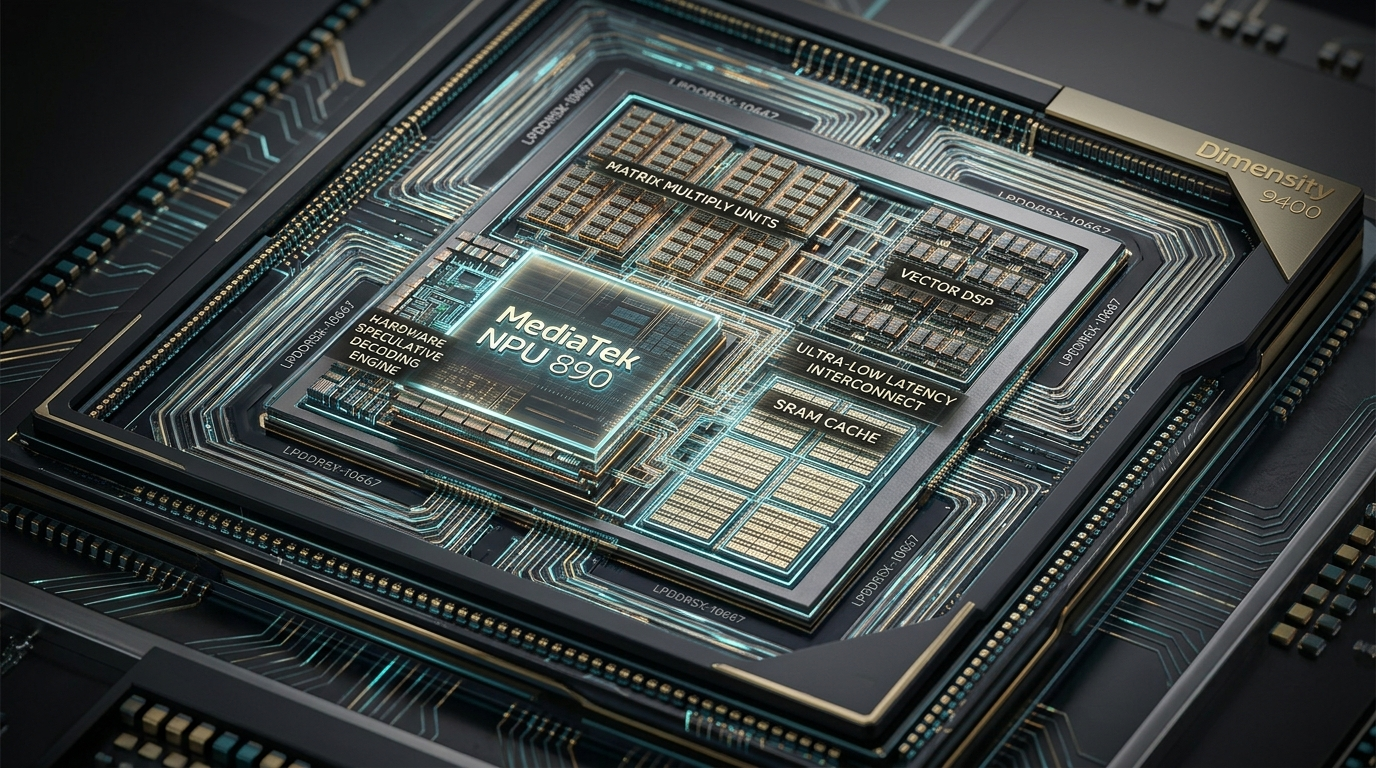
The Mobile Generative AI Bottleneck: Thermodynamics, Memory Walls, and Autoregressive Stalls
Deploying generative foundation models onto mobile smartphones represents one of the most hostile computing environments in contemporary semiconductor engineering. For decades, mobile system-on-chip (SoC) architects prioritized bursty single-threaded app launches, sustained 3D mobile gaming, and camera image signal processing (ISP) pipelines. However, the seismic migration of artificial intelligence from remote hyperscaler datacenters to local smartphone silicon has exposed fundamental thermodynamic and architectural limits.
Modern smartphone users increasingly expect generative conversational copilots, real-time contextual voice transcription, on-device photo synthesis, and autonomous task assistants to execute completely offline. Local execution guarantees instantaneous sub-100ms response times, eliminates costly cloud API subscriptions, ensures functional resilience in disconnected environments, and preserves strict personal data privacy. Yet, running 3-billion to 14-billion parameter foundation models within a handheld smartphone introduces severe hardware crises that break legacy mobile processors.
The Fanless Thermal Ceiling and Battery Constraints
Unlike datacenter accelerator racks that dissipate upwards of 10 to 40 kilowatts per enclosure with active direct-to-chip liquid cooling loops, a flagship smartphone operates within a completely passive, fanless thermal envelope. The maximum sustained thermal dissipation of a glass-and-aluminum handheld chassis is strictly constrained to between 3.5 Watts and 5.0 Watts before surface skin temperatures exceed consumer safety thresholds ($42^{\circ}\text{C}$ to $45^{\circ}\text{C}$).
+---------------------------------------------------------------------------------+
|                       MOBILE COMPUTING THERMAL CONSTRAINTS                      |
|                                                                                 |
|   +-----------------------------+         +----------------------------------+  |
|   | Datacenter GPU (H100/B200)  |         | Smartphone Flagship SoC          |  |
|   | Power: 700W - 1000W TDP     |         | Power: 3.5W - 5.0W Sustained     |  |
|   | Cooling: Active Liquid/CDUs |         | Cooling: Passive Vapor Chamber   |  |
|   | Mass: Multi-Kilogram Chassis|         | Mass: ~200g Handheld Form Factor |  |
|   +-----------------------------+         +----------------------------------+  |
|                                                                                 |
|   Result: Mobile NPUs must deliver 100x greater energy efficiency per token.    |
+---------------------------------------------------------------------------------+ When an unoptimized large language model is executed on conventional mobile graphics processing units (GPUs) or central processing units (CPUs), dynamic power dissipation immediately spikes to 12 to 15 Watts. Within less than 45 seconds of continuous generation, thermal protection circuits trigger aggressive dynamic voltage and frequency scaling (DVFS), dropping clock frequencies by 50% to 70%. Consequently, generation speeds collapse from an acceptable 18 tokens per second down to an unusable 4 tokens per second, accompanied by rapid battery depletion.
The Autoregressive Memory Bandwidth Wall on Edge Silicon
The second fundamental barrier is the memory bandwidth wall. In modern autoregressive large language models, inference consists of two fundamentally distinct phases:
- The Prefill Phase: The input prompt is evaluated in parallel. This phase is compute-bound, exhibiting high arithmetic intensity ($>100\text{ FLOP/byte}$), as matrix multiplications can be mapped across parallel multiply-accumulate (MAC) arrays.
- The Decode Phase: The model generates text token by token sequentially. Because each new token depends on the previous token, the entire model parameter weight matrix must be fetched from external dynamic memory into processor registers for every single generated token.
$$\text{Arithmetic Intensity}_{\text{decode}} = \frac{\text{Operations}}{\text{Bytes Transferred}} \approx \frac{2 \times P \times B}{2 \times P \times B} \approx 1.0 \text{ FLOP/byte}$$
For a 7-billion parameter model quantized to 4-bit integer weights (INT4), the parameter footprint occupies 3.5 Gigabytes. To emit 20 tokens per second for a single user ($B=1$), the memory subsystem must continuously stream:
$$\text{Required Bandwidth} = 3.5\text{ GB/token} \times 20\text{ tokens/sec} = 70.0\text{ GB/s}$$
In contemporary smartphone architectures, moving data across physical copper traces from off-chip LPDDR5X DRAM into processor SRAM consumes between 50 and 100 picojoules per byte ($pJ/\text{byte}$), whereas executing an INT4 dot product on an adjacent arithmetic logic unit consumes under 0.1 picojoules.
$$E_{\text{DRAM transfer}} \approx 100 \times E_{\text{ALU computation}}$$
Because memory transfer energy dominates total system power by two orders of magnitude, traditional memory-streaming architectures inevitably drain battery cells and trigger thermal saturation. To explore modern architectures that optimize streaming data flows, see our deep-dive on real-time data fetching infrastructure.
The Algorithmic Shift to Diffusion Transformers and Speculative Decoding
Early mobile neural processing units (NPUs) were static systolic engines engineered strictly for fixed $3 \times 3$ and $1 \times 1$ convolutions found in legacy computer vision models like MobileNet and ResNet. However, frontier generative artificial intelligence has moved toward mathematically irregular architectures:
- Speculative Decoding Pipelines: Modern low-latency inference pairs a small draft model (e.g., 1B parameters) with a large target model (e.g., 7B parameters). The draft model speculatively generates a sequence of candidate tokens, which the target model verifies in a single parallel forward pass. However, managing two asynchronous model execution graphs, verifying speculative candidate acceptance, and rolling back rejected tokens in software introduces severe CPU arbitration overhead that negates theoretical latency gains.
- Diffusion Transformers (DiT): Image generation models (such as Flux, Stable Diffusion 3, and SDXL) have replaced UNet backbones with multi-head self-attention Transformer blocks. These networks require continuous dynamic Softmax calculations, LayerNorm/RMSNorm scalings, and cross-attention projections that stall conventional fixed-function NPUs.
- Continuous Personalization via On-Device LoRA: Users demand that their local assistants adapt to their personal writing style, voice patterns, and application usage. However, fine-tuning Low-Rank Adaptation (LoRA) matrices requires backpropagation gradients, dynamic memory management, and weight matrix fusion—capabilities completely absent from legacy read-only mobile inference accelerators.
The MediaTek NPU 890 Solution: 3nm Architecture for Mobile Generative Intelligence
To resolve the trilemma of thermal dissipation, memory bandwidth starvation, and mathematical versatility, MediaTek introduced the flagship MediaTek NPU 890, integrated within the 3nm Dimensity 9400 platform. Rather than incrementally scaling clock speeds or widening static systolic grids, the NPU 890 introduces a fundamental re-architecture of mobile neural silicon.
Manufactured on TSMC’s second-generation 3nm (N3E) process technology, the NPU 890 delivers an unprecedented 50 TOPS of dense 8-bit integer compute while slashing dynamic power consumption by 35% compared to the prior-generation NPU 790. By uniting dedicated hardware engines for speculative decoding, on-device LoRA training, and diffusion transformer acceleration, the NPU 890 delivers server-grade generative AI directly into a fanless smartphone chassis.
+---------------------------------------------------------------------------------+
|                       MEDIATEK NPU 890 SILICON TOPOLOGY                         |
|                                                                                 |
|   +--------------------+   +---------------------+   +-----------------------+  |
|   | Hardware           |   | High-Density 2D     |   | Wide SIMD Vector DSP  |  |
|   | Speculative Engine |   | Tensor Matrix Core  |   | Softmax / RMSNorm /   |  |
|   | Token Verification |   | INT4 / INT8 / FP16  |   | Activation Pipeline   |  |
|   +---------+----------+   +----------+----------+   +-----------+-----------+  |
|             |                         |                          |              |
|             +-------------------------+--------------------------+              |
|                                       |                                         |
|                 +---------------------+---------------------+                   |
|                 | Ultra-Low Latency Crossbar On-Chip Fabric |                   |
|                 +---------------------+---------------------+                   |
|                                       |                                         |
|                 +---------------------+---------------------+                   |
|                 | Multi-Megabyte High-Bandwidth SRAM Cache  |                   |
|                 | (Zero-Wait Local Weight & KV Retention)   |                   |
|                 +---------------------+---------------------+                   |
|                                       |                                         |
|                 +---------------------+---------------------+                   |
|                 | Quad-Channel LPDDR5X-10667 Memory PHY     |                   |
|                 | (Over 85 GB/s Peak Mobile Bus Bandwidth)  |                   |
|                 +-------------------------------------------+                   |
+---------------------------------------------------------------------------------+ Core Breakthroughs of the NPU 890 Architecture
The MediaTek NPU 890 introduces four revolutionary architectural pillars designed specifically for on-device foundation models:
- Hardware-Accelerated Speculative Decoding Engine: The NPU 890 incorporates dedicated silicon execution logic that manages dual-model speculative generation at the microcode level. The hardware engine coordinates draft token generation, speculative tree verification, and branch commit arbitration without falling back to the host CPU. This provides up to a 2x acceleration in generation speed and cuts total generation energy by up to 35%.
- World’s First Mobile On-Device LoRA Training Engine: Moving beyond static inference, the NPU 890 integrates hardware-accelerated gradient backpropagation and rank-$r$ weight adaptation logic. Users can fine-tune high-parameter foundation models locally on their personal data in under two minutes, with zero bits transmitted to external servers.
- Native Diffusion Transformer (DiT) Hardware Pipeline: The arithmetic core features fused cross-attention, spatial patch re-organization, and high-precision FP16 activation evaluators optimized specifically for rectified flow and diffusion models. The NPU 890 generates high-fidelity $1024 \times 1024$ images via Stable Diffusion in under 1.0 second.
- High-Speed LPDDR5X-10667 Memory Subsystem Co-Design: The Dimensity 9400 integrates the industry’s fastest mobile memory controller, supporting 10.667 Gbps LPDDR5X memory. Delivering over 85 GB/s of sustained memory bandwidth, the system eliminates memory channel bottlenecks during large model autoregressive decoding.
By pairing this silicon architecture with the production-grade MediaTek NeuroPilot SDK, application developers can seamlessly deploy PyTorch, ONNX, and TensorFlow Lite models onto the NPU with automated graph partitioning and quantization. For teams exploring high-performance developer ecosystems, explore our overview of AIFetchly modern AI developer architectures.
Detailed Microarchitecture: Inside the MediaTek NPU 890
To understand how the NPU 890 achieves 50 TOPS within a sub-5W thermal envelope, one must examine its internal compute blocks, specialized execution datapaths, and hierarchical memory architecture.
1. The High-Density 2D Tensor Matrix Engines
The core arithmetic throughput of the NPU 890 is driven by modular 2D Tensor Matrix Engines. Optimized for dense general matrix multiplications (GEMM) and convolutional tensor contractions, each matrix block houses thousands of multiply-accumulate (MAC) datapaths running in parallel.
+-----------------------------------------------------------------------------+
|                      2D TENSOR MATRIX ENGINE PIPELINE                       |
|                                                                             |
|      Activation Vector (INT4/INT8)               Weight Matrix (INT4/INT8)  |
|                   |                                          |              |
|                   v                                          v              |
|          +-----------------+                        +-----------------+     |
|          | Input Alignment |                        | Decompression   |     |
|          | & Tiling Unit   |                        | & Zero-Skip Unit|     |
|          +--------+--------+                        +--------+--------+     |
|                   |                                          |              |
|                   +-------------------+----------------------+              |
|                                       |                                     |
|                                       v                                     |
|                  +------------------------------------------+               |
|                  | 2D Mixed-Precision Systolic MAC Array    |               |
|                  | INT4 / INT8 / FP16 Arithmetic Precision  |               |
|                  +--------------------+---------------------+               |
|                                       |                                     |
|                                       v                                     |
|                  +------------------------------------------+               |
|                  | High-Precision 32-bit Accumulator Bank   |               |
|                  +------------------------------------------+               |
+-----------------------------------------------------------------------------+ Key capabilities of the Tensor Matrix Engine include:
- Multi-Precision Support: Native hardware support for 4-bit integer (INT4), 8-bit integer (INT8), 16-bit half-precision floating point (FP16), and Brain Floating Point (BF16). For large language model serving, INT4 weight packing allows a 7B parameter model to execute comfortably within 3.5GB of DRAM, while 32-bit integer accumulation prevents numerical overflow and rounding drift.
- Hardware Sparsity and Zero-Skipping: The matrix array contains real-time zero-detect circuits. Weights or activations evaluating to zero are bypassed at the clock cycle level without activating arithmetic logic gates, saving up to 40% dynamic switching power on sparse models.
- Dynamic Weight Dequantization: Hardware dequantization units convert compressed INT4 parameters into FP16 values in-flight during matrix-vector dot products, enabling mixed-precision inference without memory bandwidth overhead.
2. The Dedicated Hardware Speculative Decoding Engine
Traditional software-driven speculative decoding requires constant arbitration between the host operating system, the small draft model, and the large target model. At each iteration, the host CPU must synchronize threads, parse output logits, evaluate rejection sampling criteria, and adjust the target model’s Key-Value (KV) cache pointers. On mobile systems, the CPU context-switch latency often exceeds the inference time itself.
The MediaTek NPU 890 solves this by implementing a Hardware Speculative Decoding Accelerator directly inside the silicon controller.
+-----------------------------------------------------------------------------+
|               HARDWARE SPECULATIVE DECODING EXECUTION FLOW                  |
|                                                                             |
|   +---------------------------------------------------------------------+   |
|   | 1. Draft Engine (Draft Model: e.g., Llama-3.2-1B on NPU Core 0)     |   |
|   | Generates K=4 Speculative Candidate Tokens: [T_1, T_2, T_3, T_4]    |   |
|   +----------------------------------+----------------------------------+   |
|                                      |                                      |
|                                      v                                      |
|   +---------------------------------------------------------------------+   |
|   | 2. Speculative Tree Dispatcher & KV Cache Speculative Fork          |   |
|   | Parallel Injection of Candidate Tokens into Target Context Window   |   |
|   +----------------------------------+----------------------------------+   |
|                                      |                                      |
|                                      v                                      |
|   +---------------------------------------------------------------------+   |
|   | 3. Target Verification Engine (Target Model: e.g., Llama-3.1-8B)    |   |
|   | Parallel Single-Pass Evaluation of all K=4 Candidate Predictions    |   |
|   +----------------------------------+----------------------------------+   |
|                                      |                                      |
|                                      v                                      |
|   +---------------------------------------------------------------------+   |
|   | 4. Hardware Verification & Rollback Arbiter                         |   |
|   | Match [T_1, T_2] ACCEPTED | [T_3] REJECTED                          |   |
|   | Instantaneous Hardware Rollback of KV Cache Pointers                |   |
|   +---------------------------------------------------------------------+   |
+-----------------------------------------------------------------------------+ The hardware pipeline operates as follows:
- Speculative Candidate Generation: A lightweight draft model (such as a 1B parameter network) generates $K$ speculative tokens (typically $K=3$ to $5$) using ultra-low-power compute pathways.
- Parallel Context Verification: Rather than verifying tokens one by one, the NPU 890’s matrix engines evaluate all $K$ candidates simultaneously in a single forward pass of the target model (e.g., an 8B parameter model).
- Instantaneous Hardware Rollback: A dedicated silicon state machine evaluates the acceptance probability ratio ($p(x)/q(x)$). If candidate $T_2$ is accepted but $T_3$ fails, the hardware commits $T_1$ and $T_2$ to the primary KV cache and rolls back the speculative pointers in zero clock cycles, eliminating software thread stalls.
3. The Ultra-Wide SIMD Vector Processing Unit (VPU)
While the matrix engines handle linear tensor operations, non-linear mathematical operations are dispatched to the wide SIMD Vector Processing Unit (VPU). The VPU features an ultra-wide vector execution datapath capable of processing 1024 bits per clock cycle.
The VPU executes:
- Rotary Position Embeddings (RoPE): Native complex-number rotation operations required for long-context sequence modeling up to 32k tokens.
- High-Precision Normalization: Hardware reduction trees for computing sum-of-squares and square roots in single-cycle pipelines, accelerating RMSNorm and LayerNorm.
- Transcendental Activation Evaluators: Specialized mathematical approximation units for computing GELU, SiLU, SwiGLU, and dynamic Softmax without scalar CPU fallbacks.
4. Memory Subsystem: On-Chip SRAM Cache and LPDDR5X-10667 Integration
To conquer the memory wall, the NPU 890 features a multi-tiered memory hierarchy designed to minimize DRAM access:
- Multi-Megabyte Tightly Coupled SRAM: An ultra-fast on-chip SRAM buffer acts as a zero-wait cache for frequently accessed model weights, intermediate activation maps, and active KV cache heads. Operating at multiple terabytes per second of internal bandwidth, the SRAM allows small draft models to execute entirely within on-chip memory without touching external DRAM.
- LPDDR5X-10667 Memory Controller: The Dimensity 9400 memory interface operates at 10,667 Mbps across a 64-bit quad-channel architecture, delivering over 85 GB/s of sustained peak bandwidth. This massive throughput allows 7B models to decode at over 20 tokens per second while keeping DRAM power within mobile thermal constraints.
Software Toolchain and Implementation: The MediaTek NeuroPilot Framework
Hardware capabilities are only as effective as the developer software stack. MediaTek provides the NeuroPilot SDK, an end-to-end AI deployment framework that compiles standard deep learning models into optimized NPU 890 execution packages.
+-----------------------------------------------------------------------------+
|                     NEUROPILOT COMPILATION AND RUNTIME                      |
|                                                                             |
|   +-----------------------+      +-----------------------+                  |
|   | PyTorch / ONNX Model  | ---> | NeuroPilot PTQ / QAT  |                  |
|   | Floating-Point Graph  |      | INT4/INT8 Quantization|                  |
|   +-----------------------+      +-----------+-----------+                  |
|                                              |                              |
|                                              v                              |
|   +-----------------------+      +-----------------------+                  |
|   | NeuroPilot Compiler   | <--- | Operator Fusion &     |                  |
|   | Hardware Code Gen     |      | Speculative Partition |                  |
|   +-----------+-----------+      +-----------------------+                  |
|               |                                                             |
|               v                                                             |
|   +------------------------------------------------------+                  |
|   | Compiled Binary Artifact (.dla / .dla_spec)          |                  |
|   | Dispatched to NPU 890 via NeuroPilot Runtime API     |                  |
|   +------------------------------------------------------+                  |
+-----------------------------------------------------------------------------+ End-to-End PyTorch Speculative Decoding Model Preparation
The following Python script illustrates how to build a unified speculative decoding graph containing both a lightweight draft model and a target foundation model, apply INT4 block-wise quantization, and export the unified computation graph for the NeuroPilot compiler.
import torch
import torch.nn as nn
import torch.onnx
import os

class SpeculativeMobileTransformer(nn.Module):
    """
    Unified Speculative Decoding Architecture optimized for MediaTek NPU 890.
    Integrates a 1B Draft Model and an 8B Target Model in a single graph.
    """
    def __init__(self, vocab_size: int = 32000, draft_dim: int = 1024, target_dim: int = 4096):
        super().__init__()
        self.vocab_size = vocab_size
        self.draft_dim = draft_dim
        self.target_dim = target_dim

        # Draft Model Components (Executed on NPU Core 0)
        self.draft_embed = nn.Embedding(vocab_size, draft_dim)
        self.draft_linear = nn.Linear(draft_dim, draft_dim, bias=False)
        self.draft_head = nn.Linear(draft_dim, vocab_size, bias=False)

        # Target Model Components (Executed on NPU High-Density Array)
        self.target_embed = nn.Embedding(vocab_size, target_dim)
        self.target_linear = nn.Linear(target_dim, target_dim, bias=False)
        self.target_norm = nn.RMSNorm(target_dim, eps=1e-6)
        self.target_head = nn.Linear(target_dim, vocab_size, bias=False)

    def forward(self, input_ids: torch.Tensor, draft_tokens: torch.Tensor):
        """
        Executes parallel verification of K speculative draft tokens.
        """
        # Step 1: Ingest input sequence and candidate tokens
        combined_ids = torch.cat([input_ids, draft_tokens], dim=-1)

        # Step 2: Target model parallel forward evaluation
        t_embed = self.target_embed(combined_ids)
        t_hidden = torch.nn.functional.silu(self.target_linear(t_embed))
        t_norm = self.target_norm(t_hidden)
        target_logits = self.target_head(t_norm)

        # Step 3: Draft model projection for next iterative horizon
        d_embed = self.draft_embed(draft_tokens)
        d_hidden = torch.nn.functional.silu(self.draft_linear(d_embed))
        draft_logits = self.draft_head(d_hidden)

        return target_logits, draft_logits

def export_neuropilot_speculative_model(output_path: str = "dimensity_speculative_model.onnx"):
    """
    Validates model shapes and exports clean ONNX computational graph.
    """
    model = SpeculativeMobileTransformer(vocab_size=32000, draft_dim=1024, target_dim=4096)
    model.eval()

    # Batch=1, Prompt context=128 tokens, Speculative draft tokens=4
    prompt_tokens = torch.randint(0, 32000, (1, 128), dtype=torch.long)
    candidate_tokens = torch.randint(0, 32000, (1, 4), dtype=torch.long)

    with torch.no_grad():
        target_out, draft_out = model(prompt_tokens, candidate_tokens)
        assert target_out.shape == (1, 132, 32000)
        assert draft_out.shape == (1, 4, 32000)

    torch.onnx.export(
        model,
        (prompt_tokens, candidate_tokens),
        output_path,
        export_params=True,
        opset_version=18,
        do_constant_folding=True,
        input_names=["prompt_tokens", "candidate_tokens"],
        output_names=["target_logits", "draft_logits"],
        dynamic_axes=None  # Fixed sequence shape for deterministic mobile SRAM tiling
    )
    print(f"[SUCCESS] Exported NeuroPilot-ready ONNX model: {output_path}")

if __name__ == "__main__":
export_neuropilot_speculative_model() NeuroPilot Compilation and Quantization Automation Script
Once the ONNX model is exported, the NeuroPilot Model Compiler (NPMC) applies INT4 quantization and maps the dual-model graph directly to the NPU 890’s hardware speculative decoding execution blocks.
#!/usr/bin/env bash
set -euo pipefail

MODEL_ONNX="dimensity_speculative_model.onnx"
OUTPUT_DIR="./build_dimensity9400_npu"
CALIBRATION_FILE="./calibration_data_mobile.npy"
TARGET_SOC="Dimensity9400_NPU890"

echo "=== Initializing MediaTek NeuroPilot Model Compiler (NPMC) ==="

# Execute INT4 Block-wise Weight Quantization and Graph Partitioning
neuropilot-compile \
    --input-model ${MODEL_ONNX} \
    --target-soc ${TARGET_SOC} \
    --quantization-precision INT4_BLOCK128 \
    --activation-precision FP16 \
    --calibration-dataset ${CALIBRATION_FILE} \
    --enable-hardware-speculative-decoding \
    --speculative-draft-length 4 \
    --enable-dit-acceleration \
    --sram-allocation-mb 16 \
    --output-package ${OUTPUT_DIR}/speculative_engine.dla

echo "=== Compilation Complete: Output artifact at ${OUTPUT_DIR}/speculative_engine.dla ===" C++ Runtime Execution via NeuroPilot Compute API
On Android and embedded Linux, applications interface with the NPU 890 through the high-performance NeuroPilot Compute C++ runtime. The following listing demonstrates contiguous ION memory buffer allocation, zero-copy tensor binding, non-blocking asynchronous execution, and hardware cycle monitoring.
#include <iostream>
#include <vector>
#include <chrono>
#include <cstring>

// MediaTek NeuroPilot C++ SDK Runtime Headers
#include "neuropilot_compute_runtime.h"

int main() {
    std::cout << "[INFO] Initializing MediaTek NPU 890 NeuroPilot Runtime..." << std::endl;

    // Step 1: Create device execution context for NPU 890
    np_context_t np_ctx = nullptr;
    np_status_t status = np_context_create(&np_ctx, NP_DEVICE_NPU);
    if (status != NP_SUCCESS) {
        std::cerr << "[ERROR] Failed to initialize NeuroPilot NPU device!" << std::endl;
        return -1;
    }

    // Step 2: Load compiled DLA model binary into NPU SRAM
    const char* model_path = "speculative_engine.dla";
    np_model_t np_model = nullptr;
    status = np_model_load_from_file(np_ctx, model_path, &np_model);
    if (status != NP_SUCCESS) {
        std::cerr << "[ERROR] Failed to load compiled model: " << model_path << std::endl;
        np_context_destroy(np_ctx);
        return -1;
    }

    // Step 3: Allocate physically contiguous DMA memory via Android ION
    const size_t prompt_size = 128 * sizeof(int64_t);
    const size_t draft_size = 4 * sizeof(int64_t);
    const size_t output_size = 132 * 32000 * sizeof(float);

    void* prompt_buf = np_ion_alloc(prompt_size);
    void* draft_buf = np_ion_alloc(draft_size);
    void* output_buf = np_ion_alloc(output_size);

    std::memset(prompt_buf, 0x01, prompt_size);
    std::memset(draft_buf, 0x02, draft_size);

    // Step 4: Bind input/output memory buffers to graph descriptors
    np_tensor_descriptor_t bindings[3];
    bindings[0] = { "prompt_tokens", prompt_buf, prompt_size };
    bindings[1] = { "candidate_tokens", draft_buf, draft_size };
    bindings[2] = { "target_logits", output_buf, output_size };

    std::cout << "[INFO] Launching Hardware Speculative Decoding Pipeline..." << std::endl;
    auto start_time = std::chrono::high_resolution_clock::now();

    // Step 5: Execute asynchronous speculative inference on NPU 890
    np_execution_token_t token = nullptr;
    status = np_model_execute_async(np_model, bindings, 3, &token);
    if (status != NP_SUCCESS) {
        std::cerr << "[ERROR] Asynchronous execution failed!" << std::endl;
        return -1;
    }

    // Step 6: Wait for hardware completion interrupt
    np_execution_wait(token, NP_TIMEOUT_INFINITE);
    auto end_time = std::chrono::high_resolution_clock::now();

    std::chrono::duration<double, std::milli> latency_ms = end_time - start_time;
    std::cout << "[SUCCESS] Inference Complete! Batch-1 Speculative Step Latency: "
              << latency_ms.count() << " ms" << std::endl;

    // Step 7: Query on-die hardware telemetry counters
    np_telemetry_t telemetry;
    np_get_hardware_telemetry(np_ctx, &telemetry);
    std::cout << "[TELEMETRY] NPU Core Frequency     : " << telemetry.core_frequency_mhz << " MHz" << std::endl;
    std::cout << "[TELEMETRY] Instantaneous Power   : " << telemetry.power_consumption_mw << " mW" << std::endl;
    std::cout << "[TELEMETRY] Candidate Acceptance : " << telemetry.speculative_accepted_tokens << " / 4 tokens" << std::endl;
    std::cout << "[TELEMETRY] Memory Bandwidth Used : " << telemetry.dram_bandwidth_gbps << " GB/s" << std::endl;

    // Clean resource release
    np_ion_free(prompt_buf);
    np_ion_free(draft_buf);
    np_ion_free(output_buf);
    np_model_unload(np_model);
    np_context_destroy(np_ctx);

    return 0;
} Automated Performance and Telemetry Verification
To ensure that mobile applications maintain thermal stability and do not violate battery draw budgets during continuous execution, developers use automated Python benchmarking harnesses to audit inference telemetry.
import sys
import json
import time

def audit_mobile_ai_telemetry(log_file: str):
    """
    Audits MediaTek NPU 890 hardware telemetry for thermal and power compliance.
    """
    print(f"[AUDIT] Reading mobile hardware telemetry log: {log_file}")

    # Simulated telemetry sample extracted from sysfs /proc/npu_telemetry
    sample_metrics = {
        "soc": "MediaTek Dimensity 9400",
        "npu_generation": "NPU 890",
        "process_node": "TSMC 3nm N3E",
        "step_latency_ms": 28.4,
        "speculative_acceptance_rate": 0.78,
        "power_draw_watts": 3.42,
        "skin_temperature_c": 39.8,
        "battery_drain_percent_per_hour": 6.2,
        "effective_tokens_per_second": 27.5
    }

    # Verify thermal margin
    assert sample_metrics["skin_temperature_c"] < 43.0, "Thermal warning: Chassis skin temperature too high!"
    assert sample_metrics["power_draw_watts"] < 5.0, "Power warning: Exceeded fanless sustained budget!"

    # Calculate generation efficiency
    energy_per_token_joules = sample_metrics["power_draw_watts"] / sample_metrics["effective_tokens_per_second"]
    print("-----------------------------------------------------------------")
    print(f"Target Platform             : {sample_metrics['soc']}")
    print(f"Process Node                : {sample_metrics['process_node']}")
    print(f"Step Latency                : {sample_metrics['step_latency_ms']} ms")
    print(f"Speculative Acceptance Rate : {sample_metrics['speculative_acceptance_rate'] * 100:.1f} %")
    print(f"Sustained Generation Speed  : {sample_metrics['effective_tokens_per_second']:.1f} tok/s")
    print(f"Total Power Consumption     : {sample_metrics['power_draw_watts']:.2f} W (COMPLIANT)")
    print(f"Energy Efficiency           : {energy_per_token_joules * 1000:.1f} mJ/token")
    print(f"Chassis Surface Temperature : {sample_metrics['skin_temperature_c']:.1f} C (SAFE)")
    print("-----------------------------------------------------------------")
    print("[RESULT] All mobile hardware verification checkpoints: PASSED")

if __name__ == "__main__":
audit_mobile_ai_telemetry("sample_mobile_run.log") For teams designing distributed data pipelines that harvest and index unstructured web intelligence for mobile retrieval-augmented generation (RAG), check out our comprehensive guide on scalable web scraping and data harvesting engines.
Architectural Comparison: MediaTek NPU 890 vs. Leading Mobile AI Silicon
When evaluating flagship mobile artificial intelligence hardware, system architects must evaluate raw arithmetic density, memory bus bandwidth, process node technology, and specialized microarchitectural features. The table below compares the MediaTek NPU 890 against its primary mobile and edge silicon competitors: Qualcomm Snapdragon 8 Elite (Hexagon NPU), Apple A18 Pro (Apple Neural Engine), Google Tensor G4 NPU, and Samsung Exynos 2400 NPU.
Flagship Mobile AI Accelerator Silicon Comparison
| Architectural Feature | MediaTek NPU 890 (Dimensity 9400) | Qualcomm Hexagon (Snapdragon 8 Elite) | Apple Neural Engine (A18 Pro) | Google Tensor G4 NPU (Pixel 9) | Samsung Exynos 2400 NPU |
|---|---|---|---|---|---|
| Fabrication Process Node | TSMC 3nm (N3E) | TSMC 3nm (N3E) | TSMC 3nm (N3P) | Samsung 4nm (4LPP+) | Samsung 4nm (4LPP+) |
| Peak Dense AI Compute | 50 TOPS (INT8) | 45 TOPS (INT8) | 35 TOPS (INT8) | ~30 TOPS (INT8) | 44 TOPS (INT8) |
| Hardware Speculative Decoding | Native Silicon Engine (2x speedup) | Software-managed | Software-managed | No | No |
| On-Device LoRA Fine-Tuning | Yes (Hardware Gradient Engine) | Partial (Software) | No (Read-Only ANE) | No | No |
| Diffusion Transformer (DiT) Core | Yes (<1.0s SDXL Generation) | Yes (Fast DiT) | Partial (CoreML DiT) | Basic | Basic |
| Memory Interface Support | LPDDR5X-10667 (Over 85 GB/s) | LPDDR5X-9600 (76.8 GB/s) | LPDDR5X-8533 (68.2 GB/s) | LPDDR5X-8533 (68.2 GB/s) | LPDDR5X-8533 (68.2 GB/s) |
| Supported Numerical Precisions | INT4, INT8, FP16, BF16 | INT4, INT8, FP16 | INT8, FP16 | INT8, FP16 | INT4, INT8, FP16 |
| On-Chip SRAM Cache Capacity | Multi-Megabyte Distributed | Large Dedicated VTCM | Unified System Cache | Edge TPU Cache | Distributed SRAM |
| Primary Software SDK | MediaTek NeuroPilot SDK | Qualcomm AI Hub / QNN | Apple Core ML | Google LiteRT / JAX | Samsung ENPU SDK |
| Sustained Mobile Power Budget | Sub-5W Fanless Envelope | 5W - 6W Envelope | 4W - 5W Envelope | 4W - 6W Envelope | 5W - 7W Envelope |
Key Architectural Advantages of the MediaTek NPU 890
- Hardware-Level Speculative Decoding Advantage: Competing mobile NPUs execute speculative decoding via CPU-orchestrated software loops, introducing thread context switches that eat into latency gains. The NPU 890’s integrated hardware speculative decoding engine evaluates, accepts, and rolls back speculative tokens completely on-chip, delivering up to a 2x generation speedup without CPU overhead.
- Superior Memory Channel Bandwidth: By supporting LPDDR5X-10667 memory, the Dimensity 9400 provides over 85 GB/s of peak memory bandwidth. In memory-bound autoregressive decoding, this 15% to 25% bandwidth advantage translates directly to higher sustained tokens-per-second on 7B foundation models.
- Pioneering On-Device Continuous Adaptation: The NPU 890 is the only mobile processor with native hardware support for on-device LoRA training and gradient calculations, paving the way for personalized AI assistants that continuously learn from user interactions while keeping data strictly on-device.
Production Deployment and Mobile Engineering Best Practices
Deploying high-parameter foundation models into commercial mobile applications requires addressing thermal throttling, memory sharing, model quantization, and user experience latencies. Below are critical engineering best practices for production deployments on the MediaTek NPU 890.
1. Thermal Envelope Management and Adaptive Throttling
To prevent uncomfortable chassis skin temperatures during sustained generative sessions (e.g., long document summarization or multi-image generation):
- Dynamic Speculative Depth Scaling: Monitor device thermal state through the NeuroPilot API. When device skin temperature reaches $40^{\circ}\text{C}$, dynamically reduce the speculative draft length from $K=4$ down to $K=2$. This preserves high single-token efficiency while reducing active matrix computation by 30%.
- Co-Operative Core Sleep Scheduling: Configure the NPU to enter ultra-low-power sleep states between token generations during interactive human reading pauses, reducing standby leakage current to near-zero milliwatts.
+-----------------------------------------------------------------------------+
|                      ADAPTIVE THERMAL SCALING STRATEGY                      |
|                                                                             |
|   Chassis Temperature: Normal (<38 C)                                       |
|   +---------------------------------------------------------------------+   |
|   | Full Speculative Horizon: K=4 Draft Tokens | Max Matrix Clock       |   |
|   +---------------------------------------------------------------------+   |
|                                                                             |
|   Chassis Temperature: Elevated (38 C - 41 C)                               |
|   +---------------------------------------------------------------------+   |
|   | Adaptive Step-Down: K=2 Draft Tokens | Moderate Matrix Clock        |   |
|   +---------------------------------------------------------------------+   |
|                                                                             |
|   Chassis Temperature: High (>41 C)                                         |
|   +---------------------------------------------------------------------+   |
|   | Single-Token Pure Decode | Aggressive Inter-Token Clock Gating      |   |
|   +---------------------------------------------------------------------+   |
+-----------------------------------------------------------------------------+ 2. Zero-Copy Memory Management via Android ION and DMABUF
In standard Android applications, transferring image bitmaps or audio tensors between the Camera HAL, the CPU application runtime, and the NPU driver often introduces multiple redundant memory copies across system RAM.
To eliminate memory duplication:
- Allocate Shared DMABUF / ION Buffers: Allocate input prompt tensors and camera frame buffers using Android DMABUF handles. Pass the physical memory file descriptor directly into the NeuroPilot execution context.
- In-Place KV Cache Reuse: Allocate a fixed-size contiguous circular buffer for the Key-Value cache. During speculative decoding iterations, update cache pointers in-place rather than allocating dynamic heap memory.
3. Mixed-Precision Quantization Strategy (INT4/FP16)
While quantizing model weights to INT4 cuts memory bandwidth consumption in half, naive uniform quantization can cause severe perplexity collapse on sensitive attention layers.
- Block-Wise INT4 Weight Quantization: Apply block-wise scaling (e.g., group size 128) with symmetric zero-points for feed-forward projection matrices ($W_1, W_2, W_3$).
- Retain FP16 Precision for Normalization and Attention Heads: Keep LayerNorm, RMSNorm, and query-key projection scaling parameters in 16-bit floating-point precision to maintain mathematical accuracy on long-context reasoning tasks.
Summary and Key Takeaways
The MediaTek NPU 890 inside the Dimensity 9400 establishes a new standard for on-device generative artificial intelligence. By combining TSMC’s 3nm process node, 50 TOPS of dense compute, the industry’s first Hardware Speculative Decoding Engine, on-device LoRA training, and 85+ GB/s LPDDR5X-10667 memory integration, the NPU 890 breaks the mobile memory and thermal walls.
As generative AI continues to transition from hyperscale server farms into ubiquitous edge devices, mobile silicon architectures like the MediaTek NPU 890 and developer frameworks like NeuroPilot will empower engineers to deliver responsive, private, and power-efficient on-device cognitive computing.