Marco-o1 Guide: MCTS Reasoning Model for Open-Ended AI
The Verifier Bottleneck: Why RLVR Reasoning Models Fail on Open-Ended Enterprise Tasks
The emergence of frontier reasoning models—pioneered by OpenAI o1 and followed by open-source test-time reinforcement learning frameworks like DeepSeek-R1-Zero and DeepScaleR—has demonstrated how scaling inference-time computation enables Large Language Models (LLMs) to conquer complex, multi-step challenges. By allocating more token budget to internal Chain-of-Thought (CoT) trajectories, models explore alternative hypotheses, self-correct errors, and arrive at rigorous answers.
However, almost all frontier reasoning models to date have been built upon an unyielding assumption: Reinforcement Learning with Verifiable Rewards (RLVR). RLVR functions effectively in domains where a generated solution can be verified through automated, deterministic rules:
- Competitive Mathematics: An algebraic proof or AIME problem concludes with a scalar integer or exact closed-form fraction that an automated Python script can check against ground truth.
- Deterministic Coding: A competitive LeetCode program or SWE-bench software patch can be executed against unit test suites, sandbox compiler environments, and runtime assertions.
- Formal Logic and Theorem Proving: A Lean 4 or Coq formalization can be mechanically validated by an interactive proof assistant kernel.
In contrast, real-world enterprise intelligence powered by AI Fetchly rarely consists of clean math puzzles with binary pass/fail test cases. When autonomous agents synthesize unstructured documents through real-time data fetching or harvest volatile multi-lingual content via AiFetchly Web Scraping, they operate in open-ended, ambiguous, and non-deterministic domains:
- Nuanced Multi-Lingual Translation & Cultural Slang: Translating idiomatic expressions, regional colloquialisms, or ambiguous sarcasm cannot be judged by binary unit tests. Standard machine translation engines produce literal, robotic conversions that fail to convey true intent.
- Ambiguous Query Disambiguation: When a user asks a high-level strategic question with multiple plausible interpretations, the agent must deliberate across diverging contextual pathways rather than jumping to a single greedy conclusion.
- Creative and Analytic Synthesis: Evaluating whether an enterprise executive summary, customer service response, or research analysis is insightful requires subjective qualitative reasoning where outcome rewards cannot be computed by deterministic rules.
Attempting to apply RLVR to open-ended tasks triggers reward collapse. Without a ground-truth verifier, reinforcement learning policies overfit to noisy reward models, produce degenerate token lengths, or suffer severe sycophancy. Bridging this fundamental divide requires a novel reasoning paradigm that scales test-time deliberation across open-ended solution spaces without depending on rigid external reward functions.
Enter Marco-o1: Extending Large Reasoning Models to Open-Ended Domains
To establish a generalizable, open-weights foundation for open-ended reasoning, the MarcoPolo Team at Alibaba International Digital Commerce unveiled Marco-o1, detailed in arXiv:2411.14405 and released as an open-source project on GitHub.
Marco-o1 addresses the fundamental question: Can large reasoning models effectively generalize to broader domains where clear standard answers are absent and external rewards are challenging to quantify?
Rather than relying on synthetic distillation from closed commercial APIs or restricting training to competitive math datasets, Marco-o1 pioneers a comprehensive test-time exploration framework:
- Supervised Fine-Tuning on Curated Reasoning Trajectories: Marco-o1 fine-tunes Qwen2-7B-Instruct across 60,266 high-quality reasoning pairs, combining 45,125 filtered Open-O1 CoT examples, 10,000 synthetic Marco-o1 MCTS trajectories, and 5,141 robust instruction-following samples.
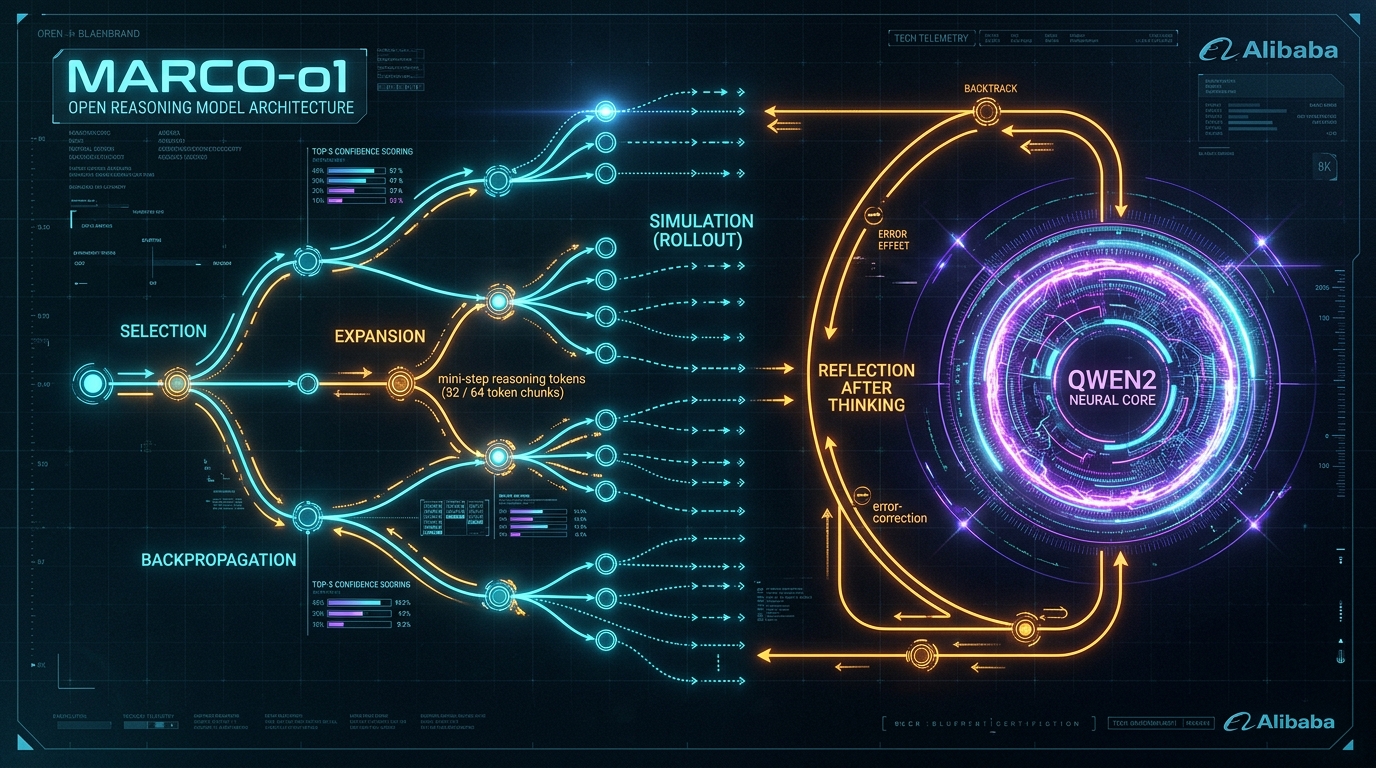
- Solution Space Expansion via Monte Carlo Tree Search (MCTS): Marco-o1 integrates LLM autoregression into an MCTS search tree. Internal node states represent partial reasoning chains, child branches represent candidate model thoughts, and search trajectories are guided by an intrinsic Top-5 Softmax Confidence Score derived directly from the model’s token output probabilities.
- Dynamic Action Granularity (Steps vs. Mini-Steps): While standard tree search explores monolithic multi-sentence steps, Marco-o1 explores mini-step actions of 32 or 64 tokens. This granular resolution allows the search engine to prune incorrect logical branches early before token generation drifts into unrecoverable hallucinations.
- Self-Reflection After Thinking: Marco-o1 introduces an explicit self-critic loop triggered by internal reflection phrases (“Wait! Maybe I made some mistakes! I need to rethink from scratch.”), enabling the model to re-evaluate previous assumptions and autonomously correct over 50% of initially failed problems.
Inside the Marco-o1 Architecture: MCTS Search Tree, Confidence Scoring, and Mini-Step Actions
Marco-o1 transforms classical single-path autoregressive decoding into an active, deliberative search process.
                           [ User Prompt / Ambiguous Task ]
                                          │
                                          ▼
                         ┌─────────────────────────────────┐
                         │   Root Node: Initial State S0   │
                         └────────────────┬────────────────┘
                                          │
                  ┌───────────────────────┴───────────────────────┐
                  ▼                                               ▼
          [ Action A1: Step ]                             [ Action A2: Step ]
                  │                                               │
          ┌───────┴───────┐                               ┌───────┴───────┐
          ▼               ▼                               ▼               ▼
     [ Mini-Step ]   [ Mini-Step ]                   [ Mini-Step ]   [ Mini-Step ]
     (32 tokens)     (64 tokens)                     (32 tokens)     (64 tokens)
          │               │                               │               │
          ▼               ▼                               ▼               ▼
  ┌───────────────┐ ┌───────────────┐             ┌───────────────┐ ┌───────────────┐
  │ Softmax Top-5 │ │ Softmax Top-5 │             │ Softmax Top-5 │ │ Softmax Top-5 │
  │ Conf. Scoring │ │ Conf. Scoring │             │ Conf. Scoring │ │ Conf. Scoring │
  └───────┬───────┘ └───────┬───────┘             └───────┬───────┘ └───────┬───────┘
          │                 │                             │                 │
          └────────┬────────┘                             └────────┬────────┘
                   │                                               │
                   ▼                                               ▼
     ┌───────────────────────────┐                   ┌───────────────────────────┐
     │ MCTS Rollout & Simulation │                   │ MCTS Rollout & Simulation │
     │ Path Reward v = Avg(c_i)  │                   │ Path Reward v = Avg(c_i)  │
     └─────────────┬─────────────┘                   └─────────────┬─────────────┘
                   │                                               │
                   └───────────────────────┬───────────────────────┘
                                           │
                                           ▼
                         ┌───────────────────────────────────┐
                         │   Reflection After Thinking Loop  │
                         │   "Wait! Maybe I made mistakes!"  │
                         └─────────────────┬─────────────────┘
                                           │
                                           ▼
[ Optimal Verified Response ] 1. Solution Space Expansion via Monte Carlo Tree Search (MCTS)
In the Marco-o1-MCTS framework, problem-solving is modeled as a directed search tree where:
- State Nodes ($S$): Each node in the tree corresponds to a sequence of preceding thought tokens and problem context.
- Action Edges ($A$): Possible actions radiating from a node are candidate semantic continuations generated by the Qwen2-7B core.
- Selection: The algorithm traverses the tree using the Upper Confidence Bound applied to Trees (UCT), balancing exploitation of high-reward reasoning chains with exploration of unvisited alternatives:
$$\text{UCT}(s, a) = Q(s, a) + c \cdot \sqrt{\frac{\ln N(s)}{N(s, a)}}$$
where $Q(s, a)$ represents the expected value of taking action $a$ from state $s$, $N(s)$ is the visit count of parent node $s$, $N(s, a)$ is the visit count of child node $(s, a)$, and $c$ is an exploration constant.
2. Intrinsic Top-5 Softmax Confidence Scoring
Because open-ended domains lack external rule-based verifiers, Marco-o1 derives an intrinsic reward signal directly from the model’s generation probabilities during the simulation rollout phase.
For each token $t_i$ emitted during rollout, Marco-o1 computes its confidence score $c_i$ by applying the softmax function over its log probability relative to the top-5 candidate tokens predicted at that exact step:
$$c_i = \frac{\exp(p(t_i))}{\sum_{k=1}^5 \exp(p(t_k))}$$
where $p(t_i)$ is the log probability of the selected token, and $p(t_k)$ represents the log probabilities of the top-5 alternative tokens. This normalizes confidence scores to $[0, 1]$, reflecting how decisively the model favored its chosen token over competing alternatives.
The overall rollout reward $v$ for a complete reasoning path of length $n$ is calculated as the mean token confidence:
$$v = \frac{1}{n} \sum_{i=1}^n c_i$$
Higher values of $v$ indicate that the language model experienced minimal internal entropy and high certainty throughout its reasoning derivation, providing a robust heuristic for backpropagation without requiring an external critic model.
3. Reasoning Action Granularity: Steps vs. Mini-Steps
A fundamental insight of Marco-o1 is that the granularity of search actions dictates both efficiency and error recovery:
- Step as Action: The model generates complete logical sentences or reasoning paragraphs per tree node. While computationally fast, coarse steps prevent the model from intervening when an error is introduced mid-sentence.
- Mini-Step as Action (32 or 64 Tokens): The model breaks continuous reasoning into fixed chunks of 32 or 64 tokens. By evaluating confidence scores at 32-token intervals, Marco-o1 detects diverging reasoning trajectories early. If a 32-token chunk exhibits low confidence or flawed logic, MCTS prunes the branch immediately, saving hundreds of wasted tokens.
4. Self-Reflection After Thinking
When humans solve challenging problems, they rarely emit a straight-line solution; they pause, scrutinize their intermediate conclusions, and actively test for contradictions.
Marco-o1 implements this through a structured self-critic reflection mechanism. At the conclusion of an initial thought process, the model is prompted with an explicit reflection trigger:
Wait! Maybe I made some mistakes! I need to rethink from scratch. This trigger alters the attention dynamics of the transformer core, prompting it to review its previous working memory, identify mathematical slips or linguistic misinterpretations, and re-derive the solution from a fresh perspective. Empirical tests demonstrate that adding this self-reflective loop allows Marco-o1 to correctly solve approximately 50% of difficult problems that it initially failed.
Hands-On Implementation: Building a Monte Carlo Tree Search Reasoning Loop with Marco-o1
Below is a complete, runnable Python implementation demonstrating how to deploy Marco-o1 locally, construct the MCTS tree search, calculate top-5 softmax confidence scores, and execute mini-step exploration on an NVIDIA GPU.
1. Environment Setup and Model Initialization
Install the required HuggingFace and PyTorch libraries:
# Create dedicated virtual environment
python3 -m venv venv-marco
source venv-marco/bin/activate

# Install PyTorch with CUDA 12.4
pip install torch torchvision torchaudio --index-url https://download.pytorch.org/whl/cu124

# Install Transformers and acceleration tools
pip install transformers accelerate sentencepiece numpy 2. Loading the Marco-o1 Model and Tokenizer
The following script loads the official AIDC-AI/Marco-o1 checkpoint in BF16 precision:
import math
import torch
import torch.nn.functional as F
from transformers import AutoModelForCausalLM, AutoTokenizer
from typing import List, Dict, Optional

class MarcoMCTSNode:
    def __init__(self, state_text: str, parent=None, action_text: str = ""):
        self.state_text = state_text
        self.parent = parent
        self.action_text = action_text
        self.children: List['MarcoMCTSNode'] = []
        self.visits = 0
        self.value_sum = 0.0

    @property
    def value(self) -> float:
        return self.value_sum / self.visits if self.visits > 0 else 0.0

    def uct_score(self, exploration_weight: float = 1.414) -> float:
        if self.visits == 0:
            return float('inf')
        return self.value + exploration_weight * math.sqrt(math.log(self.parent.visits) / self.visits)

class MarcoO1ReasoningEngine:
    def __init__(self, model_id: str = "AIDC-AI/Marco-o1", device: str = "cuda"):
        self.device = torch.device(device if torch.cuda.is_available() else "cpu")
        print(f"[*] Loading Marco-o1 from {model_id} onto {self.device}...")
        self.tokenizer = AutoTokenizer.from_pretrained(model_id, trust_remote_code=True)
        self.model = AutoModelForCausalLM.from_pretrained(
            model_id,
            torch_dtype=torch.bfloat16,
            device_map=self.device,
            trust_remote_code=True
        ).eval()

    @torch.inference_mode()
    def calculate_token_confidence(self, logits: torch.Tensor, top_k: int = 5) -> float:
        """
        Calculates Top-5 Softmax Confidence Score for the top-predicted token.
        c_i = exp(p(t_i)) / sum_k(exp(p(t_k)))
        """
        # Get top-k log probabilities
        log_probs = F.log_softmax(logits, dim=-1)
        topk_log_probs, topk_indices = torch.topk(log_probs, k=top_k, dim=-1)

        # Softmax over the top-k subset
        probs_topk = F.softmax(topk_log_probs, dim=-1)
        # Confidence score of the selected (rank 0) token
        confidence = probs_topk[0, 0].item()
return confidence 3. Implementing Mini-Step Action Generation and Rollout Simulation
Next, we implement the MCTS tree search using 32-token mini-steps and confidence-driven path evaluation:
    @torch.inference_mode()
    def generate_mini_step_actions(self, context_text: str, num_branches: int = 3, chunk_size: int = 32) -> List[Dict]:
        """
        Generates candidate mini-step actions of 32 tokens along with confidence scores.
        """
        inputs = self.tokenizer(context_text, return_tensors="pt").to(self.device)
        input_len = inputs.input_ids.shape[1]

        branches = []
        for _ in range(num_branches):
            # Sample forward with slight temperature for diverse exploration
            output = self.model.generate(
                **inputs,
                max_new_tokens=chunk_size,
                do_sample=True,
                temperature=0.7,
                top_p=0.9,
                return_dict_in_generate=True,
                output_scores=True
            )

            # Compute average confidence across generated tokens
            gen_tokens = output.sequences[0, input_len:]
            step_text = self.tokenizer.decode(gen_tokens, skip_special_tokens=True)

            confidences = []
            for score_tensor in output.scores:
                conf = self.calculate_token_confidence(score_tensor)
                confidences.append(conf)

            avg_conf = sum(confidences) / len(confidences) if confidences else 0.0
            branches.append({
                "action_text": step_text,
                "confidence": avg_conf
            })

        return branches

    def search(self, prompt: str, num_simulations: int = 12) -> str:
        """
        Executes Monte Carlo Tree Search to expand reasoning solution space.
        """
        formatted_prompt = f"<|im_start|>system
You are a thoughtful, rigorous reasoning assistant.<|im_end|>
<|im_start|>user
{prompt}<|im_end|>
<|im_start|>assistant
<thought>
"
        root = MarcoMCTSNode(state_text=formatted_prompt)

        print(f"[*] Starting MCTS Reasoning across {num_simulations} simulations...")
        for sim in range(num_simulations):
            node = root

            # 1. Selection
            while node.children:
                node = max(node.children, key=lambda c: c.uct_score())

            # 2. Expansion
            if node.visits > 0 or node == root:
                candidate_actions = self.generate_mini_step_actions(node.state_text, num_branches=2, chunk_size=32)
                for cand in candidate_actions:
                    child_state = node.state_text + cand["action_text"]
                    child_node = MarcoMCTSNode(state_text=child_state, parent=node, action_text=cand["action_text"])
                    child_node.value_sum += cand["confidence"]
                    child_node.visits += 1
                    node.children.append(child_node)

            # 3. Rollout / Simulation
            selected_child = max(node.children, key=lambda c: c.value) if node.children else node
            reward = selected_child.value

            # 4. Backpropagation
            curr = selected_child
            while curr is not None:
                curr.visits += 1
                curr.value_sum += reward
                curr = curr.parent

        # Trace best path
        best_path = []
        curr = root
        while curr.children:
            curr = max(curr.children, key=lambda c: c.visits)
            best_path.append(curr.action_text)

        full_reasoning = "".join(best_path)
return full_reasoning 4. Running Multi-Lingual and Colloquial Reasoning
To test Marco-o1 on a nuanced colloquial translation problem where standard LLMs fail:
if __name__ == "__main__":
    engine = MarcoO1ReasoningEngine()
    test_query = (
        "Translate the Chinese slang phrase '这双鞋脚感太棒了,简直是踩屎感!' into natural, "
        "idiomatic English without translating the literal scatological wording."
    )
    result = engine.search(test_query, num_simulations=8)
    print("
--- Final Synthesized Reasoning & Solution ---")
print(result) Comprehensive Benchmark Comparison: Marco-o1 vs. Frontier Reasoning Models
To evaluate Marco-o1’s capabilities across mathematical deduction, reasoning search space expansion, and open-ended linguistic comprehension, we compare it against prominent reasoning models:
| Evaluation Metric / Feature | Marco-o1 (Alibaba) | DeepSeek-R1-Zero | DeepScaleR-1.5B (Berkeley) | OpenAI o1-preview | Qwen2-7B-Instruct (Base) |
|---|---|---|---|---|---|
| Model Parameter Count | 7.5B Parameters | 671B MoE (37B active) | 1.5B Parameters | Undisclosed Frontier MoE | 7.5B Parameters |
| Search Paradigm | MCTS + Softmax Top-5 Conf. | Pure End-to-End RL | Iterative Context RL | Hidden Internal Search | Pure Autoregressive Greedy |
| Action Granularity | Step & Mini-Step (32/64 tok) | Monolithic Stream | Monolithic Stream | Hidden Deliberation | Token-by-Token |
| Open-Ended Domain Adapt | High (Translation & Slang) | Restricted to Rule RL | Math & Code Specialized | Generalist Commercial | Standard Instruction |
| MGSM English Accuracy | 90.40% (MCTS Step) | ~88.0% | N/A (1.5B Math Target) | 91.2% | 84.00% |
| MGSM Chinese Accuracy | 82.40% (MCTS Mini-32) | ~86.5% | N/A | 87.4% | 76.80% |
| Test@32 Solve Rate (MGSM) | 99.60% (English) | >99% | N/A | >99% | 96.00% |
| Self-Reflection Mechanism | Explicit Prompt Reflection | Natural CoT Emergence | Natural CoT Lengthening | Hidden Internal Critic | None |
| Open Weights & Code | 100% Fully Open Source | Open Weights & Code | Open Weights & Code | Closed Proprietary API | Open Weights |
Key Architectural Takeaways
- Expanding Solution Spaces via MCTS (90.40% vs. 84.00% on MGSM): Incorporating Monte Carlo Tree Search allows the model to explore multiple reasoning paths and escape greedy local minima. When allowed up to 32 independent MCTS guesses (Test@32), Marco-o1 achieves an astonishing 99.60% solve rate on multi-lingual grade school math.
- Mini-Step Superiority on Complex Non-English Queries: On Chinese MGSM benchmarks, fine-grained mini-steps of 32 tokens outperformed coarse step-level actions (82.40% vs. 80.00%). By re-evaluating token confidence every 32 tokens, the search algorithm catches cross-lingual semantic drift early.
- Effective Generalization Beyond Mathematics: While RLVR-trained models stumble when faced with slang, cultural idioms, or open-ended strategic planning, Marco-o1’s confidence-guided tree search successfully navigates colloquial nuances (e.g., translating Chinese internet idioms into natural idiomatic English), proving that test-time search can generalize beyond binary reward environments.
Production Engineering, Search Budgeting, and Enterprise Deployment
Deploying tree-search-based reasoning agents in enterprise production introduces latency and computational tradeoffs that require disciplined system design. Below are critical architectural patterns.
1. Dynamic Test-Time Compute Budgeting
Running full MCTS with dozens of simulations per query is computationally expensive. In high-throughput production systems, apply dynamic compute routing:
- Entropy-Gated Tree Search: For simple factual lookups or routine customer queries where first-token entropy is low ($c_1 > 0.95$), execute standard greedy decoding.
- Trigger MCTS on Ambiguous Tasks: When initial token confidence drops below $0.70$ or when the query is classified as a multi-step logical, mathematical, or cultural translation task, dynamically route the query to the MCTS engine with a budget of 8 to 16 simulations.
2. Speculative Rollouts and KV-Cache Tree Sharing
Standard MCTS naively discards the KV cache between search branches, incurring heavy recomputation overhead:
- Prefix KV-Cache Tree Management: Implement tree-based KV-cache reuse (similar to RadixAttention). When branching child nodes from state $S_0$, fork the parent node’s KV-cache pages in memory, eliminating redundant prefill computation for the shared prefix prompt.
- Early Branch Pruning: If a child node’s cumulative confidence score drops by more than $0.25$ relative to its parent node, terminate rollout simulation immediately to preserve GPU cycles.
3. Structured Self-Reflection in Enterprise Agent Workflows
To deploy Marco-o1’s self-critic loop reliably:
- Explicit Tag Parsing: Wrap the internal reasoning process within
<thought>...</thought>delimiters. If the model outputs the reflection trigger"Wait! Maybe I made some mistakes!", route the preceding context to a dedicated validation guardrail before emitting the final text to the user. - Auditable Thought Traces: Store the selected MCTS path in database telemetry logs, providing enterprise compliance teams with full visibility into how the agent evaluated competing hypotheses before executing a high-stakes transaction.
The Future Trajectory of Open Reasoning Systems
Marco-o1 provides a vital proof of concept for the next phase of foundation model development. As the artificial intelligence community transitions from brute-force pre-training toward inference-time compute scaling, architectures that combine tree-search exploration, fine-grained action granularity, and intrinsic self-criticism will unlock human-like deliberation for real-world enterprise applications.
By emancipating reasoning models from the narrow confines of mathematical verifiers, Marco-o1 opens the frontier for autonomous agents capable of navigating the rich, ambiguous, and open-ended complexity of the physical and digital world.