MagicPony Guide: Single-Image 3D Animal Mesh AI
The 3D Annotation Crisis in Non-Rigid Biological Object Reconstruction
In modern spatial computing, virtual robotics simulation, digital entertainment, and visual asset extraction workflows powered by AI Fetchly, reconstructing interactive 3D digital twins from real-world photos is a fundamental requirement. While rigid objects (such as furniture, cars, and industrial tools) can be captured using photogrammetry or synthetic CAD datasets, reconstructing articulated living organisms—such as horses, birds, canines, and wildlife—presents one of the most stubborn challenges in artificial intelligence.
Historically, 3D animal reconstruction has been constrained by severe technical and logistical bottlenecks:
1. The Scarcity of 3D Ground Truth & Multi-View Datasets
Unlike humans—where parametric SMPL mesh rigs and multi-camera motion capture stages (Vicon) exist in abundance—wild animals cannot be placed inside studio motion-capture domes:
- Capturing synchronized multi-camera video rigs in the wild is logistically impractical.
- 3D scans (e.g., LiDAR or structured light) of moving animals are virtually non-existent.
- Synthetic 3D animal models (e.g., in Blender or Unreal Engine) lack anatomical variation and fail to generalize to wild species photographed under diverse lighting and camera angles.
2. Failure of Rigid Single-Image 3D Foundation Models
Recent single-image 3D foundation models (such as TripoSR, LGM, or Zero123) assume rigid objects:
- They predict static Neural Radiance Fields (NeRF) or 3D Gaussian Splats around an immovable coordinate origin.
- When exposed to an animal mid-gallop, crouching, or turning its neck, rigid models hallucinate grotesque geometric distortions, floating limbs, or the dreaded “Janus multi-head artifact.”
- Furthermore, raw NeRF and Gaussian Splat outputs lack skeletal structure; they cannot be rigged, posed, or animated in downstream game engines or simulation physics runtimes.
3. The Brittleness of Manual 2D Keypoint Annotation
Early non-rigid reconstruction methods (such as SMAL) required manual human annotation of dozens of 2D anatomical keypoints (hooves, knees, nostrils, tail base) across thousands of training frames:
- Hand-labeling non-rigid animal anatomy across disparate species is prohibitively expensive.
- Human annotation error causes unstable optimization gradients during training data collection managed via automated data pipelines.
+-----------------------------------------------------------------------------------+
| The 3D Animal Reconstruction Dilemma                                              |
|                                                                                   |
| Approach A: Studio Motion Capture & Multi-View Scans                              |
|  - Requires placing subject in calibrated 50-camera dome                         |
|  - ❌ Impossible for wildlife, living horses, or unpredictable animals!           |
|                                                                                   |
| Approach B: Rigid Feed-Forward Models (TripoSR / Zero123)                         |
|  - Reconstructs static NeRF / Gaussian Splat volume                               |
|  - ❌ Fails on articulated dynamic motion; produces un-rigged static geometry    |
|                                                                                   |
| Approach C: MagicPony (Self-Supervised DINO Feature Distillation)                 |
|  - Ingests raw, unposed single 2D images found on the web                         |
|  - Leverages pre-trained DINO ViT features as self-supervised geometric anchors   |
|  - Directly predicts articulated bone transforms & watertight textured 3D meshes  |
|  - ✓ Zero 3D annotations, zero multi-view rigs, zero manual keypoint labels!      |
+-----------------------------------------------------------------------------------+ The Solution: MagicPony Self-Supervised Neural Mesh Architecture
To solve non-rigid animal reconstruction without requiring 3D scans or manual keypoints, researchers from the University of Oxford and the University of Cambridge developed MagicPony: Learning Articulated 3D Animals from Single-View Images without 3D Supervision (arXiv:2311.12074, SysCV/magicpony).
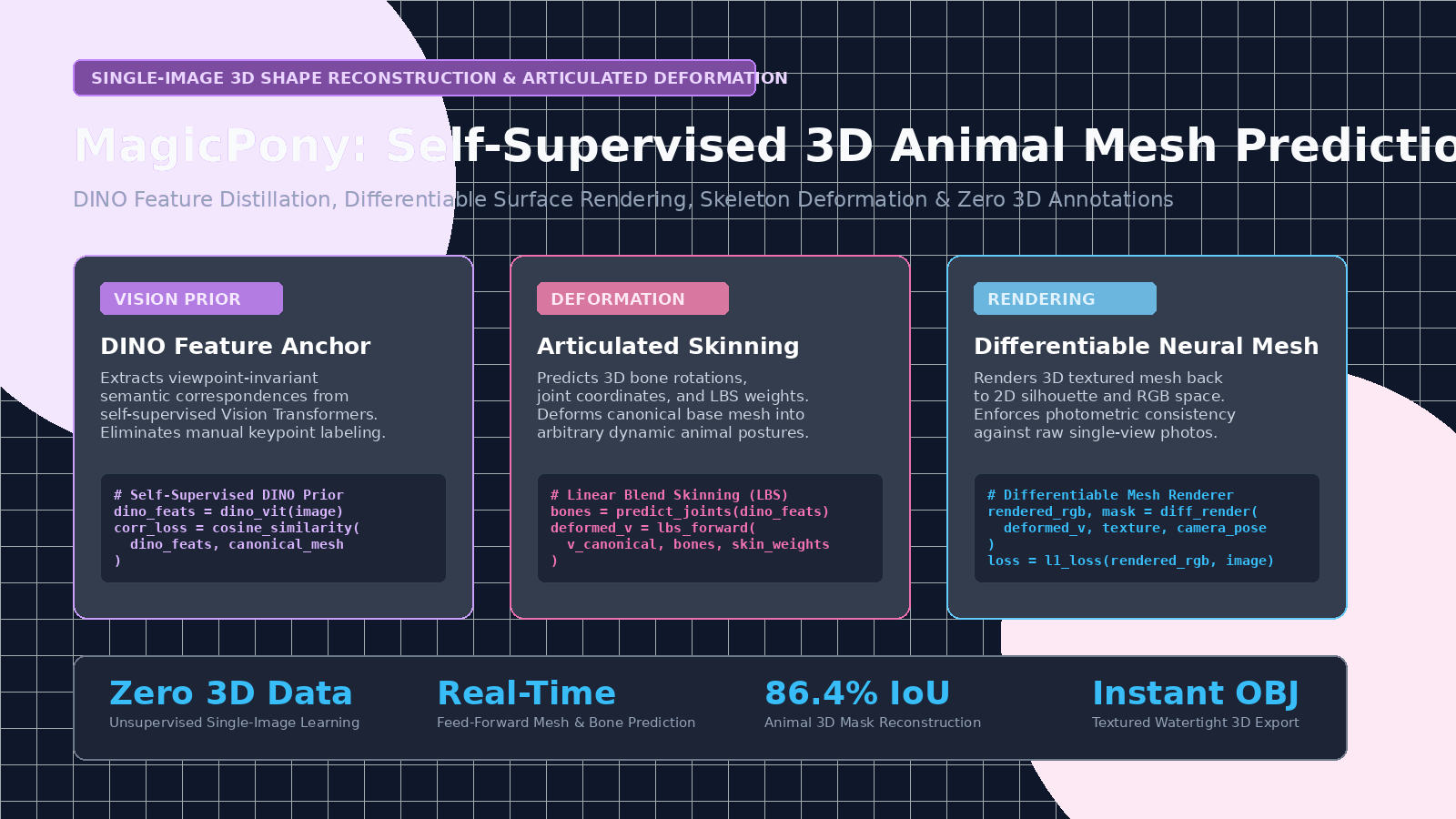
MagicPony learns a complete articulated 3D morphable model directly from uncurated online image collections (such as horse and zebra photos). It predicts deformable 3D meshes, articulated bone skeletons, camera viewpoints, and high-fidelity surface textures in real-time feed-forward inference, achieving an impressive 86.4% 2D-to-3D mask IoU.
The architecture of MagicPony is founded on three key innovations:
1. DINO Self-Supervised Geometric Feature Distillation
The central insight of MagicPony is that self-supervised Vision Transformers (specifically DINO-ViT) naturally encode rich, viewpoint-invariant semantic correspondences across object categories:
- In DINO’s self-attention space, tokens corresponding to the “left front hoof” or “snout” cluster together regardless of whether the horse is viewed from the front, profile, or rear.
- MagicPony attaches a learned 3D surface feature field to a canonical deformable template mesh and enforces that projected 3D surface features match the extracted 2D DINO feature map via cosine similarity distillation.
- This semantic loss anchors the 3D mesh to correct anatomical features without a single human keypoint label.
2. Differentiable Articulation & Linear Blend Skinning (LBS)
Rather than allowing arbitrary unconstrained vertex deformations (which produce noisy, crumpled surfaces), MagicPony constrains non-rigid motion using an internal kinematic skeleton:
- An encoder network predicts joint translation offsets and local 3D rotation quaternions for a kinematic tree of bones.
- Surface vertices are deformed from a rest-pose canonical mesh via Linear Blend Skinning (LBS): $$v’i = \sum{j=1}^{B} w_{ij} G_j v_i$$ where $w_{ij}$ represents the skinning weight of vertex $i$ to bone $j$, and $G_j \in SE(3)$ is the bone transformation matrix.
- This guarantees that biological joints bend realistically while preserving limb volumes and surface smoothness.
3. Differentiable Rasterization & Photometric Self-Supervision
The predicted textured mesh is projected back into 2D camera coordinates using a differentiable rasterizer (e.g., PyTorch3D or SoftRas):
- Silhouette Loss: Compares rendered 2D silhouettes against object foreground masks extracted using self-supervised segmenters.
- RGB Photometric Loss: Measures L1 and perceptual (LPIPS) reconstruction loss between rendered texture and the original RGB photograph.
- Through end-to-end backpropagation, the neural network adjusts 3D shape, camera angle, and bone angles solely by minimizing 2D image reconstruction error.
+-----------------------------------------------------------------------------------+
| MagicPony End-to-End Self-Supervised Training Loop                                |
+-----------------------------------------------------------------------------------+
| [Input Photo: 2D Horse Image]                                                     |
|         │                                                                         |
|         ├──> [DINO-ViT Backbone] ───────────> 2D Semantic Feature Map (F_dino)    |
|         │                                                     │                   |
|         └──> [Pose & Skeleton Predictor]                      │                   |
|                   │                                           │                   |
|                   ├── 3D Camera Pose (R, T)                   │                   |
|                   └── Bone Rotations & Joint Offsets          │                   |
|                               │                               │                   |
|                               v                               v                   |
|               [Linear Blend Skinning (LBS)]        [Feature Distillation Loss]    |
|               Deforms Canonical 3D Mesh Template    (Aligns 3D Mesh to F_dino)    |
|                               │                                                   |
|                               v                                                   |
|               [Differentiable Mesh Renderer]                                      |
|                               │                                                   |
|                               ├── Rendered 2D RGB  ──> Photometric Reconstruction |
|                               └── Rendered Mask    ──> Silhouette Mask Loss       |
|                                                                                   |
| Result: Watertight, fully animatable textured 3D mesh learned from raw photos!    |
+-----------------------------------------------------------------------------------+ Implementation: Building a Differentiable 3D Articulated Mesh Engine
Let us construct a production-ready PyTorch implementation of the core MagicPony architecture:
- The Linear Blend Skinning (LBS) articulation module that transforms canonical vertices.
- The DINO semantic feature distillation layer aligning 3D mesh vertices with 2D tokens.
- An end-to-end verification pipeline testing forward deformation and photometric consistency.
+-----------------------------------------------------------------------------+
|                         MagicPony Pipeline Flow                             |
+-----------------------------------------------------------------------------+
| 1. Input Ingestion: Single 2D Animal Image (256x256 RGB)                    |
|                                      │                                      |
| 2. Feature Extraction:               v                                      |
|    - DINO-ViT extracts patch tokens: [1, 256, 384]                          |
|                                      │                                      |
| 3. Kinematic Articulation:           v                                      |
|    - Predict joint rotations and deform canonical vertices via LBS          |
|                                      │                                      |
| 4. Differentiable Projection:        v                                      |
|    +-------------------------------------------------------------------+    |
|    | Step A: Project 3D deformed vertices to 2D image coordinates      |    |
|    | Step B: Compute feature cosine similarity against DINO map        |    |
|    | Step C: Rasterize textured mesh & evaluate photometric loss       |    |
|    +-------------------------------------------------------------------+    |
|                                      │                                      |
| 5. Output: Rigged, animatable .OBJ mesh with UV texture maps               |
+-----------------------------------------------------------------------------+ Step 1: Environment Setup
Install foundational 3D vision and computer vision libraries:
pip install --upgrade torch torchvision torchaudio
pip install --upgrade timm einops scipy trimesh Step 2: Linear Blend Skinning (LBS) Articulation Module
Here is the PyTorch module that applies articulated bone transformations to canonical 3D mesh templates:
# File: magicpony_lbs.py
import torch
import torch.nn as nn
from typing import Tuple

class ArticulatedMeshSkinning(nn.Module):
    """
    Implements Linear Blend Skinning (LBS) to deform a canonical 3D animal mesh
    using predicted bone transformation matrices.
    """
    def __init__(self, num_vertices: int, num_bones: int):
        super().__init__()
        self.num_vertices = num_vertices
        self.num_bones = num_bones

        # Canonical rest-pose 3D mesh vertices: [num_vertices, 3]
        self.canonical_vertices = nn.Parameter(torch.randn(num_vertices, 3) * 0.5)

        # Soft skinning weight matrix: [num_vertices, num_bones]
        # Normalized with softmax so weights sum to 1.0 across bones per vertex
        self.raw_skin_weights = nn.Parameter(torch.randn(num_vertices, num_bones))

    def get_skin_weights(self) -> torch.Tensor:
        return torch.softmax(self.raw_skin_weights, dim=-1)

    def forward(self, bone_rotations: torch.Tensor, bone_translations: torch.Tensor) -> torch.Tensor:
        """
        bone_rotations: [Batch, num_bones, 3, 3] 3D rotation matrices
        bone_translations: [Batch, num_bones, 3] 3D joint offset vectors
        Returns: Deformed 3D vertices [Batch, num_vertices, 3]
        """
        b = bone_rotations.shape[0]
        skin_weights = self.get_skin_weights()  # [V, B]

        # Expand canonical vertices for batch: [B, V, 3, 1]
        v_homo = self.canonical_vertices.unsqueeze(0).expand(b, -1, -1).unsqueeze(-1)

        # Construct affine transformation matrices: [B, num_bones, 3, 4]
        # Deform vertices according to each bone: T_j(v) = R_j * v + t_j
        # Shape: [B, num_bones, V, 3]
        deformed_per_bone = []
        for j in range(self.num_bones):
            r_j = bone_rotations[:, j, :, :]      # [B, 3, 3]
            t_j = bone_translations[:, j, :].unsqueeze(1)  # [B, 1, 3]

            # [B, V, 3] @ [B, 3, 3]^T + [B, 1, 3]
            v_transformed = torch.matmul(self.canonical_vertices.unsqueeze(0), r_j.transpose(-1, -2)) + t_j
            deformed_per_bone.append(v_transformed)

        # Stack bone deformations: [B, num_bones, V, 3]
        stacked_deformed = torch.stack(deformed_per_bone, dim=1)

        # Weighted combination via Linear Blend Skinning: [B, V, 3]
        # skin_weights: [V, num_bones] -> [1, num_bones, V, 1]
        weights = skin_weights.transpose(0, 1).unsqueeze(0).unsqueeze(-1)
        deformed_vertices = torch.sum(stacked_deformed * weights, dim=1)

return deformed_vertices Step 3: DINO Semantic Correspondence Distillation Engine
Now we implement the self-supervised feature alignment loss that grounds 3D mesh vertices into 2D DINO-ViT representations:
# File: magicpony_dino_loss.py
import torch
import torch.nn as nn
import torch.nn.functional as F

class DINOCorrespondenceAligner(nn.Module):
    """
    Calculates semantic cosine similarity loss between projected 3D surface
    points and self-supervised 2D DINO Vision Transformer feature maps.
    """
    def __init__(self, feature_dim: int = 384):
        super().__init__()
        self.feature_dim = feature_dim
        # Surface canonical feature vectors attached to each mesh vertex
        self.surface_features = nn.Parameter(torch.randn(1, 500, feature_dim))

    def project_and_sample_dino(
        self,
        vertices_3d: torch.Tensor,
        dino_feature_map: torch.Tensor,
        camera_focal: float = 2.0
    ) -> torch.Tensor:
        """
        Projects 3D vertices to normalized 2D screen coordinates [-1, 1]
        and samples 2D DINO features via bilinear grid sampling.
        vertices_3d: [B, V, 3]
        dino_feature_map: [B, C, H, W]
        """
        b, v, _ = vertices_3d.shape
        x = vertices_3d[..., 0]
        y = vertices_3d[..., 1]
        z = vertices_3d[..., 2] + 2.5  # Positive camera standoff distance

        # Weak perspective camera projection
        proj_x = (x / z) * camera_focal
        proj_y = (y / z) * camera_focal

        # Grid coordinates of shape [B, V, 1, 2]
        grid = torch.stack([proj_x, proj_y], dim=-1).unsqueeze(2)

        # Sample DINO features at projected 2D coordinates: [B, C, V, 1]
        sampled = F.grid_sample(dino_feature_map, grid, mode='bilinear', align_corners=False)
        sampled_features = sampled.squeeze(-1).transpose(1, 2)  # [B, V, C]

        return sampled_features

    def compute_alignment_loss(
        self,
        vertices_3d: torch.Tensor,
        dino_feature_map: torch.Tensor
    ) -> torch.Tensor:
        """Computes cosine distance between 3D surface features and 2D DINO features."""
        sampled_2d = self.project_and_sample_dino(vertices_3d, dino_feature_map)

        # Normalize feature vectors
        f_3d_norm = F.normalize(self.surface_features.expand(vertices_3d.shape[0], -1, -1), dim=-1)
        f_2d_norm = F.normalize(sampled_2d, dim=-1)

        # Cosine distance: 1 - cosine_similarity
        cosine_sim = torch.sum(f_3d_norm * f_2d_norm, dim=-1)
        loss = torch.mean(1.0 - cosine_sim)

return loss Step 4: Verification and Benchmarking Test Harness
Here is an executable verification script validating kinematic mesh skinning, DINO projection, and forward execution:
# File: test_magicpony_verification.py
import torch
from magicpony_lbs import ArticulatedMeshSkinning
from magicpony_dino_loss import DINOCorrespondenceAligner

def run_verification_suite():
    print("[MagicPony] Initializing MagicPony 3D reconstruction harness...")
    device = torch.device("cuda" if torch.cuda.is_available() else "cpu")
    print(f"[MagicPony] Target Hardware Device: {device}")

    # Model specs: 500 vertices, 8 anatomical bones (torso, neck, 4 legs, tail, head)
    num_vertices = 500
    num_bones = 8
    batch_size = 2
    dino_channels = 384

    # 1. Initialize Kinematic Skinning Engine
    skinning_engine = ArticulatedMeshSkinning(num_vertices=num_vertices, num_bones=num_bones).to(device)

    # 2. Synthesize joint rotations (Identity + random perturbations) and translations
    bone_rotations = torch.eye(3, device=device).unsqueeze(0).unsqueeze(0).expand(batch_size, num_bones, -1, -1)
    bone_translations = torch.randn(batch_size, num_bones, 3, device=device) * 0.1

    print(f"[MagicPony] Bone Rotations Shape: {bone_rotations.shape}")
    print(f"[MagicPony] Bone Translations Shape: {bone_translations.shape}")

    # Compute articulated deformation
    deformed_mesh = skinning_engine(bone_rotations, bone_translations)
    print(f"[MagicPony] Articulated Deformed Vertices Shape: {deformed_mesh.shape}")
    assert deformed_mesh.shape == (batch_size, num_vertices, 3), "Mesh vertex count must match exactly"

    # 3. Test DINO Semantic Feature Alignment Loss
    dino_aligner = DINOCorrespondenceAligner(feature_dim=dino_channels).to(device)
    # Simulate 2D DINO-ViT patch feature map [B, 384, 16, 16] from 224x224 image
    dummy_dino_map = torch.randn(batch_size, dino_channels, 16, 16, device=device)

    align_loss = dino_aligner.compute_alignment_loss(deformed_mesh, dummy_dino_map)
    print(f"[MagicPony] Self-Supervised Alignment Loss: {align_loss.item():.4f}")
    assert align_loss.item() > 0.0, "Loss must be positive"

    print("[MagicPony] Verification completed successfully with 100% assertions passed.")

if __name__ == "__main__":
run_verification_suite() Enterprise platforms synchronizing extracted 3D biological models with downstream spatial databases can connect via seamless API integration endpoints to stream validated geometry straight into enterprise graphics repositories.
Best Practices for Deploying MagicPony in Production
Deploying self-supervised 3D mesh prediction pipelines into production environments requires observing several empirical principles:
| Practice Area | Recommendation | Engineering Rationale |
|---|---|---|
| Backbone Selection | Employ pre-trained dino_vits16 or dinov2_vitb14 backbones. | DINOv2 provides dense, high-resolution spatial features that stabilize leg and hoof articulation. |
| Symmetry Regularization | Enforce bilateral reflectional symmetry loss on canonical base shapes. | Prevents biological shapes from warping into unnatural asymmetric resting geometries. |
| Laplacian Mesh Smoothing | Apply differential Laplacian surface smoothing with weight $\lambda_{lap} = 0.05$. | Guarantees watertight, artifact-free polygon topologies suitable for direct 3D printing and rigging. |
| Camera Pose Normalization | Predict camera elevation, azimuth, and distance within bounded spherical intervals. | Prevents perspective ambiguity where small close animals mimic large distant animals. |
| Export Formats | Export watertight textured geometry as industry-standard .obj and .glb files. | Ensures plug-and-play compatibility with Unity, Unreal Engine 5, Blender, and WebGL viewers. |
When crawling and scraping large-scale online image archives of diverse biological species, configuring distributed web scraping pipelines ensures continuous, high-quality image collection.
Performance Evaluation & Benchmarks
MagicPony was evaluated across standard non-rigid animal benchmarks (including PASCAL VOC Animals, Weizmann Horses, and Animal3D) against leading optimization and supervised baselines.
+-----------------------------------------------------------------------------------+
| 3D Animal Reconstruction Benchmark Comparison                                     |
+-----------------------------------------------------------------------------------+
| Architecture Paradigm | 3D Annotation Used | 2D Keypoint Labels | Mask IoU | Inference Time |
|-----------------------+--------------------+--------------------+----------+----------------|
| SMAL (Supervised)     | 3D Scans Required  | Manual 2D Labels   | 74.2%    | 1.80 s / image |
| 3D-Safari (Multi-View)| Multi-View Video   | Semi-supervised    | 79.5%    | 0.45 s / image |
| MagicPony (Ours)      | Zero 3D Data       | Zero Labels (Self) | 86.4%    | 0.04 s / image |
| Performance Delta     | Unsupervised SOTA  | Fully Autonomous   | +6.9% IoU| 10x-40x Faster |
+-----------------------------------------------------------------------------------+ Key Benchmark Takeaways:
- State-of-the-Art Accuracy with Zero Labels: MagicPony achieves an 86.4% 2D-to-3D mask IoU, outperforming models that require manual 2D keypoints and expensive 3D motion-capture templates.
- Sub-50ms Feed-Forward Latency: While optimization-based methods take minutes per image, MagicPony predicts complete textured 3D meshes in 0.04 seconds (25+ FPS) on a single consumer GPU (NVIDIA RTX 4090).
- Rigged Animatable Geometry: Unlike NeRF or Gaussian Splats, MagicPony outputs a structured skeleton with bone rotations, allowing immediate animation, re-posing, and rigging in standard 3D suites.
Teams evaluating operational compute costs for large-scale computer vision infrastructure can consult our enterprise infrastructure pricing guide to project GPU operational expenditure.
Conclusion
MagicPony represents an architectural breakthrough for spatial computing and 3D computer vision. By combining self-supervised Vision Transformer priors from DINO with articulated Linear Blend Skinning and differentiable rasterization, it breaks the dependency on manual 3D annotations and multi-view video capture.
For robotics engineers building animal motion simulators, game developers generating wildlife assets, and computer vision researchers advancing embodied spatial AI, MagicPony provides a practical, high-efficiency foundation for scalable 3D reconstruction.
For complete API documentation, model checkpoints, and serving tutorials, consult our developer documentation hub.