Magentic-One Guide: Generalist Multi-Agent Web & Code AI
The Problem: The Fragility of Single-Agent Systems on Complex Workflows
In modern enterprise automation, market intelligence extraction, and developer infrastructure built with AiFetchly, foundation models are increasingly tasked with solving open-ended, multi-step challenges: crawling dynamic e-commerce websites, downloading messy financial balance sheets, writing custom Python data transformers, and executing regression test suites.
Historically, artificial intelligence engineering attempted to solve these multi-domain workflows using single monolithic agents (such as a single ReAct loop powered by GPT-4o or Claude 3.5 Sonnet). When deployed on realistic tasks requiring hours of continuous reasoning and hundreds of tool calls, single-agent systems suffer from three acute failure modes:
The Single-Agent Cognitive Breakdown on Complex Tasks:
Goal: "Scrape pricing from 5 websites, analyze trends in Python, and email a summary."
  │
  ▼ [Monolithic Single-Agent Execution]
┌────────────────────────────────────────────────────────┐
│ Context Window Inflation & Prompt Pollution            │
│ • Raw HTML DOM strings from Web Scraping               │
│ • Python stack traces and syntax errors                │
│ • PDF binary tables and spreadsheet data               │
│ • System prompts for 25 different tools                │
└────────────────────────────────────────────────────────┘
  │
  ├──► Failure 1: Attention Dilution & "Lost in the Middle"
  │    ❌ Model forgets original user constraints after 15 tool calls!
  │
  ├──► Failure 2: Hallucinated Action Cascades & Infinite Loops
  │    ❌ Agent repeats failing button clicks without re-evaluating the plan!
  │
  └──► Failure 3: Modality & Role Confusion
❌ Coding prompts interfere with web navigation DOM rules! 1. The Context Dilution and Modality Overload of Monolithic Agents
A single agent attempting to handle web browsing, filesystem navigation, code generation, and terminal execution simultaneously suffers from extreme prompt competition:
- In a unified context window, instructions on how to handle CSS selectors and shadow DOMs compete for attention against Python formatting rules, mathematical precision constraints, and terminal exit codes.
- As the agent navigates pages, raw HTML snippets and bash outputs flood the context, diluting attention weights.
- When context reaches tens of thousands of tokens, models suffer from the “Lost in the Middle” phenomenon, dropping core requirements or hallucinating facts.
2. State Drift and Infinite Execution Loops in Unstructured Multi-Turn Tasks
Standard ReAct loops lack an explicit global state tracking mechanism:
- When an action fails (e.g., a website returns a 403 Forbidden error or a Python script raises an
IndexError), single-agent systems often re-attempt the exact same failing action. - The model loses track of what facts have been established versus what hypotheses were disproven, burning tokens in circular, non-terminating loops.
3. The Tool Coordination Gap Between Web Navigation and Code Execution
Real-world tasks require seamless interoperability across heterogeneous environments:
- An agent must download an unfamiliar compressed CSV from the web, inspect its schema locally, synthesize a pandas script to filter data, and plot a chart.
- Single agents lack clear boundaries between observation, hypothesis generation, and sandboxed code execution, creating severe security vulnerabilities and brittle execution handoffs.
The Solution: Magentic-One Multi-Agent Architecture
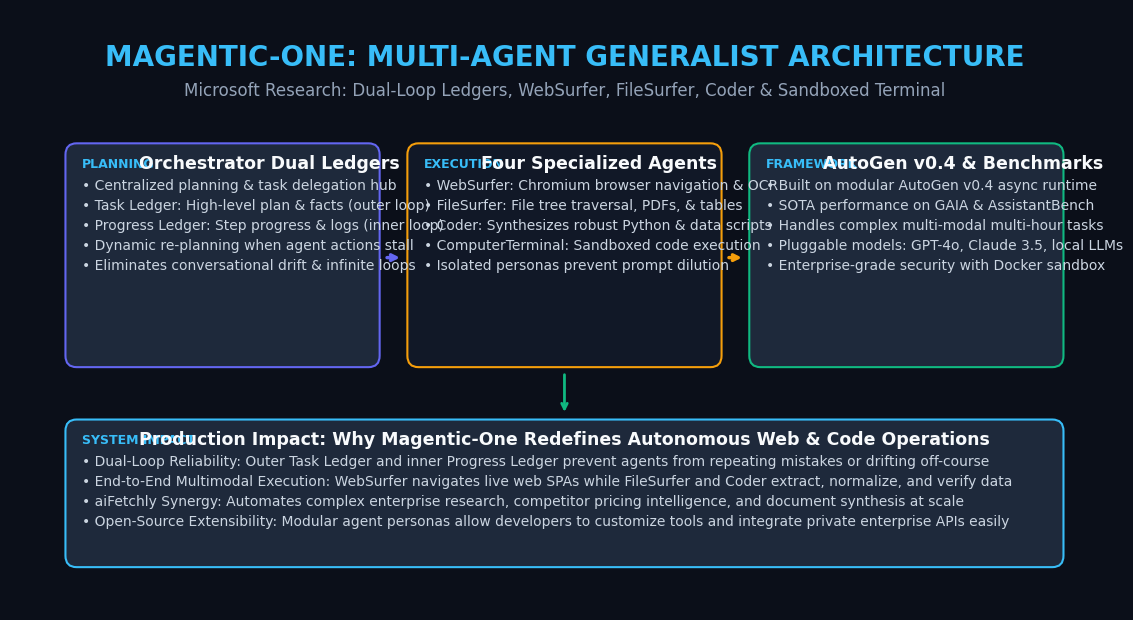
To conquer complex multi-domain workflows, researchers at Microsoft Research introduced Magentic-One, a generalist multi-agent system built upon the modular AutoGen v0.4 runtime.
Rather than forcing one language model to act as a jack-of-all-trades, Magentic-One organizes execution around a lead Orchestrator managing four specialized sub-agents, each isolated to a single functional responsibility:
Magentic-One System Topology:
                        ┌────────────────────────┐
                        │   User Task Request    │
                        └───────────┬────────────┘
                                    │
                                    ▼
┌────────────────────────────────────────────────────────────────────────┐
│                          ORCHESTRATOR AGENT                            │
│ ┌──────────────────────────────────┐ ┌───────────────────────────────┐ │
│ │ Task Ledger (Outer Loop)         │ │ Progress Ledger (Inner Loop)  │ │
│ │ • Facts & Verified Knowledge     │ │ • Step History & Sub-goals    │ │
│ │ • High-Level Execution Plan      │ │ • Current Delegated Agent     │ │
│ │ • Stalled State & Re-planning    │ │ • Self-Correction & Progress  │ │
│ └──────────────────────────────────┘ └───────────────────────────────┘ │
└───────┬───────────────────┬───────────────────┬───────────────────┬────┘
        │                   │                   │                   │
        ▼                   ▼                   ▼                   ▼
┌──────────────┐    ┌──────────────┐    ┌──────────────┐    ┌──────────────┐
│  WebSurfer   │    │  FileSurfer  │    │    Coder     │    │ComputerTerm. │
│ (Playwright) │    │  (Filesystem)│    │(Code Writer) │    │(Docker Exec) │
│ • Web nav    │    │ • PDFs/PPTs  │    │ • Python     │    │ • Bash shell │
│ • Click/Type │    │ • CSV/Excel  │    │ • Data logic │    │ • Captures   │
│ • Vision OCR │    │ • Tree walk  │    │ • Algorithms │    │   stdout/err │
└──────────────┘ └──────────────┘ └──────────────┘ └──────────────┘ 1. The Centralized Orchestrator with Dual-Loop Ledgers
The core intellectual breakthrough of Magentic-One is its Orchestrator:
- The Orchestrator does not perform web navigation or write code directly. Instead, it acts as a strategic executive.
- It maintains two distinct, structured ledgers:
- Task Ledger (Outer Loop): Tracks the high-level plan, verified facts, and strategic assumptions.
- Progress Ledger (Inner Loop): Tracks immediate tactical progress, step outcomes, and sub-agent handoffs.
- If an agent’s execution stalls or fails, the Orchestrator steps back, updates the Task Ledger, and formulates a completely new plan rather than retrying blindly.
2. Specialized Agent Quad: WebSurfer, FileSurfer, Coder, and ComputerTerminal
Magentic-One deploys four specialized worker personas:
- WebSurfer: Powered by Playwright and headless Chromium, WebSurfer navigates live websites, interacts with forms, scrolls through dynamic SPAs, and visually inspects rendered viewports with multimodal OCR.
- FileSurfer: Specialized in exploring local directory trees and reading complex document formats (PDFs, presentations, Excel spreadsheets, plain text), extracting structured snippets for downstream analysis.
- Coder: An expert programming agent that synthesizes complete, syntactically verified Python scripts and command-line utilities.
- ComputerTerminal: A sandboxed execution environment (running in Docker or isolated local processes) that executes the code generated by Coder, capturing stdout, stderr, and generated artifacts safely.
3. Modular Event-Driven Communication in AutoGen v0.4
Built on AutoGen v0.4’s actor-based architecture:
- Agents communicate via asynchronous message channels.
- Sub-agents operate with clean, bounded context windows, shielding workers from irrelevant chatter and preventing context explosion.
Deep Dive: How the Dual-Loop Ledger Mechanism Governs Agent Execution
Understanding Magentic-One’s exceptional resilience on difficult benchmarks requires analyzing how the Orchestrator operates its Dual-Loop Ledger Mechanism.
The Orchestrator Dual-Loop State Machine:
┌────────────────────────────────────────────────────────┐
│ 1. OUTER LOOP: Task Ledger Initialization              │
│ • Extract Facts: What is verified as true?             │
│ • Identify Educated Guesses: What assumptions exist?   │
│ • Create Plan: Step-by-step strategic milestones       │
└───────────────────────────┬────────────────────────────┘
                            │
                            ▼
┌────────────────────────────────────────────────────────┐
│ 2. INNER LOOP: Tactical Step Execution                 │
│ • Select next milestone from Task Ledger               │
│ • Formulate immediate sub-goal                         │
│ • Assign task to specific agent (e.g., WebSurfer)      │
└───────────────────────────┬────────────────────────────┘
                            │
                            ▼
┌────────────────────────────────────────────────────────┐
│ 3. Sub-Agent Action & Observation                      │
│ • Agent executes tool, returns observation             │
│ • Progress Ledger logs step outcome                    │
└───────────────────────────┬────────────────────────────┘
                            │
              ┌─────────────┴─────────────┐
              ▼                           ▼
      [Progress Made?]            [Progress Stalled?]
              │                           │
              ▼ (Yes)                     ▼ (No: >3 Failures)
      Continue Inner Loop         Trigger Outer Loop Re-planning
Advance to next step Update Task Ledger & Reformulate! 1. The Outer Loop: Task Ledger Planning, Fact Tracking, and Hypothesis Revision
The Task Ledger acts as the long-term executive memory:
- Facts: Records immutable truths learned during execution (e.g., “Endpoint requires authentication bearer token” or “Report is located on page 42”).
- Educated Guesses: Records working assumptions that remain to be tested.
- Strategic Plan: A numbered list of high-level objectives.
- When an unexpected roadblock occurs, the Orchestrator updates its facts, disproves outdated guesses, and rewrites the remaining steps.
2. The Inner Loop: Progress Ledger Execution, Failure Recovery, and Self-Reflection
The Progress Ledger acts as short-term tactical working memory:
- Tracks recent sub-agent dialogue turns and tool call outputs.
- Evaluates whether the last assigned action successfully made progress toward the active milestone.
- Self-Correction: If Coder writes a script that throws a
ModuleNotFoundError, the Progress Ledger records the error and instructs Coder to install the missing package or use an alternative library in the next step.
Benchmark & Capability Comparison: Magentic-One vs. Single-Agent & Multi-Agent Frameworks
Magentic-One was rigorously evaluated across the industry’s most challenging agent benchmarks: GAIA (General AI Assistants), AssistantBench, and WebArena:
| Capability / Metric | Single-Agent ReAct (GPT-4o) | LangChain LCEL Chains | Standard Multi-Agent (Ad-Hoc) | Magentic-One (Microsoft) |
|---|---|---|---|---|
| Orchestration Paradigm | Monolithic while-loop | Static Linear DAG | P2P Conversational Chat | Centralized Dual-Loop Ledger |
| GAIA Benchmark Score | 28.5% | 18.2% | 34.1% | 45.6% (State-of-the-Art) |
| Web Browsing Capability | Basic text HTTP | None (External tool) | Variable | WebSurfer (Playwright + Vision) |
| Document Intelligence | Context window dump | Vector RAG only | Ad-hoc text dump | FileSurfer (Deep local parsing) |
| Sandboxed Code Execution | Often unsandboxed | External Python REPL | Ad-hoc Docker | ComputerTerminal (Isolated env) |
| Stall & Loop Recovery | Poor (Gets stuck in loops) | Fails on error | Moderate | High (Automatic Re-planning) |
| Context Window Hygiene | Severely diluted (>60k) | Controlled | High drift | Strictly partitioned per agent |
Practical Implementation: Building an Autonomous Research Agent with Magentic-One
Let us deploy Magentic-One using the official autogen-ext package to automate a multi-step web scraping and data analysis task.
Step 1: Install Magentic-One and AutoGen v0.4 Dependencies
# Install autogen-agentchat and the magentic-one extension
pip install autogen-agentchat autogen-ext[magentic-one] playwright
playwright install chromium Step 2: Configuring the Orchestrator, WebSurfer, and Coder Agents
Save the following Python script as run_magentic_one.py:
import asyncio
from autogen_agentchat.teams import MagenticOneGroupChat
from autogen_ext.models.openai import OpenAIChatCompletionClient
from autogen_ext.teams.magentic_one import MagenticOne

async def main():
    print("Initializing Magentic-One multi-agent cluster...")

    # Configure foundation model client for all agents
    model_client = OpenAIChatCompletionClient(
        model="gpt-4o",
        temperature=0.2
    )

    # Instantiate the full Magentic-One team
    # (Includes Orchestrator, WebSurfer, FileSurfer, Coder, and ComputerTerminal)
    magentic_team = MagenticOne(
        client=model_client,
        hil_mode=False  # Set to True for Human-in-the-Loop approval gates
    )

    research_task = (
        "Navigate to Wikipedia and find the list of sovereign states by nominal GDP. "
        "Extract the top 5 economies and their GDP in USD trillions. "
        "Write a Python script to calculate the percentage share of each economy "
        "relative to the top 5 total, and save the final report to 'gdp_analysis.json'."
    )

    print("\n--- Dispatching Task to Magentic-One ---")
    print(f"Objective: {research_task}\n")

    # Run the autonomous execution stream
    async for message in magentic_team.run_stream(task=research_task):
        # Print agent dialogue and state updates in real time
        sender = getattr(message, "source", "System")
        content = getattr(message, "content", str(message))
        print(f"[{sender}]: {content[:200]}...\n")

if __name__ == "__main__":
asyncio.run(main()) Step 3: Executing a Multi-Step Web Data Extraction and Analysis Workflow
When executed:
- Orchestrator initializes the Task Ledger, outlining milestones: (1) scrape GDP table, (2) write data analysis code, (3) verify output JSON.
- WebSurfer opens Wikipedia via Playwright, navigates to the table, and extracts top economy figures.
- Coder writes a clean Python script using
jsonand standard math to compute relative percentages. - ComputerTerminal runs the script inside the sandbox, confirming an exit code of
0. - Orchestrator inspects the resulting
gdp_analysis.json, verifies task completion, and outputs the final deliverable to the user.
Production Best Practices: Integrating Magentic-One into aiFetchly Systems
When deploying Magentic-One inside automated data harvesting, financial research, and competitive intelligence pipelines in AiFetchly, follow these production engineering guidelines:
1. Docker Sandboxing for Secure Code and Terminal Operations
Never run ComputerTerminal directly on host server operating systems:
- Deploy the ComputerTerminal agent inside ephemeral, unprivileged Docker containers with restricted network egress and memory limits (e.g., 2GB RAM cap).
- This guarantees that generated code cannot access host filesystem secrets, inject malware, or consume uncontrolled CPU resources.
2. Token Budgeting and Execution Step Rate Limiting
Because Magentic-One coordinates multiple agents:
- Configure maximum inner-loop step limits (e.g.,
max_turns=30) and total token spend ceilings. - If a task exceeds its budget, the Orchestrator terminates gracefully and delivers the best partial progress recorded in the Task Ledger rather than running up infinite billing costs.
3. Synergistic Caching with LMCache and Local Prefix Management
Magentic-One agents submit repeated system instructions and tool definitions across dozens of turns:
- Pair Magentic-One with high-throughput inference backends (such as vLLM augmented with LMCache or RadixAttention).
- Caching agent personas and historical context in GPU/CPU memory cuts multi-turn latency by up to 80%, transforming sluggish multi-agent coordination into a rapid, responsive production service.