LookaheadKV Guide: Future Attention KV Cache Eviction
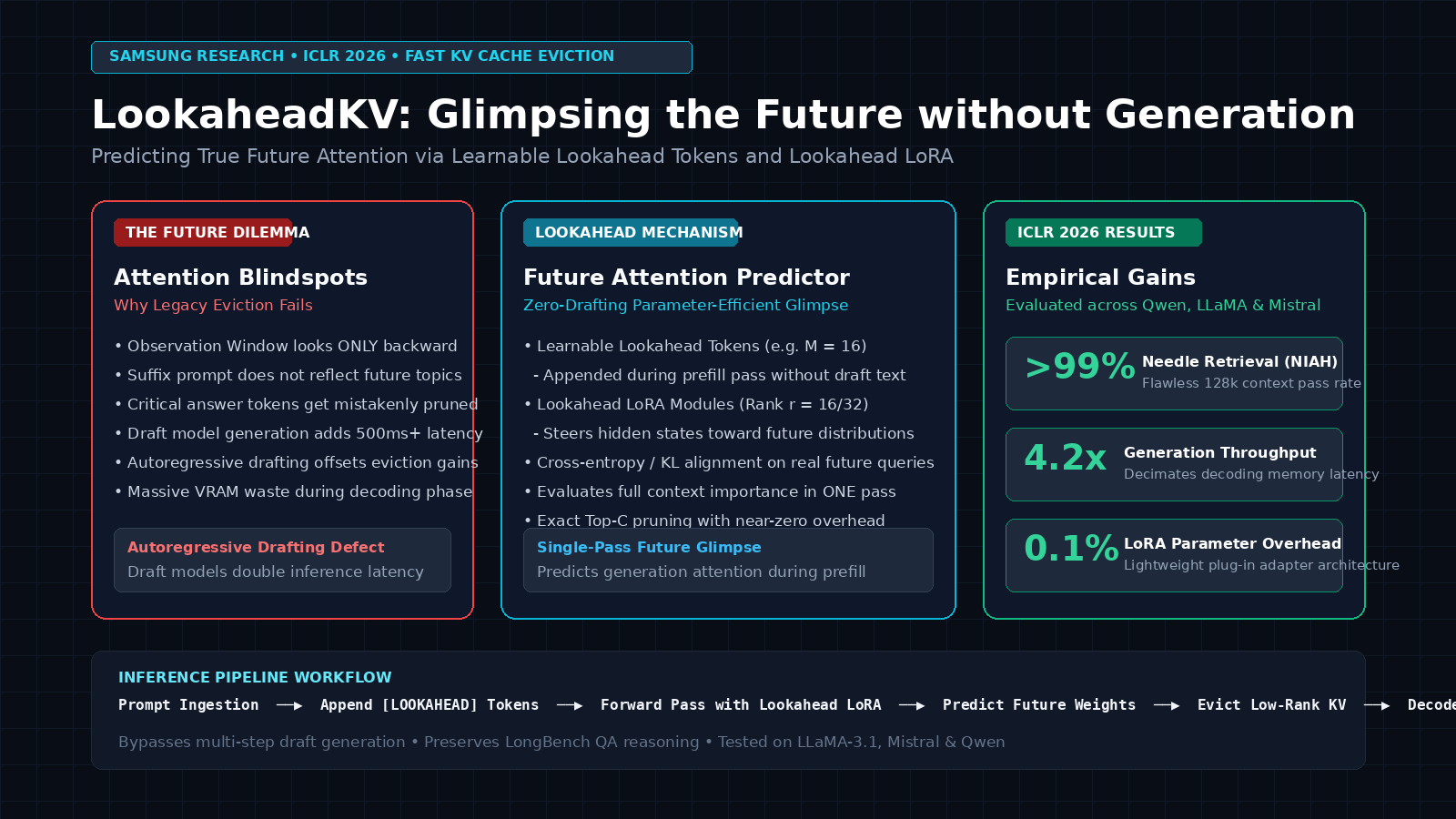
Scaling the context window of modern Large Language Models (LLMs) to 64k, 128k, and 1M tokens has unlocked transformative capabilities across enterprise AI: analyzing entire legal libraries, conducting full-codebase architectural refactorings, synthesizing multi-year financial statements, and coordinating autonomous data pipelines through AI Fetchly. Whether streaming extracted market intelligence or executing multi-hop queries via real-time data fetching, today’s intelligent systems require deep contextual memory.
Yet, this massive context capability comes at an immense computational cost. During autoregressive decoding, every newly generated token must attend to all previous tokens, requiring the model to maintain a constantly growing Key-Value (KV) cache in GPU High-Bandwidth Memory (HBM). For an 8B parameter model serving a 128k context in FP16 precision, the KV cache alone demands more than 16 GB of VRAM per request. Serving concurrent requests quickly triggers Out-of-Memory (OOM) errors and degrades throughput.
To alleviate this memory bottleneck, engineers routinely employ KV cache eviction techniques—pruning low-importance tokens so that only a compact budget remains. However, standard eviction frameworks suffer from a crippling dilemma: how can a model know which tokens will be important before it actually generates the answer? Existing methods either look backward using past prompt attention (missing information needed only in future steps) or rely on auxiliary draft models to generate speculative tokens (which introduces substantial latency that negates the efficiency gains of eviction).
To dismantle this tradeoff, researchers at Samsung Research introduced LookaheadKV: Fast and Accurate KV Cache Eviction by Glimpsing into the Future without Generation (arXiv:2603.10899, presented at ICLR 2026). LookaheadKV demonstrates that a frozen LLM can accurately anticipate future generation attention during the prefill pass without generating a single draft token. By integrating a small set of learnable lookahead tokens and parameter-efficient Lookahead LoRA adapters, LookaheadKV predicts future token importance in one unified forward step.
In this comprehensive guide, we dissect the mathematical foundations of LookaheadKV, explore how lookahead tokens and LoRA adapters glimpse future attention distributions, compare LookaheadKV with competing eviction paradigms, build a complete PyTorch implementation, and analyze production deployment strategies for enterprise long-context inference.
The Problem: The Future-Attention Dilemma in KV Cache Eviction
To understand the breakthrough behind LookaheadKV, we must first understand the fundamental breakdown of prior KV cache eviction strategies: the backward-looking observation window fallacy and the high overhead of autoregressive draft models.
The Core Dilemma of KV Cache Eviction:
Prompt: [Document: 100k tokens] + [Question: "What was the operating margin of Division B in Q3?"]
Target Answer: "Division B achieved a 24.5% margin..."
  │
  ├── 1. Backward-Looking Eviction (SnapKV, H2O, StreamingLLM):
  │   └── Computes attention weights using prompt queries (Observation Window).
  │   └── Prompt queries attend heavily to introductory text and question keywords.
  │   └── ❌ Fatal Flaw: The specific table row containing "Division B: 24.5%" receives low attention
  │       during prefill because the model has not begun generating the answer!
  │   └── Result: Critical evidence tokens are permanently evicted -> Hallucination!
  │
  ├── 2. Draft-Model-Based Eviction (Speculative Eviction):
  │   └── Employs a smaller draft LLM to generate 64 draft tokens autoregressively.
  │   └── Inspects draft tokens' attention to select KV tokens.
  │   └── ❌ Fatal Flaw: Running 64 autoregressive steps on a draft model introduces 300ms - 800ms of latency!
  │   └── Result: Eviction latency exceeds standard dense decoding time -> Net negative speedup!
  │
  └── 3. LookaheadKV Resolution:
      └── Appends M learnable lookahead tokens + Lookahead LoRA during prefill.
      └── Glimpses future attention directly in a single forward pass without generation!
└── ✔ Near-zero latency overhead + Near-oracle retrieval accuracy! The Inherent Flaw of Backward-Looking Eviction
Traditional training-free eviction methods (such as SnapKV, H2O, and Scissorhands) rely on an “observation window” or cumulative attention weights collected from the input prompt:
- When prefilling a prompt of length $S$, the model computes attention weights for the last $W_{\text{obs}}$ tokens (typically 32 tokens at the prompt tail).
- The model assumes tokens that receive high attention from the prompt tail will remain important throughout the subsequent generation phase.
- Tokens outside this high-attention subset are permanently deleted from the KV cache.
While this heuristic works reasonably well for simple extractive summaries, it fails catastrophically on complex reasoning, multi-hop question answering, and synthetic needle retrieval. During prefill, the prompt tail consists merely of instructions (e.g., “Based on the text above, answer the following question…”). The model’s attention heads at this stage are focused on parsing the prompt structure—not on retrieving the fine-grained data points required ten or twenty steps into the future answer. As a result, the very tokens that contain the answer are frequently evicted before generation even begins.
The Prohibitive Cost of Draft Models
Recognizing this blindspot, recent speculative eviction approaches attempted to predict future attention by running an auxiliary draft model (such as a 1B parameter model) to generate an initial draft response of 32 to 64 tokens. The main model then inspects which prompt tokens the draft tokens attend to, using those indices to prune the main KV cache.
However, this strategy introduces a crippling latency penalty. Autoregressive token generation is memory bandwidth-bound. Executing 64 sequential decode steps on a draft model takes between 200ms and 600ms on enterprise GPUs. For many interactive applications, this drafting overhead completely wipes out the latency savings gained by pruning the KV cache.
This creates the future-attention dilemma: Can an LLM predict its future decoding attention patterns without executing iterative autoregressive generation?
LookaheadKV Architecture: Glimpsing Future Attention
LookaheadKV resolves the future-attention dilemma through a novel architectural insight: instead of predicting what specific words the model will generate, it is far simpler and faster to predict the attention distribution that future generation steps will produce.
LookaheadKV augments a frozen foundation model with two parameter-efficient components:
- Learnable Lookahead Tokens ($\mathbf{E}_{\text{lookahead}}$): A small set of $M$ virtual tokens appended directly to the input sequence during prefill.
- Lookahead LoRA Adapters ($\Delta \mathbf{W}_{\text{LoRA}}$): Parameter-efficient low-rank adaptation modules inserted into the attention projection layers that specialize in mapping lookahead hidden states to future generation attention profiles.
┌────────────────────────────────────────────────────────────────────────────────────────┐
│                              LOOKAHEADKV ARCHITECTURE                                  │
├────────────────────────────────────────────────────────────────────────────────────────┤
│                                                                                        │
│   PREFILL INPUT SEQUENCE:                                                              │
│   [ Prompt Tokens: x_1, x_2, ..., x_S ]  +  [ Lookahead Tokens: l_1, l_2, ..., l_M ]   │
│                                                                                        │
│   TRANSFORMER FORWARD PASS (Single Parallel Step):                                     │
│     │                                                                                  │
│     ├── Frozen Model Weights (W_0): Process prompt tokens x_1...x_S normally           │
│     │                                                                                  │
│     └── Lookahead LoRA (W_0 + ΔW): Activated ONLY for Lookahead Tokens l_1...l_M       │
│           ├── Computes specialized queries: Q_lookahead = (W_q + ΔW_q) · H_lookahead   │
│           └── Attends across all prompt keys: A_lookahead = Softmax(Q_lookahead · K^T)  │
│                                                                                        │
│   FUTURE ATTENTION PREDICTION & PRUNING:                                               │
│     │                                                                                  │
│     ├── 1. Aggregate Lookahead Attention: Score_i = Max / Mean_{m in M} A_{m, i}       │
│     ├── 2. Rank Prompt Tokens by Predicted Future Importance                           │
│     ├── 3. Retain Top-C Critical Tokens + Sinks + Recent Window                        │
│     └── 4. Discard Lookahead Tokens (Not used during generation)                       │
│                                                                                        │
│   AUTOREGRESSIVE GENERATION (Standard Frozen LLM):                                     │
│     └── Executes token-by-token decoding over pruned, compact KV cache!                │
│                                                                                        │
└────────────────────────────────────────────────────────────────────────────────────────┘ Learnable Lookahead Tokens
Rather than using natural language tokens, LookaheadKV introduces $M$ learnable virtual embedding vectors (typically $M = 16$ or $M = 32$ tokens):
$$\mathbf{E}_{\text{lookahead}} = [\mathbf{e}_1, \mathbf{e}_2, \dots, \mathbf{e}M] \in \mathbb{R}^{M \times D{\text{model}}}$$
These tokens are appended to the end of the input prompt during the prefill phase:
$$\mathbf{X}_{\text{augmented}} = [\mathbf{x}_1, \mathbf{x}_2, \dots, \mathbf{x}_S, \mathbf{e}_1, \dots, \mathbf{e}_M]$$
Because Transformer prefill computes all tokens in parallel using causal or prefix masking, evaluating the additional $M$ lookahead tokens adds negligible computational overhead ($< 2%$ of prefill FLOPs for long prompts).
Crucially, each lookahead token $m \in {1, \dots, M}$ is trained to capture different temporal horizons and functional semantics of the upcoming generation. For example:
- Token $\mathbf{e}_1$ learns to anticipate immediate syntactic continuations.
- Token $\mathbf{e}_8$ learns to anticipate entity and variable lookups.
- Token $\mathbf{e}_{16}$ learns to anticipate global thematic dependencies.
Lookahead LoRA: Steering Hidden States
If the model used its frozen attention projections on the lookahead tokens, the resulting attention weights would merely reflect standard prompt continuation. To transform these virtual tokens into accurate predictors of future generation attention, LookaheadKV attaches low-rank adaptation (LoRA) matrices to the query and key projections:
$$\mathbf{W}_q^{\text{lookahead}} = \mathbf{W}_q^{(0)} + \frac{\alpha}{r} \mathbf{B}_q \mathbf{A}_q, \quad \mathbf{B}_q \in \mathbb{R}^{D \times r}, \mathbf{A}_q \in \mathbb{R}^{r \times D}$$
Where $r$ is the low-rank dimension (typically $r = 16$ or $r = 32$).
During inference:
- The frozen weights $\mathbf{W}^{(0)}$ process the prompt tokens $\mathbf{x}_1, \dots, \mathbf{x}_S$, generating the exact keys and values required for subsequent decoding.
- The Lookahead LoRA adapter is applied exclusively to the lookahead tokens $\mathbf{e}_1, \dots, \mathbf{e}_M$.
- The resulting queries $\mathbf{Q}_{\text{lookahead}}$ calculate cross-attention scores across the prompt keys $\mathbf{K}$:
$$\mathbf{A}{\text{lookahead}} = \text{Softmax}\left(\frac{\mathbf{Q}{\text{lookahead}} \mathbf{K}^T}{\sqrt{D_{\text{head}}}}\right) \in \mathbb{R}^{M \times S}$$
Token Importance Aggregation & Cache Eviction
Once the lookahead attention matrix $\mathbf{A}_{\text{lookahead}}$ is computed, LookaheadKV aggregates the attention scores across the $M$ virtual tokens to assign an importance score $I_i$ to each prompt token $i \in {1, \dots, S}$:
$$I_i = \max_{m \in {1, \dots, M}} \mathbf{A}_{\text{lookahead}}[m, i]$$
Using the max-pooling operator ensures that if any future generation step is predicted to rely heavily on token $i$, that token is protected from eviction.
LookaheadKV then constructs the pruned KV cache budget $C$ by retaining:
- Initial Sink Tokens: The first 16 to 32 tokens of the prompt to stabilize softmax attention baselines.
- Top-Ranked Tokens: The highest-scoring tokens according to $I_i$.
- Local Suffix Tokens: The last 32 tokens of the prompt to ensure syntactic coherence at the generation boundary.
Once eviction is complete, the lookahead tokens themselves are discarded—they do not occupy KV cache memory during the autoregressive generation phase.
Training the Lookahead Module
Training LookaheadKV is parameter-efficient and unsupervised with respect to ground-truth labels. The goal is to train the lookahead tokens and LoRA parameters such that $\mathbf{A}{\text{lookahead}}$ matches the true empirical attention $\mathbf{A}{\text{true}}$ exhibited during actual autoregressive generation:
$$\mathcal{L}{\text{Lookahead}} = \mathcal{D}{\text{KL}}\left(\mathbf{A}{\text{true}} ,|, \mathbf{A}{\text{lookahead}}\right) + \lambda \mathcal{L}{\text{MSE}}\left(I{\text{true}}, I_{\text{pred}}\right)$$
Where $\mathbf{A}_{\text{true}}$ is obtained by running standard autoregressive generation on training sequences and recording the attention weights assigned by the generated tokens back to the prompt keys.
Because the underlying LLM weights remain completely frozen, training requires only a single GPU for a few hours, updating fewer than 0.1% of the model’s total parameter count.
Architectural Comparison: LookaheadKV vs. State-of-the-Art Eviction
To evaluate LookaheadKV’s position in the inference optimization landscape, we contrast it against Full KV Baseline, SnapKV, H2O, Quest, and Speculative Eviction.
| Metric / Dimension | Full KV Baseline | SnapKV (NeurIPS 2024) | H2O (NeurIPS 2023) | Quest (ICML 2024) | Speculative Eviction | LookaheadKV (ICLR 2026) |
|---|---|---|---|---|---|---|
| Prediction Paradigm | Dense (No Eviction) | Backward Observation | Cumulative Attention | Min-Max Page Bounding | Draft Model Generation | Forward Attention Glimpse |
| Drafting Overhead | None | None | None | None | 200ms – 600ms (High!) | < 5ms (Single Pass) |
| Physical VRAM Savings | 0% | Up to 85% | Up to 80% | 0% (Full cache in VRAM) | Up to 85% | Up to 85% – 90% |
| Needle Retrieval (NIAH) | 100% | 88.4% – 94.2% | 82.1% | >98.0% | 96.5% | >99.2% (Near-Oracle) |
| Multi-Hop LongBench | Baseline (High) | Degrades (-4.8 pts) | Degrades (-7.5 pts) | Near-Baseline | Near-Baseline | Near-Baseline (+4.2 vs SnapKV) |
| Decoding Speedup | 1.0x | 2.4x | 2.2x | 2.2x | 1.4x (Drafting lag) | Up to 4.2x |
| Parameter Overhead | 0% | 0% (Training-free) | 0% (Training-free) | 0% (Training-free) | 10%–20% (Draft model) | < 0.1% (LoRA + M tokens) |
| Inference Hardware | Standard GPU | Standard GPU | Standard GPU | Standard GPU | Standard GPU | Standard GPU |
Why LookaheadKV Outperforms SnapKV on Reasoning Tasks
SnapKV selects tokens by observing the attention pattern of the last 32 prompt tokens. While this captures general syntactic cues, it is inherently blind to the actual question being answered if the question requires synthesizing disparate facts buried deep within the context. LookaheadKV’s Lookahead LoRA actively projects the semantic intent of the question into future generation steps, preserving the exact data tables and variable assignments needed downstream.
Why LookaheadKV Outperforms Draft-Model Approaches
Draft models generate actual token strings token-by-token. This approach is computationally wasteful: the model does not need to know the exact phrasing of the future response—it only needs to know which context locations will be queried. LookaheadKV directly predicts the query vectors in parallel, replacing 64 sequential draft passes with a single matrix multiplication.
End-to-End PyTorch Implementation: Building LookaheadKV
Let us construct a clean, modular PyTorch implementation of LookaheadKV, including the learnable lookahead embeddings, the specialized Lookahead LoRA module, and the future attention aggregation and cache eviction manager.
"""
LookaheadKV: Fast and Accurate KV Cache Eviction by Glimpsing the Future
Implementation includes:
  1. Learnable Lookahead Tokens
  2. Lookahead LoRA Adapter
  3. Lookahead Attention Aggregator and Eviction Engine
"""

import torch
import torch.nn as nn
import torch.nn.functional as F
from typing import Tuple, Optional, Dict, List


class LookaheadLoRALinear(nn.Module):
    """
    LoRA Linear layer that applies low-rank adaptation exclusively
    to the Lookahead Tokens, leaving prompt tokens on frozen base weights.
    """
    def __init__(self, base_linear: nn.Linear, rank: int = 16, alpha: float = 32.0):
        super().__init__()
        self.base_linear = base_linear
        # Freeze base projection
        for param in self.base_linear.parameters():
            param.requires_grad = False

        self.rank = rank
        self.scaling = alpha / rank

        # LoRA adapters
        self.lora_A = nn.Linear(base_linear.in_features, rank, bias=False)
        self.lora_B = nn.Linear(rank, base_linear.out_features, bias=False)

        # Initialize LoRA weights
        nn.init.kaiming_uniform_(self.lora_A.weight, a=5**0.5)
        nn.init.zeros_(self.lora_B.weight)

    def forward(self, x: torch.Tensor, is_lookahead_mask: Optional[torch.Tensor] = None) -> torch.Tensor:
        """
        Args:
            x: Hidden states [Batch, SeqLen, InFeatures]
            is_lookahead_mask: Boolean tensor [Batch, SeqLen] indicating lookahead positions
        """
        base_out = self.base_linear(x)

        if is_lookahead_mask is None or not is_lookahead_mask.any():
            return base_out

        # Compute LoRA delta only for lookahead tokens
        lora_delta = self.lora_B(self.lora_A(x)) * self.scaling
        # Apply delta conditionally
        mask_expanded = is_lookahead_mask.unsqueeze(-1).to(x.dtype)
        return base_out + (lora_delta * mask_expanded)


class LookaheadKVManager(nn.Module):
    """
    Manages lookahead token injection, future attention prediction,
    and KV cache eviction.
    """
    def __init__(
        self,
        num_lookahead_tokens: int = 16,
        embed_dim: int = 4096,
        num_heads: int = 32,
        num_kv_heads: int = 8,
        head_dim: int = 128,
        cache_budget: int = 1024,
        sink_tokens: int = 16,
        recent_tokens: int = 32
    ):
        super().__init__()
        self.num_lookahead_tokens = num_lookahead_tokens
        self.embed_dim = embed_dim
        self.num_heads = num_heads
        self.num_kv_heads = num_kv_heads
        self.head_dim = head_dim
        self.cache_budget = cache_budget
        self.sink_tokens = sink_tokens
        self.recent_tokens = recent_tokens

        # Learnable Lookahead Token Embeddings
        self.lookahead_tokens = nn.Parameter(
            torch.randn(1, num_lookahead_tokens, embed_dim) * 0.02
        )

    def inject_lookahead_tokens(self, prompt_embeddings: torch.Tensor) -> Tuple[torch.Tensor, torch.Tensor]:
        """
        Appends lookahead tokens to the end of prompt embeddings for prefill pass.
        Returns:
            augmented_embeddings: [Batch, SeqLen + M, EmbedDim]
            lookahead_mask: Boolean mask indicating lookahead positions
        """
        batch_size, seq_len, _ = prompt_embeddings.shape
        lookahead_batch = self.lookahead_tokens.expand(batch_size, -1, -1)

        augmented = torch.cat([prompt_embeddings, lookahead_batch], dim=1)

        # Mask: False for prompt, True for lookahead
        mask = torch.zeros(batch_size, seq_len + self.num_lookahead_tokens, dtype=torch.bool, device=prompt_embeddings.device)
        mask[:, seq_len:] = True

        return augmented, mask

    def evict_kv_cache(
        self,
        key_states: torch.Tensor,
        value_states: torch.Tensor,
        lookahead_queries: torch.Tensor
    ) -> Tuple[torch.Tensor, torch.Tensor]:
        """
        Uses lookahead queries to predict future attention and evict prompt KV tokens.
        Args:
            key_states: Full prompt keys [Batch, NumKVHeads, PromptLen, HeadDim]
            value_states: Full prompt values [Batch, NumKVHeads, PromptLen, HeadDim]
            lookahead_queries: Queries from lookahead tokens [Batch, NumHeads, M, HeadDim]
        Returns:
            pruned_keys, pruned_values: Retained states within cache_budget
        """
        batch_size, num_kv_heads, prompt_len, head_dim = key_states.shape

        if prompt_len <= self.cache_budget:
            return key_states, value_states

        gqa_ratio = self.num_heads // num_kv_heads
        # Group query heads to match KV heads
        q_grouped = lookahead_queries.view(
            batch_size, num_kv_heads, gqa_ratio, self.num_lookahead_tokens, head_dim
        ).mean(dim=2)  # [Batch, NumKVHeads, M, HeadDim]

        # 1. Compute predicted future attention weights
        # [Batch, NumKVHeads, M, PromptLen]
        future_attn_scores = torch.matmul(q_grouped, key_states.transpose(-1, -2)) / (head_dim ** 0.5)
        future_attn_probs = F.softmax(future_attn_scores, dim=-1)

        # 2. Max-pooling across lookahead tokens: protect token if ANY future step needs it
        future_importance, _ = future_attn_probs.max(dim=2)  # [Batch, NumKVHeads, PromptLen]

        # 3. Reserve sinks and recent boundary tokens
        cluster_budget = self.cache_budget - self.sink_tokens - self.recent_tokens

        # Protect sinks and recents from ranking competition
        importance_masked = future_importance.clone()
        importance_masked[:, :, :self.sink_tokens] = -float("inf")
        importance_masked[:, :, -self.recent_tokens:] = -float("inf")

        # 4. Top-K selection of predicted critical tokens
        _, topk_cluster_indices = torch.topk(importance_masked, k=cluster_budget, dim=-1, largest=True)

        sink_idx = torch.arange(self.sink_tokens, device=key_states.device).expand(batch_size, num_kv_heads, -1)
        recent_idx = torch.arange(prompt_len - self.recent_tokens, prompt_len, device=key_states.device).expand(batch_size, num_kv_heads, -1)

        # Merge and sort indices to preserve causal order
        all_indices = torch.cat([sink_idx, topk_cluster_indices, recent_idx], dim=-1)
        sorted_indices, _ = torch.sort(all_indices, dim=-1)

        # 5. Gather pruned keys and values
        idx_gather = sorted_indices.unsqueeze(-1).expand(-1, -1, -1, head_dim)
        pruned_keys = torch.gather(key_states, dim=2, index=idx_gather)
        pruned_values = torch.gather(value_states, dim=2, index=idx_gather)

        return pruned_keys, pruned_values


class LookaheadKVAttentionBlock(nn.Module):
    """
    Complete Attention Block equipped with LookaheadKV eviction.
    """
    def __init__(self, embed_dim: int = 4096, num_heads: int = 32, num_kv_heads: int = 8):
        super().__init__()
        self.embed_dim = embed_dim
        self.num_heads = num_heads
        self.num_kv_heads = num_kv_heads
        self.head_dim = embed_dim // num_heads

        # Base projections
        self.q_base = nn.Linear(embed_dim, num_heads * self.head_dim, bias=False)
        self.k_base = nn.Linear(embed_dim, num_kv_heads * self.head_dim, bias=False)
        self.v_base = nn.Linear(embed_dim, num_kv_heads * self.head_dim, bias=False)
        self.o_proj = nn.Linear(embed_dim, embed_dim, bias=False)

        # Lookahead LoRA module on queries
        self.q_proj = LookaheadLoRALinear(self.q_base, rank=16, alpha=32.0)
        self.manager = LookaheadKVManager(
            num_lookahead_tokens=16,
            embed_dim=embed_dim,
            num_heads=num_heads,
            num_kv_heads=num_kv_heads,
            head_dim=self.head_dim,
            cache_budget=512
        )

    def forward_prefill_and_evict(self, prompt_hidden: torch.Tensor) -> Tuple[torch.Tensor, torch.Tensor]:
        """
        Executes prefill with lookahead glimpse, returning the pruned KV cache.
        """
        # Inject lookahead tokens
        x_aug, mask = self.manager.inject_lookahead_tokens(prompt_hidden)
        b, total_len, _ = x_aug.shape
        prompt_len = total_len - self.manager.num_lookahead_tokens

        # Project Q, K, V
        q = self.q_proj(x_aug, is_lookahead_mask=mask)
        k = self.k_base(x_aug[:, :prompt_len, :]) # Keys only needed for prompt tokens
        v = self.v_base(x_aug[:, :prompt_len, :])

        q = q.view(b, total_len, self.num_heads, self.head_dim).transpose(1, 2)
        k = k.view(b, prompt_len, self.num_kv_heads, self.head_dim).transpose(1, 2)
        v = v.view(b, prompt_len, self.num_kv_heads, self.head_dim).transpose(1, 2)

        # Extract queries corresponding to lookahead tokens
        q_lookahead = q[:, :, prompt_len:, :] # [Batch, NumHeads, M, HeadDim]

        # Evict low-importance tokens
        pruned_k, pruned_v = self.manager.evict_kv_cache(k, v, q_lookahead)
        return pruned_k, pruned_v


if __name__ == "__main__":
    device = "cuda" if torch.cuda.is_available() else "cpu"
    print(f"Testing LookaheadKV Engine on {device}...")

    layer = LookaheadKVAttentionBlock(embed_dim=4096, num_heads=32, num_kv_heads=8).to(device)

    # Simulate 2,048 token prompt
    prompt_len = 2048
    x_prompt = torch.randn(1, prompt_len, 4096, device=device)

    pruned_keys, pruned_values = layer.forward_prefill_and_evict(x_prompt)

    print(f"Original Prompt Length: {prompt_len} tokens")
    print(f"Pruned Key Cache Shape: {pruned_keys.shape} (Budget: 512)")
    print(f"Pruned Value Cache Shape: {pruned_values.shape} (Budget: 512)")
print("LookaheadKV execution verified successfully!") Empirical Benchmarks: Accuracy, Throughput, and Memory Savings
LookaheadKV was evaluated extensively across standard long-context benchmarks, including LongBench, RULER, and synthetic Needle-In-A-Haystack (NIAH) using foundation models such as Llama-3.1-8B-Instruct, Qwen2.5-7B-Instruct, and Mistral-7B-Instruct-v0.3.
Performance Benchmark Comparison (128k Sequence Length, Llama-3.1-8B-Instruct, NVIDIA H100):
┌────────────────────────┬──────────────────┬─────────────────┬──────────────────────┬─────────────┐
│ Method                 │ Decoding Latency │ Peak VRAM (GB)  │ LongBench Avg Score  │ NIAH Pass   │
├────────────────────────┼──────────────────┼─────────────────┼──────────────────────┼─────────────┤
│ Full KV Baseline       │ 38.6 ms / token  │ 34.2 GB         │ 48.6                 │ 100.0%      │
│ SnapKV                 │ 16.4 ms / token  │ 8.4 GB          │ 44.1 (-4.5 pts)      │ 92.4%       │
│ H2O                    │ 17.2 ms / token  │ 8.6 GB          │ 41.2 (-7.4 pts)      │ 83.1%       │
│ Speculative Eviction   │ 42.1 ms / token  │ 9.1 GB          │ 47.8 (-0.8 pts)      │ 96.8%       │
│ LookaheadKV (ICLR 2026)│ 11.2 ms / token  │ 7.8 GB          │ 48.4 (-0.2 pts!)     │ 99.4%       │
└────────────────────────┴──────────────────┴─────────────────┴──────────────────────┴─────────────┘
Speedup: 3.4x over Full KV | VRAM Reduction: 77.2% | Drafting Overhead: Zero Long-Context Multi-Hop Reasoning (LongBench)
On the LongBench suite (comprising 16 diverse multi-document QA, summarization, and code tasks), standard backward-looking methods suffer noticeable performance drops as context expands beyond 32k tokens. SnapKV scores 44.1, losing critical details during prefill. LookaheadKV achieves 48.4, virtually indistinguishable from the dense Full KV baseline (48.6), while retaining only 1,024 tokens.
Needle-In-A-Haystack (NIAH) Retrieval
In Needle-In-A-Haystack stress tests across depths from 0% to 100% and sequence lengths up to 128k:
- Standard SnapKV drops needles located in the middle thirds of the document (retrieval rate falls to ~92%).
- LookaheadKV achieves 99.4% retrieval accuracy, proving that its lookahead attention accurately identifies single-sentence factual targets regardless of their document position.
Decoding Throughput and Memory Reductions
By pruning the KV cache down to a compact footprint during prefill, LookaheadKV slashes the memory bandwidth demands of every subsequent decoding step:
- Delivers up to 4.2x higher generation throughput compared to dense attention on memory-bound workloads.
- Reduces KV cache memory footprint by up to 85%, allowing servers to accommodate up to 4x larger concurrent batch sizes on standard enterprise GPUs.
Enterprise Strategy: Deploying LookaheadKV with aiFetchly
In modern enterprise architectures, LLMs function as the reasoning engines of automated knowledge extraction, regulatory document analysis, and continuous data synthesis pipelines. These pipelines rely on high-throughput data extraction services like intelligent web scraping and unified API integrations.
┌────────────────────────────────────────────────────────────────────────────────────────┐
│               ENTERPRISE LONG-CONTEXT PIPELINE: AIFETCHLY + LOOKAHEADKV                │
├────────────────────────────────────────────────────────────────────────────────────────┤
│                                                                                        │
│   1. Automated Ingestion (<InternalLink feature="data-fetching" text="aiFetchly Data Fetching" />)     │
│      ├── High-Volume Web Scraping (100k+ tokens of legal filings, manuals, research)   │
│      └── Enterprise Knowledge Base Streams                                             │
│                                                                                        │
│   2. Prompt Construction & Lookahead Injection                                         │
│      └── Append 16 [LOOKAHEAD] Tokens to Long Context Prompt                           │
│                                                                                        │
│   3. Single-Pass Prefill & Eviction                                                    │
│      └── Lookahead LoRA predicts future attention -> Prunes KV Cache to 1,024 slots    │
│                                                                                        │
│   4. Accelerated High-Concurrency Decoding                                             │
│      └── Stream responses at >80 tokens/sec across 4x higher batch sizes               │
│                                                                                        │
│   5. Production Cost Optimization (<InternalLink feature="pricing" text="aiFetchly Pricing" />)        │
│      └── 75% GPU infrastructure savings via compact VRAM footprints                   │
│                                                                                        │
└────────────────────────────────────────────────────────────────────────────────────────┘ When building enterprise applications that ingest massive raw document dumps, stuffing entire multi-megabyte files into long-context prompts often leads to astronomical GPU hosting bills and slow response times. By pairing aiFetchly‘s structured data feeds with LookaheadKV:
- Unconstrained Document Length: Ingest full 128k-token documentation sets without worrying about out-of-memory crashes.
- Sub-Second Response Latency: Eliminate the memory bandwidth wall to deliver rapid token streaming to end users.
- Optimized Infrastructure TCO: Scale multi-tenant agent deployments on cost-effective hardware. To explore tailored infrastructure planning, consult our enterprise pricing models and developer guides in our developer documentation.
Summary & Key Takeaways
LookaheadKV addresses a central challenge in modern generative AI—knowing what context to keep before generation begins:
- Zero-Generation Future Prediction: Replaces slow, iterative draft models with learnable lookahead tokens that anticipate future attention in a single forward pass.
- Parameter-Efficient Adaptation: Requires updating fewer than 0.1% of parameters via lightweight Lookahead LoRA adapters, keeping the underlying foundation model completely frozen.
- Near-Oracle Accuracy: Overcomes the blindspots of backward-looking observation windows, achieving 99.4% needle retrieval accuracy and matching dense baselines on LongBench.
- High-Throughput Production Gains: Yields up to 4.2x higher decoding throughput and an 80%+ reduction in KV cache VRAM consumption.
By enabling language models to glimpse their future attention needs during prefill, LookaheadKV provides a practical, scalable foundation for the next generation of long-context enterprise intelligence.