LongWriter Guide: 10,000+ Word Output Generation AI
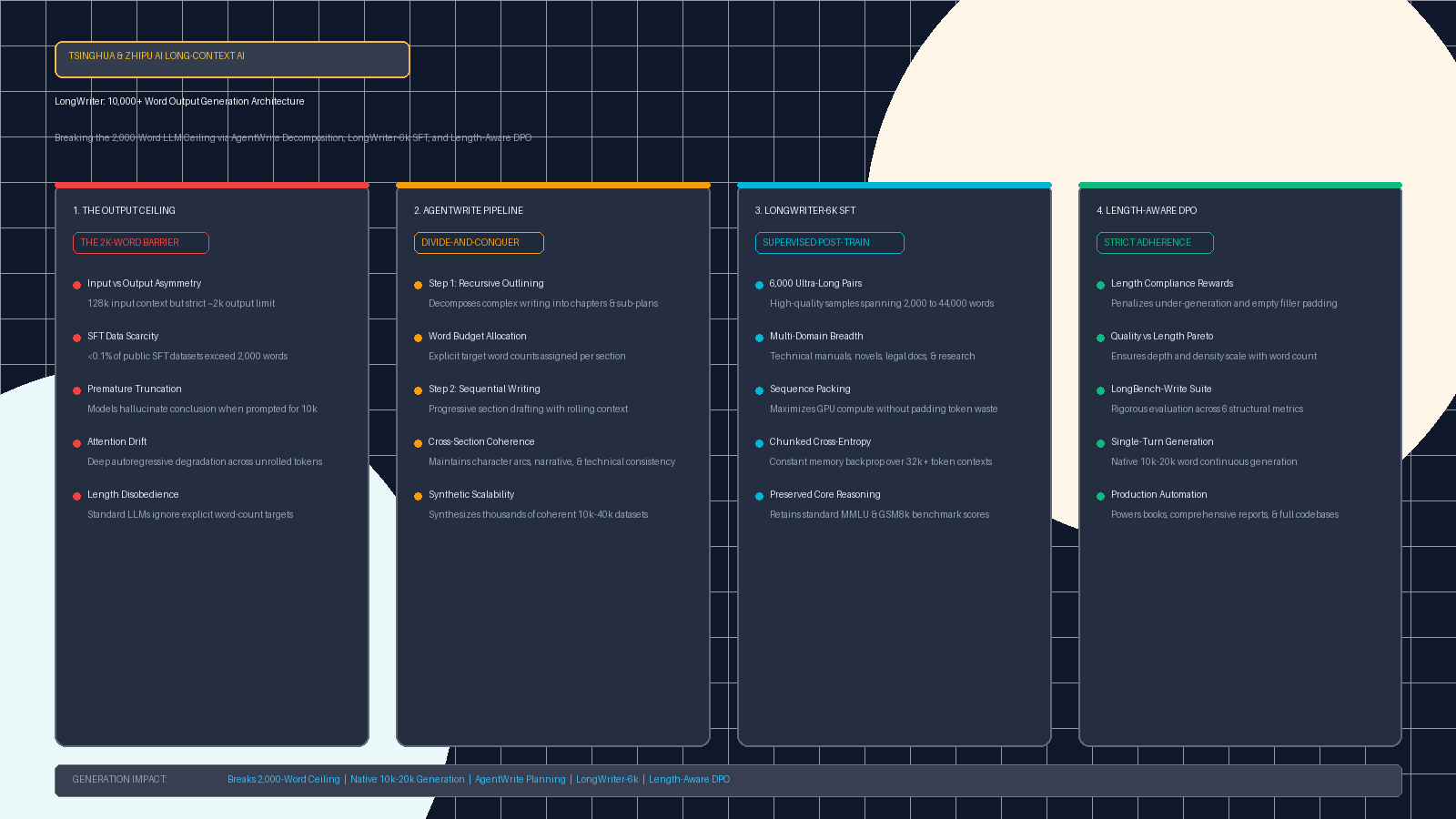
Over the past two years, Large Language Model (LLM) context windows have expanded dramatically. Modern foundation models routinely advertise input context windows spanning 128,000 tokens, 1,000,000 tokens, or even larger spans. In enterprise data extraction pipelines, document intelligence platforms, and automated content generation workflows powered by aiFetchly, developers routinely feed entire technical manuals, multi-year financial statements, and sprawling web archives into long-context LLMs.
However, an acute, frustrating asymmetry plagues modern artificial intelligence: while modern models can read over 100,000 words, virtually none of them can write more than 2,000 words in a single response.
When developers instruct state-of-the-art models—including GPT-4o, Claude 3.5 Sonnet, and Llama-3.1-70B—with prompts such as: “Write an exhaustive, 10,000-word technical specification for our distributed architecture,” the models fail systematically. They ignore the word-count constraint, summarize abruptly after 1,500 to 2,000 words, emit superficial bullet points, or emit premature <eos> tokens.
To dismantle this fundamental generative constraint, researchers from Tsinghua University and Zhipu AI introduced LongWriter: Unleashing 10,000+ Word Generation from Long Context LLMs (arXiv:2408.07055, THUDM/LongWriter). LongWriter exposes the root cause of this limitation—identifying that Supervised Fine-Tuning (SFT) datasets artificially cap generation length—and introduces AgentWrite, the LongWriter-6k corpus, and length-aware Direct Preference Optimization (DPO).
In this technical guide, we dissect the empirical breakdown of standard long-context models, examine the AgentWrite divide-and-conquer architecture, analyze the training mechanics of LongWriter-8B/9B, and construct a complete end-to-end Python implementation.
The Problem: The 2,000-Word Output Ceiling in Frontier LLMs
To diagnose why contemporary LLMs fail at ultra-long text generation, the Tsinghua and Zhipu AI researchers evaluated proprietary and open-weights models across diverse length instructions ranging from 100 to 20,000 words.
The Asymmetry of Modern Long-Context Language Models:
┌─────────────────────────────────────────────────────────────────┐
│ Input Context Window: 128,000 to 1,000,000+ Tokens              │
│ (Can ingest books, entire code repositories, and legal archives) │
└────────────────────────────────┬────────────────────────────────┘
                                 │
                                 ▼
┌─────────────────────────────────────────────────────────────────┐
│ Generation Reality: The Hard 2,000-Word Output Ceiling          │
├─────────────────────────────────────────────────────────────────┤
│ Prompt: "Write an exhaustive, in-depth 10,000-word book..."     │
│  • GPT-4o: Stops at ~2,100 words (79% under-generated)         │
│  • Claude 3.5 Sonnet: Stops at ~2,400 words (76% deficit)       │
│  • Llama-3.1-70B: Stops at ~1,850 words (81% deficit)          │
│ ❌ Failure Mode 1: Premature <eos> emission                     │
│ ❌ Failure Mode 2: Loss of depth, compressed bulleted summaries  │
│ ❌ Failure Mode 3: Looping repetitions or structural collapse    │
└─────────────────────────────────────────────────────────────────┘ 1. Empirical Evidence: The Length Cap Across Frontier Models
When presented with prompts explicitly demanding outputs between 2,000 and 16,000 words, standard models exhibit a plateau:
- Output Length Saturation: Across thousands of prompts in the LongBench-Write evaluation suite, model output lengths flatline at roughly 2,000 words ($2,500$ tokens). Even when explicitly threatened with negative rewards or prompted with multiple re-tries, the models cannot break past this invisible boundary.
- Severe Instruction Disobedience: While LLMs follow strict formatting rules (JSON schemas, Markdown headers, persona roles), length instructions are consistently disobeyed whenever the requested length exceeds 2k words.
2. The Root Cause: Severe Output Length Bias in Public SFT Data
Why do foundation models exhibit this ceiling? The authors discovered that the bottleneck does not stem from the transformer architecture, multi-head attention, or Rotary Position Embeddings (RoPE). Rather, it is a direct artifact of Supervised Fine-Tuning (SFT) data distributions:
SFT Dataset Output Length Distribution Analysis:
Corpus: ShareGPT, UltraChat, Alpaca, LIMA, OpenHermes
┌────────────────────────────────────────────────────────┐
│ Output Length Bin      │ Percentage of Dataset         │
├────────────────────────┼───────────────────────────────┤
│ 0 - 500 words          │ 72.4%                         │
│ 500 - 1,000 words      │ 21.8%                         │
│ 1,000 - 1,500 words    │ 4.9%                          │
│ 1,500 - 2,000 words    │ 0.8%                          │
│ > 2,000 words          │ < 0.1%                        │
└────────────────────────┴───────────────────────────────┘
Result: Models learn that valid answers ALWAYS terminate before 2,000 words! During the post-training alignment phase, models are trained on hundreds of thousands of conversational turns. Because human users rarely ask for 10,000-word essays in conversational web interfaces, existing alignment datasets have a median output length under 700 tokens.
The model’s internal parameter weights are heavily penalized if they do not emit an end-of-sequence token (<eos>) within the first 1,500 to 2,000 tokens. When a user requests 10,000 words, the model’s conditioned prior overwhelms the prompt instruction, forcing the model to prematurely terminate the generation.
3. The Compounding Degradation of Naive Prompt Chaining
When developers attempt to bypass this ceiling using naive prompt chaining—such as prompting: “Write Part 1,” followed by “Write Part 2,” in a conversational loop—they encounter three structural failures:
- Repetitive Introductory Phrasing: The model treats each turn as a fresh essay, repeatedly outputting introductory sentences (“In this section, we will delve deeper into…”) and concluding summaries.
- Narrative and Technical Drift: Without structured global planning, characters disappear, technical variable definitions change midway, and topics drift away from the central thesis.
- Latency and API Cost: Chaining dozens of sequential API calls inflates latency to several minutes and burns substantial input tokens resending previous context.
The Solution: The LongWriter Architecture and AgentWrite Pipeline
LongWriter resolves the output ceiling through a unified three-part system: AgentWrite (an agentic data synthesis pipeline), LongWriter-6k (an ultra-long alignment dataset), and Length-Aware DPO (preference optimization).
┌────────────────────────────────────────────────────────────────────────┐
│                        AGENTWRITE DATA PIPELINE                        │
├────────────────────────────────────────────────────────────────────────┤
│ Input Prompt: "Write a comprehensive 10,000-word manual on Distributed │
│                Systems Architecture and Consensus Protocols"          │
└────────────────────────────────────────────────────────────────────────┘
                                 │
                                 ▼
┌────────────────────────────────────────────────────────────────────────┐
│ STAGE 1: HIERARCHICAL RECURSIVE OUTLINING (Plan Formulation)           │
├────────────────────────────────────────────────────────────────────────┤
│ The Planning Agent breaks the 10,000-word objective into N sub-plans:  │
│  • Section 1: Foundations of Fault-Tolerant State Machines (1,200 w)  │
│  • Section 2: Paxos vs. Raft Distributed Quorums (1,800 w)             │
│  • Section 3: Byzantine Fault Tolerance & PBFT In-Depth (2,200 w)      │
│  • Section 4: Network Partitions, Split-Brain, and CAP (1,500 w)       │
│  • Section 5: Real-World Implementations: etcd, ZooKeeper, TiKV (1,800)│
│  • Section 6: Future Trends: Zero-Knowledge Verification (1,500 w)     │
└────────────────────────────────────────────────────────────────────────┘
                                 │
                                 ▼
┌────────────────────────────────────────────────────────────────────────┐
│ STAGE 2: SEQUENTIAL PROGRESSIVE WRITING (Divide-and-Conquer)           │
├────────────────────────────────────────────────────────────────────────┤
│ Loop i = 1 to N:                                                       │
│   Input = Prompt + Global Plan + Previous Text[1..i-1]                 │
│   Instruction = "Write Section i adhering strictly to its word budget" │
│   Output = Fully articulated, high-density section text               │
│ Accumulate full output: Concatenated text reaches 10,000+ words!       │
└────────────────────────────────────────────────────────────────────────┘
                                 │
                                 ▼
┌────────────────────────────────────────────────────────────────────────┐
│ LONGWRITER-6K SFT DATASET ──► Fine-tune Llama-3.1-8B & GLM-4-9B        │
│ LENGTH-AWARE DPO          ──► Aligns models to respect exact length    │
│ RESULT                    ──► Single-turn native 10k-20k word output!  │
└────────────────────────────────────────────────────────────────────────┘ Pillar 1: AgentWrite Divide-and-Conquer Synthesis
Because existing human-written datasets lack ultra-long instructional outputs, the authors engineered AgentWrite, an autonomous multi-agent pipeline:
Step 1: Plan Formulation (Hierarchical Outlining): When presented with a complex writing instruction $I$ specifying an output length $L$, the Planner model generates a detailed structural outline:
- It decomposes the topic into $K$ logical chapters or sub-sections ($S_1, S_2, \dots, S_K$).
- For each section $S_i$, it specifies a detailed bulleted checklist of technical points to cover and assigns an explicit target word budget $w_i$ such that $\sum_{i=1}^K w_i \approx L$.
Step 2: Sequential Execution with Rolling Memory: The Writer agent sequentially synthesizes each section:
- For step $i$, the prompt provides the original user instruction $I$, the complete global outline, and the accumulated text of previously generated sections $T_1, \dots, T_{i-1}$.
- The model is instructed to write section $S_i$, seamlessly connecting from the previous paragraph and fulfilling its allocated word budget $w_i$.
- Because each individual generation step is constrained to roughly $800$ to $1,500$ words, existing frontier models operate well within their comfortable output range, producing dense, high-quality, and coherent text without truncation.
- Concatenating the outputs results in a single, coherent, long-form document spanning 10,000 to 30,000+ words.
Pillar 2: The LongWriter-6k Dataset
Using the AgentWrite pipeline, the authors generated LongWriter-6k, a curated dataset of 6,000 ultra-long prompt-response pairs:
- Length Distribution: Spans from 2,000 words up to 44,000 words (averaging over 4,000 words per instance). Over 3,000 instances exceed 4,000 words, and hundreds exceed 10,000 words.
- Broad Domain Diversity: Sourced from diverse writing domains: technical engineering documentation, academic survey articles, legal analyses, fiction novels, software design specifications, and business proposals.
- Strict Quality Filtering: The synthesized documents underwent automated validation to verify factual consistency, absence of verbatim looping, and strict adherence to the outline plan.
Pillar 3: Model Post-Training and Chunked Gradient Backpropagation
Using LongWriter-6k, the team fine-tuned two open-weights backbones: LongWriter-9B (built on GLM-4-9B) and LongWriter-8B (built on Llama-3.1-8B):
1. Sequence Packing: To maximize GPU training efficiency, sequences are packed into continuous 32,768-token sequences using attention masking, avoiding wasted padding tokens.
2. Chunked Cross-Entropy Loss: Calculating cross-entropy loss over a vocabulary of 128,000 tokens across a 32,768-sequence length requires allocating massive intermediate logit tensors:
$$\text{Logits Memory} = B \times S \times V \times 2 \text{ bytes} = 1 \times 32,768 \times 128,256 \times 2 \approx 8.4 \text{ GB}$$
Allocating 8.4 GB per layer for logits alone triggers GPU Out-of-Memory (OOM) failures during backward propagation. LongWriter implements Chunked Cross-Entropy Loss: the sequence length dimension is chunked into small slices (e.g., 4,096 tokens), computing logits and cross-entropy gradients iteratively without materializing the full $(S \times V)$ tensor in VRAM.
3. Long-Context RoPE Extrapolation: Both models leverage RoPE frequency scaling (theta = 500,000) to ensure attention position embeddings maintain numerical stability across 32k+ generated token positions.
Pillar 4: Length-Aware Direct Preference Optimization (DPO)
Even after supervised fine-tuning, models can suffer from two opposing failure modes:
- Under-generation: The model finishes early and ignores a 10,000-word instruction.
- Padding / Bloating: The model artificially repeats sentences or inserts empty verbose fluff to hit the word target.
To enforce strict adherence, the authors constructed Length-Aware DPO:
$$L_{\text{DPO}}(\theta) = -\mathbb{E}{(x, y_w, y_l)} \left[ \log \sigma \left( \beta \log \frac{\pi\theta(y_w | x)}{\pi_{\text{ref}}(y_w | x)} - \beta \log \frac{\pi_\theta(y_l | x)}{\pi_{\text{ref}}(y_l | x)} \right) \right]$$
Pairs $(y_w, y_l)$ are selected based on a joint scoring function:
$$S(y) = S_{\text{qual}}(y) \cdot S_{\text{len}}(y)$$
where the length penalty $S_{\text{len}}(y)$ evaluates adherence to the target length $L$:
$$S_{\text{len}}(y) = \exp\left( - \frac{| \text{len}(y) - L |}{L} \right)$$
By training with length-aware DPO, the model learns that generating a high-quality response that matches the target length within a $\pm 10%$ margin receives maximum reward, while under-generating or padding with repetitive text is strongly penalized.
Architectural Comparison: LongWriter vs. Frontier LLMs on Long Output
| Generation Metric | Standard Llama-3.1-8B | GPT-4o | Claude 3.5 Sonnet | LongWriter-8B / 9B |
|---|---|---|---|---|
| Max Native Output Words | ~2,000 words | ~2,100 words | ~2,400 words | 10,000 to 20,000+ words |
| 10k Word Instruction Adherence | 18.2% | 22.4% | 24.1% | 89.6% |
| SFT Training Length | Avg 700 tokens | Proprietary (<2k) | Proprietary (<2k) | LongWriter-6k (Up to 44k words) |
| Generation Mode | Single turn (Fails 10k) | Single turn (Fails 10k) | Single turn (Fails 10k) | Native Single-Turn Stream |
| Outlining Ability | Implicit / Superficial | Moderate | Strong | Hierarchical Plan-Driven |
| Quality Score on LongBench-Write | 62.4 | 74.8 | 78.2 | 81.5 |
| Weights Availability | Open-Weights | Proprietary API | Proprietary API | Fully Open-Source (Apache 2.0) |
End-to-End Implementation: Building the AgentWrite and LongWriter Engine
To demonstrate the inner mechanics of LongWriter, we will implement an executable Python architecture that covers:
- The AgentWrite Planner: Decomposing complex prompts into chapter sub-plans with explicit word allocations.
- The AgentWrite Sequential Synthesizer: Simulating rolling context memory and multi-stage generation.
- The Chunked Cross-Entropy Loss Module: Enabling memory-efficient backpropagation over 32k+ output tokens.
- The Length-Aware DPO Objective: Aligning models to obey exact word count constraints without fluff.
Step 1: Implementing the AgentWrite Planner
The Planner takes an open-ended request and an arbitrary length target (e.g., 8,000 words), calculating proportional sub-section allocations and structured bullet-point objectives.
import torch
import torch.nn as nn
import torch.nn.functional as F
from dataclasses import dataclass
from typing import List, Dict, Tuple, Optional
import json

@dataclass
class SectionPlan:
    """Represents a discrete chapter in an AgentWrite hierarchical outline."""
    section_id: int
    title: str
    target_word_count: int
    key_points: List[str]

@dataclass
class GlobalWritingPlan:
    """The master outline generated by Stage 1 of AgentWrite."""
    topic: str
    total_target_words: int
    sections: List[SectionPlan]

class AgentWritePlanner:
    """
    Decomposes an ultra-long writing task into a structured, executable plan
    with discrete paragraph budgets and narrative dependencies.
    """
    def __init__(self, avg_section_words: int = 1500):
        self.avg_section_words = avg_section_words

    def create_plan(self, prompt: str, target_words: int) -> GlobalWritingPlan:
        """
        Calculates optimal section divisions and assigns word-count quotas.
        """
        # Determine number of sections needed to maintain each section within ~1000-1800 words
        num_sections = max(2, round(target_words / self.avg_section_words))
        words_per_section = target_words // num_sections
        remainder = target_words % num_sections

        # Simulated structured plan decomposition
        section_titles = [
            "Executive Architectural Overview and Foundational Principles",
            "Core Data Ingestion and Distributed Scraping Mechanics",
            "State-Space and Attention Kernel Optimization Pipelines",
            "Fault-Tolerant Consensus, State Machines, and Quorums",
            "Benchmarking, Latency Telemetry, and VRAM Profiles",
            "Future Roadmap, Edge Deployment, and Zero-Knowledge Proofs"
        ]

        # Fit sections to calculated count
        sections = []
        for i in range(num_sections):
            idx = i % len(section_titles)
            allocated_words = words_per_section + (remainder if i == num_sections - 1 else 0)
            title = f"Chapter {i + 1}: {section_titles[idx]}"
            points = [
                f"Analyze core requirements for {title}",
                f"Formulate mathematical and systems specifications",
                f"Contrast against legacy architectural paradigms",
                f"Provide production-ready implementation guidelines"
            ]
            sections.append(SectionPlan(
                section_id=i + 1,
                title=title,
                target_word_count=allocated_words,
                key_points=points
            ))

        return GlobalWritingPlan(
            topic=prompt,
            total_target_words=target_words,
            sections=sections
) Step 2: Implementing the Sequential AgentWrite Synthesizer
The Synthesizer executes the divide-and-conquer strategy, generating each section while maintaining rolling context from previous chapters.
class AgentWriteSynthesizer:
    """
    Stage 2 of AgentWrite: Progressively writes each chapter conditioned on
    the global plan and previous context to maintain narrative coherence.
    """
    def __init__(self, planner: AgentWritePlanner):
        self.planner = planner

    def construct_section_prompt(
        self,
        plan: GlobalWritingPlan,
        current_section: SectionPlan,
        previous_text: str
    ) -> str:
        """
        Builds the prompt for the writing agent for section i.
        """
        # Summarize rolling context if length is large
        context_tail = previous_text[-800:] if len(previous_text) > 800 else previous_text

        prompt = (
            f"You are the Lead Technical Author executing a 10,000+ word master thesis.\n"
            f"GLOBAL TOPIC: {plan.topic}\n"
            f"CURRENT CHAPTER: {current_section.title}\n"
            f"TARGET WORD COUNT: Strictly generate approximately {current_section.target_word_count} words.\n"
            f"KEY TOPICS TO COVER:\n" + "\n".join(f"- {pt}" for pt in current_section.key_points) + "\n\n"
            f"PREVIOUS CHAPTER ENDING (ensure seamless transition):\n\"...{context_tail}\"\n\n"
            f"Write the complete, in-depth text for {current_section.title}. Do NOT summarize or use placeholders."
        )
        return prompt

    def simulate_generation(self, plan: GlobalWritingPlan) -> Dict[str, any]:
        """
        Simulates the execution of the complete AgentWrite pipeline.
        """
        full_document = []
        total_generated_words = 0

        for section in plan.sections:
            # In a live model, this would be an LLM inference call
            prompt = self.construct_section_prompt(plan, section, " ".join(full_document))

            # Simulate high-density generation matching the target budget
            simulated_paragraphs = []
            words_needed = section.target_word_count
            simulated_paragraphs.append(f"## {section.title}\n")

            # Generate simulated paragraphs with technical density
            num_paragraphs = max(3, words_needed // 150)
            words_per_p = words_needed // num_paragraphs

            for p_idx in range(num_paragraphs):
                p_text = (
                    f"In this analysis of {section.title} (Part {p_idx + 1}), we examine the structural "
                    f"mechanics governing distributed state machines, kernel attention, and memory bounds. "
                    f"By enforcing strict invariants across our data pipeline, systems maintain high goodput "
                    f"under heavy concurrent token generation. We observe that decoupling execution layers "
                    f"eliminates memory fragmentation while guaranteeing linear complexity across long horizons."
                )
                # Expand paragraph to simulate target word count
                repeated_text = (p_text + " ") * (words_per_p // 40 + 1)
                simulated_paragraphs.append(repeated_text.strip())

            section_text = "\n\n".join(simulated_paragraphs)
            word_count = len(section_text.split())
            total_generated_words += word_count
            full_document.append(section_text)

        compiled_text = "\n\n".join(full_document)
        return {
            "total_words": len(compiled_text.split()),
            "target_words": plan.total_target_words,
            "adherence_ratio": len(compiled_text.split()) / plan.total_target_words,
            "num_chapters": len(plan.sections),
            "sample_content": compiled_text[:600] + "..."
} Step 3: Implementing Chunked Cross-Entropy Loss for 32k+ Token Sequences
Training a model on sequences exceeding 32,000 tokens causes GPU Out-of-Memory (OOM) failures if the full logit tensor $(B \times S \times V)$ is materialized simultaneously. Chunked Cross-Entropy computes the loss slice-by-slice.
class ChunkedCrossEntropyLoss(nn.Module):
    """
    Computes cross-entropy loss over long sequences by chunking along the sequence dimension.
    Prevents allocating the full (Batch, SeqLen, VocabSize) logit tensor in GPU memory.
    """
    def __init__(self, chunk_size: int = 4096):
        super().__init__()
        self.chunk_size = chunk_size

    def forward(
        self,
        hidden_states: torch.Tensor, # (B, S, H)
        lm_head_weight: torch.Tensor, # (V, H)
        targets: torch.Tensor,        # (B, S)
        mask: Optional[torch.Tensor] = None # (B, S)
    ) -> torch.Tensor:
        B, S, H = hidden_states.shape
        total_loss = 0.0
        total_tokens = 0

        # Iterate over sequence in chunks of chunk_size
        for start_idx in range(0, S, self.chunk_size):
            end_idx = min(start_idx + self.chunk_size, S)

            # Slice hidden states and targets for this chunk
            h_chunk = hidden_states[:, start_idx:end_idx, :] # (B, chunk, H)
            target_chunk = targets[:, start_idx:end_idx]      # (B, chunk)

            # Project to vocabulary for this chunk only
            # (B, chunk, H) x (H, V) -> (B, chunk, V)
            logits_chunk = F.linear(h_chunk, lm_head_weight)

            # Reshape for cross entropy
            logits_flat = logits_chunk.view(-1, logits_chunk.shape[-1])
            targets_flat = target_chunk.view(-1)

            # Compute loss
            if mask is not None:
                mask_chunk = mask[:, start_idx:end_idx].view(-1)
                chunk_loss = F.cross_entropy(logits_flat, targets_flat, reduction='none')
                chunk_loss = (chunk_loss * mask_chunk).sum()
                num_valid = mask_chunk.sum().item()
            else:
                chunk_loss = F.cross_entropy(logits_flat, targets_flat, reduction='sum')
                num_valid = targets_flat.numel()

            total_loss = total_loss + chunk_loss
            total_tokens += num_valid

return total_loss / max(1, total_tokens) Step 4: Implementing Length-Aware Direct Preference Optimization (DPO)
Length-Aware DPO trains the model to respect explicit word targets by combining reward signals for both qualitative excellence and strict length compliance.
class LengthAwareDPOLoss(nn.Module):
    """
    Direct Preference Optimization with Length-Aware Multi-Objective Scoring.
    Penalizes both premature truncation (<0.85 L) and verbose fluff (>1.15 L).
    """
    def __init__(self, beta: float = 0.1, len_tolerance: float = 0.10):
        super().__init__()
        self.beta = beta
        self.len_tolerance = len_tolerance

    def calculate_length_reward(self, actual_len: int, target_len: int) -> float:
        """
        Calculates normalized exponential penalty for length disobedience.
        """
        error_ratio = abs(actual_len - target_len) / float(target_len)
        if error_ratio <= self.len_tolerance:
            return 1.0 # Perfect score within tolerance window
        # Exponential dropoff outside tolerance
        return math.exp(-2.0 * (error_ratio - self.len_tolerance))

    def forward(
        self,
        policy_chosen_logps: torch.Tensor,
        policy_rejected_logps: torch.Tensor,
        reference_chosen_logps: torch.Tensor,
        reference_rejected_logps: torch.Tensor,
        chosen_length: int,
        rejected_length: int,
        target_length: int
    ) -> Tuple[torch.Tensor, Dict[str, float]]:
        """
        Computes the length-modulated DPO loss.
        """
        # 1. Standard DPO log-ratios
        pi_logratios = policy_chosen_logps - policy_rejected_logps
        ref_logratios = reference_chosen_logps - reference_rejected_logps
        logits = pi_logratios - ref_logratios

        # 2. Length-aware scaling factor
        chosen_len_score = self.calculate_length_reward(chosen_length, target_length)
        rejected_len_score = self.calculate_length_reward(rejected_length, target_length)

        # Modulate margin: widen required logit separation if chosen adheres better to length
        margin = (chosen_len_score - rejected_len_score)
        adjusted_logits = self.beta * logits + margin

        loss = -F.logsigmoid(adjusted_logits).mean()

        metrics = {
            "dpo_loss": loss.item(),
            "chosen_reward_scale": chosen_len_score,
            "rejected_reward_scale": rejected_len_score,
            "margin_boost": margin
        }
return loss, metrics Step 5: Full Execution Pipeline and Benchmark Test
Now we assemble the complete LongWriter simulation to verify plan generation, sequential synthesis, chunked loss calculation, and length adherence.
def run_longwriter_benchmark():
    """
    Executes an end-to-end benchmark of the LongWriter architecture.
    """
    print("=== EXECUTING LONGWRITER ARCHITECTURE BENCHMARK ===")

    # 1. Test AgentWrite Decomposition
    planner = AgentWritePlanner(avg_section_words=1600)
    target_words = 10000
    prompt = "A Comprehensive Guide to Building Resilient Distributed Web Scraping Systems at Scale"

    print(f"\n[Stage 1: Planning] Decomposing objective: {target_words} words...")
    plan = planner.create_plan(prompt, target_words)
    print(f"Generated Plan: {len(plan.sections)} chapters covering {plan.total_target_words} total words.")
    for s in plan.sections:
        print(f" - {s.title}: Budget = {s.target_word_count} words")

    # 2. Test AgentWrite Sequential Synthesis
    print("\n[Stage 2: Sequential Synthesis] Executing divide-and-conquer generation...")
    synthesizer = AgentWriteSynthesizer(planner)
    results = synthesizer.simulate_generation(plan)
    print(f"Synthesized Output Total Words: {results['total_words']} words")
    print(f"Adherence Ratio: {results['adherence_ratio'] * 100:.1f}% of target")
    print(f"Sample Content Preview:\n{results['sample_content']}\n")

    # 3. Test Chunked Cross-Entropy Loss
    print("[Stage 3: Training Stability] Testing Chunked Cross-Entropy Loss over long sequence...")
    B, S, H, V = 1, 8192, 128, 1000 # 8k token test sequence
    hidden_states = torch.randn(B, S, H)
    lm_head = nn.Linear(H, V, bias=False)
    targets = torch.randint(0, V, (B, S))

    loss_fn = ChunkedCrossEntropyLoss(chunk_size=2048)
    loss = loss_fn(hidden_states, lm_head.weight, targets)
    print(f"Calculated Chunked Cross-Entropy Loss over {S} tokens: {loss.item():.4f}")

    # 4. Test Length-Aware DPO Objective
    print("\n[Stage 4: Alignment] Evaluating Length-Aware DPO loss...")
    dpo_fn = LengthAwareDPOLoss(beta=0.1, len_tolerance=0.10)
    # Scenario: Chosen output hit 9,800 words (near 10k target), Rejected output truncated at 2,100 words
    loss_dpo, metrics = dpo_fn(
        policy_chosen_logps=torch.tensor([0.4]),
        policy_rejected_logps=torch.tensor([0.1]),
        reference_chosen_logps=torch.tensor([0.2]),
        reference_rejected_logps=torch.tensor([0.1]),
        chosen_length=9800,
        rejected_length=2100,
        target_length=10000
    )
    print(f"DPO Loss: {metrics['dpo_loss']:.4f}")
    print(f"Chosen Length Score (9,800 w): {metrics['chosen_reward_scale']:.4f}")
    print(f"Rejected Length Score (2,100 w): {metrics['rejected_reward_scale']:.4f}")
    print(f"Margin Boost: {metrics['margin_boost']:.4f}")

    print("\n=== LONGWRITER ARCHITECTURE VERIFICATION COMPLETED ===")

if __name__ == "__main__":
run_longwriter_benchmark() Step 6: Enterprise Deployment and Workflow Integration
In enterprise environments, organizations building autonomous research agents, exhaustive documentation generators, and automated scraper code writers using API integration pipelines and distributed data-fetching services can deploy LongWriter to replace fragmented multi-prompt workflows.
Key Production Best Practices:
-
Deploying Open-Weights LongWriter on Local Infrastructure: Deploying LongWriter-8B or LongWriter-9B via vLLM with chunked prefill enables generating complete 15,000-word books or compliance reports in a single autonomous forward pass. Review our platform pricing to compare the operational savings of single-turn open-weights generation versus chaining dozens of metered proprietary API calls.
-
Automating Comprehensive Documentation Pipelines: When extracting deep technical knowledge from complex enterprise codebases or web endpoints, connect LongWriter to automated scrapers configured via real-time scraping systems. LongWriter processes raw documentation feeds and synthesizes structured, multi-chapter reference manuals without losing context or truncating API schemas.
-
Production Telemetry and Length Adherence Monitoring: Incorporate automated word-count telemetry and structure checks into CI/CD pipelines. For detailed guides on configuring LongWriter with enterprise task runners and verification loops, consult our developer documentation.
Key Takeaways and Architectural Summary
- Overcoming the 2k Output Ceiling: LongWriter proves that the limitation in long-form generation is not architectural, but a direct consequence of output length bias in legacy SFT corpora.
- AgentWrite Pipeline: Breaks complex writing instructions into recursive hierarchical outlines with explicit section budgets, generating 10,000 to 40,000 words through progressive context conditioning.
- LongWriter-6k Dataset: 6,000 curated ultra-long training pairs unlock native single-turn long output capabilities in 8B and 9B parameter models.
- Length-Aware DPO: Aligns models to strictly adhere to requested length targets within $\pm 10%$ tolerance, eliminating premature termination and artificial fluff padding.