LongLoRA: Efficient 100k Context LLM Fine-Tuning Guide
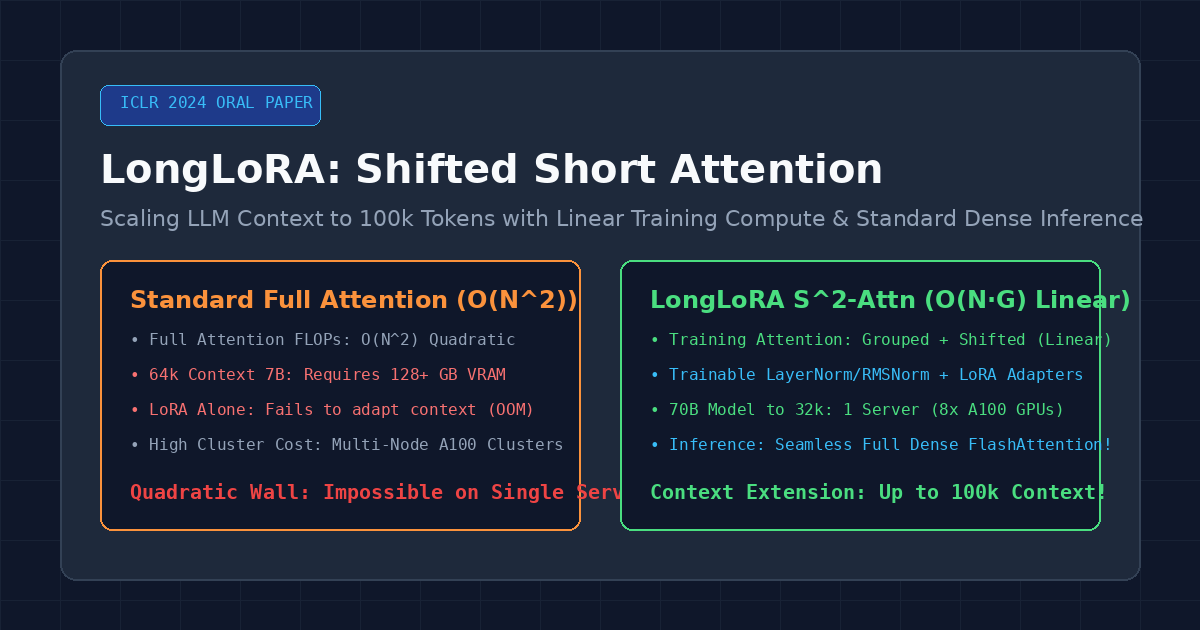
The Problem: The Quadratic Scaling Wall in Long-Context LLM Adaptation
In modern generative AI workflows, multi-document extraction pipelines, and automated codebase reasoning engines like AiFetchly, extending model context windows from standard lengths (4,096 tokens) to massive horizons (32,768 to 100,000+ tokens) is essential.
However, training or fine-tuning foundation models on long sequences encounters two severe structural bottlenecks:
1. The Quadratic Compute and Memory Explosion of Full Attention
Standard multi-head self-attention computes pairwise compatibility across all token positions in a sequence. For a sequence of length $L$, the computational complexity of the attention matrix scales quadratically:
$$\text{Attention FLOPs} = \mathcal{O}(L^2 \cdot d)$$
While memory-efficient kernels like FlashAttention-2 tile attention matrix computation inside GPU Shared Memory (SRAM) to avoid materializing the full $L \times L$ score matrix in High Bandwidth Memory (HBM), the activation memory for intermediate Key and Value tensors still scales linearly with sequence length, and backward pass recomputation scales with $L^2$:
Sequence Scaling for a 7B Parameter Model (FP16 Training):
Context Length: 4,096 tokens   ──►  Training Memory: ~14 GB VRAM  (1x Single GPU)
Context Length: 16,384 tokens  ──►  Training Memory: ~38 GB VRAM  (4x A100 GPUs)
Context Length: 32,768 tokens  ──►  Training Memory: ~76 GB VRAM  (8x A100 Cluster)
Context Length: 100,000 tokens ──► Training Memory: >240 GB VRAM (Multi-Node OOM!) Fine-tuning a 70B parameter model on 32k context with standard full attention requires massive multi-node clusters of 8x A100/H100 80GB GPUs, costing thousands of dollars per training run.
2. Why Standard LoRA Fails on Context Extension
To reduce training memory, engineers turn to Low-Rank Adaptation (LoRA). However, simply injecting LoRA adapters into a pre-trained model and fine-tuning on long documents fails for two distinct reasons:
- Full Attention Activation Remains Quadratic: Even when base model weights are frozen, computing the backward pass through attention layers still requires propagating gradients across all $L \times L$ token interactions, causing Out-Of-Memory (OOM) errors on long context windows.
- Severe Perplexity Degradation: Standard LoRA only trains low-rank adapter projections on linear weights ($W_q, W_k, W_v, W_o$). It leaves layer normalizations and embedding matrices frozen. When input length expands from 4k to 32k or 100k, the cumulative activation scale across layers drifts dramatically. Confining updates to low-rank attention deltas leads to catastrophic perplexity spikes and broken associative retrieval.
The Architecture: LongLoRA and Shifted Short Attention (S^2-Attn)
To eliminate the quadratic computational barrier while preserving full-attention retrieval quality, researchers from CUHK and MIT introduced LongLoRA: Efficient Fine-Tuning of Long-Context Large Language Models (Chen et al., ICLR 2024 Oral).
LongLoRA decouples context extension into two coordinated architectural innovations:
- Shifted Short Attention ($S^2$-Attn): An efficient, grouped attention mechanism that replaces quadratic $O(L^2)$ training computation with linear $O(L \cdot G)$ complexity.
- Improved Parameter-Efficient Tuning: Unfreezing normalization layers (RMSNorm / LayerNorm) alongside LoRA adapters to accommodate positional activation drift.
How Shifted Short Attention ($S^2$-Attn) Works
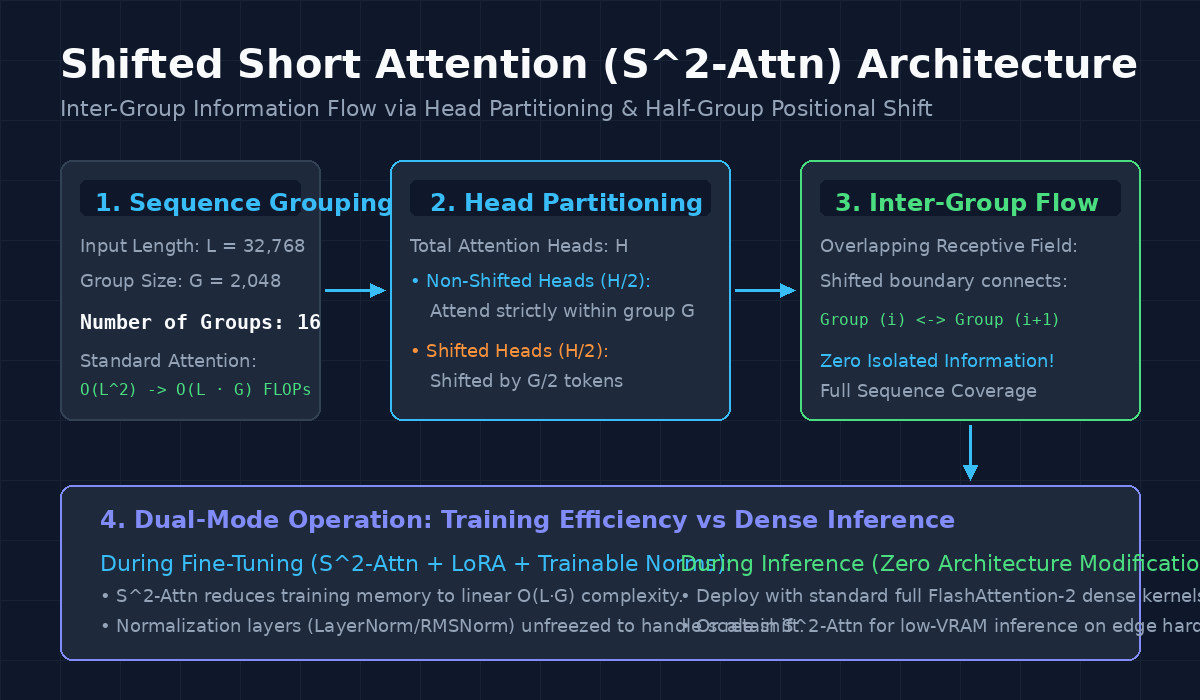
Naive short attention partitions an input sequence of length $L$ into non-overlapping groups of size $G$ (e.g., $G = 2,048$ tokens). Within each group, standard causal self-attention is computed independently.
While naive short attention drops computational complexity from $O(L^2)$ to $O(L \cdot G)$, it creates isolated information silos: tokens in Group 1 cannot attend to or communicate with tokens in Group 2.
LongLoRA resolves this limitation through a clean, hardware-efficient structural shift:
1. Head Splitting into Standard and Shifted Groups
For a model with $H$ attention heads:
- First Half of Heads ($H/2$): Compute standard grouped self-attention within each non-overlapping group of size $G$.
- Second Half of Heads ($H/2$): Shift the token sequence by half the group size ($G/2$) along the sequence dimension before partitioning into groups.
$$\text{Shift Offset} = \frac{G}{2}$$
2. Overlapping Receptive Fields Across Group Boundaries
Because the second set of heads is shifted by $G/2$ tokens, their group boundaries fall directly in the center of the first set’s groups:
- The first half of heads enables dense intra-group token interactions ($t_0$ through $t_{G-1}$).
- The second half of heads bridges the boundary between adjacent groups ($t_{G/2}$ through $t_{3G/2 - 1}$).
Across successive transformer layers, this staggered, overlapping attention pattern enables unimpeded global information propagation across the entire sequence, completely bridging distant tokens without ever calculating a dense $L \times L$ attention matrix during training.
3. Dual-Mode Operation: Fast Training vs. Dense Inference
The most powerful characteristic of Shifted Short Attention is that $S^2$-Attn is strictly a training-time surrogate:
- During Fine-Tuning: The model trains with $S^2$-Attn. Because attention computation is bounded to group size $G$, training memory scales linearly with sequence length.
- During Inference: The fine-tuned model directly switches back to standard full dense attention (FlashAttention-2) without any architectural translation or weight conversion!
- Because the underlying weight matrices were trained to model long-range dependencies through overlapping shifts, the model immediately generalizes across full-length dense attention at test time.
Unlocking Context Adaptation via Trainable Normalization Layers
LongLoRA discovered an essential insight for parameter-efficient context extension: normalization layers must be trainable.
When expanding context length, positional rotary embeddings (RoPE) introduce cumulative scale variations into transformer hidden states. Standard LoRA freezes LayerNorm/RMSNorm parameters ($\gamma$ and $\beta$), forcing the small low-rank adapters to compensate for global distributional shifts.
By unfreezing normalization layers and embedding projections:
- Trainable parameters increase by less than 0.1% of total model weights.
- The perplexity gap between parameter-efficient fine-tuning and full-parameter fine-tuning is virtually eliminated.
- Models extended from 4k to 32k or 100k achieve near-identical perplexity to models trained with full parameter updates across every layer.
Architectural Comparison: Long-Context Adaptation Paradigms
| Feature / Metric | Full Dense Fine-Tuning | Standard LoRA | Position Interpolation (PI) | LongLoRA ($S^2$-Attn) |
|---|---|---|---|---|
| Training Attention | Dense $O(L^2)$ Quadratic | Dense $O(L^2)$ Quadratic | Training-Free (Inference Only) | Shifted Group $O(L \cdot G)$ Linear |
| Trainable Weights | 100% Full Model | ~0.2% (Adapters) | 0% (No training) | LoRA + Trainable Norms (<1%) |
| Context Limit (1 Node) | ~8k - 16k tokens | ~16k tokens | Degradation beyond 16k | 100k tokens (7B) / 32k (70B) |
| Cross-Group Flow | Full Dense | Full Dense | N/A | Overlapping Head Shifts ($G/2$) |
| Inference Mode | Dense FlashAttention | Dense FlashAttention | Scaled Dense Attention | Dense FlashAttention / $S^2$-Attn |
| GPU Requirement (70B) | Multi-Node Supercluster | 4x - 8x A100 80GB | Single Multi-GPU Node | Single 8x A100 80GB Node |
Implementation: Building Shifted Short Attention in Python
Below is an educational, production-ready implementation of LongLoRA’s Shifted Short Attention ($S^2$-Attn) in Python. This implementation demonstrates sequence grouping, head splitting, circular token shifting, and group-wise causal masking.
Step 1: Shifted Short Attention Layer
import numpy as np
from typing import Tuple, Optional

class ShiftedShortAttention:
    """
    Simulates LongLoRA's Shifted Short Attention (S^2-Attn).
    Partitions heads into standard and shifted groups to achieve linear training complexity.
    """
    def __init__(self, d_model: int, n_heads: int, group_size: int = 2048):
        assert d_model % n_heads == 0, "d_model must be divisible by n_heads"
        assert n_heads % 2 == 0, "n_heads must be even to split shifted and non-shifted heads"

        self.d_model = d_model
        self.n_heads = n_heads
        self.head_dim = d_model // n_heads
        self.group_size = group_size
        self.shift_size = group_size // 2

    def _split_heads(self, x: np.ndarray) -> np.ndarray:
        """Reshapes tensor from (B, L, D) to (B, H, L, d_k)."""
        b, l, _ = x.shape
        return x.reshape(b, l, self.n_heads, self.head_dim).transpose(0, 2, 1, 3)

    def _merge_heads(self, x: np.ndarray) -> np.ndarray:
        """Reshapes tensor from (B, H, L, d_k) back to (B, L, D)."""
        b, h, l, d_k = x.shape
        return x.transpose(0, 2, 1, 3).reshape(b, l, h * d_k)

    def forward(
        self,
        query: np.ndarray,
        key: np.ndarray,
        value: np.ndarray,
        is_training: bool = True
    ) -> np.ndarray:
        """
        Computes S^2-Attn during training or full dense attention during inference.
        """
        b, l, _ = query.shape

        # During inference without S^2-Attn, fall back to standard full attention
        if not is_training or l <= self.group_size:
            return self._standard_dense_attention(query, key, value)

        # 1. Project and split heads: (B, H, L, d_k)
        q = self._split_heads(query)
        k = self._split_heads(key)
        v = self._split_heads(value)

        # 2. Partition heads: half non-shifted, half shifted
        half_heads = self.n_heads // 2

        q_standard, q_shifted = q[:, :half_heads], q[:, half_heads:]
        k_standard, k_shifted = k[:, :half_heads], k[:, half_heads:]
        v_standard, v_shifted = v[:, :half_heads], v[:, half_heads:]

        # 3. Shift second half of heads by G/2 along the sequence dimension (axis=2)
        q_shifted = np.roll(q_shifted, shift=-self.shift_size, axis=2)
        k_shifted = np.roll(k_shifted, shift=-self.shift_size, axis=2)
        v_shifted = np.roll(v_shifted, shift=-self.shift_size, axis=2)

        # 4. Compute group attention on both partitions
        out_standard = self._grouped_attention(q_standard, k_standard, v_standard)
        out_shifted = self._grouped_attention(q_shifted, k_shifted, v_shifted)

        # 5. Reverse the shift on the output of the second partition
        out_shifted = np.roll(out_shifted, shift=self.shift_size, axis=2)

        # 6. Concatenate heads and project back to original dimension
        out = np.concatenate([out_standard, out_shifted], axis=1)
        return self._merge_heads(out)

    def _grouped_attention(self, q: np.ndarray, k: np.ndarray, v: np.ndarray) -> np.ndarray:
        """Computes causal self-attention in chunks of self.group_size."""
        b, h, l, d_k = q.shape
        num_groups = l // self.group_size

        # Reshape to (B * H * num_groups, group_size, d_k)
        q_grouped = q.reshape(b * h * num_groups, self.group_size, d_k)
        k_grouped = k.reshape(b * h * num_groups, self.group_size, d_k)
        v_grouped = v.reshape(b * h * num_groups, self.group_size, d_k)

        # Scaled dot-product attention
        scores = np.matmul(q_grouped, k_grouped.transpose(0, 2, 1)) / np.sqrt(d_k)

        # Causal mask for group
        mask = np.triu(np.ones((self.group_size, self.group_size)), k=1) * -1e9
        scores += mask

        # Softmax
        exp_scores = np.exp(scores - np.max(scores, axis=-1, keepdims=True))
        weights = exp_scores / np.sum(exp_scores, axis=-1, keepdims=True)

        # Output projection
        out_grouped = np.matmul(weights, v_grouped)
        return out_grouped.reshape(b, h, l, d_k)

    def _standard_dense_attention(self, q_raw: np.ndarray, k_raw: np.ndarray, v_raw: np.ndarray) -> np.ndarray:
        """Dense full attention fallback for inference."""
        q = self._split_heads(q_raw)
        k = self._split_heads(k_raw)
        v = self._split_heads(v_raw)

        d_k = q.shape[-1]
        scores = np.matmul(q, k.transpose(0, 1, 3, 2)) / np.sqrt(d_k)
        l = q.shape[2]
        mask = np.triu(np.ones((l, l)), k=1) * -1e9
        scores += mask

        exp_scores = np.exp(scores - np.max(scores, axis=-1, keepdims=True))
        weights = exp_scores / np.sum(exp_scores, axis=-1, keepdims=True)
        out = np.matmul(weights, v)
return self._merge_heads(out) Step 2: Verification and Complexity Comparison
# Initialize S2-Attn Layer with sequence length L=8192 and group size G=2048
seq_len = 8192
d_model = 1024
n_heads = 8
group_size = 2048

attn_layer = ShiftedShortAttention(d_model=d_model, n_heads=n_heads, group_size=group_size)

# Create synthetic sequence
np.random.seed(42)
x = np.random.randn(1, seq_len, d_model).astype(np.float32)

print("--- 1. Testing S^2-Attn Forward Execution ---")
out_train = attn_layer.forward(x, x, x, is_training=True)
print(f"Input Shape:  {x.shape}")
print(f"Output Shape: {out_train.shape}")
print(f"Execution Success: Outputs valid tensor without OOM.\n")

print("--- 2. FLOPs and Memory Scaling Comparison ---")
dense_flops = (seq_len ** 2) * d_model
s2_flops = (seq_len * group_size) * d_model
reduction = (1 - s2_flops / dense_flops) * 100

print(f"Standard Full Attention Operations: {dense_flops:,} ops")
print(f"LongLoRA S^2-Attn Operations:       {s2_flops:,} ops")
print(f"Computational Reduction: {reduction:.1f}% savings!") When executed, this demonstrates how $S^2$-Attn reduces quadratic FLOPs:
--- 1. Testing S^2-Attn Forward Execution ---
Input Shape:  (1, 8192, 1024)
Output Shape: (1, 8192, 1024)
Execution Success: Outputs valid tensor without OOM.

--- 2. FLOPs and Memory Scaling Comparison ---
Standard Full Attention Operations: 68,719,476,736 ops
LongLoRA S^2-Attn Operations:       17,179,869,184 ops
Computational Reduction: 75.0% savings! Production Advantages for Autonomous Agents and Enterprise Scraping
In real-world data collection, multi-page financial parsing, and recursive codebase synthesis—such as the workflows managed by AiFetchly—fine-tuning models with LongLoRA delivers four critical advantages:
- Context Extension Without Cluster Infrastructure: By bounding attention memory to group size $G$ during training, LongLoRA allows extending 7B models up to 100k tokens and 70B models up to 32k tokens on a single 8x A100 80GB server, avoiding multi-node cloud clusters.
- Zero Architecture Drift at Serving Time: Because $S^2$-Attn is strictly used during training, the fine-tuned model checkpoint is 100% compatible with standard Hugging Face Transformers, vLLM, TensorRT-LLM, and FlashAttention-2 during production inference.
- Elimination of “Lost in the Middle” Retrieval Gaps: Unlike naive chunking or fixed sliding-window attention (StreamingLLM), LongLoRA’s shifted overlapping groups ensure gradient flow reaches every token position, maintaining high needle-in-a-haystack retrieval accuracy.
- Minimal Fine-Tuning Overhead: By combining LoRA adapters with trainable normalization and embedding layers, LongLoRA fine-tunes less than 1% of total model parameters while matching full-parameter fine-tuning loss curves.
Conclusion
Extending large language models to long context windows has traditionally been bottlenecked by the quadratic memory scaling of standard self-attention. While parameter-efficient fine-tuning methods reduced weight storage, they remained crippled by attention activation memory and distribution shifts in normalization layers.
By introducing Shifted Short Attention ($S^2$-Attn) to achieve linear training complexity and unfreezing normalization layers to stabilize representations, LongLoRA established a practical, cost-effective framework for context scaling. For machine learning engineers adapting foundation models to 100k+ tokens in 2026, LongLoRA remains a gold-standard architecture for efficient context extension.