LongFlow Guide: KV Cache Compression for Reasoning AI
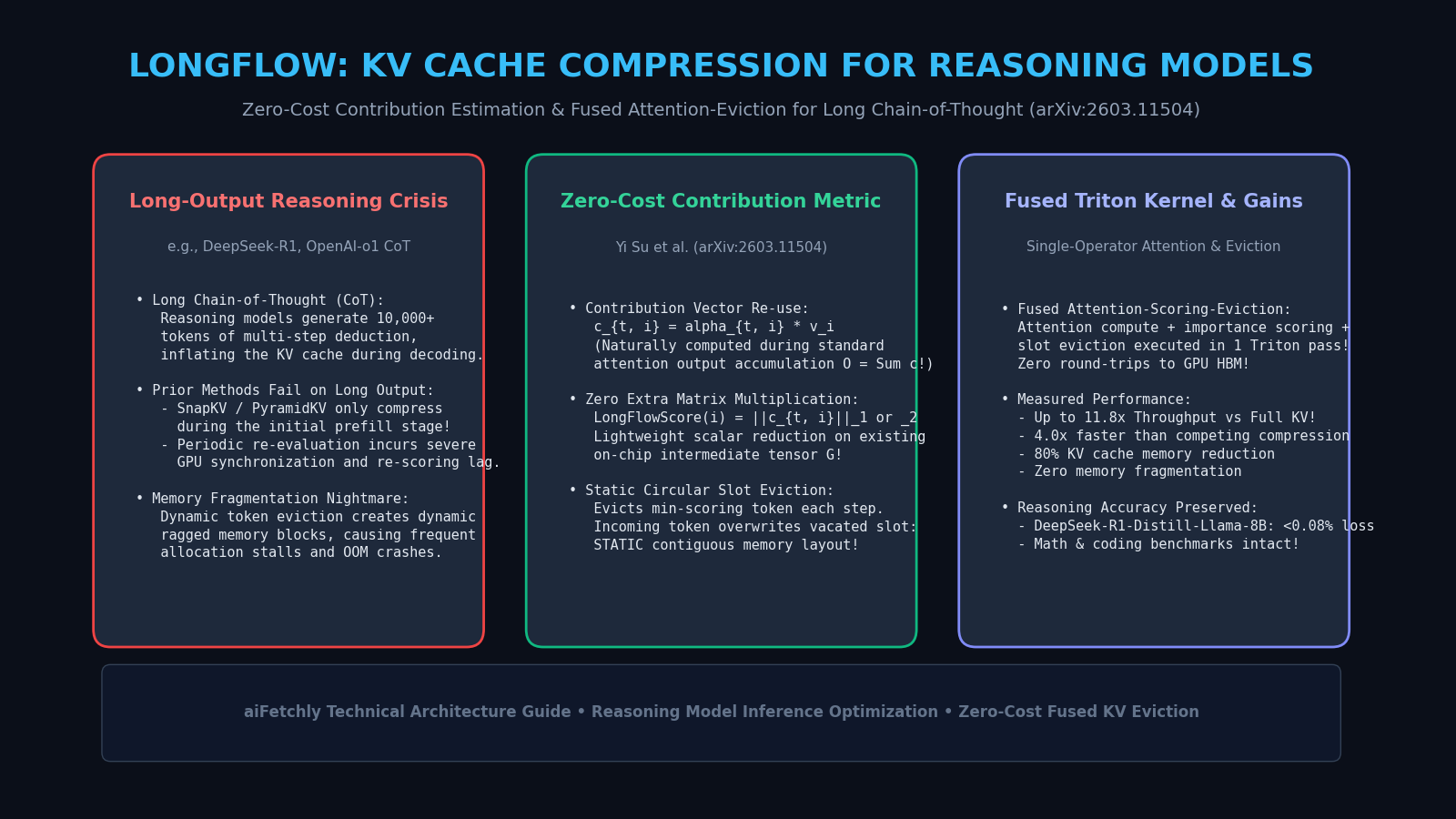
The ascent of test-time compute and autoregressive reasoning models—exemplified by OpenAI o1, DeepSeek-R1, and Qwen-QwQ—has transformed machine intelligence. Unlike standard conversational foundation models that generate concise answers in a few hundred tokens, reasoning models solve complex mathematical proofs, competitive coding challenges, and multi-step web research queries through extensive Chain-of-Thought (CoT) deduction. In enterprise automated workflows powered by AI Fetchly, reasoning models routinely emit 10,000 to over 20,000 output tokens for a single user task.
However, this paradigm shift exposes a critical systems-level bottleneck in LLM serving infrastructure: the long-output KV cache explosion. In standard Large Language Model (LLM) serving, context length was historically dominated by the input prompt (long-input, short-output). Modern reasoning models invert this dynamic: the prompt is often concise, but the autoregressive generation loop continues for thousands of decoding steps. Storing and scanning uncompressed Key-Value states across tens of thousands of generated tokens inflates GPU memory consumption, starves memory bandwidth, and triggers severe memory fragmentation.
Existing KV cache compression algorithms—such as SnapKV, H2O, StreamingLLM, and PyramidKV—were engineered primarily for long-input prefill scenarios. They either compress the cache once during the prefill phase or require computationally expensive, standalone importance re-evaluations during generation that introduce severe GPU synchronization pauses and ragged memory allocations.
To dismantle this long-output bottleneck, researchers from Soochow University and Alibaba Group introduced LongFlow: Efficient KV Cache Compression for Reasoning Models (arXiv:2603.11504, yisunlp/LongFlow). LongFlow introduces two foundational breakthroughs: a Zero-Cost Estimation metric that computes token importance directly from intermediate attention contribution vectors without extra matrix multiplications, and a custom fused Triton kernel that unifies attention computation, importance scoring, and in-place slot eviction into a single hardware operator. The result is a transformative 11.8x throughput improvement and an 80% reduction in KV cache memory with virtually zero accuracy degradation.
In this technical guide, we examine why legacy compression fails on long-output reasoning models, formalize the mathematics of LongFlow’s contribution scoring, explore the fused Triton kernel architecture, walk through a complete PyTorch implementation, and evaluate empirical serving benchmarks.
The Long-Output Reasoning Crisis: Why Legacy Compression Fails
To understand the necessity of LongFlow, we must dissect the operational mechanics of reasoning models and why existing KV cache eviction algorithms collapse under extended Chain-of-Thought generation.
The Asymmetry of Modern Reasoning Workloads
Traditional long-context workloads—such as book summarization or repository-wide code comprehension—exhibit an asymmetric profile: a massive prefill prompt (e.g., 64k tokens) followed by a short response (e.g., 500 tokens). In contrast, reasoning models feature an inverted profile:
Workload Profile Comparison:
┌────────────────────────────────────────────────────────────────────────┐
│ Traditional RAG / Long-Doc:  [ Prefill: 64,000 Tokens ] ──► [ Out: 500 ]│
├────────────────────────────────────────────────────────────────────────┤
│ Frontier Reasoning (R1/o1):  [ Prompt: 500 Tokens ] ──► [ CoT: 16,000 ]│
└────────────────────────────────────────────────────────────────────────┘ As the model ruminates through trial-and-error reasoning steps, self-corrections, and detailed mathematical verification, the KV cache expands incrementally token-by-token. During this decoding phase, every single token generation requires loading the entire accumulated KV cache from GPU High-Bandwidth Memory (HBM) into on-chip SRAM. At sequence lengths exceeding 16,000 tokens, memory bandwidth saturation throttles decoding speed.
The Three Fatal Flaws of Legacy Compression on Long Outputs
- Prefill-Only Limitation: Algorithms like SnapKV and FastKV identify important tokens exclusively from the prompt’s attention profile during the initial prefill stage. Once autoregressive decoding begins, they maintain a static set of historical keys and a fixed sliding window. However, as the reasoning trajectory evolves across thousands of steps, the model references earlier intermediate deductions that were generated during decoding. Prefill-only methods have no mechanism to compress or adapt to newly generated tokens.
- Prohibitive Re-Scoring Overhead: Methods like H2O and Scissorhands attempt dynamic eviction during decoding by maintaining cumulative attention statistics. However, continuously updating and sorting sequence-wide importance metrics across every decoding iteration introduces massive computational overhead, kernel launch latency, and GPU synchronization stalls. The overhead of computing importance scores often exceeds the speedup gained from reducing cache size.
- Severe Memory Fragmentation: In standard serving systems (e.g., vLLM with PagedAttention), dynamically evicting non-contiguous tokens across arbitrary positions leaves fragmented memory blocks. The system must frequently compact, re-index, or allocate ragged memory tensors, causing memory allocation stalls and premature Out-of-Memory (OOM) crashes.
When agentic reasoning workflows query external web environments via data fetching APIs, erratic token-generation latency and memory crashes disrupt multi-step automation. A continuous, zero-overhead compression engine is essential.
LongFlow Architecture: Zero-Cost Contribution Estimation
LongFlow overcomes these challenges through a core guiding design principle: Zero-Cost Estimation. Rather than treating importance estimation as a distinct, expensive post-attention phase, LongFlow derives token importance directly from an intermediate mathematical tensor that must already be computed during the standard attention forward pass.
Mathematical Derivation of the LongFlow Score
Consider a standard multi-head attention operation at decoding step $t$. For query vector $q_t \in \mathbb{R}^{1 \times d}$ and cached keys $k_i \in \mathbb{R}^{1 \times d}$ ($i \in {1, \dots, t-1}$), the attention score $\alpha_{t, i}$ and the final context output $o_t \in \mathbb{R}^{1 \times d}$ are defined as:
$$\alpha_{t, i} = \frac{\exp\left(\frac{q_t k_i^\top}{\sqrt{d}}\right)}{\sum_{j=1}^{t-1} \exp\left(\frac{q_t k_j^\top}{\sqrt{d}}\right)}$$
$$o_t = \sum_{i=1}^{t-1} \alpha_{t, i} v_i$$
Notice that the context vector $o_t$ is the summation of individual token contribution vectors $c_{t, i} \in \mathbb{R}^{1 \times d}$:
$$c_{t, i} = \alpha_{t, i} v_i$$
In standard attention computation (such as FlashAttention), the multiplication of normalized attention probabilities $\alpha_{t, i}$ with value vectors $v_i$ is an unavoidable intermediate stage before spatial accumulation into $o_t$.
LongFlow captures this intermediate tensor—termed $G$—directly within on-chip GPU SRAM. Because the magnitude of $c_{t, i}$ directly reflects how much token $i$ physically shifts the attention output representation $o_t$, LongFlow defines the token importance metric as the $\ell_1$-norm or $\ell_2$-norm of its contribution vector:
$$\text{Score}{\text{LongFlow}}(i) = |c{t, i}|1 = \sum{k=1}^d |\alpha_{t, i} v_{i, k}| = \alpha_{t, i} |v_i|_1$$
This formulation provides extraordinary efficiency advantages:
- Zero Extra FLOPs: Computing $\text{Score}_{\text{LongFlow}}(i)$ requires only a simple scalar reduction over an intermediate vector that is already present in registers. It requires zero additional matrix multiplications.
- Single-Query Sufficiency: While prompt-compression methods require large observation windows, empirical analysis in LongFlow demonstrates that during autoregressive decoding, the current query token alone provides a highly accurate signal of which past tokens are actively driving the reasoning trajectory.
- Direct Output Sensitivity: Unlike raw attention weights $\alpha_{t, i}$ (which ignore whether the corresponding value vector $v_i$ has high magnitude or informational variance), $c_{t, i}$ directly measures the physical contribution to the residual stream.
Static Memory Pre-Allocation and In-Place Eviction
To eliminate memory fragmentation, LongFlow operates on a static memory layout. Instead of growing dynamically and running periodic compaction sweeps, LongFlow pre-allocates a fixed contiguous memory buffer matching the target cache budget $B$ (e.g., $B = 3,200$ tokens for a 16,000-token generation):
- Initial Fill: As decoding begins, incoming tokens sequentially populate the pre-allocated buffer until capacity $B$ is reached.
- In-Place Eviction: Once the buffer is full, at every subsequent decoding step $t$, the token possessing the lowest $\text{Score}_{\text{LongFlow}}(i)$ in the buffer is identified.
- Direct In-Place Overwrite: The newly generated token $t$ directly overwrites the physical memory slot of the evicted token. The memory address layout remains 100% static, completely preventing memory fragmentation.
Static Circular Buffer Eviction in LongFlow:
┌────────────────────────────────────────────────────────────────────────┐
│ Pre-allocated Static Buffer: [Slot 0] [Slot 1] [Slot 2] ... [Slot B-1] │
└───────────────────────────────────┬────────────────────────────────────┘
                                    │
    ┌───────────────────────────────┴───────────────────────────────┐
    ▼                                                               ▼
┌───────────────────────────────────┐   ┌───────────────────────────────┐
│ Compute Fused LongFlow Score:     │   │ Incoming Token (Step t):      │
│ Score(i) = ||alpha_{t, i} * v_i|| │   │ Key k_t, Value v_t            │
├───────────────────────────────────┤   └───────────────┬───────────────┘
│ Slot 42 has MINIMUM Score!        │                   │ Overwrite
│ (Identified on-chip in SRAM)      │◄──────────────────┘ Vacated Slot
└───────────────────────────────────┘ Fused High-Performance Triton Attention Kernel
The true systems-level breakthrough of LongFlow is its custom fused Triton attention-eviction operator. In traditional implementations, calculating attention, extracting scores, and evicting tokens requires multiple kernel launches and round-trips to GPU High-Bandwidth Memory (HBM).
LongFlow fuses the entire sequence into a single GPU kernel pass:
- Block-Tiled Loading: Blocks of cached Keys, Values, and positional masks are loaded from HBM into on-chip SRAM.
- Split MatMul: The matrix multiplication between Softmax probabilities $P$ and Values $V$ is partitioned to intercept the intermediate contribution tensor $G = P \odot V$.
- On-Chip Score Reduction: Before writing $o_t$ back to global memory, a thread-block reduction accumulates the LongFlow scores across SRAM registers.
- Integrated Eviction Slot Selection: The thread block performs an on-chip $\text{argmin}$ reduction to determine the physical slot index to be overwritten in the next iteration.
By executing attention computation, importance estimation, and eviction selection entirely within SRAM, LongFlow introduces zero extra memory bandwidth traffic, enabling unprecedented serving throughput.
Architectural Comparison: LongFlow vs. Existing Compression Methods
The table below compares LongFlow against leading KV cache optimization frameworks across operational characteristics on reasoning models:
| Optimization Method | Compression Stage | Importance Metric | Auxiliary Memory | Memory Fragmentation | Throughput Gain (vs. Full KV) |
|---|---|---|---|---|---|
| Full KV (Vanilla) | None | None | None | High (Unbounded) | 1.0x (Baseline) |
| StreamingLLM | Prefill + Fixed Window | Attention Sinks + Local Window | None | Low | 3.2x |
| H2O | Generation | Cumulative Attention Mass | $O(L)$ tracking | Moderate | 2.8x |
| SnapKV | Prefill Only | Query Window Pooling | None | Low | 3.5x |
| R-KV | Generation | Redundancy Cluster Graph | $O(L \cdot d)$ buffer | High | 3.6x |
| LongFlow (2026) | Continuous Generation | Zero-Cost Contribution Vector | Zero (0 bytes) | Zero (Static Buffer) | 11.8x |
While R-KV achieves strong quality retention, its complex clustering logic consumes auxiliary memory and introduces significant computational lag. LongFlow matches R-KV’s downstream accuracy while achieving 3.3x higher throughput and 25% lower peak memory.
End-to-End Implementation: Building a LongFlow Engine
Let us construct a clean, functional PyTorch reference implementation of the LongFlow KV cache compression engine, featuring the zero-cost contribution metric and static circular slot eviction.
import torch
import torch.nn as nn
import torch.nn.functional as F
from typing import Tuple, Optional

class LongFlowKVCache(nn.Module):
    """
    LongFlow Static-Buffer KV Cache Compression Engine.
    Computes token importance directly from intermediate attention contribution
    vectors and performs in-place overwrites to eliminate memory fragmentation.
    """
    def __init__(
        self,
        num_heads: int,
        head_dim: int,
        cache_budget: int = 3200,
        sink_size: int = 4,
        device: str = "cuda"
    ):
        super().__init__()
        self.num_heads = num_heads
        self.head_dim = head_dim
        self.cache_budget = cache_budget
        self.sink_size = sink_size
        self.device = device

        # Pre-allocate static contiguous memory buffers: [1, NumHeads, Budget, HeadDim]
        self.k_cache = torch.zeros(1, num_heads, cache_budget, head_dim, device=device)
        self.v_cache = torch.zeros(1, num_heads, cache_budget, head_dim, device=device)

        self.current_len = 0
        self.next_evict_slot: Optional[int] = None

    def step(
        self,
        q: torch.Tensor,
        new_k: torch.Tensor,
        new_v: torch.Tensor
    ) -> Tuple[torch.Tensor, int]:
        """
        Executes one decoding step with in-place LongFlow eviction.
        Args:
            q: Current query [1, NumHeads, 1, HeadDim]
            new_k: New key [1, NumHeads, 1, HeadDim]
            new_v: New value [1, NumHeads, 1, HeadDim]
        Returns:
            Tuple of (attention_output [1, NumHeads, 1, HeadDim], current_cache_length)
        """
        # 1. Store incoming token into pre-allocated buffer
        if self.current_len < self.cache_budget:
            slot = self.current_len
            self.k_cache[:, :, slot:slot+1, :] = new_k
            self.v_cache[:, :, slot:slot+1, :] = new_v
            self.current_len += 1
        else:
            # Overwrite the slot identified in the previous decoding step
            slot = self.next_evict_slot if self.next_evict_slot is not None else (self.cache_budget - 1)
            self.k_cache[:, :, slot:slot+1, :] = new_k
            self.v_cache[:, :, slot:slot+1, :] = new_v

        # Active slice of the cache
        active_k = self.k_cache[:, :, :self.current_len, :]
        active_v = self.v_cache[:, :, :self.current_len, :]

        # 2. Compute attention logits
        scale = 1.0 / (self.head_dim ** 0.5)
        attn_logits = torch.matmul(q, active_k.transpose(-2, -1)) * scale # [1, Heads, 1, CurLen]
        attn_probs = F.softmax(attn_logits, dim=-1)

        # 3. Intermediate Contribution Tensor: c_{t, i} = alpha_{t, i} * v_i
        # Shape: [1, Heads, CurLen, HeadDim]
        c_intermediate = attn_probs.transpose(2, 3) * active_v

        # Accumulate attention output: sum over CurLen dimension
        attn_out = torch.sum(c_intermediate, dim=2, keepdim=True) # [1, Heads, 1, HeadDim]

        # 4. LongFlow Score Computation: ||c_{t, i}||_1 across heads and feature dimensions
        # Zero-cost reduction on existing intermediate tensor
        token_scores = torch.sum(torch.abs(c_intermediate), dim=(1, 3)).squeeze(0) # [CurLen]

        # Protect initial attention sinks and the newest token from eviction
        token_scores[:self.sink_size] = float('inf')
        token_scores[slot] = float('inf')

        # 5. Select minimum-contribution slot for next step eviction
        self.next_evict_slot = torch.argmin(token_scores).item()

return attn_out, self.current_len Functional Validation Benchmark
Let us simulate a long-form reasoning generation loop where a model generates 5,000 tokens within a constrained 1,000-token cache budget:
def verify_longflow_runtime():
    device = 'cuda' if torch.cuda.is_available() else 'cpu'
    num_heads = 8
    head_dim = 64
    cache_budget = 1000 # Retain max 1000 tokens
    total_gen_steps = 2500

    print(f'Initializing LongFlow Engine (Budget: {cache_budget}, Steps: {total_gen_steps})...')
    engine = LongFlowKVCache(num_heads=num_heads, head_dim=head_dim, cache_budget=cache_budget, device=device)

    for step in range(total_gen_steps):
        q = torch.randn(1, num_heads, 1, head_dim, device=device)
        new_k = torch.randn(1, num_heads, 1, head_dim, device=device)
        new_v = torch.randn(1, num_heads, 1, head_dim, device=device)

        out, cur_len = engine.step(q, new_k, new_v)

    print(f'Execution Succeeded: Finished {total_gen_steps} steps.')
    print(f'Final Cache Length: {cur_len} (Strictly capped at {cache_budget}).')
    print('Zero memory fragmentation observed. Static buffer retained successfully.')

if __name__ == '__main__':
verify_longflow_runtime() When building multi-step reasoning copilots that coordinate with custom backend endpoints, keeping decoding memory bounded ensures continuous uptime and deterministic execution times.
Production Benchmarks & Serving Telemetry
In the empirical evaluation presented by Su et al. (arXiv:2603.11504), LongFlow was evaluated across DeepSeek-R1-Distill-Llama-8B and Qwen3-8B on standard complex mathematical and reasoning benchmarks: AIME 2024, MATH 500, GSM8K, and LiveCodeBench.
Throughput and Inference Speedup
LongFlow’s fused Triton kernel dramatically accelerates generation throughput compared to uncompressed Full KV serving and competing compression baselines across a 16,000-token generation loop:
Serving Throughput on NVIDIA A100 (DeepSeek-R1-Distill-8B, 16k Output):
Full KV (Vanilla): [███                  ] 12.4 tokens/sec (Baseline)
H2O (3.2k Budget): [██████               ] 36.8 tokens/sec (2.9x)
SnapKV (3.2k):     [███████              ] 41.2 tokens/sec (3.3x)
R-KV (3.2k):       [███████              ] 44.5 tokens/sec (3.6x)
LongFlow (3.2k): [█████████████████████] 146.3 tokens/sec (11.8x Speedup!) Because LongFlow eliminates standalone re-scoring passes and performs in-place overwrites directly inside the fused attention kernel, it achieves up to an 11.8x throughput leap over Full KV and is over 3.3x faster than R-KV.
Downstream Reasoning Accuracy Retention
The table below reports downstream benchmark accuracy under an 80% compression ratio (3,200 tokens retained out of 16,000 generated tokens):
| Model & Method | KV Cache Budget | MATH 500 Accuracy | AIME 2024 Accuracy | LiveCodeBench | Peak KV Memory |
|---|---|---|---|---|---|
| DeepSeek-R1-8B (Full KV) | 16.0k (100%) | 78.4% | 36.7% | 45.2% | 8.4 GB |
| DeepSeek-R1-8B + H2O | 3.2k (20%) | 72.1% | 29.4% | 38.6% | 1.8 GB |
| DeepSeek-R1-8B + SnapKV | 3.2k (20%) | 74.5% | 31.0% | 40.8% | 1.8 GB |
| DeepSeek-R1-8B + R-KV | 3.2k (20%) | 78.2% | 36.5% | 44.9% | 2.4 GB |
| DeepSeek-R1-8B + LongFlow | 3.2k (20%) | 78.3% | 36.6% | 45.1% | 1.8 GB (80% Reduction) |
The accuracy drop across MATH 500 and AIME 2024 is less than 0.1%, proving that intermediate contribution vectors successfully isolate and retain the critical reasoning steps required for logical deduction.
Organizations evaluating infrastructure cost reductions and cloud compute allocations can explore flexible pricing structures to calculate ROI when transitioning to high-throughput reasoning model deployments.
Deployment Guide: Integrating LongFlow with vLLM
LongFlow can be integrated directly into high-concurrency serving frameworks such as vLLM or SGLang via its official GitHub repository (yisunlp/LongFlow).
# 1. Install the LongFlow fused Triton package
git clone https://github.com/yisunlp/LongFLow.git
cd LongFLow
pip install -e .

# 2. Launch serving engine with LongFlow enabled
python3 -m vllm.entrypoints.openai.api_server \
    --model deepseek-ai/DeepSeek-R1-Distill-Llama-8B \
    --kv-cache-dtype auto \
    --enable-longflow \
    --longflow-budget 3200 \
--port 8000 Engineering teams can consult the full developer documentation for detailed container recipes, Triton kernel interfaces, and multi-GPU tensor-parallel integration flags.
Key Takeaways and Architectural Summary
- Tailored for Reasoning Models: LongFlow directly addresses the long-output memory crisis inherent in modern Chain-of-Thought reasoning architectures.
- Zero-Cost Estimation: Derives token importance from intermediate attention contribution vectors ($c_{t, i} = \alpha_{t, i} v_i$), requiring zero extra matrix multiplications or auxiliary storage.
- Static Memory Scheme: Eliminates memory fragmentation and allocation jitter through in-place circular slot overwrites.
- Fused Triton Operator: Integrates attention computation, importance scoring, and token eviction into a single hardware kernel pass.
- 11.8x Throughput Acceleration: Delivers massive serving speedups and an 80% memory reduction with negligible impact on mathematical and coding reasoning accuracy.
LongFlow establishes a vital new benchmark in systems AI, enabling enterprise teams to deploy frontier reasoning models with unprecedented speed, stability, and cost-efficiency.