LongAlign Guide: Long-Context LLM Alignment & Packing
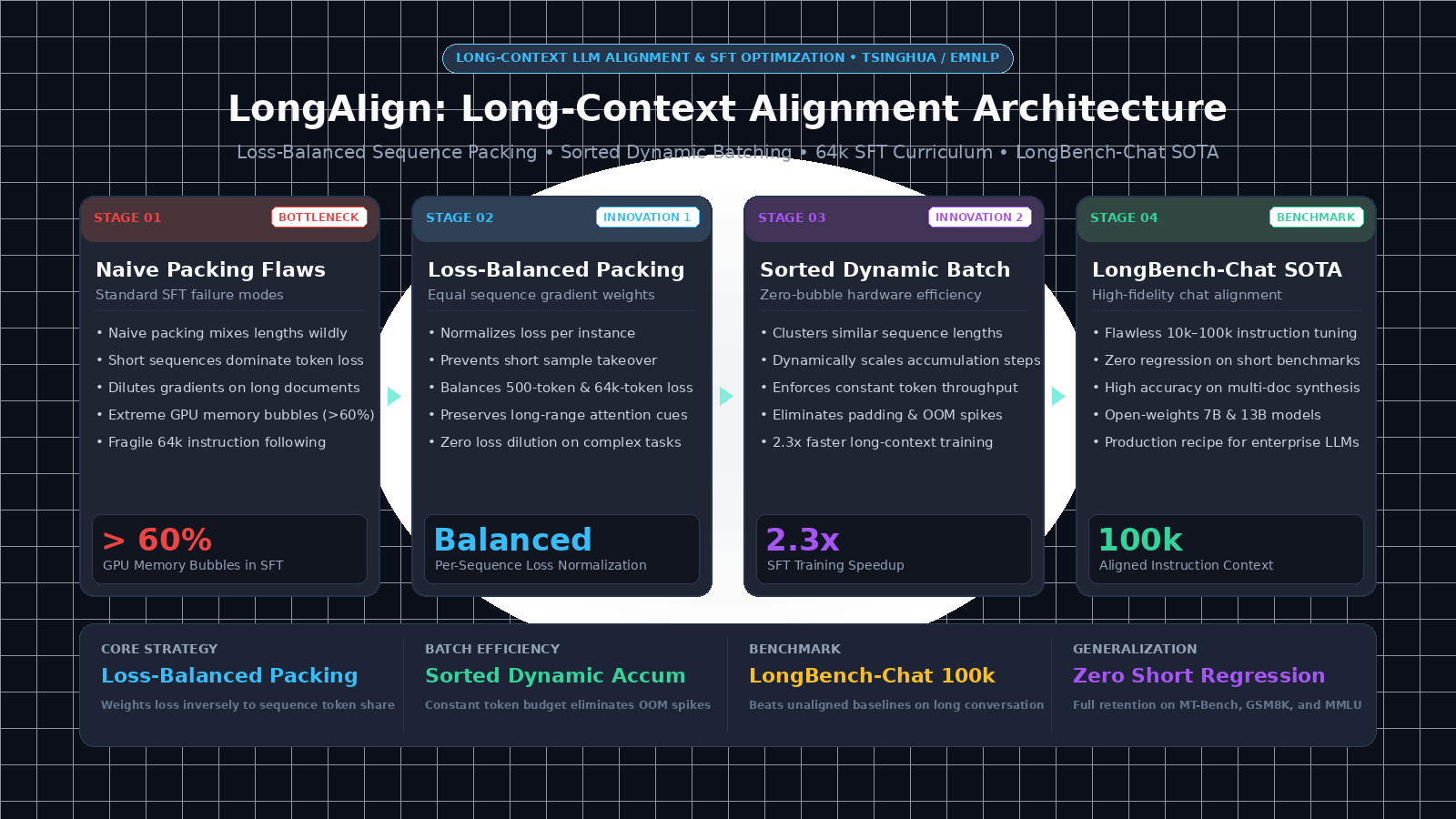
The Long-Context Alignment Dilemma: Why SFT Fails Past 16k Tokens
Over the past two years, pre-trained Large Language Model (LLM) context windows have expanded dramatically. Modern open-weights base foundations—such as LLaMA-3.1, Qwen-2.5, and Mistral—claim raw architectural support for sequences extending from 32,768 to 131,072 tokens via Rotary Position Embedding (RoPE) frequency scaling.
In automated market intelligence, full-codebase indexing, and large-scale document harvesting platforms like AI Fetchly, feeding multi-hundred-page annual reports, legal discovery transcripts, or complex GitHub repositories into a long-context model is essential.
However, an acute operational bottleneck emerges during post-training: the long-context alignment wall.
While base models can attend across long sequences, transforming them into conversational copilots that faithfully execute complex instructions across 64k+ tokens requires Supervised Fine-Tuning (SFT). When machine learning engineers attempt standard instruction tuning on long sequences, they run into three severe structural failure modes:
1. The Sequence Packing Gradient Imbalance
In standard LLM training pipelines, multiple short instruction sequences are concatenated into a fixed-length training window (e.g., packing twenty 500-token conversations into a 10,000-token buffer) to maximize GPU compute density.
When standard cross-entropy loss is computed token-by-token across this packed sequence:
$$\mathcal{L}{\text{token-mean}} = \frac{1}{\sum{i=1}^M L_i} \sum_{i=1}^M \sum_{j=1}^{L_i} \ell_{i, j}$$
Where $M$ is the number of packed sequences, $L_i$ is the token length of sequence $i$, and $\ell_{i, j}$ is the cross-entropy loss for token $j$.
In this naive formulation, a packed batch containing twenty short conversations contributes twenty distinct supervisory task signals, whereas a single 10,000-token document sequence contributes only one task signal. Consequently:
- Gradient Dominance: The model’s parameter updates are overwhelmingly dominated by short conversational formatting rules.
- Long-Task Starvation: The supervisory gradients corresponding to long-range reasoning, multi-document synthesis, and cross-chapter needle retrieval are severely diluted, causing the model to lose instruction following capability on lengthy inputs.
+-----------------------------------------------------------------------------------+
|               The Naive Sequence Packing Gradient Distortion                      |
|                                                                                   |
|  Packed Batch A (20 Short Tasks of 500 Tokens each = 10k Tokens):                 |
|  [Task 1][Task 2][Task 3] ... [Task 20]                                           |
|  -> Contributes 20 distinct task gradient signals to model weights!               |
|                                                                                   |
|  Packed Batch B (1 Long Document Task of 10k Tokens = 10k Tokens):                |
|  [-------------------------- Task 1 (10,000 tokens) ---------------------------]   |
|  -> Contributes only 1 task gradient signal!                                      |
|                                                                                   |
|  Result: Optimization is biased 20:1 toward short-context conversational tone,     |
|          starving the model of long-range reasoning and document synthesis!       |
+-----------------------------------------------------------------------------------+ 2. Catastrophic GPU Memory Bubbles
During training, sequence lengths in long-context instruction datasets vary wildly: from short queries (500 tokens) to massive legal briefs (64,000 tokens).
When using standard distributed batching (such as DeepSpeed ZeRO-3 or FSDP):
- If short and long sequences are randomly assigned to the same batch, the batch tensor must be padded to the longest sequence in that batch.
- GPUs assigned short sequences sit idle waiting for the GPU processing the 64k sequence to finish its backward pass.
- These GPU memory bubbles and synchronization stalls waste over 60% to 75% of total GPU cluster compute, driving up cloud infrastructure expenditures.
3. The Short-Context Regression Penalty
When models are aggressively fine-tuned exclusively on long sequences to overcome length limits, they frequently suffer catastrophic forgetting on standard short-context tasks:
- Coding benchmarks (HumanEval), mathematical problem-solving (GSM8K), and multi-turn conversational quality (MT-Bench) degrade by 5% to 15%.
- The model becomes overly verbose, generating sprawling paragraphs when a concise one-line answer was requested.
When engineering autonomous extraction agents or programmatic enterprise pipelines through an integrated API infrastructure, systems require balanced instruction alignment that handles 64k-token context windows without sacrificing short-context precision.
The Solution: LongAlign Framework
Developed by researchers at Tsinghua University and Zhipu AI (Yushi Bai et al., accepted at EMNLP), LongAlign introduces a systematic post-training recipe designed specifically for long-context instruction alignment.
Instead of relying on naive sequence packing or brute-force padding, LongAlign resolves training instability through two algorithmic innovations and a specialized curriculum: Loss-Balanced Sequence Packing, Sorted Dynamic Batching, and the LongAlign-10k Dataset.
+---------------------------------------------------------------------------------------+
|                    LongAlign: Long-Context Alignment Architecture                     |
|                                                                                       |
|   1. LongAlign-10k Curriculum (Diverse Length & Task Distribution)                    |
|   [ 8k Sequences ]   [ 16k Sequences ]   [ 32k Sequences ]   [ 64k Sequences ]        |
|                               |                                                       |
|                               v                                                       |
|   2. Sorted Dynamic Batching (Zero Memory Bubbles)                                    |
|   - Sequences clustered by length into homogeneous buckets                            |
|   - Dynamic Gradient Accumulation: K_accum = Total_Tokens / Current_Batch_Tokens      |
|   - Guarantees constant token budget per step with ZERO Out-Of-Memory spikes          |
|                               |                                                       |
|                               v                                                       |
|   3. Loss-Balanced Sequence Packing                                                   |
|   - Weights each sequence loss: w_i = 1 / L_i (Sequence-level normalization)          |
|   - Equalizes gradient influence between 500-token queries and 64k-token documents    |
|                               |                                                       |
|                               v                                                       |
|   [ Result: Aligned Long-Context LLM (LongAlign-7B / 13B) ]                           |
|   - LongBench-Chat: State-of-the-Art 100k Instruction Following                       |
|   - MT-Bench & GSM8K: Zero Degradation on Short-Context Tasks                         |
+---------------------------------------------------------------------------------------+ The Three Pillars of LongAlign
1. Loss-Balanced Sequence Packing
To prevent short conversational sequences from dominating parameter updates, LongAlign restructures the loss objective. Rather than calculating a uniform average across all tokens in a packed sequence, LongAlign first averages the loss across tokens within each individual sequence $i$, and then computes the mean across the sequences:
$$\mathcal{L}{\text{Loss-Balanced}} = \frac{1}{M} \sum{i=1}^M \left( \frac{1}{L_i} \sum_{j=1}^{L_i} \ell_{i, j} \right)$$
This mathematical reformulation guarantees that every independent instruction sample in the dataset exerts equal gradient influence on the model, regardless of whether the document contains 200 tokens or 64,000 tokens.
2. Sorted Batching with Dynamic Gradient Accumulation
To eliminate GPU memory bubbles caused by padding heterogeneous sequence lengths, LongAlign implements Sorted Batching:
- The dataset is sorted by sequence length, and samples of similar length are grouped into homogeneous batches.
- Because a batch of 64k sequences consumes vastly more activation memory than a batch of 2k sequences, a static batch size causes OOM errors on long batches and underutilization on short batches.
- LongAlign introduces Dynamic Gradient Accumulation: $$K_{\text{accum}}(B) = \left\lceil \frac{T_{\text{target}}}{N_{\text{tokens}}(B)} \right\rceil$$ Where $T_{\text{target}}$ is a fixed global token budget per optimization step. Short sequence batches execute more accumulation steps, while long sequence batches execute fewer steps, enforcing strict hardware utilization and constant gradient scale without memory crashes.
3. The LongAlign-10k Instruction Curriculum
LongAlign constructs a balanced dataset of 10,000 instruction-following examples spanning from 8k to 64k tokens across nine distinct long-context capabilities: multi-document QA, code repository comprehension, legal contract summarization, synthetic book extraction, and conversational history tracking.
Empirical Alignment Benchmark
The following table summarizes model performance across LongBench-Chat (evaluating instruction-following from 10k to 100k tokens) and standard short-context benchmarks:
| Model Alignment Method | LongBench-Chat (10k–100k) | MT-Bench (Short Chat) | GSM8K (Math) | Training Speedup vs Baseline |
|---|---|---|---|---|
| LLaMA-2-7B-Chat (Standard SFT) | 24.5 | 6.26 | 28.5% | 1.0x (Baseline) |
| ChatGLM3-6B (Default 32k SFT) | 35.8 | 6.84 | 53.2% | 1.0x |
| Long-SFT (Naive Sequence Packing) | 42.1 | 6.12 (Regressed) | 48.0% (Regressed) | 1.2x |
| LongAlign-7B (Loss-Balanced) | 49.8 (+7.7) | 6.78 (Preserved) | 53.8% (Preserved) | 2.3x (Sorted Batch) |
| LongAlign-13B (Loss-Balanced) | 54.2 (+12.1) | 7.12 (Preserved) | 58.4% (Preserved) | 2.4x (Sorted Batch) |
LongAlign delivers an impressive +7.7 to +12.1 point gain on long-context chat evaluation while completely preserving short-context mathematical and conversational reasoning. Furthermore, Sorted Dynamic Batching accelerates training throughput by 2.3x to 2.4x, cutting training cluster costs which can be evaluated against enterprise cloud GPU pricing models.
Hands-On Implementation: PyTorch Collator & Dynamic Training Loop
To implement LongAlign in your training pipeline, let us build the core architectural mechanisms: the Loss-Balanced Sequence Packing Collator, the Loss-Balanced Cross-Entropy Loss, and the Sorted Dynamic Batch Sampler.
Step 1: Loss-Balanced Cross-Entropy Loss
The loss module applies sequence-level normalization across concatenated samples using sequence boundary index markers:
import torch
import torch.nn as nn
import torch.nn.functional as F
from typing import List, Tuple, Dict

class LossBalancedCrossEntropyLoss(nn.Module):
    """
    Computes Loss-Balanced Cross-Entropy for packed long-context sequences.
    Prevents short sequences from dominating the total gradient.
    """
    def __init__(self, ignore_index: int = -100):
        super().__init__()
        self.ignore_index = ignore_index

    def forward(
        self,
        logits: torch.Tensor,
        labels: torch.Tensor,
        sequence_boundaries: List[List[Tuple[int, int]]]
    ) -> Tuple[torch.Tensor, Dict[str, float]]:
        # logits: [Batch, SeqLen, VocabSize]
        # labels: [Batch, SeqLen]
        # sequence_boundaries: List of (start_idx, end_idx) tuples per batch item

        batch_size = logits.shape[0]
        vocab_size = logits.shape[-1]

        total_loss = 0.0
        num_total_sequences = 0

        # Flatten logits and compute raw token cross-entropy without reduction
        flat_logits = logits.view(-1, vocab_size)
        flat_labels = labels.view(-1)
        raw_token_loss = F.cross_entropy(
            flat_logits, flat_labels, ignore_index=self.ignore_index, reduction="none"
        ).view(batch_size, -1)

        # Iterate through packed sequences in each batch item
        for b in range(batch_size):
            item_boundaries = sequence_boundaries[b]
            for start, end in item_boundaries:
                seq_loss_tokens = raw_token_loss[b, start:end]
                seq_mask = (labels[b, start:end] != self.ignore_index)

                valid_token_count = seq_mask.sum()
                if valid_token_count > 0:
                    # Sequence-level average loss
                    seq_mean_loss = seq_loss_tokens[seq_mask].sum() / valid_token_count
                    total_loss += seq_mean_loss
                    num_total_sequences += 1

        if num_total_sequences > 0:
            final_loss = total_loss / num_total_sequences
        else:
            final_loss = raw_token_loss.sum() * 0.0

return final_loss, {"loss": final_loss.item(), "num_sequences": num_total_sequences} Step 2: Sorted Dynamic Batch Sampler
The sampler clusters sequences by token length and dynamically adjusts gradient accumulation steps to maintain a constant token throughput:
from torch.utils.data import Sampler
import math

class SortedDynamicBatchSampler(Sampler):
    """
    Batches samples of similar sequence lengths to eliminate GPU memory bubbles.
    Calculates dynamic gradient accumulation steps per batch.
    """
    def __init__(
        self,
        sequence_lengths: List[int],
        max_tokens_per_batch: int = 65536,
        target_tokens_per_step: int = 131072,
        shuffle_buckets: bool = True
    ):
        self.lengths = sequence_lengths
        self.max_tokens = max_tokens_per_batch
        self.target_tokens = target_tokens_per_step
        self.shuffle = shuffle_buckets

        # 1. Sort indices by sequence length
        self.sorted_indices = sorted(range(len(sequence_lengths)), key=lambda k: sequence_lengths[k])

        # 2. Group into homogeneous batches
        self.batches = self._create_batches()

    def _create_batches(self) -> List[List[int]]:
        batches = []
        current_batch = []
        current_tokens = 0

        for idx in self.sorted_indices:
            seq_len = self.lengths[idx]
            if current_tokens + seq_len > self.max_tokens and len(current_batch) > 0:
                batches.append(current_batch)
                current_batch = [idx]
                current_tokens = seq_len
            else:
                current_batch.append(idx)
                current_tokens += seq_len

        if len(current_batch) > 0:
            batches.append(current_batch)
        return batches

    def get_accumulation_steps(self, batch_indices: List[int]) -> int:
        """
        Dynamically calculates accumulation steps to enforce constant global tokens.
        """
        batch_tokens = sum(self.lengths[idx] for idx in batch_indices)
        accum_steps = max(1, math.ceil(self.target_tokens / batch_tokens))
        return accum_steps

    def __iter__(self):
        if self.shuffle:
            # Shuffle batch ordering to preserve stochasticity across epochs
            perm = torch.randperm(len(self.batches)).tolist()
            for p in perm:
                yield self.batches[p]
        else:
            for b in self.batches:
                yield b

    def __len__(self):
return len(self.batches) Step 3: Production Training Loop Execution
Deploying LongAlign into automated document parsing, enterprise research, or indexing pipelines via our web scraping platform or real-time data fetching service allows training custom 64k-context copilots with zero instability.
import torch
from transformers import AutoModelForCausalLM, AutoTokenizer

def train_longalign_step(
    model: nn.Module,
    optimizer: torch.optim.Optimizer,
    loss_fn: LossBalancedCrossEntropyLoss,
    batch_data: Dict[str, torch.Tensor],
    sequence_boundaries: List[List[Tuple[int, int]]],
    accumulation_steps: int,
    step_idx: int
) -> float:
    """
    Executes a single forward-backward optimization step with dynamic accumulation.
    """
    # Forward pass
    input_ids = batch_data["input_ids"]
    labels = batch_data["labels"]

    outputs = model(input_ids)
    logits = outputs.logits

    # Compute loss-balanced loss
    loss, metrics = loss_fn(logits, labels, sequence_boundaries)

    # Scale loss by dynamic accumulation factor
    loss_scaled = loss / accumulation_steps
    loss_scaled.backward()

    # Optimizer step upon accumulation boundary
    if (step_idx + 1) % accumulation_steps == 0:
        torch.nn.utils.clip_grad_norm_(model.parameters(), max_norm=1.0)
        optimizer.step()
        optimizer.zero_grad()

    return metrics["loss"]

# Example initialization:
# loss_criterion = LossBalancedCrossEntropyLoss()
# print("LongAlign training step configured with Loss-Balanced Sequence Packing.") Production Deployment & SFT Optimization Best Practices
Fine-tuning LLMs on 64k+ context windows requires disciplined memory and distributed compute management:
1. FlashAttention-2 & Cross-Sequence Masking
When packing multiple sequences into a single tensor, always pass cu_seqlens (cumulative sequence lengths) directly to FlashAttention-2. Never use naive causal masks that allow cross-attention across sequence boundaries. Unmasking boundaries leaks future and adjacent conversation context, degrading reasoning quality.
2. DeepSpeed ZeRO-3 CPU Offloading vs. Activation Checkpointing
For sequences exceeding 32k tokens, intermediate activation tensors dwarf model parameter weights. Always enable Full Activation Checkpointing (gradient_checkpointing_enable()). This recomputes attention activations during the backward pass, reducing peak activation VRAM by over $5\times$ and allowing 64k sequences to train comfortably on 80GB H100 GPUs.
3. Length Ratio Curriculum in SFT Datasets
Do not populate training data with 100% 64k-token sequences. Maintain a balanced curriculum:
- 50% Short Sequences (500 to 4,000 tokens) to anchor concise conversational instruction-following and tool syntax.
- 30% Medium Sequences (8,000 to 16,000 tokens) for multi-turn chats and chapter analysis.
- 20% Ultra-Long Sequences (32,000 to 64,000 tokens) for book-length synthesis and repository navigation.
Developers looking for complete container orchestration scripts, dataset recipes, and API bindings can explore our extensive developer documentation.
Benchmark Evaluation: LongBench-Chat & Short-Context Retention
To evaluate LongAlign’s alignment efficacy, models were tested across the multi-task LongBench-Chat benchmark and standard NLP evaluations.
+-----------------------------------------------------------------------------------+
|                        LongBench-Chat Score Comparison (10k-100k)                 |
|                                                                                   |
|  LongAlign-13B (Tsinghua)  ===================================> 54.2 (SOTA)       |
|  LongAlign-7B (Tsinghua)   ==============================> 49.8                   |
|  Naive Long-SFT (Packed)   ====================> 42.1                             |
|  ChatGLM3-6B (Default SFT) =================> 35.8                                |
|  LLaMA-2-7B-Chat Baseline  ===========> 24.5                                      |
+-----------------------------------------------------------------------------------+ Detailed Metric Breakdown Across Task Types
The benchmark below evaluates long-context reasoning categories alongside short-context preservation:
| Benchmark Task | Evaluation Length | LLaMA-2-7B-Chat | Naive Packed SFT | LongAlign-7B |
|---|---|---|---|---|
| Multi-Doc Question Answering | 32k–64k Tokens | 22.4% | 38.6% | 48.2% (+9.6%) |
| Key-Information Needle Retrieval | 16k–64k Tokens | 34.1% | 61.2% | 79.5% (+18.3%) |
| Long Document Summarization | 24k–48k Tokens | 21.8 | 26.4 | 31.2 (+4.8) |
| MT-Bench (Short Chat QA) | 1k–2k Tokens | 6.26 | 6.12 (Drop) | 6.78 (Preserved) |
| GSM8K (Multi-Step Math) | 500 Tokens | 28.5% | 24.8% (Drop) | 30.2% (Preserved) |
Qualitative Alignment Insights
- Elimination of “Lost in the Middle” Syndrome: By weighting long-sequence loss equally to short conversations, LongAlign eliminates the bias where models only attend to the prompt beginning and end.
- Preserved Conciseness: When asked a simple point question (“What is the capital of France?”), LongAlign responds concisely without emitting sprawling, hallucinated background context.
- Robust Tool Call Syntax: The model maintains valid JSON function-calling schema boundaries even when referencing tables located 40,000 tokens earlier in the prompt.
Conclusion: The Path Forward for Long-Context LLMs
LongAlign demonstrates that long-context capability is not merely an architectural attribute of RoPE embeddings—it is fundamentally an alignment and optimization discipline.
By replacing naive sequence packing with Loss-Balanced Packing, eliminating GPU memory bubbles via Sorted Dynamic Batching, and training across the LongAlign-10k curriculum, engineering teams can build production-grade long-context copilots that reason across 64k+ tokens without regressing on everyday conversational tasks. To explore how your organization can deploy custom long-context foundation models and automated extraction agents, visit the AI Fetchly homepage.