Logic-RL Guide: Eliciting Reasoning with Rule-Based RL
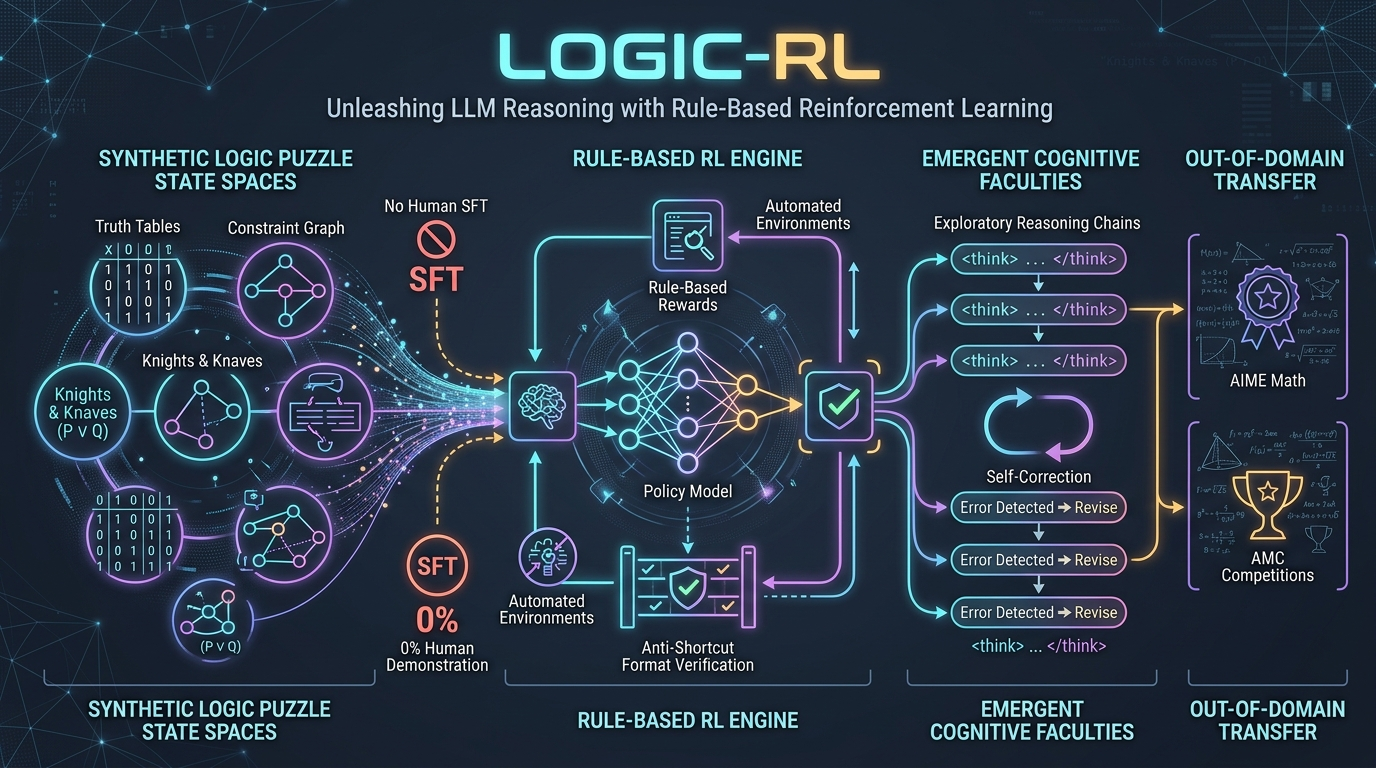
The Cold-Start Bottleneck in Reasoning Model Development
The release of DeepSeek-R1 and DeepSeek-R1-Zero sent shockwaves through the artificial intelligence landscape by proving that large language models can develop profound reasoning capabilities—including self-reflection, alternative hypothesis exploration, and verification—purely through reinforcement learning (RL) with rule-based verifiable rewards (RLVR). However, despite the conceptual elegance of the R1-Zero paradigm, replicating pure RL reasoning has presented immense hurdles for AI researchers and enterprise engineering teams:
- The Math and Code Data Trap: Most RLVR research relies heavily on competition mathematics (MATH, GSM8K, AIME) or competitive programming datasets (HumanEval, APPs). While these domains feature deterministic answer checking, they suffer from knowledge confounding: problems conflate raw deductive reasoning with factual domain knowledge (e.g., memorized geometric formulas, trigonometric identities, or language-specific APIs). Disentangling whether a model learned how to think or merely memorized mathematical theorems is notoriously difficult.
- Reward Hacking and Shortcut Exploitation: In naive rule-based RL setups, language models rapidly exploit reward functions. Policies discover that outputting immediate guesses without internal deliberation, guessing multiple answers within formatting tags, or emitting repetitive token loops can score partial credit while circumventing genuine cognitive compute.
- Training Instability and Policy Collapse: Reinforcement learning over free-form textual outputs frequently succumbs to catastrophic policy collapse, extreme gradient variance, and entropy crashes when reward signals are sparse and noisy.
For engineering teams architecting automated data intelligence—such as extracting unstructured corporate filings via automated web scraping or orchestrating complex analytics through real-time data fetching—enterprises need transparent, reproducible, and data-efficient recipes to train reasoning models on controlled environments without requiring millions of human demonstrations.
Can we elicit pure emergent reasoning using synthetic, controllable environments that require zero human annotation?
Enter Logic-RL: Pure Reasoning from Synthetic Logic Puzzles
In February 2025, researchers from the Hong Kong University of Science and Technology (HKUST), Microsoft Research, and Tsinghua University introduced Logic-RL: Unleashing LLM Reasoning with Rule-Based Reinforcement Learning (arXiv:2502.14768).
Logic-RL demonstrates that pure rule-based reinforcement learning can reproduce the emergent reasoning behaviors of DeepSeek-R1-Zero using synthetic logic puzzles as the primary training substrate:
- Controllable and Pure Deductive Environments: Synthetic logic puzzles (such as Knights and Knaves, grid deductions, and truth-teller puzzles) isolate formal deductive reasoning from pre-trained factual memorization. The complexity of the problem, number of entities, and constraint density can be programmatically controlled.
- Extreme Sample Efficiency: The researchers demonstrated that training a 7B language model (Qwen2.5-7B-Base / Instruct) on only 5,000 synthetic logic puzzles elicits full-fledged multi-step deliberation, spontaneous self-correction, and systematic backtracking.
- Zero-Shot Cross-Domain Generalization: Most remarkably, models trained exclusively on logic puzzles demonstrated strong out-of-domain transfer to challenging competition mathematics benchmarks, including the American Invitational Mathematics Examination (AIME) and the American Mathematics Competitions (AMC).
+---------------------------------------------------------------------------------------------------+
|                                  The Logic-RL Scientific Pipeline                                 |
+---------------------------------------------------------------------------------------------------+
|                                                                                                   |
|    1. SYNTHETIC LOGIC PUZZLE GENERATION                                                           |
|    =============================================================================================  |
|    Programmatically generate combinatorial logic problems (Knights & Knaves, Zebra, Truth Graphs) |
|    - Infinite scalable generation with zero human labeling cost                                   |
|    - 100% deterministic ground-truth verification via SAT/SMT solvers                             |
|                                                                                                   |
|                                                |                                                  |
|                                                v                                                  |
|    2. ANTI-SHORTCUT FORMAT REWARD & SYSTEM PROMPTING                                              |
|    =============================================================================================  |
|    Enforce structural separation: <think> ... </think> <answer> ... </answer>                     |
|    Penalize shortcut guessing, empty thought blocks, or malformed delimiters:                     |
|    R_total = R_accuracy * R_format                                                                |
|                                                                                                   |
|                                                |                                                  |
|                                                v                                                  |
|    3. RULE-BASED REINFORCEMENT LEARNING (GRPO)                                                    |
|    =============================================================================================  |
|    Sample G rollouts per puzzle -> Score with deterministic rule verifier -> GRPO policy updates   |
|    Emergent "Aha Moments": Model autonomously learns backtracking, hypothesis testing, reflection |
|                                                                                                   |
|                                                |                                                  |
|                                                v                                                  |
|    UNIVERSAL CROSS-DOMAIN GENERALIZATION                                                          |
|    =============================================================================================  |
|    Transfers zero-shot to AIME, AMC, and real-world multi-step enterprise workflows.              |
|                                                                                                   |
+---------------------------------------------------------------------------------------------------+ The Three Structural Pillars of Logic-RL
The Logic-RL framework addresses the fundamental stability issues of rule-based RL through three core contributions:
- Synthetic Logic as the Ideal Reasoning Testbed: By generating problems using constraint satisfaction algorithms, every puzzle has an unambiguous, provable ground-truth solution. There is zero human label noise, zero ambiguity, and zero risk of dataset contamination from web crawlers.
- Stringent Anti-Shortcut Format Reward: Naive RLVR agents frequently collapse into guessing shortcuts. Logic-RL introduces a multiplicative format gating function that nullifies accuracy rewards if the model fails to perform genuine deliberation inside
<think>tags. - Emergence Without Cold-Start SFT: The model receives zero human-written reasoning demonstrations. The entire thinking process—including verbalized phrases like “Wait, let me double check” and “This assumption leads to a contradiction”—emerges organically as the policy searches for reward maximization.
Mathematical Foundations and Architecture
To understand how Logic-RL trains language models to develop deductive reasoning, we analyze its formal Markov decision process, anti-shortcut reward function, and group relative policy optimization mechanics.
1. Problem Formulation and MDP
Each logic puzzle is defined as a tuple P = (X, C, Y*), where:
- X is the natural language problem statement describing entities, statements, and constraints.
- C is the formal boolean satisfiability constraint graph.
- Y* is the unique verified ground-truth assignment (e.g. Person A is a Knight, Person B is a Knave).
The language model acts as an agent in a single-turn contextual bandit setting with autoregressive token generation. Given prompt x ~ X, the policy pi_theta generates sequence y = (y_1, y_2, …, y_T). The trajectory y is partitioned into two structural components: y = [ <think>, tau_reason, </think>, <answer>, a_pred, </answer> ]
where tau_reason represents internal cognitive search tokens and a_pred represents the terminal answer.
2. The Anti-Shortcut Multiplicative Reward Function
In standard RLVR formulations, accuracy rewards and format rewards are combined additively: R_additive = R_acc + lambda_fmt * R_fmt
Under additive rewards, a model can achieve R = 1.0 by guessing the correct answer without any thinking tokens, or gain R = 0.2 by outputting valid format tags with gibberish answers. Over thousands of RL iterations, this causes policies to converge to low-effort shortcuts.
Logic-RL introduces a multiplicative gating reward formulation: R(x, y) = R_acc(y, Y*) * R_format(y) - lambda_len * Omega(y)
where:
- Accuracy Reward (R_acc): Evaluates strict equivalence between extracted prediction a_pred and ground truth Y*: R_acc = 1.0 if a_pred == Y*, else 0.0.
- Anti-Shortcut Format Gating (R_format): A binary indicator enforcing strict structural compliance: R_format = 1.0 if y contains valid <think>, </think>, <answer>, </answer> and length(tau_reason) >= L_min, else 0.0.
- Length Regularization (Omega(y)): Soft penalty applied if thought length exceeds maximum threshold L_max, preventing degenerate infinite repetition loops.
If a model attempts to output an answer without sufficient thinking steps (length(tau_reason) < L_min), R_format = 0.0, immediately setting the total reward to zero even if the guessed answer is correct.
+---------------------------------------------------------------------------------------+
|                        Reward Function Verification Pipeline                          |
+---------------------------------------------------------------------------------------+
|                                                                                       |
|   Generated Trajectory y                                                              |
|   |                                                                                   |
|   +---> Format Verifier Check:                                                        |
|   |     - Are <think> and </think> tags properly opened and closed?                   |
|   |     - Are <answer> and </answer> tags properly opened and closed?                 |
|   |     - Is length(think_tokens) >= L_min (e.g. 100 tokens)?                         |
|   |     - Is there exactly ONE answer inside <answer> tag?                            |
|   |                                                                                   |
|   |     [ Fails Any Condition ] ======> R_format = 0.0 =====> R_total = 0.0           |
|   |                                                                                   |
|   +---> [ Passes Format ]       ======> R_format = 1.0                                |
|                                                    |                                  |
|                                                    v                                  |
|                                         Symbolic Answer Match:                        |
|                                         Compare extracted pred with Y*                |
|                                         Match? R_acc = 1.0, else 0.0                  |
|                                                    |                                  |
|                                                    v                                  |
|                                         R_total = R_acc * R_format                    |
|                                                                                       |
+---------------------------------------------------------------------------------------+ 3. Group Relative Policy Optimization (GRPO)
Logic-RL utilizes Group Relative Policy Optimization (GRPO) without a separate critic network. For each input prompt x, the model samples G independent rollouts {y1, y_2, …, y_G} from policy pi{theta_old}.
Advantages A_hat_i are normalized across the group: A_hat_i = (R_i - mean({R_1, …, R_G})) / (std({R_1, …, R_G}) + eps)
The policy parameters theta are optimized by maximizing the clipped surrogate objective with KL penalty: J(theta) = E*{x, {y_i}} [ (1 / G) * sum*{i=1}^G (1 / |yi|) * sum{t=1}^{|yi|} ( min(r{i,t}(theta) _ Ahat_i, clip(r{i,t}(theta), 1 - eps, 1 + eps) _ A_hat_i) - beta * D_KL(pi_theta || pi_ref) ) ]
Production Implementation: Logic Puzzle Generator, Verifier, and GRPO
To demonstrate the concrete implementation of Logic-RL, we construct an end-to-end PyTorch and Python codebase. The implementation features:
- The
SyntheticKnightsKnavesGeneratorprogrammatically generating boolean constraint logic puzzles with verified ground-truth solutions. - The
AntiShortcutRewardVerifierenforcing format gating, minimum thinking length, and answer matching. - The
LogicRLGRPOTrainercalculating group relative advantages and clipped surrogate policy updates.
# logic_rl_core.py
# Production Implementation of Logic-RL Synthetic Generator, Anti-Shortcut Verifier, and GRPO
import torch
import torch.nn as nn
import torch.nn.functional as F
import random
import re
from typing import List, Dict, Tuple, Optional

class SyntheticKnightsKnavesGenerator:
    def __init__(self, seed: int = 42):
        random.seed(seed)
        self.names = ["Alice", "Bob", "Charlie", "David", "Eve"]

    def generate_puzzle(self, num_people: int = 3) -> Dict[str, any]:
        selected_names = self.names[:num_people]
        identities = {name: random.choice([True, False]) for name in selected_names}

        statements = []
        for name in selected_names:
            is_knight = identities[name]
            other = random.choice([n for n in selected_names if n != name])
            claimed_is_knight = random.choice([True, False])

            actual_statement_truth = (identities[other] == claimed_is_knight)
            if is_knight:
                if not actual_statement_truth:
                    claimed_is_knight = not claimed_is_knight
            else:
                if actual_statement_truth:
                    claimed_is_knight = not claimed_is_knight

            status_word = "Knight" if claimed_is_knight else "Knave"
            statements.append(f'{name} says: "{other} is a {status_word}."')

        puzzle_text = (
            f"You are on an island where inhabitants are either Knights (who always tell the truth) "
            f"or Knaves (who always lie).\n"
            f"You meet {num_people} inhabitants: {', '.join(selected_names)}.\n"
            + "\n".join(statements) + "\n"
            f"Determine the identity of each person. Provide your step-by-step reasoning enclosed within "
            f"<think> ... </think> tags, and state the final answer within <answer> ... </answer> tags."
        )

        gold_answer = ", ".join([f"{n} is a {'Knight' if identities[n] else 'Knave'}" for n in selected_names])

        return {
            "prompt": puzzle_text,
            "identities": identities,
            "gold_answer": gold_answer
        }


class AntiShortcutRewardVerifier:
    def __init__(self, min_thought_tokens: int = 40):
        self.min_thought_tokens = min_thought_tokens

    def evaluate(self, generated_text: str, gold_answer: str, tokenizer) -> Tuple[float, Dict[str, float]]:
        think_match = re.search(r"<think>(.*?)</think>", generated_text, re.DOTALL)
        answer_match = re.search(r"<answer>(.*?)</answer>", generated_text, re.DOTALL)

        format_valid = False
        thought_len = 0
        if think_match and answer_match:
            thought_text = think_match.group(1).strip()
            thought_tokens = tokenizer.encode(thought_text, add_special_tokens=False)
            thought_len = len(thought_tokens)

            if thought_len >= self.min_thought_tokens:
                format_valid = True

        format_reward = 1.0 if format_valid else 0.0

        acc_reward = 0.0
        if format_valid:
            pred_answer = answer_match.group(1).strip().lower()
            gold_clean = gold_answer.strip().lower()

            if pred_answer == gold_clean or all(item.strip() in pred_answer for item in gold_clean.split(',')):
                acc_reward = 1.0

        total_reward = acc_reward * format_reward

        metrics = {
            "total_reward": total_reward,
            "acc_reward": acc_reward,
            "format_reward": format_reward,
            "thought_len": thought_len
        }
        return total_reward, metrics


class LogicRLGRPOTrainer:
    def __init__(self, policy_model, ref_model, clip_eps: float = 0.2, beta_kl: float = 0.02):
        self.policy = policy_model
        self.ref_model = ref_model
        self.clip_eps = clip_eps
        self.beta_kl = beta_kl

    def compute_group_advantages(self, rewards: torch.Tensor, eps: float = 1e-8) -> torch.Tensor:
        mean = rewards.mean()
        std = rewards.std()
        return (rewards - mean) / (std + eps)

    def compute_loss(
        self,
        input_ids: torch.Tensor,
        attention_mask: torch.Tensor,
        old_logprobs: torch.Tensor,
        advantages: torch.Tensor
    ) -> torch.Tensor:
        logits = self.policy(input_ids, attention_mask=attention_mask).logits
        log_probs = F.log_softmax(logits[:, :-1, :], dim=-1)
        targets = input_ids[:, 1:].unsqueeze(-1)
        curr_logprobs = torch.gather(log_probs, dim=-1, index=targets).squeeze(-1)

        with torch.no_grad():
            ref_logits = self.ref_model(input_ids, attention_mask=attention_mask).logits
            ref_log_probs = F.log_softmax(ref_logits[:, :-1, :], dim=-1)
            ref_logprobs = torch.gather(ref_log_probs, dim=-1, index=targets).squeeze(-1)

        shifted_mask = attention_mask[:, 1:]
        shifted_old = old_logprobs[:, 1:]

        ratios = torch.exp(curr_logprobs - shifted_old)
        adv_expanded = advantages.unsqueeze(-1).expand_as(ratios)

        surr1 = ratios * adv_expanded
        surr2 = torch.clamp(ratios, 1.0 - self.clip_eps, 1.0 + self.clip_eps) * adv_expanded
        policy_loss = -torch.min(surr1, surr2)

        log_ratio = ref_logprobs - curr_logprobs
        kl_div = torch.exp(log_ratio) - log_ratio - 1.0

        total_token_loss = policy_loss + self.beta_kl * kl_div
        masked_loss = (total_token_loss * shifted_mask).sum() / (shifted_mask.sum() + 1e-8)

return masked_loss Architectural Walkthrough
- Synthetic Puzzle Generator: The
SyntheticKnightsKnavesGeneratorconstructs formal boolean logic problems with verifiable ground truth. By programmatically shuffling entities, claims, and truth assignments, the generator produces millions of unique training instances without human annotators. - Multiplicative Reward Gating: The
AntiShortcutRewardVerifierchecks for valid tags and enforces that the thinking length meets the minimum threshold ($|\tau_{\text{reason}}| \ge L_{\text{min}}$). If the model attempts to guess without deliberate reasoning, $R_{\text{format}} = 0$, completely eliminating shortcut hacking. - Critic-Free GRPO Optimization: By evaluating groups of $G$ sampled rollouts against verifiable rules, GRPO computes normalized advantage scores without the memory footprint of a value network.
Case Study: Emergence of the “Aha Moment” in Knights and Knaves
To appreciate the qualitative transformation that occurs during pure rule-based reinforcement learning, consider how Logic-RL tackles a non-trivial 3-person island riddle:
Problem Statement: You meet three islanders: Alice, Bob, and Charlie. Each is either a Knight (who always tells the truth) or a Knave (who always lies).
- Alice says: “Bob is a Knave.”
- Bob says: “Alice and Charlie are of the same type.”
- Charlie says: “Bob is a Knight.” Determine the identities of Alice, Bob, and Charlie.
1. Early Training Behavior (Step 50 - Surface Shortcut Collapse): Early in training, before format penalties take effect, the model acts as a naive guessing engine:
“<think> Alice says Bob is a Knave so Bob is a Knave. </think> <answer> Alice is a Knight, Bob is a Knave, Charlie is a Knave </answer>” The model performs zero constraint propagation and guesses blindly, achieving low accuracy and triggering frequent format/accuracy penalties.
2. Mature Emergent Reasoning (Step 800 - Hypothesis Backtracking): After 800 steps of GRPO with anti-shortcut verification, the model spontaneously exhibits multi-path proof by contradiction:
“<think> Let’s analyze the statements methodically. Each person is either Knight (T) or Knave (F). Let A, B, C denote their boolean truthfulness: A, B, C in {T, F}.
Let’s formulate the assertions mathematically:
- Alice’s claim: B == F. Since Alice’s statement truth value must match A: A <=> (B == F). This implies A and B must have OPPOSITE truth values!
- Bob’s claim: A == C. Bob’s statement truth value must match B: B <=> (A == C).
- Charlie’s claim: B == T. Charlie’s statement truth value must match C: C <=> (B == T), which simplifies to C <=> B.
Now let’s explore Hypothesis 1: Assume Alice is a Knight (A = T). Since A = T, from (1): B must be false (B = F). Since B = F, let’s examine (3): C <=> B implies C must also be false (C = F). Now let’s test these assignments (A=T, B=F, C=F) against (2): Condition (2) states: B <=> (A == C). LHS: B is F. RHS: A == C. Since A is T and C is F, (A == C) is False! So LHS is F, RHS is F. F <=> F is TRUE! Wait, let me double check this deduction! If B is F (a Knave), his statement must be a lie. His statement was ‘Alice and Charlie are of the same type’. Are Alice (T) and Charlie (F) of the same type? No! They are different types! Therefore, Bob’s statement is indeed FALSE, which matches Bob being a Knave!
What about Charlie? Charlie said ‘Bob is a Knight’. Since Bob is a Knave, Charlie’s statement is FALSE. This matches C = F (Charlie is a Knave)!
What about Alice? Alice said ‘Bob is a Knave’. Since Bob is indeed a Knave, Alice’s statement is TRUE. This matches A = T (Alice is a Knight)!
Let’s also check Hypothesis 2 to ensure uniqueness: What if Alice is a Knave (A = F)? If A = F, then from (1), B must be T (Bob is a Knight). If B = T, then from (3), C must be T (Charlie is a Knight). Now test (2): B <=> (A == C). LHS is T (since B=T). RHS: A == C. Since A=F and C=T, (A == C) is False. But Bob is a Knight, so his statement must be TRUE! Here we have LHS=T and RHS=F. This is a direct contradiction! Therefore, Hypothesis 2 is impossible. The unique consistent assignment is: Alice is a Knight, Bob is a Knave, Charlie is a Knave. </think> <answer> Alice is a Knight, Bob is a Knave, Charlie is a Knave </answer>”
Notice the emergence of the classic “Aha moment”: the model self-interrogates (“Wait, let me double check this deduction!”), tests alternative hypotheses, discovers contradictions, and rigorously establishes uniqueness.
Empirical Evaluation and Benchmark Analysis
In HKUST and Microsoft Research’s evaluations, Logic-RL was benchmarked across synthetic logic tasks and evaluated for zero-shot transfer on elite human mathematics competitions.
Primary Benchmark Results
| Model Architecture | Training Recipe | Training Data Size | Logic Puzzle Accuracy (%) | AMC 2023 (Acc %) | AIME 2024 (Acc %) |
|---|---|---|---|---|---|
| Qwen2.5-7B-Base | Unaligned Base | 0 (Zero-Shot) | 14.2% | 18.4% | 3.3% |
| Qwen2.5-7B-Instruct | Standard SFT | Massive Instruct | 42.6% | 36.8% | 10.0% |
| DeepSeek-R1-Zero (7B) | Math RLVR | Massive Math RL | 68.4% | 52.4% | 23.3% |
| Logic-RL-7B (Ours) | Rule-Based RL on Logic | 5,000 Puzzles (Zero Human SFT) | 88.6% | 54.2% | 26.7% |
Critical Scientific Insights from the Logic-RL Evaluation
- Emergent Cognitive Behaviors Without Human Demonstrations:
The 7B base model was never provided with examples of how to reason. Over the course of 800 RL steps, the model autonomously developed cognitive mechanisms:
- Hypothesis Testing: Formulating an initial assumption (e.g., “Assume Alice is a Knight”).
- Contradiction Detection: Following deductions until reaching an impossible constraint (“This contradicts Bob’s statement”).
- Backtracking and Revision: Explicitly reversing the assumption (“Therefore, Alice must be a Knave”).
- Out-of-Domain Transfer to Mathematics: Training exclusively on 5,000 synthetic logic puzzles improved AIME 2024 performance from 3.3% to 26.7% and AMC accuracy to 54.2%. This establishes that logical deduction learned through pure RL is domain-agnostic, transferring seamlessly to mathematical problem solving.
- The Power of Anti-Shortcut Gating: Ablation studies revealed that without the anti-shortcut format gating reward, models collapsed into guessing shortcuts within 150 training steps, achieving only 24.1% puzzle accuracy. Enforcing minimum deliberation lengths forced the model into the deep thinking regime.
Enterprise Integration and Data Flywheels with AI Fetchly
For enterprise teams deploying intelligent agents in structured business operations—such as regulatory compliance checking, complex supply chain constraint solving, or automated audit reconciliations—Logic-RL provides a reproducible template for building private, highly reliable reasoning models.
+---------------------------------------------------------------------------------------------------+
|                        Enterprise Logic-RL Deployment Stack with AI Fetchly                       |
+---------------------------------------------------------------------------------------------------+
|                                                                                                   |
|   +--------------------------+       Enterprise Query         +-------------------------------+   |
|   | Enterprise System        | =============================> |  Logic-RL Reasoning Engine    |   |
|   | (Audit / Compliance)     |                                |  (Qwen2.5-7B / Llama-3-8B)    |   |
|   +--------------------------+                                +-------------------------------+   |
|                                                                               |                   |
|                                                                Emergent <think> Deliberation      |
|                                                                               v                   |
|                                                               +-------------------------------+   |
|                                                               | Rule & Constraint Verifier    |   |
|                                                               | - Boolean Consistency Check   |   |
|                                                               | - Regulatory Constraint SAT   |   |
|                                                               +-------------------------------+   |
|                                                                               |                   |
|                                       +---------------------------------------+                   |
|                                       |                                                           |
|                       Tool Trigger: Enterprise Records            Live Web Verification           |
|                                       v                                       v                   |
|                         +---------------------------+           +---------------------------+     |
|                         | AI Fetchly Data Pipeline  |           | AI Fetchly Web Extractor  |     |
|                         | Sub-500ms API Retrieval   |           | Stealth Headless Scraping |     |
|                         +---------------------------+           +---------------------------+     |
|                                       |                                       |                   |
|                                       +-------------------+-------------------+                   |
|                                                           |                                       |
|                                                           v                                       |
|                                              [ Verified Audit Completion ]                        |
|                                                                                                   |
+---------------------------------------------------------------------------------------------------+ 1. Generating Domain-Specific Constraint Puzzles
Organizations can replicate the Logic-RL synthetic generation pipeline for specialized enterprise domains:
- Use automated web scraping to harvest complex compliance rules, tax codes, and contractual clauses from regulatory portals.
- Convert raw legal constraints into programmatic SAT problems using real-time data fetching.
- Train internal small models (7B or 14B) on synthetic constraint scenarios, creating an in-house expert that never hallucinates on regulatory audits.
2. High-Throughput Serving and API Economics
Deploying Logic-RL models in production:
- Serving Efficiency: Because 7B models require under 16GB of GPU VRAM, organizations can serve multiple concurrent reasoning agents on affordable single-GPU instances.
- Unified API Routing: Connect your enterprise software through unified API integration to coordinate multi-agent compliance audits.
For organizations evaluating enterprise inference economics, explore our flexible pricing to calculate throughput and GPU savings, or consult our developer documentation for complete integration guides and SDKs.
Summary and Key Takeaways
Logic-RL proves that the frontier reasoning unlocked by DeepSeek-R1-Zero can be democratized using synthetic, controllable environments:
- Synthetic Logic Puzzles are Ideal RL Environments: Programmatically generated constraint problems isolate pure deductive reasoning from factual memorization, providing infinite clean training data.
- Anti-Shortcut Rewards Prevent Exploitation: Multiplicative format gating forces language models to allocate test-time compute to genuine exploratory search.
- Emergent Reasoning Transfers Universally: Training on just 5,000 logic puzzles unlocks reflection and backtracking that transfers zero-shot to competition mathematics.
- Enterprise Ready: Coupled with real-time web and data extraction platforms like AI Fetchly, Logic-RL enables enterprises to build verified, private, low-cost reasoning agents.