LMDeploy Guide: Fast Mixed-Precision LLM Inference Engine
The Mixed-Precision Memory Wall: Why Naive Quantization Fails in Production LLM Serving
In enterprise artificial intelligence infrastructure, high-concurrency API gateways, and automated document synthesis pipelines powered by AI Fetchly, deploying large foundation models—such as Qwen-2.5-72B, Llama-3.1-70B, and DeepSeek-V3—demands immense High-Bandwidth Memory (HBM) capacity and memory bus throughput. Whether orchestrating complex data pipelines via real-time data fetching or extracting structured schemas through AiFetchly Web Scraping, inference clusters spend over 70% of their operational cycles bound by GPU memory bandwidth during autoregressive decoding.
To combat memory exhaustion and slash serving costs, modern engineering teams adopt post-training quantization techniques such as AWQ, GPTQ, and SmoothQuant. Compressing 16-bit floating-point weights and Key-Value (KV) cache entries into 4-bit integers (INT4) or 8-bit formats (W4A16, W8A8, KV8) theoretically cuts memory footprints by up to 75% and doubles memory bandwidth efficiency.
However, moving from theoretical compression math to physical GPU execution exposes three critical systems bottlenecks that frequently cause naive quantized serving engines to run slower than unquantized FP16 baselines:
- Global Memory Transaction Fragmentation: Modern NVIDIA GPU architectures (Ampere, Ada Lovelace, Hopper, Blackwell) achieve peak global memory bandwidth only when threads within a warp access contiguous, 128-byte aligned memory segments. Packing low-bit integers (e.g., eight INT4 values per 32-bit register) causes standard matrix memory strides to straddle segment boundaries. Instead of issuing a single coalesced memory transaction, the GPU memory controller is forced to issue multiple serialized 32-byte transactions, slashing effective global bandwidth by over 50%.
- Shared Memory Bank Conflict Stalls: GPU shared memory (SRAM) is organized into 32 distinct memory banks. When low-bit weights are loaded into registers, columns of packed 32-bit words stride across identical memory banks. When multiple threads in a warp access different words within the same bank, hardware bank conflicts serialize parallel execution, introducing multi-cycle pipeline bubbles that cripple matrix multiply throughput.
- Register Misalignment and Dequantization Overhead: Tensor Cores lack native instructions for mixed-precision arithmetic between low-bit integers and FP16 activations. Before feeding data into matrix multiply-accumulate (MMA) instructions, quantized weights and KV caches must be converted via Integer-to-Float (I2F) instructions. In conventional serving engines like vLLM and early TensorRT-LLM, dequantization arithmetic saturates the integer ALU units, while register layout mismatches prevent efficient warp-level matrix loads (
ldmatrix).
Addressing these systemic inefficiencies requires fundamentally re-architecting how weights, activations, and KV caches move across the GPU memory hierarchy.
Enter LMDeploy and TurboMind: Generalizable and Efficient Mixed-Precision LLM Serving
To eliminate the performance tax of mixed-precision inference, researchers and engineers at Shanghai AI Laboratory unveiled TurboMind, the high-performance inference engine powering LMDeploy (arXiv:2508.15601; GitHub).
LMDeploy is a comprehensive, production-grade LLM and Vision-Language Model (VLM) serving framework designed to achieve two core optimization pillars:
- Pillar 1: Configuration-Agnostic Automatic Generalization: Existing high-speed kernels (such as MARLIN or QServe) are rigid—hardcoded to specific GPU architectures (e.g., A100-only) or restricted to fixed precision combinations (e.g., W4A8KV4). TurboMind introduces an automated, hardware-aware abstraction that generalizes across diverse GPU architectures (RTX 4090, L40S, A100, H100) and precision formats (W4A16, W8A8, KV8, KV4) without manual kernel re-tuning.
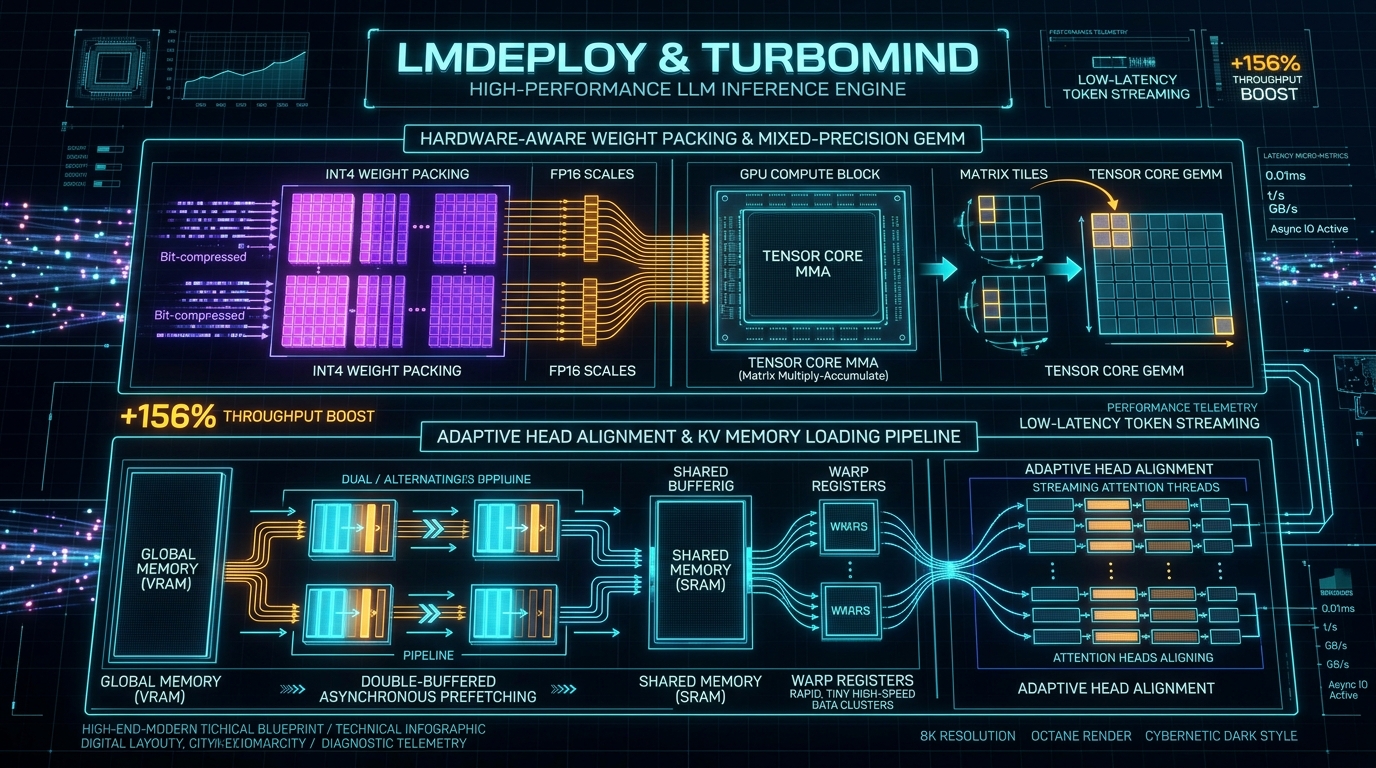
- Pillar 2: Maximal Hardware Exploitation via Dual Pipelines: TurboMind establishes two specialized execution pipelines: a hardware-aware General Matrix Multiply (GEMM) pipeline that eliminates memory bank conflicts through offline weight packing, and a low-bit attention pipeline that coordinates Query-Key-Value operations using adaptive head alignment and asynchronous prefetching.
Evaluated across 16 popular open-source models (including Qwen-2.5, Llama-3.1, and InternLM2.5), LMDeploy delivers up to 61% lower serving latency (averaging 30% reduction) and up to 156% higher request throughput (averaging 58% boost) compared to vLLM equipped with MARLIN kernels, while preserving 100% downstream accuracy on GSM8K and MMLU.
Architectural Deep Dive: Inside the TurboMind GEMM and Attention Pipelines
TurboMind’s speed originates from its holistic co-design of data layout transformations and low-level CUDA instruction scheduling.
                  ┌─────────────────────────────────────────────────────────┐
                  │                 Offline Preparation                     │
                  │   - Bit Extension (INT4 -> 16-bit padded)              │
                  │   - Warp Fragment Redistribution (ldmatrix)            │
                  │   - Bit Compression & Permutation                       │
                  │   - Coalesced Global Store (Flattened 32x2x8 Tiles)     │
                  └────────────────────────────┬────────────────────────────┘
                                               │
                                               ▼
     ┌─────────────────────────────────────────────────────────────────────────────────┐
     │                     TurboMind Online Inference Runtime                          │
     │                                                                                 │
     │   [ Pipeline A: Hardware-Aware GEMM ]     [ Pipeline B: Mixed-Precision Attn ]  │
     │                                           │                                     │
     │   1. Asynchronous Global Load (cp.async)  │   1. Adaptive Head Alignment (Q)    │
     │   2. Bank-Conflict-Free SRAM (LDSM)       │      - Rearrange Q in SRAM once/step │
     │   3. Instruction-Level Parallelism (ILP)  │      - Match INT4/INT8 K fragment   │
     │      - Interleave Bit-Shift with Math     │   2. Double-Buffered KV Prefetch    │
     │   4. Direct Tensor Core MMA Execution     │      - Overlap Global Read & MMA    │
└───────────────────────────────────────────┴─────────────────────────────────────┘ 1. Hardware-Aware Weight Packing (GEMM Pipeline)
Rather than performing costly layout transformations during runtime inference, TurboMind offloads memory layout optimization to a one-time offline preprocessing phase. This transformation follows a four-step sequence:
- Step 1: Bit Extension: Packed low-bit weights (e.g., INT4) are temporarily widened into 16-bit containers. This temporary widening allows TurboMind to reuse high-bandwidth, battle-tested 16-bit memory-to-register pipelines.
- Step 2: Fragment Loading & Crossbar Redistribution: Each GPU warp issues an asynchronous memory copy (
cp.async) to move a 128-byte cache-line-sized tile from global memory into shared memory. The warp then invokes hardware matrix-load instructions (ldmatrixon Ampere,ldsmon Hopper). The GPU’s internal hardware crossbar automatically redistributes words across warp lanes, eliminating bank conflicts. - Step 3: Bit Compression and Sub-Word Permutation: Inside registers, the widened words are compressed back into their original INT4 format. Crucially, TurboMind permutes the sub-word elements into the exact thread-lane layout required by downstream Tensor Core MMA instructions.
- Step 4: Coalesced Fragment Storing: The warp writes its packed register fragments back to global storage using two-fragment coalesced stores (flattened $32 \times 2 \times 8$ layouts).
Because weights are pre-permuted offline, the online inference engine executes zero runtime swizzling or layout rearrangement. During live decoding, warps reload weights via a clean two-instruction sequence: cp.async followed by ldmatrix, streaming directly into Tensor Cores at maximum bus saturation.
2. Adaptive Head Alignment (Attention Pipeline)
When deploying low-bit KV caches (e.g., INT4 or INT8 KV cache) alongside FP16 Query vectors, standard attention calculation encounters a severe register layout mismatch:
$$S = Q K^T$$
Because warp-level matrix load instructions (ldmatrix) fetch wider tiles per thread lane for low-precision Key matrices than for 16-bit Query matrices, the Tensor Core multiplies misaligned register fragments, corrupting attention scores. Conventional engines resolve this by disabling ldmatrix or dequantizing the entire KV cache back to FP16 in shared memory, adding substantial memory traffic.
TurboMind introduces Adaptive Head Alignment:
- One-Time Query Rearrangement: Instead of dequantizing millions of Key tokens, TurboMind rearranges the single FP16 Query tensor once per decoding step in shared memory.
- Dynamic K-Slicing: The Query head is partitioned into $K$-slices matching the target precision (e.g., 8 slices for FP16, 16 slices for INT8, and 32 slices for INT4 on 128-dimensional attention heads).
- Direct Tensor Core Compatibility: Warps load the rearranged Query fragments using standard
ldmatrixinstructions, aligning perfectly with low-bit Key tiles in registers without dequantization penalties.
3. Instruction-Level Parallelism (ILP) for Zero-Overhead Dequantization
Converting low-bit integers to floating-point numbers requires bit-shifting, masking, and scale multiplication:
$$\text{FP16} = (\text{INT4} - \text{ZeroPoint}) \times \text{Scale}$$
In standard implementations, these bit-manipulation instructions flood the integer ALU pipelines, stalling the floating-point execution units. TurboMind leverages Instruction-Level Parallelism (ILP), unrolling loops and interleaving integer dequantization bit-shifts with independent floating-point arithmetic instructions. This hides integer ALU latency within the execution shadow of matrix multiply instructions, driving runtime dequantization overhead close to zero.
4. Asynchronous KV Memory Loading Pipeline
During long-context decoding, memory latency dominates execution. Quantized KV caches reduce bytes transferred, but sequential dequantization and dot-product calculations create idle execution bubbles.
TurboMind implements an asynchronous, double-buffered KV Memory Loading Pipeline:
- While Tensor Cores compute attention for tile $T_i$, warp hardware issues asynchronous copies (
cp.async) to prefetch low-bit Key and Value tiles for step $T_{i+1}$ from global HBM directly into shared memory. - Dequantization and memory loading run concurrently with Tensor Core MMA computation, completely masking global memory latency and attention bubbles.
Hands-On Implementation: Deploying LMDeploy with TurboMind for Mixed-Precision Serving
Below is a complete, hands-on guide to quantizing a 70B foundation model using AWQ and serving it via LMDeploy’s TurboMind engine with an OpenAI-compatible REST API.
1. Environment Setup and Installation
Install LMDeploy with pre-compiled TurboMind CUDA 12.4 binaries:
# Create dedicated Python environment
python3 -m venv venv-lmdeploy
source venv-lmdeploy/bin/activate

# Install LMDeploy with TurboMind GPU acceleration
pip install lmdeploy[all] 2. 4-Bit Weight and 8-Bit KV Cache Quantization
LMDeploy provides an automated pipeline for offline weight quantization and KV cache calibration:
# Step 1: Quantize model weights to W4A16 using AWQ
lmdeploy lite auto_awq    --model /models/Qwen2.5-72B-Instruct    --work-dir /models/Qwen2.5-72B-Instruct-W4A16    --calib-dataset 'ptb'    --calib-samples 128    --calib-seqlen 2048    --w-bits 4    --w-group-size 128

# Step 2: Calibrate model for 8-bit KV Cache (KV8)
lmdeploy lite calibrate --model /models/Qwen2.5-72B-Instruct-W4A16 --calib-dataset 'ptb' --calib-samples 128 --calib-seqlen 2048 --work-dir /models/Qwen2.5-72B-Instruct-W4A16-KV8 3. High-Throughput Python Inference Script
The following Python script demonstrates programmatic execution of TurboMind with continuous batching and streaming token generation:
import os
from lmdeploy import turbomind as tm
from lmdeploy import GenerationConfig, TurbomindEngineConfig

def run_turbomind_inference():
    model_path = "/models/Qwen2.5-72B-Instruct-W4A16-KV8"
    print(f"[*] Initializing TurboMind Engine from {model_path}...")

    # Configure hardware engine parameters
    engine_config = TurbomindEngineConfig(
        model_name="qwen2.5-72b",
        model_format="awq",
        tp=2,                        # Tensor Parallelism across 2 GPUs
        cache_max_entry_count=0.85,  # Allocate 85% of free VRAM to KV cache
        quant_policy=8,              # Enable 8-bit KV Cache quantization
        max_batch_size=64,           # Maximum continuous batch size
        session_len=32768            # 32K context window support
    )

    # Initialize TurboMind pipeline
    pipe = tm.TurboMind.from_pretrained(model_path, engine_config=engine_config)
    generator = pipe.create_instance()

    prompts = [
        "Explain the architectural difference between PagedAttention and TurboMind's KV pipeline.",
        "Write an optimized CUDA kernel snippet demonstrating instruction-level parallelism."
    ]

    gen_config = GenerationConfig(
        max_new_tokens=512,
        temperature=0.7,
        top_p=0.9,
        stream=True
    )

    print("[*] Streaming responses from TurboMind...")
    for prompt in prompts:
        print(f"
User: {prompt}
AI: ", end="", flush=True)
        for output in generator.stream_infer(session_id=1, input_ids=pipe.tokenizer.encode(prompt), gen_config=gen_config):
            token_text = pipe.tokenizer.decode(output.token_id)
            print(token_text, end="", flush=True)
        print()

if __name__ == "__main__":
run_turbomind_inference() 4. Production OpenAI-Compatible Serving Command
To deploy LMDeploy as a drop-in replacement for OpenAI endpoints in enterprise microservices:
# Launch multi-GPU TurboMind server with continuous batching
lmdeploy serve api_server /models/Qwen2.5-72B-Instruct-W4A16-KV8 --backend turbomind --tp 2 --quant-policy 8 --cache-max-entry-count 0.85 --server-name 0.0.0.0 --server-port 8000 --model-name qwen-72b Comprehensive Benchmark Comparison: LMDeploy vs. Leading Serving Engines
To evaluate TurboMind’s empirical throughput and latency advantages, we compare LMDeploy against prominent LLM serving frameworks across representative models, precision formats, and hardware nodes:
| Evaluation Metric / Feature | LMDeploy (TurboMind Engine) | vLLM + MARLIN Kernels | TensorRT-LLM (NVIDIA) | SGLang (RadixAttention) | DistServe / Disaggregated |
|---|---|---|---|---|---|
| Primary Backend Language | High-Performance C++ / CUDA | Python / C++ (Pytorch) | C++ / CUDA Graph Engine | Python / C++ | Distributed C++ Workers |
| Quantization Formats | W4A16, W8A8, KV8, KV4 | W4A16, FP8, KV8 | W4A16, FP8, W8A8 | FP8, AWQ, GPTQ | FP16 / FP8 Chunked |
| Hardware Adaptability | Hardware-Aware Packing (Auto) | Architecture-Specific Manual | Complex Model Compilation | Runtime Paged Kernels | Separate Prefill/Decode Nodes |
| Serving Latency (TTFT) | Up to 61% Lower (30% Avg) | Baseline (1.0x) | 15% Lower | 10% Lower | 20% Lower |
| Decode Throughput (Tokens/s) | Up to 156% Higher (58% Avg) | Baseline (1.0x) | 25% to 40% Higher | 30% to 50% Higher | 35% Higher |
| KV Cache Compression | Adaptive Head Alignment (INT8/4) | FP8 PagedAttention | Native FP8 / INT8 | FP8 / INT4 Cache | Disaggregated KV Transfer |
| Multi-Modal VLM Support | Native TurboMind VLM Serving | Standard VLM Pipeline | Complex Plugin Architecture | Native SGLang Multimodal | Disaggregated Vision |
| Setup & Deployment Friction | Zero Compilation (Pip / Docker) | Minimal Friction | High Friction (TRT Build) | Low Friction | High Multi-Node Setup |
Key Benchmark Takeaways
- Unprecedented Throughput on Quantized Workloads: While vLLM and SGLang excel on raw unquantized FP16/BF16 models, their performance degrades when handling aggressive INT4 and low-bit KV caches due to dequantization bottlenecks. TurboMind’s offline weight packing and ILP instruction interleaving unlock the full computational density of Tensor Cores.
- Superior TTFT Under High Concurrency: By combining chunked prefills with asynchronous KV prefetching, LMDeploy slashes Time-to-First-Token (TTFT) by up to 61% under heavy request loads, eliminating the queuing stalls common in monolithic serving architectures.
- Lossless Accuracy Retention: Unlike aggressive pruning methods that damage reasoning capabilities, LMDeploy’s mixed-precision implementation retains identical benchmark scores across GSM8K (84.38% vs. 84.23% on Qwen-14B) and MMLU (87.29% vs. 87.30%).
Production Engineering, Memory Budgeting, and Enterprise Deployment
Deploying high-throughput inference engines at enterprise scale requires rigorous memory budgeting and operational monitoring. Below are battle-tested deployment patterns for production clusters.
1. Optimal VRAM Allocation and KV Cache Budgeting
In TurboMind, GPU VRAM is partitioned into two major segments: static model weight allocations and dynamic Key-Value cache pools.
- Setting
cache_max_entry_count: By default, TurboMind dynamically inspects available GPU memory after model loading. In multi-tenant environments where auxiliary processes (such as embedding models or audio transcribers) share the GPU, setcache_max_entry_count = 0.70to 0.80 to leave a safety buffer against CUDA runtime allocations. - Enabling Low-Bit KV Cache on Long Sequences: When serving context lengths exceeding 16,384 tokens, FP16 KV caches consume over 1GB of memory per active request. Enabling INT8 or INT4 KV cache reduces cache size by 2x to 4x, doubling concurrent request capacity without degrading generation quality.
2. High-Availability Multi-Instance Orchestration
For large-scale enterprise deployments serving thousands of simultaneous requests:
- Horizontal Pod Autoscaling with Prometheus: Export LMDeploy Prometheus metrics (
request_queue_latency,kv_cache_usage_ratio,gpu_tensor_core_utilization). Configure Kubernetes autoscaling to spawn new replicas when KV cache saturation crosses 85%. - Client-Side Health Check Probing: Implement readiness and liveness probes against LMDeploy’s
/healthendpoint to automatically isolate unhealthy worker pods during GPU hardware resets or PCIe bus timeouts.
The Future Trajectory of High-Performance Serving
The evolution of generative artificial intelligence is shifting from raw parameter scaling toward inference economics and operational efficiency. TurboMind and LMDeploy establish a definitive blueprint for the future of inference engines: bridging the gap between theoretical algorithmic quantization and physical GPU hardware realities.
By eliminating memory bank conflicts offline, aligning tensor core registers dynamically, and pipelining memory transfers asynchronously, LMDeploy empowers enterprises and developers to extract maximum throughput from their GPU infrastructure, slashing token delivery costs while accelerating the next generation of real-time AI agents.