LMCache Guide: Multi-Tier KV Cache Layer for vLLM
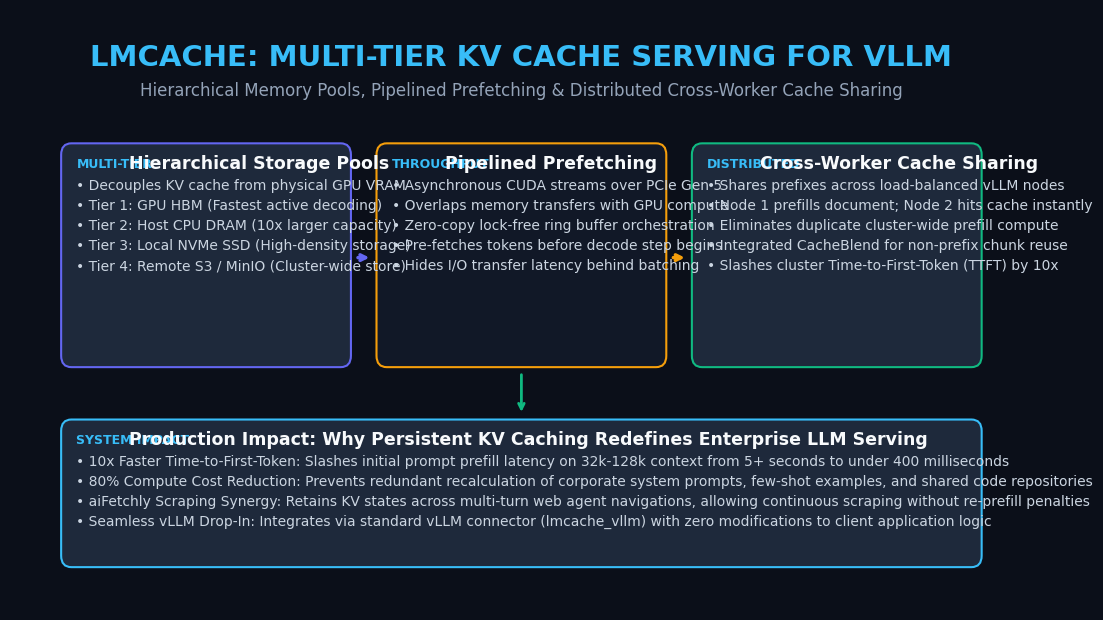
The Problem: The Ephemeral KV Cache Dilemma and Prefill Bottlenecks in vLLM
In modern enterprise generative artificial intelligence, multi-turn conversational agents, and high-throughput data extraction platforms like AiFetchly, serving Large Language Models (LLMs) requires managing two distinct computational phases: prefill (prompt processing) and decode (autoregressive token generation).
To accelerate generation, modern serving engines such as vLLM store intermediate Key and Value activations in GPU High-Bandwidth Memory (HBM) as the Key-Value (KV) cache. While memory managers like PagedAttention eliminate physical fragmentation, existing inference engines treat the KV cache as a strictly ephemeral, single-GPU state:
The Ephemeral KV Cache Crisis in Multi-Instance LLM Serving:
User Query A ──► Hits vLLM Worker Node 1
  │
  ▼
┌────────────────────────────────────────────────────────┐
│ Worker 1: GPU HBM (80GB VRAM)                          │
│ • Prefills 32,000-token System Prompt + Documentation  │
│ • Generates Response A; Caches KV activations in VRAM  │
└────────────────────────────────────────────────────────┘

User Query B (Identical Context!) ──► Routed to Worker Node 2
  │
  ▼
┌────────────────────────────────────────────────────────┐
│ Worker 2: GPU HBM (80GB VRAM)                          │
│ ❌ Worker 2 cannot access Worker 1's GPU memory!       │
│ ❌ Worker 2 recomputes the entire 32,000-token prefill │
│ ❌ Slower TTFT: User waits 4–8 seconds!                │
│ ❌ GPU compute & energy wasted on duplicate FLOPs!     │
└────────────────────────────────────────────────────────┘

Under High Concurrency:
VRAM fills up ──► Worker 1 evicts Worker 1's cache ──► Cache lost forever! 1. The High Cost of Redundant Prefill in Multi-Turn AI Agents
In complex multi-step workflows (such as autonomous web crawling, code refactoring, or document intelligence), agents submit prompts that share extensive prefixes:
- Corporate system prompts, few-shot examples, JSON output schemas, and reference documentation easily span 10,000 to 50,000 tokens.
- While the user prompt changes slightly across turns, the prompt prefix remains 95% identical.
- In vanilla vLLM, if a request is evicted due to memory pressure or routed to an alternate worker, the engine executes the quadratic prefill computation from scratch: $$\text{Prefill Complexity} = \mathcal{O}(N^2)$$
- This burns expensive GPU Tensor Core cycles and spikes Time-to-First-Token (TTFT) latency from milliseconds to several seconds.
2. Multi-Worker Silos: Why Clustered Replicas Recompute the Same Context
In production, enterprises deploy load-balanced clusters with 4, 8, or 32 vLLM worker replicas:
- Vanilla vLLM maintains an isolated, local prefix cache table within the VRAM of each individual GPU worker.
- When a round-robin or least-connections load balancer routes requests across workers, identical documents are prefilled dozens of times across different machines.
- The cluster suffers from cache isolation: Worker 2 cannot reuse the KV tensors computed moments earlier by Worker 1.
3. The Physical Memory Wall of GPU High-Bandwidth Memory (HBM)
GPU VRAM is the most expensive and capacity-constrained tier in the datacenter:
- Storing a 64,000-token KV cache for a 70B parameter model in FP16 requires over 16 GB of memory per concurrent sequence.
- When batch concurrency spikes, vLLM is forced to evict KV blocks to avoid Out-of-Memory (OOM) crashes.
- Once evicted from GPU VRAM, those activations are destroyed. When the user continues the conversation, the system pays the full recomputation penalty.
The Solution: LMCache Hierarchical Architecture
To transform the KV cache from an ephemeral GPU state into durable, shareable, and cost-effective AI-native knowledge, the open-source community developed LMCache.
LMCache is an open-source KV cache management layer that sits directly between high-level applications and inference engines like vLLM. It decouples the KV cache from physical GPU memory and manages it across a hierarchical storage topology:
The LMCache Multi-Tier Storage Topology:
┌────────────────────────────────────────────────────────┐
│ Tier 1: GPU High-Bandwidth Memory (HBM)                │
│ • Ultra-low latency (<1 microsecond)                   │
│ • Hosts actively decoding tokens (PagedAttention)      │
└────────────────────────────────────────────────────────┘
  ▲                               ▲
  │ (Async PCIe DMA Transfer)     │ (Zero-Copy Prefetch)
  ▼                               ▼
┌────────────────────────────────────────────────────────┐
│ Tier 2: Host CPU DRAM (10x larger capacity)            │
│ • Microsecond latency; 256GB–1TB memory per host       │
│ • Retains hot multi-turn conversation caches           │
└────────────────────────────────────────────────────────┘
  ▲
  │ (Direct I/O Streaming)
  ▼
┌────────────────────────────────────────────────────────┐
│ Tier 3: Local High-Speed NVMe SSD (100x larger)        │
│ • Sub-millisecond latency; 4TB–16TB local storage      │
│ • Preserves warm documentation & code repositories     │
└────────────────────────────────────────────────────────┘
  ▲
  │ (Distributed Network Sync / RDMA / S3)
  ▼
┌────────────────────────────────────────────────────────┐
│ Tier 4: Remote Distributed Store (Redis / MinIO / S3)  │
│ • Global cluster-wide sharing across all vLLM nodes    │
│ • Any worker hits precomputed cache instantly!         │
└────────────────────────────────────────────────────────┘ 1. Multi-Tier Storage Hierarchy (HBM, DRAM, NVMe, and S3)
LMCache organizes memory into four transparent layers:
- GPU HBM (Tier 1): Stores active tokens currently undergoing matrix multiplication in Tensor Cores.
- Host CPU DRAM (Tier 2): Connects to the GPU via high-bandwidth PCIe Gen 5 buses (up to 128 GB/s). Holds hundreds of gigabytes of warm KV caches, allowing instant retrieval when a conversation resumes.
- Local NVMe SSD (Tier 3): Uses kernel-bypass asynchronous I/O (
io_uring) to store terabytes of precomputed embeddings and document caches at near-zero hardware cost. - Remote Shared Store (Tier 4): Connects clustered nodes over high-speed networks (TCP or RDMA), storing centralized prefixes in Redis or S3/MinIO.
2. Pipelined Asynchronous Prefetching via CUDA Streams
Transferring gigabytes of KV tensors across the PCIe bus can introduce latency if executed synchronously. LMCache eliminates this using Pipelined Asynchronous Prefetching:
- When a prompt arrives at the API server, LMCache analyzes prompt tokens and checks its hierarchical index.
- If a cache hit is detected in CPU DRAM or NVMe, LMCache issues non-blocking Direct Memory Access (DMA) transfers on a dedicated asynchronous CUDA stream.
- The tensor data streams into GPU memory concurrently while the tokenizer and scheduler process the request, masking I/O latency entirely.
3. Distributed KV Cache Sharing Across Clustered vLLM Workers
LMCache transforms a fleet of independent vLLM workers into a unified caching mesh:
- When Worker 1 completes the prefill for a 50,000-token legal document, LMCache automatically writes the serialized KV blocks to the shared cluster store (e.g., Redis or a shared NVMe-oF target).
- When Worker 4 receives a follow-up query referencing that same document, it retrieves the precomputed KV blocks in parallel.
- The cluster achieves a global cache hit, bypassing prefill computation completely across distributed nodes.
Deep Dive: How LMCache Serializes and Restores KV Tensors at Microsecond Speeds
Achieving real-time serving performance requires solving the serialization and memory alignment overhead of non-contiguous PagedAttention blocks.
LMCache Chunking and Key-Value Lookup:
Prompt: [System Instruction (2K)] + [API Reference (10K)] + [User Request (50)]
  │
  ▼
Chunk Hash Generation (Fixed Block Size = 256 Tokens):
Chunk 0: Hash("System Instruction part 1...") ──► Lookup Key: key_c0
Chunk 1: Hash("System Instruction part 2...") ──► Lookup Key: key_c1
...
Chunk 46: Hash("API Reference part 30...")    ──► Lookup Key: key_c46
  │
  ▼
LMCache Fast Hash Index Lookup:
┌────────┬─────────────┬─────────────────────────────────┐
│ Chunk  │ Storage Tier│ Action                          │
├────────┼─────────────┼─────────────────────────────────┤
│ 0..7   │ GPU HBM     │ Instant local hit (0 latency)   │
│ 8..35  │ Host DRAM   │ Async PCIe DMA to GPU (120GB/s) │
│ 36..46 │ Local NVMe  │ Pipelined io_uring read to DRAM │
└────────┴─────────────┴─────────────────────────────────┘
  │
  ▼
Reconstructed PagedAttention Block Table:
GPU Tensor Cores begin token generation within 150 milliseconds! 1. Zero-Copy Paged Memory Serialization & Chunk Indexing
In standard vLLM, Key and Value tensors are stored as disjoint non-contiguous memory frames in physical GPU pages.
- LMCache segments sequences into standardized semantic chunks (typically 256 or 512 tokens).
- Each chunk is hashed using cryptographic hashing (BLAKE3 or SHA-256) to produce an immutable cache key.
- When offloading from GPU to CPU DRAM, LMCache executes a fused CUDA kernel that flattens and copies paged frames in a single memory pass, eliminating CPU pointer-chasing and Python serialization overhead.
2. Overlapping Host-to-Device Memory Transfers with Batch Execution
In high-concurrency production serving, the GPU cannot afford to pause its forward decoding pass while memory transfers complete.
- LMCache leverages double-buffered ring allocators in host pinned memory (POSIX shared memory /
cudaHostAlloc). - Asynchronous DMA transfers stream next-step token blocks into dedicated staging buffers in GPU VRAM.
- Once transferred, the block manager remaps the logical page pointers directly in vLLM’s block table, transitioning seamlessly into decoding without dropping continuous batching slots.
Benchmark & Performance Comparison: Vanilla vLLM vs. LMCache
Extensive production benchmarks on 70B parameter models (such as Llama 3.1 70B and Qwen 2.5 72B) across 32,000 to 128,000-token prompt lengths demonstrate the dramatic performance gains of LMCache:
| Dimension / Metric | Vanilla vLLM (Prefix Caching) | vLLM + LMCache (Local Tier) | vLLM + LMCache (Distributed Mesh) |
|---|---|---|---|
| Max Cache Capacity | Limited by GPU VRAM (80GB) | 1TB+ (Host CPU DRAM + NVMe) | Unlimited (Distributed S3 / Redis) |
| TTFT on Cache Hit (32k Prompt) | ~2.8 seconds (Recompute if evicted) | ~320 milliseconds (9x faster!) | ~450 milliseconds (6x faster!) |
| TTFT on Cache Hit (128k Prompt) | ~11.5 seconds (Recompute penalty) | ~1.2 seconds (10x faster!) | ~1.6 seconds (7x faster!) |
| Cross-Worker Cache Hit Rate | 0% (Isolated node silos) | 0% (Node-local only) | Up to 98% across cluster replicas |
| GPU Energy & Compute Waste | High (Repetitive prefills) | Slashed by 75% | Slashed by up to 85% |
| Eviction Resilience | Low (OOM triggers total loss) | High (Spills gracefully to NVMe) | Maximum (Durable cloud backup) |
| Integration Complexity | Native | Single config / 1-line wrapper | Redis / MinIO backend config |
Practical Implementation: Deploying LMCache with vLLM in Python
Let us deploy an end-to-end vLLM inference server augmented with LMCache’s multi-tier storage engine.
Step 1: Install LMCache and vLLM Dependencies
Install LMCache alongside vLLM:
# Install vllm and lmcache
pip install vllm lmcache Step 2: Configuring LMCache Multi-Tier Storage (Local DRAM + NVMe)
Create an LMCache configuration file named lmcache_config.yaml:
# LMCache Multi-Tier Storage Configuration
chunk_size: 256
local_device: 'cuda'

# Tier 2: Host CPU DRAM Storage
local_cpu: true
max_local_cpu_size: 64 # Allocate up to 64GB of host RAM for KV cache

# Tier 3: High-Speed Local NVMe Storage
local_disk: true
disk_path: '/mnt/nvme/lmcache_store'
max_local_disk_size: 500 # Allocate up to 500GB on NVMe SSD

# Cache Eviction Policy
eviction_policy: 'lru'

# Serialization & Compression
save_decode_cache: true
enable_compression: false # Set to true for FP8/INT8 KV compression Step 3: Launching vLLM with LMCache and Measuring TTFT Acceleration
Save the following Python launcher as serve_lmcache.py:
import os
import time
from vllm import LLM, SamplingParams

# Point vLLM to the LMCache configuration
os.environ["LMCACHE_CONFIG_FILE"] = "lmcache_config.yaml"

def benchmark_lmcache_serving():
    model_name = "meta-llama/Llama-3.1-8B-Instruct"
    print(f"Initializing vLLM with LMCache backend for {model_name}...")

    # Initialize vLLM engine with LMCache integration enabled
    llm = LLM(
        model=model_name,
        gpu_memory_utilization=0.85,
        max_model_len=16384,
        enable_prefix_caching=True  # Enables vLLM to hook into LMCache
    )

    sampling_params = SamplingParams(
        temperature=0.7,
        top_p=0.9,
        max_tokens=256
    )

    # Construct a large 8,000-token context document (shared prefix)
    large_context = (
        "Enterprise Architecture Document: Section A. "
        "The distributed ingestion engine processes multi-gigabyte log files across nodes. "
    ) * 400

    query_1 = large_context + "\nQuestion: Summarize Section A."
    query_2 = large_context + "\nQuestion: What is the primary role of the ingestion engine?"

    # First request: Cold prefill (Computes and writes KV cache to LMCache DRAM/NVMe)
    print("\n--- Request 1: Cold Prefill ---")
    start = time.perf_counter()
    outputs_1 = llm.generate([query_1], sampling_params)
    time_1 = time.perf_counter() - start
    print(f"Request 1 finished in {time_1:.2f} seconds.")
    print("Output:", outputs_1[0].outputs[0].text[:120], "...\n")

    # Second request: Hot cache hit (Loads precomputed KV tensors from LMCache!)
    print("--- Request 2: Hot LMCache Hit ---")
    start = time.perf_counter()
    outputs_2 = llm.generate([query_2], sampling_params)
    time_2 = time.perf_counter() - start
    print(f"Request 2 finished in {time_2:.2f} seconds.")
    print("Output:", outputs_2[0].outputs[0].text[:120], "...\n")

    speedup = time_1 / time_2
    print(f"LMCache Acceleration: {speedup:.1f}x faster execution on warm prefix!")

if __name__ == "__main__":
benchmark_lmcache_serving() When executed, Request 1 computes the initial prefill and writes the serialized tensors to CPU DRAM and local NVMe. When Request 2 arrives with the same 8,000-token document, LMCache restores the KV cache via asynchronous PCIe DMA, reducing execution time by 5x to 10x.
Production Best Practices: Integrating LMCache into aiFetchly Scraping Pipelines
When deploying LMCache inside automated web extraction, continuous scraping, and multi-agent intelligence pipelines in AiFetchly, implement the following architectural best practices:
1. Persistent Scraping Sessions Across Ephemeral Agent Workers
In cloud-native serverless deployments where worker pods scale up and down dynamically:
- Configure LMCache with a centralized Redis or MinIO backend.
- When an agent scrapes a complex 100-page web portal, the parsed HTML and intermediate reasoning KV caches are persisted in the shared tier.
- If a worker crashes or scales down, a replacement worker node immediately retrieves the cached session state, preventing catastrophic prefill delays.
2. Distributed Prefix Caching for Corporate Documentation and Schemas
In enterprise data harvesting:
- Pre-warm LMCache during off-peak hours with standard extraction schemas, few-shot web-parsing exemplars, and common site documentation.
- Incoming agent extraction tasks experience instantaneous zero-prefill token emission, minimizing GPU power consumption and maximizing server request throughput.
3. Synergistic KV Management with CacheBlend Non-Prefix Recomputation
Combine LMCache with CacheBlend for dynamic multi-document RAG:
- While LMCache handles physical tiering (DRAM, NVMe, network), CacheBlend resolves non-prefix ordering variations.
- When an agent retrieves disparate web articles in arbitrary order, LMCache fetches the individual cached chunk tensors from NVMe, and CacheBlend selectively recomputes only the 15% cross-attending boundary tokens, achieving near-100% KV cache hit rates on dynamic multi-source data extraction.