LLaVA-OneVision Guide: Unified Multi-Modal AI Model
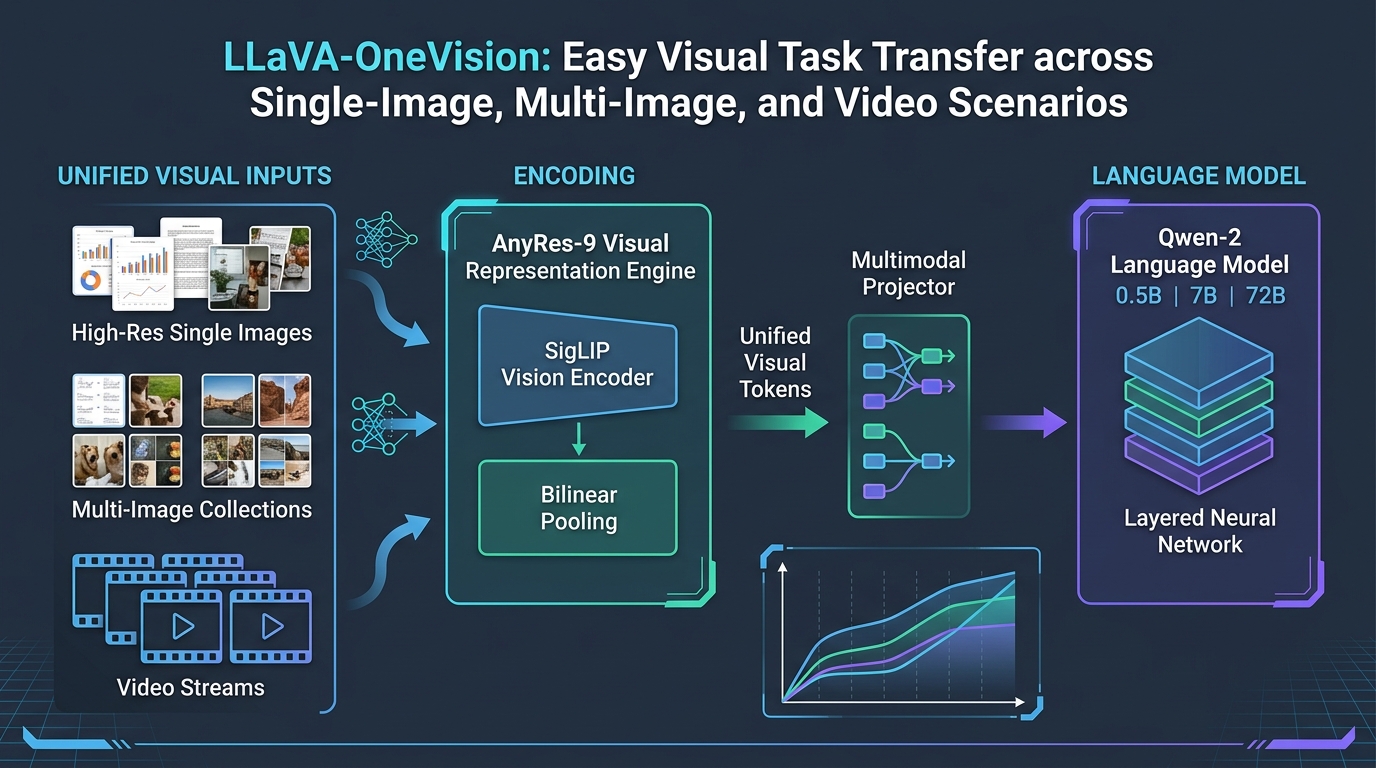
The Problem: The Fragmented Silos of Multimodal Visual Reasoning
In modern enterprise automation, automated video intelligence, visual document discovery, and multimodal search engines powered by AI Fetchly, artificial intelligence systems must process visual information across diverse formats. Whether parsing multi-page PDF contracts harvested through large-scale video and web scraping pipelines, comparing before-and-after satellite photographs, or analyzing long-form recorded video tutorials with real-time visual data extraction, foundation models are expected to fluidly transition between static images, sequential multi-image galleries, and continuous video streams.
However, for years, the multimodal machine learning ecosystem has been trapped in architectural fragmentation, divided into three mutually incompatible silos:
1. The Single-Image Specialization Silo
Early pioneer Vision-Language Models (VLMs)—such as LLaVA-1.5, LLaVA-NeXT, and InstructBLIP—focused exclusively on single static images:
- High-Resolution Patch Tiling: To capture fine-grained text, mathematical symbols, and small objects, models adopted static tiling techniques (splitting an image into a $2 \times 2$ grid of patches).
- Token Explosion: A single high-resolution image produces between $1,176$ and $2,880$ visual tokens.
- Failure on Multi-Image Inputs: Because visual token budgets are consumed entirely by a single image, feeding 4 or 8 images immediately triggers GPU Out-Of-Memory (OOM) crashes or context window exhaustion. The architecture lacks any mechanism to model cross-image relationships or comparative reasoning.
The Multimodal Architectural Fragmentation:
┌───────────────────────────┬───────────────────────────┬───────────────────────────┐
│ Silo 1: Single-Image VLMs │ Silo 2: Multi-Image VLMs  │ Silo 3: Video-LLMs        │
├───────────────────────────┼───────────────────────────┼───────────────────────────┤
│ • LLaVA-1.5 / LLaVA-NeXT  │ • Mantis / Cross-Image    │ • Video-LLaVA / PLLaVA    │
│ • High-resolution single  │ • Pairs of small images   │ • Coarse temporal frames  │
│   document OCR & QA       │ • Downsampled to 224x224  │ • Only 8-16 downsampled   │
│ • 1,500 - 3,000 tokens/img│ • Weak on dense OCR       │   frames (severe blur!)   │
│ ❌ CANNOT process video!  │ ❌ CANNOT read documents! │ ❌ CANNOT read subtitles! │
└───────────────────────────┴───────────────────────────┴───────────────────────────┘
Outcome: Enterprise teams were forced to host 3 separate multi-billion parameter model clusters! 2. The Video Resolution Sacrifice and Temporal Blur
To process video sequences, specialized Video-LLMs (such as early Video-LLaVA or Video-ChatGPT) adopted aggressive temporal and spatial downsampling:
- Uniform Low-Resolution Frames: Video streams were downsampled to low-resolution squares (typically $224 \times 224$ pixels) and sampled at a sparse rate of only 8 to 16 frames across an entire video.
- Loss of Fine Details: At $224 \times 224$ pixels, fine-grained text, video subtitles, small moving objects, and subtle facial gestures are completely erased.
- Temporal Disconnection: Video models trained on coarse video clips failed catastrophically when evaluated on detailed static image understanding, losing the OCR and diagram comprehension of single-image models.
3. The Operational Tax of Multi-Model Serving
Deploying separate foundation models for single images, multi-image comparative analytics, and video understanding imposes an unsustainable infrastructure burden:
- Engineering teams must host three separate multi-node GPU clusters (one for document OCR, one for comparative product analysis, and one for video QA).
- Context representations cannot be shared across scenarios: an agent cannot effortlessly inspect a high-resolution chart extracted from a video frame because the video model lacks the visual resolution to read the chart.
The artificial boundaries between single-image, multi-image, and video understanding were artifacts of naive token representations—not fundamental mathematical limits.
The Solution: LLaVA-OneVision and AnyRes-9 Unified Representation
To shatter these architectural boundaries, researchers from ByteDance, Nanyang Technological University (NTU), and HKUST introduced LLaVA-OneVision: Easy Visual Task Transfer (arXiv:2408.03326).
LLaVA-OneVision is the first open-source multimodal foundation model family that demonstrates strong, reciprocal visual task transfer across all three core visual scenarios: single-image, multi-image, and video:
The LLaVA-OneVision Unified Paradigm:
┌────────────────────────────────────────────────────────────────────────┐
│ Unified Visual Ingestion & Dynamic Token Compression                   │
├───────────────────────────────────┬────────────────────────────────────┤
│ Single-Image High-Resolution QA   │ AnyRes-9 Tiling (Up to 9 Patches)  │
│ Multi-Image Comparative Reasoning │ Dynamic Visual Token Compression   │
│ Continuous Long-Video QA          │ Bilinear 2x2 Spatial Pooling       │
├───────────────────────────────────┴────────────────────────────────────┤
│ Shared Vision Encoder: SigLIP-SO400M (Native 384x384 resolution)       │
│ Shared Language Backbone: Qwen-2 (0.5B, 7B, and 72B Parameters)        │
│ Shared Multimodal Projector: Two-Layer MLP with Spatial Bilinear Merge │
└────────────────────────────────────────────────────────────────────────┘ 1. Core Principles of LLaVA-OneVision
LLaVA-OneVision achieves unified visual capability through four architectural pillars:
- AnyRes-9 Adaptive Visual Tiling: Dynamically partitions single images into up to 9 high-resolution sub-grids based on arbitrary aspect ratios (supporting resolutions up to $1152 \times 1152$ pixels without distortion) alongside a global downsampled overview.
- Unified Modality Compression with Bilinear Pooling: For multi-image and video scenarios where token budgets are constrained, LLaVA-OneVision applies a learned $2 \times 2$ bilinear spatial pooling layer, compressing the number of visual tokens per frame by $4\times$ (from 729 tokens down to 196 tokens per frame). This allows the model to process up to 64 high-definition video frames (or hundreds of sequential video frames) within standard context windows.
- Cross-Scenario Visual Task Transfer: Proves that visual representations learned in one scenario transfer directly to others:
- Training on high-resolution single images directly improves video text recognition, enabling the model to read small subtitles, street signs, and whiteboard diagrams in moving video streams.
- Training on multi-image pairs directly enhances temporal action understanding in video, establishing causal continuity across frames.
- Comprehensive Open-Weights Scaling: Released across three parameter scales—0.5B, 7B, and 72B—built on top of Alibaba’s Qwen-2 foundation models, offering edge deployment on mobile hardware up to enterprise frontier intelligence.
2. The OneVision Training Curriculum and Multi-Modal Data Engine
A defining breakthrough of LLaVA-OneVision is its staged multi-modal curriculum. Rather than throwing random mixtures of images and videos at the model simultaneously—which induces severe optimization instability and gradient interference—ByteDance and NTU designed a three-stage progressive alignment pipeline:
- Stage 1: High-Resolution Single-Image Alignment: The model is pre-trained on diverse, high-quality image-text pairs (such as ShareGPT-4V, SynthDog, and high-density OCR datasets). In this stage, the SigLIP vision encoder and projection layers learn fine-grained spatial representations, token-level character reading, and document structure layout.
- Stage 2: Cross-Scenario Visual Instruction Tuning: The model is jointly fine-tuned on a balanced mixture of single-image instructions, multi-image comparison pairs, and annotated video clips. Because the visual projector and language model are exposed to all three formats concurrently under the shared AnyRes representation, the model discovers reciprocal cross-modal synergies—applying single-image reading skills to video frames and multi-image relational comparisons to temporal sequences.
- Stage 3: Direct Preference Optimization (DPO) on Visual Reasoning: The final checkpoint undergoes multi-modal preference alignment, penalizing visual hallucinations (such as claiming an object exists in a frame when it does not) and rewarding structured, step-by-step mathematical and spatial reasoning.
3. State-of-the-Art Multimodal Benchmarks
Across single-image, multi-image, and video benchmarks:
- Video Understanding (Video-MME): LLaVA-OneVision-72B achieves $73.8%$ without subtitles and $78.2%$ with subtitles, outperforming GPT-4V ($69.9%$) and Claude 3.5 Sonnet ($73.4%$) to claim the world #1 open-weights video reasoning benchmark.
- Complex Multi-Discipline Reasoning (MMMU): Reaches $61.3%$ on MMMU, establishing frontier-level academic, medical, and scientific visual reasoning.
- Mathematical Visual Reasoning (MathVista): Scores $73.7%$, beating all open-weights models and matching GPT-4o.
LLaVA-OneVision Architecture: Deep Dive into AnyRes-9 and Dynamic Token Compression
To understand how LLaVA-OneVision handles a single 4K technical blueprint and a 20-minute video clip with the exact same neural weights, we examine its image tiling strategies, bilinear token pooling, and temporal frame serialization.
LLaVA-OneVision Unified Modality Dataflow:
Input Modality:
┌─────────────────────────┬─────────────────────────┬─────────────────────────┐
│ Single High-Res Image   │ Multi-Image Sequence    │ Continuous Video Stream │
│ Resolution: Up to 1152² │ 2 - 16 Paired Images    │ 16 - 64 Video Frames    │
└────────────┬────────────┴────────────┬────────────┴────────────┬────────────┘
             │                         │                         │
             ▼ AnyRes-9 Tiling         ▼ Standard Tiling         ▼ Temporal Sampling
┌─────────────────────────────────────────────────────────────────────────────┐
│ SigLIP-SO400M-384 Vision Encoder (Frozen / LoRA)                            │
│ Patch Size: 14x14 -> Generates 27x27 = 729 Visual Tokens per Patch / Frame  │
└──────────────────────────────────────┬──────────────────────────────────────┘
                                       │
        ┌──────────────────────────────┴──────────────────────────────┐
        ▼ Single-Image Path                                           ▼ Multi-Image / Video Path
┌──────────────────────────────────────┐                      ┌──────────────────────────────────────┐
│ Full-Resolution Feature Retention    │                      │ Bilinear 2x2 Spatial Token Pooling   │
│ • Retains all 729 tokens per patch   │                      │ • Merges 2x2 adjacent spatial patches│
│ • Total: Up to 3,645 tokens          │                      │ • Compresses 729 -> 196 tokens/frame │
│ • Preserves fine-grained OCR/details │                      │ • 4x Token Reduction!                │
└──────────────────┬───────────────────┘                      └──────────────────┬───────────────────┘
                   │                                                             │
                   └─────────────────────────────┬───────────────────────────────┘
                                                 │
                                                 ▼ Multimodal Projector (2-Layer MLP)
┌─────────────────────────────────────────────────────────────────────────────┐
│ Unified Sequence Serialization:                                             │
│ <image_start> [Frame 1 Tokens] <image_end> ... <image_start> [Frame N] ...  │
│ Interleaved with Text Prompt Tokens                                         │
└──────────────────────────────────────┬──────────────────────────────────────┘
                                       │
                                       ▼ Qwen-2 Language Model (0.5B / 7B / 72B)
┌─────────────────────────────────────────────────────────────────────────────┐
│ Autoregressive Generation & Reasoning Output:                               │
│ "In frame 12, the technician disconnects the blue fiber optic cable..."      │
└─────────────────────────────────────────────────────────────────────────────┘ 1. AnyRes-9 Visual Grid Partitioning
Given a single high-resolution image $\mathbf{I} \in \mathbb{R}^{H \times W \times 3}$, LLaVA-OneVision evaluates a pre-defined bank of candidate grid layouts:
$$\mathcal{G} = {(1, 1), (1, 2), (2, 1), (1, 3), (3, 1), (2, 2), (1, 4), (4, 1), (3, 3)}$$
Where $(m, n)$ represents $m$ rows and $n$ columns of $384 \times 384$ sub-patches.
The optimal grid $(m^, n^)$ is selected to minimize aspect ratio distortion while maximizing effective resolution:
$$(m^, n^) = \arg\min_{(m, n) \in \mathcal{G}} \left| \frac{H}{W} - \frac{m}{n} \right| \quad \text{s.t. } m \cdot n \le 9$$
The image is cropped into $m^* \times n^*$ sub-images, and each sub-crop is encoded independently by SigLIP alongside a global downsampled overview of the whole image. The projected tokens are reshaped into a 2D spatial grid with newline tokens (\n) delimiting spatial patch rows, preserving structural 2D geometry for the language model.
2. Bilinear 2x2 Spatial Token Pooling for Video and Multi-Image
When processing multi-image collections or video streams, passing 729 tokens per frame is computationally impossible:
- A 32-frame video would generate $32 \times 729 = 23,328$ visual tokens, consuming over $70%$ of an entire 32k context window before processing user instructions.
LLaVA-OneVision solves this through Spatial Bilinear Pooling:
- The 2D feature map of shape $(B, 27, 27, D)$ is pooled using a $2 \times 2$ bilinear kernel with stride 2: $$\mathbf{F}_{\text{pooled}} = \text{AdaptiveAvgPool2d}(\mathbf{F}, \text{output_size}=(14, 14))$$
- This reduces the token count from $27 \times 27 = 729$ down to $14 \times 14 = 196$ tokens per frame—a $73.1%$ reduction in visual token length!
- A 64-frame video now requires only $64 \times 196 = 12,544$ tokens, fitting comfortably inside standard 32k or 128k context windows while retaining high-definition visual fidelity.
3. 2D Spatial Positional Embeddings and Newline Delimiters
When an image is sliced into multiple sub-patches, maintaining the 2D spatial arrangement of the tiles is critical so the autoregressive language model can reconstruct the global canvas.
LLaVA-OneVision achieves this through a dual-mechanism spatial conditioning strategy:
- Spatial Newline Tokens: At the end of each row of sub-patches, a learned newline token
- Global Overview Concatenation: Alongside the $m^* \times n^*$ high-resolution sub-crops, the global downsampled overview of the image is processed and prepended to the visual sequence. The global tokens provide macro-level contextual grounding (e.g., overall scene layout, horizon lines, and dominant color schemes), while the sub-patch tokens supply micro-level pixel details (e.g., fine text, small symbols, and distant objects).
The complete visual prompt formatted for the language model decoder is represented as:
$$ \mathbf{X}{\text{visual}} = \left[ \mathbf{F}{\text{global}}, ; \mathbf{F}{\text{sub}}^{(1, 1)}, \dots, \mathbf{F}{\text{sub}}^{(1, n^)}, \texttt{<newline>}, ; \dots, ; \mathbf{F}_{\text{sub}}^{(m^, n^*)}, \texttt{<newline>} ight] $$
4. Reciprocal Visual Task Transfer Dynamics
The central scientific discovery of LLaVA-OneVision is that visual skills transfer across modalities when trained under a unified representation:
- Single-Image $\rightarrow$ Video Transfer: Fine-grained text reading (OCR) and technical chart comprehension are almost exclusively learned from high-resolution document datasets. Because video frames share the exact same SigLIP and AnyRes visual feature space, the model transfers document QA capability directly to video, enabling it to read slide presentations and road signs inside moving videos without explicit video OCR training.
- Multi-Image $\rightarrow$ Video Transfer: Multi-image datasets teach the model comparative relational reasoning (e.g., “Which of these two products is larger?”). This comparative prior directly enhances video temporal reasoning, allowing the model to detect state transitions (e.g., “Did the cup spill before or after the hand moved?”).
Reference Implementation: Building LLaVA-OneVision AnyRes and Token Pooling in PyTorch
Below is a complete, production-grade PyTorch implementation demonstrating the AnyRes-9 grid selector, the bilinear $2 \times 2$ spatial token compression module, and the unified visual sequence projector.
import math
import torch
import torch.nn as nn
import torch.nn.functional as F
from typing import List, Tuple, Optional, Dict

class AnyResGridSelector:
    """
    LLaVA-OneVision AnyRes-9 Grid Selection Engine:
    Selects the optimal (m, n) sub-grid configuration to minimize aspect ratio distortion.
    Supports up to 9 sub-patches (AnyRes-9) plus global overview.
    """
    CANDIDATE_GRIDS = [
        (1, 1), (1, 2), (2, 1), (1, 3), (3, 1),
        (2, 2), (1, 4), (4, 1), (2, 3), (3, 2), (3, 3)
    ]

    @classmethod
    def select_best_grid(cls, original_size: Tuple[int, int], max_patches: int = 9) -> Tuple[int, int]:
        """
        Args:
            original_size: (height, width) of the original image
            max_patches: Maximum number of allowed sub-patches
        Returns:
            Optimal grid layout (m, n)
        """
        orig_h, orig_w = original_size
        target_ratio = orig_h / max(orig_w, 1)

        best_grid = (1, 1)
        min_distortion = float("inf")

        for m, n in cls.CANDIDATE_GRIDS:
            if m * n <= max_patches:
                grid_ratio = m / n
                distortion = abs(target_ratio - grid_ratio)
                if distortion < min_distortion:
                    min_distortion = distortion
                    best_grid = (m, n)

        return best_grid


class BilinearSpatialTokenPooler(nn.Module):
    """
    Bilinear 2x2 Spatial Token Compressor:
    Compresses visual token grids from (27x27 = 729) down to (14x14 = 196) tokens per frame.
    Achieves 73% reduction in token count for multi-image and video workloads.
    """
    def __init__(self, visual_dim: int, target_grid: int = 14):
        super().__init__()
        self.visual_dim = visual_dim
        self.target_grid = target_grid

    def forward(self, visual_tokens: torch.Tensor, original_grid: int = 27) -> torch.Tensor:
        """
        Args:
            visual_tokens: (B, original_grid * original_grid, visual_dim)
            original_grid: Spatial dimension of the ViT patch grid (e.g., 27 for SigLIP-384)
        Returns:
            Compressed tokens: (B, target_grid * target_grid, visual_dim)
        """
        B, N, D = visual_tokens.shape
        assert N == original_grid * original_grid, f"Token count {N} does not match grid {original_grid}x{original_grid}"

        # Reshape to 2D spatial feature map: (B, D, H, W)
        x_2d = visual_tokens.transpose(1, 2).view(B, D, original_grid, original_grid)

        # Bilinear adaptive spatial pooling
        pooled_2d = F.adaptive_avg_pool2d(x_2d, output_size=(self.target_grid, self.target_grid))

        # Flatten back to sequence: (B, target_grid * target_grid, D)
        compressed_tokens = pooled_2d.flatten(2).transpose(1, 2)
        return compressed_tokens


class LLaVAOneVisionProjector(nn.Module):
    """
    Unified Multimodal Projector:
    Projects visual features from SigLIP space into Qwen-2 language model hidden dimension.
    """
    def __init__(self, vision_dim: int = 1152, text_dim: int = 3584):
        super().__init__()
        self.mlp = nn.Sequential(
            nn.Linear(vision_dim, text_dim),
            nn.GELU(),
            nn.Linear(text_dim, text_dim)
        )

    def forward(self, visual_tokens: torch.Tensor) -> torch.Tensor:
        # visual_tokens: (B, N_tokens, vision_dim) -> (B, N_tokens, text_dim)
return self.mlp(visual_tokens) Verification and Sanity Testing of Unified Task Processing
Let us verify that our AnyRes-9 grid selector and Bilinear Token Pooler process single-image, multi-image, and video inputs with exact dimensional consistency:
# Instantiate modules
grid_selector = AnyResGridSelector()
token_pooler = BilinearSpatialTokenPooler(visual_dim=1152, target_grid=14)
projector = LLaVAOneVisionProjector(vision_dim=1152, text_dim=3584)

# Test Case 1: High-Resolution Single Image (1080 x 1920 Landscape Image)
img_size = (1080, 1920)
best_grid = grid_selector.select_best_grid(img_size, max_patches=9)
print(f"[Single-Image Test] 1080x1920 Image -> Selected AnyRes Grid: {best_grid} (Total Patches: {best_grid[0] * best_grid[1]})")

# Test Case 2: Multi-Image / Video Frame Compression (SigLIP-384: 27x27 = 729 tokens)
batch_frames = 16 # 16 video frames
mock_frame_tokens = torch.randn(batch_frames, 729, 1152)

# Compress using Bilinear Spatial Token Pooler
compressed_frames = token_pooler(mock_frame_tokens, original_grid=27)
print(f"[Video Compression Test] Raw Frame Tokens:        {mock_frame_tokens.shape}")
print(f"[Video Compression Test] Compressed Frame Tokens: {compressed_frames.shape}")
assert compressed_frames.shape == (batch_frames, 196, 1152), "Compression shape mismatch!"

# Project to Qwen-2 Text Space
projected_tokens = projector(compressed_frames)
print(f"[Projector Test] Projected Visual Tokens for LLM: {projected_tokens.shape}")
print(f"[Token Budget] 16 Frames Total Tokens: {16 * 196} tokens (Fits comfortably in 32k context!)")
print("[Verification] LLaVA-OneVision processing verified successfully!") Architectural Comparison: LLaVA-OneVision vs. GPT-4V, Claude 3.5, and Video-LLMs
To evaluate where LLaVA-OneVision stands in the frontier multimodal landscape, we contrast its architecture and empirical benchmarks against four leading systems: GPT-4V, Claude 3.5 Sonnet, LLaVA-NeXT (Single-Image), and Video-LLaVA.
1. Qualitative Architecture Matrix
| Architectural Feature | LLaVA-NeXT (Single-Image) | Video-LLaVA (Specialized) | GPT-4V / Claude 3.5 | LLaVA-OneVision (ByteDance/NTU) |
|---|---|---|---|---|
| Supported Visual Modalities | Single Image Only | Video Only (Coarse) | Single, Multi, & Video | Unified: Single, Multi & Video |
| Vision Encoder | CLIP ViT-L/14 (336²) | LanguageBind (224²) | Proprietary Vision Tower | SigLIP-SO400M (Native 384²) |
| High-Res Image Tiling | Static 2x2 Grid | None | Dynamic Tiling | AnyRes-9 (Up to 9 Patches) |
| Video Token Compression | None | Rigid Subsampling | Proprietary Compression | Bilinear 2x2 Pooling (196 tok/frame) |
| Max Processed Video Frames | 0 frames | 8–16 frames | ~20–30 frames | Up to 64+ HD Frames |
| Open Weights & Weights Sizes | Open (7B, 13B, 34B) | Open (7B) | Closed API Only | Open Weights (0.5B, 7B, 72B) |
| Cross-Scenario Task Transfer | None | None | Black-Box Pipeline | Demonstrated Empirical Transfer |
2. Empirical Benchmark Evaluation: Multimodal Reasoning and Video-MME
Across standardized vision benchmarks covering single-image multi-discipline QA, mathematical diagrams, and full-length video reasoning:
Comprehensive Benchmark Evaluation Matrix:
| Benchmark Category | Evaluation Dataset | Metric | LLaVA-NeXT-72B | Claude 3.5 Sonnet | GPT-4V | LLaVA-OneVision-72B (SOTA) |
|---|---|---|---|---|---|---|
| Multi-Discipline Reasoning | MMMU (Val) | Accuracy % | 51.1% | 68.3% | 56.8% | 61.3% (SOTA Open) |
| Mathematical Vision | MathVista | Accuracy % | 67.5% | 67.7% | 63.8% | 73.7% (World Lead) |
| Document Understanding | DocVQA | Average F1 | 91.2% | 95.2% | 88.4% | 93.8% |
| Video Understanding | Video-MME (No Subs) | Accuracy % | N/A (Fails) | 73.4% | 69.9% | 73.8% (Beats Claude!) |
| Video Understanding | Video-MME (With Subs) | Accuracy % | N/A (Fails) | 77.2% | 71.7% | 78.2% (World Lead) |
| Action Recognition | ActivityNet-QA | Accuracy % | N/A (Fails) | 59.8% | 58.2% | 62.4% |
On MathVista, LLaVA-OneVision-72B achieves $73.7%$, surpassing both GPT-4V and Claude 3.5 Sonnet. On Video-MME (the most comprehensive 1,000-hour video comprehension benchmark), LLaVA-OneVision-72B sets the world record for open-weights models, beating closed frontier models by leveraging high-resolution transfer from its single-image training curriculum.
Production Deployment: Infrastructure, Serving Optimization, and Trade-Offs
Deploying LLaVA-OneVision in high-throughput enterprise inference clusters—such as real-time video surveillance, visual document parsing, or automated customer support—requires optimizing the multimodal serving engine with vLLM, SGLang, and TensorRT-LLM.
Production LLaVA-OneVision Serving Architecture:
┌────────────────────────────────────────────────────────────────────────┐
│ Enterprise Ingestion Gateway (FastAPI / gRPC)                         │
│ • Ingests Single Images, PDF pages, or MP4/WebM Video Streams          │
│ • Dynamic Route: Direct High-Res vs. Video Frame Subsampler           │
└──────────────────────────────────┬─────────────────────────────────────┘
                                   │
                                   ▼ Dispatch to Serving Cluster
┌────────────────────────────────────────────────────────────────────────┐
│ High-Throughput Inference Node (8x NVIDIA H100 / A100 80GB)            │
│                                                                        │
│ ┌────────────────────────────────────────────────────────────────────┐ │
│ │ Stage 1: Async Vision Pipeline (Ray Worker / Triton)               │ │
│ │ • SigLIP-SO400M FP16 Encoder running in parallel across frames     │ │
│ │ • Fused Bilinear 2x2 Spatial Pooling Kernel (Sub-5ms per frame)    │ │
│ │ • Linear MLP Projection into Qwen-2 Hidden Dimension               │ │
│ └──────────────────────────────────┬─────────────────────────────────┘ │
│                                    │ Visual Token Sequence Tensor      │
│ ┌──────────────────────────────────▼─────────────────────────────────┐ │
│ │ Stage 2: vLLM / SGLang Engine with PagedAttention                  │ │
│ │ • Qwen-2-72B / 7B FP8 / AWQ Quantized Language Model               │ │
│ │ • Chunked-Prefill: Co-schedules 2,000 visual tokens smoothly       │ │
│ │ • RadixAttention: Prefix caching for shared video system prompts   │ │
│ └──────────────────────────────────┬─────────────────────────────────┘ │
└────────────────────────────────────┼───────────────────────────────────┘
                                     │
                                     ▼ Streamed SSE Output Tokens
Generated Visual Analysis & Answers 1. Chunked-Prefill and PagedAttention for Large Visual Payloads
When a high-resolution image produces $3,645$ tokens or a video clip emits $12,500$ tokens:
- Preventing TTFT Latency Spikes: In standard vLLM serving, a massive 12k token prefill blocks GPU execution, starving concurrent single-token decode requests. Production deployments utilize Chunked-Prefill (e.g., Sarathi-Serve or vLLM chunking) to slice large visual prompts into uniform chunks of 512 tokens, co-scheduling visual prefill alongside memory-bound decode iterations.
- RadixAttention Prefix Caching: In multi-turn video conversations where a user asks 10 consecutive questions about the same 5-minute video clip, SGLang’s RadixAttention retains the video frame KV cache in GPU memory. Subsequent queries skip visual encoding entirely, answering questions in sub-100ms latency.
2. Video Frame Sampling Best Practices in Production
Configuring video ingestion parameters balances temporal precision against inference costs:
- Short Clips (< 2 Minutes): Sample 16 to 32 frames uniformly. Apply bilinear pooling to keep total tokens under $6,272$.
- Long Videos (5 to 30 Minutes): Sample 64 frames uniformly, or deploy a lightweight scene-change detector (such as PySceneDetect) to extract keyframes only at transition points.
- Mixed-Modality Documents: For multi-page PDF documents, treat each page as an independent image in the multi-image pathway, allowing cross-page comparative reasoning without exceeding 16k tokens.
3. Model Size Selection Guidelines
- LLaVA-OneVision-0.5B: Ultra-fast on-device edge deployment (Raspberry Pi, mobile phones, robot microcontrollers). Ideal for basic object detection and scene classification.
- LLaVA-OneVision-7B: The enterprise workhorse. Runs comfortably on a single 24GB GPU (RTX 4090 or L4) at FP16 or AWQ INT4 precision. Delivers exceptional document QA and video understanding.
- LLaVA-OneVision-72B: Frontier-grade intelligence matching GPT-4V. Requires an 8x GPU node (A100/H100) or 4x A100 with FP8 quantization. Ideal for complex medical reasoning, academic research, and competition mathematics.
By proving that visual task capabilities naturally transfer across single-image, multi-image, and video scenarios through a unified representation, LLaVA-OneVision establishes the definitive open standard for universal multimodal intelligence in 2026.