Llama Stack Guide: Standardized Agentic AI Architecture
The Problem: The Fragmentation and Vendor Lock-in of Generative AI Stacks
As enterprise engineering teams, desktop productivity copilots, and autonomous data extraction platforms like AiFetchly transition from isolated prompt-completion toys to production agentic workflows, software architects face a daunting infrastructure challenge: the acute fragmentation of the generative AI application stack.
While open foundation models such as Llama 3.1, Llama 3.2, and Llama 3.3 democratized frontier-grade reasoning, the software ecosystem required to operationalize these models fractured into incompatible, proprietary silos:
The Fragmented Generative AI Integration Crisis:
┌─────────────────────────────────────────────────────────────────┐
│ 1. The N×M Provider Tax: Custom connectors for every model/host  │
│ 2. Proprietary Lock-in: Closed agent runtimes (e.g. OpenAI Assts)│
│ 3. Safety Afterthoughts: Unchecked tool calls & prompt injections│
│ 4. Brittle Agent Loops: Hand-rolled ReAct while-loops without state│
└─────────────────────────────────────────────────────────────────┘
Result: 70% of developer time spent wrestling glue code rather than core value! 1. The N×M Connector Problem Across Local and Cloud Runtimes
When deploying an AI assistant capable of multi-step tool execution, document search (RAG), and structured JSON emission:
- Local Workstation Friction: On developer machines and edge desktop environments, the system must interface with local engines such as Ollama, llama.cpp, or vLLM over custom REST or UNIX domain sockets.
- Cloud Provider Discrepancies: In production datacenters, the exact same agent workflow must be redeployed across managed hyperscalers—such as AWS Bedrock, Microsoft Azure AI, Fireworks AI, or Groq—each exposing diverging authentication schemes, payload wrappers, and streaming formats.
- RAG & Vector Silos: Developers are forced to maintain disparate vector client bindings (Milvus, Chroma, pgvector, FAISS), each requiring unique chunking schemas, cosine distance operators, and metadata filters.
Whenever an engineering team changes their serving backend or evaluates a new hardware accelerator, they must rewrite hundreds of lines of brittle orchestration logic.
2. Proprietary Agent Runtimes and the Loss of Data Sovereignty
To bypass this orchestration complexity, many enterprises initially turned to proprietary cloud agent APIs (such as the OpenAI Assistants API). While convenient for quick demonstrations, hosted agent runtimes introduce severe operational liabilities:
- Vendor Lock-in: Agent state, conversation threads, tool definitions, and retrieval files are locked inside closed cloud databases, making multi-provider fallbacks impossible.
- Privacy & Compliance Violations: Financial records, legal disclosures, and sensitive database credentials must be uploaded to external cloud servers, violating strict data sovereignty mandates (e.g., GDPR, HIPAA, SOC 2).
- Inflexible Tool Execution: Cloud agent engines strictly dictate how and where tools are executed, complicating access to local desktop resources, private intranet endpoints, or sandboxed execution environments.
3. Safety as a Fragile External Middleware
In standard agent development, safety mechanisms (such as prompt injection detection, jailbreak mitigation, and code execution validation) are treated as afterthought wrapper functions:
- Developers manually invoke safety classifiers before and after their agent calls.
- If an agent executes a multi-step loop, intermediate tool outputs frequently evade inspection, allowing malicious web payloads or indirect prompt injections to hijack the system mid-conversation.
- Without a protocol-level safety interface, enforcing uniform corporate guardrails across diverse desktop and mobile devices is virtually unachievable.
The Solution: Meta’s Layered Llama Stack Architecture
To dismantle these architectural silos and establish an open, standardized operating system for generative AI, Meta released the Llama Stack.
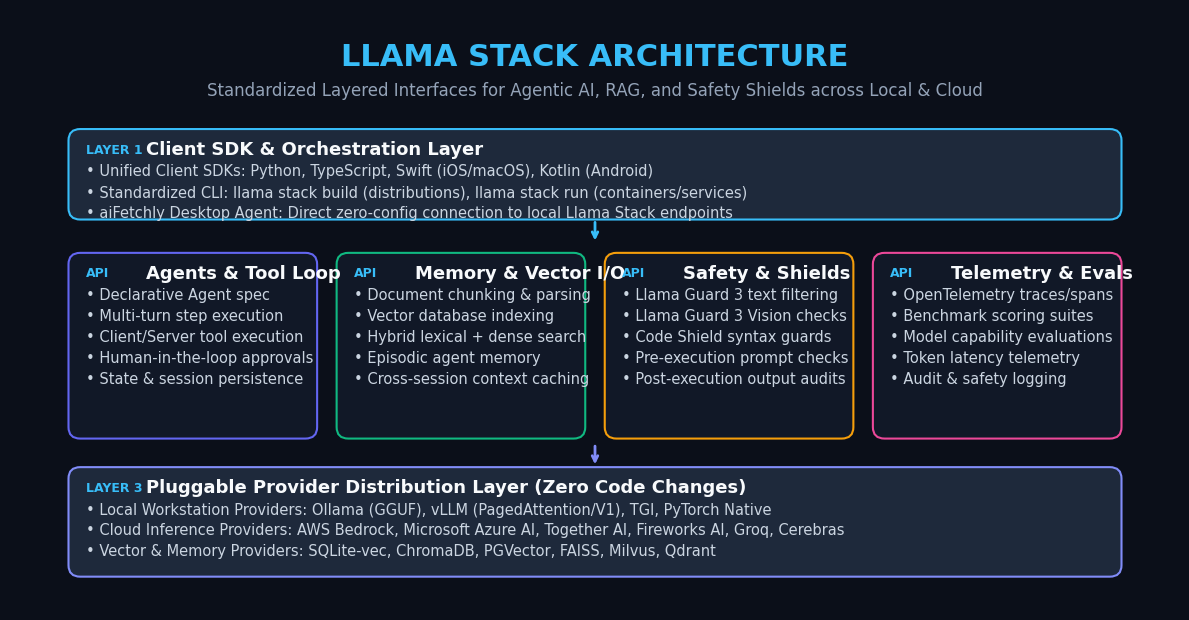
Rather than introducing yet another heavyweight monolithic framework, Llama Stack defines a rigorous, open specification of API boundaries, distribution templates, and idiomatic client SDKs. It separates the high-level intent of an AI application (what the agent should do) from the low-level infrastructure runtime (which GPU kernel or cloud endpoint executes the computation).
The 4-Layer Llama Stack System Architecture:
┌─────────────────────────────────────────────────────────────────┐
│ Layer 1: Client Application SDKs (Python, TS, Swift, Kotlin)    │
│          → Declarative Agent Sessions, Turn Streams, UI Bindings│
├─────────────────────────────────────────────────────────────────┤
│ Layer 2: Distribution Engine & CLI (llama stack build / run)    │
│          → Declarative YAML Configs, Server Orchestration       │
├─────────────────────────────────────────────────────────────────┤
│ Layer 3: Core Standardized API Primitives                       │
│  [Inference API]   [Vector I/O Memory]  [Agents & Tool Loop]   │
│  [Safety Shields]  [Telemetry & Spans]  [Model Evaluations]    │
├─────────────────────────────────────────────────────────────────┤
│ Layer 4: Pluggable Provider Implementations                     │
│  • Local: Ollama, vLLM, TGI, PyTorch Native, SQLite-vec        │
│  • Cloud: AWS Bedrock, Azure AI, Groq, Fireworks, Together AI  │
└─────────────────────────────────────────────────────────────────┘ The Four Architectural Pillars of Llama Stack
Llama Stack structures modern generative AI systems around four modular, decoupled layers:
1. Standardized Client SDKs and Unified Contracts
Developers write agentic applications using first-party, strongly typed SDKs available in Python, TypeScript/JavaScript, Swift (for native iOS and macOS desktop apps), and Kotlin (for Android). Regardless of whether the backend is an on-device local Ollama instance or a multi-node datacenter cluster, the client API contract remains 100% identical.
2. Declarative Distribution Templates (llama stack build)
Llama Stack introduces the concept of Distributions. Instead of manually packaging Docker containers with conflicting dependencies, developers select or define a declarative run.yaml configuration that maps abstract API interfaces to concrete providers. The CLI tool compiles and executes these distributions as isolated microservices with a single command:
llama stack build --template ollama-local
llama stack run ollama-local --port 5000 3. Core Standardized API Primitives
The protocol defines clean, unopinionated REST and gRPC endpoints for every fundamental generative task:
- Inference: Unified streaming chat completions, token embeddings, and speculative decoding.
- Agents: Stateful, multi-turn execution loops with automated tool scheduling and turn checkpoints.
- Memory (Vector I/O): Unified document ingestion, semantic chunking, and similarity search.
- Safety (Shields): Turn-level guardrail evaluation with Llama Guard 3, Llama Guard 3 Vision, and Code Shield.
- Telemetry & Evals: End-to-end OpenTelemetry instrumentation and automated LLM benchmarking.
4. The Pluggable Provider System
Providers are modular plugins that implement the standardized APIs. Crucially, providers can be hot-swapped without altering a single line of client application code. A developer can build and test an agent locally using Ollama and SQLite-vec on their laptop, then deploy the exact same compiled container into production powered by vLLM and Milvus.
Deep Dive: Core Standardized API Primitives in Llama Stack
To understand why Llama Stack represents a massive leap forward for AI engineering, let us examine its four most critical API primitives in detail.
The Unified Agentic Execution Pipeline in Llama Stack:
Client Query ──► [Safety Shield Check] ──► [Inference: Plan & Reason]
                         │                             │
                         ▼                             ▼
              [Block on Violation]           [Tool Call Emitted?]
                                                       │
                                      ┌────────────────┴───────────────┐
                                      ▼                                ▼
                             [No: Final Answer]             [Yes: Execute Tool]
                                                                       │
                                                                       ▼
                                                           [Vector I/O Memory Search]
                                                                       │
                                                                       ▼
[Feed Observation to Agent] 1. The Agents API: Stateful Turn-by-Turn Execution Loops
In traditional Python frameworks, agent behavior is implemented as an unbounded procedural while loop that handles tool invocations manually. If the process crashes mid-execution, all intermediate reasoning state is permanently lost.
The Llama Stack Agents API formalizes agent loops as stateful, server-managed state machines:
- Agent Sessions & Checkpointing: An agent session maintains persistent episodic memory, system prompts, active tools, and safety policies. Each user interaction initiates a Turn.
- Turn Step Streaming: A single turn breaks down into discrete, observable steps:
inference(reasoning and planning),tool_execution(invoking external APIs or functions), andshield_call(verifying guardrails). - Client-Side vs. Server-Side Tools: Llama Stack distinguishes between tools that run on the server (e.g., standard code interpreters or vector memory search) and tools that execute on the client device (e.g., browsing the local file system or clicking DOM elements in AiFetchly). For client-side tools, the turn loop pauses, yields a structured tool-call payload to the client, and seamlessly resumes once the client submits the observation.
2. The Vector I/O and Memory API: Standardizing Enterprise RAG
Instead of tying an application to a proprietary vector database SDK, the Memory API establishes a universal interface for document ingestion, storage, and retrieval:
- Document Ingestion Pipelines: Documents (PDFs, Markdown files, web pages) are submitted to a memory bank. Llama Stack handles text extraction, layout parsing, and semantic chunking behind the scenes.
- Embedding Abstraction: Vector generation is handled automatically using the configured embedding provider (such as local
all-MiniLM-L6-v2or datacenterbge-m3), guaranteeing that query vectors and stored document vectors use identical dimensionality and normalization parameters. - Hybrid Retrieval: The Vector I/O API unifies dense semantic similarity (cosine/inner product) with keyword BM25 lexical search, returning ranked passages with normalized relevance scores.
3. The Safety and Shields API: Protocol-Level Defense
Llama Stack elevates AI safety from an external wrapper to a first-class protocol primitive:
- Native Shield Configuration: When initializing an agent or inference endpoint, developers attach one or more Shields (such as
meta-reference/llama-guard-3-8bormeta-reference/code-shield). - Bidirectional Verification: The Llama Stack server automatically passes user inputs through the shield pipeline before invoking the foundation model. If a prompt injection or malicious intent is detected, the turn terminates immediately with a structured safety violation code.
- Code Shield Validation: For agents generating executable code (e.g., Python scripts or SQL queries), Code Shield analyzes the generated AST to intercept dangerous system calls, shell escapes, or unauthorized file deletions before code enters an execution sandbox.
4. Telemetry and Model Evaluation API
Observability in distributed agent architectures is notoriously difficult. Llama Stack provides:
- OpenTelemetry Spans: Every agent step, tool invocation, token prefill, and vector query automatically emits OpenTelemetry-compliant spans with timing, token count, and latency telemetry.
- Standardized Benchmarking: The Evaluation API allows teams to run standardized scoring suites (such as MMLU, GSM8K, or custom domain benchmarks) across local and cloud distributions to verify model capability regressions prior to deployment.
Architectural Comparison: Llama Stack vs. Legacy Agent Approaches
To highlight how Llama Stack reshapes production AI infrastructure, the table below compares it against proprietary cloud agent APIs, high-level orchestration libraries, and raw inference runtimes:
| Architectural Dimension | Llama Stack (Meta) | OpenAI Assistants API | LangChain / LlamaIndex | Raw vLLM / Ollama |
|---|---|---|---|---|
| Architectural Role | Standardized API spec & multi-provider stack | Proprietary hosted agent runtime | Code orchestration library & DAG framework | Low-level model serving engine |
| Hosting Portability | 100% Portable (Local edge, on-prem, cloud) | Closed cloud only (Vendor locked) | Code-portable, but requires manual provider glue | Self-hosted only (No client/agent API spec) |
| Agent State Management | Server-managed turns, steps, and checkpoints | Server-managed (Black-box cloud threads) | In-memory or client-configured database | None (Stateless inference requests) |
| Tool Execution Model | Unified client-side & server-side execution | Server-side code, polling client-side tools | Pure client-side Python loop execution | Raw function calling tokens only |
| RAG & Memory Integration | Universal Vector I/O API across all DBs | Proprietary Vector Stores | 50+ third-party vector DB wrappers | None (Manual vector pipeline required) |
| Protocol-Level Safety | Native Shields (Llama Guard 3, Code Shield) | Moderation API (Separate endpoint) | Custom middleware chains | None (Unchecked model output) |
| Client Language Support | Python, TypeScript, Swift, Kotlin | Python, TypeScript | Python, TypeScript | HTTP/OpenAI REST specs |
| Offline / On-Device Ready | Yes (Native Swift/Kotlin + local Ollama) | No (Requires continuous cloud connection) | Partial (Complex dependency bundling) | Yes (Local CLI/daemon) |
Production Implementation: Building a Resilient Desktop Agent with Llama Stack
Let us build a complete, production-grade agent using the official Llama Stack Python SDK. In this walkthrough, we will configure an agent with:
- A local LLM backend (Llama 3.2 3B running via Ollama).
- A protocol-level safety shield (Llama Guard 3).
- A client-side data extraction tool for AiFetchly.
- A memory bank for local document search.
Step 1: Install the Llama Stack Client SDK
First, install the client library and CLI:
pip install llama-stack-client llama-stack Step 2: Define the Distribution Configuration (run.yaml)
Llama Stack uses a declarative configuration file to wire up providers. Save the following configuration as run.yaml:
version: '2'
image_name: 'aifetchly-local-stack'
apis:
  - inference
  - memory
  - agents
  - safety
providers:
  inference:
    - provider_id: ollama
      provider_type: remote::ollama
      config:
        url: http://localhost:11434
  memory:
    - provider_id: sqlite_vec
      provider_type: inline::sqlite_vec
      config:
        db_path: ~/.aifetchly/memory.db
  safety:
    - provider_id: llama_guard
      provider_type: inline::llama_guard
      config:
model: meta-reference/llama-guard-3-1b Start the local Llama Stack server:
llama stack run run.yaml --port 5000 Step 3: Implement the Client Agent Loop in Python
Now, create agent_runner.py. We initialize the client, register our vector memory bank, define our client-side extraction tool, and execute a multi-turn agent interaction:
import os
from llama_stack_client import LlamaStackClient
from llama_stack_client.types import Document
from llama_stack_client.types.agent_create_params import AgentConfig

# 1. Initialize client connected to our Llama Stack distribution
client = LlamaStackClient(base_url="http://localhost:5000")

# 2. Register a Vector Memory Bank for enterprise RAG
memory_bank_id = "enterprise_knowledge"
client.memory.register(
    memory_bank_id=memory_bank_id,
    embedding_model="all-MiniLM-L6-v2",
    embedding_dimension=384,
    provider_id="sqlite_vec"
)

# Ingest technical documentation into memory
client.memory.insert(
    memory_bank_id=memory_bank_id,
    documents=[
        Document(
            document_id="doc_compliance_01",
            content="Enterprise API Policy: All external data fetches must include user-agent headers and obey robots.txt.",
            mime_type="text/plain"
        )
    ]
)

# 3. Create an Agent Session with Safety Shields and Memory
agent_config = AgentConfig(
    model="meta-llama/Llama-3.2-3B-Instruct",
    instructions=(
        "You are an expert autonomous data extraction assistant for aiFetchly. "
        "Retrieve technical policies from your memory bank, invoke extraction tools, "
        "and synthesize verified JSON records."
    ),
    client_tools=[
        {
            "name": "fetch_web_data",
            "description": "Extracts structured content from a target URL",
            "parameters": {
                "url": {"type": "string", "description": "Target website URL"},
                "css_selector": {"type": "string", "description": "DOM selector or extraction pattern"}
            }
        }
    ],
    memory_bank_ids=[memory_bank_id],
    input_shields=["meta-reference/llama-guard-3-1b"],
    max_infer_iters=5
)

agent = client.agents.create(agent_config=agent_config)
session = client.agents.sessions.create(agent_id=agent.agent_id, session_name="web_scraping_run")

print(f"[*] Agent initialized with ID: {agent.agent_id}")
print(f"[*] Session created with ID: {session.session_id}")

# 4. Execute an Agent Turn with Client-Side Tool Resolution
prompt = "Check our corporate API compliance policy, then fetch competitive pricing from https://api.store.local/pricing"
turn_stream = client.agents.turns.create(
    agent_id=agent.agent_id,
    session_id=session.session_id,
    messages=[{"role": "user", "content": prompt}],
    stream=True
)

for chunk in turn_stream:
    event = chunk.event
    event_type = event.payload.event_type

    if event_type == "turn_start":
        print("[>] Turn started...")

    elif event_type == "step_progress":
        step_type = event.payload.step_type
        if step_type == "inference":
            print(f"[LLM Thinking] {event.payload.model_response_object.content}")

    elif event_type == "step_complete":
        step_details = event.payload.step_details

        # Intercept client-side tool execution requests
        if step_details.step_type == "tool_execution":
            for call in step_details.tool_calls:
                print(f"[Tool Call Required] {call.tool_name}({call.arguments})")

                # Execute tool locally within the application environment
                if call.tool_name == "fetch_web_data":
                    simulated_result = '{"status": "success", "products": [{"sku": "A10", "price": 499.00}]}'

                    # Submit observation back to the Llama Stack agent loop
                    client.agents.turns.submit_tool_outputs(
                        agent_id=agent.agent_id,
                        session_id=session.session_id,
                        turn_id=event.turn_id,
                        tool_outputs=[{
                            "call_id": call.call_id,
                            "output": simulated_result
                        }]
                    )

    elif event_type == "turn_complete":
        print("[✓] Turn completed successfully!")
        print(f"Final Agent Answer:
{event.payload.turn.output_message.content}") Production Best Practices: Integrating Llama Stack into Desktop Workspaces
When deploying Llama Stack in enterprise desktop applications like AiFetchly, adopting the following architectural patterns guarantees optimal performance and security:
1. Hybrid Edge-Cloud Distribution Routing
Configure a dual-provider inference routing strategy. Small, latency-critical operations (such as initial prompt sanitization, JSON schema correction, and short tool decisions) are directed to local on-device models (Llama-3.2-1B or 3B via Ollama). Deep multi-document synthesis and code refactoring are routed to local high-end hardware or cloud inference endpoints (Llama-3.3-70B or 405B). Because both endpoints speak the identical Llama Stack protocol, client application code requires zero conditional branching.
2. Zero-Leak Sandboxed Tooling
When granting agents access to local desktop resources:
- Never expose raw shell interpreters to untrusted agent loops without an input shield.
- Enforce Code Shield as an inline output shield. If the model attempts to emit hazardous Python or shell commands containing
rm -rf,os.system("curl ... | sh"), or raw socket connections, Code Shield halts execution before the payload touches the OS runtime. - For web data extraction, route requests through isolated browser contexts or headless engines (such as Crawl4AI or Playwright) equipped with strict domain allowlists.
3. Persistent Local Memory with SQLite-vec
For local desktop applications, avoid deploying heavy, standalone vector database servers like Milvus or Qdrant that consume gigabytes of background memory. Use the inline::sqlite_vec provider. SQLite-vec embeds fast C-based vector similarity search directly into a standard SQLite file database, delivering single-millisecond vector lookups with zero background CPU overhead.
4. Continuous Observability via OpenTelemetry
Export Llama Stack’s native telemetry to local observability backends (such as Jaeger or Prometheus). By tracking token consumption, Time-to-First-Token (TTFT), tool call latency, and shield violation rates per session, engineering teams can pinpoint performance degradation and optimize agent instructions with quantitative precision.