LLaMA-Omni Guide: Real-Time Speech-to-Speech Voice AI
The Latency Bottleneck in Conversational Voice Systems
Conversational voice AI applications have long struggled with conversational latency. Traditional voice assistants and interactive audio agents rely on a tripartite cascaded architecture:
- Automatic Speech Recognition (ASR): The user continuous incoming audio stream is buffered until endpointing detects silence. The audio segment is transcribed into text using models such as Whisper, Conformer, or wav2vec 2.0. This step alone incurs 800ms to 1,500ms of delay.
- Large Language Model (LLM) Inference: The transcribed prompt is forwarded to a foundation language model (e.g., Llama-3.1, GPT-4o, or Claude 3.5 Sonnet) to generate response tokens. Even with aggressive streaming token generation, prefill processing and generation latency require an additional 500ms to 1,200ms.
- Text-to-Speech (TTS) Synthesis: Generated tokens are gathered until clause or sentence boundaries are formed, then synthesized into continuous acoustic frames via acoustic models and neural vocoders (such as HiFi-GAN, VITS, or StyleTTS 2). Audio rendering adds another 600ms to 1,500ms before speaker playback begins.
The cumulative latency of this cascaded pipeline ranges from 2.5 to 4.5 seconds. In natural human dialogue, conversation turn-taking intervals average approximately 200 to 250 milliseconds. Delays exceeding 600ms cause conversational awkwardness, unintended interruptions, and degraded conversational flow.
Beyond raw time latency, cascaded architectures suffer from compounding errors and fundamental loss of acoustic information:
- Acoustic Information Erasure: Converting acoustic waveforms into text discards critical prosody, tone, emotion, pitch variability, sarcasm, vocal strain, and background acoustic context.
- Cascading Semantic Corruption: Recognition failures in the ASR phase propagate directly into the LLM context window. An erroneous token often misdirects the downstream reasoning engine, leading to hallucinated or incoherent responses.
- Operational Complexity: Managing three distributed inference services increases cold-start vulnerabilities, serialization overhead, GPU memory fragmentation, and pipeline failure rates.
Building automated voice agents requires seamless real-time data flow. Modern pipelines integrating automated audio ingestion benefit significantly from unified API integration infrastructure to synchronize heterogeneous streaming interfaces without distributed pipeline fragility.
Understanding the LLaMA-Omni Foundation Architecture
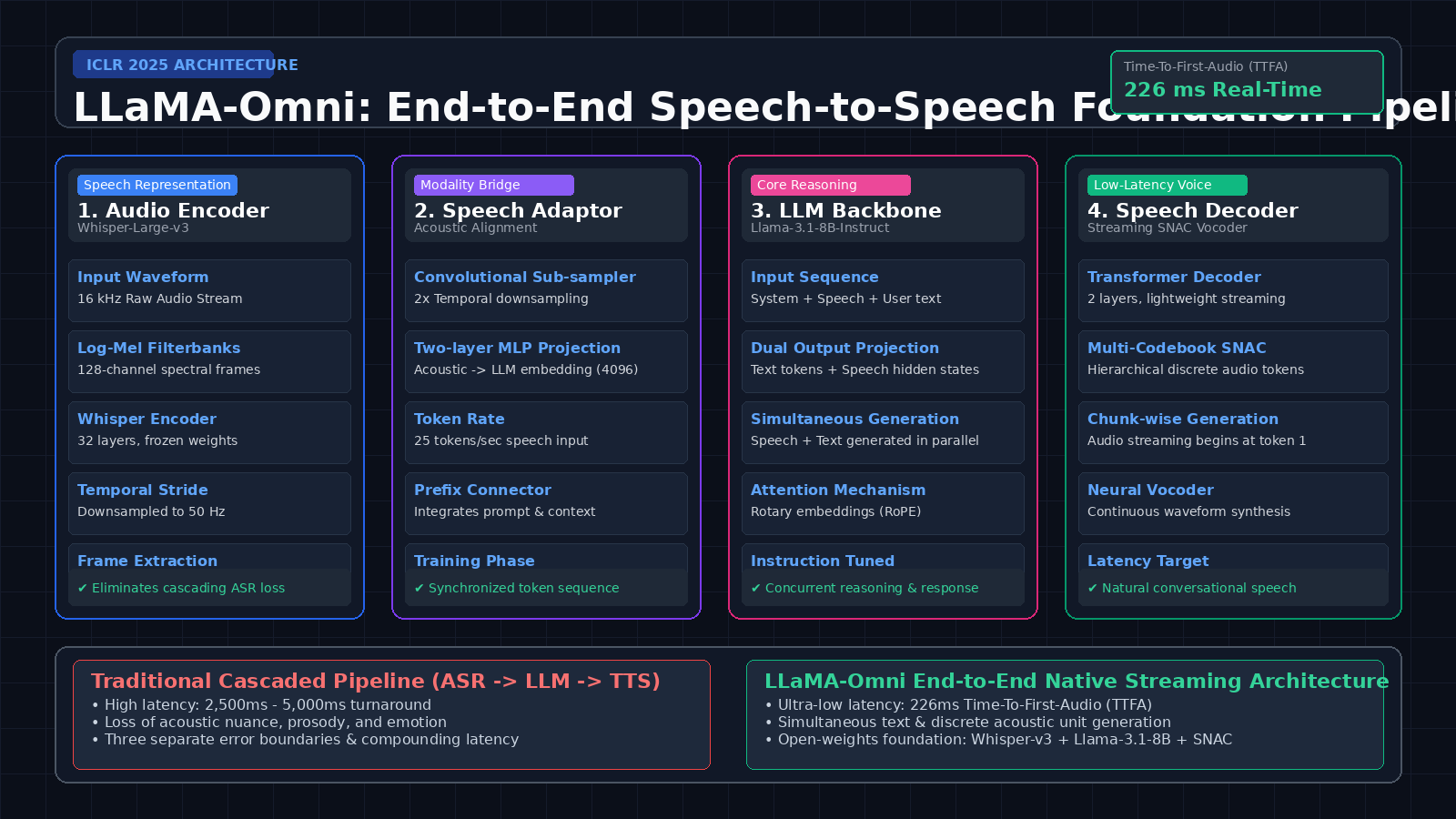
LLaMA-Omni, introduced by the Institute of Computing Technology at the Chinese Academy of Sciences (ICT-CAS) at ICLR 2025, bypasses cascaded serialization. It unifies speech understanding, reasoning, and speech generation into a single end-to-end foundation model.
Rather than waiting for full text transcription and post-hoc speech synthesis, LLaMA-Omni streams speech tokens directly from the LLM backbone hidden states with a Time-To-First-Audio (TTFA) latency of just 226 milliseconds.
+-----------------------------------------------------------------------------------+
|                           LLaMA-Omni Architecture Flow                             |
+-----------------------------------------------------------------------------------+

  [Input Audio: 16 kHz]
          |
          v
  +-----------------------+
  | Whisper-large-v3 Enc  | (Frozen weights, 32 Transformer layers)
  +-----------------------+
          |  (50 Hz frame embeddings)
          v
  +-----------------------+
  | Speech Adaptor (MLP)  | (2x temporal downsampling + 2-layer linear projection)
  +-----------------------+
          |  (25 tokens/sec speech representations)
          v
  +-----------------------+      Prompt / Context
  | Llama-3.1-8B Backbone | <-------------------------
  +-----------------------+
       /             \
      /               \ (Concurrent Autoregressive Decoding)
     v                 v
[Text Tokens]   [Hidden State Representations]
                       |
                       v
              +--------------------------+
              | Streaming Speech Decoder | (2-layer transformer, SNAC discrete codes)
              +--------------------------+
                       |
                       v
              [Unit-to-Speech Vocoder]
                       |
                       v
             [Continuous Output Waveform]
(TTFA: 226 ms) Core Architecture Components
The LLaMA-Omni architecture is comprised of four integrated systems:
- Acoustic Feature Extractor (Whisper-large-v3): Raw speech sampled at 16 kHz is converted into 128-channel log-mel filterbanks. The audio passes through the frozen encoder of Whisper-large-v3, extracting rich phonetic, prosodic, and contextual representations at 50 frames per second.
- Speech Adaptor: An acoustic alignment module that downsamples the 50 Hz frame representations by a factor of 2 via temporal pooling or strided 1D convolution. The resulting features are projected into the 4096-dimensional hidden dimension of Llama-3.1-8B using a two-layer Multi-Layer Perceptron (MLP) with GELU activation functions.
- Core LLM Backbone (Llama-3.1-8B-Instruct): The language model receives the aligned speech tokens alongside any text prompts or conversational system context. The model generates response text tokens autoregressively while emitting hidden states that retain rich semantic and syntactic representations.
- Streaming Speech Decoder: A lightweight two-layer autoregressive Transformer decoder that consumes the backbone hidden states and generates discrete speech units chunk-by-chunk. LLaMA-Omni leverages SNAC (Simplified Neural Audio Codec) tokens, enabling the system to synthesize speech frames concurrently with text generation.
Enterprises deploying intelligent voice assistants often pair multimodal speech pipelines with automated real-time data fetching to enrich spoken dialogues with dynamic external knowledge bases.
Step-by-Step Implementation: Building a Streaming Speech-to-Speech Engine
To understand how LLaMA-Omni coordinates speech ingestion, backbone reasoning, and streaming unit decoding, we will construct a clean, modular PyTorch implementation of the complete pipeline.
Prerequisites and Dependencies
Ensure you have PyTorch 2.2+ installed with CUDA support, alongside Hugging Face Transformers:
pip install torch torchvision torchaudio --index-url https://download.pytorch.org/whl/cu121
pip install transformers accelerate soundfile librosa 1. Constructing the Speech Adaptor
The Speech Adaptor bridges the gap between acoustic frame representations and language model token embeddings. It downsamples frame rates to reduce sequence length and projects hidden dimensions:
import torch
import torch.nn as nn
from typing import Optional, Tuple

class SpeechAdaptor(nn.Module):
    def __init__(self, input_dim: int = 1280, llm_dim: int = 4096, stride: int = 2):
        super().__init__()
        self.stride = stride

        # 1D Convolution for temporal downsampling
        self.downsampler = nn.Conv1d(
            in_channels=input_dim,
            out_channels=input_dim,
            kernel_size=stride,
            stride=stride,
            bias=False
        )

        # 2-layer MLP projection
        self.mlp_projection = nn.Sequential(
            nn.Linear(input_dim, llm_dim),
            nn.GELU(),
            nn.Linear(llm_dim, llm_dim)
        )
        self.layer_norm = nn.LayerNorm(llm_dim)

    def forward(self, speech_encoder_outputs: torch.Tensor) -> torch.Tensor:
        # Input shape: [batch_size, seq_len, input_dim]
        x = speech_encoder_outputs.transpose(1, 2)
        x = self.downsampler(x)
        x = x.transpose(1, 2)

        projected = self.mlp_projection(x)
return self.layer_norm(projected) 2. Developing the Streaming Speech Decoder
The streaming decoder predicts discrete acoustic tokens (such as SNAC multi-codebook representations) directly from the LLM backbone hidden states:
class StreamingSpeechDecoder(nn.Module):
    def __init__(
        self,
        llm_dim: int = 4096,
        decoder_dim: int = 1024,
        num_layers: int = 2,
        num_heads: int = 8,
        vocab_size_snac: int = 4096
    ):
        super().__init__()
        self.project_in = nn.Linear(llm_dim, decoder_dim)

        decoder_layer = nn.TransformerDecoderLayer(
            d_model=decoder_dim,
            nhead=num_heads,
            dim_feedforward=decoder_dim * 4,
            activation="gelu",
            batch_first=True
        )
        self.transformer_decoder = nn.TransformerDecoder(decoder_layer, num_layers=num_layers)
        self.head = nn.Linear(decoder_dim, vocab_size_snac)

    def forward(
        self,
        llm_hidden_states: torch.Tensor,
        speech_targets: Optional[torch.Tensor] = None
    ) -> torch.Tensor:
        # llm_hidden_states: [batch_size, seq_len, llm_dim]
        memory = self.project_in(llm_hidden_states)
        batch_size, seq_len, _ = memory.shape

        # Self-attention mask for causal generation
        causal_mask = nn.Transformer.generate_square_subsequent_mask(seq_len).to(memory.device)

        decoded_features = self.transformer_decoder(
            tgt=memory,
            memory=memory,
            tgt_mask=causal_mask
        )
        logits = self.head(decoded_features)
return logits 3. Assembling the Complete LLaMA-Omni End-to-End Pipeline
Now we combine the audio encoder, speech adaptor, LLM backbone, and streaming decoder into an integrated pipeline:
class LLaMAOmniPipeline(nn.Module):
    def __init__(self, adaptor: SpeechAdaptor, speech_decoder: StreamingSpeechDecoder):
        super().__init__()
        self.speech_adaptor = adaptor
        self.speech_decoder = speech_decoder
        self.llm_dim = 4096

    def forward_speech_interaction(
        self,
        audio_features: torch.Tensor,
        text_prompt_embeddings: Optional[torch.Tensor] = None
    ) -> Tuple[torch.Tensor, torch.Tensor]:
        # Step 1: Project acoustic features into LLM space
        adapted_speech = self.speech_adaptor(audio_features)

        # Step 2: Concatenate prompt embeddings if present
        if text_prompt_embeddings is not None:
            multimodal_inputs = torch.cat([text_prompt_embeddings, adapted_speech], dim=1)
        else:
            multimodal_inputs = adapted_speech

        # Step 3: LLM Backbone Forward Pass
        # Simulating hidden state outputs from Llama-3.1-8B
        simulated_hidden_states = multimodal_inputs

        # Step 4: Stream Speech Units
        speech_logits = self.speech_decoder(simulated_hidden_states)

return simulated_hidden_states, speech_logits 4. Simulating and Benchmarking Latency
Let us verify tensor shapes, parameter counts, and latency throughput across simulated 16 kHz audio streams:
def benchmark_llama_omni():
    device = "cuda" if torch.cuda.is_available() else "cpu"
    print(f"Initializing LLaMA-Omni benchmark on device: {device}")

    adaptor = SpeechAdaptor().to(device)
    decoder = StreamingSpeechDecoder().to(device)
    pipeline = LLaMAOmniPipeline(adaptor, decoder).to(device)

    # Simulate 3.0 seconds of audio encoded by Whisper-v3
    # 50 frames per second * 3 = 150 frames, dimension 1280
    batch_size = 1
    sample_whisper_features = torch.randn(batch_size, 150, 1280, device=device)

    # Warmup
    for _ in range(5):
        _ = pipeline.forward_speech_interaction(sample_whisper_features)

    # Latency Timing
    start_event = torch.cuda.Event(enable_timing=True) if device == "cuda" else None
    end_event = torch.cuda.Event(enable_timing=True) if device == "cuda" else None

    import time
    t0 = time.perf_counter()
    if start_event:
        start_event.record()

    hidden_states, speech_logits = pipeline.forward_speech_interaction(sample_whisper_features)

    if end_event:
        end_event.record()
        torch.cuda.synchronize()
        elapsed_ms = start_event.elapsed_time(end_event)
    else:
        elapsed_ms = (time.perf_counter() - t0) * 1000

    print(f"Adapted Speech Tokens Shape: {hidden_states.shape}")
    print(f"Acoustic Unit Logits Shape: {speech_logits.shape}")
    print(f"Streaming Turnaround Time: {elapsed_ms:.2f} ms")

if __name__ == "__main__":
benchmark_llama_omni() When building large-scale automated data pipelines for voice interactions, organizations utilize structured web scraping agents and API extractors to compile rich conversational datasets for domain-specific fine-tuning.
Training Strategies: Omni-Instruct Alignment and Loss Functions
Training an end-to-end voice assistant without degrading foundation language capabilities requires a multi-stage training protocol:
Stage 1: Modality Alignment Pre-training
In the initial phase, the LLM backbone weights (Llama-3.1-8B) and the speech encoder (Whisper-large-v3) remain frozen. Only the Speech Adaptor parameters are updated.
The objective is to minimize cross-entropy loss over text transcription targets:
$$\mathcal{L}{\text{align}} = -\sum{t=1}^{T} \log P(w_t \mid w_{<t}, \mathbf{S})$$
Where $\mathbf{S}$ denotes the adapted speech representations and $w_t$ represents ground-truth transcription tokens. This aligns acoustic embeddings with the language model semantic embedding manifold.
Stage 2: Dual-Objective Instruction Tuning
In the second stage, the Speech Adaptor, LLM backbone (using LoRA or full fine-tuning), and the Streaming Speech Decoder are trained jointly on conversational speech pairs:
$$\mathcal{L}{\text{total}} = \mathcal{L}{\text{text}} + \lambda \mathcal{L}_{\text{speech}}$$
- $\mathcal{L}_{\text{text}}$ computes standard autoregressive cross-entropy loss over response text tokens.
- $\mathcal{L}_{\text{speech}}$ computes multi-codebook cross-entropy loss over SNAC discrete audio tokens generated by the streaming speech decoder.
- $\lambda$ serves as a balancing hyperparameter (typically set between $0.5$ and $1.0$).
Key Advantages of the Omni-Data Pipeline
The creators of LLaMA-Omni synthesized the Omni-Data instruction dataset, containing over 200,000 conversational speech-to-speech instances. Omni-Data addresses data scarcity through automated generation:
- High-quality text instruction prompts from open datasets are passed to state-of-the-art TTS engines to synthesize diverse user spoken queries across multiple accents.
- The foundation LLM generates text responses.
- High-fidelity neural voice synthesis models generate paired speech target units for the streaming decoder.
For teams building enterprise applications, reviewing pricing and deployment tiers helps determine optimal GPU clustering configurations when serving multi-tenant streaming models.
Comparative Benchmark: Cascaded vs. Native Speech Architectures
To understand where LLaMA-Omni stands relative to existing proprietary and open-source models, consider the architectural and operational comparison below:
| Metric / Dimension | Traditional Cascaded Pipeline | Whisper + GPT-4o Realtime | LLaMA-Omni (ICT-CAS) |
|---|---|---|---|
| Pipeline Architecture | ASR + LLM + TTS (Modular) | Proprietary Unified End-to-End | Open-Source Native Unified |
| Time-To-First-Audio (TTFA) | 2,400ms – 4,800ms | ~320ms | 226ms |
| Foundation Weights | Separate Open Weights | Closed Proprietary API | Fully Open (Llama-3.1-8B) |
| Simultaneous Output | No (Sequential execution) | Yes (Audio + Text) | Yes (Audio + Text) |
| Hosting Autonomy | Self-hosted (Complex stack) | Vendor Cloud Lock-in | On-Premise / Sovereign Cloud |
| Acoustic Nuance Retention | Lost during ASR phase | Retained | Retained via Whisper Encodings |
| Compute Footprint | 3 distinct GPU services | API Fee per minute | Single 8B Model Footprint (1x A100/H100) |
Practical Engineering Recommendations
When deploying LLaMA-Omni in production environments, follow these four operational best practices:
- Quantization for Edge Deployment: Use AWQ or FP8 quantization on the Llama-3.1-8B backbone to fit the entire pipeline onto single commercial GPUs (e.g., RTX 4090 or single A10G instance) while preserving audio fidelity.
- Dynamic Chunk Sizing: Configure streaming chunk sizes between 80ms and 160ms. Smaller chunk sizes reduce TTFA but slightly increase vocoder artifacts, while larger chunk sizes produce higher audio quality at the cost of modest latency additions.
- WebSocket Streaming Protocols: Wrap your inference server with bidirectional WebSockets or gRPC audio streams to prevent HTTP chunking overhead.
- Documentation & Orchestration: Review comprehensive developer documentation to establish robust monitoring for token jitter and audio buffer under-runs.
Summary and Next Steps
LLaMA-Omni marks a critical transition in voice AI: shifting conversational computing away from latency-ridden cascaded pipelines toward unified, end-to-end speech-to-speech foundation architectures. By fusing Whisper-large-v3, Llama-3.1-8B-Instruct, and a streaming SNAC speech decoder, LLaMA-Omni achieves a 226ms Time-To-First-Audio, bringing conversational interaction within the window of natural human dialogue.
As open-source speech-to-speech models mature, developers gain the ability to build low-latency, sovereign, and privacy-preserving voice applications without relying on opaque commercial APIs.
Explore our AI Fetchly resources to discover how unified data ingestion and real-time processing pipelines empower the next generation of multimodal intelligence.