LLaMA-Mesh Guide: 3D Mesh Generation with Language Models
The Problem: The Architectural Silo Between 3D Generation and Language Models
In modern enterprise automation, spatial computing, game development, and intelligent web harvesting platforms like AiFetchly, AI systems must process diverse data representations: text, structured schemas, images, and increasingly, three-dimensional spatial assets.
For decades, digital 3D creation has relied on polygonal meshes—the universal industry standard used in Blender, Unreal Engine, Unity, CAD software, and 3D printing. A polygonal mesh defines surface geometry through discrete vertices and interconnected faces, making it lightweight, editable, and ready for real-time physics rendering.
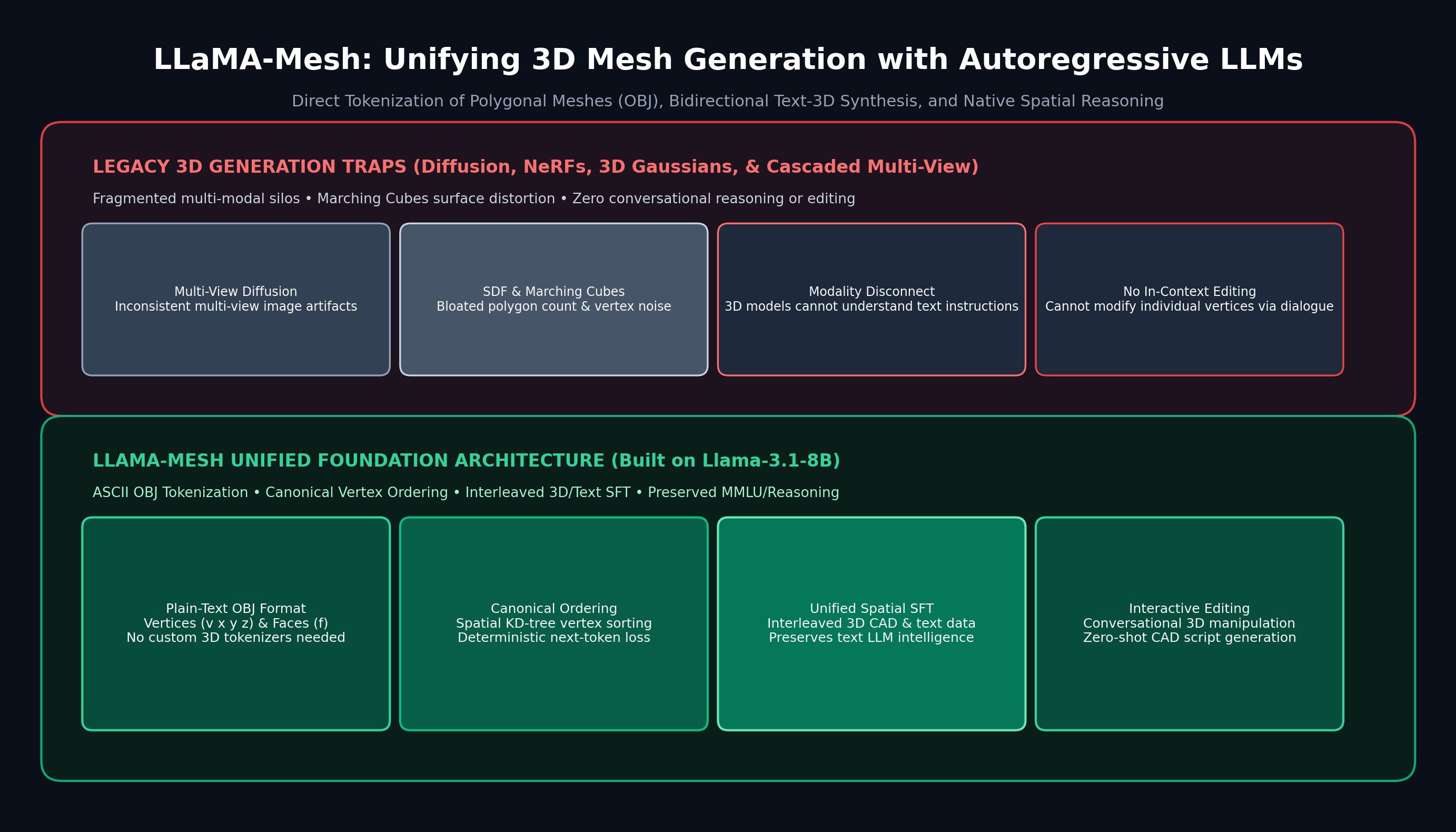
However, when generative AI expanded into 3D asset creation, the field split into an isolated, fragmented technological silo. Rather than integrating with frontier Large Language Models (LLMs), 3D generation relied on complex, cascaded continuous representations:
- Multi-View Diffusion Models: Generating 2D synthetic images from multiple viewpoints (e.g., front, side, back) and attempting to fuse them using Neural Radiance Fields (NeRFs) or 3D Gaussian Splatting (3DGS).
- Implicit Volumetric Fields & Signed Distance Functions (SDFs): Training continuous 3D neural fields and extracting surfaces using the Marching Cubes algorithm.
The Legacy 3D Generation Pipeline:
[Text Prompt] ──► [2D Diffusion] ──► [Multi-View Images]
                                             │
[Surface Mesh (.OBJ)] ◄── [Marching Cubes] ◄── [NeRF / 3D Gaussian Splatting]
Flaws: Heavy multi-step latency • Noisy polygon geometry • Zero conversational editing! These cascaded 3D architectures suffer from three critical engineering bottlenecks:
1. Inconsistent Multi-View Projections and Geometry Artifacts
Cascading 2D diffusion into 3D fields introduces severe spatial inconsistencies:
- The Janus Multi-Face Problem: Because 2D diffusion models generate each viewpoint with independent latent noise, reconstructed 3D objects frequently exhibit duplicate heads, misaligned limbs, or floating surface artifacts.
- Surface Noise from Marching Cubes: Extracting a polygon mesh from a continuous neural field using Marching Cubes yields millions of tiny, disorganized triangles. These raw meshes lack clean edge loops, exhibit bumpy surface noise, and require manual CAD artist retopology before they can be used in production game engines.
2. The Modality Disconnect and Complete Absence of Reasoning
Legacy 3D generation models are fundamentally unimodal black boxes:
- A multi-view diffusion model can generate an isolated shape, but it cannot understand what it built.
- It cannot answer questions about the generated 3D geometry (e.g., “How many legs does this table have?” or “Is this mechanical bracket symmetric across the Y-axis?”).
- It cannot read mathematical spatial constraints or compile 3D assets from technical engineering specifications.
3. Inability to Perform In-Context 3D Editing and Conversational Refinement
In real-world creative workflows, 3D artists never accept an initial draft without iterative adjustments:
- With diffusion-based 3D generators, asking for an edit (e.g., “Make the chair armrests 20% higher” or “Round the sharp corners”) requires running an entirely new random seed from scratch, completely destroying the original model geometry.
- Because the 3D generator is detached from a language model backbone, it lacks conversational in-context memory, preventing step-by-step interactive 3D refinement.
The Architecture: LLaMA-Mesh Unified Foundation Scale
To resolve the divide between language reasoning and spatial 3D generation, researchers from NVIDIA Toronto AI Lab and Tsinghua University (Wang et al., late 2024 / 2025) introduced LLaMA-Mesh.
Rather than designing complex new neural network layers, custom geometric latent autoencoders, or continuous diffusion projections, LLaMA-Mesh establishes a radically simple thesis: 3D polygonal meshes are already text.
Built directly on top of the open-weights Llama-3.1-8B-Instruct foundation model, LLaMA-Mesh trains a standard autoregressive transformer to generate, understand, and edit 3D meshes represented in standard plain-text Wavefront OBJ format without altering the core transformer architecture.
The LLaMA-Mesh Unified Architecture Blueprint:
┌────────────────────────────────────────────────────────────────────────┐
│ LLaMA-Mesh Foundation Backbone: Llama-3.1-8B-Instruct                  │
├───────────────────────────────────┬────────────────────────────────────┤
│ Architectural Primitive           │ Technical Implementation           │
├───────────────────────────────────┼────────────────────────────────────┤
│ Base Model Weights                │ Llama-3.1-8B-Instruct (Frozen Vocab│
│ 3D Geometric Representation       │ Standard ASCII Wavefront OBJ (.obj)│
│ Primary Generative Tokens         │ Vertices (v x y z) & Faces (f a b c│
│ Context Window Capacity           │ 8,192 to 131,072 tokens with RoPE  │
│ Coordinate Discretization         │ Float strings rounded to 2 decimals│
│ Vertex Ordering Strategy          │ Spatial KD-Tree Lexicographical Sort│
│ Multi-Task Training Curriculum    │ Text-to-3D, 3D-to-Text, and Text QA│
└───────────────────────────────────┴────────────────────────────────────┘ The model architecture is underpinned by three foundational engineering breakthroughs:
1. Zero Architectural Surgery (Leveraging Native Text Tokenizers)
Unlike previous attempts that designed specialized vector-quantized 3D tokenizers (such as MeshGPT), LLaMA-Mesh uses the standard Llama-3.1 BPE tokenizer:
- Wavefront OBJ format expresses geometry using human-readable ASCII text:
v 0.12 -0.45 0.88 v -0.34 0.50 0.12 f 1 2 3 - Because Llama-3.1’s vocabulary already contains tokens for numbers, signs, spaces, decimal points, and characters (
v,f), the model requires zero new embeddings or vocabulary expansion. - By preserving the exact token embedding space, LLaMA-Mesh completely prevents catastrophic forgetting of general reasoning, mathematics, and coding skills.
2. SFT on Canonicalized Spatial KD-Tree Ordering
In standard 3D files, vertex and face orderings are arbitrary: a cube can be written with 40,320 different vertex permutations, each representing the identical physical shape. This combinatorial explosion cripples standard autoregressive next-token prediction loss.
To make 3D mesh generation deterministic:
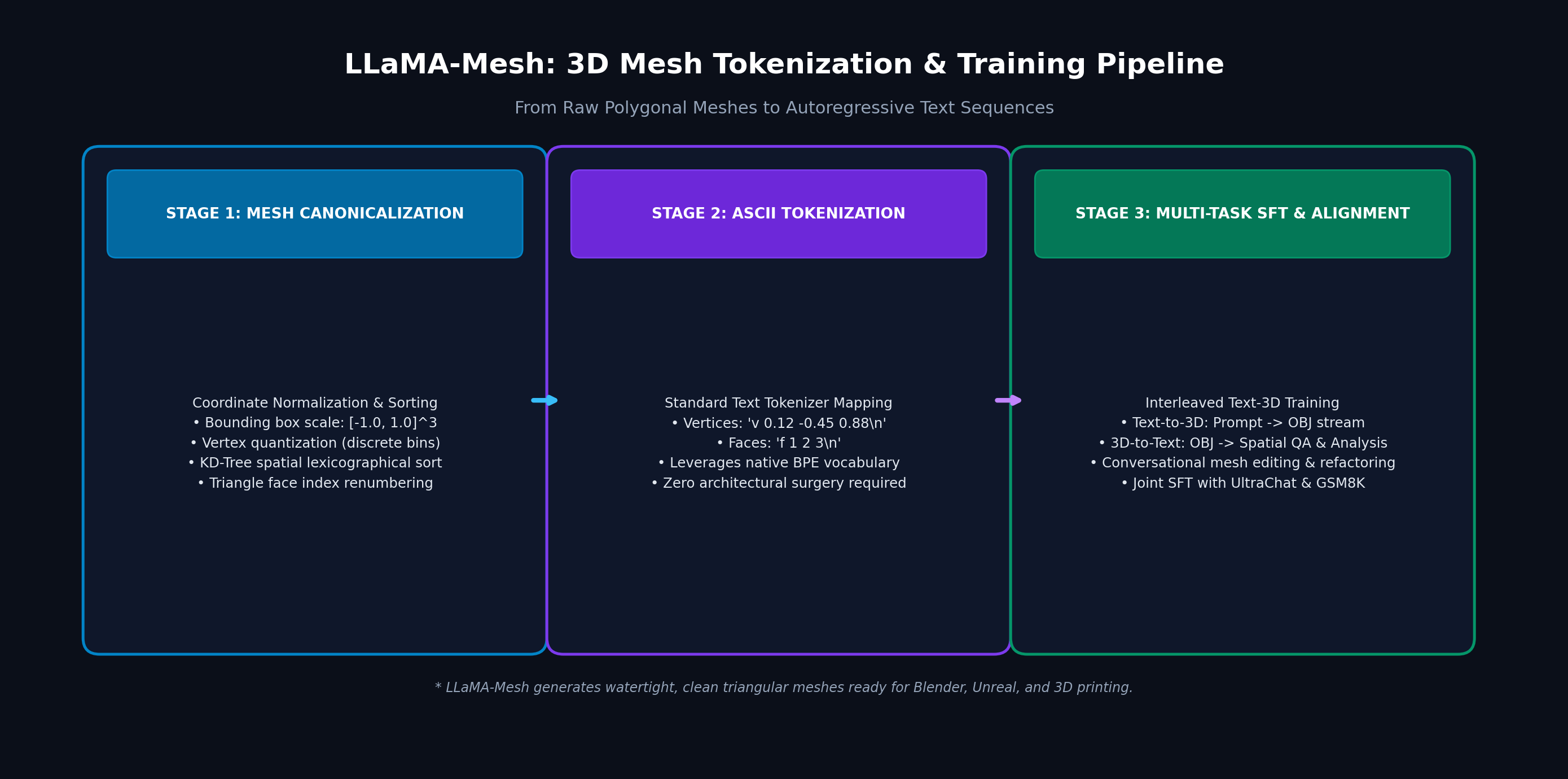
- LLaMA-Mesh applies a canonical spatial sorting algorithm. Vertices are structured using a spatial KD-tree and sorted along primary coordinate axes (Z then Y then X).
- Faces are re-indexed to reference the sorted vertices monotonically.
- This canonicalization reduces token entropy by orders of magnitude, allowing standard causal attention to learn 3D surface topologies efficiently.
3. Bidirectional Text and 3D Spatial Understanding
Because LLaMA-Mesh is an autoregressive language model, information flows bidirectionally:
- Text-to-3D Generation: Prompts requesting a specific shape emit the complete vertex and face stream.
- 3D-to-Text Spatial Reasoning: Inputting complete or partial OBJ mesh strings allows the model to answer geometric questions regarding symmetry, part composition, or watertightness.
- In-Context Mesh Editing: Instruction-driven prompts modify existing OBJ geometries while preserving unchanged vertices.
Core Mechanics: OBJ Mesh Canonicalization and Multi-Task SFT
Transforming raw 3D CAD files into sequences suitable for an 8B language model requires a disciplined data preparation pipeline.
1. The Wavefront OBJ Representation Format
The Wavefront OBJ format decomposes 3D shapes into two primary primitives:
- Geometric Vertices (
v): Defined by 3D coordinates $(x, y, z)$ bounded within a normalized unit bounding box $[-1.0, 1.0]^3$. - Polygonal Faces (
f): Defined by 1-indexed pointers to the vertex list, forming closed planar triangles.
LLaMA-Mesh formats coordinates as floating-point decimals with two or three digits of precision (e.g., v 0.25 -0.80 0.15), striking an optimal balance between spatial geometric resolution and sequence token length. A complete low-poly asset (300 to 800 vertices and 600 to 1,500 faces) fits comfortably within 4,000 to 8,000 tokens.
2. Multi-Task Training Mixture and Alignment
To teach LLaMA-Mesh 3D spatial concepts without degrading language capabilities, the training pipeline blends three distinct data streams:
LLaMA-Mesh Supervised Fine-Tuning (SFT) Mixture:
┌────────────────────────────────────────────────────────────────────────┐
│ 1. Text-to-3D Generation Tasks (40%):                                  │
│    • High-quality curated 3D meshes from Objaverse & CAD datasets      │
│    • Paired with detailed multi-paragraph descriptive text prompts      │
├────────────────────────────────────────────────────────────────────────┤
│ 2. 3D-to-Text Spatial Reasoning & QA (30%):                            │
│    • Input: Complete or partial OBJ mesh strings                       │
│    • Output: Semantic classification, bounding volume, symmetry, parts  │
├────────────────────────────────────────────────────────────────────────┤
│ 3. General Language & Instruction Tuning (30%):                        │
│    • UltraChat, GSM8K, and Open-Platypus datasets                      │
│    • Anchors core reasoning, tool use, and conversational flow         │
└────────────────────────────────────────────────────────────────────────┘ By co-training on standard language tasks alongside 3D tokens, LLaMA-Mesh retains a 68.2% score on MMLU and maintains strong Python coding capabilities, enabling the model to write Blender Python scripts that programmatically manipulate the meshes it generates.
Implementation: Generating and Visualizing 3D Meshes with LLaMA-Mesh
Deploying LLaMA-Mesh allows developers to build local 3D generation pipelines using standard LLM serving tools (such as vLLM, Ollama, or Hugging Face transformers). Below is a complete implementation demonstrating how to generate a 3D asset from a text prompt and export it directly to an .obj file for rendering in Blender, Three.js, or Unity.
Step 1: Install Dependencies
Ensure your environment has PyTorch, Hugging Face transformers, and trimesh installed:
pip install torch transformers trimesh Step 2: Python Script for 3D Mesh Generation & Validation
The following script loads Zhengyi/LLaMA-Mesh, prompts the model to generate a 3D object, extracts the raw OBJ tokens, and verifies watertight geometry using trimesh:
import os
import re
import torch
import trimesh
from transformers import AutoModelForCausalLM, AutoTokenizer

MODEL_ID = "Zhengyi/LLaMA-Mesh"

print(f"Loading {MODEL_ID} onto local GPU/CPU...")
tokenizer = AutoTokenizer.from_pretrained(MODEL_ID)
model = AutoModelForCausalLM.from_pretrained(
    MODEL_ID,
    torch_dtype=torch.bfloat16 if torch.cuda.is_available() else torch.float32,
    device_map="auto"
)

def generate_3d_mesh(prompt_text: str, output_obj_path: str = "output_mesh.obj") -> str:
    system_prompt = (
        "You are an expert 3D modeling assistant. You generate clean, watertight 3D meshes "
        "in standard Wavefront OBJ format. Output valid vertices (v x y z) and faces (f a b c)."
    )

    user_query = f"Generate a 3D mesh of: {prompt_text}. Output ONLY the raw OBJ file format."

    messages = [
        {"role": "system", "content": system_prompt},
        {"role": "user", "content": user_query}
    ]

    prompt = tokenizer.apply_chat_template(messages, tokenize=False, add_generation_prompt=True)
    inputs = tokenizer(prompt, return_tensors="pt").to(model.device)

    print("Synthesizing 3D mesh tokens autoregressively...")
    with torch.no_grad():
        output_tokens = model.generate(
            **inputs,
            max_new_tokens=4096,
            temperature=0.2,   # Low temperature for strict coordinate formatting
            top_p=0.95,
            do_sample=True,
            pad_token_id=tokenizer.eos_token_id
        )

    response_text = tokenizer.decode(
        output_tokens[0][inputs.input_ids.shape[1]:],
        skip_special_tokens=True
    )

    # Extract OBJ lines (vertices 'v' and faces 'f')
    obj_lines = []
    for line in response_text.splitlines():
        trimmed = line.strip()
        if trimmed.startswith("v ") or trimmed.startswith("f "):
            obj_lines.append(trimmed)

    raw_obj = "\n".join(obj_lines)

    # Save to disk
    with open(output_obj_path, "w", encoding="utf-8") as f:
        f.write(raw_obj)

    print(f"Successfully saved 3D mesh to: {output_obj_path}")

    # Validate geometry using trimesh
    try:
        loaded_mesh = trimesh.load(output_obj_path, file_type="obj")
        print("\n--- 3D GEOMETRIC SUMMARY ---")
        print(f"Total Vertices: {len(loaded_mesh.vertices)}")
        print(f"Total Faces:    {len(loaded_mesh.faces)}")
        print(f"Is Watertight:  {loaded_mesh.is_watertight}")
        print(f"Bounding Box:   {loaded_mesh.bounds.tolist()}")
    except Exception as e:
        print(f"Warning: Could not parse mesh geometry with trimesh: {e}")

    return output_obj_path

if __name__ == "__main__":
    test_prompt = "a low-poly wooden dining chair with four straight legs and a flat backrest"
generate_3d_mesh(test_prompt, output_obj_path="/tmp/dining_chair.obj") Architectural Comparison: LLaMA-Mesh vs. MeshGPT vs. 3D Diffusion
To appreciate why LLaMA-Mesh marks a turning point in generative 3D architectures, examine how it compares to prior 3D generation paradigms:
| Evaluation Dimension | Multi-View Diffusion (TripoSR / Instant3D) | Code-Book Tokenizers (MeshGPT) | LLaMA-Mesh (Unified Text LLM) |
|---|---|---|---|
| Model Backbone | 2D Diffusion + NeRF/Gaussian Splatting | Autoregressive Decoder + VQ-VAE | Pure Llama-3.1-8B-Instruct |
| Modality Architecture | Cascaded Multimodal Pipeline | Custom Discrete Codebook Tokens | Plain ASCII Text (BPE Tokenizer) |
| Output Representation | Volumetric SDF to Marching Cubes | Quantized Triangle Indices | Standard Wavefront OBJ (.obj) |
| Text Reasoning Skills | None (3D generator is text-blind) | Weak / Degraded Language | Full 8B LLM Reasoning (MMLU 68%) |
| Interactive 3D Editing | No (rerolls entire generation) | Limited (requires specialized masks) | Native (Conversational in-context) |
| Watertight Topology | Often noisy with unmerged vertices | Variable based on codebook errors | High (Clean planar triangles) |
| Mesh Understanding QA | Impossible (unidirectional) | Impossible | Native Bidirectional (3D-to-Text) |
| Deployment Footprint | Multi-model pipeline (GPU VRAM heavy) | Dedicated 3D serving engine | Standard LLM runtime (vLLM, Ollama) |
Why Direct Text Representation Beats Specialized 3D Codebooks
Earlier models like MeshGPT attempted to train vector-quantized codebooks (VQ-VAEs) specifically for 3D triangles:
- The Codebook Quantization Error: VQ-VAEs discretize geometry into fixed codebook clusters, introducing high-frequency vertex rounding errors that warp thin geometric details.
- Loss of Language Pretraining: A language model fine-tuned on specialized 3D codebook tokens loses its connection to English vocabulary. In contrast, by operating on human-readable ASCII numbers, LLaMA-Mesh leverages the massive numerical and spatial reasoning priors already present in Llama-3.1.
Production Engineering: Deploying 3D LLMs in Agentic Pipelines
When integrating LLaMA-Mesh into enterprise systems, e-commerce automation, or physical AI platforms like AiFetchly, implement these production patterns to maximize throughput and geometric precision:
1. Spatial Parsing of E-Commerce 3D Assets
In automated data extraction platforms like AiFetchly, modern e-commerce sites (Shopify, Amazon, Wayfair) increasingly host 3D digital twins of products in glTF or OBJ format:
- Automated Dimensional Auditing: LLaMA-Mesh can ingest raw 3D mesh files downloaded by scrapers, calculate bounding box dimensions, verify clearance measurements, and validate catalog claims without manual inspection.
- Defect Detection: Compares uploaded CAD models against technical product specifications, identifying missing parts or incorrect scale ratios.
2. Mesh Simplification and Decimation Post-Processing
Because autoregressive language models operate under sequence length limits ($8 ext{K}$ to $32 ext{K}$ tokens), output meshes typically target low-to-medium poly counts (under 2,000 faces):
- Decimation Pipelines: Pair LLaMA-Mesh with lightweight C++ geometry libraries (such as OpenMesh or PyVista) to merge co-planar faces and apply Laplacian smoothing.
- Subdivision Surfaces: Use Catmull-Clark subdivision post-generation to transform low-poly models into ultra-smooth production-ready assets with zero extra LLM compute cost.
3. Guardrails for Spatial Validity
Autoregressive models can occasionally emit invalid face indices (e.g., referencing a vertex index that exceeds the total vertex count). Enforce strict syntactic guardrails:
- Implement a streaming validator that intercepts lines during generation. If a face index references an out-of-bounds vertex ($i > V$), the line is corrected or discarded before saving.
- Combine with temperature scaling ($T \le 0.2$) during face generation to guarantee topological integrity.
Summary Checklist: Evaluating 3D Foundation Architectures
Before integrating 3D generative models into your software stack in 2026, verify that your architecture meets these criteria:
- Direct Mesh Output: Generates clean polygonal meshes (OBJ/glTF) directly without requiring noisy Marching Cubes surface extraction.
- Unified Language Intelligence: Retains conversational reasoning, instruction following, and mathematical problem-solving capabilities.
- Bidirectional Spatial Reasoning: Capable of both generating 3D shapes from text and answering spatial questions about existing 3D files.
- Deterministic Vertex Ordering: Uses canonical spatial sorting (KD-tree) to eliminate combinatorial permutation ambiguity during training.
- Standard Infrastructure Compatibility: Runs on standard LLM inference engines (vLLM, Hugging Face, Ollama) without custom 3D hardware drivers.