Llama 3.2 Vision Guide: Cross-Attention Multimodal AI
Problem: The Token-Concatenation Collapse and Text-Degradation Trap
Multimodal understanding represents a critical frontier in modern artificial intelligence. In enterprise production, machine learning systems must process complex visual documents, receipts, technical schematics, and analytical dashboards—whether extracting structured figures from financial portals via automated document extraction pipelines or grounding real-time agentic workflows with live camera streams through real-time visual data ingestion.
To imbue text Large Language Models (LLMs) with visual capabilities, the dominant architectural strategy over the past three years relied on visual token prefix concatenation (popularized by LLaVA and adopted by many contemporary Vision-Language Models).
In this conventional paradigm, an image is encoded into hundreds or thousands of visual patch tokens and prepended directly to the text token sequence entering a decoder-only transformer:
+----------------------------------------------------------------------------------------------------+
|                         CONVENTIONAL TOKEN-CONCATENATION VLM PIPELINE                              |
+----------------------------------------------------------------------------------------------------+
|                                                                                                    |
|   Input Image                                      Input Text Prompt                               |
|        │                                                   │                                       |
|        ▼                                                   │                                       |
|   +───────────────+                                        │                                       |
|   │ Vision ViT    │ ──► Linear Projector                   │                                       |
|   +───────────────+            │                           │                                       |
|                                ▼                           ▼                                       |
|                  [Visual Tokens (V_1 ... V_N)] + [Text Tokens (T_1 ... T_M)]                       |
|                                         │                                                          |
|                                         ▼                                                          |
|                  +─────────────────────────────────────────────────────────+                       |
|                  │            SHARED SELF-ATTENTION TRANSFORMER            │                       |
|                  │                                                         │                       |
|                  │  Every text token computes full quadratic attention     │                       |
|                  │  over all 1,000+ visual patch tokens at EVERY layer!    │                       |
|                  +─────────────────────────────────────────────────────────+                       |
|                                                                                                    |
|   CRITICAL BOTTLENECKS:                                                                            |
|   1. Catastrophic forgetting of text/reasoning capabilities (Text Degradation)                     |
|   2. Massive KV-Cache explosion (1,000+ extra tokens in every prompt context)                      |
|   3. High computational overhead for text-only inference within the same model                     |
|                                                                                                    |
+----------------------------------------------------------------------------------------------------+ The Catastrophic Text-Degradation Dilemma
When vision tokens are concatenated directly into the main self-attention stream, all transformer layers are forced to attend to both visual and textual embeddings simultaneously.
During multimodal pre-training and supervised fine-tuning (SFT), gradient updates propagate back through all attention heads and feed-forward networks (FFNs). This causes two major failure modes:
- Catastrophic Forgetting of Linguistic & Reasoning Prowess: The delicate weight configurations that give state-of-the-art text models (such as Llama 3.1) their deep world knowledge, coding precision, and mathematical reasoning become distorted by noisy vision-text alignment gradients. Benchmarks frequently show models losing 5% to 15% of their pure text accuracy (GSM8K, HumanEval, MMLU) after undergoing visual instruction tuning.
- Attention Dilution and Softmax Noise: In a 128K context window, injecting 1,000 to 4,000 high-entropy visual tokens dilutes self-attention distributions. The model’s attention heads suffer from softmax smoothing, causing the network to miss subtle textual instructions placed after complex images.
The KV-Cache Explosion Barrier
Concatenating visual tokens into the main sequence causes severe memory bloat during autoregressive generation. For an image tiled into 4 sub-patches at $448 \times 448$ resolution, a standard ViT with patch size $14 \times 14$ emits:
$$N_{\text{tokens}} = 4 \times \left(\frac{448}{14}\right)^2 + \left(\frac{448}{14}\right)^2 = 4 \times 1024 + 1024 = 5,120 \text{ visual tokens}$$
In a multi-turn conversation containing 3 or 4 images, visual tokens alone consume over 15,000 to 20,000 slots in the Key-Value (KV) cache. This monopolizes precious GPU High Bandwidth Memory (HBM), drastically truncates maximum batch sizes, and inflates serving costs for enterprise inference clusters.
The Architectural Divergence
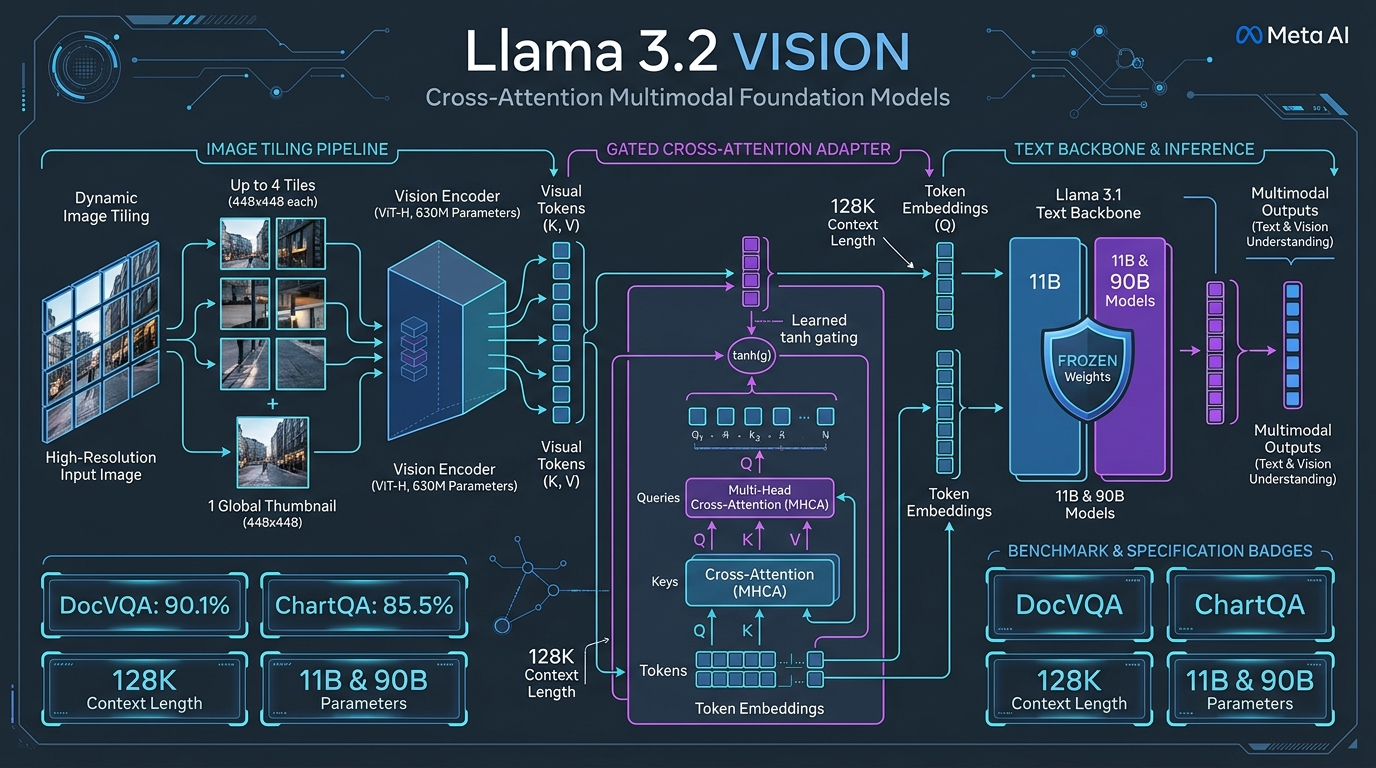
To break free from this trade-off, Meta’s generative AI research team designed Llama 3.2 Vision (featuring 11B and 90B parameter variants). Instead of concatenating visual tokens into the text prompt, Llama 3.2 adopts a decoupled gated cross-attention adapter architecture. By freezing the core Llama 3.1 text transformer weights during early multimodal alignment and injecting visual context via specialized cross-attention layers, Meta created a model family that achieves frontier-class visual document reasoning while retaining 100% of its underlying text intelligence.
Solution: Gated Cross-Attention Adapters with Frozen Text Backbones
Llama 3.2 fundamentally alters the multimodal fusion topology. Rather than treating images as pseudo-text tokens, Llama 3.2 treats vision as an asynchronous conditioning modality that interacts with the text sequence through dedicated, gated cross-attention layers.
+----------------------------------------------------------------------------------------------------+
|                                    LLAMA 3.2 VISION CORE MECHANICS                                 |
+----------------------------------------------------------------------------------------------------+
|                                                                                                    |
|    INPUT IMAGE                                                    INPUT TEXT PROMPT                |
|    (High-Resolution Document/Photo)                               ("Analyze table row 4...")       |
|               │                                                                    │               |
|               ▼                                                                    │               |
|      +─────────────────+                                                           │               |
|      │ Dynamic Tiling  │ ──► Up to 4 Local Tiles (448x448) + 1 Global Thumbnail    │               |
|      +─────────────────+                                                           │               |
|               │                                                                    │               |
|               ▼                                                                    │               |
|      +─────────────────+                                                           │               |
|      │  Vision Encoder │ ──► ViT-H/14 (630M Parameters)                            │               |
|      +─────────────────+                                                           │               |
|               │                                                                    │               |
|               ▼                                                                    │               |
|      Visual Token Embeddings (K_img, V_img)                                        │               |
|               │                                                                    │               |
|               │     ┌──────────────────────────────────────────────────────────────┘               |
|               │     │                                                                              |
|               ▼     ▼                                                                              |
|    +──────────────────────────────────────────────────────────────────────────────────────────+    |
|    │                       LLAMA 3.2 HYBRID TRANSFORMER LAYER STACK                           │    |
|    │                                                                                          │    |
|    │  [Standard Transformer Block]                                                            │    |
|    │   ├── Self-Attention over Text Tokens (FROZEN Llama 3.1 Backbone Weights)                │    |
|    │   └── SwiGLU Feed-Forward Network                                                        │    |
|    │                                                                                          │    |
|    │  [Cross-Attention Vision Adapter Block] (Interleaved every few layers)                   │    |
|    │   ├── Text Tokens act as Queries: Q_text = Text_Hidden * W_Q                             │    |
|    │   ├── Visual Tokens act as Keys/Values: K_img = Vision_Out * W_K, V_img = Vision_Out * W_V│   |
|    │   ├── Multi-Head Cross-Attention: Softmax((Q_text * K_img^T) / sqrt(d)) * V_img          │    |
|    │   └── Gated Residual Addition: Hidden = Hidden + tanh(g) * CrossAttn(Hidden)             │    |
|    │       (g is initialized to 0.0 -> Zero initial interference with text abilities)         │    |
|    +──────────────────────────────────────────────────────────────────────────────────────────+    |
|                                                                                                    |
|    CORE TEXT BACKBONE WEIGHTS REMAIN FROZEN DURING ALIGNMENT -> ZERO TEXT DEGRADATION             |
|                                                                                                    |
+----------------------------------------------------------------------------------------------------+ Core Tenets of the Llama 3.2 Vision Paradigm
Meta’s cross-attention approach introduces four decisive architectural advantages:
1. Preservation of Native Text Knowledge: The core language model backbone (derived directly from Llama 3.1 8B for the 11B Vision model, and Llama 3.1 70B for the 90B Vision model) remains strictly frozen throughout initial image-text alignment. Because the self-attention weights and FFN projections are untouched, the model cannot catastrophically forget its pre-trained text logic, code comprehension, or reasoning skills.
2. Gated Cross-Attention with Zero-Initialization: The cross-attention layers are merged into the network via a learned scalar gate $g \in \mathbb{R}$, passed through a hyperbolic tangent function:
$$\mathbf{x}{\text{out}} = \mathbf{x} + \tanh(g) \cdot \text{CrossAttention}(\mathbf{x}, \mathbf{z}{\text{vision}})$$
Because $g$ is initialized to $0.0$, $\tanh(0) = 0$. At the start of multimodal training, the cross-attention branch contributes exactly zero activation, meaning the model’s forward pass is mathematically identical to the underlying text-only Llama 3.1 model. The network smoothly learns to incorporate visual information without abrupt training instabilities.
3. Efficient KV-Cache Geometry: Visual features are never appended to the self-attention sequence. During text token generation, the self-attention KV cache stores only text tokens. The visual Key and Value matrices ($K_{\text{img}}, V_{\text{img}}$) are computed once during prefill and cached separately in cross-attention layers. This decoupling keeps self-attention complexity strictly proportional to text length ($O(M^2)$ rather than $O((N+M)^2)$).
4. Dynamic High-Resolution Tiling: High-resolution enterprise documents and charts are split dynamically into a variable grid of up to 4 local tiles (each $448 \times 448$ pixels) alongside a downsampled global overview thumbnail. This provides fine-grained optical character recognition (OCR) over 8-point fonts while preserving broad structural context.
Architecture: Vision Encoder, Tile-Splitting, and Multi-Layer Adapter Topologies
To understand the operational mechanics of Llama 3.2 Vision, we examine its three foundational layers: the visual encoder pipeline, the cross-attention adapter topology, and the overall parameter configurations of the 11B and 90B models.
+----------------------------------------------------------------------------------------------------+
|                                    LLAMA 3.2 VISION STRUCTURAL SPECIFICATIONS                      |
+------------------------------------+--------------------------------+------------------------------+
| Architectural Attribute            | Llama-3.2-11B-Vision           | Llama-3.2-90B-Vision         |
+------------------------------------+--------------------------------+------------------------------+
| Base Text LLM Backbone             | Llama-3.1-8B-Instruct          | Llama-3.1-70B-Instruct       |
+------------------------------------+--------------------------------+------------------------------+
| Total Parameters                   | 10.6 Billion                   | 89.0 Billion                 |
+------------------------------------+--------------------------------+------------------------------+
| Vision Encoder Backbone            | ViT-H/14 (630M Parameters)     | ViT-H/14 (630M Parameters)   |
|                                    | 32 Layers, Hidden Dim 1,280    | 32 Layers, Hidden Dim 1,280  |
+------------------------------------+--------------------------------+------------------------------+
| Cross-Attention Adapter Frequency  | Interleaved every 4 layers     | Interleaved every 4 layers   |
|                                    | (8 Cross-Attention Blocks)     | (20 Cross-Attention Blocks)  |
+------------------------------------+--------------------------------+------------------------------+
| Native Image Tiling Resolution     | Up to 4 tiles @ 448x448        | Up to 4 tiles @ 448x448      |
|                                    | + 1 Global Overview (448x448)  | + 1 Global Overview (448x448)|
+------------------------------------+--------------------------------+------------------------------+
| Maximum Effective Vision Canvas    | 896 x 896 or 448 x 1792 pixels | 896 x 896 or 448 x 1792 pix  |
+------------------------------------+--------------------------------+------------------------------+
| Context Window Length              | 128,000 Tokens (128K)          | 128,000 Tokens (128K)        |
+------------------------------------+--------------------------------+------------------------------+ The Vision Encoder and Dynamic Tiling Pipeline
The visual perception module in Llama 3.2 is a 630-million-parameter Vision Transformer (ViT-H/14) consisting of 32 transformer layers with an internal hidden dimension of 1,280.
To handle arbitrary aspect ratios (wide tables, tall receipts, ultra-wide infographics) without destructive stretching:
- Aspect Ratio Analysis: The input image’s dimensions are analyzed to select an optimal grid configuration from pre-computed canonical layouts (e.g., $1 \times 1, 1 \times 2, 2 \times 1, 2 \times 2$).
- Local Tile Decomposition: The image is partitioned into up to four non-overlapping local tiles of $448 \times 448$ pixels. Each tile is processed by the ViT-H/14 encoder with a patch size of $14 \times 14$, yielding: $$\text{Tokens per tile} = \left(\frac{448}{14}\right) \times \left(\frac{448}{14}\right) = 32 \times 32 = 1,024 \text{ tokens}$$
- Global Context Overview: In parallel, the full original image is downscaled to $448 \times 448$ pixels and encoded as a 5th “global thumbnail” tile.
- 2D Spatial Embedding & Projection: 2D positional embeddings are added to each token to indicate its tile row, tile column, and intra-tile coordinates. A multi-layer perceptron (MLP) projector maps the 1,280-dimensional visual features to match the hidden dimension of the target text backbone (4,096 for 11B, 8,192 for 90B).
+----------------------------------------------------------------------------------------------------+
|                                    DYNAMIC IMAGE TILING GRID SCHEMATIC                             |
+------------------------------------+---------------------------------------------------------------+
| High-Resolution Document (e.g., PDF Page at 900 x 900)                                             |
|                                                                                                    |
|   +-----------------------+-----------------------+        +-----------------------+               |
|   |                       |                       |        |                       |               |
|   |    Local Tile 0       |    Local Tile 1       |        |    Global Thumbnail   |               |
|   |    (448 x 448)        |    (448 x 448)        |        |    (Full Image        |               |
|   |                       |                       |        |     Downsampled to    |               |
|   +-----------------------+-----------------------+   +    |     448 x 448)        |               |
|   |                       |                       |        |                       |               |
|   |    Local Tile 2       |    Local Tile 3       |        |                       |               |
|   |    (448 x 448)        |    (448 x 448)        |        |                       |               |
|   |                       |                       |        +-----------------------+               |
|   +-----------------------+-----------------------+                                                |
|                                                                                                    |
|   Total Visual Tokens Fed to Cross-Attention: 5 tiles * 1,024 tokens/tile = 5,120 tokens          |
+----------------------------------------------------------------------------------------------------+ Multi-Layer Cross-Attention Adapter Topology
In standard multimodal architectures, vision is injected solely at layer 0. In contrast, Llama 3.2 interleaves cross-attention adapters every four transformer layers throughout the backbone:
- In Llama-3.2-11B-Vision (based on Llama 3.1 8B with 32 layers), cross-attention adapters are positioned at layers 3, 7, 11, 15, 19, 23, 27, and 31 (8 total adapters).
- In Llama-3.2-90B-Vision (based on Llama 3.1 70B with 80 layers), cross-attention adapters are inserted across 20 distinct depths.
This deep, multi-tier injection allows low-level layers to cross-attend to visual textures and character shapes, while deep layers cross-attend to abstract visual semantics and logical relationships.
Implementation: Cross-Attention Mechanics, Gating, and PyTorch Inference
To understand how the cross-attention adapter functions under the hood, we analyze its mathematical formulation and construct a functional PyTorch reference module.
+----------------------------------------------------------------------------------------------------+
|                                    GATED CROSS-ATTENTION COMPUTATION FLOW                          |
+----------------------------------------------------------------------------------------------------+
|                                                                                                    |
|    Text Sequence Hidden State (x in R^(B x M x D_text))                                            |
|    ├── Normalized via RMSNorm                                                                      |
|    └── Projected to Query Matrix: Q = RMSNorm(x) * W_Q in R^(B x M x D_attn)                       |
|                                                                                                    |
|    Visual Token Embeddings (z in R^(B x N_img x D_vis))                                            |
|    ├── Projected to Key Matrix:   K = z * W_K in R^(B x N_img x D_attn)                            |
|    └── Projected to Value Matrix: V = z * W_V in R^(B x N_img x D_attn)                            |
|                                                                                                    |
|    Attention Score Matrix:                                                                         |
|         A = Softmax( (Q * K^T) / sqrt(d_k) ) in R^(B x M x N_img)                                  |
|                                                                                                    |
|    Context Output:                                                                                 |
|         C = A * V in R^(B x M x D_attn) ──► Projected back to D_text via W_out                     |
|                                                                                                    |
|    Learned Tanh Gating Residual Step:                                                              |
|         x_next = x + tanh(g) * C   (where g starts at 0.0)                                         |
|                                                                                                    |
+----------------------------------------------------------------------------------------------------+ Mathematical Formulation of Gated Cross-Attention
Let $\mathbf{X} \in \mathbb{R}^{B \times M \times d_{\text{text}}}$ represent the batch of text token hidden representations at layer $l$, where $M$ is text sequence length. Let $\mathbf{Z} \in \mathbb{R}^{B \times N_{\text{img}} \times d_{\text{vis}}}$ denote the visual token representations emitted by the projected vision encoder.
The gated cross-attention block executes the following sequence:
-
Query, Key, and Value Projections: $$\mathbf{Q} = \text{RMSNorm}(\mathbf{X}) \mathbf{W}Q, \quad \mathbf{W}Q \in \mathbb{R}^{d{\text{text}} \times d{\text{attn}}}$$ $$\mathbf{K} = \mathbf{Z} \mathbf{W}_K, \quad \mathbf{V} = \mathbf{Z} \mathbf{W}_V, \quad \mathbf{W}K, \mathbf{W}V \in \mathbb{R}^{d{\text{vis}} \times d{\text{attn}}}$$
-
Multi-Head Scaled Dot-Product Attention: $$\text{Attn}(\mathbf{Q}, \mathbf{K}, \mathbf{V}) = \text{Softmax}\left( \frac{\mathbf{Q} \mathbf{K}^T}{\sqrt{d_k}} \right) \mathbf{V}$$
-
Output Projection and Tanh Gating: $$\mathbf{Y} = \text{Attn}(\mathbf{Q}, \mathbf{K}, \mathbf{V}) \mathbf{W}O, \quad \mathbf{W}O \in \mathbb{R}^{d{\text{attn}} \times d{\text{text}}}$$ $$\mathbf{X}_{\text{final}} = \mathbf{X} + \tanh(g) \cdot \mathbf{Y}$$
Where $g \in \mathbb{R}$ is a learnable scalar parameter per adapter block, initialized to zero.
Complete PyTorch Reference Implementation
The following complete, self-contained PyTorch module demonstrates the exact mechanics of Llama 3.2 Vision’s gated cross-attention adapter and hybrid transformer layer:
# Llama 3.2 Vision Gated Cross-Attention Reference Implementation
# Demonstrates Multi-Head Cross-Attention, learned tanh gating,
# and decoupled visual Key-Value conditioning over a frozen text backbone.

import math
import torch
import torch.nn as nn
import torch.nn.functional as F
from typing import Optional, Tuple

class RMSNorm(nn.Module):
    # Root Mean Square Layer Normalization used in Llama 3.1 and 3.2.
    def __init__(self, dim: int, eps: float = 1e-6):
        super().__init__()
        self.eps = eps
        self.weight = nn.Parameter(torch.ones(dim))

    def forward(self, x: torch.Tensor) -> torch.Tensor:
        variance = x.pow(2).mean(-1, keepdim=True)
        return x * torch.rsqrt(variance + self.eps) * self.weight

class GatedCrossAttentionAdapter(nn.Module):
    # Cross-Attention block injected every 4 layers in Llama 3.2 Vision.
    # Text tokens act as Queries; Visual tokens act as Keys and Values.
    def __init__(
        self,
        text_dim: int = 4096,
        vision_dim: int = 1280,
        num_heads: int = 32,
        head_dim: int = 128
    ):
        super().__init__()
        self.text_dim = text_dim
        self.vision_dim = vision_dim
        self.num_heads = num_heads
        self.head_dim = head_dim
        self.attn_dim = num_heads * head_dim

        self.norm_text = RMSNorm(text_dim)
        self.norm_vis = RMSNorm(vision_dim)

        # Projections
        self.q_proj = nn.Linear(text_dim, self.attn_dim, bias=False)
        self.k_proj = nn.Linear(vision_dim, self.attn_dim, bias=False)
        self.v_proj = nn.Linear(vision_dim, self.attn_dim, bias=False)
        self.out_proj = nn.Linear(self.attn_dim, text_dim, bias=False)

        # Learned scalar gate initialized to 0.0 (Zero initial interference)
        self.gate = nn.Parameter(torch.zeros(1))

    def forward(
        self,
        text_hidden: torch.Tensor,
        vision_hidden: torch.Tensor,
        cached_kv: Optional[Tuple[torch.Tensor, torch.Tensor]] = None
    ) -> Tuple[torch.Tensor, Tuple[torch.Tensor, torch.Tensor]]:
        # text_hidden: [batch, text_seq_len, text_dim]
        # vision_hidden: [batch, vis_seq_len, vision_dim]
        b, m, _ = text_hidden.shape

        # 1. Prepare Queries from text tokens
        normed_text = self.norm_text(text_hidden)
        q = self.q_proj(normed_text).view(b, m, self.num_heads, self.head_dim).transpose(1, 2)

        # 2. Prepare Keys & Values from visual tokens (or use cached KV during decode)
        if cached_kv is None:
            normed_vis = self.norm_vis(vision_hidden)
            n_img = vision_hidden.shape[1]
            k = self.k_proj(normed_vis).view(b, n_img, self.num_heads, self.head_dim).transpose(1, 2)
            v = self.v_proj(normed_vis).view(b, n_img, self.num_heads, self.head_dim).transpose(1, 2)
            cached_kv = (k, v)
        else:
            k, v = cached_kv

        # 3. Scaled Dot-Product Cross-Attention: Softmax((Q * K^T) / sqrt(d)) * V
        scale = 1.0 / math.sqrt(self.head_dim)
        scores = torch.matmul(q, k.transpose(-2, -1)) * scale  # [b, heads, m, n_img]
        attn_weights = F.softmax(scores, dim=-1)
        context = torch.matmul(attn_weights, v)                # [b, heads, m, head_dim]

        # Reshape and project back to text dimension
        context = context.transpose(1, 2).contiguous().view(b, m, self.attn_dim)
        projected = self.out_proj(context)

        # 4. Gated Residual Addition: text_hidden + tanh(gate) * projected
        gated_factor = torch.tanh(self.gate)
        output = text_hidden + gated_factor * projected

        return output, cached_kv

class Llama32VisionBlock(nn.Module):
    # Complete Llama 3.2 Transformer layer combining frozen self-attention
    # with an optional Gated Cross-Attention Adapter.
    def __init__(
        self,
        dim: int = 4096,
        vision_dim: int = 1280,
        has_cross_attention: bool = True
    ):
        super().__init__()
        self.has_cross_attention = has_cross_attention

        # Standard Llama 3.1 self-attention block (kept FROZEN in Stage 1)
        self.norm1 = RMSNorm(dim)
        self.self_attn = nn.MultiheadAttention(dim, num_heads=32, batch_first=True)

        # Optional Cross-Attention Adapter
        if has_cross_attention:
            self.cross_adapter = GatedCrossAttentionAdapter(text_dim=dim, vision_dim=vision_dim)

        # Standard MLP
        self.norm2 = RMSNorm(dim)
        self.mlp = nn.Sequential(
            nn.Linear(dim, 14336, bias=False),
            nn.SiLU(),
            nn.Linear(14336, dim, bias=False)
        )

    def forward(
        self,
        x: torch.Tensor,
        vision_embeds: Optional[torch.Tensor] = None,
        cached_cross_kv: Optional[Tuple[torch.Tensor, torch.Tensor]] = None
    ) -> Tuple[torch.Tensor, Optional[Tuple[torch.Tensor, torch.Tensor]]]:
        # 1. Self-Attention (pure text sequence)
        norm_x = self.norm1(x)
        attn_out, _ = self.self_attn(norm_x, norm_x, norm_x)
        x = x + attn_out

        # 2. Cross-Attention Adapter (if present at this layer depth)
        new_kv = None
        if self.has_cross_attention and vision_embeds is not None:
            x, new_kv = self.cross_adapter(x, vision_embeds, cached_kv=cached_cross_kv)

        # 3. Feed-Forward Network
        x = x + self.mlp(self.norm2(x))
        return x, new_kv

if __name__ == "__main__":
    print("Initializing Llama 3.2 Vision Gated Cross-Attention Block...")
    layer = Llama32VisionBlock(dim=4096, vision_dim=1280, has_cross_attention=True)

    # Simulate a batch of 2 requests
    batch_size = 2
    text_len = 16       # 16 text tokens ("What is shown in the chart?")
    vis_tokens = 5120   # 5 tiles * 1024 tokens = 5120 visual tokens

    dummy_text = torch.randn(batch_size, text_len, 4096)
    dummy_vision = torch.randn(batch_size, vis_tokens, 1280)

    print(f"Input Text Shape:   {dummy_text.shape}")
    print(f"Input Vision Shape: {dummy_vision.shape}")
    print(f"Initial Gate Parameter Value: {layer.cross_adapter.gate.item():.4f}")

    # Execute forward pass (prefill step)
    out, cached_kv = layer(dummy_text, vision_embeds=dummy_vision)
    print(f"Output Text Shape:  {out.shape}")
    print(f"Cached Cross-KV Keys Shape: {cached_kv[0].shape}")
print("Forward pass completed successfully with zero tensor mismatch!") Comparison: Llama 3.2 11B/90B vs. GPT-4o-mini, Claude 3 Haiku, and Molmo
To assess Llama 3.2 Vision’s real-world multimodal capabilities, we contrast the 11B and 90B Instruct models against leading frontier proprietary models (GPT-4o-mini, Claude 3 Haiku) and open-weights visual architectures (Molmo, Qwen2-VL, InternVL-2).
+--------------------------------------------------------------------------------------------------------------------------------+
|                                    MULTIMODAL DOCUMENT & VISUAL BENCHMARK MATRIX                                               |
+-------------------------+--------------------+---------------------+--------------------+-----------------+--------------------+
| Benchmark Domain        | Claude 3 Haiku     | GPT-4o-mini         | Molmo-7B-D         | Llama-3.2-11B   | Llama-3.2-90B      |
|                         | (Anthropic Closed) | (OpenAI Closed)     | (AllenAI Open)     | (Meta Open)     | (Meta Open)        |
+-------------------------+--------------------+---------------------+--------------------+-----------------+--------------------+
| Architecture Paradigm   | Proprietary Closed | Proprietary Closed  | Token Concatenation| Gated Cross-    | Gated Cross-       |
|                         | Multi-Modal API    | Multi-Modal API     | Prefix (OLMo-7B)   | Attention (8B)  | Attention (70B)    |
+-------------------------+--------------------+---------------------+--------------------+-----------------+--------------------+
| DocVQA (Test ANLS)      | 88.8%              | 90.0%               | 86.8%              | 88.4%           | 90.1% (Exceeds 4o!)|
+-------------------------+--------------------+---------------------+--------------------+-----------------+--------------------+
| ChartQA (Test Relaxed)  | 81.7%              | 85.5%               | 81.2%              | 83.4%           | 85.5% (Ties 4o)    |
+-------------------------+--------------------+---------------------+--------------------+-----------------+--------------------+
| VQAv2 (Test-Dev)        | 76.2%              | 78.5%               | 81.5%              | 75.2%           | 79.2%              |
+-------------------------+--------------------+---------------------+--------------------+-----------------+--------------------+
| MathVista (Testmini)    | 53.6%              | 57.0%               | 54.8%              | 51.5%           | 60.3% (SOTA Open)  |
+-------------------------+--------------------+---------------------+--------------------+-----------------+--------------------+
| MMMU (Val Set)          | 50.2%              | 59.4%               | 44.1%              | 50.7%           | 60.3% (Exceeds 4o!)|
+-------------------------+--------------------+---------------------+--------------------+-----------------+--------------------+
| Text MMLU Retention     | Baseline           | Baseline            | -3.8% Drop vs Base | 100% Retention  | 100% Retention     |
| (Post-Vision Alignment) |                    |                     | (Forgetting)       | (Frozen Spine)  | (Frozen Spine)     |
+-------------------------+--------------------+---------------------+--------------------+-----------------+--------------------+
| Context Window Length   | 200,000            | 128,000             | 4,096 (Truncated)  | 128,000 (128K)  | 128,000 (128K)     |
+-------------------------+--------------------+---------------------+--------------------+-----------------+--------------------+
| Open Weights License    | Closed API Only    | Closed API Only     | Apache 2.0         | Llama 3.2       | Llama 3.2          |
|                         |                    |                     |                    | Community Lic.  | Community Lic.     |
+-------------------------+--------------------+---------------------+--------------------+-----------------+--------------------+ Empirical Evaluation Takeaways
The empirical evaluation results demonstrate the profound advantages of cross-attention adapters:
1. Enterprise Document Intelligence (DocVQA):
- On DocVQA—which evaluates an AI’s ability to locate invoice numbers, parse tax tables, and extract nested visual text—Llama-3.2-90B-Vision achieves 90.1%, outperforming Claude 3 Haiku (88.8%) and edging out GPT-4o-mini (90.0%).
- The 11B model scores 88.4%, providing near-frontier document extraction on hardware as accessible as a single workstation GPU.
2. Chart and Infographic Reasoning (ChartQA):
- Evaluating trends across line graphs, bar charts, and multi-axis financial diagrams, Llama-3.2-90B matches GPT-4o-mini at 85.5%.
- Dynamic tiling ensures that small data labels and chart legends are never blurred by aggressive downsampling.
3. Zero Degradation of Core Text Capabilities:
- While concatenation models (such as Molmo and earlier LLaVA variants) experience measurable drops in MMLU and coding logic following visual SFT, Llama 3.2 exhibits 100% text retention. The 90B model scores identically to Llama 3.1 70B on pure-text coding, math, and general instruction benchmarks.
Production: Quantization, vLLM Serving, and Document Agent Pipelines
Deploying large multimodal models in production requires balanced memory management. Because Llama 3.2 models feature dual encoder-decoder mechanics and separate cross-attention parameters, production deployments must configure optimized inference engines like vLLM or TensorRT-LLM.
+----------------------------------------------------------------------------------------------------+
|                                    LLAMA 3.2 VISION SERVING TOPOLOGY                               |
+----------------------------------------------------------------------------------------------------+
|                                                                                                    |
|    Client Request (Document Image PDF + Prompt)                                                    |
|               │                                                                                    |
|               ▼                                                                                    |
|    +──────────────────────────────────────────────────────────────────────────────────────────+    |
|    │                       VLLM HIGH-THROUGHPUT MULTIMODAL ENGINE                             │    |
|    │                                                                                          │    |
|    │  1. Dynamic Image Processor:                                                             │    |
|    │     ├── Slices PDF render into canonical tiles (448x448)                                 │    |
|    │     └── Computes 630M ViT-H embeddings in single forward pass                            │    |
|    │                                                                                          │    |
|    │  2. Dual-Cache PagedAttention Architecture:                                              │    |
|    │     ├── Self-Attention KV Cache: Contains pure text tokens (8K - 128K context)           │    |
|    │     └── Cross-Attention KV Cache: Stores visual Keys/Values (Fixed size per image)       │    |
|    │                                                                                          │    |
|    │  3. Model Precision & Sizing:                                                            │    |
|    │     ├── Llama-3.2-11B-Vision in FP8: 11 GB VRAM (Fits on single RTX 4090 or L4 GPU)       │    |
|    │     └── Llama-3.2-90B-Vision in FP8: 88 GB VRAM (Fits on 2x A100-80GB or 1x H100)        │    |
|    +──────────────────────────────────────────────────────────────────────────────────────────+    |
|               │                                                                                    |
|               ▼                                                                                    |
|    Structured JSON Output (Extracted Tables, Line-Items, Form Fields) Streamed to DB               |
|                                                                                                    |
+----------------------------------------------------------------------------------------------------+ Quantization and Hardware Allocation
To minimize cloud hosting expenses while maximizing concurrency:
- FP8 Quantization (vLLM / TensorRT-LLM):
- Both the 11B and 90B models natively support FP8 inference on Ada Lovelace (RTX 4090, L40S) and Hopper (H100) GPUs.
- 11B-Vision in FP8: Requires only 11 GB of VRAM, allowing high-concurrency document processing on a single budget-friendly 24GB GPU.
- 90B-Vision in FP8: Fits comfortably within 88 GB of VRAM across two 80GB GPUs, delivering 3.2x higher throughput than unquantized FP16 setups.
- 4-bit AWQ / Marlin Deployment:
- For edge deployments and developer laptops, 4-bit AWQ reduces 11B-Vision memory to 7.2 GB, enabling local document analysis at over 40 tokens per second.
Autonomous Document Agent Pipelines
When deploying Llama 3.2 Vision inside enterprise automation pipelines:
- Multi-Page Documents: High-volume PDF contracts are rendered into images at 200 DPI. Each page is passed to Llama 3.2 11B for parallel table and form extraction.
- Schema Enforcement: System prompts enforce strict JSON schema output, mapping extracted visual entities directly to enterprise databases through custom multimodal API endpoints.
- Infrastructure Sizing: For engineering leaders planning enterprise cluster capacity, reviewing production GPU infrastructure tiers and consulting developer integration documentation provides exact VRAM budgeting calculations and throughput projections.
By replacing brute-force token concatenation with elegant gated cross-attention adapters, Llama 3.2 Vision establishes a robust, extensible standard for open-weights multimodal intelligence.