Llama 3.2 Guide: Lightweight Edge & Multimodal Vision
The Problem: The Edge Deployment Barrier and Multimodal Fragmentation
In modern enterprise automation, automated web extraction engines, and autonomous agent platforms like AiFetchly, foundation models face a severe operational divergence: the division between massive cloud-hosted clusters and latency-sensitive client edge devices.
While models like Llama 3.1 70B and 405B pushed the limits of complex multi-step reasoning, deploying them at scale encounters two critical structural barriers:
1. The Compute, Memory, and Privacy Wall of Edge Deployment
Modern intelligent devices—such as smartphones, local desktop assistants, IoT sensors, and client-side browser automation agents—require sub-second response times without transmitting sensitive user data to third-party cloud servers:
- The VRAM Penalty: Running standard 8B foundation models requires over 16 GB of memory in 16-bit precision, or ~5 GB in 4-bit quantization. On mobile chipsets (Qualcomm Snapdragon, Apple Silicon, MediaTek) where RAM is shared between the OS, graphics, and applications, an 8B model quickly triggers Out-of-Memory (OOM) app crashes and heavy thermal throttling.
- The Cold-Start Limitation of Small Models: Historically, training compact models (1B to 3B parameters) from scratch yields poor reasoning, fragile instruction following, and catastrophic forgetting on long sequences. Small models trained in isolation lack the rich probabilistic representations learned by massive foundational teachers.
2. The Architectural Flaws of Naive Multimodal Projection
Prior to Llama 3.2, open multimodal Vision-Language Models (VLMs)—such as LLaVA and early CLIP-adapter pipelines—relied on naive visual token concatenation:
The Traditional LLaVA-Style Concatenation Flaw:
[Image Patches] ──► [Linear Projection] ──► [576 to 2,880 Visual Tokens] ┐
                                                                           ├─► [Shared LLM Self-Attention]
[User Prompt] ──────────────────────────► [Text Tokens] ┘ This brute-force approach introduces three severe failure modes:
- KV Cache Explosion: Injecting thousands of visual tokens directly into the LLM self-attention stack monopolizes GPU memory, dramatically limiting the remaining context window for text reasoning and multi-turn conversations.
- Text Degradation (Catastrophic Forgetting): Jointly fine-tuning an LLM backbone on image-caption datasets frequently damages its existing text capabilities, reducing its coding performance, tool-calling precision, and mathematical reasoning.
- Aspect-Ratio Warping: Forcing high-resolution documents or wide web screenshots into low-resolution square grids ($336 \times 336$ or $448 \times 448$) blurs dense typography, ruining OCR and chart extraction accuracy.
The Architecture: The Dual Strategy of Llama 3.2
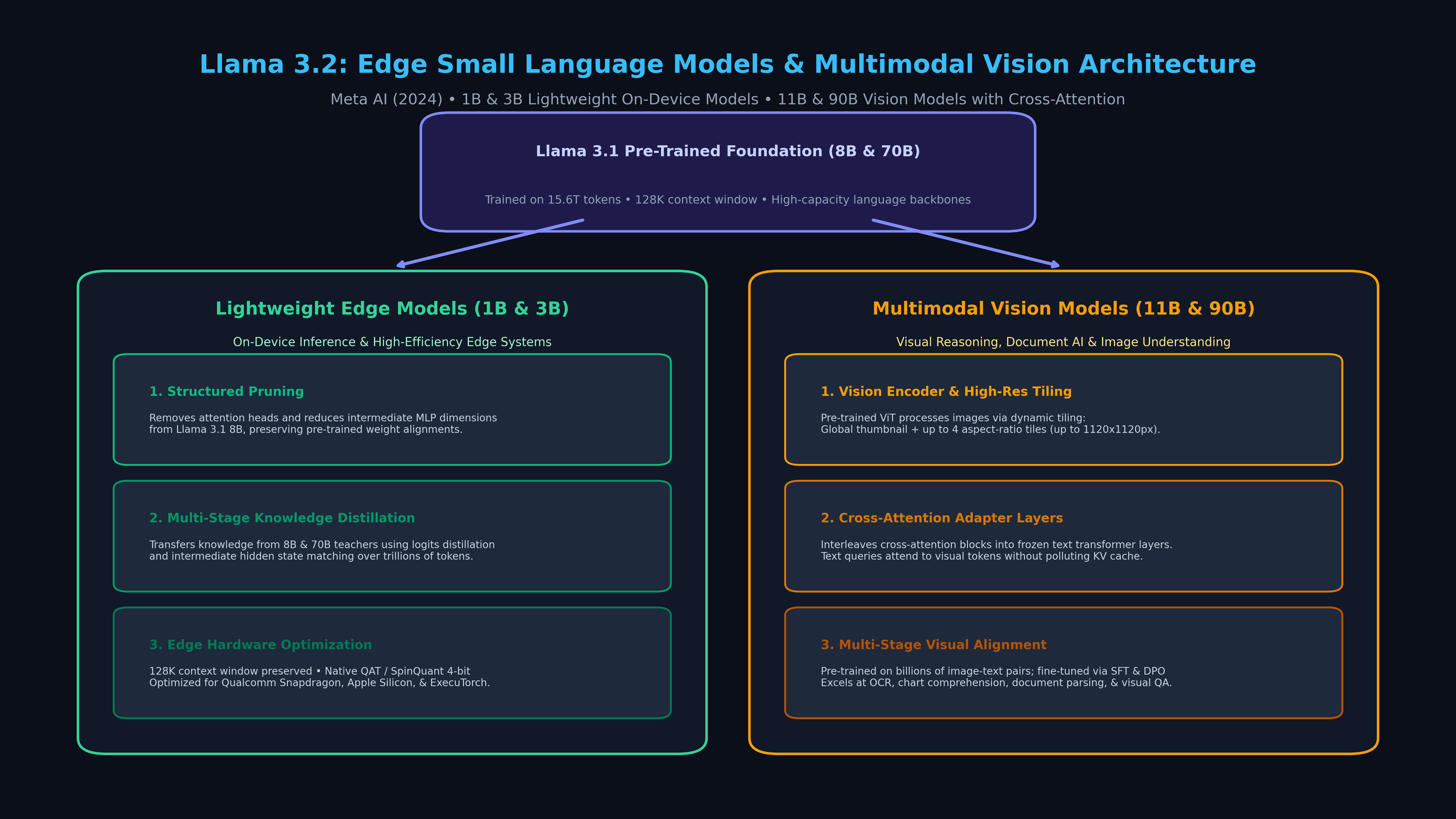
To bridge both cloud-scale multimodal reasoning and edge-native efficiency, Meta introduced Llama 3.2. Rather than releasing a single monolithic architecture, Llama 3.2 executes a coordinated dual bifurcation strategy:
The Llama 3.2 Family Matrix:
┌─────────────────┬───────────┬──────────────┬─────────────┬─────────────┬──────────────────────────┐
│ Model           │ Params    │ Context Win. │ Attention   │ Hidden Dim  │ Primary Deployment Focus │
├─────────────────┼───────────┼──────────────┼─────────────┼─────────────┼──────────────────────────┤
│ Llama 3.2 1B    │ 1.23B     │ 128,000      │ GQA (8 KV)  │ 2,048       │ Ultra-low-power Edge/IoT │
│ Llama 3.2 3B    │ 3.21B     │ 128,000      │ GQA (8 KV)  │ 3,072       │ Mobile Devices & Desktops│
│ Llama 3.2 11B   │ 10.6B     │ 128,000      │ Cross-Attn  │ 4,096       │ High-Efficiency Vision   │
│ Llama 3.2 90B   │ 88.6B     │ 128,000      │ Cross-Attn  │ 8,192       │ Frontier Enterprise VLM  │
└─────────────────┴───────────┴──────────────┴─────────────┴─────────────┴──────────────────────────┘ The Architectural Core
Across both lightweight text and large multimodal models, Llama 3.2 maintains foundational consistency with Llama 3.1:
- Extended 128,000-Token Context Window: Standardized across all models—including the 1B edge variant—using frequency-banded RoPE scaling (base frequency $\theta = 500,000$).
- Grouped-Query Attention (GQA): Employs 8 Key-Value heads across all model tiers to minimize KV cache footprint during generation.
- 128,256 Vocabulary Size: Tokenizer optimized for multilingual compression and dense code syntax.
Lightweight Edge Engineering: Structured Pruning & Knowledge Distillation
Rather than pre-training the 1B and 3B models from scratch on raw web text, Meta developed a two-stage compression pipeline that distills the pre-trained weights and knowledge of Llama 3.1 8B:
The 1B/3B Distillation Pipeline:
┌─────────────────────┐
│    Llama 3.1 8B     │
│ (Pre-Trained Base)  │
└──────────┬──────────┘
           │
           ▼  Stage 1: Structured One-Shot Pruning
┌─────────────────────┐
│ Pruned Model Matrix │ (Systematic removal of attention heads & MLP channels)
└──────────┬──────────┘
           │
           ▼  Stage 2: Multi-Stage Logits & Hidden Distillation
┌─────────────────────┐
│  Llama 3.2 1B & 3B  │ (Trained over trillions of tokens against 8B/70B teachers)
└─────────────────────┘ 1. Structured One-Shot Pruning
Unstructured pruning (zeroing out individual arbitrary weights) creates sparse matrices that do not accelerate execution on standard mobile GPUs and NPUs. Instead, Meta applied structured pruning:
- Layer & Head Slicing: Pruned transformer layers and Grouped-Query Attention heads based on second-order weight importance metrics: $$I_w = \left| W \odot \nabla_W \mathcal{L} \right|$$
- MLP Channel Compression: Sliced the intermediate hidden dimension of the SwiGLU feed-forward network (e.g., shrinking the 8B model’s 14,336 MLP dimension down to 8,192 for the 3B model and 4,096 for the 1B model).
This structured removal ensures that the remaining weights inherit the mature linguistic feature detectors already formed during Llama 3.1’s 15.6-trillion-token pre-training run.
2. Multi-Stage Knowledge Distillation
Pruning introduces immediate accuracy degradation. To restore and elevate performance, the pruned student models undergo extensive knowledge distillation:
During next-token prediction, the training objective combines standard cross-entropy on ground-truth tokens with Kullback-Leibler (KL) divergence over the soft output probabilities of the teacher model (Llama 3.1 8B and 70B):
$$\mathcal{L}{\text{total}} = (1 - \lambda) \mathcal{L}{\text{CE}}\left( P_{\text{student}}, y \right) + \lambda T^2 D_{\text{KL}}\left( P_{\text{teacher}} ,|, P_{\text{student}} \right)$$
Where $T$ is the distillation temperature. By learning from the soft probabilities (“dark knowledge”), the student models capture subtle lexical nuances and semantic synonyms.
3. Edge Hardware Acceleration
Llama 3.2 1B and 3B are engineered for native deployment across edge frameworks:
- Quantization-Aware Training (QAT): Calibrated using SpinQuant and SmoothQuant, enabling 4-bit integer weights (INT4) that fit within under 2 GB of RAM on smartphones.
- ExecuTorch & KleidiAI: Optimized kernels for Apple Silicon (Metal), Qualcomm Snapdragon NPU, and Arm Cortex-A CPUs, achieving generation speeds exceeding 40 to 60 tokens per second on consumer handheld hardware.
Multimodal Vision Mechanics: Interleaved Cross-Attention & Dynamic Tiling
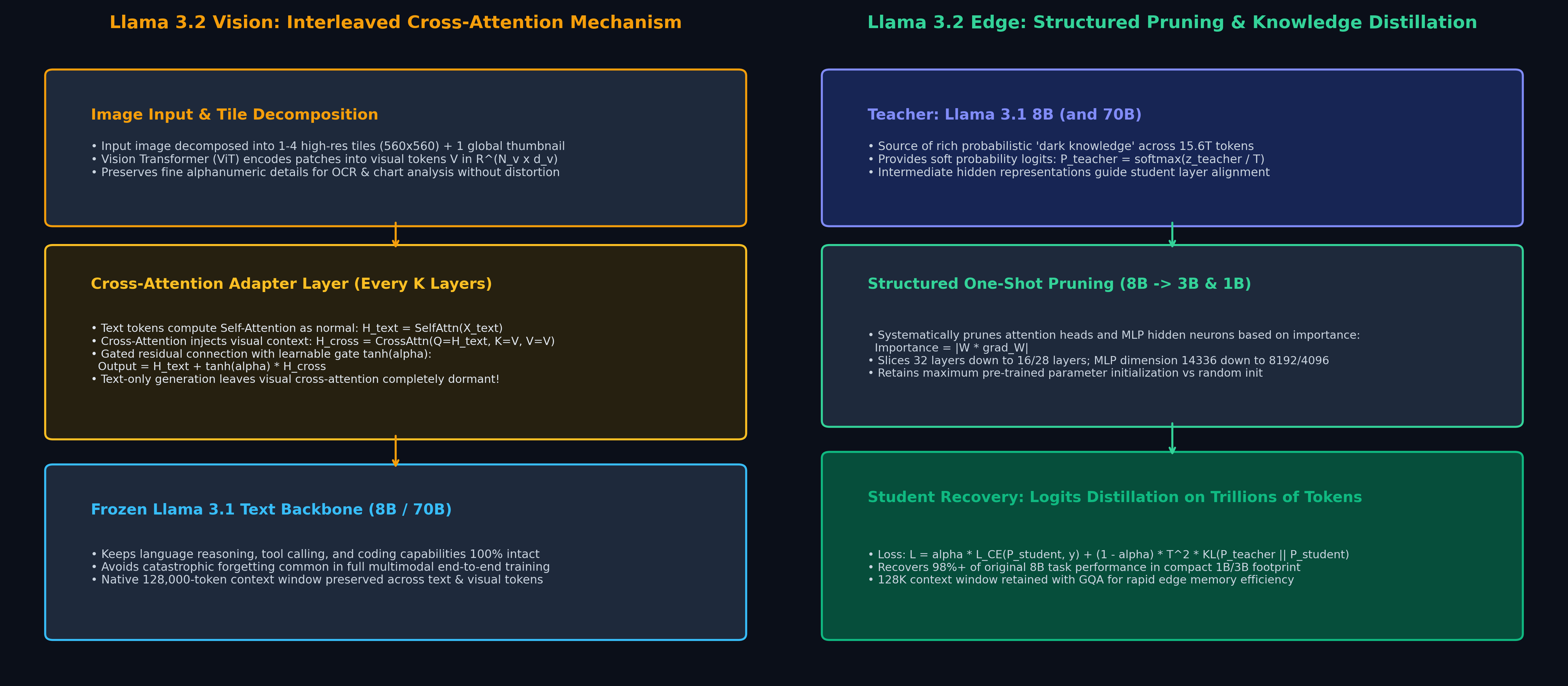
For the 11B and 90B models, Meta rejected the naive concatenation approach. Instead, they engineered an Interleaved Cross-Attention Adapter Architecture that leaves the core text model completely frozen.
1. High-Resolution Dynamic Image Tiling
To process variable aspect-ratio images and high-density documents without geometric distortion:
- Global Thumbnail: The entire input image is rescaled to a standard $560 \times 560$ resolution to provide global semantic context.
- Dynamic Aspect-Ratio Tiles: Depending on native dimensions, the image is sliced into up to 4 high-resolution tiles (each $560 \times 560$ pixels), supporting effective resolutions up to $1120 \times 1120$.
- Vision Transformer (ViT): Sliced patches are processed by a dedicated pre-trained Vision Transformer backbone, producing a rich visual representation matrix $V \in \mathbb{R}^{N_v \times d_v}$.
2. Gated Cross-Attention Layers
Rather than feeding visual tokens into the main text KV cache, Meta inserted dedicated Cross-Attention Blocks every few transformer layers:
Cross-Attention Adapter Data Flow:
Text Tokens H_text ──► [LayerNorm] ──► Query Projections Q = W_q H_text ┐
                                                                         ├─► Softmax(Q K^T / √d) V ──► H_cross
Visual Tokens V    ──► [LayerNorm] ──► Key/Val Projections K=W_k V, V=W_v V ┘
                                                                               │
Text Input H_text ─────────────────────────────────────────────────────────────┴─► [+] ──► Output
                                                                                  ▲
tanh(α) Gate ┘ Mathematically, the update rule for the cross-attention layer is:
$$H_{\text{cross}} = \text{CrossAttention}\left( \text{LN}(H_{\text{text}}), \text{LN}(V) \right)$$
$$H_{\text{out}} = H_{\text{text}} + \tanh(\alpha) \cdot H_{\text{cross}}$$
Where $\alpha$ is a learnable gating parameter initialized to zero.
The Zero-Degradation Guarantee
This mathematical design provides a crucial engineering property:
- When processing pure text inputs, visual tokens are absent, and the cross-attention gate $\tanh(\alpha)$ remains dormant.
- The frozen language weights ensure that Llama 3.2 11B and 90B retain 100% of their base Llama 3.1 text reasoning, coding, and tool-calling performance, completely immune to multimodal catastrophic forgetting.
End-to-End Implementation: Deploying Llama 3.2
1. Multimodal Document & Chart Extraction with Python
Using the Hugging Face transformers library, we can load Llama 3.2 11B Vision to parse complex financial balance sheets and visual diagrams:
import torch
from PIL import Image
from transformers import MllamaForConditionalGeneration, AutoProcessor

model_id = "meta-llama/Llama-3.2-11B-Vision-Instruct"

# 1. Initialize Processor and Model with FlashAttention-2
processor = AutoProcessor.from_pretrained(model_id)
model = MllamaForConditionalGeneration.from_pretrained(
    model_id,
    torch_dtype=torch.bfloat16,
    device_map="auto",
    attn_implementation="flash_attention_2"
)

# 2. Load Input Image (e.g., Financial Report / System Diagram)
image = Image.open("financial_statement_2026.png").convert("RGB")

prompt = "<|image|><|begin_of_text|>Analyze this income statement. Extract total gross revenue, operating margin, and compute the YoY EBITDA growth rate in JSON format."

inputs = processor(
    images=image,
    text=prompt,
    return_tensors="pt"
).to(model.device)

# 3. Autoregressive Generation with Cross-Attention
with torch.no_grad():
    output_tokens = model.generate(
        **inputs,
        max_new_tokens=1024,
        temperature=0.2,
        do_sample=False
    )

response = processor.decode(output_tokens[0][inputs.input_ids.shape[1]:], skip_special_tokens=True)
print("Extracted Analysis:\n", response) 2. High-Throughput Edge Serving with vLLM
To serve the lightweight Llama 3.2 3B Instruct model locally on workstations or edge servers with full 128K context support:
# Serve Llama 3.2 3B with OpenAI-compatible API and 128K context window
python3 -m vllm.entrypoints.openai.api_server \
    --model meta-llama/Llama-3.2-3B-Instruct \
    --max-model-len 131072 \
    --gpu-memory-utilization 0.90 \
    --dtype bfloat16 \
--port 8000 Empirical Benchmarks: Vision & On-Device Cognitive Performance
On standardized academic and industry benchmarks, the Llama 3.2 family establishes new frontiers in parameter efficiency:
Multimodal Vision Evaluation (11B & 90B)
Multimodal Benchmark Comparison:
┌────────────────────────────┬─────────────┬─────────────┬─────────────┬─────────────┐
│ Benchmark                  │ Claude 3.5  │ GPT-4o mini │ Llama 3.2   │ Llama 3.2   │
│                            │ Haiku       │             │ 11B Vision  │ 90B Vision  │
├────────────────────────────┼─────────────┼─────────────┼─────────────┼─────────────┤
│ DocVQA (Document QA)       │ 90.6%       │ 89.2%       │ 90.1%       │ 93.4%       │
│ ChartQA (Visual Charts)    │ 84.2%       │ 82.5%       │ 83.4%       │ 88.3%       │
│ MathVista (Visual Math)    │ 54.8%       │ 57.3%       │ 56.7%       │ 64.1%       │
│ MMMU (College Multimodal)  │ 52.3%       │ 50.4%       │ 50.8%       │ 60.3%       │
└────────────────────────────┴─────────────┴─────────────┴─────────────┴─────────────┘ The 11B Vision model matches or exceeds proprietary models like GPT-4o mini and Claude 3.5 Haiku on Document and Chart understanding, while running efficiently on a single consumer GPU (NVIDIA RTX 4090).
Lightweight Edge Evaluation (1B & 3B)
Edge Small Language Model Comparison:
┌────────────────────────────┬─────────────┬─────────────┬─────────────┬─────────────┐
│ Benchmark                  │ Gemma 2 2B  │ Phi-3.5-mini│ Llama 3.2   │ Llama 3.2   │
│                            │             │ (3.8B)      │ 1B Instruct │ 3B Instruct │
├────────────────────────────┼─────────────┼─────────────┼─────────────┼─────────────┤
│ MMLU (General Knowledge)   │ 56.1%       │ 69.0%       │ 49.3%       │ 63.4%       │
│ GSM8K (Math Reasoning)     │ 55.4%       │ 81.2%       │ 44.5%       │ 77.7%       │
│ HumanEval (Code Synthesis) │ 38.4%       │ 64.6%       │ 37.2%       │ 59.8%       │
│ Native Context Window      │ 8,192       │ 128,000     │ 128,000     │ 128,000     │
└────────────────────────────┴─────────────┴─────────────┴─────────────┴─────────────┘ Despite its compact parameter size, Llama 3.2 3B rivals models nearly twice its size, delivering unmatched tool-calling and context-handling capacity directly on edge client hardware.
By combining structured pruning and distillation for edge computing with decoupled cross-attention for multimodal vision, Llama 3.2 provides the architectural blueprint for the next generation of pervasive artificial intelligence.