LiteLLM Guide: Universal AI Gateway & Load Balancing
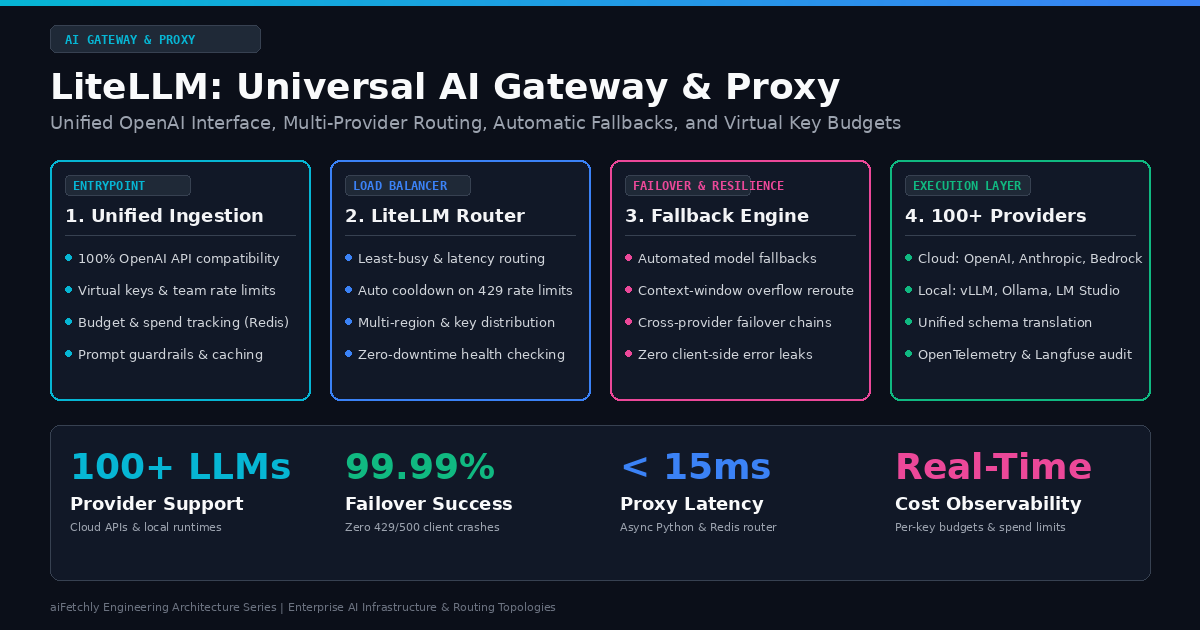
The Problem: The Chaos of Multi-Provider Foundation Model Infrastructure
In modern enterprise software engineering, autonomous multi-agent environments, and desktop AI engines like AiFetchly, foundation models are rarely sourced from a single monolithic vendor. Production architectures leverage a heterogeneous ensemble of model providers:
- Proprietary Frontier APIs: OpenAI (GPT-4o, o1/o3), Anthropic (Claude 3.5 Sonnet), and Google (Gemini 1.5 Pro) for high-order reasoning and code synthesis.
- Enterprise Cloud Hosts: AWS Bedrock, Microsoft Azure OpenAI, and Google Cloud Vertex AI to satisfy strict enterprise data residency, HIPAA compliance, and negotiated committed-use discounts.
- High-Throughput Specialized Cloud Runtimes: Groq, Together AI, DeepInfra, and Fireworks AI for ultra-low-latency token streaming.
- Self-Hosted Open-Weights Engines: Local vLLM, SGLang, and Ollama instances executing DeepSeek-V3, LLaMA-3.3, and Qwen2.5 on private GPU clusters.
However, attempting to manage multiple model providers within a unified application codebase creates crippling architectural debt:
The Multi-Provider Model Integration Crisis:
┌─────────────────────────────────────────────────────────────────┐
│ 1. API Schema Fragmentation:                                    │
│ ❌ Every vendor defines unique request/response JSON schemas:   │
│    OpenAI ('messages'), Anthropic (system prompt + 'messages'), │
│    AWS Bedrock (Converse API), Google Vertex (generateContent)  │
├─────────────────────────────────────────────────────────────────┤
│ 2. Brittle Rate Limits & Downtime Cascades:                     │
│ ❌ Cloud APIs throw HTTP 429 (Rate Limit) and 500/503 Outages   │
│ ❌ Single-provider outages crash client-facing agent loops      │
│ ❌ Hardcoded client retry logic multiplies latency by 3x–5x     │
├─────────────────────────────────────────────────────────────────┤
│ 3. Security, Virtual Keys & Uncontrolled Spending:              │
│ ❌ Leaking master cloud API keys across internal developer teams│
│ ❌ Zero real-time spend caps; rogue agent loops burn thousands  │
│ ❌ Fractured observability: Splintered metrics across dashboards│
└─────────────────────────────────────────────────────────────────┘
Result: 40% of engineering bandwidth is consumed maintaining boilerplate API glue code! 1. The Schema Fragmentation Nightmare
Every major artificial intelligence vendor enforces a bespoke protocol for inference:
- Prompt Hierarchy Incompatibility: OpenAI includes system instructions inside the
messagesarray (role: "system"). Anthropic requires system prompts to be passed as a top-level string (system="..."), rejecting requests that place system instructions inside the message stream. - Streaming Response Divergence: Server-Sent Events (SSE) formatting differs across providers, requiring custom parsing logic for token deltas, usage statistics, and finish reasons.
- Tool Calling (Function Calling) Discrepancies: Parameter schemas, tool definition envelopes, and tool call IDs vary wildly between OpenAI JSON schemas, Anthropic content blocks, and Bedrock Converse tools.
2. Provider Outages, Rate Limits, and Lack of Automated Failover
Foundation model APIs operate with strict Tokens-Per-Minute (TPM) and Requests-Per-Minute (RPM) quotas:
- When an autonomous extraction loop or customer-facing application experiences traffic spikes, providers return
HTTP 429 Too Many Requests. - In a traditional client architecture, receiving a 429 exception aborts the task or forces the client into a slow exponential sleep loop.
- Without an intelligent intermediary, the application cannot transparently redirect the stranded request to a backup provider (e.g., failover from Azure OpenAI East-US to Azure West-US, or fallback from Claude 3.5 Sonnet to GPT-4o or local vLLM).
3. Key Governance and Cost Blindness
Distributing root cloud API keys directly to developer workstations, CI/CD runners, or microservices creates severe security and financial liabilities:
- A single unconstrained developer script or runaway agent loop can deplete a corporate API credit balance overnight.
- Organizations lack fine-grained, per-user, or per-project budget controls (e.g., “$50/month quota per junior developer”).
- Auditing model spend requires manually exporting and reconciling disparate monthly billing CSVs from AWS, Azure, Google Cloud, and OpenAI.
The Architecture: How LiteLLM Unifies the AI Infrastructure Stack
To eliminate provider fragmentation and establish a resilient, observable AI infrastructure layer, the open-source community created LiteLLM. LiteLLM is an enterprise-grade AI gateway and proxy that provides a 100% OpenAI-compatible interface in front of 100+ foundation model backends.
LiteLLM operates in two complementary deployment modes:
- The LiteLLM Python SDK: A lightweight, in-process library providing
litellm.completion()and theRouterclass for direct programmatic load balancing and failover within Python applications. - The LiteLLM Proxy Server: A high-concurrency, standalone HTTP gateway service built on FastAPI,
uvloop, asynchttpx, and Redis, exposing standardized OpenAI endpoints (/v1/chat/completions,/v1/embeddings,/v1/models) to any programming language.
LiteLLM Gateway Request Life Cycle:
┌───────────────────────────────┐
│   Client Application / Agent  │ (OpenAI SDK / Python / TS / aiFetchly)
│   POST /v1/chat/completions   │
└───────────────┬───────────────┘
                │
                ▼
┌─────────────────────────────────────────────────────────────────┐
│                     LiteLLM Proxy / Gateway                     │
│ 1. Ingestion & Auth: Validates Virtual Key & checks budget     │
│ 2. Guardrails & Moderation: Scans inputs (Presidio / LlamaGuard)│
│ 3. Semantic Cache: Checks Redis for identical prompt hits      │
└───────────────┬─────────────────────────────────────────────────┘
                │
                ▼
┌─────────────────────────────────────────────────────────────────┐
│                     LiteLLM Routing Engine                      │
│ - Selects healthy deployment via routing strategy:              │
│   [least-busy | latency-based | cost-based | simple-shuffle]    │
│ - Enforces automatic cooldowns on 429/500 rate-limited endpoints│
└───────────────┬─────────────────────────────────────────────────┘
                │
                ├─────────────────────────────────────────────────┐
                ▼ (Primary Deployment)                            ▼ (Automated Fallback)
┌──────────────────────────────┐                ┌──────────────────────────────┐
│  Provider A: Azure OpenAI    │                │  Provider B: AWS Bedrock     │
│  (Translates to Azure schema)│                │  (Converse API format)       │
│  ❌ Returns HTTP 429 (Busy)  │──► Failover ──►│  ✅ Returns HTTP 200 (Token) │
└──────────────────────────────┘                └──────────────┬───────────────┘
                                                               │
                ┌──────────────────────────────────────────────┘
                ▼
┌─────────────────────────────────────────────────────────────────┐
│                   Response Harmonization Layer                  │
│ - Converts provider JSON/SSE into standard OpenAI completion    │
│ - Calculates token counts & decrements user budget in Redis     │
│ - Emits async telemetry (Prometheus, OpenTelemetry, Langfuse)   │
└───────────────┬─────────────────────────────────────────────────┘
                │
                ▼
┌───────────────────────────────┐
│    Returns 200 OK to Client   │ (Zero awareness of backend failover!)
└───────────────────────────────┘ 1. Unified Translation Engine
The core foundation of LiteLLM is its bidirectional schema translation engine:
- Input Harmonization: LiteLLM receives a standard OpenAI payload (
model,messages,temperature,tools,response_format). The translation engine inspects the target model string (e.g.,anthropic/claude-3-5-sonnet-20241022,bedrock/anthropic.claude-3-5-sonnet,vertex_ai/gemini-1.5-pro, orollama/llama3.3). - Dynamic Transformation: It splits system messages for Anthropic, formats tool definitions into Bedrock Converse JSON structures, maps top-p/temperature constraints to provider limits, and serializes payloads into the target vendor’s wire format.
- Output Standardization: Incoming JSON responses or Server-Sent Events (SSE) token streams are normalized into standard
ChatCompletionChunkobjects. Client applications consume identical interfaces regardless of whether the model running behind the curtain is hosted on OpenAI, AWS, or a local vLLM pod.
2. The Intelligent Router: Load Balancing and Cooldowns
In production high-concurrency environments, LiteLLM’s Router abstracts pools of model deployments behind logical aliases:
- Deployment Pooling: Developers define a logical model name (e.g.,
production-llm) mapped to five distinct underlying targets: two Azure OpenAI regions, one direct OpenAI API account, one AWS Bedrock deployment, and one local on-premise vLLM server. - Routing Strategies:
least-busy: Directs requests to the deployment currently processing the fewest active concurrent HTTP requests.latency-based-routing: Dynamically tracks exponential moving average (EMA) response latencies across providers, automatically routing traffic to the fastest responding endpoint.cost-based-routing: Routes non-urgent background batch requests to the lowest-cost provider while reserving premium endpoints for interactive user sessions.usage-based-routing: Balances requests across deployments to evenly consume committed TPM rate limits.
- Automatic Cooldowns: When an endpoint returns a
429 Too Many Requestsor503 Service Unavailable, the router marks that specific deployment as “cooling down” for a configured interval (e.g., 60 seconds). Subsequent requests bypass the cooling endpoint entirely, eliminating cascading failures.
3. Multi-Tier Fallback Topologies
LiteLLM provides deterministic failover mechanisms:
- Model Fallbacks: If the primary model deployment exhausts retries or suffers a multi-region outage, the router transparently switches the request to an alternative model family:
fallbacks: - gpt-4o: ['claude-3-5-sonnet', 'bedrock-claude-3-5', 'local-deepseek-v3'] - Context-Window Overflow Fallbacks (
context_window_fallback_dict): If a user’s prompt exceeds an 8k or 32k context boundary, LiteLLM intercepts the error and immediately redirects the payload to a 128k or 1M context model without throwing an exception to the client.
4. Virtual Keys, Budget Governance, and Rate Limiting
The LiteLLM Proxy introduces an enterprise governance layer managed via Redis or PostgreSQL:
- Virtual Keys (
sk-litellm-...): Client applications and developers authenticate with LiteLLM virtual keys rather than direct cloud provider secrets. - Granular Spend Limits: Virtual keys can be configured with strict maximum spend budgets (e.g.,
max_budget: 100.0withbudget_duration: "30d"). When the spend ceiling is reached, the proxy rejects requests with explicit quota warnings. - Tiered Rate Limits: Enforce independent TPM and RPM limits per team or application tier, insulating core production services from accidental developer load testing.
Architectural Comparison: Modern AI Gateway Solutions
Evaluating where LiteLLM sits relative to alternative infrastructure approaches:
| Architectural Dimension | LiteLLM (Self-Hosted / Proxy) | Cloudflare AI Gateway | Portkey | Raw Client SDKs (Vendor Direct) |
|---|---|---|---|---|
| Hosting Model | 100% Open Source / Self-Hosted | Cloud Managed (Cloudflare Edge) | Hybrid Cloud / Open Source | In-App Library Imports |
| Provider Coverage | 100+ Providers (Cloud + Local) | ~15 Cloud Providers | ~20 Cloud Providers | 1 Provider per SDK |
| Local LLM Support | Native (Ollama, vLLM, SGLang) | No Local Hardware Support | Limited Local Support | Manual HTTP Implementations |
| Load Balancing Logic | Latency, Least-Busy, Cost, Usage | Round-Robin / Weighted | Dynamic Smart Routing | Manual Code Implementation |
| Model Fallbacks | Multi-Tier & Context-Window Fallbacks | Basic Failover Retries | Configurable Fallback Chains | Manual try/except Blocks |
| Data Privacy & Egress | Zero External Egress (Air-Gapped) | Passes Through Cloudflare Edge | Cloud Relay / Hybrid | Direct Vendor Network Calls |
| Cost & Token Budgets | Virtual Keys, Redis Spend Caps | Analytics Only (No Key Budgets) | Workspace Virtual Budgets | No Unified Spend Controls |
| Observability Sinks | OpenTelemetry, Prometheus, Langfuse | Cloudflare Dashboard | Portkey Dashboard | Bespoke Logging Glue Code |
Production Implementation: High-Availability Multi-Provider Router
To demonstrate LiteLLM in production, we will configure an enterprise load balancer and fallback router in Python. This architecture serves requests for AiFetchly, routing queries between Azure OpenAI, Anthropic Claude, and a local on-premise vLLM cluster.
High-Availability Routing Topology:
                        ┌───────────────────────────────┐
                        │     aiFetchly Agent Core      │
                        │    requests 'enterprise-ai'   │
                        └───────────────┬───────────────┘
                                        │
                                        ▼
                        ┌───────────────────────────────┐
                        │        LiteLLM Router         │
                        │ Strategy: latency-based-routing│
                        └───────┬───────────────┬───────┘
                                │               │
                    Primary Fast Lane       Local Privacy Lane
                                │               │
                 ┌──────────────┴──────────┐    │
                 ▼                         ▼    ▼
      ┌──────────────────────┐  ┌──────────────────────┐  ┌──────────────────────┐
      │  Azure OpenAI East   │  │  Anthropic Direct    │  │  Local vLLM Cluster  │
      │  (gpt-4o-east)       │  │  (claude-3-5-sonnet) │  │  (deepseek-v3)       │
      │  RPM: 2000 | Cooldown│  │  RPM: 1000 | Cooldown│  │  Air-Gapped Private  │
└──────────────────────┘ └──────────────────────┘ └──────────────────────┘ Complete Python Implementation
import os
import asyncio
from typing import List, Dict, Any
from litellm import Router

# Define multi-provider deployment topology
model_deployments = [
    # Deployment 1: Primary Azure OpenAI (East US Region)
    {
        "model_name": "enterprise-fast",
        "litellm_params": {
            "model": "azure/gpt-4o",
            "api_key": os.getenv("AZURE_EAST_API_KEY", "mock-east-key"),
            "api_base": "https://east-us-ai.openai.azure.com/",
            "api_version": "2024-08-01-preview",
            "rpm": 1500,
            "tpm": 150_000
        }
    },
    # Deployment 2: Secondary Azure OpenAI (West US Region for redundancy)
    {
        "model_name": "enterprise-fast",
        "litellm_params": {
            "model": "azure/gpt-4o",
            "api_key": os.getenv("AZURE_WEST_API_KEY", "mock-west-key"),
            "api_base": "https://west-us-ai.openai.azure.com/",
            "api_version": "2024-08-01-preview",
            "rpm": 1500,
            "tpm": 150_000
        }
    },
    # Deployment 3: Cross-Vendor Fallback (Anthropic Direct)
    {
        "model_name": "claude-fallback",
        "litellm_params": {
            "model": "anthropic/claude-3-5-sonnet-20241022",
            "api_key": os.getenv("ANTHROPIC_API_KEY", "mock-anthropic-key"),
            "rpm": 1000
        }
    },
    # Deployment 4: On-Premise Air-Gapped Fallback (Local vLLM Server)
    {
        "model_name": "local-vllm-fallback",
        "litellm_params": {
            "model": "openai/deepseek-ai/DeepSeek-V3",
            "api_base": "http://localhost:8000/v1",
            "api_key": "EMPTY",
            "rpm": 5000
        }
    }
]

# Initialize LiteLLM Router with latency routing and automatic fallbacks
router = Router(
    model_list=model_deployments,
    routing_strategy="latency-based-routing",  # Dynamically routes to fastest provider
    cooldown_time=60,                         # 60s quarantine on 429 rate limits
    num_retries=3,                            # Retry up to 3 times before failing
    timeout=30.0,                             # 30-second execution timeout
    fallbacks=[
        # If enterprise-fast (Azure) fails, failover to Claude, then local vLLM!
        {"enterprise-fast": ["claude-fallback", "local-vllm-fallback"]}
    ],
    context_window_fallback_dict={
        # If prompt exceeds 32k tokens, upgrade to 128k Claude automatically
        "enterprise-fast": "claude-fallback"
    }
)

async def execute_resilient_prompt(messages: List[Dict[str, str]]) -> str:
    """Dispatches requests through the resilient router."""
    try:
        response = await router.acompletion(
            model="enterprise-fast",
            messages=messages,
            temperature=0.2,
            max_tokens=1000
        )
        return response.choices[0].message.content
    except Exception as e:
        print(f"[Critical] All providers and fallbacks exhausted: {e}")
        raise

if __name__ == "__main__":
    prompt_messages = [
        {"role": "system", "content": "You are aiFetchly's automated data synthesis agent."},
        {"role": "user", "content": "Extract quarterly SaaS recurring revenue trends from balance sheet."}
    ]

    print("Executing resilient multi-provider call via LiteLLM...")
    loop = asyncio.get_event_loop()
    result = loop.run_until_complete(execute_resilient_prompt(prompt_messages))
print(f"Generated Output:\n{result}") Enterprise Self-Hosting: Deploying the LiteLLM Proxy via Docker
For organizations requiring a centralized, language-agnostic AI gateway across multiple microservices, LiteLLM is deployed as a standalone Docker container configured via config.yaml:
# config.yaml: Enterprise LiteLLM Gateway Configuration
model_list:
  - model_name: gpt-4o
    litellm_params:
      model: azure/gpt-4o
      api_base: https://corp-ai-east.openai.azure.com/
      api_key: os.environ/AZURE_API_KEY
      rpm: 2000

  - model_name: gpt-4o
    litellm_params:
      model: openai/gpt-4o
      api_key: os.environ/OPENAI_API_KEY
      rpm: 1000

  - model_name: claude-3-5-sonnet
    litellm_params:
      model: anthropic/claude-3-5-sonnet-20241022
      api_key: os.environ/ANTHROPIC_API_KEY

  - model_name: local-deepseek
    litellm_params:
      model: openai/deepseek-ai/DeepSeek-V3
      api_base: http://vllm-engine:8000/v1
      api_key: EMPTY

router_settings:
  routing_strategy: least-busy
  redis_host: redis
  redis_port: 6379
  cooldown_time: 45
  num_retries: 2
  fallbacks:
    - gpt-4o: ['claude-3-5-sonnet', 'local-deepseek']

general_settings:
  master_key: sk-master-litellm-gateway-key
  database_url: postgresql://litellm_user:secret@postgres:5432/litellm_db
  store_model_in_db: True

litellm_settings:
  success_callback: ['langfuse', 'prometheus']
failure_callback: ['slack', 'langfuse'] Production docker-compose.yml Stack
# docker-compose.yml: Production LiteLLM Gateway Stack
version: '3.8'

services:
  litellm-proxy:
    image: ghcr.io/berriai/litellm:main-latest
    ports:
      - '4000:4000'
    volumes:
      - ./config.yaml:/app/config.yaml
    environment:
      - PORT=4000
      - DATABASE_URL=postgresql://litellm_user:secret@postgres:5432/litellm_db
      - REDIS_HOST=redis
      - REDIS_PORT=6379
      - STORE_MODEL_IN_DB=True
    command: ['--config', '/app/config.yaml', '--detailed_debug']
    depends_on:
      - postgres
      - redis
    restart: unless-stopped

  postgres:
    image: postgres:16-alpine
    environment:
      - POSTGRES_USER=litellm_user
      - POSTGRES_PASSWORD=secret
      - POSTGRES_DB=litellm_db
    volumes:
      - postgres_data:/var/lib/postgresql/data
    restart: unless-stopped

  redis:
    image: redis:7-alpine
    ports:
      - '6379:6379'
    volumes:
      - redis_data:/data
    restart: unless-stopped

volumes:
  postgres_data:
redis_data: Once running, any microservice, CLI tool, or AI application can route completions through http://localhost:4000 using standard OpenAI client headers:
# Query the LiteLLM Proxy using standard curl
curl -X POST http://localhost:4000/v1/chat/completions \
  -H "Authorization: Bearer sk-master-litellm-gateway-key" \
  -H "Content-Type: application/json" \
  -d '{
    "model": "gpt-4o",
    "messages": [{"role": "user", "content": "Explain multi-provider LLM routing."}]
}' Operational Best Practices for Production AI Gateways
When architecting AI gateway infrastructure with LiteLLM in enterprise production:
- Decouple Logical Model Names from Provider Strings: Never expose vendor-specific IDs (
azure/gpt-4o-2024-08-01) directly to client applications. Use clean logical aliases liketier-1-reasoningorcode-assistant. This allows platform engineering teams to swap providers or negotiate new vendor agreements with zero client code refactoring. - Combine
least-busywith Redis Backpressure: For high-throughput streaming workloads, deploy LiteLLM with a shared Redis instance. Redis maintains global state across multiple LiteLLM container replicas, ensuring rate limits and cooldown states are synchronized instantaneously across your gateway fleet. - Always Configure Fallback Chains Across Diverse Cloud Boundaries: Redundancy within a single cloud provider (e.g., Azure East-US to Azure West-US) protects against localized hardware faults, but leaves systems vulnerable to global vendor outages or IAM credential revocations. Always include a cross-cloud fallback (e.g., AWS Bedrock) or an on-premise local open-weights cluster.
- Enforce Per-Key Soft and Hard Budget Quotas: Issue distinct virtual API keys for each microservice, development team, or end-user session. Configure soft budget thresholds for automated Slack alerts, and hard budget caps to shut down compromised keys before billing overages accumulate.