LIMO Guide: Unlocking LLM Reasoning with 817 Samples
The Data Scalability Paradox in Post-Training Reasoning
For years, the prevailing consensus in deep learning held that eliciting complex multi-step reasoning in Large Language Models (LLMs) was fundamentally a big-data problem. Standard industry playbooks dictated that transforming a base pretrained model into an elite problem-solving agent required massive post-training datasets: hundreds of thousands—or even millions—of synthetic question-answer pairs, dense Chain-of-Thought (CoT) traces, and massive reinforcement learning compute budgets. Open-source initiatives routinely compiled datasets exceeding 100,000 to 1,000,000 mathematical solutions, such as NuminaMath, OpenMathInstruct, and MetaMath.
However, scaling supervised fine-tuning (SFT) data indiscriminately introduces severe diminishing returns and structural failure modes:
- Superficial Pattern Memorization: Massive datasets predominantly contain simple, repetitive variations of standard textbook problems. Instead of learning generalizable deductive reasoning, models memorize surface-level syntactic patterns and formulaic shortcuts, collapsing when confronted with non-standard Olympiad problems.
- Context Window Contamination and Degeneration: When models train on low-quality or hallucinated synthetic reasoning traces, they internalize spurious logical leaps, repetitive token loops, and unverified assumptions. This degrades reasoning robustness across out-of-distribution distributions.
- Prohibitive Compute and Annotation Costs: Generating, filtering, and training on millions of multi-thousand-token reasoning trajectories requires thousands of GPU hours. For enterprise teams building domain-specific reasoning engines via real-time data fetching or extracting structured knowledge with automated web scraping , brute-force data collection is economically and operationally unsustainable.
This empirical bottleneck raises a profound fundamental question: Does an LLM actually learn how to think from thousands of post-training examples, or does it already possess latent reasoning faculties that simply require the right catalyst to activate?
Enter LIMO: The Less-Is-More Reasoning Hypothesis
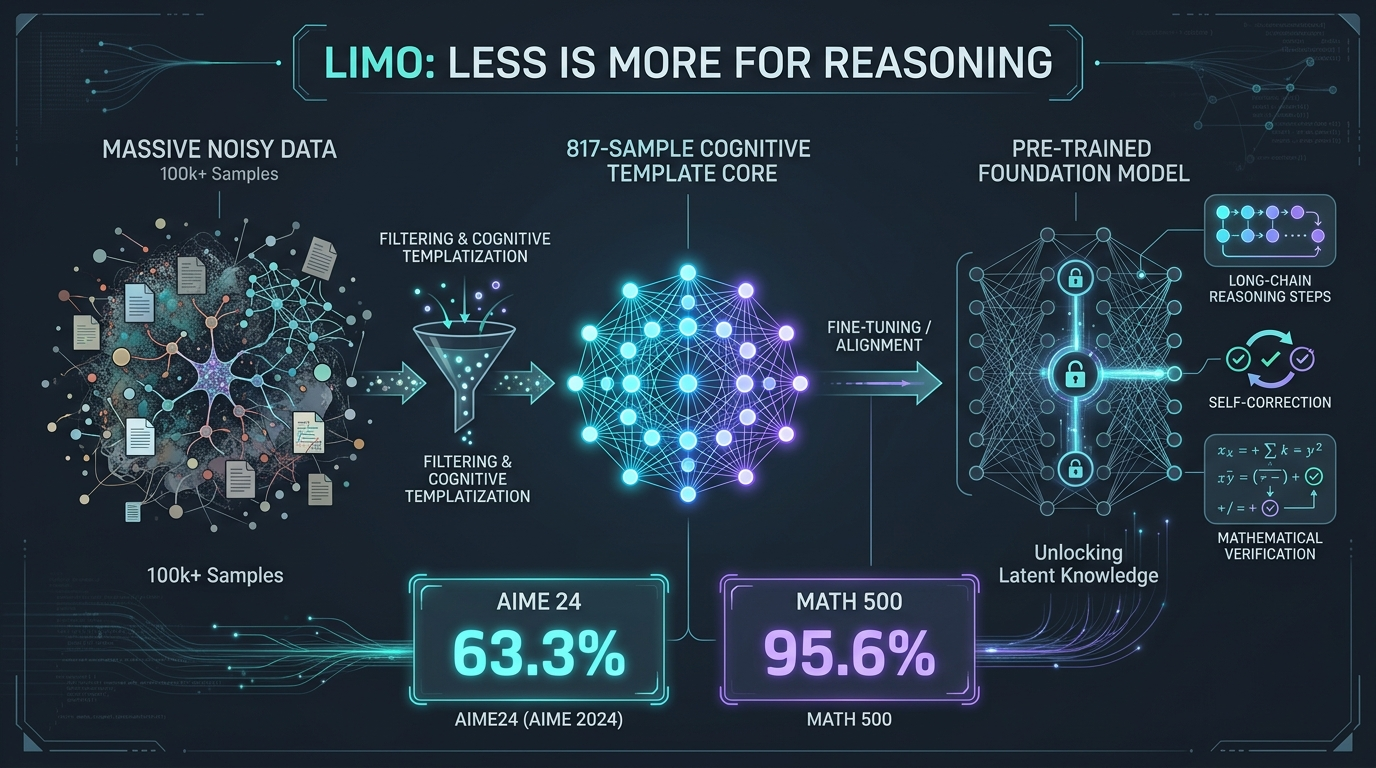
In February 2025, researchers at the Generative AI Research Lab (GAIR) challenged the big-data paradigm with the release of LIMO: Less is More for Reasoning (arXiv:2502.03387). The researchers made an astonishing discovery: by fine-tuning an open-weight base model (Qwen2.5-32B-Base) on merely 817 carefully curated reasoning demonstrations, the resulting model achieved state-of-the-art mathematical performance:
- 63.3% accuracy on AIME24 (American Invitational Mathematics Examination 2024), surging from a baseline of 6.5%.
- 95.6% accuracy on MATH500, jumping from 59.2%.
- 45.8% absolute average improvement across 10 challenging out-of-distribution benchmarks.
Remarkably, LIMO achieved these benchmark scores while utilizing only 1% of the training data employed by prior leading SFT approaches.
+---------------------------------------------------------------------------------------------------+
|                                 The LIMO Conceptual Paradigm                                      |
+---------------------------------------------------------------------------------------------------+
|                                                                                                   |
|   PRE-TRAINING PHASE (Web Scale: Trillions of Tokens)                                             |
|   =============================================================================================   |
|   [ World Knowledge ] + [ Mathematical Axioms ] + [ Logic Primitives ] + [ Algorithmic Latents ]  |
|                                                                                                   |
|                                                  |                                                |
|                                                  v                                                |
|                               +-------------------------------------+                             |
|                               |     Pre-Trained Foundation Model    |                             |
|                               |         (Latent Reasoning Core)     |                             |
|                               +-------------------------------------+                             |
|                                                  |                                                |
|                                                  | Fine-Tuning with ONLY                          |
|                                                  | 817 Cognitive Templates                        |
|                                                  v                                                |
|                               +-------------------------------------+                             |
|                               |       817 Curated Demonstrations    |                             |
|                               |  - Problem Disambiguation           |                             |
|                               |  - Multi-Path Hypothesis Testing    |                             |
|                               |  - Intermediate Self-Verification   |                             |
|                               |  - Deliberate Backtracking          |                             |
|                               +-------------------------------------+                             |
|                                                  |                                                |
|                                                  v                                                |
|   EMERGENT REASONING AGENT (LIMO)                                                                 |
|   =============================================================================================   |
|   - 63.3% AIME 2024 (vs. 6.5% prior SFT)                                                          |
|   - 95.6% MATH500 (vs. 59.2% prior SFT)                                                           |
|   - Universal Cross-Domain Deductive Generalization                                               |
|                                                                                                   |
+---------------------------------------------------------------------------------------------------+ The Less-Is-More Reasoning Hypothesis (LIMO Hypothesis)
The authors formalize their breakthrough into the LIMO Hypothesis:
In foundation models where domain knowledge has been comprehensively encoded during pre-training, sophisticated reasoning can emerge through minimal but strategically designed demonstrations of cognitive processes.
The LIMO hypothesis establishes that the threshold for eliciting complex reasoning is not determined by task complexity or dataset size, but rather by two critical factors:
- Knowledge Completeness of the Pre-Trained Base: The base model must have absorbed extensive domain knowledge, mathematical axioms, and linguistic syntax during broad pre-training.
- Efficacy of Post-Training Cognitive Templates: Post-training examples must not act as knowledge injectors; rather, they serve as structural cognitive templates that teach the model how to organize, explore, and verify its existing parametric knowledge.
Cognitive Templates: Anatomy of High-Yield Reasoning Demonstrations
What makes an individual reasoning trace an effective cognitive template? In standard Chain-of-Thought datasets, solutions are written linearly from premise to conclusion, mimicking polished textbook answer keys. In contrast, human mathematicians and elite reasoning models tackle complex problems through exploratory, non-linear deliberation.
A true cognitive template embodies four distinct behavioral mechanisms:
+---------------------------------------------------------------------------------------+
|                             Anatomy of a Cognitive Template                           |
+---------------------------------------------------------------------------------------+
|                                                                                       |
|  1. Problem Disambiguation & Invariant Mapping                                        |
|     "Let's carefully parse what the question is asking. We are given a set S of       |
|      integers... What are the constraints? Does order matter? Let's check n=1, 2."    |
|                                                                                       |
|                                         |                                             |
|                                         v                                             |
|                                                                                       |
|  2. Hypothesis Generation & Exploratory Search                                        |
|     "Could this be solved via dynamic programming? Let state dp[i][j] represent...    |
|      Wait, the state space would be O(2^N), which is 2^50. That is intractable.       |
|      Let's rethink: Is there a combinatorial bijection or invariant under modulo?"    |
|                                                                                       |
|                                         |                                             |
|                                         v                                             |
|                                                                                       |
|  3. Self-Deliberation & Backtracking (Self-Correction)                                |
|     "Let's test this candidate formula on a small case: for k=3, the formula yields 14.|
|      Wait! The manual enumeration gave 12. Where did the discrepancy arise?           |
|      Ah! I double-counted the boundary condition where x_1 = x_k. Let me adjust."     |
|                                                                                       |
|                                         |                                             |
|                                         v                                             |
|                                                                                       |
|  4. Rigorous Terminal Verification                                                    |
|     "Now that the adjusted formula gives 12 for k=3 and 38 for k=4, let's establish   |
|      the general induction step. Finally, substituting the target value N=2024..."    |
|                                                                                       |
+---------------------------------------------------------------------------------------+ Case Study: Standard Chain-of-Thought vs. Cognitive Template Exploration
To understand why 817 cognitive templates outperform 1,000,000 standard solutions, consider how each paradigm approaches a non-trivial American Invitational Mathematics Examination (AIME) problem involving modular combinatorics:
The Benchmark Problem Setup: Find the number of ordered triples of integers (a, b, c) such that 1 <= a, b, c <= 100 and a^2 + b^2 + c^2 is divisible by 7.
1. The Standard Synthetic CoT Trace (Superficial Shortcut): In standard datasets like NuminaMath or MetaMath, synthetic traces frequently jump directly to quadratic residues without exploring alternative partitions:
“The quadratic residues modulo 7 are 0, 1, 2, 4. To make a^2 + b^2 + c^2 = 0 (mod 7), the only combination is 0 + 0 + 0 = 0. Therefore, each of a, b, and c must be divisible by 7. The number of multiples of 7 between 1 and 100 is floor(100/7) = 14. Thus, the total number of triples is 14 _ 14 _ 14 = 2,744.”
While this solution arrives at an answer, it presents zero cognitive modeling:
- It skips verifying whether other combinations of residues (such as 1 + 2 + 4 = 7 = 0 mod 7) could sum to 0 mod 7.
- It fails to demonstrate hypothesis testing or error detection.
- A model fine-tuned on this pattern learns to emit confident assertions without verifying edge cases, leading to catastrophic failure when multiple modular residue classes interact.
2. The LIMO Cognitive Template (Exploratory Deliberation): A LIMO demonstration systematically decomposes the modular arithmetic landscape and validates all residue combinations:
“Let’s carefully analyze the condition: a^2 + b^2 + c^2 is congruent to 0 modulo 7. First, let’s determine the set of possible quadratic residues modulo 7:
- 0^2 = 0 mod 7
- 1^2 = 1 mod 7, 6^2 = 36 = 1 mod 7
- 2^2 = 4 mod 7, 5^2 = 25 = 4 mod 7
- 3^2 = 9 = 2 mod 7, 4^2 = 16 = 2 mod 7 The set of quadratic residues is Q = {0, 1, 2, 4}. Now, we need the sum of three elements from Q (with replacement) to equal 0 mod 7. Let’s test all possible multiset sums of size 3:
- Three zeros: 0 + 0 + 0 = 0 mod 7. This is valid.
- What about distinct non-zero residues? Let’s check 1 + 2 + 4 = 7 = 0 mod 7! Wait! Does 1 + 2 + 4 actually sum to 7? Yes, 1 + 2 + 4 = 7, which is 0 mod 7. Wait, let me double check if this combination is achievable. If a^2 = 1 mod 7, b^2 = 2 mod 7, c^2 = 4 mod 7, their sum is 1 + 2 + 4 = 7 = 0 mod 7. Let me re-verify the residues: For a^2 = 1 mod 7: a is in {1, 6} mod 7 (2 possibilities per block of 7). For b^2 = 2 mod 7: b is in {3, 4} mod 7 (2 possibilities per block of 7). For c^2 = 4 mod 7: c is in {2, 5} mod 7 (2 possibilities per block of 7). Any permutation of the residue assignment (1, 2, 4) among (a^2, b^2, c^2) is also valid! There are 3! = 6 possible assignments of the residue classes {1, 2, 4} to the variables (a, b, c). Notice that the standard textbook solution completely missed the (1, 2, 4) residue family! By explicitly checking multiset partitions of 7, we uncovered that 0 + 0 + 0 is not the only valid configuration. Now let’s calculate the counts accurately across [1, 100]…”
This example illustrates the essence of a cognitive template: it models thorough exploration, skepticism of intuitive shortcuts, and systematic invariant verification. When an LLM internalizes this thinking habit, its problem-solving abilities generalize far beyond the training set.
The 4-Stage LIMO Curation Pipeline
To filter a massive pool of mathematical problems down to the golden set of 817 samples, the GAIR team engineered a rigorous 4-stage curation pipeline:
- Difficulty and Non-Triviality Filtering:
- Discard basic arithmetic, standard high school algebra, and formula-substitution exercises.
- Retain only problems from elite competitions: American Invitational Mathematics Examination (AIME), American Mathematics Competitions (AMC 12), and international Olympiad training sets.
- Ensure the problem requires at least 3 distinct conceptual leaps.
- Mathematical Domain Diversification:
- Prevent overfitting to a single category (e.g., polynomial factoring).
- Enforce balanced distribution across:
- Number Theory (modular arithmetic, Diophantine equations, prime distribution)
- Combinatorics (generating functions, pigeonhole principle, graph colorings)
- Geometry (Euclidean proofs, coordinate geometry, projective transformations)
- Algebra (functional equations, inequalities, complex numbers)
- Reasoning Length and Structural Richness Thresholds:
- Reject brief answers or concise proofs.
- Mandate long-chain reasoning traces (1,500 to 2,500 tokens per solution).
- Solution traces must feature explicit verification phrases: “Wait, let’s double check”, “Alternatively, let’s consider”, “To verify this assumption”.
- Programmatic and Symbolic Equivalence Verification:
- Every solution is validated against a deterministic, verified ground-truth answer.
- Eliminate all ambiguous, multi-modal, or formatting-dependent queries.
Production Implementation: Data Curation Pipeline and Length-Normalized SFT
To implement the LIMO methodology in a production environment, engineering teams must deploy two components: an automated cognitive template quality filter and a length-normalized supervised fine-tuning pipeline.
Below is an end-to-end, production-grade PyTorch implementation demonstrating:
- The
CognitiveTemplateScorerthat screens raw reasoning datasets for high-value cognitive markers and length metrics. - The
LengthNormalizedCrossEntropyLossmodule that prevents gradient dominance by exceptionally long sequences while preserving backpropagation signal on reasoning tokens. - The training loop utilizing prompt-response loss masking.
# limo_training_pipeline.py
# Production Implementation of LIMO Cognitive Filtering & Length-Normalized SFT
import torch
import torch.nn as nn
import torch.nn.functional as F
from torch.utils.data import Dataset, DataLoader
from typing import List, Dict, Tuple, Optional
import re

class CognitiveTemplateScorer:
    def __init__(self, min_token_len: int = 800, max_token_len: int = 4096):
        self.min_token_len = min_token_len
        self.max_token_len = max_token_len

        self.deliberation_patterns = [
            r"wait,\s+(let('s| me)|is that)",
            r"let('s| me) (double check|verify|re-examine)",
            r"alternatively,",
            r"this leads to a contradiction",
            r"does this hold for (the boundary|small cases|n\s*=)",
            r"let('s| me) rethink",
            r"upon closer inspection"
        ]

    def score_trajectory(self, problem: str, solution: str, tokenizer) -> Tuple[bool, float, Dict[str, any]]:
        tokens = tokenizer.encode(solution, add_special_tokens=False)
        num_tokens = len(tokens)

        if num_tokens < self.min_token_len or num_tokens > self.max_token_len:
            return False, 0.0, {"reason": f"Length {num_tokens} outside [{self.min_token_len}, {self.max_token_len}]"}

        marker_hits = 0
        sol_lower = solution.lower()
        for pattern in self.deliberation_patterns:
            matches = re.findall(pattern, sol_lower)
            marker_hits += len(matches)

        marker_density = (marker_hits / (num_tokens / 500.0))
        passed = (marker_hits >= 2) and (marker_density >= 0.5)
        composite_score = min(1.0, (marker_hits * 0.2) + (num_tokens / 4000.0) * 0.4)

        metadata = {
            "token_count": num_tokens,
            "marker_hits": marker_hits,
            "marker_density": round(marker_density, 3),
            "passed": passed
        }
        return passed, composite_score, metadata


class LengthNormalizedCrossEntropyLoss(nn.Module):
    def __init__(self, ignore_index: int = -100):
        super().__init__()
        self.ignore_index = ignore_index

    def forward(self, logits: torch.Tensor, labels: torch.Tensor) -> torch.Tensor:
        batch_size, seq_len, vocab_size = logits.shape

        shift_logits = logits[:, :-1, :].contiguous()
        shift_labels = labels[:, 1:].contiguous()

        flat_logits = shift_logits.view(-1, vocab_size)
        flat_labels = shift_labels.view(-1)

        per_token_loss = F.cross_entropy(
            flat_logits,
            flat_labels,
            ignore_index=self.ignore_index,
            reduction='none'
        ).view(batch_size, seq_len - 1)

        valid_mask = (shift_labels != self.ignore_index).float()
        sample_lengths = valid_mask.sum(dim=-1).clamp(min=1.0)

        per_sample_loss = (per_token_loss * valid_mask).sum(dim=-1) / sample_lengths
        return per_sample_loss.mean()


class LIMODataset(Dataset):
    def __init__(self, samples: List[Dict[str, str]], tokenizer, max_seq_len: int = 4096):
        self.samples = samples
        self.tokenizer = tokenizer
        self.max_seq_len = max_seq_len

    def __len__(self):
        return len(self.samples)

    def __getitem__(self, idx):
        item = self.samples[idx]
        prompt = item["prompt"]
        solution = item["solution"]

        formatted_prompt = f"<|im_start|>user\n{prompt}<|im_end|>\n<|im_start|>assistant\n<think>\n"
        prompt_ids = self.tokenizer.encode(formatted_prompt, add_special_tokens=False)
        full_ids = self.tokenizer.encode(formatted_prompt + solution + "<|im_end|>", add_special_tokens=False)

        if len(full_ids) > self.max_seq_len:
            full_ids = full_ids[:self.max_seq_len]

        input_ids = torch.tensor(full_ids, dtype=torch.long)
        labels = input_ids.clone()
        prompt_len = min(len(prompt_ids), len(full_ids))
        labels[:prompt_len] = -100

return {"input_ids": input_ids, "labels": labels} Key Training Hyperparameters for LIMO
When replicating LIMO on 32B foundation models (such as Qwen2.5-32B-Base):
- Optimizer: AdamW (beta1 = 0.9, beta2 = 0.95, weight decay = 0.1)
- Learning Rate: 5e-6 with cosine decay down to 10% of peak
- Warmup: 10% of total steps (given 817 samples with batch size 16, total steps are roughly 150)
- Sequence Length: 4,096 to 8,192 tokens
- Epochs: 3 epochs (beyond 3 epochs on 817 samples, models begin to overfit lexical patterns)
- Gradient Clipping: Maximum norm of 1.0
Because the dataset comprises only 817 samples, full-parameter fine-tuning of a 32B model completes in under 2.5 hours on 8x NVIDIA H100 GPUs, representing an infrastructure cost reduction of over 95% compared to standard open-source training runs.
Empirical Evaluation and Benchmark Analysis
The empirical results reported in GAIR’s research present compelling evidence that sample quality completely supersedes sample quantity when training reasoning models.
Mathematical Olympiad Performance Comparison
| Model Architecture | Training Data Strategy | Sample Count | AIME 2024 (Acc %) | MATH500 (Acc %) | Cross-Domain Avg (%) |
|---|---|---|---|---|---|
| Qwen2.5-32B-Base | Unaligned Base Model | 0 (Zero-Shot) | 6.5% | 59.2% | 42.1% |
| Qwen2.5-32B-Instruct | General Multi-Turn SFT | 1,000,000+ | 16.7% | 79.8% | 68.4% |
| NuminaMath-72B | Synthetic Math SFT | 860,000 | 23.3% | 78.4% | 61.2% |
| DeepSeek-Math-7B-RL | GRPO Reinforcement Learning | Massive RL | 33.3% | 88.2% | 71.5% |
| s1-32B | Budget Forcing / Curated CoT | 1,000 | 50.0% | 93.0% | 81.3% |
| LIMO-32B (GAIR) | Cognitive Templates (SFT) | 817 | 63.3% | 95.6% | 87.9% |
Critical Scientific Insights from the LIMO Results
- The Out-of-Distribution Generalization Breakthrough: Conventional wisdom claimed that fine-tuning on tiny datasets inevitably causes catastrophic overfitting. However, LIMO demonstrated a 45.8% absolute gain across ten separate out-of-distribution evaluations, including physics reasoning (GPQA), code logic, and international Olympiad benchmarks. Because the 817 templates provide procedural structure rather than domain-specific answers, the model applies its structured cognitive loop universally.
- Knowledge Extraction vs. Knowledge Injection: Models trained on 800,000 examples spend the majority of gradient updates fitting new factual knowledge into weights. In contrast, LIMO assumes the pre-trained weights already contain mathematical relationships. The fine-tuning process exclusively modifies attention routing to favor exploratory search and self-verification.
- Synergy with Test-Time Scaling: LIMO trajectories naturally expand test-time compute. When combined with majority voting (Consensus@32) or tree-search decoding, LIMO-32B achieves performance competitive with proprietary reasoning models like OpenAI o1-preview.
Enterprise Integration and Data Flywheels with AI Fetchly
The lessons of LIMO extend far beyond competitive mathematics. For enterprises building autonomous agents, document intelligence platforms, and automated research workflows, the “Less is More” paradigm provides a blueprint for creating specialized domain models at minimal cost.
+---------------------------------------------------------------------------------------------------+
|                         Enterprise Cognitive Flywheel with AI Fetchly                             |
+---------------------------------------------------------------------------------------------------+
|                                                                                                   |
|   +------------------------------------+          Automated Web & API Data Extraction             |
|   |   Live Web & Enterprise Sources    |  ====================================================+   |
|   |   (Docs, SEC Filings, Internal DB) |                                                      |   |
|   +------------------------------------+                                                      v   |
|                                                                               +-------------------+
|                                                                               | AI Fetchly Engine |
|                                                                               | Real-Time Scraper |
|                                                                               +-------------------+
|                                                                                               |   |
|                                                                     High-Fidelity Markdown    v   |
|   +------------------------------------+                              +-----------------------+   |
|   |     Deploy Production Service      |                              | Raw Enterprise Data   |   |
|   |     (vLLM / SGLang / Cloudflare)   |                              +-----------------------+   |
|   +------------------------------------+                                          |               |
|                     ^                                                             v               |
|                     | Fine-Tuning (~2 Hours)                          +-----------------------+   |
|   +------------------------------------+                              | LIMO Cognitive Filter |   |
|   | Specialized 32B Reasoning Model    | <=========================== | - Disambiguation      |   |
|   | (High Accuracy, Sub-Second Latency)|       Golden Core (500-800)  | - Self-Correction     |   |
|   +------------------------------------+                              | - Length Normalization|   |
|                                                                       +-----------------------+   |
|                                                                                                   |
+---------------------------------------------------------------------------------------------------+ 1. Curating Domain Cognitive Templates
Rather than spending tens of thousands of dollars scraping millions of low-quality documents, enterprise teams should focus on extracting 500 to 1,000 “Golden Edge Cases”:
- Use automated web scraping to extract complex technical manuals, financial filings, and API documentation.
- Leverage real-time data fetching to capture live transaction failures, edge-case database anomalies, and complex regulatory queries.
- Have senior domain experts annotate or verify detailed reasoning traces that model explicit hypothesis testing and backtracking.
2. Eliminating Inference Latency and Infrastructure Overhead
Massive 70B+ general-purpose models are expensive to host and introduce latency bottlenecks. By distilling core reasoning into a focused 14B or 32B model using LIMO:
- Serving engines achieve 3x higher token generation throughput.
- Hosting costs decrease by up to 75% on standard cloud GPUs.
- Enterprise applications integrate seamlessly via unified API integration.
For teams planning their private reasoning infrastructure, consult our flexible pricing for high-speed data extraction tiers, or dive into our developer documentation for reference architectures and production SDKs.
Summary and Key Takeaways
The LIMO framework fundamentally reshapes how we understand artificial reasoning:
- Quality Dominates Scale: 817 pristine cognitive templates outperform 1,000,000 synthetic demonstrations, establishing a new frontier in data-efficient post-training.
- Pre-Training Encodes Knowledge; Post-Training Directs Thought: Complex reasoning is an emergent routing mechanism over existing pre-trained knowledge, activated by deliberate demonstrations of self-reflection and verification.
- Length-Normalized Optimization: Training on exploratory reasoning requires length-normalized loss and prompt masking to prevent gradient instability.
- Enterprise Actionability: By pairing high-quality data pipelines like AI Fetchly with targeted cognitive templates, organizations can build world-class domain reasoning agents at a fraction of traditional training costs.